
Is AI citing you or another wealth management firm? Here’s how to check, for free.
Microsoft’s free AI Performance report shows where Copilot cites your website and the questions behind each citation. Its new Topic Portfolio goes further, showing the topics where AI cites you and where it cites other sites instead. Here’s how advisors and wealth management firms can use it, read it correctly, and act on it, with real examples from Wealthtender’s own data.
For the past two years, advisors have had no real way to see what AI tools say about them. You could type your name into ChatGPT and hope for the best, but you couldn’t see how often an AI answer relied on your website, or what the person was asking at the time.
That changed in February 2026, when Microsoft added an AI Performance report to Bing Webmaster Tools. In June, it added intent labels, topic clusters, citation share and period comparisons, and in October it added Topic Portfolio. Any website owner can now see how often their pages are cited in answers from Microsoft Copilot, Bing’s AI summaries and select partner experiences, the search phrases the AI used to find them, and the related questions where AI cited other sites instead.
Copilot represents a (very) small slice of AI search, which may be why the report hasn’t drawn much attention in our industry. We think it deserves more. It is the most transparent view any AI platform offers today, and it shows how an AI assistant researches, compares and cites sources when someone asks about financial advice. The key is reading it with the right perspective, so we start there.
When someone asks an AI assistant about you, the answer is the first impression. This report shows you, for the first time, which of your pages shaped that answer, and which questions AI answered without you.
Copilot is a small window, and a particular one
Copilot data is directional at best. It is a narrow, work-heavy view of AI search, not a measure of how visible you are everywhere else.
By most measures, Copilot accounts for a small share of AI assistant use:
These figures likely understate Copilot somewhat, because much of its use happens inside Windows, the Edge browser and Microsoft 365 apps rather than on a website. Even allowing for that, it is a minority of AI search.
Who uses Copilot, and when
Copilot’s audience skews toward people at work. Microsoft has built Copilot into Microsoft 365, and in 2026 it folded its consumer Copilot app into its workplace product. Many people who use Copilot on an office computer during the day likely turn to ChatGPT, Gemini or Google on their own devices at home.
Our data fits that picture. On an average weekday, Copilot cited Wealthtender about 2.1 times as often as on an average weekend day, and Tuesday was the busiest day of the week. Some of our most-cited pages explain workplace topics such as vested retirement plan balances, long-term incentive plans and professional designations, the kinds of questions people look up at their desks.
That matters for advisors. A prospect researching an advisor on a Sunday evening with ChatGPT on their phone won’t appear in this report at all. So if your name, or your firm’s, doesn’t show up in Copilot data, it says very little about how visible you are in the AI tools most consumers use.
What the AI Performance report shows
The report has two main views, Grounding Queries and Pages, plus a daily chart. These are the terms you’ll see.
Citations
How many times your pages were referenced as a source in an AI-generated answer. One answer can cite several of your pages, and each one counts.
Cited pages
Which of your URLs earned citations in the period, and how many each received.
Grounding queries
The search phrases the AI ran behind the scenes to find supporting content. They are the AI’s own wording of what someone asked, not the exact words the person typed.
Citation share
Of all the citations shown for a grounding query, the percentage that pointed to your site. Microsoft calls it observational: it doesn’t name other sites or measure traffic.
Intent and topic
AI-generated labels that group queries by purpose (informational, research, comparison, local and others) and by theme. They help with sorting, but they can be imprecise in a specialized field like ours.
The most common misreading
When we first opened our own report, we saw the grounding query “using AI tools to find financial advisors” with 99 citations and about a 50% citation share for September 22 to October 22, 2026. It’s tempting to read that as “99 people asked this and we showed up half the time.”
That isn’t what it means. Wealthtender pages were cited 99 times in answers that used that query, and those citations made up about half of all the citations shown for it. A single conversation can trigger several grounding queries and several citations, so read citations as a measure of how much AI relies on you, not as a count of people.
How to get started with AI Performance in Bing Webmaster Tools
Most firms can do this in about 15 minutes. If an outside web or SEO agency manages your site, ask them to set it up and send you a monthly export.
Sign in to Bing Webmaster Tools
Go to bing.com/webmasters and sign in with a Microsoft, Google or Facebook account. There’s no cost.
Add and verify your website
The fastest route is to import your site from Google Search Console, which verifies it automatically. You can also verify with a DNS record or an HTML tag.
Submit your sitemap
If it didn’t come over with the import, add your sitemap. Many WordPress SEO plugins also support IndexNow, which tells Bing when a page changes.
Give it a day or two
Data can take a day or more to appear after you verify. If your site was verified earlier, some history may already be there.
Open AI Performance
Choose it from the left menu, pick a date range from 7 days to 6 months, and switch between the Grounding Queries and Pages views. The Compare option lays one period over another, and the Topic Portfolio tab groups everything by theme.
Export your data every month
Microsoft notes the data is a sample and may be refined. Downloading a monthly export builds a history you control.
Five checks every advisor should run first
Search for your own name
Type your firm’s name and each advisor’s name into the grounding query search. If you find queries about your firm, check your citation share. A low share means other sites are supplying most of what AI says about you.
See which pages AI relies on
In the Pages view, look at what gets cited. Are your advisor bios and “who we serve” pages there, or only an old blog post? The pages AI cites are the ones shaping its answers about you.
Check your niche
Search for the specialties you want to be known for, such as divorce, physicians, tech employees or retirement income. Your citation share on those queries shows whether AI treats you as a source on the topic.
Compare periods
Use Compare to set the last 30 days against the 30 before. Expect swings: an article can rise and fall with the news cycle, so look for trends over several months.
Notice what’s missing
If an important page never appears, treat it as a content signal. Is it specific about who you serve, written in plain language, and easy for a machine to read, with text in the page rather than inside images? Once you’ve run these checks, Topic Portfolio takes the next step and shows queries where AI cited other sites instead of yours.
Citations rarely become clicks. Plan for that.
From late July to late October 2026, while Copilot cited Wealthtender about 135,000 times, AI tools like ChatGPT and Gemini sent us roughly 825 visits, less than 1% of our site traffic.
That isn’t a reason to ignore AI search. It changes what success looks like. When the answer itself is the first impression, being a source the AI draws on matters more than whether someone clicks. So does making sure that what it finds about you is accurate and specific, and that it can see what your clients say about working with you. Prospects who first hear about you in an AI answer may later search your name or visit your site directly, and analytics records those visits as branded search or direct traffic, not AI.
Many advisor websites will see small numbers in this report, or none at first. That’s normal. The report only lists pages that were actually cited, and a small site gives AI fewer pages to draw on. It’s also why the other places you appear online matter so much.
Wealthtender’s AI visibility in Copilot, by the numbers
Bing Webmaster Tools AI Performance report for wealthtender.com. Citation and page totals cover July 21 to October 19, 2026. Profile figures cover July 23 to October 22, 2026.
What we found in Wealthtender’s own report
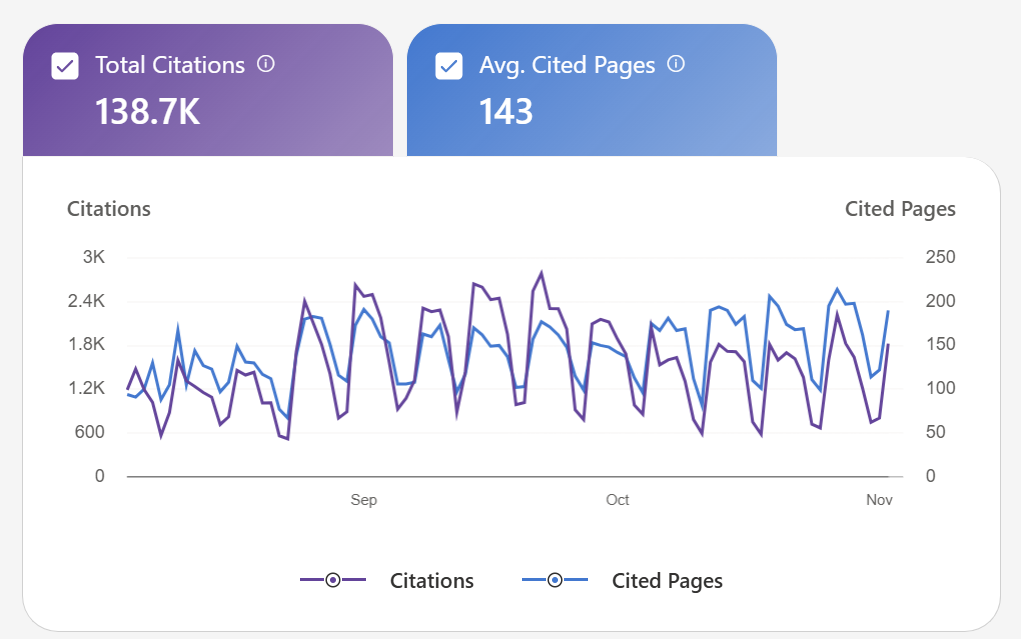
From July 21 to October 19, 2026, Copilot and Bing’s AI features cited Wealthtender about 1,480 times a day. Some of that came from our educational content: explainers on professional designations, compensation terms like vested balance and LTIPs, and interest rate forecasts. For advisors, the more important finding is what happened on profile pages.
When people ask AI about a specific firm, Wealthtender is part of the answer
Grounding queries that name a firm show what happens when a prospect asks an AI assistant to research an advisor they’ve heard about. For each firm below, Copilot cited the firm’s Wealthtender profile when it answered, and Wealthtender earned a meaningful share of all the citations shown.
Citation share is the percentage of all citations Copilot showed for that grounding query that pointed to a Wealthtender page. Profile citations are the total for the firm’s or advisor’s Wealthtender profile from July 23 to October 22, 2026. Figures come from Microsoft’s sampled data and may be refined.
What to know about the examples shown above
These six firms are examples drawn from 200 profiles that Copilot cited from July 23 to October 22, 2026, on one AI platform with a small, work-heavy audience. A profile appears in this data only when a Copilot user happened to ask about that firm or topic and Copilot chose to cite it, and Microsoft’s figures are a sample rather than a complete count.
So a profile that isn’t named here, or that shows few Copilot citations, isn’t a sign that it isn’t working. Most consumers researching advisors use ChatGPT, Gemini and Google, which don’t yet share this kind of detail, and your profile also works in ordinary search results, on Wealthtender itself and wherever you display your reviews.
Profiles are gaining ground
From September 22 to October 22, 2026, compared with the 30 days before, citations of individual advisor and firm profiles rose 47%, from 1,286 to 1,896. The number of different profiles cited rose from 78 to 134, even as interest in a few large explainer articles cooled. AI assistants are reaching for advisor profiles more often, not less.
When prospects ask AI how to find an advisor
On grounding queries about finding, comparing or vetting an advisor, Wealthtender’s average citation share was about 19%. On some of the most direct questions, it was much higher.
Wealthtender’s citation share for selected grounding queries, July 23 to October 22, 2026.
Topic Portfolio: see where you show up, and where you don’t
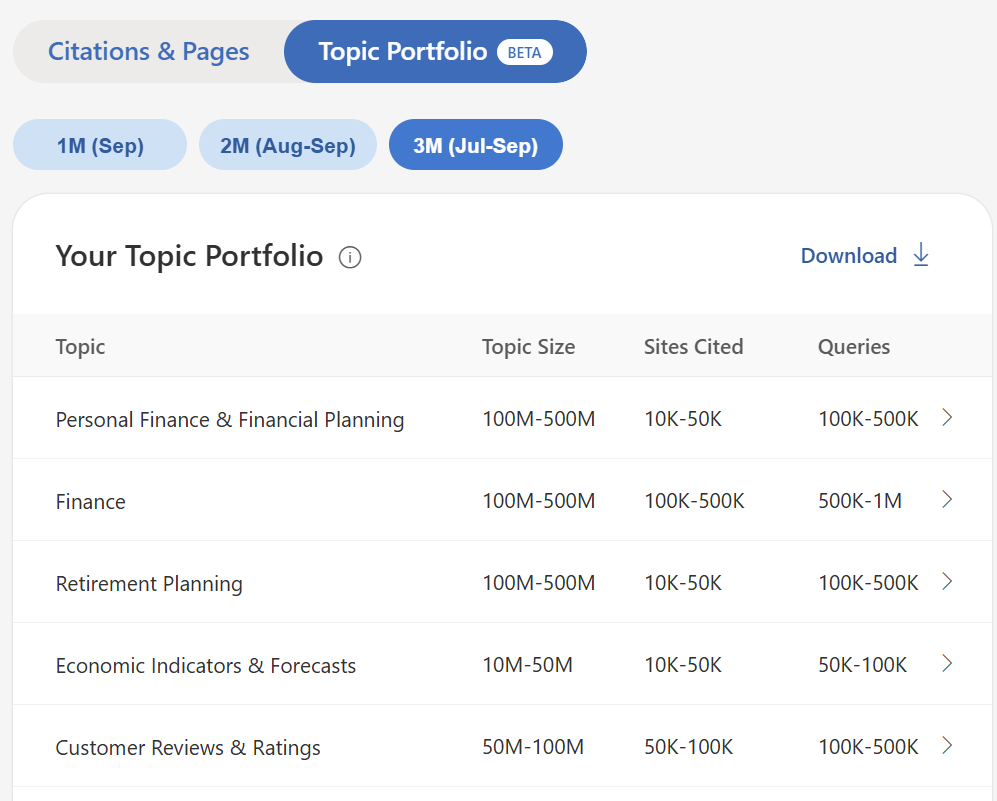
Topic Portfolio, added in beta in October 2026, organizes your AI citations by theme. For each one, it shows the questions where AI cites you and related questions where it cites other sites instead.
Microsoft introduced Topic Portfolio as a new tab in the AI Performance report. Open any topic and you see two lists: your own grounding queries, with the number of times your site was cited for each, and “opportunity queries,” where other sites were cited and yours wasn’t. For an advisor or a firm leader, it is the clearest view yet of which subjects AI already connects with you, and which conversations in your field it is having without you.
Topic
A broad cluster of related grounding queries where your site appears, such as Retirement Planning or Customer Reviews & Ratings.
Topic size
The approximate total citations across all sites for the topic. It shows how much AI search demand the theme represents.
Sites cited and queries
The approximate number of websites cited in the topic, which shows how crowded it is, and the approximate number of distinct grounding queries it contains.
Opportunity queries
Queries in the topic where other sites were cited and yours wasn’t, shown with a citation range rather than an exact count.
How to use it
- See what’s already working. Open a topic to see the grounding queries where AI cites you and how often. It’s the quickest way to learn which subjects AI already associates with your firm.
- Pick specialties to invest in. Compare topic size and sites cited for the themes you care about. A sizable topic where few sites are cited is a better bet for new content than a crowded one.
- Turn relevant opportunity queries into content. Each one is a question someone asked an AI assistant that your site didn’t help answer. If it fits your expertise, it’s a ready-made topic for an article or an FAQ.
- Watch for your firm’s name. If a query naming your firm or advisors shows up as an opportunity, AI is answering questions about you from other sources. That is the clearest signal to strengthen your own pages and your profiles elsewhere.
- Revisit every month. You can view one, two or three months at a time, so a monthly check shows whether your work is paying off.
What Wealthtender’s Topic Portfolio shows
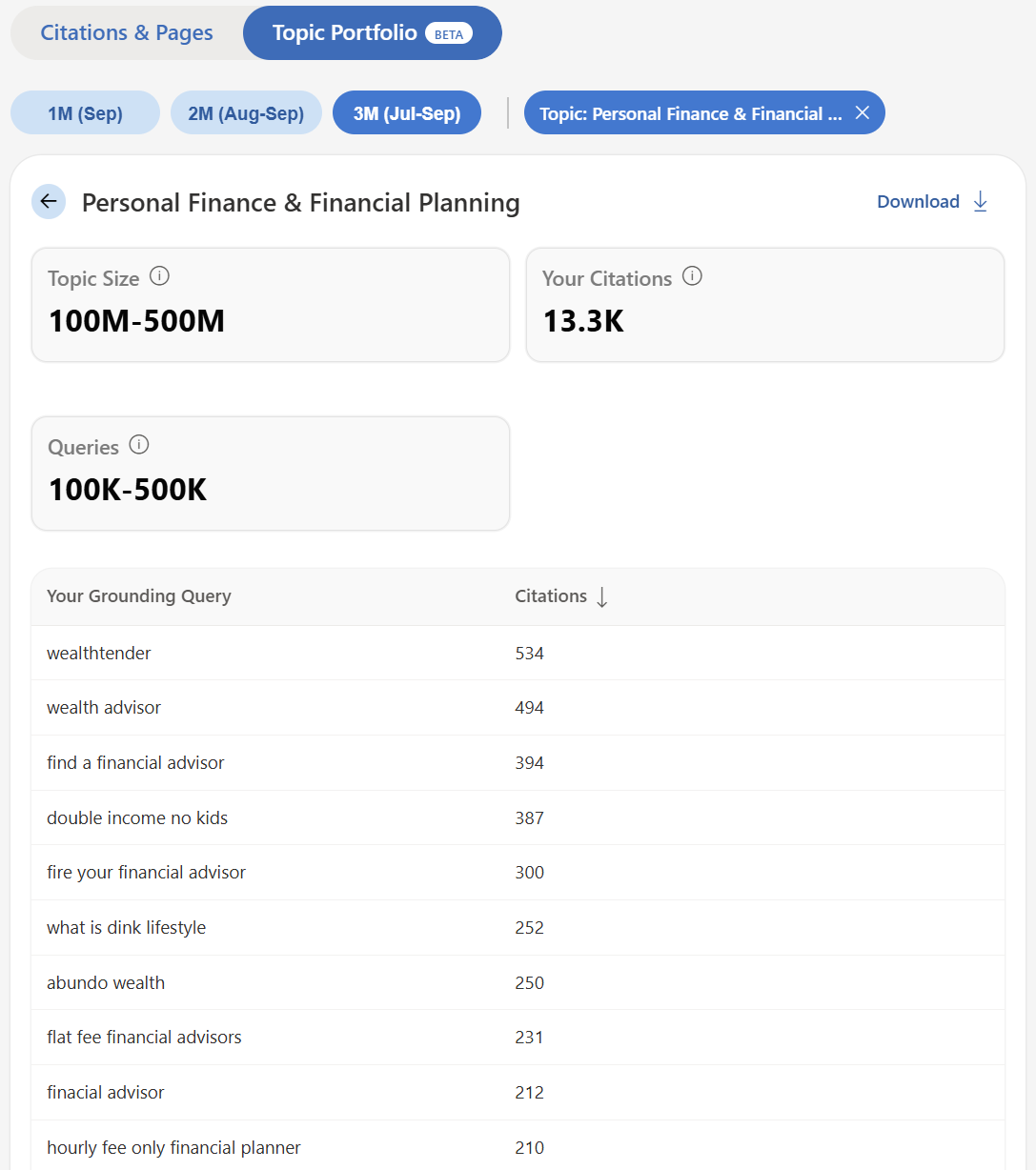
For July through September 2026, Bing grouped Wealthtender’s citations into 49 topics. Here are two that matter most to advisors.
- wealth advisor 494
- find a financial advisor 394
- fire your financial advisor 300
- flat fee financial advisors 231
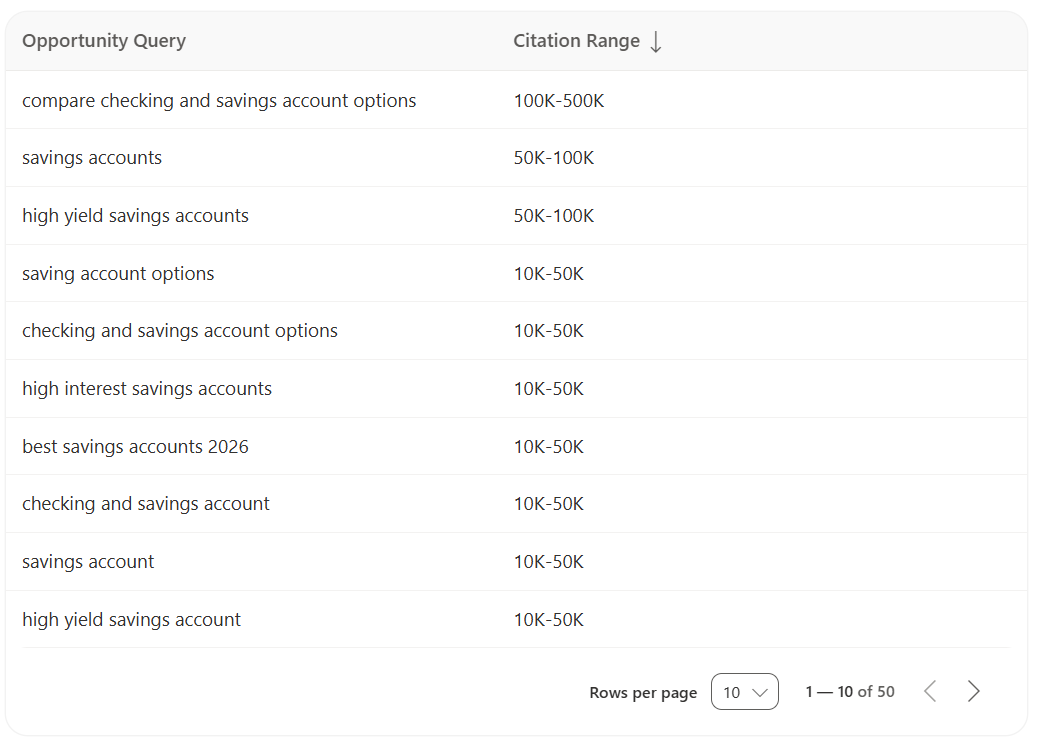
- compare checking and savings account options 100K to 500K
- savings accounts 50K to 100K
- high yield savings accounts 50K to 100K
- best savings accounts 2026 10K to 50K
- financial advisor reviews 333
- financial advisors top client satisfaction scores 114
- compare financial advisor credentials client reviews 40
- brindle and bay wealth management reviews 34
- thinkorswim review 1K to 5K
- american home shield reviews 1K to 5K
- cit bank reviews 1K to 5K
- hometap reviews 1K to 5K
Wealthtender citations are for July to September 2026, with topic totals shown rounded in the report. Opportunity queries show Microsoft’s approximate citation ranges for all other sites combined. Topic labels are AI-generated.
Not every opportunity is one you want
The opportunity list for Personal Finance & Financial Planning is a good example. Its largest opportunity queries are about checking and savings accounts. They sit in the same broad topic as financial advice, but they’re questions banks are better suited to answer, and we’re losing zero sleep over not being cited for them. Within that same topic, we’re glad to be cited hundreds of times for queries like “wealth advisor” and “find a financial advisor,” which is exactly where we want to be.
Your report will work the same way. Treat opportunity queries as a menu, not a to-do list: pursue the ones that match your expertise and your ideal clients, and ignore the rest. When one does fit, act on it. In September, for example, “how to choose a financial advisor” was among our opportunity queries, so in November we published How to Find the Right Financial Advisor (and Avoid a Disappointing One), with advice from 11 financial professionals.
People ask AI for reviews of firms by name
The reviews topic shows something firm leaders should notice. People regularly ask AI assistants for reviews of specific wealth management firms by name, and the assistant answers by citing whatever reviews and evaluations it can find, wherever they live. Our opportunity queries include several household names:
- fisher investments reviews 5K to 10K
- merrill lynch wealth management review 101 to 500
- morgan stanley wealth management review 101 to 500
- ubs wealth management review 101 to 500
Citation ranges for all other sites combined. Fisher Investments, July to September 2026. Merrill Lynch, Morgan Stanley and UBS, September 2026.
It isn’t only the household names. The same kind of question comes up for independent firms: “brindle and bay wealth management reviews,” about an independent firm based in Frisco, Texas, appears among the queries where Copilot cited Wealthtender, 34 times from July to September 2026. A firm with verified client reviews published in a structured, machine-readable format gives AI something credible to cite. A firm without them leaves the answer to others.
Read opportunity queries with care
Microsoft calls these numbers “directional signals for planning.” Sizes and ranges are approximate, topic labels can be off, and queries naming other brands or products can appear as opportunities even when they aren’t a fit for your site. Smaller sites may see few topics or none, because topics with too little activity are hidden. And as with everything in this report, it reflects Copilot’s work-heavy audience only.
Does Copilot predict ChatGPT and Gemini?
Not exactly. Each AI assistant retrieves and ranks sources its own way, and Copilot’s audience differs from ChatGPT’s or Gemini’s, so treat Copilot data as directional at best. There are signs the broader pattern holds.
In June 2026, Google added a Generative AI report to Search Console. It shows impressions in AI Overviews and AI Mode by page, but not the grounding queries or citation share Microsoft provides. From July 21 to October 20, 2026, Wealthtender pages earned 1.73 million impressions in Google’s AI features, and five of the ten pages Google showed most often were also among Copilot’s 25 most-cited pages.
The overlap isn’t perfect. Our most-cited page on Copilot ranks much lower in Google’s report. Still, the logic is the same across platforms: AI assistants look for sources that are structured, specific and authoritative, and they cite the ones that are. Our guide to answer engine optimization for financial advisors covers how to become one of them.
What to do with what you find
On your own website
- Give each advisor a bio that says who they serve, their credentials and where they work.
- Answer the questions prospects actually ask, in plain language, with FAQ schema.
- Keep important text in the page itself, not inside images or PDFs.
- Refresh pages that lose citations, and check that the facts are current.
Beyond your website
- Claim your Google and ChatGPT business profiles so the basics are right everywhere.
- Build complete profiles on authoritative directories AI already cites.
- Collect compliant client reviews that are published with review schema.
- Keep your name, credentials and specialties consistent everywhere you appear.
- Earn media mentions that reinforce your expertise.
This is where Wealthtender helps. Every advisor and firm profile is built with structured data, Certified Advisor Reviews™ published with review schema, and specialist directory listings that describe who each advisor serves. Your profile sits on a domain that AI assistants already cite tens of thousands of times a month, so you don’t start from zero.
Frequently asked questions
Yes. Bing Webmaster Tools, including the AI Performance report, is free for any website owner who verifies their site. Importing a site from Google Search Console is the fastest way to get started.
Copilot is a small share of AI search, used mostly at work, but it is the only major AI platform that shows site owners which pages were cited and which search phrases led there. AI assistants generally look for structured, specific and authoritative sources, so the report is a useful directional view of how AI tools treat your content, not an exact predictor of other platforms.
Copilot is used mostly at work. Microsoft has built it into Microsoft 365, Windows and the Edge browser, and in 2026 it folded its consumer Copilot app into its workplace product. Many Copilot users likely use ChatGPT, Gemini or Google on their own devices at home, so Copilot data shows only a narrow slice of how consumers research advisors.
A grounding query is a search phrase the AI ran behind the scenes to find supporting content for its answer. It is the AI’s own wording of what someone asked, not necessarily the words the person typed, and one conversation can produce several grounding queries.
Citation share is the percentage of all citations shown for a grounding query that pointed to your website. Microsoft describes it as an observational metric. It does not name competing sites, and it is not a measure of traffic or ranking.
Topic Portfolio is a beta tab in the AI Performance report, added in October 2026. It groups your grounding queries into broad topics, shows each topic’s approximate size and how many sites are cited, and lists opportunity queries where other sites were cited and yours wasn’t.
Microsoft shows Topic Portfolio only when a site has enough AI citation activity, and it hides topics with too little activity. Smaller advisor websites may see few topics or none at first, which is a reflection of data volume rather than a problem with your site.
Most people read the AI answer and move on without clicking a source. From late July to late October 2026, while Copilot cited Wealthtender about 135,000 times, AI tools including ChatGPT and Gemini sent us roughly 825 visits in total. The value of a citation is that your information shapes the answer, so accuracy, specificity and trust signals matter more than clicks.
The report only shows pages that were actually cited, so many advisor websites will see small numbers or none at first. Specific, plainly written pages about who you serve tend to help, and so does appearing on authoritative third-party sites that AI assistants already cite.
No. The firms in this article are a few examples from 200 profiles Copilot cited from July 23 to October 22, 2026, on a platform with a small, work-heavy audience. Copilot cites a profile only when one of its users asks about that firm or topic, and Microsoft’s data is a sample. Most consumers research advisors with ChatGPT, Gemini and Google, which don’t share this level of detail, and profiles also work in ordinary search results and on Wealthtender itself.
No. Each site owner sees citations of their own domain only. Citations of your Wealthtender profile appear in Wealthtender’s report, which is why we share examples like the ones in this article.
Show up where AI is already looking.
Join 1,000+ advisors and firms using Wealthtender to collect compliant reviews, build authority and get found in Google and AI search.
Learn more about Wealthtender for advisors →