



I ran the numbers on every major cost and benefit of buying vs. renting. What I learned changed how I think about the debate.
What this article covers
After selling his home of 90 months for a 74% gain, Opher Ganel ran the full rent-vs-buy math: inflation, mortgage payments, property taxes, insurance, repairs, improvements, selling costs, the rent he didn’t pay, and what a renter could have earned in the S&P 500. Buying still came out about 14% ahead, but he explains why that result was unusually favorable and why the right answer for you depends on more than a spreadsheet.
Key Takeaways
A 74% home price gain shrank to about 14% ahead of renting once every cost was counted
After adjusting for inflation, mortgage payments, property taxes, insurance, maintenance, improvements and selling costs, then crediting the rent saved and comparing against investing in the S&P 500, the 90-month result was roughly $70,000 ahead on a home scaled to a $500,000 purchase price. That’s a real gain, but far from the headline number.
Unusually favorable conditions drove the result, and many may not repeat for today’s buyers
Faster-than-average appreciation, 3% to 4% mortgage rates, below-average insurance and repair costs, and rents rising about 5.5% a year all tilted the math toward owning. With 30-year mortgage rates above 6% today, the same spreadsheet could tell a very different story.
The deciding factor is often flexibility versus control, not the math
Owning lets you stay put as long as you like, while renting makes it far easier to leave. The advisors quoted here say the decision often turns as much on lifestyle, timeline and whether a renter will actually invest the savings as on the numbers.
 Jon Lapp
 Michael DeMassa
 Chris Chen
It’s one of the most hotly debated questions in personal finance blogs.
Which is better, renting or buying?
Here’s how the typical arguments go…
The Case for Buying a Home
If you’re renting…
- You’re throwing away your money, paying off your landlord’s mortgage.
- You’re missing one of the best ways to build wealth.
- You’re at the mercy of your landlord, who can decline to renew your lease when you want to stay put, and who usually jacks up the rent every year.
If you buy, on the other hand…
- You’re forcing yourself to save, building equity, and thus building wealth.
- You’re safe from being forced out (as long as you make your mortgage payments) and will eventually own your home outright (if you don’t move before paying off the loan).
- Your monthly principal and interest payment never increases (assuming you have a fixed-rate mortgage like most buyers).
- The purchasing power of your monthly payments drops with inflation, making the mortgage easier to pay over time.
- You can generally deduct mortgage interest (on up to $750k of qualifying mortgage debt).
The Case for Renting
If you’re buying…
- You’re putting a huge amount of money into the down payment and closing costs that don’t bring in any cash flow, and constantly have to pull extra money out of your pocket to cover homeowners’ insurance, property taxes, repairs, maintenance, improvements, etc.
- When you sell, you have to pay closing costs including taxes and realtor commissions.
- Moving becomes a huge headache because you have to find someone who wants to buy your house, at a price you’re willing to accept.
- And, if you’re a Robert Kiyosaki fan, you’re “buying” a liability instead of assets. Personally, this last argument always seemed ridiculous to me. Your house is an asset. You can sell it for money. The mortgage you use to buy it is a liability. Whether the house turns out to be a good investment is a whole other question, which we’ll dig into below.
If you’re renting…
- Instead of sinking five, six, or even seven figures into illiquid home equity, you can invest the money and get investment returns that can average ~10% a year or more.
- You’re flexible and mobile. If you need to move for a new job, because you get married, have children, etc., you just give notice to the landlord and move out at the end of your lease.
Why I’ve Always Leaned Toward Buying
I’ve always preferred buying, myself.
Maybe it’s because my parents bought a house that stretched their finances, but 15 years’ worth of inflation later, their final mortgage payment was about the cost of a modest dinner for four at a neighborhood restaurant.
And when they both passed away, that house, split three ways between my sisters and me, was enough to cover the down payment on a home we absolutely loved, and then some.
Having said that, it was many years before I felt I could afford to buy.
In fact, it took a friend urging me to do the math before I even tried. As a result, we bought our first home when I was 38. Looking back, I’m sure we could have done it several years earlier.
But there’s another critical, and often overlooked factor that Jon Lapp, CFP®, Founder of Haven Financial Advisors, points out:
Either path has a behavioral component too. A mortgage forces people to build equity, while many renters never consistently invest the savings. On the other hand, some buyers stretch their budgets so far that the mortgage, taxes, insurance, and repairs crowd out retirement savings. The better financial choice is partly determined by what the person will actually do with the rest of their cash flow.
A 90-Month Rent vs. Buy Case Study: Did a 74% Gain Really Pay Off?
We’ve just sold our home of the last 90 months.
Guess what?
Over those 7.5 years, our house went up by 74%! WOW!
Right?!
That was my gut reaction. The problem was that this ignored a lot of details:
- Inflation
- Mortgage payments
- Homeowners’ insurance
- Maintenance and repairs
- Improvements
- Property taxes
- Closing costs, buying and selling, including taxes and realtor commissions
Being the personal finance nerd that I am, I decided to figure out exactly how all these affected our real results.
So, I built an Excel spreadsheet that did exactly that. The following details everything, but to preserve financial privacy, I scaled everything to a hypothetical $500k initial home price.
Here’s the progression of what I found.
Step 1: The Nominal Return on the House
Scaling to a $500k purchase price, the house sold for $870k.
That’s a 74% increase, which works out to a 7.7% average annual appreciation.
The rent-over-buy crowd would likely be quick to point out that this is much less than the 10.5% long-term average annual return of stocks. What that misses is that the appreciation was on the entire value of the house, but we’d only put in 23% of the purchase price, so our effective return on investment was 317%, or an annualized average of 21%!
Step 2: Adjusting the Return for Inflation
The first problem was that the dollars we got for selling the house were nowhere near as valuable as the dollars we paid when we bought it.
Using the US Bureau of Labor Statistics inflation calculator, over those 90 months, the purchasing power of the US dollar dropped by 24.3%, or 3.6% per year, on average.
Adjusting for that, the 74% increase decreases to a real, inflation-adjusted appreciation of 32%, or 3.7% a year.
Considering the mortgage leverage, as above, this translates to a 136% total return, or a still respectable average annual return of 12.1%.
Step 3: Subtracting the Real Costs of Owning
This is where the going got quite a bit rougher.
I entered all our homeownership bills into the spreadsheet, with each independent payment in the month it occurred, and applied inflation adjustments for each month, as appropriate.
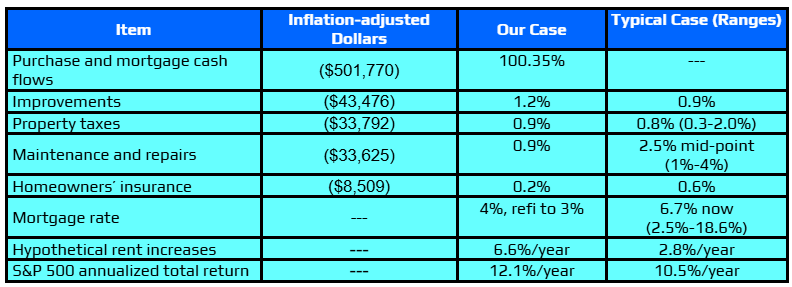
- Down payment, closing costs, mortgage payments, and mortgage payoff totaled $502k (remember, this is all scaled to a $500k purchase price).
- Voluntary improvements totaled $43k, 9% of the purchase price, or 1.2% a year.
- Property taxes totaled $34k, which was 7% of the purchase price, or 0.9% a year.
- Maintenance and repairs totaled another $34k, again, 7% of the purchase price, or 0.9% a year.
- Homeowners’ insurance was $9k, about 2% of the purchase price, or 0.2% a year.
The bottom line came to an underwhelming (inflation-adjusted) $7k of profit. That’s just 1.4% total, or an annualized 0.2%.
Even accounting for the mortgage leverage, this was just a 0.3% annualized rate of return.
I can already hear a loud “Aha!” from the “renting is better” crowd.
But we can’t call it a day quite yet.
Step 4: Adding Back the Rent We Didn’t Pay
Using estimated values for the rent we didn’t have to pay because we lived in a house we owned, we saved almost $193k over these 90 months.
Adding this to the $7k net return, we have just under $200k more than we’d have had if we had rented instead.
This works out to an effective return of nearly 40%, or an annualized rate of 4.6%. Accounting for the leverage, this increases to an annual rate of 7.7% (accidentally similar to the original nominal rate).
And now we hear a similarly loud “Aha!” from the “buying is better” crowd.
Not so fast.
Step 5: Comparing Against Renting and Investing the Difference
To address the gains a renter would have had, I assumed that each month, the hypothetical renter would have taken whatever money we paid for housing, subtracted their rent, and invested the difference in an S&P 500 ETF. I even ignored the 0.03% management fee of, e.g., the Vanguard S&P 500 ETF (VOO).
If in a given month we ended up with a net gain, e.g., due to a tax deduction, I assumed the hypothetical renter would have sold that amount from their investment.
I applied both the monthly S&P 500 total return with dividends reinvested from Shiller’s data and inflation from the Bureau of Labor Statistics.
Finally, since we “closed out our position” by selling the house, leading to long-term capital gains taxes, which I counted against our effective return, I forced the hypothetical renter to sell their investments at the end of the 90 months, paying long-term capital gains taxes on gains on investments made 12 months ago or earlier, and short-term capital gains taxes on investments made in the last 12 months.
One important caveat here, as a strategy, renters should invest the money they’d otherwise sink into illiquid housing had they bought. However, I suspect many don’t do that, which would tend to make their financial outcome far worse.
This exercise led to the final result…
The Result: Buying Beat Renting and Investing by About 14%
We came out just under 14% ahead (~$70k vs. a $500k purchase price), even accounting for all the above factors. Adjusting for leverage, that turns into a 26% total return. That’s over 3% a year above what a hypothetical “rent-and-invest” person would have come out with, relative to the capital we had invested (rather than the full purchase price that included the bank’s money).
And this wasn’t because the S&P 500 suffered poor returns during the past 90 months. On the contrary, using Yale economist Robert Shiller’s data, the S&P 500 annualized total return, with dividends reinvested, was 12.1% over the past 90 months, significantly higher than the long-term 10.5% average.
Stay connected
See more of Wealthtender when you search Google
Add us as a preferred source, and our guides to personal finance and choosing a financial advisor can appear more often in your Google results, with a “Preferred” label in AI Overviews.
Why Your Rent vs. Buy Math Could Turn Out Differently
You must keep several things in mind before you take our experience and decide that buying always wins over renting.
We were favored by multiple factors, as you’ll see below.
Some were pure luck. Others resulted from where we chose to live. And some reflected decisions we made, including buying a home warranty (I counted that warranty costs under maintenance and repairs) to avoid expensive repair surprises.
Crucially, some of these positive factors are very unlikely to recur for current buyers.
- Our house value appreciated faster than average. According to the Federal Reserve Bank of St. Louis, S&P Cotality Case-Shiller U.S. National Home Price Index, over the nearly 40 years from January 1987 to June 2026, US housing prices increased at an average annual rate of 4.3%. Even during the same 90-month period we owned our house, US housing appreciated at an average annual rate of 6.5%, significantly less than our 7.7% experience. However, as Lapp cautions, “The homeownership risk I think even sophisticated buyers underestimate is how concentrated the investment becomes. A substantial portion of their net worth may be tied to one property, in one neighborhood, exposed to one local economy. The recent appreciation in home prices can make that concentration feel safer than it really is. A home can build wealth over time, but it is not a diversified investment, and accessing that wealth usually requires selling, borrowing against the property, or downsizing.”
- We spent an annual average of 1.2% of the purchase price on voluntary improvements to the house, substantially more than the 0.9% average ($827 billion spent in two years, according to NerdWallet, divided by the $47.9 trillion total value of owner-occupied US housing, according to Realtor.com).
- Our annual property tax rate was an effective 0.9%. Many jurisdictions in the US have much higher rates. For example, according to the Tax Foundation, NJ has an effective rate more than double that. On the other hand, some jurisdictions have a much lower rate. Hawaii, for example, has a rate less than 1/3 as high.
- Our maintenance and repair costs, at 0.9% a year, were far lower than Fannie Mae’s guidance: “The rule of thumb is to budget 1% to 4% of your home’s value per year for maintenance costs, including repairs and replacements.” Actual costs will depend heavily on your home’s location, age, condition, and environment. Chris Chen, Owner, Insight Financial Strategists, relates a case in point: “Buyers sometimes neglect to look deep enough under the cover. Recently, a buyer bought a condo that looked very nice. It was secluded in a nature area near a large city. So, they repainted inside, changed some of the flooring, bought a new refrigerator, and moved in. About nine months later, the condo board announced that they were going to approve a condo-wide project to address maintenance that had been deferred for almost 50 years, at an average cost of $150,000 per condo. There is a reason new houses sell for more than old houses. It’s because old houses come with baggage. A building that’s almost 50 years old is likely going to be due for a major renovation. It could be delayed a couple of years, but eventually it has to be paid. When it comes to houses, the expression caveat emptor gained new significance for this buyer!”
- Our insurance cost was 0.2% of the purchase price per year vs. the average, according to NerdWallet, of more than 0.6%.
- We were extremely fortunate in that mortgage rates were very favorable to us. We purchased the house with a 4% 30-year-fixed mortgage, and a couple of years later, refinanced to a 3% loan. Currently, typical mortgage rates are over 6.6%. Historically, they’ve fluctuated between 2.5% and nearly 19%, with a median rate of about 5% during the 90 months in question.
- Rents, over the last 7.5 years, increased by more than 50%, a 5.5% average annual increase. This was faster than the long-term national average of 2.8% a year from 1914 to date. In our area, rents increased even faster, at 6.6% a year.
- On the investing side, the S&P 500 annualized total return, with dividends reinvested, was 12.1% over the past 90 months, significantly higher than the long-term 10.5% average. That means the “rent and invest the saved money” crowd can’t count on the same returns in the future.
Table 1 captures the multiple metrics that affected our results.
As Michael E. DeMassa, CFP®, Founder of Forza Wealth Management, shares:
Just this week, I advised three clients who either recently sold a home or own other properties that it may be perfectly OK to rent for a while as things settle down. Whether you’re moving to a new city, recently widowed or divorced, or simply unsure what the next few years will look like, renting can provide something valuable: time and flexibility to make a more informed decision about your next home.
But one mantra kept coming up: ‘Renting is just throwing money away.’ I understand where that comes from. Homeownership can be a great long-term investment. But the comparison is not simply rent vs. a mortgage payment. When we look at the economics of owning a home, we add up the property taxes, insurance, HOA or condo fees, maintenance, and the investment income that could have been earned on the money used for the down payment or purchase.
Once you account for all of those costs, the cash-flow difference between renting and owning is often much smaller than people realize. What ultimately tips the equation toward homeownership is potential long-term appreciation. That can be a compelling reason to own a home, particularly if you plan to stay put for many years.
But if your living situation could change in the next couple of years, that potential appreciation may not be worth giving up the flexibility that renting provides. Sometimes, the best financial decision is to avoid rushing into the next home purchase.
What a Rent vs. Buy Spreadsheet Can’t Tell You
The nominal 74% we “won” after 90 months led to my gut reaction of WOW!
After accounting for all the different arguments and factors, we still came out 14% of the purchase price ahead of a hypothetical rent-and-invest alternative.
That’s about half of the above naïve number, but I’m still thrilled with it.
The thing is, that’s not the most important message you should take away from all this.
There are two other things you should keep in mind.
First, for the entire time we owned the house, the spreadsheet numbers looked awful for us.
Plotting the cumulative result month by month before recognizing the eventual proceeds from selling the house, we appeared to be underwater relative to a rent-and-invest alternative by multiple six figures, between 53% and 64% of the purchase price, for 89 of the 90 months (Fig.1).

Note that this doesn’t mean we were actually hundreds of thousands of dollars poorer during that time. The house remained an asset whose value wasn’t recognized in this cumulative cash-flow presentation until the sale.
Homeownership typically requires years of substantial cash outflows while much of its financial benefit remains locked inside an illiquid asset.
Similarly, the final jump doesn’t represent hundreds of thousands of dollars of wealth suddenly appearing when we sold the house. It represents the conversion of an illiquid asset into cash.
The second factor is even more critical.
It has to do with what’s more important for you emotionally and practically. With what risks you’re more comfortable taking, and over what you want more control.
If you’re like me, you probably prefer the predictability of fixed principal and interest costs of a mortgage over the likelihood that your rent will increase each year, sometimes by a lot.
If you, like me, also tend to stay in one place for a long time, you likely value having control over being able to stay in the same home for as long as you want more than having the flexibility and freedom to “up stakes” at the end of any given year’s lease.
When you own, no landlord can inform you that in X months you’ll have to move out of your home, often despite your being an ideal renter who always pays rent on time and takes excellent care of the property.
Two real-life cases illustrate this.
For several years after moving into our recent house, we leased out our previous home. When we decided to sell it last year, we notified our renter that we would not be renewing their lease. A few years earlier, a neighbor of ours non-renewed a renter because they needed the house for their adult child.
Before we bought our first home, on average, I moved every 1-2 years. Sometimes because I graduated from a school, sometimes because of overseas stays, sometimes because a landlord needed the place for a kid, etc.
Since buying that first home, we’ve stayed in the same home nearly 9 years, on average.
- I lived in the first home for 5 years, during which time it more than doubled in value (in nominal dollars).
- We lived in the second home for 13.5 years, during which time it appreciated by about 50% in nominal dollars, a far slower pace.
- As detailed above, we lived in our most recent home for 7.5 years, during which time it went up by 74% in nominal dollar terms.
This experience hasn’t made me neutral about the own-or-rent decision for myself.
I tend to stay put. I expect to live in our next house for many years, just like I’ve done since first owning my home, so I continue to heavily favor owning.
That’s because one of the biggest disadvantages of homeownership, reduced flexibility to move, doesn’t bother me nearly as much as it might bother someone whose career, family situation, or personal preferences could have them moving every couple of years.
If you get a job offer across the country, get married, get divorced, need to care for a parent, lose your job, or simply decide you want to live somewhere else, a lease is much easier to unwind than a house you own.
To sum this up, owning lets you stay in place as long as you want to. Renting gives you greater control over leaving when you want to.
According to the Federal Reserve’s 2024 household survey, 58% of renters said renting was more convenient or flexible, while 47% said renting was less financially risky.
Financial calculations matter a lot, because you may not be able to afford to buy, and your situation may make it riskier.
But if both options seem plausible, the factor that determines the right answer for you has to do with what you prefer to control, and what you’re willing to risk (Table 2).
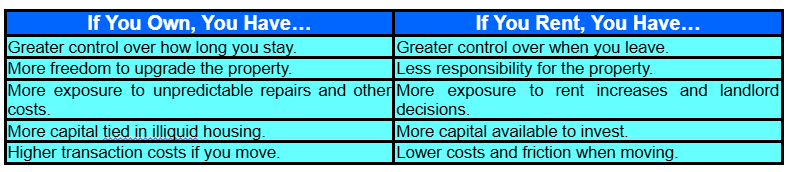
I value a great deal having greater control over being able to stay in place.
You may feel the opposite.
The Bottom Line: Run the Numbers, Then Decide What You Value
Yes, we came out ahead by buying our house. By a lot.
But what’s easy (well, excluding the spreadsheet pain) to see in retrospect was far from a given beforehand.
- The housing market appreciated at historically high rates during this time, and our house value appreciated even faster.
- Mortgage rates were low when we bought, and dropped even lower soon after, to less than half of today’s rates. Had rates then been what they are today, my spreadsheet would tell a very different story.
- Our expenses were lower than we could have expected based on average values.
When you’re trying to decide whether to buy or rent, there’s a lot of uncertainty.
- You don’t know if mortgage rates will drop, allowing you to refi and reduce your costs.
- You don’t know whether your house will appreciate, and if so, how fast.
- You don’t know your expenses, just what historic averages suggest you budget.
- You don’t know if the stock market will keep roaring, or if it’ll crash while you’re trying to invest the down payment you don’t have to make if you rent.
- You can plan, but you can’t know how long you’ll stay in the house.
You can, and should, run the average numbers and stress-test your assumptions. You can run scenarios in which housing appreciates faster than average, slower, or even drops in value. You can ask what happens if your repair bills run high, or insurers post massive losses in your state and jack up premiums.
But you can’t know.
So, the most you can get from even the best spreadsheet is whether buying and/or renting are financially feasible and defensible. Assuming both pass, the factors that should decide the matter for you may not be the financial ones.
Yes, things worked out extremely well for us financially, but had things happened to be less favorable to us, with financial headwinds rather than tailwinds, they could have easily turned out far worse.
That’s why, after spending a lot of time building a spreadsheet that accounted for inflation, mortgage payments, taxes, insurance, maintenance, improvements, selling costs, avoided rent, stock-market opportunity costs, and taxes on both sides, I’m convinced that a spreadsheet can’t make that final decision for you.
As Lapp puts it:
One thing impossible to quantify is the value of optionality. A renter can relocate for a better job, move closer to family, or adjust housing costs relatively quickly. A homeowner has more control and stability, but also has capital tied up and significant friction around moving. In most cases when helping guide my clients through this decision, my recommendation revolves as much, if not more, around the lifestyle, timeline, and flexibility preferences than it does around just the math.
Personally, I continue to heavily favor buying and staying put for many years. This has worked out well for us over the last quarter century, financially and emotionally.
But for someone who can’t afford to buy and/or who values most the ability to up stakes quickly, with minimal hassles, the right decision may well be to rent.
As I wrote above, owning lets you stay in place as long as you want to. Renting lets you leave when you want to.
Frequently Asked Questions
Is it better to rent or buy a home?
It depends on your numbers and your priorities. A full comparison should count inflation, every ownership cost, selling costs, the rent you avoid and what a renter could earn by investing the difference. If both options are financially feasible, the deciding factors are often how long you expect to stay and whether you value the control of owning or the flexibility of renting.
What costs should you include when comparing renting and buying?
Include the down payment, closing costs when buying and selling, mortgage payments, property taxes, homeowners insurance, maintenance and repairs, improvements, and any HOA or condo fees. On the renting side, include rent and its likely increases, plus the investment returns and taxes on money a renter would invest instead of putting it into a home.
How much should you budget for home maintenance each year?
Fannie Mae’s rule of thumb is 1% to 4% of a home’s value per year for maintenance, repairs and replacements. Actual costs depend heavily on the home’s age, condition, location and environment, and older buildings can carry large deferred-maintenance bills.
Is renting just throwing money away?
Not necessarily. Once property taxes, insurance, fees, maintenance and the lost investment return on a down payment are counted, the cash-flow gap between renting and owning is often smaller than people expect. Renting can also buy time and flexibility, though it works best financially when renters consistently invest what they save.
Find financial advisors who specialize in helping people like you
Search Wealthtender by specialty, location and fee type, compare advisors’ approaches, and read what their clients say before you reach out.
Disclaimer: This article is intended for informational purposes only, and should not be considered financial advice. You should consult a financial professional before making any major financial decisions.

About the author
Contributing Writer, Wealthtender
My career has taken some unexpected turns, from earning a PhD in experimental high-energy physics, to conducting cosmic-ray research in Antarctica, to supporting NASA projects and programs, to running my own consulting business. I also run several other small businesses and help my wife run her Marriage and Family Therapy practice.
Those experiences taught me to question assumptions, think critically, and recognize that real-world decisions of any significance rarely have simple answers that apply to everyone. Today, I bring that perspective to writing about personal finance. Drawing on my analytical background, business experience, and research, I explore financial decisions, challenge conventional wisdom, and help readers understand the tradeoffs that can affect their financial well-being. To complement my own research and experience, I also weave insights from financial professionals into my articles, drawing on their expertise and real-world experience helping clients navigate financial decisions and challenges.
At medium.com/@opher-ganel, you can read more of my articles and subscribe to receive email notifications when new ones come out.