



Wealthtender is a trusted, independent financial directory and educational resource governed by our strict Editorial Policy, Integrity Standards, and Terms of Use. While we receive compensation from featured professionals (a natural conflict of interest), we always operate with integrity and transparency to earn your trust. Wealthtender is not a client of these providers. ➡️ Find a Local Advisor | 🎯 Find a Specialist Advisor

You’re asking the wrong question; ask this instead!
I see it everywhere, and I’m sure you’ve seen it too.
“Delay claiming Social Security to age 70. It’ll grow your guaranteed benefits by 24%!”
If you’re asking, “When should I claim Social Security to get the most money?” delaying is often good advice, and sometimes even excellent advice. But it can lead you into a trap that even smart retirees fall into.
When to claim is the wrong question to ask first.
The better first question is, “What risk am I trying to protect myself from through my Social Security claiming strategy?”
If you ask the wrong question, you may end up making a decision that looks great on the surface, but quietly works against you, given your personal situation.
Two Potentially Valid Approaches
If you ask when to claim, your best answer could be at age 70 to maximize your monthly benefit, or early, to start (smaller) benefits sooner.
Let’s do a deeper dive into the two paths.
Morningstar’s Approach: Treat Social Security as Longevity Insurance
Morningstar’s research frames Social Security less as an investment decision and more as insurance against the risk that you’ll live for a long time in retirement.
Into your late 80s, 90s, or beyond.
If that’s what you’re solving for, you want to maximize your guaranteed income by delaying until age 70.
The problem is that, unless you plan to keep working until age 70, your income will be much lower between retirement and age 70. Given that those will be your youngest, healthiest retirement years, you’ll want to spend more then, not less.
Morningstar’s solution is to “bridge” the income gap by drawing more from your nest egg during those years. They analyze three bridge strategies.
- A ladder of Treasury Inflation-Protected Securities (TIPS): Withdraw several years’ worth of planned draws from your portfolio and buy TIPS maturing in a year, two years, and three years. This protects you from sequence-of-returns risk by covering your expenses for the first few years of retirement, and ensures the money keeps up with inflation, even if it spikes.
- Forgoing inflation adjustment if your portfolio drops: This somewhat reduces how much of your portfolio you may need to sell at lower prices, at the cost of potentially trimming your planned spending. If inflation spikes at the same time, that cut could be large.
- Forgoing inflation plus cutting draws by 20%: While this can significantly increase your lifetime spending and remaining balance after 30 years in retirement, it does so by aggressively cutting your spending exactly when you want to spend the most.
All three draw more from your portfolio until age 70 to let you delay claiming Social Security benefits until that age.
This is emotionally appealing for several reasons:
- Maximal guaranteed benefits to address fast-rising health expenses, which is especially helpful once financial flexibility declines and cognitive capability may drop.
- Reduced dependence on market returns.
- Targets one of retirees’ biggest fears – running out of money late in life.
Even if you end up with lower lifetime benefits (if you die before breaking even), you’re buying current confidence for your oldest possible age. That emotional payoff can be more important than optimizing your financial math.
Vanguard’s Approach: Protect Against Regret and Overspending Risk
Vanguard looks at the same decision and highlights a different risk.
Instead of asking, “How do I insure against living a very long time?” Vanguard asks, “What happens if I delay and that turns out to be the wrong bet?”
They don’t say delaying is necessarily a bad choice, but rather that it isn’t optimal for everyone. For example, if you’re wealthy enough (relative to your desired retirement lifestyle) that running out of money isn’t a real concern, and/or you’re not likely to live long enough to break even.
Their suggested approach works to reduce regret and mismatch.
They point out the costs of delaying to age 70:
- Drawing down investments faster than comfortable until age 70.
- Being forced to constrain spending exactly when you’re healthiest and likely want to spend more, especially if the markets don’t do well during those early years.
- Potentially spending less than you could, because you’re uncomfortable seeing your portfolio shrink.
- The risk of lower lifetime benefits if you die before breakeven.
- The mismatch of higher eventual income in years when most retirees naturally spend less (the so-called “slow-go” and “no-go” years).
If you’re unlikely to live past breakeven, the math of delaying gets flipped.
But even if your personal life expectancy makes you likely to live beyond the breakeven age, if your portfolio throws off far more income than your desired retirement budget, and especially if much of your budget is discretionary (think travel, dining out, gifts, etc.), so you can draw less in market down years, Social Security isn’t your safety net. It’s just one element of a larger financial picture.
As such, early claiming offers multiple benefits:
- Reduces the risk of having to sell assets during down years, preserving your portfolio’s longevity.
- Supports estate goals.
- Offers higher income when you’re healthier and can enjoy spending more.
This approach is emotionally appealing because:
- Most people dislike spending more of their assets if they can avoid it.
- It reduces the impact of a bad sequence of returns by reducing your dependence on portfolio-based income before age 70.
- Many people prefer “a bird in the hand” rather than “two in the bush.”
- People want to take advantage of their best health in retirement by spending more when they’re younger.
The emotional punch of this approach doesn’t come from longevity insurance, optimizing your longest-term future at the expense of your present self.
It comes from a feeling of greater control and predictability where you live – in the present.
Reconciling the Differences
At first glance, these conclusions seem to contradict each other. They don’t.
The two finance giants are looking at the same problem, so why do they arrive at such different conclusions?
The answer is that they have different objectives.
Morningstar is concerned with mitigating the so-called longevity risk. That’s the risk that a retiree will survive to a very old age and may run out of money before they die. Vanguard, on the other hand, is trying to mitigate the more immediate risks of regret, stress over spending in early retirement, and a potential mismatch between lifestyle and available income.
Trying to compare their approaches is a classic “apples and oranges” problem. Both are fruits, but different ones, so neither is better nor worse than the other. It’s just a matter of which one you prefer to bite into.
The real mistake is if you try to think of Social Security as an investment to maximize, rather than an insurance to optimize.
The Problem with Considering Social Security as an Investment
Thinking of Social Security as an investment leads you to focus on lifetime benefits and breakeven age. This optimizes for:
- The age with the highest probable lifetime payout.
- The age you need to exceed to “win” the game.
- The internal rate of return.
All are interesting questions, just not the most important ones to consider.
It’s more useful to consider Social Security as insurance against specific retirement-related risks.
These are the real risks you’re insuring against:
- Living longer than expected.
- Dealing with eventual cognitive decline.
- Loss of spending flexibility later in life.
- Regret if you end up dying before breakeven.
- Your widow(er)’s survivor benefits if you die first and your benefits are higher than hers/his.
- Emotional stress over higher spending early in your retirement, leading to a mismatch between your desired lifestyle and what you allow yourself to spend.
- Sequence of returns risk, if the market crashes just before retirement or in your early retirement years, in which case not having guaranteed Social Security income hurts your portfolio worse.
- Poor health limiting your ability to enjoy spending later in your retirement.
By focusing on risk management over maximizing returns, you realize that you aren’t choosing a claiming age for the eventual financial return. Instead, your choice should be against which risks you want more protection.
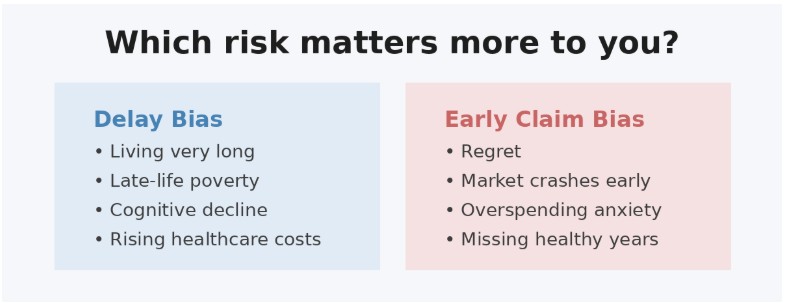
If your highest priority is protecting against the first four risks, that tilts the balance toward late claiming. If, on the other hand, you want better protection against the last four risks, early claiming will serve you better.
The decision isn’t a mathematical one that you can solve with a calculator or spreadsheet. It’s a philosophical/emotional one.
It’s about which risks you’re more comfortable with; which potential problems you’re better positioned to deal with financially, and more importantly, from an emotional perspective; and how you want those risks and issues to distribute over the length of your retirement.
The best plan isn’t necessarily the one that offers the better idealized spreadsheet solution; it’s the one you will be comfortable executing. A technically optimal strategy that makes you anxious is not optimal for you.
If you’re more fearful of late-life poverty, you should strongly consider delaying your claim to age 70. If you’re more fearful of missing out on doing things when you’re still healthy enough to enjoy them, an early claim is likely to be a better fit for you.
Both fears are justified.
The problem isn’t that you have them. It’s pretending they don’t apply to you, leading you to ask and answer the wrong question.
What the Pros Say
I asked several financial advisors for their take on Social Security claiming strategies and their experience with clients around this topic. Here’s what they say.
Brett N. Fry, Managing Director at Forteris Wealth Management, relates, “A couple I met with today recently retired and were looking to optimize when to claim Social Security. The numbers came back saying to delay until age 70, but for them, it was a hurdle to know that they would be relying on their portfolio so heavily for the next few years until they got their benefits.
“One of the primary reasons was that they spent their entire lives saving this amount up, and it was hard for them to fathom dipping into the principal to fund their retirement. They were also concerned they would hesitate enjoying life in retirement if they didn’t have some sort of ‘mailbox money’ coming in. Fortunately for them, the numbers for claiming Social Security at their full retirement age, much earlier than 70, also worked, so it was a win-win.”
Claire Pywell, CFP®, of Highline Advisors, reports, “As an advisor, I frequently have open conversations with my clients about their mortality (and feelings about it)! Fear of missing out (FOMO) is a big driver behind the decision to take Social Security earlier than age 70.”
Chris Chen, CFP®, owner of Insight Financial Strategists, agrees and expands, “I find that many people fear not getting a return on their Social Security contributions if they happen to pass away before 70, a form of FOMO.
“It makes sense for most people to delay Social Security to 70. The return you get is difficult to match. It makes a meaningful difference in most financial plans. The best example of when taking social security early makes sense is when people have terminal conditions, so they expect to pass away soon. More generally, people who don’t have enough income or assets to bridge until 70 may need to take social security early.
“My only rule of thumb here is that if you don’t actually need the benefits, you should postpone claiming.
“The biggest regret I see happens when a husband who is a few years older takes the benefit early, and then realizes their wife could have had a higher benefit when he eventually passes away, especially if the wife’s benefit is significantly lower.”
Brady Lochte, Fee-only Financial Advisor & Founder of Axon Capital Management, offers a similar take, “Delaying to 70 is a clear win for clients with longevity in their family, sufficient assets to bridge the gap without portfolio stress, and a need for inflation-protected guaranteed income later in retirement. It doesn’t necessarily make sense if you’re in poor health, need the cash flow now to avoid selling depressed assets, or would deplete retirement accounts so aggressively that you’d face higher RMDs and tax bombs later.
“If you delay claiming and have to bridge, the biggest mistake is using taxable brokerage accounts while leaving 401(k)s untouched, then getting hammered by Required Minimum Distributions (RMDs) later on.
“Fear of missing out on early retirement years drives far more decisions than the math suggests it should. Clients routinely say, ‘I want to enjoy it while I’m healthy,’ even when they have $3 million in assets. It’s emotional, not financial.
“The most common regret I see is claiming early without understanding the permanent haircut to survivor benefits. Widows who lose the higher earner’s benefit because they both claimed early realize too late they optimized for the short term and sacrificed decades of higher income.
“Overall, we find that behavior dominates the math. The math says delay if you can, but clients who are psychologically uncomfortable spending down assets will claim early, no matter what the breakeven analysis shows. They view Social Security as ‘permission’ to retire, not as longevity insurance to optimize.”
Ben Simerly, CFP®, Financial Advisor & Founder of Lakehouse Family Wealth, rounds things out, “If a client is more concerned with maintaining a current account balance than with growth, we encourage them to wait before claiming Social Security. An overly conservative investment portfolio is a common reason why the Social Security amount may grow faster in the government’s hands than in your own accounts.
“Often, clients who are willing to take more risk could do better by taking Social Security earlier and investing the money while they continue to work. Starting Social Security does not mean you need to spend the money. This can also work great for those concerned about future cuts, but still willing to work.
“By and large, the wealthier the client, the more it’s about the math. For clients on the cusp of having enough money to retire, in the $600,000 to $2,000,000 range at retirement in current dollars, we find many clients have already come up with a retirement age in their mind, and likely won’t deviate from it more than a year or two.
“Fear of delaying retirement is the number one driver I’ve seen in making the final decision to begin Social Security or not. For those willing to work part-time or delay retirement, the decision becomes more math-based. But at some point, if you’re burned out from work, the decision becomes about retirement, not math.
“The most common regret we see is when a client or a spouse gets sick, and they regret not retiring sooner. Often, they made the right decision, but the fear of missing out becomes overwhelming. This is why we often encourage clients who are on the fence regarding retirement, due to the math, to work part-time and find a bit of relief from work, but still reduce distributions from their retirement accounts.
“My best advice is, whatever you do, work with someone who can help you do the math. I have yet to see one rule of thumb that consistently works, given how many complex strategies exist surrounding the Social Security decision. Social Security decisions tie into workplace contributions, significant tax planning changes, and more. If I have any rule of thumb, it’s that the first idea folks have often turns out to be the most costly, and doing the math reveals significant gains.”
The Bottom Line: Ignore Slogans, Implement Useful Decision Rules
I wish there were a simple and easy choice that I could recommend, and that I could implement in my own life, now that I’m beyond the earliest claiming age and (mostly) retired!
Unfortunately, it isn’t.
As I often say, personal finance is exactly that – personal.
This applies to Social Security claiming strategies. There’s no universally best claiming age. There’s just the question of which retirement-related risks are your higher priority, which fears take precedence for you.
That’s why both “Always delay claiming to age 70” and “Always claim early” are seductive, but misleadingly incomplete. Following either one blindly replaces a considered, deeply personal insurance decision with a slogan that may not serve you well.
Slogans are catchy and easy to remember.
They’re just not necessarily the best guidance for your personal finances.
Once you accept that Social Security is best understood as insurance against your highest-priority risks, your decision becomes clearer. You stop chasing the highest theoretical payout and design your strategy to help you sleep better at night.
For some, it’s protecting against late-life poverty and loss of independence. For others, it’s mitigating sequence-of-returns risk and matching current income to a desired lifestyle while healthy enough to enjoy it.
Your best bet is to stop obsessing over spreadsheet perfection and optimize for what helps you feel the confidence and emotional stability that lets you execute your financial plans. If that means you want to secure the highest income floor in late retirement, that’s perfectly valid. If it’s enjoying early retirement as much as possible, it’s equally valid.
The trap isn’t in choosing one or the other.
It’s asking the wrong question, solving for the wrong thing, and implementing a slogan rather than what personally helps you most. The right Social Security timing decision isn’t the one that maximizes your benefit check. It’s the one that lets you stop worrying about it.
Now, all I need to do is follow my own advice!
Disclaimer: This article is intended for informational purposes only, and should not be considered financial advice. You should consult a financial professional before making any major financial decisions.

About the Author
Opher Ganel, Ph.D.
My career has had many unpredictable twists and turns. A MSc in theoretical physics, PhD in experimental high-energy physics, postdoc in particle detector R&D, research position in experimental cosmic-ray physics (including a couple of visits to Antarctica), a brief stint at a small engineering services company supporting NASA, followed by starting my own small consulting practice supporting NASA projects and programs. Along the way, I started other micro businesses and helped my wife start and grow her own Marriage and Family Therapy practice. Now, I use all these experiences to also offer financial strategy services to help independent professionals achieve their personal and business finance goals. Connect with me on my own site: OpherGanel.com and/or follow my Medium publication: medium.com/financial-strategy/.
Learn More About Opher
Wealthtender is a trusted, independent financial directory and educational resource governed by our strict Editorial Policy, Integrity Standards, and Terms of Use. While we receive compensation from featured professionals (a natural conflict of interest), we always operate with integrity and transparency to earn your trust. Wealthtender is not a client of these providers. ➡️ Find a Local Advisor | 🎯 Find a Specialist Advisor