



What this article covers
Real estate investor Grant Cardone told his millions of Instagram followers that buying a house is the worst investment you’ll ever make. Opher Ganel fact-checks that claim line by line, finds Cardone overstated the 10-year break-even price by 57%, and shows that once rent is counted, buying a median-priced home came out about $106,000 ahead of renting in his scenario. Four financial advisors explain why the decision still has to fit your own situation.
Key Takeaways
Grant Cardone’s “worst investment” math overstated the cost of owning a home by 57%
Cardone claimed a $576k home would have to sell for $1.2 million after 10 years just to break even. Using the March 2023 median price of $429,000, about 10.4% in round-trip closing costs, the 1.11% median property tax rate and the actual interest on a 7% mortgage, Opher Ganel puts the full 10-year cost at about $763,000.
Counting rent saved, buying a median home beat renting by about $106,000 over 10 years
At the 5.24% long-term annual appreciation Case and Shiller found, the buyer sells for about $715k and ends roughly $48k behind. The renter pays about $270k in rent and renter’s insurance, and even after investing the $85.8k down payment at 10% a year ends about $154k behind.
Whether to rent or buy depends on your situation, not a guru’s blanket rule
Advisors interviewed called Cardone’s claim misleading and oversimplified, pointing to homeownership as forced savings, a source of stability and highly dependent on local markets. One noted that Cardone’s rental business benefits when people rent, and Opher stresses there are still many situations where renting is the smarter choice.
 Joe Marshall
 Doug Greenberg
 Eric Rodriguez
Busting another real-estate mogul’s proclamation that could cost you over $100k
Social media makes it far too easy for “gurus” to make proclamations that reach millions of people.
That wouldn’t be so bad if only their advice wasn’t so dangerous to our financial well-being!
Grant Cardone’s Claim: Is Buying a House the Worst Investment You’ll Ever Make?
In a June 2023 Instagram interview segment, Grant Cardone, entrepreneur and real estate investor reportedly worth $600 million, implied that 2/3 of Americans (US homeownership rate is 66%) are making a stupid mistake.
He said, “Buying a house — worst investment you’ll ever make in your entire life…
“Average house here is $576k… Now you need 12% for broker fees, let’s say you keep the house 10 years. You need 10% in maintenance fees, it’s 1% a year in maintenance fees. It’s about 2% in property taxes every year. That’s 20%… And it’s probably 7% to the bank, so that’s 70%… Total those up it’s 112%. A $576 home will have to be sold for $1.2 million in 10 years. You’re not going to sell it for that… To break even. Dead money. And you had to put $100k down to do this deal…
“They’re serving a master. They’ll borrow money from the Bank of America, and then if they can get some more money, they’ll have a little retirement account that funds Wall Street. This is a big game bro!
“Rather than buying one house, rent where you live, and take that $100k and go buy a piece of real estate where other people live. I just don’t need to own a home on the way up. I need to own assets that pay me on the way up.
“And once I have enough cash flow from the assets, then if I want to go buy a house, or a watch, or a car, I buy it out of the passive income.”
He isn’t the first real estate “guru” to dis the majority of us.
That questionable “honor” belongs to Australian real estate mogul Tim Gurner, who famously said Millennials can’t buy a house because they waste their money on “avocado toasts.”
Gurner has already faced widespread ridicule online for that.
Is it Cardone’s turn?
Fact-Checking Cardone’s Math on the Cost of Owning a Home
Since Cardone ignored inflation, so will we, and just fact-check his claims.
Home Price: Was the Average House Really $576k?
Start with his $576k “average” home price.
According to the St. Louis Fed, the median home price at the end of March 2023 (the latest number when Cardone’s Instagram segment went live) was $429,000, and it had never been higher than $479,500, let alone anywhere near $576k.
How Much Are Closing Costs When You Buy and Later Sell a Home?
I’m not sure where Cardone gets 12% in brokerage fees. Maybe that’s true for investment properties, but not when buying and selling your primary residence.
When we bought our current house, our closing costs, including all taxes and fees, were 3.2%. The seller’s costs were 7.2%, bringing the total, relevant in Cardone’s scenario of buying and then selling 10 years later, to 10.4%, not 12%.
How Much Do Home Maintenance and Property Taxes Really Cost?
Next up, maintenance and property taxes.
My personal experience of 20-plus years points to 0.5% in maintenance costs. Still, Cardone’s 1% is in line with typical figures, so we’ll keep it.
The median property tax rate in the US is 1.11% however, not 2%.
How Much Mortgage Interest Do You Pay Over 10 Years at 7%?
Finally, we get to mortgage interest, where Cardone claims that at 7%/year interest, you’d pay 70% of the home’s cost over 10 years.
Really?
Let’s check.
For a $429k (median home price), assuming 20% down, you’d borrow $343,200. With Cardone’s 7% rate, your interest cost over a decade would be $225,307.
That’s 52.5% of the purchase price, not 70%.
What’s more, this ignores the mortgage interest tax deduction. Assuming a marginal tax rate (federal, state, and local) of, say, 18%, the effective mortgage interest over a decade drops to 43% of the purchase price.
The Real 10-Year Cost of Owning a Median-Priced Home
Putting this all together, what’s the real break-even number Cardone should have quoted instead of $1.2 million?
- $85.8k down payment
- $42.9k maintenance
- $47.6k property taxes
- $14.3k homeowner insurance (Cardone neglected this one)
- $44.6k “roundtrip” closing costs
- $184.5k post-tax-benefit mortgage interest
- $48.7k mortgage principal
- $294.5k mortgage payoff balance
That’s $763k, which means Cardone’s fuzzy math is off by 57%!
How Much Must a Home Appreciate to Break Even After 10 Years?
Thus, to break even over the decade, your home would need to appreciate by 78%.
Still sounds like a lot, right?
Not when you look in annual terms. Then, it’s just 5.9%, which is slightly higher than the 5.24% long-term average annual appreciation Case and Shiller found for US residential real estate.
Assuming a 5.24% annual appreciation over a decade, you could expect to sell your home for $715k. Since you’d have paid a total of $763k by then, you’d be down $48k.
Hmmm. That still sounds like a less-than-stellar investment, right?
Not so fast…
Stay connected
See more of Wealthtender when you search Google
Add us as a preferred source, and our guides to personal finance and choosing a financial advisor can appear more often in your Google results, with a “Preferred” label in AI Overviews.
What Cardone Missed: Renting Isn’t Free Either
Unless your alternative plan was to couch-surf with your family for a decade, you’d have to account for renting a place to live.
The median rent was recently $2052 a month (and that assumes the average rental property is the same size and quality as the average purchased home, which in my experience it isn’t).
Ignoring potential rent increases, owning your home for 10 years saves you $246k in rent! Add $24k for a decade of renter’s insurance, and that’s $270k.
On the other hand, as Cardone points out, if you rent, you could invest the money you’d tie down through your down payment.
Being generous, let’s assume a 10% annual return for ten years. Your $85.8k saved on the down payment could grow to $222.5k. If the $136.7k gain is taxed at 15%, you’d have $116k net return.
Where does that leave us, when comparing Cardone’s recommended option of renting to what most Americans have done — buying?
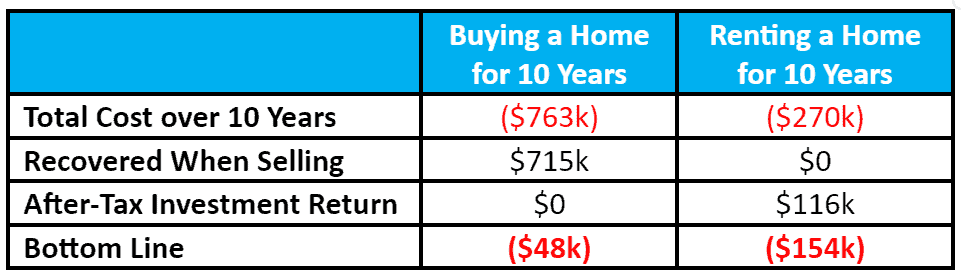
As the table shows, you’d be $48k in the red after a decade if you buy. However, following Cardone’s advice, you’d be $154k in the hole!
Relatively speaking, that makes it $106k better to buy than rent! That’s why I say that following Cardone’s advice could cost you over $100k.
Unfortunately, Cardone has over 4.6 million Instagram followers, and this particular segment received nearly 60,000 “likes” as of this writing.
If only those 4.6 million (or even the 60k fans) could read this, it could save a lot of people needless financial misery.
Is Buying a Home a Bad Investment? What Financial Advisors Say
To verify my argument holds water, I asked financial advisors who aren’t real estate moguls what they think about Cardone’s assertion.
Here’s what they said.
Joe Marshall, Partner, Coastal Capital Advisors, says:
It’s extremely misleading to say that buying a home is the worst investment ever. While I agree that some of the benefits of homeownership tend to be overstated (often the ‘gain’ is calculated as ‘I bought for x, I sold for y,’ not including property taxes, maintenance, insurance, etc., as done here), even if it’s not the best, it’s a good forced savings mechanism.
Further, buying today is very different from buying in 2020 or 2021. That’s why you need to run the numbers for yourself. I expect people on either side of this argument can (and will) find something wrong with the math because buying vs. renting borders on religion and politics.
Doug Greenberg, President Pacific Northwest Advisory, says:
Cardone’s assertion oversimplifies a complex decision. Homeownership isn’t just about the numbers; it’s about stability, security, and personal preference. Financial wisdom isn’t one-size-fits-all.
It’s critical to approach Cardone’s statements with a balanced perspective. Every investment, including homeownership, comes with a unique set of challenges and benefits. Financial success is rooted in individualized strategies, not universal proclamations.
Then, there’s this from Eric Rodriguez, CFP®, Founder & Financial Advisor, Wealthbuilders, “Cardone’s comments assume homes don’t appreciate much. However, if you have the means to buy vs. rent in a high-cost-of-living area, e.g., CA, WA, NYC, etc., it’s advantageous to put your money into an asset that can grow and guarantee tax benefits, such as purchasing a home.
Cardone’s bias is due to his real estate investment business thriving when people rent vs. buy. Without renters, his business would go bankrupt. Regardless, it’s not always about the numbers. Buying a home can provide peace of mind, build equity, and potentially make a profit should you choose to sell.
Garrett Harper, Chief Possibility Officer, Harper Financial Strategies LLC, rounds out the discussion, saying, “Grant Cardone is spot on… in certain real estate markets. For example, Nashville and many parts of Florida are at all-time highs, and real estate prices are starting to come down. This means you might end up ‘underwater’ on a property, especially factoring in maintenance, property taxes, and insurance costs.
However, the blanket idea that buying a home is a horrible investment is completely wrong. In today’s market, you have to do your homework and know what home you can afford.
The Bottom Line: Check the Math (and the Motive) Behind Guru Advice
Does all the above mean everyone should rush out now and buy a house?
Of course not.
That’s why we call it “personal” finance — what’s right for me personally may be wrong for you.
As I previously wrote, there are at least 15 situations where you’d be foolish to buy instead of rent.
It’s just that you have to be cautious when listening to some grand proclamations from an uber-wealthy guy, even when it’s within his or her area of expertise.
You have to question if he or she may have a hidden agenda (for example, if he owns hundreds of millions of dollars in rental units, would he stand to benefit from lots of people preferring to rent than own?).
You also need to consider whether his numbers are accurate (as we’ve seen, they’re off, and not by a little).
In the final analysis, do your due diligence when making major life decisions such as buying a home or not. Don’t just assume a rich guy knows better (and has your best interest at heart).
Find a Financial Advisor
Frequently Asked Questions
Is buying a house the worst investment you can make?
Not according to this analysis. When Opher Ganel corrected Grant Cardone’s figures and counted the rent a homeowner avoids paying, buying a median-priced home came out about $106,000 ahead of renting over 10 years. Advisors interviewed agreed the blanket claim is misleading, though buying isn’t right for everyone.
How much does it really cost to own a home for 10 years?
For a $429,000 home with 20% down and a 7% mortgage, the article totals about $763,000 over a decade, including the down payment, maintenance, property taxes, homeowner insurance, round-trip closing costs, after-tax mortgage interest, principal and the payoff balance at sale. That is far below the $1.2 million Cardone claimed.
How much does a home need to appreciate to break even after 10 years?
In the article’s scenario, the home would need to rise about 78% over a decade, or roughly 5.9% a year. That is only slightly above the 5.24% long-term average annual appreciation Case and Shiller found for US residential real estate.
Is it better to rent and invest your down payment instead of buying?
In this scenario, no. Investing an $85.8k down payment at 10% a year for a decade nets about $116k after a 15% tax on the gain, but about $270k in rent and renter’s insurance over the same period leaves the renter around $154k behind, compared with about $48k behind for the buyer.
Should you trust financial advice from social media gurus?
Be cautious. Opher Ganel suggests asking whether the person has a hidden agenda (for example, owning many rental units) and checking whether the numbers are accurate. One advisor interviewed pointed out that Cardone’s real estate business thrives when people rent rather than buy.
Find financial advisors who specialize in helping people like you
Search Wealthtender by specialty, location and fee type, compare advisors’ approaches, and read what their clients say before you reach out.
Disclaimer: This article is intended for informational purposes only, and should not be considered financial advice. You should consult a financial professional before making any major financial decisions.

About the author
Contributing Writer, Wealthtender
My career has taken some unexpected turns, from earning a PhD in experimental high-energy physics, to conducting cosmic-ray research in Antarctica, to supporting NASA projects and programs, to running my own consulting business. I also run several other small businesses and help my wife run her Marriage and Family Therapy practice.
Those experiences taught me to question assumptions, think critically, and recognize that real-world decisions of any significance rarely have simple answers that apply to everyone. Today, I bring that perspective to writing about personal finance. Drawing on my analytical background, business experience, and research, I explore financial decisions, challenge conventional wisdom, and help readers understand the tradeoffs that can affect their financial well-being. To complement my own research and experience, I also weave insights from financial professionals into my articles, drawing on their expertise and real-world experience helping clients navigate financial decisions and challenges.
At medium.com/@opher-ganel, you can read more of my articles and subscribe to receive email notifications when new ones come out.