




What this article covers
A reader’s costly experience (Social Security that suddenly became taxable and Medicare premiums that cut her benefit by 28 percent for two years) prompted Opher Ganel to map the hidden costs of Roth conversions. He walks through seven pitfalls, from IRMAA surcharges and the 5-year rule to the pro-rata rule and a lost QBI deduction, and three financial advisors add warnings about bracket management, college financial aid and ACA premium tax credits.
Key Takeaways
A Roth conversion counts as taxable income and can make up to 85% of your Social Security taxable
The amount you convert is added to your taxable income for that year. Once your combined income (AGI plus nontaxable interest plus half your benefit) passes $25,000 for individuals or $32,000 for joint filers, half your benefits can become taxable, and above $34,000 or $44,000, up to 85 percent. A large conversion can also push you into a higher marginal bracket, which is why one advisor interviewed aims to fill only the 22% or 24% bracket.
A large Roth conversion can raise your Medicare Part B and D premiums through IRMAA
Medicare’s Income-Related Monthly Adjustment Amount adds a surcharge to Part B and Part D premiums as income rises. Using 2024 figures ($174.70 for Part B and an average $55.50 for Part D), a conversion big enough to reach the top IRMAA tier could add about $1,000 a month, or $12,000 a year, for a couple. The reader who prompted the article saw her Social Security income reduced by 28 percent for two years.
The pro-rata rule and the QBI deduction phase-out can push a conversion’s effective tax rate above 50%
The pro-rata rule taxes conversions based on pre-tax versus after-tax dollars across all your IRAs, so converting $5,000 of after-tax money when you hold $495,000 pre-tax leaves 99 percent taxable. Business owners who claim the Qualified Business Income Deduction can lose it when a conversion lifts taxable income past the phase-out, which in Opher’s $200,000 example pushes the effective tax rate on the conversion above 50 percent.
 Anthony Ferraiolo
 Cody Lachner
Sometimes, you write something intended to help people with one thing, but it floats an unexpected objection.
That’s exactly what happened to me with a recent piece: 7 Best Ways You Can Use Excess RMD Money.
Previously, I wrote that one way to avoid or reduce Required Minimum Distributions (RMDs) was to convert, e.g., traditional IRAs to Roth IRAs. A reader responded by sharing her painful experience with Roth conversions.
She wrote (lightly edited): “I did large conversions from my 401k to my Roth in 2021 and 2022, congratulating myself on the taxes I expected to save on Roth profits over the 20+ years I expect to live (planning on hitting 100, since my family is long-lived). However, I was hit with several things I did NOT expect.
“1. Because of my large “annual income increase” from the taxable conversion (even though it did not increase my actual income at all), my Social Security income went from being 100% untaxed on Federal and State to 100% TAXED for the next 2 years.
“2. In addition, because of my large “annual income increase” from the conversions, Social Security made large increases in what they charged me for both Part B and Part D insurance. As a result, FOR 2 YEARS, my Social Security income was reduced by a staggering 28%, in addition to it becoming taxable, as mentioned above.
“3. That in turn, of course, forced me to withdraw much more than I expected for living expenses from my retirement savings for 2 years.”
Ouch!
I promised this reader that I’d write about the pitfalls that can snare the unsuspecting Roth converter, so here goes…
Pitfall #1: Can a Roth Conversion Make Your Social Security Taxable?
When you do a Roth conversion, the amount you convert is considered taxable income in the year you convert.
If your main source of income is your Social Security retirement benefits, possibly along with minimal other income, you may not expect to pay any taxes.
However, converting a significant amount of IRA money to a Roth can easily boost your taxable income to the point that at least half, and potentially up to 85 percent of your Social Security benefits are suddenly taxable.
The IRS looks at your “combined income,” which is your Adjusted Gross Income (AGI) plus nontaxable interest plus half your Social Security benefit (and if you’re married filing jointly, all these are for both spouses together).
For a combined income of $25k to $34k for individuals or $32k to $44k for married couples filing jointly, half your Social Security benefits become taxable. For combined income above $34k for individuals or $44k for couples filing jointly, 85 percent of your benefits become taxable.
If you’re married and filing separately, it’s a good bet your benefits become taxable.
Pitfall #2: A Roth Conversion Can Push You Into a Higher Tax Bracket
Since the converted amount gets added to your other taxable income, depending on how much you convert that year, you may be pushed into a higher tax bracket, from 10 percent to 12, from 12 percent to 22, from 22 percent to 24, from 24 percent to 32, from 32 percent to 35, or from 35 percent to 37.
If the conversion is large enough, it could potentially push you from 10 percent to as high as 37 (though that’s unlikely as it requires converting over $700k in a single year)!
T. Rowe Price studied when a Roth conversion may make sense from a tax perspective and came up with a mixed bag.
Anthony Ferraiolo, Partner Advisor of AdvicePeriod, shares how he analyzes conversion cases:
We look at changes in the client’s effective tax rate, heirs’ tax brackets, and cash flow constraints. Usually, we aim to ‘fill’ clients’ marginal tax brackets (usually 22% or 24%), but when income is low, you want to check the effective tax on the conversion itself. If that’s close to or higher than the terminal tax bracket, you don’t convert. Another reason not to convert is if you don’t have the excess capital or cash flow to pay the taxes or can’t stomach paying $20k-$30k. I often use a tax budget in Roth conversion analyses to avoid taking money from the conversion or the IRA for taxes, so it typically comes from cash flow or distributions that might happen early in the following year.
One of my clients (72) has a $300k IRA and five primary beneficiaries. While a conversion would make her IRA tax-free to those heirs, they already have low tax rates (under 24%) and may be in their lowest tax rate period (60-70) when they inherit. Each might only get $60k or $6k/year if distributed over 10 years, unlikely to push up their tax rate.
Pitfall #3: Higher Medicare Part B and D Premiums (IRMAA) After a Conversion
The Centers for Medicare & Medicaid Services (CMS) explain how they calculate your Medicare Part B and Part D premiums.
A critical item is the Income-Related Monthly Adjustment Amount (IRMAA).
Without IRMAA, the 2024 premiums are $174.70 for Part B and an average of $55.50 for Part D. Using the average for Part D, here’s how the premiums increase due to IRMAA based on your income.
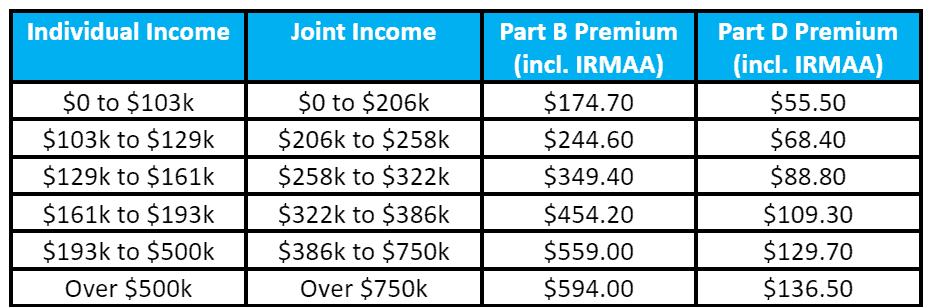
If you were married, lived with your spouse at any time during the year, and filed taxes separately, your IRMAA would jump higher much faster.

As you can see, your Medicare premiums could jump by up to $1000 per month or $12k/year for a couple if your Roth conversion amount is high enough to push you to the highest IRMAA.
Stay connected
See more of Wealthtender when you search Google
Add us as a preferred source, and our guides to personal finance and choosing a financial advisor can appear more often in your Google results, with a “Preferred” label in AI Overviews.
Pitfall #4: The 5-Year Rule Can Delay Access to Converted Money
This one isn’t as severe since converting to a Roth implies you want to let the money sit there for many years to get the biggest “bang for the tax buck” you paid.
However, things change, and as the saying goes, “If you want to make G-d laugh, tell him your plans.”
If you do a Roth conversion before you’re 59.5 years old, you must leave the converted money in the Roth account for at least 5 years to avoid the 10 percent penalty. That’s in addition to the other 5-year rule that applies to the age of the account, so this pitfall can get you even if you did the conversion into a long-standing Roth account.
Pitfall #5: How the Pro-Rata Rule Can Make Your Conversion Taxable
This is an interesting one and the main reason why I can’t use a fun little trick that bypasses the income limits on Roth contributions. That (legal) trick is to contribute after-tax money into a traditional IRA, and then immediately convert it to a Roth IRA.
The problem is that the IRS established the “pro-rata rule.”
This rule says that when you convert from a traditional IRA to a Roth IRA, the determination as to whether the converted dollars have already been taxed isn’t based on the specific IRA account.
Rather, you have to pro-rate the fraction of your overall total after-tax vs. pre-tax dollars across all your IRAs.
For example, say you have a total of $495k in pre-tax dollars in your IRAs. Then, you open a new IRA for your after-tax contribution and put $5k after-tax into it.
If you then convert that new IRA to a Roth IRA, you can’t claim the entire $5k is after-tax. You can only claim 1 percent (the $5k out of the total $500k in all your IRAs) as being after-tax.
You’d owe income tax on the remaining 99 percent!
Pitfall #6: Why Convert If You Plan to Give to Charity or Expect High Medical Bills?
As mentioned above, Roth conversions convert money from tax-deferred to tax-free, including any returns on that money, reducing your future taxes or your heirs’ taxes (at the expense of having to pay taxes when you convert).
However, there are situations where paying taxes now for such a conversion doesn’t make sense. For example:
- You plan to leave your IRA(s) to a charity, which is already exempt from paying taxes.
- You plan to make Qualified Charitable Distributions (QCDs) directly from your IRA to a charity.
- You expect to have unusually high medical bills, so even if you take a distribution from your IRA(s), your taxes wouldn’t be especially high because you’ll have a large deduction (medical expenses above 7.5 percent of your AGI are deductible if you itemize).
In these scenarios, you may be better off not converting to avoid the extra current-year taxes.
Pitfall #7: A Roth Conversion Can Cost You the QBI Deduction
Suppose you have a “passthrough business” that passes all profits to you as personal income. In that case, you may claim a “Qualified Business Income Deduction” (QBID), of 20 percent of your business income (excludes the salary your business pays you) beyond any business expenses you deduct.
If so, you may or may not be aware that for many businesses, the QBID phases out beyond a certain income level. For 2023 (2024) the QBID starts phasing out if your taxable income is over $232,100 ($241,950) if you’re single, and $464,200 ($483,900) if you’re married filing jointly.
Doing a Roth conversion bumps up your taxable income, potentially by hundreds of thousands of dollars, which could cost you the QBID altogether, effectively increasing your taxes by more than just the regular taxes on the converted amount.
Consider the following scenario:
- Your federal marginal tax rate is 37 percent.
- Your state and local marginal tax rate is 8.25 percent.
- Your property taxes are over $10k, so you can’t deduct your state and local tax from your federal taxable income.
- Your QBID (if you don’t hit the income limit) is $30k.
- You convert $200k from a traditional IRA to a Roth.
Your total income taxes on the conversion is $90,500 (37 percent plus 8.25 percent of $200k).
However, your conversion makes your taxable income too high, so you pay income taxes on the $30k that’s no longer deductible as QBID, adding another $13,575 to your total tax bill.
That makes your effective tax rate on the conversion over 52 percent!
Two Bonus Pitfalls: College Financial Aid and ACA Premium Tax Credits
I asked financial pros for their best advice on possible pitfalls from Roth conversions, and they came through with a couple more…
Terry Parham Jr, Founder, Innovative Wealth Building, says:
Viewed in isolation, Roth Conversions almost always sound like a good idea. Seriously, who doesn’t like the idea of building up a nest egg of tax-free dollars that can be spent in the future? Like all things, the devil here is in the details. Clients need to be aware of the potentially negative side effects that can result from these well-intentioned strategies so there are no unexpected consequences. One of the basic things to be aware of is tax implications. In addition to federal and state taxes, clients under age 59.5 face a penalty if they withhold from the conversion to pay the taxes.
Parham then adds a pitfall:
If a client is currently paying for college (or will be soon), a Roth conversion could increase their Expected Family Contribution (EFC) due to additional income as a result of the conversion, hurting their chances of getting financial aid.
Cody Lachner, founder of Next Adventure Financial, shares another possible pitfall:
I’ve had clients who retired early and experienced a large drop in income. Their new lower income allowed them to benefit from tax credits to help cover the cost of health insurance purchased through their state’s health insurance marketplace.
Normally, Roth conversions are a no-brainer in these low-income years, especially before Social Security begins. However, in these specific situations, the additional income generated by Roth conversions would’ve greatly reduced their premium tax credits. The tax credit loss combined with their marginal tax rate produced a higher effective marginal tax rate than their expected future tax rate. Situations like this are why it’s crucial to review your tax plan year by year to consider all outcomes.
The Bottom Line: Run the Full Numbers Before You Convert
Roth conversions can save you and/or your heirs a lot in taxes, but if you’re not careful, there are at least 7 ways (plus a couple of bonus traps) they could cause you significant financial pain instead. And as you can see, people do run afoul of these pitfalls.
Frequently Asked Questions
Does a Roth conversion make Social Security benefits taxable?
It can. The converted amount counts as taxable income, which raises your combined income (AGI plus nontaxable interest plus half your Social Security benefit). Above $25,000 for individuals or $32,000 for married couples filing jointly, half of your benefits can become taxable, and above $34,000 or $44,000, up to 85 percent.
Can a Roth conversion increase my Medicare premiums?
Yes. Medicare Part B and Part D premiums include an Income-Related Monthly Adjustment Amount (IRMAA) that rises with income, and conversion income counts. The article estimates that reaching the highest IRMAA tier could add up to about $1,000 a month, or $12,000 a year, for a couple, and married people who file separately hit higher IRMAA tiers much faster.
What is the 5-year rule for Roth conversions?
If you convert before age 59 and a half, you must leave the converted money in the Roth account for at least five years to avoid the 10 percent penalty. This is separate from the 5-year rule tied to the age of the account, so it applies even if you convert into a long-standing Roth IRA.
How does the pro-rata rule affect a Roth conversion?
The pro-rata rule says the taxable share of a conversion is based on your after-tax versus pre-tax dollars across all your IRAs, not just the account you convert. In the article’s example, someone with $495,000 pre-tax who converts a new $5,000 after-tax IRA can treat only 1 percent as after-tax and owes income tax on the other 99 percent.
When does a Roth conversion not make sense?
Opher Ganel points to cases where paying tax now buys little: leaving your IRA to a charity, making Qualified Charitable Distributions, or expecting large deductible medical bills. One advisor interviewed also skips conversions when the effective tax on the conversion is close to or above the client’s expected future bracket, when heirs are already in low brackets, or when the client lacks the cash flow to pay the tax. Other advisors warn that conversion income can reduce college financial aid and ACA premium tax credits.
Find financial advisors who specialize in helping people like you
Search Wealthtender by specialty, location and fee type, compare advisors’ approaches, and read what their clients say before you reach out.
Disclaimer: This article is intended for informational purposes only, and should not be considered financial advice. You should consult a financial professional before making any major financial decisions.

About the author
Contributing Writer, Wealthtender
My career has taken some unexpected turns, from earning a PhD in experimental high-energy physics, to conducting cosmic-ray research in Antarctica, to supporting NASA projects and programs, to running my own consulting business. I also run several other small businesses and help my wife run her Marriage and Family Therapy practice.
Those experiences taught me to question assumptions, think critically, and recognize that real-world decisions of any significance rarely have simple answers that apply to everyone. Today, I bring that perspective to writing about personal finance. Drawing on my analytical background, business experience, and research, I explore financial decisions, challenge conventional wisdom, and help readers understand the tradeoffs that can affect their financial well-being. To complement my own research and experience, I also weave insights from financial professionals into my articles, drawing on their expertise and real-world experience helping clients navigate financial decisions and challenges.
At medium.com/@opher-ganel, you can read more of my articles and subscribe to receive email notifications when new ones come out.