




Higher-income Illinois residents often overlook these state-specific tax rules. Here’s what financial advisors want you to know.
What this article covers
Opher Ganel and two financial advisors explain why the costliest Illinois tax mistakes usually come from good financial decisions made at the wrong time, not from missed deductions. The article covers how Illinois’ exemption of most retirement income should shape decisions decades before retirement, why income timing still matters in a flat-tax state, and how the state’s $4 million estate tax cliff can hit families who don’t consider themselves wealthy.
Key Takeaways
Illinois exempts most retirement income from its 4.95% flat income tax
Federally taxed distributions from 401(k)s, IRAs, government and military pensions, Roth conversions and the taxable portion of Social Security are not taxed by Illinois. Because withdrawals that are taxable federally can be state-tax-free, the best mix of traditional and Roth accounts, and the order of withdrawals, can differ from what works in other states.
Illinois taxes an entire estate once it exceeds $4 million, with no portability between spouses
Unlike the $15 million federal exemption in 2026, which taxes only the excess and can double to $30 million for a surviving spouse, Illinois’ $4 million figure is a threshold, and rates run up to 16%. Vincent DeCrow of RISE Investments estimates an Illinois couple with an $8 million estate could owe around $680,000 without a Credit Shelter Trust, and potentially nothing with one.
Timing large income events still matters in Illinois, mostly for federal taxes
Shifting income between years won’t change a flat-rate Illinois bill, but it can affect federal brackets, the Net Investment Income Tax and Medicare IRMAA surcharges. Dr. Steven Crane of Financial Legacy Builders warns that by tax-filing season these decisions are locked in, so planning around RSU vesting, business sales, bonuses and Roth conversions has to happen during the year.
 Dr. Steven Crane
If you’re a high-earning Illinois resident, there’s something financial advisors want you to know that could save you thousands of dollars or more.
As Dr. Steven Crane, Founder of Financial Legacy Builders, shares:
What drives me crazy is how many people think tax planning happens in March. By then, the game is basically over. That’s tax preparation. Real tax planning starts months before the year ends, and honestly, it happens all year long.
It’s deciding when to recognize income, when to sell an asset, when to make charitable gifts, how retirement accounts fit into the bigger picture, and making sure your CPA, financial advisor, and attorney are actually talking to each other instead of working in three different silos.
If you’re a higher-income Illinois resident and your only tax meeting is when you’re signing your return, there’s a pretty good chance you’re leaving opportunities on the table, and you don’t even know it.
Crane’s point is that failing to plan throughout the year increases the odds of making an otherwise smart financial decision at the wrong time.
For example:
- Selling a business near the end of a high-income year.
- Exercising a large quantity of stock options all at once.
- Making an overly large Roth conversion in a single year.
Or, worse, failing to make a smart decision at the right time, such as:
- Retiring without understanding how Illinois treats retirement income.
- Waiting too long to begin estate planning because you assume the federal rules are all that matter, and your estate is below the federal tax threshold.
For many higher-income Illinois residents, the biggest tax impact won’t come from finding another legitimate tax deduction or three.
They will be far more likely to come from taking the right steps at the right time, in a way that best aligns with how Illinois tax law differs from the federal tax code. That’s because many costly tax mistakes aren’t necessarily the result of bad financial decisions. They result from good financial decisions made at the wrong time.
Doing this right, through long-term planning, can produce dramatically better after-tax outcomes, even when, at times, your immediate tax bill may be higher. Long-term planning is crucial because that’s how you avoid mistakes that are difficult or impossible to undo.
As Crane explained, tax preparation and tax planning are completely different. The former reflects the results of good or bad decisions you’ve already made. The latter lets you make better decisions while you still have options.
Does Illinois Tax Retirement Income? Most Sources Are Exempt
This is important in Illinois. That’s because:
- Illinois lands in the top 10 highest average per-capita state and local tax collections in the nation, per a Tax Foundation 2025 report, 15% higher than the national average.
- It also has the highest effective property tax rate in the nation.
- Finally, it has an “estate tax cliff” that taxes estates that exceed its $4 million threshold by even a single dollar in full; an estate-tax threshold that can surprise affluent families because Illinois’ rules differ significantly from federal ones.
On the positive side, Illinois is very generous about exempting many retirement benefits and withdrawals from state taxes:
“Illinois does not tax the amount of any federally taxed portion (not the gross amount) included in your Form IL-1040, Line 1, that you received from:
- “qualified employee benefit plans, including 401(K) plans;
- “an Individual Retirement Account (IRA) or a self-employed retirement plan;
- “a traditional IRA that has been converted to a Roth IRA;
- “the redemption of U.S. retirement bonds;
- “state and local government deferred compensation plans;
- “a government retirement or government disability plan, including military plans;
- “railroad retirement income;
- “retirement payments to retired partners;
- “a lump sum distribution of appreciated employer securities; and
- “the federally taxed portion of Social Security benefits.”
Taking these facts into account in your long-term planning can let you keep far more of your money invested and compounding for longer, so it can support a much better long-term after-tax lifestyle.
Why Federal Tax Planning Isn’t Enough for Illinois Residents
Illinois taxpayers may mistakenly believe that if they optimize for federal taxes, that probably means their state taxes are also optimized.
That may be true for some, but often it isn’t accurate.
Illinois happens to have several unique tax rules that affect retirement planning, estate planning, charitable giving, business ownership, and major one-time income events differently than the federal code.
Two examples we’ve already seen are the generous exemptions of many retirement income sources and, on the other hand, the much more onerous taxation of estates.
This means that a high-earning Illinois resident will likely need to use a somewhat different tax strategy than a resident of another state, even if they have similar finances.
New Jersey high earners face a similar gap between federal and state rules.
Some strategies may need to be addressed:
- Recognizing unusually large amounts of income in a single year.
- Selling appreciated investments or a business.
- Exercising stock options or receiving large amounts of Restricted Stock Units (RSUs).
- Making large Roth conversions.
- Coordinating charitable giving.
- Deciding how retirement income will eventually be withdrawn.
- Planning an estate well before Illinois’ estate-tax rules become relevant.
The common thread here is that these are financial decisions first and tax decisions second. So, it’s common to make these decisions in isolation, without considering tax implications until you file. That, unfortunately, limits your options by tax-filing time.
Table 1 details several common assumptions that may well lead to expensive Illinois tax mistakes.

These common misconceptions point to a broader lesson: the biggest tax savings often come from asking better questions, not simply finding better deductions. One way to do that is to think about taxes and financial decisions in four progressively broader ways.
Tax Preparation vs. Tax Planning: Four Levels of Thinking About Your Taxes
There are four levels you can consider for your taxes and finances in ascending order of impact.
- How can I minimize my tax bill at filing? This is tax preparation.
- What can I do during the year to minimize my taxes come filing time? This is short-term tax planning.
- How can I structure my finances to reduce my lifetime taxes? This is long-term tax strategy.
- What can I do over the years and decades to maximize my after-tax lifestyle? This is the path to your best lifetime financial outcome.
Each level leads to different decisions and different short- and long-term outcomes.
For example, recognizing income over multiple years rather than one, or coordinating charitable gifts with unusually high-income years, may not dramatically affect your state taxes in a flat-tax state like Illinois.
However, they may have a dramatic impact on your overall lifetime taxes and wealth.
Table 2 details the four levels of tax and financial thinking and what is the primary question each has you ask yourself when making decisions.

How Illinois’ Retirement Income Exemption Should Shape Planning Decades Before You Retire
If you ask most Illinois residents what they like most about their state’s tax law, they might say “Nothing.” Or, if they feel more generous, they might say, “A flat tax with a sub-5% rate.”
More than likely, most wouldn’t correctly identify what will turn out to be their greatest state-tax win.
It’s how many types of retirement income aren’t taxable under Illinois tax law.
That’s understandable, since many people don’t start serious retirement planning until they’re just a few years before retiring.
Having state-tax-free retirement income is certainly a big win, but it becomes an even bigger win if you incorporate that into your tax strategy in the years and decades before retirement.
Questions like the following have long-term tax implications:
- Should you prioritize traditional retirement accounts, Roth accounts, or a combination?
- Does a Roth conversion make sense during lower-income years?
- Which accounts should you draw from first during retirement, taxable, tax-deferred, and tax-free, or a combination?
Illinois’ favorable treatment of retirement income changes the tradeoffs.
Because retirement withdrawals may avoid Illinois income tax even though they’re still subject to federal income tax, strategies that make sense in another state may not be the best choice for someone planning to retire in Illinois.
For example, using deferred-tax accounts like traditional IRAs reduces your current income tax, federal and state. When you start drawing money from these accounts in retirement, those withdrawals are taxed as regular income for federal taxes, no matter where you live.
However, whereas in most states, the withdrawals would also be taxed by the state, they may be free of state tax in Illinois, which would likely lead to a different optimal strategy. That’s why tax strategy and planning aren’t necessarily about reducing your current-year taxes, but rather about positioning yourself today for the best long-term outcome, benefiting from rules that may not affect you for years or even decades.
Illinois’ retirement-income tax rules are an example of how long-term planning often rewards people who think ahead beyond the next tax filing deadline.
Stay connected
See more of Wealthtender when you search Google
Add us as a preferred source, and our guides to personal finance and choosing a financial advisor can appear more often in your Google results, with a “Preferred” label in AI Overviews.
Why Income Timing Still Matters in Flat-Tax Illinois
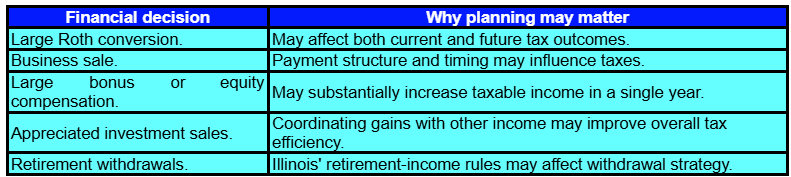
Higher-income households often experience years with higher-than-usual taxable income. This could result from many factors, including the following:
- RSUs vest.
- Stock options are exercised.
- A closely held business is sold.
- A particularly large bonus arrives.
- Appreciated investments are sold.
- A significant Roth conversion is completed.
These are all positive financial events, but they result in a higher tax bill.
Since Illinois has a flat state income-tax rate, your multi-year state tax bill won’t change by shifting some of your income to a different year.
However, state taxes are just one piece of the puzzle.
Income realization timing can significantly affect your federal tax bracket, Net Investment Income Tax (NIIT), and Medicare Income-Related Monthly Adjustment Amount (IRMAA) surcharges, if applicable.
The following strategies can help reduce your overall long-term tax burden, depending on your circumstances.
- Bunching charitable donations into higher-income years to maximize their tax benefit.
- Timing Roth conversions to take place during lower-income years.
- Planning the timing and structure of a business sale to realize taxable income when it doesn’t stack on top of high income from other sources.
To best implement such strategies, you need to carry out ongoing tax strategy and cash flow planning. By the time tax-filing season rolls around, you’re already locked in and can’t change your realized taxable income.
This doesn’t mean you should always defer taxable income as much as possible. Sometimes, recognizing income in the current tax year is the better decision. The point is that this timing often deserves careful consideration rather than becoming an afterthought.
Table 3 summarizes some of the major decisions that can benefit from ongoing planning.
The Illinois Estate Tax Cliff: Why a $4 Million Estate Can Be Taxed in Full
State income tax isn’t the main “tax trap” to watch for in Illinois.
That “honor” goes to the state’s estate tax.
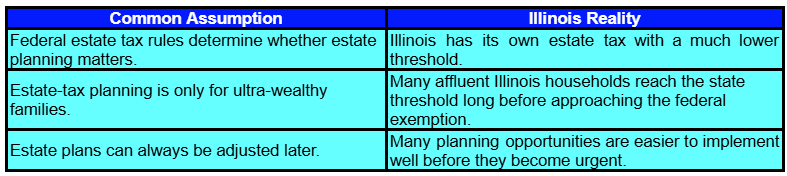
The federal estate tax has an exemption of $15 million per person in 2026, and portability doubles that to $30 million for a widow(er). Further, only the portion of an estate that exceeds the exemption is taxed.
Illinois estate taxation is far less generous on all three counts.
- Rather than $15 million, the state’s estate tax threshold is $4 million.
- There is no portability, so a widow(er) is still held to the $4 million threshold, rather than $30 million.
- Rather than an exemption, like the federal $15 million or $30 million, the state’s $4 million number is a threshold. This means that an estate exceeding $4 million by even a single dollar is taxed in full by Illinois.
Vincent DeCrow, CFP®, Founder and Wealth Advisor, RISE Investments, identifies this as an especially common misconception, saying:
Illinois residents’ estates up to $4M are exempt from Illinois estate taxes. However, unlike Federal estate taxes, the $4M is not portable between spouses, and the full amount of an estate valued over $4M is subject to estate taxes rather than just the amount over $4M. State-level estate taxes are probably the most overlooked planning opportunity for Illinois residents.
According to the Wall Street Journal, there are currently about 430,000 US households “worth” over $30 million. That’s about 0.32% of the 133,675,000 US households.
Households with a net worth of $4 million are 15 times more numerous, comprising 5% nationwide. While the exact fractions for Illinois are smaller, the $4 million Illinois estate-tax threshold potentially affects a similarly larger share of households.
This means that far more Illinois high-earning families will likely be hit by their state’s estate taxes, with graduated rates up to 16%, making estate planning an important part of financial planning.
How a Credit Shelter Trust Can Protect Both Spouses’ $4 Million Thresholds
DeCrow says this is one of the most significant Illinois-specific mistakes he encounters. He says:
The biggest tax mistake I see high-earning and wealthy Illinois residents make is not planning for the state’s punitive estate tax. Without proper planning, this can cost wealthy families hundreds of thousands in state-level estate taxes.
He then suggests a planning approach that can address this problem:
One solution in particular is to utilize a Credit Shelter Trust structure, which leverages both spouses’ $4M exemptions and doesn’t leave the surviving spouse with a large tax bill upon the passing of the first spouse.
Without a Credit Shelter Trust, an Illinois couple with an $8M estate could be subject to around $680k in estate taxes. Alternatively, having a Credit Shelter Trust could result in zero Illinois estate taxes.
That doesn’t mean every affluent Illinois family should necessarily establish a Credit Shelter Trust. Estate planning depends on many factors, including family dynamics, charitable intentions, liquidity needs, and evolving tax laws.
However, if that may be a viable strategy for you, it’s best to start considering it early, when you still have multiple options.
Table 4 suggests several estate planning assumptions worth reconsidering.
Other Illinois Tax Issues: Property Taxes, Muni Bonds, Business Income and Charitable Credits
While retirement planning is relevant everywhere, and estate planning is especially relevant in Illinois, depending on your specific circumstances, several other topics warrant discussion with your financial advisor.
- Property taxes. According to SmartAsset, “The state of Illinois has the highest effective property tax rate in the nation and some of the highest median property taxes of any state. The typical homeowner in the Land of Lincoln pays nearly $5,400 per year in real estate taxes, sixth most in the U.S.” That makes property taxes one of the largest recurring expenses Illinoisan homeowners face, before and during retirement. While property taxes are an unavoidable aspect of homeownership, periodically reviewing assessment notices, understanding the appeal process, and factoring those costs into long-term retirement cash-flow planning may help reduce surprises and, in some cases, lower the ongoing tax burden.
- Municipal bonds. According to the Illinois Department of Revenue, “Income from state and local obligations (municipal interest), which is tax-exempt for federal purposes, is not exempt from Illinois Income Tax except where legislation has been specifically adopted to provide for an exemption.” Thus, Illinois residents shouldn’t assume every municipal bond receives identical state tax treatment, and should verify before investing whether a specific bond is state-tax-free or not.
- Business income. In Illinois, different business entity types are taxed differently. Sole proprietorships and disregarded sole-member LLCs flow their profit to the owner’s personal tax return, where profits are subject to the state’s flat 4.95% rate. Passthrough entities such as S corporations and LLCs taxed as S corporations are subject to the same 4.95% tax, plus Personal property replacement tax (PPRT) of 1.5%. C corporations are taxed at 7% plus 2.5% PPRT. These different tax rates affect your optimal choice of entity type.
- Charitable giving. Beyond tax deduction for charitable giving in general, Illinois has set up the so-called Illinois Gives Act that offers a 25% tax credit for gifts made to qualified community charities. Because the credit applies only to donations made to approved organizations and is subject to program rules, it’s worth confirming eligibility before assuming a gift will qualify. Timing such gifts during especially high-income years won’t reduce your long-term state income taxes, but will make your cash flow less volatile.
All of these point to the importance of ongoing planning and making optimal strategic decisions as early as possible, and with your overall financial picture in mind. Most of these aren’t just tax decisions. They’re financial and business decisions with tax implications.
When Should Illinois Residents Get Professional Tax Planning Help?
If your financial life is relatively straightforward, good tax software or an experienced tax preparer may be all you need.
With a more complex financial picture, however, the number of planning decisions tends to grow, increasing the potential value of a good professional advisor.
For example, if you:
- Own a closely held business.
- Receive stock options, RSUs, or other forms of equity compensation.
- Expect a particularly high-income year because of a business sale, major bonus, or significant investment gains.
- Are approaching retirement and deciding how to structure future withdrawals.
- Have an estate that may eventually approach Illinois’ estate-tax threshold.
- Want to coordinate charitable giving with retirement, investment, or estate-planning goals.
These tend to involve decisions whose consequences may last for years, or even decades.
Also, taxes rarely exist in isolation. A CPA will understand the tax implications of a transaction. However, a good financial advisor would evaluate how that same decision affects retirement, investments, cash flow, and long-term financial independence.
An estate-planning attorney may identify opportunities to transfer wealth more efficiently while ensuring your wishes are carried out.
When those professionals communicate with one another instead of working independently, they’re more likely to identify opportunities before they disappear.
Also, planning opportunities evolve.
For example, recent federal changes increased the State and Local Tax (SALT) deduction cap from $10k to $40k for tax years 2025-2029, affecting the usefulness of certain planning strategies and specific state tax treatment of passthrough entities that had previously benefited many taxpayers.
Such changes don’t make planning useless. They just require revisiting planning whenever personal circumstances and/or relevant laws change.
This leads to a crucial realization for higher-income Illinois residents.
Don’t Let the Tax Tail Wag the Financial Dog: Why Paying Less Tax Isn’t the Goal
The biggest opportunities don’t involve some obscure state tax deductions or hidden tax loopholes.
Instead, the important thing is to make the best financial decisions you can ongoingly, before mistakes become expensive or impossible to undo.
Your decisions need to be informed by, but not driven by, tax implications.
While this isn’t “sexy” or exciting, it can be extremely valuable.
Crane believes many higher-income taxpayers lose sight of that distinction.
He explains:
One thing I wish more people understood is that you don’t build wealth by becoming obsessed with paying less tax. I know that’s not what people expect a financial advisor to say, especially in a state like Illinois, but I’ve watched way too many people make terrible financial decisions just because they hated the idea of paying taxes.
Nobody enjoys paying high taxes, but the cost, financial or otherwise, of reducing your taxes should never be greater than the tax reduction you expect.
For example:
- A concentrated stock position appreciates dramatically, so selling it would create a significant tax bill. However, staying overly concentrated risks a large loss should the stock decline.
- A business owner has an opportunity to sell a successful company, but delays because of taxes. However, losing that opportunity may result in significantly lower eventual exit proceeds. In addition, it could delay retirement to the point that you’re less healthy and less able to enjoy your wealth.
As Crane explains:
Some people hold onto bad investments, turn down better career opportunities, avoid selling a business at the right time, all because they’re trying to save a few dollars in taxes. That’s backwards. Taxes are something you manage, not something you build your financial life around.
If you optimize purely for lower taxes, you could be setting yourself up for a less enjoyable and less affluent life. Thus, your goal shouldn’t be just about lowering taxes. It should be to maximize your after-tax wealth and improve your long-term financial security.
Sometimes, the two align. Other times, they pull in opposite directions.
When the latter occurs, you should ask yourself if you’re optimizing for the right goal.
The Bottom Line: Plan for Lifetime After-Tax Wealth, Not This Year’s Tax Bill
Illinois is a high-tax state.
It’s especially aggressive when it comes to estate and property taxes.
However, on the flip side, Illinois is very favorable when it comes to taxing many retirement income sources, creating opportunities that residents of many other states don’t enjoy.
These realities deserve careful planning.
However, the bigger lesson applies to both Illinois and other high-tax states.
Your best bet isn’t always to reduce your current-year income tax, at either the federal or state level. Instead, it’s to avoid expensive mistakes, make important decisions before deadlines eliminate your options, and periodically revisit your plan as your financial life and tax laws evolve.
Instead of asking, “How do I pay the least tax this year?” you should ask, “What should I do to leave me with the greatest amount of wealth after taxes over the course of my life?”
If you’re a high-earning Illinoisan, that’s the question most likely to improve both your finances and your peace of mind.
Frequently Asked Questions
Does Illinois tax retirement income?
Illinois does not tax the federally taxed portion of most retirement income, including distributions from 401(k) plans, IRAs, government and military pensions, railroad retirement, converted Roth IRAs and the taxable portion of Social Security benefits. Those withdrawals are still subject to federal income tax.
How does the Illinois estate tax work?
Illinois uses a $4 million threshold rather than an exemption, so an estate that exceeds $4 million by even a dollar is taxed in full, at graduated rates up to 16%. There is no portability, so a surviving spouse is still held to the $4 million threshold rather than inheriting the deceased spouse’s unused amount.
How can married couples reduce Illinois estate tax?
One advisor interviewed recommends a Credit Shelter Trust, which lets a couple use both spouses’ $4 million thresholds rather than leaving the survivor with a large tax bill. He estimates that without one, an $8 million estate could owe around $680,000 in Illinois estate tax, compared with potentially zero with one. Whether it fits depends on family dynamics, charitable goals, liquidity needs and changing tax laws.
What is the difference between tax preparation and tax planning?
Tax preparation reflects the results of decisions you have already made, while tax planning lets you make better decisions while you still have options. One advisor interviewed notes that real tax planning starts months before year end and continues all year, covering when to recognize income, sell assets, make charitable gifts and coordinate retirement accounts.
Are municipal bonds tax-free in Illinois?
Not automatically. According to the Illinois Department of Revenue, municipal interest that is exempt from federal tax is not exempt from Illinois income tax unless legislation specifically provides an exemption, so residents should verify a bond’s state tax treatment before investing.
Find financial advisors who specialize in helping people like you
Search Wealthtender by specialty, location and fee type, compare advisors’ approaches, and read what their clients say before you reach out.
Disclaimer: This article is intended for informational purposes only, and should not be considered financial advice. You should consult a financial professional before making any major financial decisions.

About the author
Contributing Writer, Wealthtender
My career has taken some unexpected turns, from earning a PhD in experimental high-energy physics, to conducting cosmic-ray research in Antarctica, to supporting NASA projects and programs, to running my own consulting business. I also run several other small businesses and help my wife run her Marriage and Family Therapy practice.
Those experiences taught me to question assumptions, think critically, and recognize that real-world decisions of any significance rarely have simple answers that apply to everyone. Today, I bring that perspective to writing about personal finance. Drawing on my analytical background, business experience, and research, I explore financial decisions, challenge conventional wisdom, and help readers understand the tradeoffs that can affect their financial well-being. To complement my own research and experience, I also weave insights from financial professionals into my articles, drawing on their expertise and real-world experience helping clients navigate financial decisions and challenges.
At medium.com/@opher-ganel, you can read more of my articles and subscribe to receive email notifications when new ones come out.