




Financial advisors explain why the best tax strategy isn’t always the one that produces the smallest tax bill and share a better framework for making financial decisions.
What this article covers
Opher Ganel asked six financial advisors how high earners in New Jersey and other high-tax states can optimize their taxes, and their answers pointed to a bigger goal than this year’s tax bill. They explain why planning for lifetime taxes, and ultimately for the best after-tax lifestyle your wealth can support, can mean paying more tax now through Roth conversions or gradual diversification. They also walk through New Jersey rules that differ from federal ones, from retirement contributions and basis tracking to HSAs and Treasury interest.
Key Takeaways
The best tax strategy maximizes your lifetime after-tax lifestyle, not this year’s refund
Advisors interviewed say high earners often chase current-year deductions and lock themselves into a tax spike five to ten years later. Joon Um describes a client who saved six figures in future taxes by spreading Roth conversions over several years instead of waiting for RMDs, and Steven Crane warns that the goal isn’t to die with the lowest tax bill.
Paying more tax now can be the stronger financial decision
Sean Lovison describes spreading the sale of a concentrated executive stock position over several years to use lower brackets, while hedging with options collars, which he says saved hundreds of thousands in taxes. Roth conversions and gradually realizing capital gains raise this year’s bill but can reduce RMDs, Medicare surcharges and portfolio risk.
New Jersey often doesn’t follow federal tax rules, and that changes the math
Justin Rice notes that many retirement contributions deductible federally are taxed by New Jersey, so retirees who don’t track their New Jersey basis can pay tax twice, especially once income tops the $150,000 limit for the retirement income exclusion. Vincent Grosso adds that New Jersey offers no deduction for HSA contributions, while Lovison points out that Treasury interest is exempt from New Jersey income tax.
 Vincent Grosso
 Dr. Steven Crane
If you’re a high earner living in a high-income-tax state like New Jersey, I’m sure you’d agree that (legally) reducing your tax bill is a good thing.
According to the Tax Foundation’s report, 2025 State and Local Tax Collections Per Capita by State, New Jersey collects an average of $9,366 per resident in state and local taxes. That’s 32% above the national average of $7,109, making it the 5th-highest-tax state for average state and local tax collections (6th if we count Washington DC).
Living in Maryland, another high-income-tax state, I feel the same way.
So I asked several financial advisors for their best ideas for optimizing taxes in New Jersey, expecting that many of their answers would apply more broadly.
I expected many of the “usual suspects” ideas:
- Deductions
- Roth conversions
- Charitable giving
- Retirement accounts
- Health Savings Accounts (HSAs)
And the financial advisors I asked indeed mentioned those.
However, the responses I received gradually showed a different decision framework that helps you accomplish a far more important goal than minimizing this year’s taxes.
Tax Preparation vs. Tax Planning: Why Lifetime Taxes Matter More
The advisors hammered home the importance of evaluating tax decisions not just by their short-term impact on how much taxes we’ll need to pay this tax year, but rather on the multi-decade results we can achieve through good planning.
As Sean Lovison, CFP®, CPA, of Purpose Built, says:
The most common trap for high-income households is chasing immediate, current-year tax credits or deductions without looking at a long-term timeline. Many traditional CPAs do a great job with reporting history (inputting the statements you give them), but high earners often make decisions that save them a dollar today only to lock themselves into a massive, unmanaged tax spike five to ten years down the road.
True wealth optimization requires mapping out exactly what your expected tax rate will be during each distinct phase of your life: peak earning years, early retirement (including getting your own insurance), and your eventual Required Minimum Distribution (RMD) years.
Intentionally paying some tax today at a known bracket to execute strategic Roth conversions often creates far more lifetime after-tax wealth than blindly deferring every possible dollar to minimize this year’s bill.
Joon Um, CFP® EA CLU® ChFC®, of Secure Tax & Accounting, agrees:
The biggest tax-related mistake people make is focusing on this year’s taxes instead of lifetime taxes. A good longer-term strategy includes Roth conversions and tax diversification. Not planning for NJ taxes in retirement early enough can lead to higher lifetime taxes. For example, a client saved six figures in future taxes by spreading Roth conversions over several years instead of waiting for RMDs. The first thing I review when a new client comes in is their tax return, as that usually shows the biggest planning opportunities. Tax planning should happen during the year, not at filing time. Instead of asking, ‘How do I save taxes this year?’ ask, ‘How do I pay less tax over my lifetime?’
As they both say, tax planning isn’t something short-term that you do at tax-filing time. It’s an ongoing process that becomes part of retirement planning, investment planning, and even cash management.
It may sound obvious, but it changes how you evaluate many common financial decisions.
One result of this mindset shift is that, e.g., a Roth conversion shouldn’t be seen purely as something that forces you to pay taxes before you must, because it could result in a larger win through reducing eventual RMDs.
Similarly, intentionally realizing capital gains over time results in higher taxes now, but that may be a worthwhile trade considering asset diversification, future tax brackets, and withdrawal flexibility.
These examples illustrate that tax planning isn’t about preparing a tax return that minimizes current taxes, but rather about designing a better lifetime financial outcome.
Tax preparation generally looks backward at income already earned, transactions already completed, and deductions and credits that can legitimately be taken.
Tax planning looks forward, evaluating how today’s decisions may affect taxes, retirement income, charitable giving, investment flexibility, and estate planning years from now.
Matt Chancey, CFP®, of Tax Alpha Companies, explains:
The biggest tax planning mistake high-income households make, even when they have a CPA, is to assume their team is complete because they have a CPA. A CPA’s job is to report what happened accurately and on time. That’s compliance, and the best CPAs do it well. Some are now leaning into advisory work too, and that’s a real shift in the profession I have enormous respect for. Even the most sophisticated CPA isn’t placing clients into the investments that change what the return looks like, because CPAs aren’t registered to do that work. That’s not a knock on the profession. It’s how the regulatory structure is built.
I work with sophisticated CPAs across the country who recognize this and bring in someone like me to deliver the investment piece alongside their compliance and advisory work. That’s a collaboration model, not a competition one, and the best teams around high-income households are built that way. When one of those seats is empty, the default plan wins, and the default plan is to pay the tax.
Lovison puts it like this:
When evaluating a new high-income client, the first place I look is always their prior-year tax return. However, that document must go hand-in-hand with a comprehensive, long-term financial plan. A common misconception is that a tax return contains all the answers. In reality, a tax return is just the rearview mirror. Without a long-term plan explicitly detailing where the client is actually going, it is impossible to build an effective tax strategy.
Vincent Grosso, CFP®, Founder of Grosso Wealth Management, agrees and adds:
If someone’s financial situation becomes more complex with retirement accounts, investment portfolios, a business interest, trusts, or planning for retirement, basic tax preparation likely isn’t enough. A CPA doing tax prep is typically looking backward at what has already happened. A financial advisor working alongside a CPA looks forward to potential planning opportunities such as managing capital gains, planning Roth conversions, building a retirement income plan, charitable giving strategies, and coordinating decisions across the full financial picture. In my experience, when a financial advisor and CPA aren’t communicating, strategic opportunities get missed, and money is left on the table.
Another example is retirement savings.
As I did throughout most of my working career, if you’re only focusing on this year’s tax burden, you’ll maximize every available pre-tax contribution you’re able.
But if you consider lifetime taxes, you might instead choose to pay somewhat higher taxes today through Roth contributions or conversions, if it would create greater flexibility decades from now.
Neither is intrinsically wrong.
It’s just that each optimizes for something different.
None of the advisors I asked thought that claiming legitimate deductions or credits was a bad idea. But they all agreed that planning taxes across decades is better than optimizing for a single filing season.
Then, Dr. Steven Crane, Founder of Financial Legacy Builders, took things in a totally different direction. He said:
The most controversial thing I can say about high-income tax planning is that many affluent households have a tax problem because they have an ego problem. They become obsessed with paying less tax instead of becoming wealthier.
I’ve watched people spend years chasing deductions, tax shelters, and complicated strategies that saved them a few thousand dollars while completely ignoring the investment, business, and career decisions that could have increased their net worth by hundreds of thousands or even millions. One of the biggest mistakes I see, particularly in high-tax states like New Jersey, is treating taxes as the enemy instead of treating them as a byproduct of success.
I am not suggesting people should overpay taxes. Far from it. But the most successful families I work with focus first on building wealth and second on managing taxes. The families who struggle often do the opposite. They become so focused on avoiding taxes that they make poor financial decisions, hold investments too long, avoid profitable opportunities, or overcomplicate their lives chasing strategies that look impressive at a cocktail party but add very little value in the real world.
The goal isn’t to die with the lowest tax bill. The goal is to build the strongest financial life possible after taxes.
Said simply, he cautions that you should avoid letting your “tax tail” wag your “wealth dog.”
This matches perfectly with what I’ve been working on with my own financial planner, though I hadn’t seen it articulated so beautifully before.
- Our goal shouldn’t necessarily be to minimize our current-year taxes.
- It shouldn’t even be to minimize our lifetime taxes (after all, you can reduce your lifetime taxes to zero by earning very little).
- Our real goal should be to maximize the after-tax lifestyle that our wealth can support over a lifetime.
These objectives sometimes align in terms of what actions you should take.
But not always.
And when they don’t, we have to make some important financial decisions.
Table 1 compares these approaches and the objectives each pursues.
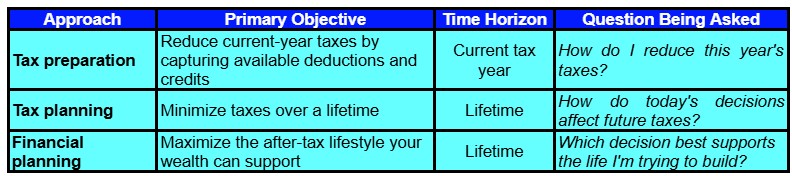
Most tax-related articles concentrate on the first approach.
More sophisticated articles and planning focus on the second row, incorporating the first one as appropriate.
Good planners focus on that last row, using the first two only as they support the main objective.
Current taxes matter.
Lifetime taxes matter more.
But the thing that matters most is how those two can support your real objective, how to achieve the best lifestyle that your wealth can support.
Stay connected
See more of Wealthtender when you search Google
Add us as a preferred source, and our guides to personal finance and choosing a financial advisor can appear more often in your Google results, with a “Preferred” label in AI Overviews.
When Paying More Tax Now Leads to a Better Long-Term Outcome
As all advisors would agree, and as you likely intuitively already know, if you can legitimately claim a tax deduction, or even better, a tax credit, without a long-term negative impact that outweighs it, there’s no reason not to claim it.
You should claim every legitimate deduction and credit available to you that fits that criterion.
The problem arises when a strategy you’re considering improves one objective but would make it harder to achieve the goals of a different strategy.
Like the examples above, of Roth conversions and intentionally capturing a capital gain gradually over time instead of pushing it into the far future.
Both increase your short-term tax bill, which, when viewed solely through the tax preparation lens, seems like a loss. However, tax planning could show that avoiding them may make your long-term results worse.
Paying taxes now could reduce your RMDs and allow you to take full advantage of lower tax brackets over many years and decades, reducing your lifetime taxes and making a better after-tax lifestyle possible.
This shifts your objective from minimizing taxes to maximizing what your wealth can actually do for you and your heirs, through greater flexibility in managing retirement income, adapting to changing tax laws, controlling Medicare surcharges, and leaving assets to heirs more efficiently.
Another tradeoff comes in the form of diversification.
Lovison describes working with executives holding large concentrated positions in company stock.
We often have clients who are executives with massive, concentrated company stock positions. Liquidating it all in a single year would place them straight into the highest federal and NJ state tax brackets.
As he says, selling everything immediately would generate a very high tax bill on both the federal and New Jersey levels. On the other extreme, not selling anything now would postpone those taxes, but leave much of the family’s financial future dependent on a single company. This is especially concerning since the same company also provides the taxpayer’s ongoing income.
The risk that comes with such a gradual diversification is that the company’s stock could drop in value by the time the client fully divests.
To mitigate that risk, Lovison has clients use options collars, where one buys an “out-of-the-money” put option while also writing an “out-of-the-money” call option as a hedging strategy that protects against large losses, at the cost of limiting upside gains.
He continues:
Instead, we built a strategy to spread the divestiture over several calendar years to maximize lower brackets, while simultaneously using options collars to hedge and protect the underlying position from a market drop during the waiting period. It saved them hundreds of thousands in unnecessary taxes while eliminating downside risk.
This strategy balanced higher short-term taxes against portfolio risk, long-term wealth creation, and financial resilience.
Sometimes the financially stronger decision carries a higher tax bill.
Taxes are important, but so are investment returns and the resulting flexibility, retirement income, and risk management. Optimizing just one factor while ignoring the others can end up biting you.
And sometimes, you can use state tax laws to improve tax efficiency without impacting anything else.
Lovison shares a perfect example:
New Jersey high earners face some of the steepest state income tax brackets in the nation, topping out at 10.75%. Yet, an astonishing number of affluent households leave large emergency funds and cash balances sitting in standard high-yield savings accounts where the interest is heavily taxed by the state. Simply shifting those cash management reserves into short-term government bond Exchange Traded Funds (ETFs) yields a highly competitive return (often higher), but with a massive secondary benefit: the interest is entirely exempt from New Jersey state income tax.
As Table 2 illustrates, the best financial answer depends on the question you’re asking and what you’re trying to optimize.

Since so many financial decisions don’t impact just a single consideration, it’s crucial to implement careful tax planning into your personal overall financial plan. That leads to far better outcomes than following some generic tax advice.
If you’re a high earner in New Jersey, coordination becomes especially important.
As Justin Rice, CFP®, CSLP®, of IN Financial Strategic Wealth, explains:
One of the most overlooked New Jersey tax planning issues involves retirement account contributions and the tracking of New Jersey tax basis. Many New Jersey residents assume that if a retirement contribution is deductible for federal income tax purposes, it’s also deductible for New Jersey purposes. In many cases, that is not true.
For example, contributions to Traditional IRAs, SEP IRAs, SIMPLE IRAs, 403(b)s, TSPs, and many other retirement plans often don’t receive the same tax treatment from New Jersey that they receive federally. As a result, many New Jersey taxpayers have already paid state income tax on dollars that will eventually be distributed from those accounts.
This creates two important planning opportunities. First, for self-employed individuals and small business owners deciding which retirement plan to establish, the New Jersey tax consequences should be part of the analysis. In many situations, a Solo 401(k) can be more tax-efficient than a SEP IRA because of New Jersey’s unique treatment of retirement plan contributions.
Second, and even more importantly, taxpayers should carefully track their New Jersey basis. Because New Jersey has already taxed many retirement contributions, a portion of future retirement distributions may be received free of New Jersey income tax.
Unfortunately, many retirees, and even some tax preparers, fail to maintain adequate records, causing retirees to potentially pay tax twice on the same dollars. The irony is that this often goes unnoticed because New Jersey provides a generous retirement income exclusion for retirees aged 62 and older. For married couples filing jointly, if total New Jersey income is $100,000 or less, up to $100,000 of pension, annuity, and IRA income may be excluded from New Jersey taxation.
If income falls between $100,001 and $125,000, 50% of qualifying retirement income may be excluded. If income falls between $125,001 and $150,000, 25% may be excluded. Once income exceeds $150,000, the exclusion disappears entirely.
As a result, retirees with lower and moderate incomes may never notice that basis tracking was overlooked because much or all of their retirement income is already sheltered by the exclusion. However, affluent retirees with income above the $150,000 threshold often discover that every dollar of retirement distributions is being taxed by New Jersey. In those cases, accurately tracking and documenting New Jersey basis can produce meaningful tax savings over the course of retirement.
The broader lesson is that New Jersey frequently does not follow federal tax rules. High-income households that understand those differences and maintain proper records can potentially save thousands of dollars in unnecessary state taxes throughout retirement.
This isn’t purely a tax problem. It’s a planning and record-keeping one.
Grosso shares another example:
HSAs are a powerful tool due to their triple tax advantage. Contributions are deductible, growth is tax-free, and withdrawals for qualified medical expenses are tax-free. One of the most common mistakes I see is high-income New Jersey households using an HSA without realizing that New Jersey does not conform fully to federal HSA tax rules. Unlike at the federal level, New Jersey offers no state deduction for HSA contributions and treats employer contributions as taxable wages. Missing this federal-state difference can lead to an unpleasant surprise at tax time.
Lovison’s above-mentioned Treasury cash example also reaches the same conclusion. Federal taxes are only part of the story. New Jersey’s state tax treatment often changes your after-tax outcome.
Taking all of this together, your best bet is to use the following simple yet powerful hierarchy of considerations.
- Start with legitimate deductions and credits. If they don’t have long-term negative implications, claim them.
- Next, evaluate the impact of decisions over decades instead of one filing season.
- When those objectives conflict with diversification, flexibility, retirement income, or long-term wealth creation, step back and ask a broader question: Which option best supports my long-term after-tax lifestyle?
Once you recognize that your real objective is maximizing the long-term after-tax lifestyle your wealth can support, tax planning becomes much simpler. Every deduction, Roth conversion, investment decision, or retirement strategy becomes a tool for achieving that goal rather than an objective in itself.
Why Flexibility and Tax Diversification Can Beat Another Deduction
Most of us tend to focus on the things we can most easily see.
In the financial arena, that could be:
- Deductions and credits that reduce this year’s tax bill.
- Roth conversions that reduce future RMDs and Medicare surcharges.
- A move to a lower-tax (or no-tax) state that reduces (or eliminates) state taxes.
However, that’s a little like the comical allegory of the drunk looking for his car keys under the streetlamp rather than where he lost them, because the light is better.
Chancey gives a perfect example:
New Jersey’s top marginal rate is close to 11%, property taxes punish home ownership, and the exit tax makes leaving expensive. The state is a real drag, but the federal piece is two to three times larger, and federal doesn’t change when you cross the bridge. New Jersey households split into two camps. The first moves to Florida, convinced they’re escaping the problem, arrives with a portfolio generating fully taxable income, and the federal bill barely moves. The second stays, because the move felt overwhelming, and does nothing about federal either. Both groups looked at geography because geography is easier to think about than the kind of income they’re receiving.
We always need to remember that just because something is easier to see doesn’t necessarily mean it’s the right thing to concentrate on.
For example, increasing flexibility can be more valuable than claiming another current-year tax deduction. One way to increase flexibility is to diversify your accounts’ tax treatment.
Many of us instinctively see taxable brokerage accounts as less attractive than tax-deferred retirement accounts. Over the years, I did exactly that, leading to us having the great majority of our assets in tax-deferred accounts.
However, having a significant portion of your money in taxable accounts, in addition to tax-deferred and Roth accounts, gives you multiple ways to generate retirement income while managing taxable income, long-term capital gains, RMDs, Medicare premium surcharges, and changing tax laws.
Similarly, a Roth conversion isn’t valuable just because it may reduce lifetime taxes, but, more importantly, because it creates more options.
And diversifying a concentrated position in your employer’s stock isn’t valuable simply because it spreads investment risk, but also because it reduces dependence on a single investment or outcome.
This flexibility doesn’t show up on a tax return, but it will show up in how well your wealth can support the after-tax lifestyle you want. Since none of us can accurately predict the future, making sure you have as many options as possible will make your finances more resilient when, not if, things don’t go to plan.
As my financial planner repeatedly points out, accumulating the largest portfolio you can plausibly achieve is important, but it’s only a means to achieve the real goal of having the best sustainable after-tax lifestyle possible.
And it’s not the only important factor.
Tax diversification, asset diversification, a right-sized emergency fund, withdrawal sequencing, Roth conversions, etc., are all part of the plan that will help you achieve your true goal.
When you realize all this, you understand that the important question isn’t “How do I reduce my taxes the most?” but rather the far broader question, “How do I create the most sustainable and flexible after-tax income stream possible?”
Chancey puts it like this:
A longer-term tax strategy that creates more after-tax wealth than minimizing this year’s taxes is to build income streams from investments that are tax-advantaged at the source. That’s why the first thing we look at with a new client is what actually generates their cash flow, and what category of income each dollar arrives as.
Most high earners own a portfolio that generates fully taxable income. The interest is ordinary. The dividends are mostly ordinary. The W-2 is fully ordinary. Every dollar arrives at the top of the table before anything is done with it. There’s a different category of investments, real assets, specific partnerships, and certain credit structures, where a meaningful portion of the income arrives partially or fully sheltered before it ever shows up on a tax return. Not deductions taken later. Not deferrals that come due. Cash flow that’s tax-advantaged by design. Multiply 15 to 30 percent tax savings on a slice of annual income across a career, and the gap is enormous. The reason most households don’t have any of this isn’t that it’s exotic. It’s that nobody around them was built to access it.
Don’t Optimize the Wrong Variable: What the Advisors Agree On
Several advisors pointed out how many people try to optimize the wrong factor, the one that’s more visible, rather than the one that would move the needle most for their true long-term objective.
Um encouraged readers to optimize lifetime taxes instead of annual taxes; Lovison emphasized long-term planning instead of immediate deductions; and Grosso distinguished coordinated planning from simply preparing a return.
Rice reminded that optimizing federal taxes alone may overlook important state consequences.
Related to that, Chancey gave the example of people choosing to move from New Jersey to Florida, or allowing inertia to keep them in New Jersey, when neither choice addresses the larger federal tax burden.
Crane argued that affluent households optimize paying less tax rather than building greater wealth.
It’s all about optimizing the right variable, not just the one that’s simplest and easiest to see.
How New Jersey Tax Rules Differ From Federal Rules, and Why It Matters
New Jersey tax treatment differs from federal tax rules in many ways, and this affects retirement planning, cash management, recordkeeping, and investment decisions.
Table 3 shows several prominent examples and their implications.
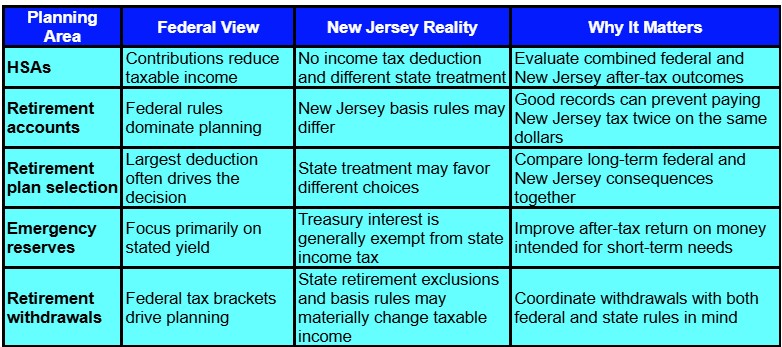
While none of these examples will transform your financial picture from end to end, considering New Jersey state taxes, in parallel with federal taxes, can result in lower overall taxes over a lifetime.
This reinforces the same principle: the best financial decisions usually consider more than one variable.
The factor that drives how much you can benefit from coordinated planning isn’t about net worth or even necessarily how high your income is.
Rather, it’s the complexity of your financial picture.
If all you have is a W2 income, even a large one, a 401(k), an IRA, and possibly a brokerage account, planning may be helpful, but you have a limited range of planning opportunities.
Where planning becomes especially powerful is when you also have several of the following:
- Business ownership.
- Overly concentrated employer stock positions.
- Multiple retirement accounts.
- Significant taxable investments.
- Charitable planning and trusts.
- Large tax-deferred accounts that threaten high RMDs and Medicare surcharges.
The Bottom Line: Aim for the Strongest Financial Life After Taxes
Tax deductions and credits can certainly help reduce current-year taxes.
Beyond those, the advisors discussed Roth conversions, retirement account selection, Treasury interest, HSAs, basis tracking, diversification, coordinated planning, tax-efficient income, and New Jersey’s unique tax rules.
Each of those can improve after-tax outcomes in the right circumstances.
But more importantly, remember that your real goal isn’t to pay the least taxes. As Crane said:
The goal isn’t to die with the lowest tax bill. The goal is to build the strongest financial life possible after taxes.
That isn’t the most visible thing you can focus on, but it’s the one that will truly make the biggest difference in your finances and the life they enable, maximizing your after-tax lifestyle over your lifetime.
That may sometimes mean intentionally paying more taxes now to increase your wealth and long-term flexibility.
The best financial decisions don’t always have to produce the smallest tax bill.
They should produce the strongest financial life after taxes.
Frequently Asked Questions
What is the difference between tax preparation and tax planning?
Tax preparation looks backward at income already earned, transactions already completed, and the deductions and credits you can legitimately claim. Tax planning looks forward, evaluating how today’s decisions may affect taxes, retirement income, charitable giving, investment flexibility and estate planning for years to come. Advisors interviewed say a CPA who reports what happened and an advisor who plans ahead work best together.
Does New Jersey tax retirement account contributions that are deductible federally?
In many cases, yes. According to one advisor interviewed, contributions to Traditional IRAs, SEP IRAs, SIMPLE IRAs, 403(b)s, TSPs and many other plans often don’t receive the same treatment in New Jersey as they do federally. That means a portion of later distributions may be free of New Jersey income tax, but only if you track your New Jersey basis carefully.
How does New Jersey’s retirement income exclusion work?
As described in the article, New Jersey offers a retirement income exclusion for retirees aged 62 and older. For married couples filing jointly with total income of $100,000 or less, up to $100,000 of pension, annuity and IRA income may be excluded, with partial exclusions up to $150,000 of income and none above that.
Are HSA contributions deductible on New Jersey state taxes?
No. One advisor interviewed explains that New Jersey does not fully conform to federal HSA rules: it offers no state deduction for HSA contributions and treats employer contributions as taxable wages. Missing this difference can lead to an unpleasant surprise at tax time.
Does moving from New Jersey to Florida solve a high earner’s tax problem?
Not on its own. One advisor points out that the federal tax bill is two to three times larger than New Jersey’s and doesn’t change when you move, so a portfolio generating fully taxable income keeps generating it in Florida. The type of income you receive can matter as much as where you live.
Find financial advisors who specialize in helping people like you
Search Wealthtender by specialty, location and fee type, compare advisors’ approaches, and read what their clients say before you reach out.
Disclaimer: This article is intended for informational purposes only, and should not be considered financial advice. You should consult a financial professional before making any major financial decisions.

About the author
Contributing Writer, Wealthtender
My career has taken some unexpected turns, from earning a PhD in experimental high-energy physics, to conducting cosmic-ray research in Antarctica, to supporting NASA projects and programs, to running my own consulting business. I also run several other small businesses and help my wife run her Marriage and Family Therapy practice.
Those experiences taught me to question assumptions, think critically, and recognize that real-world decisions of any significance rarely have simple answers that apply to everyone. Today, I bring that perspective to writing about personal finance. Drawing on my analytical background, business experience, and research, I explore financial decisions, challenge conventional wisdom, and help readers understand the tradeoffs that can affect their financial well-being. To complement my own research and experience, I also weave insights from financial professionals into my articles, drawing on their expertise and real-world experience helping clients navigate financial decisions and challenges.
At medium.com/@opher-ganel, you can read more of my articles and subscribe to receive email notifications when new ones come out.