Annuities are often sold as “tax-advantaged,” but what do taxes actually look like when you’re in retirement? It’s important to understand the “wait now, pay later” nature of tax-deferred growth and annuity taxation. Retirement isn’t the time to get caught off guard by tax surprises.
The name of the game is keeping more of your retirement check and not overpaying Uncle Sam. The first step in maximizing your tax strategy is understanding what you have and how your investments are taxed. This is an essential part of a comprehensive financial plan to make the most of your retirement savings.
The “Where” Matters: Qualified vs. Non-Qualified Annuities
The first step to understanding how an annuity is taxed is deciphering what type of annuity you’re talking about. In other words, what tax “bucket” is your money in? Annuities are classified into two main categories for tax purposes: qualified and non-qualified.
Qualified Annuities (The Pre-Tax Bucket)
The term “qualified” simply means the annuity was funded with pre-tax dollars (such as an IRA or 401(k)). The catch? The money you pull out is taxed as ordinary income.
These annuities are either purchased inside your employer plan or funded with a rollover from a qualified (pre-tax) plan. In these instances, the IRS typically counts your cost basis (the amount you paid for the asset) as zero.
Non-Qualified Annuities (The After-Tax Bucket)
A non-qualified annuity is purchased with after-tax money. In other words, these are funded with money outside a qualified plan. In most cases, only the earnings are taxed when you withdraw them.
There are some overly complicated rules on exactly how to calculate the taxable portion of a non-qualified annuity. We’ll go over this in more depth below.
Ordinary Income vs. Capital Gains
Remember, annuity gains are taxed at your regular income rate, not the lower capital gains rate. This can be confusing because exclusion ratios and other annuity tax considerations depend on several distinct factors.
Bottom line, annuities don’t function like a regular investment asset. These are often extraordinarily complex, with sometimes circular language in the contracts themselves. Even seasoned professionals have difficulty decoding the legalese and the interplay among various riders and if/then rules.
For a non-qualified annuity, there are specific rules based on how and when you choose to receive your money. In other words, a single lump-sum distribution or one-off withdrawal changes how the IRS views it. The “normal” way to receive annuity payouts is through regular, usually monthly, payments.
The Exclusion Ratio
If you “annuitize” and start receiving monthly distributions, each payment from the annuity is part return of principal (tax-free) and part earnings (taxed). This spreads the tax bill over your (theoretical) lifetime or the specific contract length. For a qualified annuity, your cost basis is generally considered $0 for tax purposes.
For most annuities, you’ll follow what’s called the general rule. In short, you’ll spread out the cost of the annuity over a certain period. This is based on your age and the chart in the Form 1040 instructions.
The specifics can be complex, but we’ll outline the “basic” process for calculating your exclusion ratio.
Step 1: Determine Net Cost
The first step is to determine your net cost in the annuity contract. This is based on your payments into the annuity contract adjusted for your age (life expectancy), any unpaid loans, or other special circumstances.
Step 2: Calculate Your Expected Return
Next, you’ll calculate the money you’re expected to receive from the annuity. This is what the IRS calls your expected return. Calculate the expected return using the normal monthly payment amount and the total number of payments.
This is also adjusted for your age and/or life expectancy. If you have a variable annuity, your actual returns may differ significantly. A fixed annuity will vary as well (check the contract for crediting rate calculations).
Step 3: Determine the Exclusion Ratio
Divide your net cost from step one by the expected return from step two. Round this number to the “nearest three decimal places,” which is the IRS’s confusing way of saying nearest tenth. If your exclusion ratio is 0.5174257425742574 (calculated using the IRS example), your actual percentage is 51.7%.
Step 4: Apply to First Regular Payment
Next, you’ll apply the exclusion ratio to your first regular periodic payment. For example, if your exclusion ratio is 40%, and your first payment of the year is $500, then $200 is a tax-free return of cost. Multiply that by 12, and your annual exclusion amount is $2,400.
Keep in mind, this is a simplified version of the general rule. There are other exceptions for the death of an annuitant and other factors. Your personal situation and annuity will be different.
Exceptions to the General Rule
If your annuity started after July 1, 1986, and before November 19, 1996, you could have chosen the Simplified Method or the General Rule. However, you can’t change your election. We’ll very briefly cover the simplified method.
Image Credit: NextGen Wealth
The Simplified Method
The simplified method is covered in IRS Publication 575. This is the method used for qualified annuities. There are still exceptions, and some non-qualified annuities might use the simplified method to determine exclusion amounts.
In short, the simplified method divides your total cost by the estimated number of payments listed at the bottom of the simplified method worksheet. The number of payments is determined using your age.
The last section of the simplified method form tracks your total recovered costs from the annuity.
More Information on General Rule versus the Simplified Method
Refer to IRS Publication 939 for more information on whether your annuity is subject to the general rule or simplified method. It’s 85 pages of sleep-inducing specifics on annuity taxation.
Interestingly enough, you can actually pay to have the IRS calculate your exclusion ratio. The fee is $1,000 as of today. In return, you’d receive a “letter ruling” from the IRS explaining your exclusion ratio. The fact the IRS has this process should be a sign of how complicated annuity taxation can be.
This is why coordinating with your accountant can be so valuable. We highly recommend engaging a competent tax professional to ensure your taxes are prepared correctly.
Single Distributions and the “Earnings First” Rule
For random withdrawals, called “nonperiodic distributions” by the IRS, the IRS assumes you’re taking your gains out first. It’s “Last-In, First-Out,” meaning you pay taxes upfront before you get to your tax-free principal.
Also, the IRS doesn’t deduct your assumed cost (basis) for surrender charges. The surrender charges are all on you to cover. Regardless, it’s generally best to follow the contract rather than take distributions at random, though there are some exceptions for hardship.
The “Survivor” Rule
Another rule to keep in mind is how annuity taxation applies if you outlive your life expectancy. It eventually becomes 100% taxable. This is because your tax exclusion is limited to the total cost you paid for the annuity.
Once you’ve received the cost back, you can’t claim an exclusion. Everything you receive after your maximum exclusion is fully taxable as income.
Avoiding IRS Penalties
In addition to the other complex annuity taxation rules, you still need to be mindful of specific ages and dates. Just like other retirement accounts, there are rules for when you can withdraw funds penalty-free.
The 59½ Line in the Sand
Like other qualified accounts, withdrawals from qualified annuities before age 59½ are subject to the 10% early withdrawal penalty. If you need to withdraw funds for early retirement, you may want to explore alternative early retirement options.
Similar to other traditional retirement accounts, annuities are subject to required minimum distributions. However, there are rules (and exceptions) for your required beginning date as well. Your required beginning date is usually age 73 or the year you retire.
Furthermore, SECURE 2.0 enhanced the ability to count certain annuity payments as a portion of your RMDs. If you have an annuity within a qualified account, such as an IRA, your annuity payments count toward the total RMD for the account it’s held in. Before SECURE 2.0, the RMD would have to be taken from other investments inside the account.
In theory, your calculated payments for your annuity will meet your RMD because they’re both based on life expectancy. It’s always best to check so you don’t get hit with the 25% excise tax for failing to take your RMD.
On the other hand, non-qualified annuities aren’t subject to RMDs.
Rules for 1035 Exchanges and Annuities
In some cases, it might be a good idea to swap an old annuity for a new one without triggering a massive tax bill. You can use a 1035 exchange to switch to a different annuity. However, you must be careful not to trigger surrender charges, lose your mortality credits, or lose out on unique features you may need.
How an Annuity Affects Your Heirs
As with everything else, annuities have unique rules when the owner passes away. The type of annuity is important as well. In general, you’ll apply annuity taxation as if you were the original owner of the annuity.
Annuities don’t get the same “step-up in basis” as stocks or a home. It can be messy to close an estate which has an annuity.
Spousal Continuity
For joint-life annuities, the surviving spouse will continue to receive payments based on the contract terms. In some cases, their payments may be reduced, so ensure you understand what’s specified in the contract. There are additional rules for applying the exclusion ratio in this case.
The rules vary slightly depending on whether the original owner/annuitant had started receiving payments. In general, there is still a “return of basis” for the original cost of the contract.
If the annuity owner had started payments, the estate can deduct the portion of the estate tax attributable to the annuity. If the annuity payments had not begun, the death benefit would be treated as income, but the estate could still claim an estate tax deduction.
Annuities vs. Life Insurance
Although annuities are insurance products, they are taxed differently from the death benefits paid under a life insurance contract. Annuities are “tax-deferred,” but death benefit payments from life insurance are generally “tax-free” for the designated beneficiary.
Making Taxes Part of Your Retirement Strategy
As the saying goes, don’t let the tax “tail” wag the investment “dog,” but we don’t need to pay extra to the IRS either. Trust us, they’ll take what they’re owed. Don’t let taxes catch you by surprise.
Furthermore, make sure you understand the potential ongoing tax headaches you get with an annuity. It can get messy quickly, and the IRS doesn’t always care whether you understand everything before assessing a penalty.
Have a Plan
If you don’t already have a clear, written financial plan, you need one. Whether you think you have a complex situation or not, there’s a ton of value in having a game plan. This is especially important if you’re considering a complex financial product like an annuity.
Discover financial advisors trusted by residents of Missoula, Montana in the only local directory featuring 5-Star Certified Advisor Review™ recipients and Wealthtender Voice of the Client Award™ winners—recognition earned for exceptional client feedback. Compare fiduciary, fee-only advisors, CFP® professionals, and specialists to find the right fit for your unique financial needs.
Whether you have lived in Missoula for years or recently moved to town, you may need help finding the right financial advisor in the community best suited for your individual needs.
It’s important to first consider your own financial planning priorities before choosing an advisor. Here are a few quick tips to help you get started along with financial advisors in Missoula featured on Wealthtender you may want to add to your shortlist.
Featured Missoula Financial Advisors
As you prepare to interview financial advisors in Missoula who may be right for you, get to know local financial advisors featured on Wealthtender.
📍 Map: Financial Advisors with their Primary Office Location in Missoula
Double-click (or pinch the map on mobile devices) to zoom in and expand the details for financial advisors whose primary office location is in Missoula.
The Benefits of Hiring a Financial Advisor in Missoula
Hiring a financial advisor can be a great move to help you build a long-term investing strategy. Advisors can help you build an investment portfolio to meet your financial goals and help you plan appropriately for retirement.
As a resident living in Missoula, hiring a financial advisor who lives nearby and understands the local economy, cost of living, and regional employers can be quite valuable, especially if your individual circumstances are deeply tied to such factors.
Do you work for one of the largest employers in Missoula? If so, there’s a good chance the local financial advisor you hire will also have other clients who work there. This knowledge could prove valuable if they are already familiar with your employee benefits, such as a 401(k) plan, Health Savings Accounts, and other components of your total compensation package.
When you reach out to financial advisors you’re considering hiring, let them know where you work and ask if they are familiar with your employer’s unique benefits and compensation structure.
Quick Tips For Hiring an Missoula Financial Advisor
Before hiring a financial advisor in Missoula, here are a few quick tips to help you find the best advisor for you.
1. Decide Which Services You Need
Before hiring an advisor, determine what services you need from them. Whether it’s full-service investment management or a plan focused on a specific area of your finances, put together a list of what you’d like help with before contacting an advisor.
Though most people use a financial planner simply to invest for retirement, this is only a small part of what many advisors offer. Here’s a quick rundown of potential services a financial advisor may offer you:
Budgeting and money management
Debt management
Insurance planning
Retirement planning
Other investment planning
Inheritance planning
Estate planning
Tax planning
As you can see, financial advisors can help you with your entire financial picture, not just investing. As you start to plan for life’s bigger milestones, you should consider finding a financial advisor that specializes in those areas.
Finding the right advisor can help you minimize risk, maximize gains and take advantage of tax breaks while investing for your future. They can also help you protect your assets with the right kinds of insurance and help you pass on your financial legacy with a proper estate plan.
2. Consider Your Budget and Payment Preferences
Once you have a list of services you would like, review the fee structures financial advisors offer. Finding a balance between the services you need and the cost of those services will help narrow down the field of advisors you may want to work with.
If you are looking for a full-service advisor to manage all of your investments, consider searching among fee-based financial advisors. If you want to manage your money yourself, consider the flat fee and monthly subscription advisors for ongoing support.
3. Interview Multiple Financial Advisors
Once you have chosen the services and fee structure you prefer, it’s time to contact a few advisors and interview them. Here are questions to ask financial advisors:
What services do you provide?
What are all the ways you get paid? (fee transparency)
What is your investment strategy?
How do you measure investment performance?
How do we communicate about my plan?
Interview multiple advisors to get a feel for who you want to work with. A combination of fees, services, and customer service will help you determine the best fit for your financial advice.
4. Review Financial Advisor Credentials
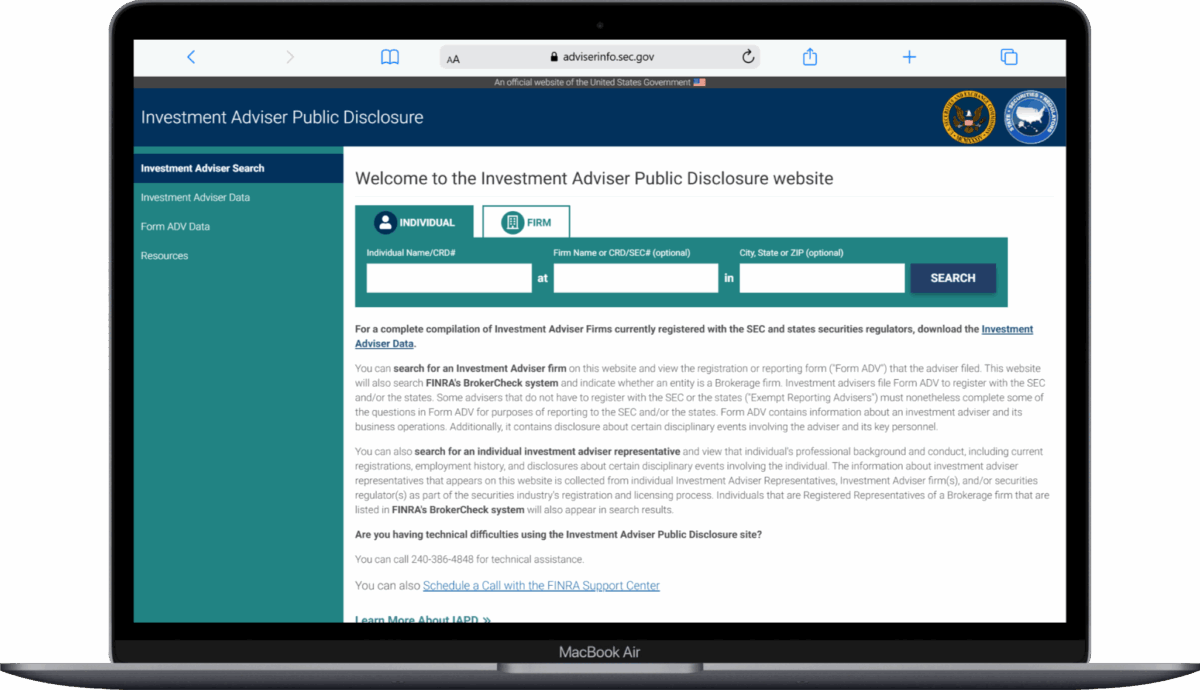
Once you find an advisor (or two) you feel comfortable with, it’s always a good practice to check their credentials and the firm’s details. You can do this at the Investment Adviser Public Disclosure (IAPD) website.
You can check both the individual and the firm to view their background and experience details, as well as any disciplinary action taken against them or their firm.
As licensed financial professionals, there is oversight into how financial advisors conduct business, so running a quick (free) check on them is recommended.
For additional information about advisor credentials, read our article to learn the most popular designations held by financial advisors, as well as specialized credentials which may be important to consider if you have unique financial planning needs.
Frequently Asked Questions & Additional Resources
How do I know if I’m ready to hire a financial advisor?
You should strongly consider hiring a financial advisor if you have a significant amount of money available for saving or investing. This could occur after years of making annual contributions to a retirement plan like a 401(k) through your employer or suddenly if you receive a large inheritance or sell your house for a large profit.
But even if you don’t have a lot of money saved, many financial advisors and planners provide reasonable pricing options and valuable services you should consider, especially if you’re facing a significant life event. For example, if you’re starting a new job, getting married, starting a family, getting divorced, lost your job, starting or selling a business, or approaching retirement age, working with a trusted financial advisor or planner may prove worthwhile.
Before I hire a new financial advisor, should I fire my current advisor?
You don’t need to fire your current advisor before beginning your search for a new financial advisor. In fact, your new advisor can help coordinate the transition of your assets from your previous financial advisor.
Where can I read reviews about financial advisors written by their clients to help me decide if I should hire them?
After 60 years of regulatory prohibition of financial advisor reviews in the US, a rule issued by the Securities and Exchange Commission (SEC) became effective on May 4, 2021 that means both financial advisors and directory websites that help consumers search for a financial advisor can collect and display financial advisor reviews, an important factor worth considering when choosing who you’ll hire to manage your investments and life savings.
Wealthtender is the first independent advisor review platform designed to be fully compliant with the new SEC rule, and we look forward to helping you evaluate financial advisors based on reviews written by their clients.
I’m a local financial advisor interested in being featured in this guide. How do I get started?
Thanks for your interest. We look forward to learning more about your practice and helping you attract your ideal clients where you may be a good fit based on their individual needs and circumstances. Please click here to learn how you can join local financial advisors featured on Wealthtender.
Brian is CEO and founder of Wealthtender and Editor-in-Chief. He and his wife live in Austin, Texas. With over 25 years in the financial services industry, Brian is applying his experience and passion at Wealthtender to help more people enjoy life with less money stress. Learn More about Brian

Do you work at Dimensional Fund Advisors? Get the resources you need and expert insights from financial professionals who specialize in helping Dimensional employees make the most of their compensation package and benefits.
Whether you’re a new employee of Dimensional Fund Advisors or you’ve moved up the ranks into a management or executive leadership role over a multi-year career, it’s important to make smart money moves with your income and employee benefits. For example:
✅ Do you know the right moves to make to get the greatest value from the Dimensional benefits available to you?
✅If you’re thinking about leaving Dimensional Fund Advisors for another job or planning to retire from the company in a few years, are you taking the right steps today to ensure you will receive all of the compensation and benefits that you’ve earned?
Get the Most Value from the Benefits and Compensation Package Available to Dimensional Employees
Throughout the year, Dimensional provides its employees and executives with updates about their benefits ranging from health insurance and health savings plans to retirement plans like a 401(k) and deferred compensation plans. While the company offers many useful resources and access to knowledgeable staff who can assist with questions, you’ll also find financial professionals not affiliated with Dimensional Fund Advisors who specialize in helping Dimensional employees make the most of their income and benefits.
Whether you work in the Dimensional Fund Advisors headquarters in Austin, Texas, another office location around the country, or remotely from home, you may have questions about your compensation package and benefits better suited for a financial professional who can offer unbiased advice and guidance.
For example, sensitive topics like discussing the steps you should take before quitting your job at Dimensional Fund Advisors to work elsewhere or deciding when you should plan to retire are all conversations that may be more comfortable with a trusted financial advisor.
Should you hire a Dimensional Fund Advisors specialist financial advisor or an advisor close to home?
You’ll likely find dozens of nearby financial advisors well-suited to help you reach your money goals with a personalized plan. But it may be more difficult to find a financial advisor who specializes in serving Dimensional employees.
Fortunately, many financial advisors offer virtual services so you can meet online no matter where you (or they) live.
This means you can choose to hire a specialist financial advisor who lives hundreds of miles away if you decide their knowledge and experience working with Dimensional employees is a better fit to help with your unique needs.
💡 In the Q&A below, you’ll gain insights from financial advisors who work with Dimensional employees to help them make smart decisions to get the most value from their compensation and benefits, reduce their money stress, and prepare for a comfortable retirement.
🙋♀️ Do you have questions not yet answered? Use the form below to submit questions anonymously and watch this article for updates with answers to your questions. You can also reach out to the financial advisors below to set up an introductory call or contact them with your questions by email.
💸 Smart Money Insights for Employees & Executives of Dimensional Fund Advisors
This page is organized into sections to help you quickly find the information you need and get answers to your questions:
Q&A: Financial Planning Tips for Dimensional Employees & Executives
Get Answers to Your Questions About Your Dimensional Benefits and Career
Browse Related Articles
Q&A: Financial Planning Tips for Employees & Executives of Dimensional Fund Advisors
Answers to Dimensional Employee Questions with Kelly Klingaman, CFP®, RLP®
Kelly Klingaman is a financial advisor based in Austin, Texas who specializes in offering financial planning services to employees of Dimensional Fund Advisors. Kelly helps her clients get the most value from their Dimensional benefits and compensation package so they can enjoy life and feel confident about their financial future.
Q: When you first speak with a Dimensional employee, what questions do you like to ask to better understand their unique circumstances and determine how you can best help them achieve their goals?
Kelly: During our initial consultation, I’ll ask about your current financial situation and what specific events or topics have prompted you to reach out. I also want to explore your values and vision for living a great life. Why is money important to you? What is essential to living a great life? If we decide to work together, your “why” gives us a lens to look through when making future financial decisions.
Q: Are there a particular benefits available to Dimensional employees you feel aren’t as well utilized or understood by employees as they should be?
Kelly: Dimensional provides a nice amount of free cash into your 401k as a match, so it’s important you’re contributing at least 6% of your salary to this retirement account. There’s a lot of confusion around whether to make pre-tax contributions or Roth contributions to your 401k, and this is highly dependent on other factors like your cash flow needs and your household marginal tax bracket. The truth is, there isn’t one static choice to make here – it could shift each year! I talk through these tradeoffs with each of my Dimensional employee clients on an annual basis to make sure they’re selecting the option that makes the most sense for short and long-term wants and needs.
Dimensional also offers two different medical plans, one being their HSA Health Plan, and I find that you might struggle to understand whether or not this high-deductible plan with a Health Savings Account is a sensible choice for your family. As of 2026, Dimensional gives a sizable amount of free cash into your Health Savings Account: $1500 for individuals and $3000 for families. I’ll help you understand the power of treating your HSA as a tax-free retirement account, and we create a system for investing the cash systematically and “paying yourself back” in the future for current medical expenses.
Q: Beyond Dimensional employee benefits for retirement savings, are there other types of benefits offered by the company that you find valuable to discuss with your clients?
Kelly: In recent years, Dimensional has added a four-week sabbatical every 10 years, and there is an enhancement to the Long-term Incentive Plan for senior level employees where they’ll give a 50% match on top of elective bonus contributions. There is also a new Key Contributor Program for top-performing employees who are not eligible for the LTIP yet. In this program, you can earn discretionary Key Contributor Awards (KCAs) at a minimum of $10,000 that pay out over three years.
Q: For Dimensional employees thinking about leaving the company to accept a job elsewhere, what actions do you recommend they take before resigning and shortly thereafter?
Kelly: For senior level Dimensional employees who have a good amount of vested Phantom Units in their Long-term Incentive Plan (LTIP), they need to understand that they would lose this financial benefit entirely if they leave the company – these shares don’t go with them. It’s important to understand the vested value and use that amount in negotiations with any potential new employer as part of their overall compensation package.
Q: For Dimensional employees who have managed their finances on their own to this point, what would you suggest they consider to help them decide if they should begin working with a financial advisor at this stage in their lives?
Kelly: Dimensional employees have the unique advantage of working inside a company with strong ties to the independent financial advisor community, and the firm fosters a deep respect for the value of financial advice. Despite these ties, employees often feel like they’re supposed to know exactly how to DIY the management of their own personal finances because they work for a financial firm.
As Dimensional employees reach upper-level roles (Managers, Regional Directors, Vice Presidents), this is a good time to consider working with a professional. Maybe you lack the accountability and guidance to focus on your financial health amidst the demands of a successful career and busy home life. Or perhaps you’ve built a great foundation for wealth and you’re making a competitive salary, but what are you missing and how do you prioritize your financial to-do list?
There is also a big consideration for hiring an independent, unbiased professional to guide you and your spouse through all the household financial decisions, big and small. Perhaps you want to feel connected with your partner when it comes to money, especially around aligning how you use your financial resources to live your ideal lives.
Q: What are some of the unique financial planning challenges you commonly see among your clients who are Dimensional employees and how do you help them overcome these obstacles?
Kelly: One of the unique challenges for Dimensional employees, especially those of you at a Regional Director or Vice President level, is the fact that a big portion of your total compensation comes in a semi-annual or annual bonus. This can be hard to manage in terms of balancing your cash flow across the entire year, plus you likely will get hit with unexpected tax consequences. These could be underpayment penalties and/or an unexpected large tax bill come April 15th because this supplemental income is taxed at a flat 22% tax rate. Oftentimes, your household tax bracket is much higher, so you end up owing additional tax money to the IRS. Realistically, it might even be necessary to make an estimated tax payment to avoid an underpayment penalty. Most W-2 employees have never made an estimated tax payment before, so the whole ordeal is confusing and complicated to manage.
Q: For highly compensated Dimensional employees and executives, are there any special benefits you believe it’s important to take into consideration when preparing their financial plan?
Kelly: For senior level Dimensional employees making $250K+ in total compensation, a percentage of your bonus is deferred into the Long-term Incentive Plan (LTIP) to purchase Phantom Units. Generally, the more you earn while working at Dimensional, the more your compensation is tied to the growth of the firm. It’s important from a financial planning perspective to manage this potential concentration risk where your human capital and a growing portion of your financial capital are both tied to the performance of the firm.
I also don’t see many highly compensated Dimensional employees taking advantage of their recent Mega-Backdoor Roth option inside the 401k plan. There are also many tradeoffs to consider with financial planning strategy to decide whether or not it makes sense to add more to the Roth/retirement bucket or to use extra cash flow in other ways.
Get to Know Kelly Klingaman, Financial Advisor for Employees of Dimensional Fund Advisors:
Are you a financial advisor who specializes in working with employees at Dimensional Fund Advisors or another large company?
✅ Join Wealthtender and get featured as a specialist financial advisor based on your knowledge and experience working with employees at Dimensional Fund Advisors or another large company. (Subject to availability and terms.) ✅ Sign up today and join financial advisors attracting their ideal clients on Wealthtender ✅ Or request more information by email:
🙋♀️ Have Questions About Your DimensionalBenefits or Career?
Get answers from the Wealthtender network of financial professionals and educators.
Are you ready to enjoy life more with less money stress?
Sign up to receive weekly insights from Wealthtender with useful money tips and fresh ideas to help you achieve your financial goals.
About the Author
Brian Thorp
Founder and CEO, Wealthtender
Brian is CEO and founder of Wealthtender and Editor-in-Chief. He and his wife live in Austin, Texas.
With over 25 years in the financial services industry, Brian is applying his experience and passion at Wealthtender to help more people enjoy life with less money stress.
Managing money as a couple is one of the most important things you can do for your relationship and your financial future. Yet most couples rarely sit down together to actually talk about it in a structured way. Life gets busy, conversations get avoided, and before long, financial stress starts to quietly build beneath the surface.
That’s where the money date comes in.
A money date is a scheduled, intentional time you set aside with your partner to review your finances together. It doesn’t have to be long or complicated. In fact, the simpler you keep it, the more likely you are to actually do it. Once a month is a good rhythm for most couples, though some prefer every two weeks, especially when working toward a specific goal.
Couples who regularly discuss money report higher relationship satisfaction and better financial health. This is why regular money dates can be so valuable for your relationship.
The goal isn’t to audit each other or assign blame. It’s to stay connected to your shared financial picture so you can make decisions together, reduce surprises, and work toward the things that actually matter to you as a team.
Here’s a checklist you can work through together at every money date.
Your Monthly Money Date Checklist
Review Last Month’s Spending Together
Start by pulling up your spending from the past month. This could be your budgeting app, a spreadsheet, your bank account, or your credit card statements. The format doesn’t matter as much as actually looking at the numbers together.
The point here isn’t to critique every purchase. It’s to get an honest picture of where your money went. Did spending align with what you both value? Were there any surprises? Did any categories run higher than expected?
This is also a good time to notice patterns. If dining out keeps coming in over budget, that’s useful information. Maybe the budget needs to be adjusted, or maybe it’s a signal to be more intentional. Either way, you’re making that decision together instead of one person silently stewing about it.
Keep this part of the conversation neutral and curious, not accusatory. You’re reviewing data, not assigning fault.
Check Progress on Shared Savings Goals
Whether you’re saving for a vacation, a home down payment, a new car, or an emergency fund, your money date is the time to check in on how those goals are progressing.
Pull up the balance in whatever account you’re using for each goal. Compare it to where you expected to be by now. If you’re on track, great. If you’ve fallen behind, you can talk about why and decide if you want to adjust your contribution or your timeline.
Having a visual tracker for savings goals can make this part of the conversation more motivating. Watching a number grow, even slowly, reinforces that your efforts are adding up.
If you don’t have shared savings goals yet, this is also a good time to start defining them. What are the two or three things you’re both most excited to save toward in the next year? Getting specific about goals makes it much easier to stay committed to them.
Identify Upcoming Big Expenses for Next Month
Take a few minutes to think through what’s coming up financially in the next 30 days. Are there any irregular or larger-than-usual expenses on the horizon?
This might include things like:
A car registration or annual insurance premium
A birthday or anniversary gift
Planned home maintenance or a repair
A school event or activity fee
Travel or a hotel for a trip you’ve already booked
Flagging these ahead of time helps you plan for them rather than getting caught off guard. It also gives you a chance to decide together how you’ll cover them, whether that’s from a sinking fund, from discretionary spending, or by temporarily cutting back somewhere else.
This step alone can eliminate a significant amount of financial stress. Most financial surprises aren’t truly surprises. They’re just expenses that weren’t planned for in advance.
Discuss One Financial Win Each Person Had Since the Last Date
This one might feel a little uncomfortable at first, especially if you’re not used to celebrating financial progress. But it matters.
Each person shares one thing they feel good about financially from the past month. It doesn’t have to be dramatic. Maybe you resisted an impulse purchase, automated a savings transfer, increased your 401(k) contribution, negotiated a lower rate on a subscription, or finally called to dispute a charge you’d been putting off.
Acknowledging progress, even small progress, builds positive momentum. It also helps reinforce that both people in the relationship are making an effort, which strengthens trust and keeps the financial conversation from feeling like it’s only about problems.
This part of the money date sets a constructive tone and reminds you both that you’re on the same team.
Confirm All Bills Are Paid or Scheduled
This is the unsexy but important housekeeping portion of the money date.
Go through your regular monthly bills and confirm that everything is either paid or scheduled. This includes utilities, rent or mortgage, subscriptions, loan payments, insurance premiums, and anything else that hits your accounts regularly.
If you have bills set to autopay, verify that the payment amounts look right and that there’s enough in the account to cover them. Autopay is convenient, but it can also lead to surprises if a rate changes or a payment processes at an unexpected time.
This step only takes a few minutes, but catching a missed payment or an unexpected charge during your money date is a lot less stressful than catching it after a late fee or an overdraft.
Review Debt Payoff Progress
If you’re currently paying down debt, whether that’s credit cards, student loans, a car loan, or anything else, your money date is a good time to check in on where things stand.
Look at the current balances and compare them to last month. Are they going down? Is the payoff strategy still the one you both agreed on? Are there any opportunities to accelerate payoff, like applying a bonus, a tax refund, or some extra cash flow toward a balance?
Watching debt balances decrease can be genuinely motivating, and celebrating that progress together makes the effort feel worth it.
If debt isn’t currently part of your picture, you can skip this step or use the time to talk about your strategy for staying debt-free going forward.
Ask: “Is There Anything Money-Related Causing You Stress Right Now?”
This is arguably the most important item on the list, and the one most couples skip.
Financial stress rarely announces itself clearly. More often, it shows up as irritability, avoidance, or tension that seems unrelated to money but usually isn’t. Giving each person a direct, low-pressure opportunity to name what’s worrying them can prevent a lot of that from building up.
The question is simple: Is there anything money-related causing you stress right now?
Maybe one person is anxious about job security. Maybe there’s a financial decision coming up that feels overwhelming. Maybe someone has been avoiding opening a certain account because they’re afraid of what they’ll see. Whatever it is, this question creates a safe opening to bring it into the conversation instead of carrying it alone.
You don’t have to solve everything in the money date. Sometimes just naming a concern out loud to your partner is enough to take the edge off it. And sometimes, it opens a conversation that leads to a plan.
A Few Tips for Making Your Money Date Work
You don’t need to make this elaborate. Some couples do their money date over brunch on a Sunday morning. Others do it over dinner on a weeknight. Some keep it to 20 minutes, others go longer. The format is flexible.
What matters is that it’s consistent and intentional. Put it on the calendar like any other commitment. Protect the time. And agree in advance to keep the conversation constructive.
If you and your partner are just getting started with money dates, it’s okay if the first few feel a little awkward. That’s normal. Financial conversations can carry a lot of emotional weight, especially if you’ve had conflict around money in the past. The structure of a checklist actually helps here because it gives you something concrete to focus on instead of letting the conversation drift into old patterns.
Over time, the money date becomes something most couples genuinely appreciate. It removes the guesswork from your finances, reduces conflict, and helps you feel like a real team when it comes to building the life you want together.
Financial stress in relationships often comes not from lack of money but from lack of communication. The money date is a practical way to change that.
By setting aside a small amount of time each month to review your spending, track your goals, look ahead, celebrate progress, and check in emotionally, you build the kind of financial partnership that makes everything else easier.
You don’t have to be perfect at it. You just have to show up.
Frequently Asked Questions About Money Dates
How long should a money date actually take?
For most couples, 15 to 30 minutes is a reasonable target. If you’re just starting out, your first few sessions might run longer as you set up systems and get comfortable with the format. Once you’ve established a rhythm and your finances are organized, many couples find they can get through the checklist in 10 to 15 minutes. The goal isn’t to spend hours on it. It’s to be consistent.
What if one partner is more interested in finances than the other?
This is extremely common. One person in most relationships tends to be the “money person,” and the other is less engaged. The money date helps bridge that gap because it creates a regular, low-stakes opportunity for the less financially engaged partner to stay informed without having to manage everything day to day.
Keep the conversation accessible. Avoid jargon. And remember that engagement usually grows over time once the less interested partner starts to see the value in staying connected to the financial picture.
Should we combine our finances before starting money dates?
That said, if you’re not sure what approach to take with your accounts, a money date is actually a great time to have that conversation.
What if our money date turns into an argument?
It happens, especially in the beginning. Money is emotional, and old tensions can surface when you start talking about it openly. A few things that help: agree on ground rules before you start, such as no blame and no bringing up past mistakes. Stick to the checklist so the conversation stays focused on information rather than grievances. And if things get heated, it’s okay to pause and come back to it later.
The goal is progress, not perfection. If financial conflict is a recurring and serious issue in your relationship, working with a couples therapist or a financial therapist can be genuinely helpful.
Do we need a budgeting app or special software to do this?
No. A shared spreadsheet, a notes app, or even paper works fine. What matters is that you both have access to the same information during your money date. If you don’t already have a system for tracking spending, a money date is a good time to decide together what tool you want to use going forward. But don’t let the lack of a perfect system stop you from starting. You can always refine your tools as you go.
How do we handle it if one partner earns significantly more than the other?
Income differences can create subtle power imbalances in financial conversations if you’re not careful. The key is to approach the money date as a conversation between equals regardless of who earns what. Both people’s perspectives, concerns, and goals deserve equal weight. If income disparity is creating real tension around spending, saving, or decision-making authority, that’s worth addressing directly, either in your money dates or with the help of a financial advisor or therapist who can help you build a structure that feels fair to both of you.
What if we have very different financial personalities?
One person might be a natural saver, while the other tends to spend more freely. One might be comfortable with financial risk while the other prefers security. These differences are common and don’t have to be a problem. In fact, they can balance each other out.
The money date creates a regular space to acknowledge those differences, understand where the other person is coming from, and find a middle ground that works for both of you. The structure of the checklist helps keep the conversation grounded in shared goals rather than personal habits.
When is a good time to start doing money dates?
Now. There’s no financial milestone you need to hit first. You don’t need to be debt-free, fully employed, or have a certain amount saved. Money dates are useful at every stage of a financial journey, whether you’re just starting out, actively building wealth, or navigating a financial challenge.
The earlier you establish the habit, the more natural it becomes. And if you’ve been together for years without ever having a structured financial conversation, it’s still not too late. Starting now is always better than waiting for the perfect moment.
Find financial advisors in Biloxi, Mississippi ready to help with your financial planning needs so you can enjoy life more with less money stress.
Whether you have lived in Biloxi for years or recently moved to town, you may need help finding the right financial advisor in the community best suited for your individual needs.
It’s important to first consider your own financial planning priorities before choosing an advisor. Here are a few quick tips to help you get started along with financial advisors in Biloxi featured on Wealthtender you may want to add to your shortlist.
Featured Biloxi Financial Advisors
As you prepare to interview financial advisors in Biloxi who may be right for you, get to know local financial advisors featured on Wealthtender.
📍 Map: Financial Advisors with their Primary Office Location in Biloxi
Double-click (or pinch the map on mobile devices) to zoom in and expand the details for financial advisors whose primary office location is in Biloxi.
The Benefits of Hiring a Financial Advisor in Biloxi
Hiring a financial advisor can be a great move to help you build a long-term investing strategy. Advisors can help you build an investment portfolio to meet your financial goals and help you plan appropriately for retirement.
As a resident living in Biloxi, hiring a financial advisor who lives nearby and understands the local economy, cost of living, and regional employers can be quite valuable, especially if your individual circumstances are deeply tied to such factors.
Do you work for one of the largest employers in Biloxi? If so, there’s a good chance the local financial advisor you hire will also have other clients who work there. This knowledge could prove valuable if they are already familiar with your employee benefits, such as a 401(k) plan, Health Savings Accounts, and other components of your total compensation package.
When you reach out to financial advisors you’re considering hiring, let them know where you work and ask if they are familiar with your employer’s unique benefits and compensation structure.
Quick Tips For Hiring an Biloxi Financial Advisor
Before hiring a financial advisor in Biloxi, here are a few quick tips to help you find the best advisor for you.
1. Decide Which Services You Need
Before hiring an advisor, determine what services you need from them. Whether it’s full-service investment management or a plan focused on a specific area of your finances, put together a list of what you’d like help with before contacting an advisor.
Though most people use a financial planner simply to invest for retirement, this is only a small part of what many advisors offer. Here’s a quick rundown of potential services a financial advisor may offer you:
Budgeting and money management
Debt management
Insurance planning
Retirement planning
Other investment planning
Inheritance planning
Estate planning
Tax planning
As you can see, financial advisors can help you with your entire financial picture, not just investing. As you start to plan for life’s bigger milestones, you should consider finding a financial advisor that specializes in those areas.
Finding the right advisor can help you minimize risk, maximize gains and take advantage of tax breaks while investing for your future. They can also help you protect your assets with the right kinds of insurance and help you pass on your financial legacy with a proper estate plan.
2. Consider Your Budget and Payment Preferences
Once you have a list of services you would like, review the fee structures financial advisors offer. Finding a balance between the services you need and the cost of those services will help narrow down the field of advisors you may want to work with.
If you are looking for a full-service advisor to manage all of your investments, consider searching among fee-based financial advisors. If you want to manage your money yourself, consider the flat fee and monthly subscription advisors for ongoing support.
3. Interview Multiple Financial Advisors
Once you have chosen the services and fee structure you prefer, it’s time to contact a few advisors and interview them. Here are questions to ask financial advisors:
What services do you provide?
What are all the ways you get paid? (fee transparency)
What is your investment strategy?
How do you measure investment performance?
How do we communicate about my plan?
Interview multiple advisors to get a feel for who you want to work with. A combination of fees, services, and customer service will help you determine the best fit for your financial advice.
4. Review Financial Advisor Credentials
Once you find an advisor (or two) you feel comfortable with, it’s always a good practice to check their credentials and the firm’s details. You can do this at the Investment Adviser Public Disclosure (IAPD) website.
You can check both the individual and the firm to view their background and experience details, as well as any disciplinary action taken against them or their firm.
As licensed financial professionals, there is oversight into how financial advisors conduct business, so running a quick (free) check on them is recommended.
For additional information about advisor credentials, read our article to learn the most popular designations held by financial advisors, as well as specialized credentials which may be important to consider if you have unique financial planning needs.
Frequently Asked Questions & Additional Resources
How do I know if I’m ready to hire a financial advisor?
You should strongly consider hiring a financial advisor if you have a significant amount of money available for saving or investing. This could occur after years of making annual contributions to a retirement plan like a 401(k) through your employer or suddenly if you receive a large inheritance or sell your house for a large profit.
But even if you don’t have a lot of money saved, many financial advisors and planners provide reasonable pricing options and valuable services you should consider, especially if you’re facing a significant life event. For example, if you’re starting a new job, getting married, starting a family, getting divorced, lost your job, starting or selling a business, or approaching retirement age, working with a trusted financial advisor or planner may prove worthwhile.
Before I hire a new financial advisor, should I fire my current advisor?
You don’t need to fire your current advisor before beginning your search for a new financial advisor. In fact, your new advisor can help coordinate the transition of your assets from your previous financial advisor.
Where can I read reviews about financial advisors written by their clients to help me decide if I should hire them?
After 60 years of regulatory prohibition of financial advisor reviews in the US, a rule issued by the Securities and Exchange Commission (SEC) became effective on May 4, 2021 that means both financial advisors and directory websites that help consumers search for a financial advisor can collect and display financial advisor reviews, an important factor worth considering when choosing who you’ll hire to manage your investments and life savings.
Wealthtender is the first independent advisor review platform designed to be fully compliant with the new SEC rule, and we look forward to helping you evaluate financial advisors based on reviews written by their clients.
I’m a local financial advisor interested in being featured in this guide. How do I get started?
Thanks for your interest. We look forward to learning more about your practice and helping you attract your ideal clients where you may be a good fit based on their individual needs and circumstances. Please click here to learn how you can join local financial advisors featured on Wealthtender.
Brian is CEO and founder of Wealthtender and Editor-in-Chief. He and his wife live in Austin, Texas. With over 25 years in the financial services industry, Brian is applying his experience and passion at Wealthtender to help more people enjoy life with less money stress. Learn More about Brian

If you live in Maryland, you’re already paying some of the highest taxes in the country, but chances are, you’re paying even more than you have to. Most residents only think about taxes when it’s already too late to do anything about them: at filing time, when the decisions are already made and the opportunities are gone. The good news? With the right deductions, credits, and a little proactive planning throughout the year, you could keep thousands more of your hard-earned dollars. Here are 10 strategies to legally reduce your Maryland state and local income taxes, and why starting now matters more than you think.
I’ve been a Marylander for almost 30 years. Although I’ve lived on three continents (four, if you count a couple of months in Antarctica), in three countries, and in two US states, I’ve lived here longer than anywhere else.
There’s a lot to love about Maryland. Just look at the photo below, taken not far from my home, and you’ll start to see why:
Maryland autumn, 2022. Photo by the author.
However, the tax burden isn’t one of the things I love about my home state.
According to the Tax Foundation, Maryland has the 11th-highest per-capita tax burden in the country, about 13% above the U.S. average (based on 2022 data).
As Ben Simerly, CFP®, Financial Advisor and Founder of Lakehouse Family Wealth and former Marylander, says, “Maryland has literally become famous for unique and destructive taxes. To my knowledge, it’s the first state or territory, or in some cases one of the few, to tax the rain, provide more than a dozen forms of property taxes, and even tax money at the state level both at the time of death and inheritance.
“For some, living in Maryland isn’t optional. Many federal workers and military personnel and their families are required to live and work in the region. If this is you, make the best of the situation. You may not get hazard pay like you would in earlier days of government service in the region, but with some help from pros, you can lessen the ill effects on your finances.
“Here are our top areas of tax concern in Maryland. First, Maryland has its own particularly vindictive capital gains tax, despite gains already being taxed under several other state and federal codes.
“It applies an extra 2% capital gains tax mainly on households with federal Adjusted Gross Income (AGI) above $350,000.Even if your household doesn’t normally make over $350,000, your AGI could get ‘bumped’ over $350k due to, e.g., receiving a large bonus; selling a house that appreciated too much; moving financial assets between account types that causes a taxable event; owning shares in mutual funds that distribute significant capital gains, dividends, and interest; etc. These can all trigger a ‘capital gains’ trap, which happens far more easily than you might think.
“Second is additional death and estate taxes. Maryland levies a 10% tax on inheritance to the beneficiary, even if the money was taxed at the benefactor’s death. That’s right, it taxes the money yet again. And that’s after the also unique state inheritance tax of between 8% and 16% on estates with a gross value of $5 million.
“There are look-back clauses too, meaning you can’t simply move to avoid the tax; you have to move long enough before death or inheritance to avoid the tax. States like Maryland, New York, and California will follow you around the world to collect taxes from you and take you to court or send agents if it goes that far.
“My retirement planning work with Maryland clients over the years shows that most could retire 10 years sooner and have dramatically higher retirement income outside of Maryland, largely due to the benefits of rollovers occurring outside of the state.
“So, for Maryland residents, we often plan out income for even young families the way you normally only would for someone approaching Medicare age or already retired. We do everything we can to keep income under certain thresholds and then get the resident out of Maryland as soon as humanly possible.”
If I had to, I’d bet a nickel (assuming I can still find one in these digital times) that many Marylanders overpay their taxes. Not because they’re careless, but because they start thinking about it too late.
If you’re a higher-income Maryland resident, that can mean paying several thousand dollars in higher taxes per year than you’re legally required to. And once that money is gone, you don’t get it back.
By the time you’re filing your tax return, your tax liability is already set. At that point, your income is already set, your deductions and credits have already been earned (or not), and most opportunities to reduce your tax bill are behind you.
At that point, it’s mostly a question of how well you (or your tax software) identify the deductions and credits you’re eligible for.
That’s why if you want to reduce your Maryland taxes, filing better is a secondary priority. Your top priority should be to focus on better tax planning and strategy.
Three Types of Tax-Reducing Moves for Maryland Residents
There are only three legal ways to pay lower income tax.
Lower your taxable income, ideally without reducing your standard of living (e.g., by using more and larger deductions).
Take advantage of all tax credits for which you qualify.
Make smarter timing and structural decisions.
Many taxpayers focus on the first, but still miss some opportunities, take partial advantage of the second, and almost entirely miss the third.
That’s why, even if they do everything perfectly at tax-filing time, they end up paying more than they could have.
The following are 10 tips for reducing your Maryland state and local income taxes. Some are straightforward. Others require a bit of planning. Most are easier to implement before the tax year is over.
You don’t have to use all 10, but the more you miss, the more of your hard-earned money you’ll leave on the table.
Lower Your Taxable Income
If you ask most people, this is what they’ll identify as a good way to reduce their taxes.
It’s natural. It’s the most straightforward way to reduce taxes.
But there’s a catch.
There’s using this lever, and then there’s USING it.
The former means contributing whatever you feel you can to your traditional retirement plans, using the standard deduction, and letting things flow as they will over the years.
This leaves lots of opportunities on the table, unused.
The latter requires being more proactive and committed.
Here are the top three examples.
1. Maximize Pre-Tax Retirement Contributions
If you can’t afford to maximize your retirement contributions without counting on the tax deduction, and especially if you’re already in a high tax bracket, this may be your best bet.
Not only does it reduce your federal taxable income, but it also reduces your taxable income for Maryland state and local taxes.
Table 1 shows some examples of how much you can lower your 2026 income taxes (federal, state, and local) by contributing an extra $10k to your traditional 401(k) account if you file “married filing jointly” and live in, e.g., Howard County, Maryland.
Table 1. Example 2026 tax savings (federal, state, and local) for a married couple living in Howard County, Maryland, by increasing traditional 401(k) contributions by $10k.
Clearly, the majority of the tax savings come from the federal portion, but the state and local tax reduction can go as high as $980, or 0.98% (for residents of Dorchester County with a Maryland taxable income above $1.2 million).
If you’re one of those who don’t max their retirement contributions, this is the simplest and most powerful place to start, but only if you make the contributions before the end of the tax year!
And unlike many strategies, this one is (almost) entirely within your control.
2. Use Maryland’s 529 Deduction as Much as Possible
Maryland has a relatively generous deduction for people who set aside money for their dependents’ (or their own) education.
You can deduct contributions to Maryland 529 plans, up to $2500 per contributor, per beneficiary, per year.
That means that, if you’re married and have two kids, you could potentially deduct up to $20k a year ($5k from you and your spouse per beneficiary, for each of your kids, plus for the two of you).
What’s more, you can carry over excess contributions for up to 10 years.
That means that if you, e.g., open a plan for your child when she’s born, and contribute $5k a year from you and your spouse until your daughter goes to college, then contribute $20k in her freshman year and another $50k during her senior year, all of those contributions can ultimately be deducted.
That’s $160k-worth of deductible contributions spread over 32 years.
Even if you can’t afford to set aside money until your kid goes to college, but you do pay $70k in tuition and other eligible educational expenses during his college career, you can deduct those over the four years of college, plus the following decade.
And the most incredible thing about this deduction, in my opinion, is that you can contribute to the plan, then take the money out the very next day to pay the tuition bill, and it’s still deductible!
And lest we forget, if your kid doesn’t go to college or has such large scholarships that there’s a large balance left over, you can change beneficiaries, or you can use a SECURE 2.0 provision to convert up to $35k of the remaining balance into a Roth IRA for the beneficiary.
Few deductions offer this much flexibility with this much impact.
3. Don’t Blindly Use the Standard Deduction
Despite the significant increase in the federal standard deduction over the past several years, if you own a home with a large mortgage, make significant charitable donations, and perhaps have high medical expenses, itemizing can still reduce your taxable income by more than the standard deduction would.
And the larger your federal deduction, the lower your taxable income for Maryland state and local taxes.
The above three tips are the most visible lever and the one that most people focus on.
But if you stop there, you’re likely missing more powerful opportunities.
Take Full Advantage of Tax Credits
Tax deductions are great. They reduce your taxable income, which reduces your taxes.
But there’s something even better.
Tax Credits.
For every $1 of tax deductions, your Maryland state and local taxes drop by about $0.08. But for every $1 of Maryland tax credits, your Maryland state and local taxes drop by a full $1!
If deductions are about trimming around the edges, credits are where meaningful reductions often happen.
The only problem is that, while more valuable from a tax reduction perspective, credits are far more tightly targeted.
Maryland offers quite a few such tax credits. The problem is that most middle-to-high earners assume credits don’t apply to them and never take the time to verify that assumption.
Here are a few credits worth checking carefully.
4. Child and Dependent Care Tax Credit
Even if your adjusted gross income is in the 6 figures, Maryland offers a substantial tax credit for child and dependent care expenses.
The Maryland credit amount is figured as a percentage of the federal Child and Dependent Care Credit (CDCC), which can be 20% – 32% of qualified expenses up to $3000 for a single dependent or $6000 for two or more dependents.
That percentage depends on your filing status and your federal AGI. Table 2 shows some examples for couples who file jointly, have two dependents, and paid $6k or more in qualified care expenses.
Table 2. Example 2026 tax savings (federal, state, and local) for a married couple living in Maryland, claiming the CDCC for $6k or more in qualified expenses for two kids.
5. Senior Tax Credit
Maryland offers a tax credit for seniors, even if their federal AGI is up to $150k if married filing jointly or up to $100k if single.
The credit takes up to $1750 off your Maryland tax bill if both spouses are 65 before the end of the tax year. If it’s a single taxpayer, or a couple where only one is 65 by the end of the tax year, the senior tax credit is $1000.
6. First-Time Homebuyer Subtraction
If you and your spouse (if any) are Maryland residents, haven’t owned or purchased a home in the past seven years, and contributed money to a first-time home buyer savings account, you can subtract from your taxes the lower of $5000 or the amount you contributed in the tax year, plus earnings from the account for the tax year.
You can do this for up to 10 years.
The earnings subtracted cannot exceed $50k over the 10 years.
There are caveats.
First, by the end of 15 years from when you open the account, you must use the account balance toward a down payment and/or eligible closing costs for buying a home in Maryland. Any amount not so used counts as taxable income in the following year.
Second, amounts withdrawn from the account for purposes other than eligible first-time home buying expenses count as taxable income for the tax year of the withdrawal and are also subject to a 10% penalty. Three exceptions are rollovers, bankruptcy, and administrative costs charged by the financial institution for the savings account.
Some other possible credits to investigate include:
As mentioned above, don’t simply assume that you make too much to qualify. That just increases your risk of leaving easy money on the table, paying higher taxes than you owe.
Also, you may qualify for certain income-limited credits you wouldn’t normally qualify for in years when your income is lower than usual. This could be due to, e.g.:
Being unemployed or underemployed for part of the year (or, hopefully not, all of it).
Living off withdrawals from a Roth account, taxable portfolio, and/or savings accounts.
Living off untaxable proceeds from the sale of a home or other property.
There’s no doubt that tax credits can be a powerful tool in reducing your Maryland state and local income tax.
But even these aren’t necessarily your biggest tax-cutting opportunity.
That will often result from planning and making optimal timing and strategic decisions.
Strategic Decisions and Timing – Where Planning Shines
As helpful as tax deductions may be, and as powerful as tax credits are, there’s someplace else where the biggest savings often are, and where many people leave the most money on the table.
Some because they prefer not to make the changes that would reduce their state and local taxes by the largest amount, but many others just don’t make the right moves in time.
This is the only category where decisions made months or even years earlier can completely change your tax outcome.
Simerly says, “While most of the available tax credits or deductions for Maryland are automatically asked about or applied by tax software and or accountants, some areas require more advanced planning.”
7. Time Income and Deductions Proactively
You don’t want the tax tail to wag your income dog, but the progressive nature of our tax system lets you reduce your long-term total taxes by avoiding spikes in taxable income that would push you into higher tax brackets.
This is true for federal taxes, but also for Maryland state and local taxes.
For example, if you have an especially high income in a specific year, you can:
Ask to defer at least part of your bonus (if any) to the following tax year.
Avoid realizing capital gains that year, holding off on selling appreciated assets until the following year.
Harvest tax losses by selling assets whose current value is lower than your basis in them.
Bunch charitable contributions into that year from the previous and/or next year.
The crucial thing is to be intentional and make the necessary decisions proactively, when you still have the flexibility to make them.
8. Coordinate Federal and State/Local Tax Decisions Intelligently
A Roth conversion is a plausible long-term tax-reduction and estate-planning strategy.
However, it’s important to consider your short-term taxes, including your Maryland state and local income taxes.
If you’ve decided on a Roth conversion, carry it out during years when you’re in a lower tax bracket.
Similarly, if you’re retired, you may benefit from drawing more out of your tax-deferred retirement accounts in years when your taxable income is otherwise lower than typical.
9. Where You Live Matters
Your Maryland state and local income tax could vary by up to 13% simply because you live in one jurisdiction vs. another.
For example, the local income taxes in Worcester County and Talbott County are relatively low, at 2.25% and 2.40%, respectively. Local tax in Dorchester County is the highest, at 3.30%.
All other counties fall between those extremes, with Anne Arundel and Frederic Counties charging progressive taxes, per taxable income.
In this age of remote work, all other things being equal, you could shave over 1/8 of your Maryland state and local tax by moving from a high-local-tax-rate county to the lowest one.
Crucially, if for some reason the Comptroller of Maryland can’t identify your county of residence, you will be taxed at the highest local tax rate, of 3.30%. So if you live in a county that charges a lower rate, make sure you identify it correctly on your state tax return.
10. Treat Tax Planning as a Year-Round Process
Most people only think about how they can reduce their taxes when it’s mostly too late.
At tax filing.
By then, your income is already earned, your decisions are already implemented, and your tax-reduction opportunities are mostly gone.
If you want to minimize your state and local taxes, you need to do more than file better. You need to plan, decide, and execute earlier.
This means you need to:
Review your situation before year-end (preferably far before that point).
Identify opportunities.
Make adjustments while they can still affect your taxes.
Dr. Steven Crane, Founder of Financial Legacy Builders, shares, “In my experience, the biggest state tax wins usually come from decisions around income timing and where income shows up. Maryland has relatively high state and local taxes, so things like Roth conversions, retirement withdrawals, and even where assets are held can make a noticeable difference. I’ve worked with clients who didn’t realize that simply shifting how and when they recognize income could save them thousands over time.
“One of the biggest mistakes I see is people treating state taxes as an afterthought. They focus on federal planning but ignore how state and local taxes stack on top of that. Another common issue is not coordinating decisions; someone might take a large distribution, sell assets, or exercise stock options without realizing the full state tax impact until it’s too late.”
The Bottom Line for Maryland Residents
If you’re a Maryland resident, especially one paying relatively high state and local income taxes, your biggest-impact tax-reduction strategy isn’t to find a single large tax break you somehow missed all these years.
It’s to identify and take advantage of all the deductions you’re legally allowed to take, claim all the tax credits you’re eligible for, and most crucially, make proactive choices before the end of the tax year, when they can still reduce your taxes.
The goal isn’t to find one big tax break. It’s to avoid small inefficiencies that add up over time.
Crane agrees, “The biggest thing I wish people understood is that tax planning isn’t something you do in April. By then, most of the decisions are already locked in. The real opportunities happen during the year, when you still have flexibility to control income, deductions, and timing. At the end of the day, reducing state taxes isn’t about finding one big trick. It’s about being intentional with how your financial life is structured and making small decisions that add up over time.”
You may already be implementing some of the above tips.
But it’s a good bet that you’re missing one or more and overpaying your taxes, year after year, as a result.
To reduce your Maryland state and local taxes as much as legally possible, identify the tips you’re missing and implement them as soon as possible.
The earlier you start, the more options you’ll have.
And the more options you identify and take advantage of, the more control you’ll have over how much of your money you’ll get to keep.
If you consider yourself financially disciplined, this is one area where that discipline can pay off directly. Because when it comes to taxes, the difference between ‘good enough’ and ‘well planned’ can mean thousands of dollars a year back in your pocket.
Disclaimer: This article is intended for informational purposes only, and should not be considered financial advice. You should consult a financial professional before making any major financial decisions.
About the Author
Opher Ganel, Ph.D.
My career has had many unpredictable twists and turns. A MSc in theoretical physics, PhD in experimental high-energy physics, postdoc in particle detector R&D, research position in experimental cosmic-ray physics (including a couple of visits to Antarctica), a brief stint at a small engineering services company supporting NASA, followed by starting my own small consulting practice supporting NASA projects and programs. Along the way, I started other micro businesses and helped my wife start and grow her own Marriage and Family Therapy practice. Now, I use all these experiences to also offer financial strategy services to help independent professionals achieve their personal and business finance goals. Connect with me on my own site: OpherGanel.com and/or follow my Medium publication: medium.com/financial-strategy/.
You’ve hit $1 million… now what? That milestone puts you ahead of most Americans your age, but it also changes the game in ways you might not expect. The biggest risk is no longer saving too little; it’s making less-than-optimal decisions with what you’ve built. So should you stick with the DIY approach that got you here, or is it time to bring in professional help? The answer isn’t as simple as your net worth. Here are nine signs you’d benefit from a financial advisor, and five signs you’re doing just fine on your own.
Hitting $1 million is a big milestone, and one worth celebrating. You’re ahead of roughly three out of four Americans your age. But unless you’re comfortable with a modest retirement budget, think around the median U.S. household income, you need to keep building.
But now that you’re “worth” seven figures, the game changes in ways you may not expect. At this point, the biggest risk is no longer saving too little. You’ve already proven you can save and invest. It’s making less-than-optimal decisions with what you’ve built and will keep building, and, without realizing it, giving up hundreds of thousands of dollars over time. Money that could let you retire earlier and/or live better once you do.
That’s why it’s worth stepping back and asking the question differently:
Is your best move to stay the DIY course, or would you do even better with professional support?
Things That Could Be Costing You Sleep
If you’ve crossed the $1 million mark, you might be asking yourself:
I’ve done well, but will staying solo get me to the finish line, or am I at the point where DIY stops being enough? In other words, isn’t this a case of “if it ain’t broke, don’t fix it”?
Am I leaving money on the table by not using an advisor? Am I being penny-wise and pound-foolish?
I don’t want to pay 1% unless it’s actually worth it. Is it?
What does a good advisor actually do that I can’t do, or do as well, on my own?
I don’t want to get sold things I don’t need. How do I avoid being pitched products and investments that benefit the advisor more than me?
These are all excellent questions. And not the kind you want to leave unanswered.
That’s exactly what we’ll walk through here.
The Core Question Isn’t What You Think It Is
Now that you’ve saved $1 million, do you really need a financial advisor?
It seems like a simple yes/no kind of question, right?
Unfortunately, it runs afoul of something Albert Einstein warned us: “Every problem should be simplified as far as possible, but no further!”
Posing this as a “Do you or don’t you?” question oversimplifies the issue to the point that it sets you up to get it wrong.
Because the answer isn’t based on a single number, even if it’s relatively large, like $1 million. Lots of people with more than $1 million manage just fine on their own. I did, for many years. At the same time, many people, even with less than $1 million, would benefit from professional advice.
The question isn’t if you could do it on your own. You’ve already proven that you can.
The better question is this: Would hiring the right financial pro help you do better than you could on your own?
In other words, which approach gives you the best fee-adjusted outcome, financially and behaviorally?
A Quick Way to Think About It
Before we go deeper, here’s a simple way to frame it.
You’re more likely to benefit from working with a financial advisor if:
Your financial life is getting more complicated, especially around taxes (hello 150-page tax return! Am I being tax efficient?), retirement planning (I need to plan to what age?! Is the 4% rule the best strategy?), or other major decisions (think providing for special-needs kids, negotiating a compensation package, etc.).
You’re not certain you’re optimizing what you’ve built.
You’d rather not manage every detail yourself or worry about missing something important, and worse, setting your spouse up for an unmanageable scenario if you die first.
You’re more likely to be fine on your own if:
Your finances are relatively straightforward (think W2 wages, renting, investing in low-cost index funds, etc.) , and you may be single with no kids.
You follow a disciplined, low-cost investment approach (e.g., a basket of Exchange-Traded Funds, or ETFs, charging sub-0.1% annual management fees).
You enjoy managing your money and can consistently stay on top of it.
Most people don’t fall cleanly on one side or the other. And even if they do today, they may find themselves changing sides in the future.
And that’s the point.
How to Use What Follows
This isn’t about checking off a bunch of boxes on a checklist and calling it a day.
Most people who can benefit from professional financial advisors don’t have just one reason for it. They typically see themselves in several of the “yes-side” items we’ll cover below.
So, as you keep reading, rather than asking yourself if you match all of them perfectly, ask yourself if you’re closer to “yes” than “no” for enough of them.
That will make your personal answer clearer.
With that in mind, we’ll walk through the signs that suggest you might benefit from professional advice, starting with those that tend to have the biggest long-term impact.
Nine Signs You Might Benefit from Working with a Financial Advisor
There are several common scenarios where professional advice can make the biggest difference, where things gradually become more complex, and mistakes become more costly.
1. Complicated tax situations
Early on, your tax situation was likely simple.
You had W2 income, took the standard deduction, and perhaps funded a traditional IRA and/or a pre-tax 401(k) account.
But now, with over $1 million in net worth and the income that helped build it, things stopped being so simple. Most likely, more than one of the following describes your current tax situation:
You own a business (or five) that brings in enough money that self-employment taxes are uncomfortably high.
Your taxable brokerage account generates qualified and unqualified dividends, and both short-term and long-term capital gains.
You have a mix of pre-tax and Roth IRAs and 401(k) accounts, and tapping them each has different tax implications.
You’re starting to hit income phase-outs for Roth contributions and certain deductions (or have long ago passed that marker).
You’re facing a Required Minimum Distribution (RMD) cliff in a couple of decades, so you want to do Roth conversions, but are not sure how much to convert and when.
You’re receiving multiple K-1 forms from different states and/or own properties in more than one state.
You’re thinking of moving to a different state.
Individually, these aren’t too complicated, at least not beyond tax season. But taken together, you have a system where a change in one place affects everything else, and where even small inefficiencies could be costing you thousands or tens of thousands of dollars each year.
For example, it took a while until I learned that electing to have my consulting practice, a sole-member LLC, taxed as an S-corp would save me tens of thousands in self-employment taxes.
It took changing accountants to teach me that.
And if I had had a good financial advisor back then, he or she would likely have suggested making the change a few years earlier.
It may not be flashy like identifying the next Amazon or Nvidia when they’re still small, but a good advisor adds value by coordinating decisions across your entire financial picture.
2. Approaching or entering retirement
I won’t lie.
I’ve been a dyed-in-the-wool personal-finance DIYer for decades.
I reached “work-optional” status and reduced my workload by 90%. I describe myself now as “mostly retired.”
I put together a monster spreadsheet that tracks and projects our finances, revenues, business expenses, personal expenses, estimated taxes, and investment outcomes for the past 12 years and almost forty years into the future. Call me weird, but I enjoy it.
But one thing I’ve never done before is to retire and live off a portfolio. So, I started wondering, how many things are out there that “I don’t know that I don’t know” and that could end up biting me on the rear end?
I tried two flat-fee advisory companies. Both were epic failures.
Then, I found a sort of “family office light” service, where I work with an experienced advisor rather than a different fresh-out advisor each call.
We just kicked things off, so I’ll report on my experience with him in the future. But thus far it’s promising. I especially appreciated his plausibly pushing back on some of the assumptions in my projections spreadsheet that put me at risk of retirement failure in a few decades.
When you’re in the accumulation phase, things are relatively simple. Save (a large enough fraction of your income) consistently, invest for growth, and stay the course. But when the flow reverses? When, instead of feeding your portfolio, you now need it to feed you?
Now you need to figure out:
How much can you safely withdraw each year?
From which accounts should you withdraw money, in what order, and in what proportions, to minimize taxes and maximize your long-term results?
How do you mitigate sequence-of-returns risk? I.e., how do you prevent an early-retirement market crash from eviscerating your retirement plan?
And the real problem is that there isn’t a single “right” answer for everyone.
Your personal answer depends on:
Your mix of taxable, pre-tax, and Roth accounts, and how that mix evolves throughout your retirement.
Your Social Security claim timing.
Your spending needs and how those evolve, especially with any large unplanned expenses that may crop up.
Your legacy desires, and how those might change.
Market conditions for equities, bonds, and other asset classes you may invest in.
Getting things right in all these domains can add to your discretionary spending in retirement, reduce the risk of running out, leave more for heirs and/or charities, and even let you accomplish all these with fewer years of full-time work.
Getting things wrong, or even less optimally, will likely not immediately show up on your radar, but you’ll face a less friendly outcome when it’s too late to do much about it.
3. Dealing with a major life transition or financial event
Every once in a while, something comes up that raises the stakes and/or reduces your margin of error. Things like selling a business, going through a divorce, having to support aging parents or adult children, or, on the more positive side, receiving a major bonus, stock option award, or inheritance.
These aren’t everyday things.
They come with considerations for tax impacts, timing, and hard-to-reverse tradeoffs, and you’re likely dealing with a lot emotionally. Having an experienced, objective advisor can help make decisions that will more likely turn out to your satisfaction.
4. Estate and legacy planning
You’ve hit and exceeded $1 million. That means your financial plan isn’t just about you anymore.
What if something happens to you (and possibly your spouse, too)?
How do you want your assets to be passed on? How can you set that up to minimize your heirs’ red tape nightmare?
You need estate planning, including wills and trusts, designating primary and secondary beneficiaries (I just revisited mine), coordinating accounts, ensuring legal documents are easily found by your heirs, and optimizing taxes on assets you leave behind.
And all this has to be done in a way that will work in real life, not just on paper.
This is where a good financial advisor can help, crafting a comprehensive, coordinated plan that addresses and minimizes complexity and reduces risk.
Having addressed complexity, we move on to how you react when life happens. How do you make the best decisions possible when things go wrong?
And even if you make good decisions, do you lose sleep because you’re not sure they’re the best possible ones?
5. You struggle with market volatility
When the markets keep climbing, everyone’s a genius, long-term investor. But about once every four years, the bear strikes. When it does, it isn’t as easy to stay unemotional and disciplined. The headlines are screaming that the sky is falling, and recency bias makes it look like the red ink will keep flowing indefinitely, so you’re wondering if you shouldn’t cut your losses and sit out the rest of the drop.
When this happens, even if you know a crash is just an opportunity to buy stocks at a discount, it’s beyond difficult to do the right thing, and buy the dip, or at least follow the saying, “Don’t just do something! Stand there!”
Because knowing the right thing to do (or not do) and being emotionally capable of executing it are two completely separate things.
Even smart investors get caught up in the drama and sell at the wrong time, sit on the sidelines in cash way too long because they’re afraid the most recent move back up is a “dead cat bounce,” and even when they do move back in, they chase what’s worked for others recently, which is more than likely no longer the best bet.
This is where a financial advisor’s value can be huge. Not just helping you manage your portfolio, but more importantly, managing your emotional response to what’s happening to it.
6. You stress over your decisions
In today’s financial environment, if your net worth broke through seven figures, there are a lot of decisions to be made, sometimes a few a year, but other times several a day. So you decide and act. But then, you start wondering:
“Does my Roth conversion plan optimize taxes for my heirs and me?”
“Is my portfolio allocation too aggressive, too conservative, or just right?”
“Can I really retire at age X?”
“Does it make sense to buy that vacation home my spouse wants?”
“How much can I donate to our congregation?”
“How much can I give my kid to help with buying a first home?”
“Am I missing something obvious?”
These are all financial decisions, but they’re also deeply emotional.
In extreme cases, you may be losing sleep. I’ll confess, this has happened to me more than once, especially around the decision to mostly retire at age 63.
But even in less extreme cases, you may feel stressed, which isn’t good for your next decision, and even more so for your physical health.
A financial pro can add a pair of knowledgeable eyes, helping you validate your decisions when you pick the best option, catch things you may have missed, and give you confidence in moving forward.
Having a neutral third party can also help keep things calm and constructive when you need to negotiate these decisions with your spouse or kids.
7. You don’t have the time or, frankly, the interest in managing everything
It’s not (just) about picking investments. You’ve done enough of that to reach a net worth higher than most.
But you still need to:
Monitor your investment allocations and rebalance when appropriate.
Manage and optimize taxes, including harvesting tax losses.
Review accounts for unexplained charges or withdrawals.
Make sure your spending aligns with your priorities and stays within your budget.
Stay current with changes in law, rules, and regulations, and how they impact your plan.
You can do all of this, especially if you keep up with financial and tax changes.
However, doing all of it takes time, attention, and emotional bandwidth. You may miss something important. And even if you don’t, it still takes time and energy away from the rest of your life. What’s more, you may simply not enjoy doing it.
I mean, I enjoy reading about the markets, optimizing our portfolio, and especially running multi-decade projections (I told you, I’m weird!)
But I very much doubt you’re that weird.
And if you don’t enjoy it, having to do it adds to your everyday stress, and adds to your “to-do list” things that feel like nagging chores. And if you’re like me, things that feel like that get put off until you can’t put them off anymore.
And by the time you get to them, they’re no longer just important. They’re urgent too. And you may not have enough time to address them well.
And you may also miss something from time to time, and over time, small missed actions can compound into major missed opportunities.
If this sounds like you, wouldn’t outsourcing these things improve not just your outcomes, but also your quality of life?
Would you rather spend the time and energy on tracking everything and optimizing your finances, or delegate as much as possible to a professional advisor so you can concentrate on work/business, family, friends, health and fitness, hobbies, and travel?
8. You’ve become a single point of financial failure
Even if you have everything down to a science, with systems in place to keep everything humming along, what happens if, heavens forbid, you get hit by the proverbial bus?
Could your spouse step in without missing a beat? Could even your kids step in and help your spouse without anything important being dropped?
This is something I’ve been pondering a lot, especially in recent years, after hitting age 60.
And my answer is still, “Not really.”
Frankly, that’s scary. And it’s another reason to have a financial advisor’s support. Our advisor can help by providing continuity of decision-making, serving as a resource to negotiate a painful time, and helping ensure my plan continues providing for my wife.
9. You want to do better than just “fine”
You’ve already shown you can do just fine as a DIYer.
But what if “fine” isn’t enough?
What if you want things optimized so you aren’t leaving money on the proverbial table?
A good advisor can help you optimize, structure things more efficiently, find smarter and easier ways of reaching your goals, and have all that happen without increasing the load on you.
Things like optimal tax efficiency, safe withdrawal strategies that let you spend more in retirement without increased risk of running out, and allocating assets so your returns can cover your expenses, inflation, and a bit extra for growth.
These are all signs that hiring a financial advisor may benefit you.
But that’s not the case for everyone.
Next, let’s look at who, having hit $1 million, would do just as well without paying an advisor.
Five Signs You’re Likely Fine on Your Own
The above 9 signals all point in the same direction – getting an advisor can be helpful and very much worth it.
But in many cases, the opposite may be true.
Plenty of people have reached seven figures and are perfectly capable of continuing the DIY path, saving significant money in fees that aren’t worth it for them.
Here are the 5 most common signs.
1. Despite being “worth” $1 million, your financial life is still simple
If, despite your net worth milestone, you still have just W2 income, a 401(k), some IRAs, and a couple of checking and savings accounts, and especially if you’re single with no kids, your financial situation is simple enough that you don’t need a financial pro’s help.
2. Your investment strategy is simple, low-cost, and adequately diversified
You have money in a basket of low-cost, broad-market index ETFs, and enough money in low-risk, liquid accounts to cover an emergency. You understand how asset allocation works, and your allocation makes sense given your age and net worth. When the market crashes, you stay the course or even take advantage to buy temporarily discounted assets.
If that’s you, you aren’t paying high fees (this was one of my portfolio’s weak points for a long time, paying about 0.8% annual mutual fund management fees, rather than sub-0.1% index ETF management fees).
You also don’t constantly tweak things, and don’t chase yesterday’s hot assets, which by now are likely overpriced and ready to revert to the mean anyway (i.e., drop in price right after you pile in). This means there’s less of a difference for a financial advisor to make for you.
3. You actually enjoy managing your finances and follow through consistently
This was me, in spades, for decades. I enjoyed knowing where every dollar we spend goes; projecting our revenues, business expenses, personal expenses, taxes, and investment results; optimizing our strategy; and continuously reading, learning, and writing about personal finance.
Plus, I consistently followed through on our plan. That consistency compounded into long-term results that got us to where we are. If that describes you, too, then managing your finances isn’t a burden. It’s fun (crazy, right?)!
All this means that you’re less likely to miss anything important or simply neglect it until it’s too late, without needing a financial pro to look over your shoulder and keep cluing you in.
4. You’re comfortable making decisions without constant validation
If you can make important decisions regularly, without stressing and second-guessing, and if you can make these decisions thoughtfully, accepting that there’s rarely a “perfect answer,” you can move forward without losing sleep and without getting paralyzed.
If that’s you, a financial advisor’s value for you is far less than for most mere mortals.
5. The math just doesn’t justify the fees
Financial advisors aren’t set up as a charity. They’re professionals who need to be compensated for their knowledge, expertise, experience, and time.
And different advisors use different fee structures. For example:
Assets Under Management (AUM) fees, e.g., 1% a year to manage a $1 million portfolio. The AUM rate usually drops as your assets increase.
If you’re looking at paying 1% of $1 million, that’s $10k a year. The table below shows how this may evolve over a 20-year period.
The table assumes a median tiered AUM fee schedule, where you’re charged 1.0% for the first $1 million, 0.8% for the portion from $1 million to $2.5 million, 0.65% for the portion from $2.5 million to $5 million, and 0.5% above that.
It also assumes 7.5% annual portfolio growth.
Projected fees are adjusted for a presumed 3.5% annual inflation.
The benefit/(loss) columns assume The benefit/(loss) columns assume that without advice, your annual return would be lower by 0.5% or 1%. With the former, fees exceed the pure financial return. With the latter, they don’t.
Table 1. Projected cost and benefit of (AUM-based) financial advice. The Benefit (Loss) columns show the net impact of fees after assuming 0.5% or 1% lower investment returns for DIY.
You have to ask yourself if the value you’d likely get from hiring an advisor would be much greater than the cost. In the table, we assume your annual DIY returns would be lower than your advised returns by 1%, which results in a win for hiring an advisor.
If we assume just a 0.5% performance penalty, the picture flips (but note that we’re only looking at investment returns, ignoring all other possible benefits). If your situation is so simple and well-organized that the value simply isn’t there, an advisor is likely not a good fit for you.
At least not yet. It may still be worth considering a flat fee, one-time, full financial plan, but you may not even need that yet.
Where Does All This Leave You, and Why Is It a Harder Decision Now?
Some of the first 9 signals probably resonated, at least somewhat.
Some of the last 5 may also feel right.
That’s to be expected.
This isn’t a binary decision. And at this stage of your financial life, the right answer is about what will give you the best outcome, with the least stress, over time. Unfortunately, that decision tends to get harder, not easier, once you’re in “seven-figure land.”
You’d think you’ve already done the hard part, right? You saved, invested, stayed disciplined, and crossed into seven-figure territory. Can’t you just “rinse and repeat?”
In some ways, yes.
Building wealth from nothing was relatively simple, if not easy.
Spend less than you earn.
Build an emergency fund so you don’t get easily derailed.
Consistently invest the difference between your income and your spending in a low-cost, diversified portfolio.
Even if you aren’t perfect, time and discipline do the heavy lifting. But as your net worth grew, things quietly became more complicated, and the margin for error shrank.
Now, at seven figures, you can’t continue just investing. You need to manage your taxes strategically, use different account types appropriately, and avoid excessive risk.
Unlike before, in case of massive losses, you’d have a longer road and less time to recover.
At higher income levels, being a bit less efficient in your tax strategy could eat up thousands or tens of thousands of dollars a year.
Too-aggressive an allocation could set you back years.
Too conservative a one will compound your returns far more slowly than they could.
The wrong withdrawals can lead to large penalties.
Individually, none of these feels critical. But repeated over time, they can quietly reduce what your portfolio can ultimately support.
Not overnight. Not in an obvious way. But slowly, quietly compounding in a way that only becomes visible years later, when your options are more limited.
And whether you want it or not, over time, as assets grow and as you use debt strategically, your financial life gets more complicated.
More accounts.
More tax implications.
More people who count on you to get things right.
Which makes coordination more important than ever.
So, what should you do next?
At this stage, the better question to ask isn’t, “Can I keep doing this myself?”
It’s, “Now that I’ve made it this far, what gives me the highest likelihood of achieving the best outcomes with the least stress?”
For some, continuing the DIY route is the better answer. For others, it’s engaging the right professional help.
What Does a Good Advisor Actually Do?
At this point, if you’re seriously considering hiring a financial advisor, it’s important to be clear on what you’d be paying for. Here are some of the main things.
Investment management (or advice if you prefer to keep your own finger on the trigger), but that’s the least differentiated part of an advisor’s job, the tip of the proverbial iceberg.
Help navigate complicated, interconnected, emotionally driven decisions. E.g., when to retire; how much you can safely spend; if, when, and how much to convert into Roth accounts; when to claim Social Security benefits; how to handle major, unexpected expenses, or large windfalls. These aren’t always one-off questions. You often need to revisit them as the years go by.
Tax strategy around investments, charitable giving, etc. When to draw, from what account, how much to give, and when, etc. You can’t (legally) avoid taxes, but the right setup and the right choices can help you minimize your tax liability over a lifetime.
Coordinate your entire financial situation, including different account types with different tax treatments, different asset classes that bring in returns that get taxed differently, competing goals, and interconnected insurance decisions (e.g., how big an umbrella policy makes sense, what type and how large a life insurance policy you should buy, and which carriers’ policies are your best fits). A good advisor can even help you find the best offer and negotiate the best deal on a car purchase from a dealer.
Provide emotional ballast when markets crash and/or your spending spikes. This is crucial to prevent short-term thinking and emotional reactions from derailing your long-term plan. The value of this behavioral support can’t be quantified ahead of time, but over a lifetime, it can be one of the biggest drivers of optimal outcomes.
Reduce complexity and mental and emotional load. Yes, you can probably do it all yourself. But a good advisor can take many tasks off your plate so you don’t have to. Things like tracking market conditions, insurance assessment, finding the best providers for, e.g., concierge services, etc. This not only improves financial outcomes but also reduces stress and improves your quality of life.
As mentioned above, if you’re a single financial point of failure for your family, a good advisor can provide a critical backup system.
It Isn’t All or Nothing!
It’s a common misconception. Hiring a financial advisor isn’t all or nothing. It isn’t a choice between doing everything yourself or handing everything over. Certainly not from Day One.
You could hire a full-service advisor, especially if your situation is especially complicated and you prefer to delegate everything to a pro.
Or, you could pay a flat fee for a financial plan or advice around a specific decision, then implement it yourself. This is best if you’re capable, engaged, like doing things yourself, and just want a second opinion or a better-structured overall plan.
Another option is as-needed advice, paid by the hour. This is best when you don’t need ongoing support, but want to have someone you can call on for advice whenever you need it.
Or, finally, you can go for a hybrid approach. This could be getting an initial plan including asset allocation, followed by occasional check-ins when needed, or using a robo-advisor for portfolio management, and paying for as-needed human advice when you need more.
What the Pros Say
I asked several financial advisors some questions regarding both sides of the “do they/don’t they” divide regarding millionaires needing professional support.
Here’s what they have to say.
Q. In your experience, what’s the clearest sign that someone who has built a significant portfolio on their own would benefit from working with a financial advisor?
A. Ben Simerly, CFP®, Financial Advisor and Founder of Lakehouse Family Wealth, kicks things off for us, “The clearest sign that someone who has built a significant portfolio on their own would benefit from working with a financial advisor is if they think they don’t need an advisor.
“For this one, talk to any business owner or leader in human history. The best will tell you that the #1 thing they look for in finding a ‘smart’ person is the combination of mental state and passion for learning more about what they don’t know, and an understanding that they actually know so little that they will always need help.
“One of the best compliments to any hungry mind is _”that guy/gal really knows what they don’t know…’And if I manage to die knowing even a hint of what I do not know, it will be a life well learned.’ The smartest people in the room always ask for help, across all of history, in every profession, in every scenario. The only real question is how much help, in what ways, and who will be in charge of the team. And this dictum bears out.
“Often, the prospective clients who believe they need an advisor the most have done a far better job than those who are convinced they don’t need an advisor, but want some free ideas.”
Steven Crane, Founder of Financial Legacy Builders, adds, “The clearest sign someone with a million-dollar portfolio needs an advisor is when the decisions start getting more complex than the investments themselves. Building wealth is one skill. Turning that wealth into sustainable income, managing taxes, and making smart decisions under pressure is a completely different skill set. I’ve seen plenty of people do a great job accumulating assets, but then struggle when it’s time to actually use the money.”
Jeffrey J. Smith, Founder and Managing Partner of OWL Private Wealth Advisors, offers a nuanced view, “In my experience, having a $1 million portfolio doesn’t automatically mean you should have a financial advisor. Some people are delegators and like the idea of partnering with a professional in order to keep them on the right path when it comes to their asset allocation, asset location, tax planning, estate and charitable planning goals, along with their income planning needs. For others, they are just fine as a DIY investor with $1 million or even more. There needs to be a fit between the two parties, and in many cases, that partnership can be better than going at it alone.”
Scot Johnson, CFA, Principal & Chief Investment Officer at Adell, Harriman & Carpenter, Inc., offers some observations: “There doesn’t appear to be any rhyme or reason to how the portfolio was constructed. Advisors build portfolios to target client goals and aspirations, not to accommodate a collection of stock-of-the-week picks. We will also often find that portfolios are concentrated in the market sector where the prospective client works and feels knowledgeable. Advisors build portfolios that are diversified across sectors. Each of those sectors will at some point have its proverbial day in the sun, and advisors will want to make sure clients have exposure when that day comes, even if we don’t know when it will arrive.”
Don Rudolph, Fixed Fee Fiduciary at FlatFeeCIO, shares how financial advice, these days, can be far less expensive, and thus far more approachable for many. He says, “Experienced advice is far more accessible today than even 5 or 10 years ago. We are in a new era of efficient wealth management where far lower fixed annual fees are transforming financial outcomes for affluent investors by unlocking the potential for tens of thousands of dollars in savings each year versus legacy level percentage on asset fees.
“Today, the full-service wealth suite that includes ongoing wealth management and tax and estate planning is available for a far lower single fixed annual fee based on complexity and curated for the exact services needed, versus a one-size-fits-all decades-old percentage on asset fee. The current AI disruption is rapidly accelerating this efficient wealth services wave toward fixed-fee fiduciaries as a preferred engagement alternative for affluent families.”
Q.How can a good financial advisor add value for a millionaire in ways that most people don’t fully appreciate?
A. Simerly points out the difference a financial advisor’s team can make, “For many clients aged 55 with $1 million in investable assets, we can often add 2-4% to returns, and cut taxes in retirement by 75% to 95%. That often translates to a retirement income that is 1.5 to 3 times what it would have been before they came to us.
“The key here is that plenty of our clients are more than smart enough to do my job. The difference is time. It’s the experience and knowledge that we have because of time in the seat that home investors cannot possibly accumulate on their own without changing careers or forgoing an actual retirement.
“The other is the team approach. A team always beats the performance of a single individual. Every single time. When you add an advisor, you add their team. You add tax-planning-focused accountants, you add financial and generationally focused estate attorneys, you add any specialists needed, etc. Better teams always win. And I quite simply do not believe in losing, so, I believe in better teams.”
Crane expands beyond investment advice, “Where a good advisor adds value isn’t usually in picking better investments. It’s in helping someone avoid costly mistakes. Things like pulling money out at the wrong time, making poor tax decisions, or not having a clear withdrawal strategy in retirement. Those decisions can quietly cost far more than any advisory fee.”
Johnson points out how an advisor can tell you what you need to know, even if you’d prefer not to hear it, “A good financial advisor adds value for a millionaire in ways that most people don’t fully appreciate, by speaking candidly. Valued advisors tell clients what they need to hear, even if it’s not what they want to hear. Advisors can provide a sounding board to help assess risk vs. reward across many aspects of a client’s financial life. An experienced advisor has likely encountered many different life experiences with other clients that can add value to conversations and guidance. A particular client may not have encountered a specific circumstance before, but there’s a good chance that an experienced advisor has helped someone work through that very challenge before.”
Q. What are the key characteristics of someone likely to do just as well, or better, managing their finances without a financial advisor?
A. Simerly says, “The best traits for a potential self-advisor are:
“A thirst for knowing more of what they do not know – how do you have a chance for success without a mindset that you do not know?
“Having more income than needed, giving them room for error
“Being single, because, realistically, with a spouse, who will take the blame when something goes wrong? Who will spend the time with the spouse if one person or both are always stressing over self-managing money and learning what they do not know?”
Crane expands, “There are absolutely people who don’t need a financial advisor, even with a million dollars or more. Typically, they’re disciplined, they keep things simple, and they don’t overreact to markets. They understand their plan, and they stick to it. In a lot of cases, they’re already doing the handful of things that actually matter, saving consistently, investing in low-cost funds, and avoiding emotional decisions.
Q.At what point does the cost of a financial advisor start to outweigh the benefits? For example, does someone with a $10 million portfolio under management take that much more effort for an advisor, or get that much more benefit, than someone with a $1 million or $2 million portfolio, such that the higher AUM fees make sense?
A. Simerly points out, “Advisor needs relative to investable assets are often about asset brackets. The needs for managing accounts of $200,000 and $500,000 are not very different; nor are the needs for managing $3 million or $10 million. But different asset brackets do have different costs. So, to me, the real question is about fit. The right advisor isn’t the best at their craft, but the best at the specific craft that you need. The advisor who is the right fit will also have pricing that is a fit for your situation.”
Crane has the same issue with AUM charges that many clients express: “Where I get more skeptical is when fees start to scale without a clear increase in value. A portfolio doesn’t suddenly become ten times more complex just because it’s ten times larger. Charging a percentage of assets can create a situation where the cost grows faster than the actual work or benefit being provided. At a certain point, especially as portfolios grow into the multi-million range, people should be asking whether they’re paying for advice or just paying more because they have more.”
The Bottom Line
If you think you may need a financial advisor because you’ve reached $1 million, set your mind at ease. You don’t.
It isn’t about a single number, including net worth.
Here’s what does matter:
Has your financial situation become too complex for comfort, or do you feel confident and disciplined enough to continue the DIY path?
How much time and energy do you feel like investing in managing everything yourself?
How likely do you think it is, given your situation, that a good advisor will offer far more value than their fees?
You made it to seven figures on your own, so clearly, you’ve been doing a lot right, and most likely you’ll be fine staying the DIY course.
But is “fine” what you want, or do you prefer “optimal”?
For most people, the best question to ponder isn’t “Do I need a financial advisor?” but rather “Would a good advisor help me achieve better outcomes with less stress, providing more than enough value to justify the cost?”
If your answer to that second question is yes, or even mostly yes, start looking for good advisors who could be a good fit for your needs, interview several, and see if any of them is a good enough fit to try hiring them.
And needless to say, you want a good advisor. Not a mediocre or poor one. You also want to make sure they’re a fiduciary, so they have to put your interests ahead of theirs.
If your answer is no, that’s perfectly fine too.
There isn’t a uniform answer that’s true for everyone, no rule of thumb.
Make the decision that works best for you now, and revisit it when you feel your situation may have changed enough to change your answer.
In practical terms:
If you’re unsure → consider paying for a one-time plan.
If you got multiple “yes” signals → interview advisors and hire the one that seems to be the best fit.
If you got mostly “no” signals → stay the DIY course and reassess in 2–3 years.
Are You Ready to Hire a Financial Advisor?
You’ll find a growing number of financial advisors featured on Wealthtender. You can search based on the areas of specialization most important to you and where they’re located, or browse our financial advisor directory for more search options to find advisors who may be a good fit for you.
Find Your Next Financial Advisor on Wealthtender
📍 Click on a pin in the map view below for a preview of financial advisors who can help you reach your money goals with a personalized plan. Or choose the grid view to search our directory of financial advisors with additional filtering options.
Disclaimer: This article is intended for informational purposes only, and should not be considered financial advice. You should consult a financial professional before making any major financial decisions.
About the Author
Opher Ganel, Ph.D.
My career has had many unpredictable twists and turns. A MSc in theoretical physics, PhD in experimental high-energy physics, postdoc in particle detector R&D, research position in experimental cosmic-ray physics (including a couple of visits to Antarctica), a brief stint at a small engineering services company supporting NASA, followed by starting my own small consulting practice supporting NASA projects and programs. Along the way, I started other micro businesses and helped my wife start and grow her own Marriage and Family Therapy practice. Now, I use all these experiences to also offer financial strategy services to help independent professionals achieve their personal and business finance goals. Connect with me on my own site: OpherGanel.com and/or follow my Medium publication: medium.com/financial-strategy/.
Whether you’re a financial advisor who recently joined Wealthtender and wondering what to expect, a seasoned advisor looking to make the most of your Wealthtender experience, or simply trying to understand how Wealthtender’s digital marketing benefits differ from traditional lead generation, this guide covers all of it. Honestly, with data, and without the sales pitch…well, maybe just a subtle sales pitch.
Key Takeaways
1
Wealthtender is to financial advisors what Zocdoc is to physicians: a trust-layer platform where high-intent prospects make their final decision.
Just as patients don’t choose a doctor based on a hospital’s brand alone, prospective clients don’t hire a financial advisor based on a firm’s marketing alone — they research individuals, read reviews, and validate trust before ever reaching out. Wealthtender positions you inside that decision moment: discoverable in Google and AI tools, credible through independently verified client reviews, and visible to prospects who are already motivated to act. That’s a fundamentally different point in the funnel than where traditional lead generation platforms operate.
2
Wealthtender delivers daily digital marketing ROI that increases visibility in Google and AI search, with a lead gen call option.
Think of your subscription as offering a call option: the monthly fee is the premium, and the intrinsic value is impactful — your profile indexed in Google and AI tools, your reviews differentiating you from the 90%+ of advisors who have none, your specializations surfacing in relevant searches every day. The option value (above and beyond intrinsic value) materializes when a qualified prospect discovers you on Wealthtender. Independent Kitces research found online advisor directory listings have the lowest client acquisition cost ($634) and highest marketing efficiency of any tactic studied across 14 categories.
3
Wealthtender influences more prospect decisions than advisors can directly measure.
Prospects may find you through AI-generated answers that cite Wealthtender content, see your reviews embedded on your website or compliantly promoted on social media, or discover you in a specialist directory or Q&A feature published on Wealthtender. And since 96% of referred prospects research advisors online before making contact, your Wealthtender profile is actively working on every referral you receive, not just the leads that originate directly through the platform.
What Wealthtender Is (Before We Talk About What It Isn’t)
Let’s start with a comparison that may feel outside our industry, but arguably explains Wealthtender better than anything else:
Wealthtender is to financial advisors what Zocdoc is to physicians.
This comparison matters because both financial advisors and physicians operate in what are known as trust-based professions. Yes, credentials matter. Experience matters. Designations matter. But those are table stakes. When a consumer is deciding which doctor or financial advisor they will hire, the decision is ultimately driven by something else: trust.
Today, trust is built (and validated) online. That’s where platforms like Zocdoc (for physicians) and Wealthtender (for financial advisors) come in.
The Role of the “Trust Layer” & Bottom-of-Funnel Intent
Zocdoc is a popular tool used by people to find, compare and hire doctors. But patients don’t use Zocdoc every day, and doctors don’t sign up for Zocdoc with the expectation of receiving a steady stream of appointments. Usage is episodic. People use Zocdoc when they have a specific need (e.g., when something is wrong, when a decision needs to be made, when they’re ready to act). And when they show up, they’re not casually browsing. It’s bottom-of-funnel intent. They search for providers they can trust, compare profiles and specialties, read reviews carefully, and make a decision. Sometimes they book through Zocdoc. Sometimes they call the office directly. Sometimes they leave and come back later. And sometimes, they never visit Zocdoc at all.
How Zocdoc (and Wealthtender) Influence the Decision – Even If They’re Invisible
This is where many people misunderstand how platforms like Zocdoc – and Wealthtender – actually work. These platforms operate as part of the internet’s trust layer. Consumers today rely on third-party platforms for provider discovery, lean on reviews and profiles to evaluate credibility, and move through a multi-step journey before ever reaching out. And increasingly, that journey includes something new: AI-powered search.
When someone asks “Who is a good doctor in Los Angeles for an executive physical?” or “What do patients say about Dr. Smith?”, or, in the advisor world, “Who is a good financial advisor in Austin for Dell employees?” or “What do clients say about [advisor name]?”, AI tools like ChatGPT, Gemini, Perplexity, and others generate answers by pulling from trusted sources across the web. Platforms like Zocdoc and Wealthtender are among those sources, because each hosts independent third-party reviews, structure data in ways AI systems can interpret, and sit on high-authority domains that both search engines and AI tools trust. That means even if a consumer never visits Zocdoc or Wealthtender directly, their decision may still be shaped by information sourced from these platforms.
The Implication Some Advisors Miss
This leads to an important and often misunderstood aspect of the value these types of platforms can provide: Specifically, Wealthtender and Zocdoc can be highly valuable and influential even if consumer usage is episodic and attribution is imperfect. The value isn’t just in direct bookings. It’s in being visible in the right places, being validated by third-party credibility, and being trusted at the exact moment a decision is made. This is simply the nature of trust-layer marketplaces.
When a prospective client is ready to hire a financial advisor, they don’t start from scratch, and they don’t rely on a single source. They Google your name, ask AI tools like ChatGPT and Gemini for recommendations, look for reviews and third-party validation, and compare multiple advisors before reaching out. Even when receiving a glowing referral to an advisor from a friend or colleague, 83% of Americans who participated in a 2025 Wealthtender research study said the very next thing they will do is look online for reviews to learn if others feel the same way.
Wealthtender is designed to position you inside that decision process. So when the right prospect shows up, you’re discoverable, you’re credible, and you’re trusted. Sometimes that results in a direct introduction through Wealthtender. Other times, it results in a prospect calling you directly, booking time on your calendar, or reaching out after researching you elsewhere. In those cases, the influence is real, but the attribution isn’t always visible. And that’s okay. Because the goal isn’t constant activity. The goal is simple: be the advisor they choose when they’re ready to decide.
What Wealthtender Isn’t
Now, with that framing in mind, let’s level-set clearly: Wealthtender is not a traditional lead generation platform, and we’re not trying to be.
Platforms like SmartAsset are built around a fundamentally different model. They generate a high volume of leads, typically through quizzes, calculators, and forms, and sell that information to advisors on a pay-per-lead basis, with advisors typically investing $2,000–$4,000+ per month to receive a steady stream of inbound contacts. Those leads can absolutely convert, but they come with real tradeoffs.
Prospects originating through SmartAsset are often early in their journey, they may be contacted by multiple advisors simultaneously, and success depends heavily on speed, persistence, and robust follow-up systems. Conversion rates are typically (very) low but scalable with volume. In other words: top-of-funnel intent. That model works well for firms with dedicated sales teams, structured follow-up processes, and the budget to operate at scale. There’s a reason the most successful firms utilizing SmartAsset are national aggregators like Creative Planning and Fisher Investments with call centers exclusively dedicated to working the leads.
Wealthtender operates at a completely different point in the journey. Instead of generating volume at the top of the funnel, Wealthtender positions you where decisions are made: when prospects are actively researching advisors, comparing credibility and fit, and when trust, not outreach, determines who they contact. Which is why lead flow is less frequent, but intent is significantly higher. And why many advisors might choose to use both: SmartAsset to generate volume, Wealthtender to convert trust into clients.
When it comes to traditional lead gen platforms like SmartAsset, here’s an analogy worth your consideration. Casinos have spent decades perfecting the science of the dopamine hit. Slot machines aren’t designed to make you rich, they’re designed to keep you playing. The ding of a near-miss, the flash of three matching symbols, the occasional modest payout just large enough to feel like validation: all of it is engineered to trigger a neurochemical response that makes it genuinely difficult to walk away. And the most sophisticated machines don’t just keep you at the same bet, they gradually encourage you to increase your wager for the prospect of a bigger reward. The cycle becomes self-reinforcing: the next pull might be the one, so you keep pulling.
Traditional lead generation platforms like SmartAsset understand this dynamic, even if they’d never describe it in those terms. The inbox notification of a new lead is a ding. The asset level in the prospect profile is the flashing symbol. The occasional conversion, the client who actually signs, is the payout that keeps you feeding the machine. And when a month goes by with nothing to show for it, the natural human response is not to question whether the machine is working, but to wonder if maybe you just need to increase your spend, improve your follow-up cadence, or try the next tier of the platform.
We’re not saying this analogy is perfectly accurate. Traditional lead gen can and does work for the right practices with the right commitment and resources, as we’ve acknowledged throughout this article. And unlike slot machines, it isn’t purely a game of chance. But the dopamine mechanism is real. It’s human nature to crave the feeling of something happening… a tangible, countable signal that your marketing investment is producing activity. Lead gen platforms like SmartAsset deliver that feeling reliably, which is part of why they’re so compelling even when the ROI math gets difficult to justify.
The honest question to ask yourself is whether that dopamine hit is actually informative signal or just psychological comfort. A lead notification feels like progress. But if that lead turns out to be someone who didn’t even intend to speak with a financial advisor, or who is simultaneously being called by two other advisors, or who stops returning calls after the first voicemail, was that ding actually telling you something useful? Or was it, like so many slot machine payouts, just enough of a reward to keep you in the game a little longer?
Inbound lead generation platforms like Wealthtender are simply not built to offer frequent dopamine hits. There’s no inbox ding when your profile shows up in a Google search. There’s no notification when an AI tool cites your reviews. There’s no alert when a prospect reads your testimonials and decides to reach out through your calendar link without mentioning Wealthtender. These things happen, and they influence real decisions, but they happen quietly. The tradeoff is that Wealthtender also poses no risk to your financial solvency with all plans below $100/month, is very unlikely to ever become your largest marketing expense, and doesn’t require you to talk yourself into another month of spend after a dry run. The downside is truly capped. The upside, when it materializes, tends to show up as exactly the kind of client you actually wanted.
What Wealthtender Delivers
Wealthtender is your long-term digital marketing partner for compliant online reviews and maximum visibility with prospects using AI search tools and Google to research and hire financial advisors, all for less than $100 per month (per advisor).
Each Wealthtender subscription covers a lot of ground. Your profile is built for organic visibility in AI tools like ChatGPT, Gemini, Claude, and Perplexity, in addition to traditional Google search. You get access to the industry’s first SEC/FINRA-compliant platform for collecting and publishing verified client reviews, hosted on a trusted, independent third-party website with industry-leading domain authority. Advisors on the Growth Premier tier and above also receive weekly media quote opportunities in major publications that build authority and fuel AI citations, placement in local guides and specialist directories designed to surface you in the right searches, and the ability to be featured as a specialist in Large Employer Q&A discovery resources to get found and hired by employees and executives. And across all plans, when the right prospect finds you, they can reach out directly: no gatekeeping, no friction, no cost per lead.
Don’t just take our word for it. The 2024 Kitces Research Marketing Survey, arguably the most comprehensive independent study of financial advisor marketing effectiveness periodically conducted, found that online advisor directory listings have the lowest client acquisition cost of any marketing tactic studied, at just $634 per client, and the highest marketing efficiency of any tactic, with a score of 3.4. The Kitces researchers described online directory listings as one of the two “most underappreciated marketing tactics” in the industry.
“Using online directory listings (i.e., various ‘Find An Advisor’ platforms), along with cold calling or door knocking, are likely the 2 most underappreciated marketing tactics. With a solid rate of success and minimal cost to list in an advisor directory, listings have the highest marketing efficiency of any tactic.” — Kitces Report: How Financial Planners Actually Market Their Services (2024)
Think of Wealthtender as a Call Option on High-Quality Leads
Here’s the framework that best captures how Wealthtender works, and why the comparison to high-volume lead gen platforms misses the point entirely.
Joining Wealthtender is similar to purchasing a call option on the opportunity to attract your ideal clients. The monthly subscription (less than $100/month) is the premium you pay. And like any call option, it delivers two distinct types of value.
The first is intrinsic value: benefits you’re receiving every single day, regardless of whether you ever receive a direct inquiry. Your profile is continuously working to strengthen your visibility in Google, ChatGPT, Gemini, Perplexity, and other tools used by consumers to find and research advisors. Your independently-hosted reviews differentiate you from the 90%+ of advisors who have no online reviews at all. Your placement in local, specialist, and designation directories surfaces you in relevant searches. Backlinks from a high-domain-authority platform quietly strengthen your own website’s search ranking. And media quote opportunities build the kind of authority that compounds over time. None of this requires a prospect to contact you through Wealthtender for it to be valuable, though much of it can influence prospects to contact you without either of you ever knowing Wealthtender played a role.
The second is option value: realized when qualified prospects discover your profile and reach out to your directly through Wealthtender. And when that happens, the attributable ROI on your nominal monthly investment can be extraordinary – which is precisely what the Kitces research team calls out.
Just as call options provide asymmetric upside (e.g., limited downside, unlimited potential upside), Wealthtender works the same way. The downside is capped at your modest monthly subscription. The upside, when a single new client can generate thousands or tens of thousands in annual revenue, is uncapped.
This is why we say Wealthtender offers impactful digital marketing benefits as the core value proposition, with a call option on high-quality leads embedded at no additional cost. Not the other way around.
When the Option Is Exercised: Clicks That Become Clients
Prospect inquiries through Wealthtender are episodic: they don’t arrive with the predictable frequency (or cost) of a high-volume cold lead platform. But when they do arrive, they are categorically different from what most lead generation platforms deliver.
These prospects have already researched you. They’ve read your reviews, browsed your profile, confirmed you could be the right fit, and made a deliberate, self-directed decision to reach out to you specifically. They are not annoyed and standoffish, as we hear is often the case among consumers on the receiving end of three call center reps auto-dialing them after they click submit on a SmartAsset quiz. Rather, they are warm, self-qualified, and much further along in their decision-making process.
To illustrate what this looks like in practice, here’s a sample of real messages advisors have received through their Wealthtender profiles:
“We’re interested in learning more about your retirement planning services. Our portfolio is between $5–7M, we are 60 and 61, and live in…”
“My wife and I are looking for an advisor to help with equity and options. We are corporate professionals with options/RSUs in…”
“We are in Austin and retiring in a few weeks… selling our business. I would like to schedule a meeting with you and very likely proceed to…”
“I am currently with Edward Jones and wanted to look into a fiduciary or advisory financial planner…”
“I am an engineer at Google. I would appreciate the opportunity to schedule a brief introductory call…”
“I am a physician with investments in my hospital practice, retirement accounts, real estate, and…”
“We live in California and have a net worth around $5.5M. Please contact me if you are interested in working with us…”
“I came across your profile and would like to explore working with you for divorce-related financial planning…”
“I am looking for a flat fee financial advisor. I found your contact information on Wealthtender.”
We share these not because you should expect them regularly… you shouldn’t. But they do happen, and when they do, Wealthtender can instantly become the lowest cost-per-client acquisition channel of any platform you use. A single new client from one of these inquiries can deliver ROI that dwarfs years of monthly subscription fees. Again, we would point you back to the Kitces research.
Wealthtender Fattens Your Funnel at Every Stage
This is perhaps the most important concept in this entire article: Wealthtender doesn’t just offer the potential to periodically add leads to the top of your funnel. It’s more important role is to make every stage of your funnel fatter (wider) and that compounds dramatically.
At the awareness stage, your Wealthtender profile is indexed by Google and ingested by AI tools like ChatGPT, Gemini, Claude, and Perplexity. More prospects discover you through organic search, AI-generated answers, directory listings, and media mentions without you paying-per-click or per lead. Your reach expands invisibly but meaningfully every day.
At the research and consideration stage, your client reviews create trust that most advisors simply cannot compete with. According to Wealthtender’s 2025 study of 500 affluent households planning to hire an advisor, 83% specifically look for online reviews before deciding whether to reach out. If you have verified, independently-hosted reviews on Wealthtender and your competitors don’t (and fewer than 10% of all advisors have any online reviews at all) you have a structural advantage at the exact moment the decision is being made.
At the conversion stage, consider what a prospect actually knows about you before they reach out through Wealthtender – They’ve read your reviews. They’ve confirmed your specializations match their situation. They’ve evaluated your credentials, your approach, and what real clients say about working with you. They chose you specifically, not because a call center rep from a national aggregator auto-dialed them, but because they did their homework and decided you were the right fit. Compare that to a cold lead who filled out a form and is now fielding calls from three advisors simultaneously. The conversion math isn’t complicated. A prospect who arrives already trusting you closes at a fundamentally different rate than one who has never heard your name.
Wealthtender Benefits You May Not Be Measuring
Here are three Wealthtender benefits with impactful ROI that many advisors dramatically underestimate:
1. You’re Showing Up in Google and AI Search, Whether You Know It or Not
When a consumer searches Google for “financial advisor specializing in equity compensation in Austin” or asks ChatGPT “Who is a good financial advisor for tech employees in Seattle?”, Wealthtender profiles with relevant specializations, client reviews, and well-structured content are increasingly surfacing in those results.
As covered by Barron’s in November 2025, platforms like Wealthtender are “designed to help make advisors discoverable by AI chatbots.” The article featured advisor Arielle Tucker of Connected Financial Planning, who received a new prospect inquiry that began simply: “I was searching for a U.S. expat advisor, and your name came up on ChatGPT.” Tucker’s specialized focus on U.S. expatriates, combined with her Wealthtender profile and client reviews, made her discoverable at the exact moment a highly qualified prospect was looking, without any paid advertising, cold outreach, or subscription to a lead generation platform.
The consumer behavior data behind that story is worth revisiting. According to Wealthtender’s 2025 consumer research study previously referenced, 50% of consumers begin their search for an advisor online through Google, and 25% (likely an even higher percentage today) are using AI tools like ChatGPT and Gemini to research advisors. Perhaps most importantly, 96% of people who receive a referral will still research the advisor online before making contact, and 83% specifically look for online reviews before deciding whether to reach out.
That last statistic carries significant implications. There is no such thing as a purely offline referral anymore. Even when a CPA refers a client to you, that prospect will Google you, ask ChatGPT about you, or look for your reviews before they ever pick up the phone or book a call on your calendar. Your Wealthtender presence is working for you at that exact moment, a moment that matters more than most, whether or not the prospect ever visits wealthtender.com directly.
2. Your Reviews Are Being Ingested by AI Tools
Client reviews published on Wealthtender don’t just live on your profile page. They are indexed by search engines and ingested by AI systems that use them to answer consumer queries. This means a prospect who has never visited Wealthtender.com may still be influenced by your Wealthtender presence, because when they ask ChatGPT or Perplexity what clients say about you, the answer is shaped by the content on your profile. Wealthtender’s structured data architecture, schema markup, and independent review infrastructure are specifically designed to maximize this effect. AI tools weight independent third-party review platforms more heavily than testimonials on advisor websites, which they recognize as self-curated rather than independently verified.
3. You’re Converting More Prospects Across Every Channel
Your Wealthtender profile builds trust that spills over into every other marketing channel you use. When a SmartAsset lead googles you or asks ChatGPT about you after receiving your call/email, your Wealthtender presence can be the difference between a callback and silence. When a seminar attendee goes home and researches you before your follow-up call, your reviews strengthen the likelihood they show up. When a referral researches you before reaching out, your independent third-party profile removes friction and your reviews accelerate their decision. Your profile is always working – 24/7, across all of these scenarios.
The Wealthtender Ripple Effect: How Prospects Find You Without Ever Visiting Wealthtender
One of the most counterintuitive benefits of Wealthtender is that we can influence a prospect’s decision to hire you even if they never visit wealthtender.com. There are three distinct ways this happens.
Through AI-generated answers. When prospects ask ChatGPT, Perplexity, Claude, or Gemini about financial advisors in their area or with a particular specialty, Wealthtender’s structured data and your client reviews surface your name and credentials in those answers more frequently and prominently, even when the prospect doesn’t search Wealthtender specifically. Advisors with complete profiles and verified reviews on the platform have a measurable advantage in AI-generated recommendations, because AI tools treat independently hosted third-party reviews as more authoritative than testimonials published on an advisor’s own website.
Through reviews embedded on your website. Every Wealthtender plan includes the ability to compliantly display your verified client reviews via a widget directly on your website. A prospect visiting your site sees verified third-party social proof without ever clicking to wealthtender.com.
Through specialist resources, like Wealthtender’s Large Employer Q&A content series. Advisors featured in Wealthtender’s Large Employer Q&A content series (available on the Growth Premier tier and higher) can be discovered through highly targeted Google and AI searches by employees and executives of specific companies, with those employees never visiting Wealthtender’s homepage. One advisor in our community described her first experience with the feature this way: “I had a prospect reach out this week from one of the large companies that I did the Q&A on and he mentioned that he found me through a Google search using the keywords of ‘advisor, CFP and [the name of the $50B tech company where he works].’ Wow! These tools at Wealthtender are already working!!” She wasn’t found through Wealthtender’s homepage. She was found through Google, because Wealthtender’s content put her in exactly the right place at exactly the right moment.
The gist is this: Wealthtender’s reach is even greater than Wealthtender’s direct traffic. Our domain authority, structured data, and review infrastructure creates a ‘halo effect’ that extends your visibility across the internet everywhere prospects are looking to find and research advisors.
See It for Yourself: AI Prompts to Try Right Now
One of the most tangible ways to appreciate Wealthtender’s impact is to run a few searches yourself in the AI tools that prospects are already using. These prompts are designed to surface the type of information Wealthtender helps shape, specifically around your reviews and reputation, which are the areas most likely to return results influenced by your Wealthtender presence.
To see how your reviews appear to prospects researching you:
“What do clients of [Your Name] say about their experience working with them?”
“Are there reviews for financial advisor [Your Name]?”
“What is [Your Name]’s reputation as a financial advisor?”
“Can you summarize client feedback for [Your Name], CFP?”
To see how AI recommends you and/or competitors based on areas of specialization:
“Who is a good financial advisor for [your niche] in [your city]?”
“Can you recommend a financial advisor near [your city] who specializes in [your specialty]?”
“I work at [large employer you serve]. What financial advisor would be a good fit for someone in my situation?”
To see how you appear when a prospect researches you by name:
“Tell me about [Your Name], CFP. What are their areas of expertise?”
“I was referred to [Your Name] as a financial advisor. What can you tell me about them?”
“I’m looking for a financial advisor who specializes in [your specialty] near [your city]. Who comes up?”
If you have client reviews published on Wealthtender, you may be pleasantly surprised by what these queries return. If you haven’t yet collected reviews, these prompts will quickly illustrate how much more visible and credible you could be to prospects who are actively looking for someone exactly like you.
What to Do If You’re Not Showing Up — Yet
Don’t be discouraged if your name doesn’t immediately appear in every search. A few things are worth understanding before drawing conclusions, and a few concrete steps are worth taking.
First, understand how AI search actually works. Unlike a traditional Google search which often returns the same ranked list for a given query, AI tools like ChatGPT and Gemini are probabilistic, they don’t return identical answers every time. The same prompt entered twice in the same tool may surface different advisors on different occasions. So before drawing conclusions, run each prompt multiple times across multiple tools (ChatGPT, Gemini, Perplexity, Claude) and note both how often you appear and how consistently certain other advisors appear. You may show up more than you think, or you may identify a clear gap worth closing.
Second, flag the advisors who do appear more often for further analysis. When other advisors consistently appear in searches you want to own, look them up. Visit their website. Look at their Wealthtender profile. Count their reviews. Look for dedicated landing pages built for specific client segments. Check whether they’ve been quoted in media outlets or articles aligned to that topic, or whether they’re featured in YouTube videos or podcasts that could be elevating their AI visibility. Look at whether they’re publishing FAQs with schema markup on their site or profile. This isn’t about copying what they do, it’s about understanding what’s earning them visibility and honestly assessing where your own online presence has gaps you can fill.
Third, make sure the prompts you’re targeting actually match what your ideal clients are searching for. This is where advisors sometimes work hard on the wrong thing. If your ideal client is a Google employee navigating RSU vesting, the question worth asking is: are Google employees actually entering prompts like “financial advisor for Google employees with RSUs” into AI tools or Google itself? (Hint: we know at least some are.) A narrow niche can be extraordinarily powerful for establishing you as the recognized expert and elevating your visibility, but its smaller audience also means inbound interest will naturally be more episodic, even when your online presence is excellent. For niches like this, it’s worth pairing your inbound strategy (Wealthtender, reviews, website, Q&As) with outbound tactics that put you directly in front of your ideal audience: speaking to employee resource groups, writing content distributed in channels your ICP (Ideal Client Profile) frequents, or building relationships with HR teams and CPAs who work with those employees.
Fourth, remember that even referrals are influenced by your online presence. If you serve Amazon employees and a current client refers a colleague to you, that colleague is almost certainly going to Google your name, ask an AI tool about you, and look for reviews before scheduling a call. If your Wealthtender profile has reviews from other Amazon employees describing exactly the kind of help you provided them, a dedicated section on your website for Amazon employees, and FAQs built around their specific financial questions, that referral is very likely to convert. If none of those things exist, the referral may quietly choose someone else, or simply never reach out. This is one of the most underappreciated ways Wealthtender fattens your funnel: it doesn’t just generate new top-of-funnel interest, it helps convert the referrals and warm leads you’re already getting.
What to Expect: A Realistic Timeline for Seeing Results
Like any meaningful investment in organic digital marketing, Wealthtender rewards patience and consistency.
In the first 30–90 days, your profile is published, your specializations and credentials are indexed, and your digital presence begins strengthening. Consumers and AI tools start picking up your Wealthtender profile (typically within a day of signing up). You may not receive a direct inquiry in this early window, but your footprint is already expanding.
Over months 3–12, as you collect client reviews and your profile becomes richer, your visibility in Google and AI search grows. Each additional review is an independent piece of content indexed by search engines, a trust signal for AI tools, and a piece of social proof for any prospect researching you. The compounding effect of reviews accumulating over time is significant.
Over the long term, advisors with a strong presence on Wealthtender, particularly those who actively collect reviews, can expect the most meaningful impact on their business. And we’re grateful for the advisors who have consistently rated Wealthtender near the top of its category in the annual T3 Advisor Software Survey, reflecting strong advisor advocacy year after year. That recognition reflects long-term value, not overnight results.
The most successful Wealthtender advisors tend to share three habits: they keep their profile complete and up to date, they systematically invite clients to write reviews, and they pair their Wealthtender digital marketing benefits with their established sales and marketing tactics to attract and convert the right prospects at the right time.
Tips to Maximize Your Wealthtender Benefits
Knowing what Wealthtender does is one thing. Getting the most out of it is another. These are the habits and features that separate advisors who see compounding returns from those who wonder why the platform isn’t doing more for them.
Complete your profile thoroughly. AI tools strongly favor complete, detailed profiles. Fill in every section: specializations, credentials, geographic information, fee structures, a bio written in the language your ideal client uses, and a video if possible. A half-completed profile is a missed opportunity.
Free Profile Check
Could your Wealthtender profile be working even harder for you?
Paste your profile URL below and get personalized, AI-powered tips in less than 2 minutes. Of course, when it comes to artificial intelligence, it’s no replacement for OG AI: “Actual Intelligence”; We encourage you to speak with your marketing counterpart and your compliance officer before making updates to your profile.
How would you like your feedback?
Reading your profile…
Checking reviews, bio, video, booking links, and more.
This typically takes 60–90 seconds — your personalized report is worth the wait.
Your profile report
📌 Important reminder
This analysis is AI-generated based on a review of your public profile page. While the guidance should prove helpful, please consider it directional and remember there’s a difference between “artificial intelligence” and “actual intelligence” (OG “AI”). For the best guidance and recommendations to improve your profile, please speak with your marketing counterpart or a qualified marketing consultant with experience serving financial advisors. And of course, always speak with your compliance officer for their guidance and approval before making any changes. Questions? yourfriends@wealthtender.com
Collect reviews consistently. This is the single highest-leverage action you can take. Set up a simple, repeatable process: 60–90 days after onboarding a new client, send them an invitation to write a Wealthtender review. Aim for at least 10 reviews in your first year. Even a handful of thoughtful, detailed testimonials can dramatically strengthen your visibility in both Google and AI search tools — and give you a structural competitive advantage over the 90%+ of advisors who have no online reviews at all.
Embed reviews on your website. Every plan includes the ability to display Wealthtender reviews on your website via a compliant widget. Use it. Prospects who land on your site should see social proof immediately, in an SEC-compliant format you can actively promote.
Participate in media opportunities (Growth Premier and Marketing Pro). Being quoted in popular publications builds credibility, strengthens SEO, and sends trust signals to AI tools. These opportunities come to your inbox weekly — take advantage of them.
Use the FAQ feature strategically (Marketing Pro). AI-optimized FAQs with schema markup on your profile are among the most powerful tools for appearing in AI-generated answers. Write FAQs the way your ideal clients actually ask questions — “Does [Your Name] offer retirement planning services for Google employees in the Bay Area?” — rather than generic questions about what financial planning is. Wealthtender automatically applies schema markup so AI tools can extract and cite your answers directly.
Participate in Large Employer Q&As (Growth Premier and Marketing Pro). If you serve employees of major companies, these features target highly specific, high-intent searches that can produce exceptional results — as the advisor story earlier in this article illustrates. The cost is built into your subscription. The payoff can be substantial.
A Note for Advisors on the Growth Essentials Plan
If you’re on our Growth Essentials plan, you’re already receiving many of Wealthtender’s most valuable core benefits, an SEO/AEO-optimized profile, directory placement, the compliant review platform, a review widget for your website, and eligibility for our Voice of the Client Highly Rated Advisor Awards.
As your practice grows and you see the benefits accumulating, you may find yourself wanting more. Here’s what’s available on our higher-tier plans, not as a sales pitch, but simply as context.
Growth Premier ($53/month annual, $59/month monthly) adds weekly media quote opportunities, placement in up to four specialist directories, supplemental local directory placement, and the ability to be featured in up to two Large Employer Q&A articles. If you have a defined niche or serve employees of specific companies, this plan can meaningfully accelerate the right kind of visibility.
Marketing Pro ($69/month annual, $79/month monthly) adds AI-Optimized FAQs with automatic schema markup, a significant advantage for appearing in AI search results, and access to all Testimonial Marketing Studio benefits, which makes it easy to create compliant, scroll-stopping social media content from your reviews in just a few clicks.
You can compare all plan features in detail on our pricing page. There’s no pressure to upgrade… the right plan is the one that matches where you are in your practice growth today.
A Powerful Complement to Other Marketing Strategies
Wealthtender works best as part of a broader marketing strategy, not as a replacement for one.
If you’re using SmartAsset or another lead generation platform, Wealthtender can make that investment significantly more productive. When those leads Google you or ask ChatGPT about you – and research shows 96% of prospects who receive a referral will research you online before reaching out – a credible, review-rich Wealthtender profile accelerates trust and increases conversion. A prospect who arrives already knowing you’re credible closes at a fundamentally different rate than one who finds nothing when they search your name.
If you’re building your practice through referrals, networking, and word of mouth, Wealthtender validates those relationships digitally at the exact moment it matters, when a prospect is doing their research before reaching out.
If you’re investing in content marketing, PR, or social media, Wealthtender’s directory placement and independent review platform reinforce your messaging with third-party credibility that your own content can’t provide alone.
And if AI-driven search is something you’re paying attention to (as it should be, given how rapidly consumer behavior is shifting) Wealthtender is currently the most purpose-built platform in our industry for ensuring you appear favorably in answers generated by ChatGPT, Perplexity, Claude, Gemini, and Google AI Overviews.
In Summary: Is Wealthtender Worth It for You?
If you’re wondering whether Wealthtender is working for you, here’s the honest answer: it’s almost certainly doing more than you can directly measure.
Your profile is being indexed. Your reviews are being read by prospects and AI tools alike. Your specializations are helping you get noticed by consumers looking for someone with your exact expertise. And when the right prospect is ready to reach out, you’re positioned to be found first and trusted immediately.
Direct inquiries that reference Wealthtender by name are a bonus, and a meaningful one when they occur, given the quality of prospects they represent and the extraordinary ROI a single new client can generate. But they represent only a fraction of the value Wealthtender delivers every day.
We’d love to offer the kind of recurring dopamine hits that pay-per-lead platforms deliver, but those hits come at a cost of $200 or more each, adding up to $25,000 to $50,000 a year. So while the full value of your Wealthtender subscription may not always be directly measurable, the money you’re not spending on frequent lead notifications absolutely is. That’s a dopamine hit worth savoring every time you look at your marketing budget.
The advisors who see the greatest returns are those who treat Wealthtender as the long-term investment it is and who give it the time and consistency to compound. If you’d like help assessing how your profile is set up or want to talk through your digital marketing strategy, we’re always happy to talk shop. Reach out to us anytime at yourfriends@wealthtender.com.
Frequently Asked Questions
How long does it take for advisors to see results after joining Wealthtender?
For SEO and AI visibility improvements, the benefits of joining Wealthtender begin accumulating from the moment your profile is published, typically within a day or two of joining. For direct prospect inquiries, there’s no predictable timeline. Some advisors receive their first inquiry within weeks; for others it may take months, and it’s very possible to experience tremendous success attracting leads and converting clients without prospects using the ‘Contact Me’ button on your Wealthtender profile if they instead schedule an intro call from your linked calendar or reach out to you directly. The advisors who see the most meaningful long-term results are those who invest consistently in collecting client reviews and keeping their profile up to date. Think of it as a marathon strategy where the compounding effect grows over time.
How does Wealthtender help me show up in ChatGPT, Gemini, and other AI tools?
Wealthtender profiles are built with structured data, schema markup, and content architecture specifically designed for AI parsing. When someone asks an AI tool about financial advisors in your specialty or location, or asks what clients say about you, Wealthtender’s authoritative domain and independently-hosted reviews signal to AI systems that your information is reliable and worth citing. AI tools consistently weight independent third-party review platforms more heavily than advisor websites because they recognize them as unbiased sources. The more complete your profile and the more reviews you have, the stronger this effect. Read the full guide to AI visibility.
Why do I need Wealthtender reviews if I already have Google reviews?
Google reviews have two significant limitations for financial advisors. First, they lack the SEC-required disclosures for testimonials, which means you can’t actively promote them in your marketing without triggering compliance issues. Second, Google reviews have very limited visibility in AI-powered search environments, including Google’s own Gemini AI (as of Q1 2026). Wealthtender reviews are compliance-first by design, can be actively promoted across all your marketing channels, and are structured to be indexed and cited by the full range of AI tools including ChatGPT, Perplexity, and Claude. You can also import your Google reviews to Wealthtender to convert them into compliant testimonials and amplify their impact. Read the full comparison.
A prospect mentioned they found me on Wealthtender. How should I track this?
Ask every new prospect how they found you and listen carefully when they answer. Some may say Wealthtender directly. Others may say ‘I found you through a Google search or ‘ChatGPT recommended you’ without realizing Wealthtender played a role in surfacing your name. Because Wealthtender intentionally removes friction for consumers (they can contact you directly without gatekeeping), we don’t track attribution the way a pay-per-lead platform would (and that happily charges you hundreds of dollars each time). What we do provide is our ongoing commitment to building upon the investments we’ve made since 2019 into the Wealthtender platform to deliver industry-leading SEO and AEO (Answer Engine Optimization) benefits to ensure your profile strengthens your reputation, improves your ranking in Google, and increases how frequently and prominently you show up in AI search tools like ChatGPT and Gemini.
I’m on the Growth Essentials plan. Am I missing out on important benefits?
Growth Essentials gives you the core foundation: an SEO/AEO-optimized profile, directory placement, the industry’s leading compliant review platform, the ability to embed reviews on your website, and eligibility for Voice of the Client awards. These are the highest-leverage benefits for most advisors. The primary features you’re missing compared to higher tiers are media quote opportunities (Growth Premier and above), specialist and Large Employer Q&A features (Growth Premier and above), and AI-Optimized FAQs with automatic schema markup (Marketing Pro). If you have a clear niche, serve employees of major companies, or want to maximize AI search visibility through FAQ schema, upgrading would deliver meaningful additional benefits. But for many advisors, Growth Essentials is the right starting point. Compare all plan features here.
I joined Wealthtender several months ago and haven’t received any direct prospect inquiries. Is something wrong?
Not necessarily. While direct prospect inquiries through Wealthtender (e.g., prospects clicking the ‘Contact Me’ button) represent one way a prospect may choose to reach you, they might also schedule a call with you directly through your calendar linked from your Wealthtender profile, or they may visit your website or prefer to call you. Unlike other platforms that ‘gatekeep’ leads, we eliminate friction by letting prospects choose multiple ways to get in touch with you.
And unlike pay-per-lead platforms where advisors can dial lead flow up and down, episodic prospect inquiries are expected and by design, because consumers using Wealthtender always remain in control to reach out when they choose. Also unlike pay-per-lead platforms, prospects who do reach out to you are ‘bottom-of-funnel intent’, meaning they’re much more likely to be ready to hire and a great fit as they’ve spent time researching you and you’ve made their short list for consideration.
Beyond direct inquiries you may receive periodically through Wealthtender, it’s important to remember your profile is showing up in Google searches and AI-generated answers, and prospects who have been influenced by that visibility may have reached out through your website, booked a call directly from your calendar link, or simply not mentioned Wealthtender when they contacted you. The best thing to do is make sure your Wealthtender profile is complete and remains current, start collecting reviews if you haven’t already, and try some of the AI prompts in this article to see your own visibility firsthand.
I collected a few reviews early on but haven’t added more since. Does that matter?
Yes. Review velocity matters to both search engines and AI tools. While it’s still less of an issue for financial advisors since you’re among just 10% of advisors who have online reviews at all, a profile with just a handful of reviews from three years ago sends weaker signals than a profile where reviews accumulate steadily over time. Fresh reviews signal an active practice with ongoing client satisfaction. We recommend making review collection a regular, systematic habit: identify clients at the 60–90 day mark after onboarding and extend a personal invitation. Invite all of your clients to write a review on the anniversary of your firm. A week after your annual client review meeting, invite each client to share their feedback that could help others decide if they’re a good fit to work with you, too. Even adding two or three reviews per year compounds meaningfully over time. https://wealthtender.com/advisors/marketing/financial-advisors-ongoing-client-testimonial-outreach/
Can I use my Wealthtender reviews in my own marketing materials?
Yes, and doing so is one of the most important ways to maximize the ROI of your reviews. Because Wealthtender reviews include the regulatory disclosures required under the SEC Marketing Rule, you can actively promote them using widgets on your website and elsewhere, though it’s important to speak with your compliance counterpart first and also note the additional disclosure requirements for promoting a single testimonial or curated selection of your reviews (Refer to the guide linked below for compliance tips.) Keeping compliance in mind, you can share your reviews on social media, embed them on your website via the Wealthtender widget or your own website provider’s carousel tools, referencing them in email nurturing campaigns, and using them in presentations with prospects attending seminars and webinars. Advisors on the Marketing Pro plan also have full access to Wealthtender Testimonial Marketing Studio, which makes it easy to create compliant social media graphics and marketing assets from your reviews with just a few clicks. Learn how to promote your reviews compliantly.
Is there precedent in other trust-based professions where platforms like Wealthtender have proven to work?
Yes, and it’s one of the most compelling arguments for why this model works in financial services. Think about how patients find and choose physicians today. Platforms like Healthgrades, Zocdoc, and Vitals built independent, third-party review ecosystems for healthcare professionals, and those platforms now fundamentally shape how patients discover, research, and select doctors. When someone receives a referral to a physician, they search for that doctor in Google or an AI search tool and land on one of these platforms to read reviews and narrow their shortlist before booking an appointment. AI tools citing those platforms have amplified that dynamic further. The legal profession has seen the same evolution through platforms like Avvo and FindLaw. Financial services has historically lagged in this area, in part because the SEC’s previous rules on testimonials restricted advisors from collecting and promoting client reviews. The 2021 update to the SEC Marketing Rule changed that, and Wealthtender was built from the ground up to take advantage of this shift. We are, in a meaningful sense, in the early innings of financial services catching up to what healthcare and legal have already proven.
How does the cost of Wealthtender compare to similar platforms in other professions?
Favorably — very favorably. A Healthgrades premium profile for a physician runs several hundred dollars per month. Avvo’s paid attorney plans are similarly priced. Wealthtender offers comparable infrastructure specifically built for financial advisors – including the SEC regulatory compliance architecture that healthcare and legal platforms don’t need to address – starting at $45/month (annual billing). When you factor in the SEO and AI visibility benefits, the media exposure, the directory placement, and the review platform, the value-to-cost ratio is difficult to match in any comparable profession. The more relevant comparison isn’t what Healthgrades charges physicians, it’s what happens to advisors who let competitors build that infrastructure while they wait.
Even More FAQs
Q: I hear what you’re saying, but it feels like you’re promoting Wealthtender as an elixir without showing real proof. What am I missing?
That’s a fair challenge, and we’d rather engage with it honestly than brush past it. Here’s what the evidence actually shows.
What independent research says. The 2024 Kitces Research Marketing Survey, a rigorous, independent study of financial advisor marketing tactics, found that online advisor directory listings have the lowest client acquisition cost ($634) and highest marketing efficiency (3.4) of any tactic studied across 14 categories (See report screenshots excerpted below). The Kitces team specifically called out directory listings as one of the two “most underappreciated marketing tactics” in the industry. Wealthtender is the most comprehensive advisor directory built specifically for the era of AI search and SEC-compliant reviews. That independent finding isn’t about Wealthtender specifically, it’s about the category. We happen to be the most purpose-built platform in that category.
The same study also noted that review sites (which Wealthtender combines with directory listings in a single platform) are seeing adoption grow rapidly since the SEC’s 2022 Marketing Rule update clarified advisors’ ability to use them and projected that their prominence will only increase. Wealthtender was specifically named as the most utilized industry-specific online review platform being monitored and used for marketing by advisors in the study.
What industry reports say. Wealthtender has consistently earned top ratings in the T3 Advisor Software Survey (Digital Marketing Tools – Lead Capture category). These ratings reflect feedback from advisors using the platform. A Barron’s article published in November 2025 covered how Wealthtender is helping financial advisors get found in AI search tools, featuring named advisors who received qualified inbound inquiries directly attributable to their Wealthtender presence. We have case studies like United Financial Planning Group, where reviews on Wealthtender directly influenced a prospect to choose an independent firm over a national wirehouse, a prospect who explicitly cited what they read on the platform as the reason they made contact. And we have lots of documented prospect messages from high-quality leads, physicians, Google engineers, retirees with multi-million-dollar portfolios, who found advisors specifically through their Wealthtender profiles.
The compliance credibility runs deep, too. After reviewing Wealthtender’s platform and review process, the Chief Compliance Officer of a Barron’s Top 100 RIA firm said simply: “I reviewed Wealthtender and their client review process, and I am good with it — I actually really like their process.” For advisors whose compliance teams need to sign off before joining, that kind of peer-level endorsement from a top-ranked firm’s CCO speaks volumes.
What we can’t offer is a SmartAsset-style guarantee of X leads per month. That’s not what Wealthtender is. If you need that kind of guaranteed volume, we’d genuinely tell you to look at a pay-per-lead platform (and then also join Wealthtender to make those leads convert better). But if the question is whether Wealthtender delivers measurable value beyond what most advisors expect when they sign up, the answer is yes, and both the independent research and 800+ advisors and firms who have chosen to partner with us bear that out. Read what financial professionals say about Wealthtender here.
How does the cost of Wealthtender compare to similar platforms for financial advisors?
Within the financial advisor industry, there are two meaningful comparison categories.
Category 1: Review collection tools designed to publish testimonials on your own website. Platforms like FMG Testimonials (FMG’s acquisition of Testimonial IQ, rebranded in early 2026) and Amplify Reviews are capable, well-built tools that do what they set out to do: collect compliant client testimonials and display them on your own website. We have a lot of respect for their founders and teams who share our passion for providing compliance-first solutions to collect and publish testimonials. If you’re using one of these tools, you’re already ahead of roughly 90% of advisors who use no testimonials in their marketing at all.
But there’s an important gap between collecting a testimonial and maximizing its impact, and that gap is exactly where Wealthtender comes in.
When a testimonial lives only on your website, it reaches people who have already found their way to you. Wealthtender functions as the amplification layer: your reviews are published on an independent, high-authority third-party platform that is indexed by Google, cited by AI tools, and visited by 500,000+ consumers annually. That means your testimonials are working to reach people who don’t yet know you exist.
There’s also a credibility dimension. AI tools explicitly weight reviews on independent third-party platforms more heavily than testimonials published on advisor websites, which they recognize as self-curated. Getting your reviews onto Wealthtender in addition to your own site doesn’t replace what FMG Testimonials or Amplify does, it dramatically extends its reach and impact.
Importantly, these review-only tools also carry no find-an-advisor consumer destination, no specialist or local directories, no media quote opportunities, and no Large Employer Q&A features. And notably, Wealthtender’s pricing is lower than some of these review-only tools despite offering substantially more. Advisors who use FMG Testimonials or a platform like Amplify Reviews can choose to pair it with Wealthtender specifically for the third-party amplification and consumer discovery that their existing tool can’t provide. Read more about how FMG Testimonials and Wealthtender work together.
Category 2: Third-party review platforms for financial advisors. Indyfin (now operating under WiserAdvisor following their 2025 acquisition) offers a more direct comparison in that it’s a third-party platform where advisors can collect and publish compliant reviews independent of their own website, similar to what Wealthtender does. That independent positioning is genuinely valuable, and we acknowledge it.
But the platforms are not equivalent, and the shortcomings of Indyfin relative to Wealthtender are significant. The key differences summarized below help explain why multiple advisors and wealth management firms have left Indyfin and migrated their online reviews to Wealthtender.
On pricing: Indyfin charges $99/month for a single advisor. Wealthtender’s Growth Essentials plan starts at $49/month, meaning Wealthtender’s entry-level plan costs half of Indyfin. Advisors who choose Indyfin over Wealthtender are paying more for less.
On reach and discoverability: According to data from Ahrefs and Moz, Wealthtender receives approximately 63,700 monthly visitors compared to Indyfin’s 967, roughly 66 times more consumer traffic. Wealthtender’s domain authority is 42 versus Indyfin’s 18, meaning Wealthtender’s profile pages carry significantly more weight with Google and AI tools when surfacing your name in search results. (For the most current figures, see the data disclosures on our Indyfin comparison page.)
On features Indyfin doesn’t offer: The gap extends well beyond traffic. Wealthtender provides media quote opportunities, specialist and niche directories, Large Employer Q&A features, AI-optimized FAQs with schema markup, Voice of the Client Awards, the ability to convert Google Reviews to SEC-compliant testimonials, and Testimonial Marketing Studio for creating social media content from your reviews. None of these exist in Indyfin’s platform.
What does independent industry data say? The T3 Technology Survey, one of the most widely cited independent assessments of advisor technology, has listed Wealthtender in its Digital Marketing Tools – Lead Capture category and consistently rated us among the highest in the category. In the 2025–2026 survey, Wealthtender earned an average user rating of 7.68 (2026) and 7.96 (2025) — among the highest scores in the category — and remains the only independent third-party directory and review platform in the category that combines a compliant review platform, a high-traffic consumer-facing find-an-advisor destination, and a full digital marketing suite in a single subscription. We’re proud of those ratings, which reflect feedback from advisors who use the platform, not from us.
The bottom line: for advisors who simply want a widget to display reviews on their own website, there are capable tools that do exactly that. For advisors who want their reviews, profile, and expertise to be discoverable by consumers and AI tools across the internet, and who want the credibility that comes from an independent third-party platform with real domain authority, Wealthtender stands in a category of its own within the financial services industry.
If my state regulator or home office doesn’t yet allow me to use online reviews, is Wealthtender still worth it?
We want to be completely honest with you here, because this is a question that deserves a straight answer: the inability to collect and publish client reviews does take away from one of the most powerful features Wealthtender offers. Reviews turbocharge the engine for AI visibility, SEO strength, and conversion-rate improvements we discuss throughout this article. We know that, and we don’t want to pretend otherwise.
We also know there are advisors who are waiting specifically for the green light on reviews before they sign up for Wealthtender, and we completely understand that position. If the reviews feature is the primary reason you’re interested in joining, it’s fair to wait until you have the ability to use it fully.
If you’re in this situation, we want you to know that we hear your frustration and we’re actively working on your behalf. Wealthtender has published research and engaged media coverage specifically to shine a light on the regulatory double standard that currently prohibits state-registered advisors in roughly 20 states from collecting and publishing client reviews, even as their SEC-registered counterparts and large national firms are free to do so. We’ve been engaged in ongoing conversations with state regulators, and we’ve found that our advocacy work and media efforts have been helpful in moving the needle. Several states have updated their rules in recent years, and we expect that progress to continue. We’re also in active, constructive conversations with a growing number of broker/dealer home offices, conversations that have increasingly proven fruitful, in part because we’ve built Wealthtender to be the “Boy Scout” of the industry when it comes to regulatory compliance. CCOs at firms including Barron’s Top 100 RIA practices have reviewed our platform and praised our approach. We’ll keep chipping away.
That said, a meaningful number of advisors are currently using Wealthtender even without reviews activated, and getting real value from it. Here’s why:
Your SEO/AEO-optimized profile begins working the moment it’s published, strengthening your visibility in Google searches and AI tools based on your specializations, credentials, location, and the overall authority of Wealthtender’s domain. Your placement in local, specialist, and designation directories puts you in front of consumers who are actively searching for someone like you. Media quote opportunities (Growth Premier plan and higher) give you a consistent avenue to build credibility and gain backlinks from publications your prospects read. Large Employer Q&A features can make you discoverable through highly targeted searches by employees of specific companies in your area. And when your home office or state regulator does eventually grant approval for reviews, as we expect they will, your Wealthtender profile is already established, your profile traffic is already building, and you can activate the reviews feature immediately without starting from scratch.
For advisors in this position, we’d suggest thinking of Wealthtender the way you might think of planting a tree: the best time to have started was a year ago, and the second best time is today. The reviews feature, when available to you, will layer on top of a foundation that’s already working.
What if I want to cancel my Wealthtender subscription? Will I lose my reviews?
You can cancel at any time as there’s no long-term commitment on monthly plans. If you do choose to cancel, your Wealthtender profile is removed from public visibility and you’re no longer able to publicly display reviews or actively collect new reviews through the Wealthtender platform. However, the reviews that were published on Wealthtender are available for you to export and our team is always happy to assist you with the download. And if you decide to reactivate your Wealthtender subscription in the future, we’re happy to reinstate your reviews previously collected on Wealthtender to display on your profile.
Want to see how individual advisors and leading wealth management firms are successfully using Wealthtender to grow their business? Visit Wealthtender.com/grow or schedule a demo to learn how you can start converting more prospects into clients with the industry’s first digital marketing platform for AI-optimization and compliant online reviews.
About the Author
Brian Thorp
Brian is CEO and founder of Wealthtender and Editor-in-Chief. He and his wife live in Austin, Texas. With over 25 years in the financial services industry, Brian is applying his experience and passion at Wealthtender to help more people enjoy life with less money stress. Learn More about Brian

Book a Demo
Select a day in the calendar below to schedule a meeting with Brian Thorp, Wealthtender founder and CEO.
Julian Koski, Chief Investment Officer of New Age Alpha | Image Credit: Institute for Innovation Development
[A novel way to think about portfolio risk is providing a provocative challenge to conventional portfolio management wisdom. It acknowledges that there exists a pricing disconnect between what a company can actually do and what the market believes – and this disconnect is driven by human behavior like overconfidence, herding, storytelling, or fear of missing out. It is not a numbers problem. It is a people problem.
This perspective argues that the real damage to investment performance is not coming from traditional risk measures such as volatility or beta. It comes from belief – from the stories and biases we are buying into. Humans regularly impound assumptions, along with vague and ambiguous information, into stock prices. This leads to prices that make no sense when you look under the hood. It demonstrates how emotion and narrative can drive prices far from reality and this presents risks that investors are not compensated for.
Rather than asking whether a company is overvalued or undervalued, investment managers and investors should ask a more practical question: What is the likelihood that a company will fail to deliver on what the stock price already assumes? Adding this research layer to the investment process would systematically remove stocks most likely to disappoint while maintaining the broader market exposure from an index, mutual fund, ETF, or SMA portfolio.
To better understand this novel risk management and alpha-generating perspective, we reached out to Julian Koski, Chief Investment Officer of New Age Alpha – a Rye, NY-based investment management firm that developed an innovative investment strategy that avoids systematic behavioral biases in stock pricing through objective, probability-based security selection. This led to the development of his h-factor (human factor) research tool and methodology, which uses actuarial science to actually measure the probability that a company will not deliver the growth its stock price expects.
The firm offers this approach through eight actively managed mutual funds, SMA capabilities, model portfolios, Index Licensing, and their SPACE platform, an advisor-only resource available at no cost that translates their h-factor methodology into a practical research, portfolio management, product development, and client communication tool.
As validated by Nobel laureate Daniel Kahneman in a discussion with Julian, and a University of Missouri working paper by Dan W. French and David Javakhadze, it is clear that the h-factor adds greatly to the field of behavioral finance by not providing another behavioral model, but by offering a first-time quantification tool of behavior’s impact on stock prices. By quantifying the extent to which behavioral biases affect stock prices, investors can systematically avoid unpriced behavioral risk and position portfolios to achieve superior risk-adjusted returns.]
Hortz: What in your experience most led you to the development of your h-factor behavioral risk methodology to challenge conventional portfolio management strategies?
Koski: It’s twofold. Consistently losing money; that is number one. Number two was growing up around people in the actuarial business. During my time in South Africa as an audit clerk at one of the biggest insurance companies in the world, I worked with the chief investment officer who gave me the insight into using actuarial science to pick stocks rather than traditional portfolio management processes, with the focus being on avoiding losing stocks.
I was always fascinated by the idea that people could pick stocks, and I initially bought into the prevailing Kool-Aid. I was reading research reports and doing fundamental analysis, all the traditional things investors do, but I realized very quickly that it was just Kool-Aid – investing that way just did not go anywhere. You ended up losing more money than you won.
I was on Wall Street as an investment banker doing all those things, but the real push came when Armen Arus and I joined forces to start a private equity firm back in 1999. It was the time of the dotcom era. You had firms coming into our offices telling us that they had zero revenue but were worth a billion dollars. Well, how do you underwrite that kind of risk when somebody has nothing but a good idea and tells you they are worth a billion dollars?
In response, we conceived the idea that instead of trying to worry about the valuation, let us give them the billion-dollar valuation and work backwards to figure out what that valuation implies. Instead of building term sheets around valuation, we will build them around the company’s ability to deliver the growth implied by the valuation.
In other words, my view as an investment banker at that time was that I would rather own 1% of a company that actually can deliver returns and growth, than own 50% of something that is worthless. In most cases in investment banking, there is a tension that exists between the client, who is the company, and the investors. As an investment banker, who do I represent? Do I represent the people putting the money in or do I represent the client company that is coming to us for money? There is an inherent conflict of interest there. But by going backwards, you remove that conflict of interest because you basically say, “Look, I’ll give you your valuation, but this is what I need you to do to get that valuation.”
Armen and I built that model, then built a probability score around that, all the while acknowledging the disconnect between human behavior and stock prices and borrowing key principles from an actuarial perspective – learning how to invest in equities using probabilities rather than relying on traditional research and selection processes.
Hortz: Can you explain your stance on the role of human behavior’s impact on stock prices and behavioral finance in investing?
Koski: First off, we are not a behavioral economics company. We are not looking to try to “exploit” human behavior. We believe that behavior influences stock prices, and we, as a company, have developed what we believe is the first way to really measure when behavior is actually impacting stock prices.
Our stance is that you cannot exploit human behavior in the traditional sense, like a traditional factor, but you can avoid it. The problem with exploiting behavior is two-fold. One, you do not really know which behavior is at work. Number two, behavioral economics is often arbitraged away very quickly. The market arbitrages any dislocation in behavior quite quickly. So, to capture the effects of behavioral economics, you have to be very quick, but you also have to know which behavior is working. Our view is that we do not care. We do not care what behavior is working.
We just believe that behavior impacts stocks and it is all there in the stock price. We sweep it up completely in our process and say that we do not need to use this in measuring valuation. We only use the facts that we positively know – the financial statements and the stock price. That is all you need because the rest is assumptions with little hard evidence of whether you are right or wrong. You just do not know, so the outcome is going to be random. We feel that the outcomes of traditional Wall Street and asset management analysis simply lead to random outcomes and that is the problem. We, on the other hand, have figured out a way to quantify and measure human behavior’s effects on stock prices, and, therefore, when you can measure it, you can also avoid it.
Daniel Kahneman recognized in our discussions that we offer a unique first-time tool – what we call the h-factor, or human-factor – that quantifies human behavior and offers a tool and methodology that completely differentiates us from other behavioral investing practitioners.
Hortz: Can you explain how you validated that this approach actually measures behavioral risk and offers a useful tool for capturing performance?
Koski: If you think about information, it is broken down into known information and what we call vague and ambiguous information. Known information in investing, to us, is the stock price and the financial statements. Now, that is the same proxy for life insurance.
Life insurance does not underwrite risk based on what they think they know about you. Insurance companies do not ask you, “Are you going to quit smoking? Are you going to go to the gym?” They underwrite risk based on what they know. You either go to the gym or do not smoke, and they underwrite that risk. When you think about a stock, the same thing is true. There are only two things known about a stock at any point in time – financial statements and stock price. Now, if you give financial statements and stock prices to a group of analysts, generally they will all come back with the same consensus view about the valuation of that company.
But the minute you give them vague and ambiguous information as defined by news, stories, and emotion; then the consensus view is all over the place. It is not systematic anymore. By removing this problem completely, we are basically saying that when we make an investment decision, we look hard at the stock price. We want to make sure that the stock price is not being influenced by vague and ambiguous information.
We feel that a nice word for working with vague and ambiguous information is forecasting. The second nice word for it is predicting, and the worst word for it is gambling. By doing it our way, we are removing this speculative behavior.
When we calculate the h-factor scores, we break stocks down into low h-factor scores, which represent low human behavior effects, and high h-factor scores, which represent high human factor effects. We do not see much human behavior effects when a stock price has a 1% probability of failing to deliver the growth implied by the stock price. Now, if a company stock has a 90% chance of failing, that means that the stock price has been heavily impacted by some kind of human behavior – aggressive forecasting or other speculative behavior. What we know from the years and years of doing this is that historically low h-factor stocks outperform the high h-factor stocks 71% of the time, on a quarterly basis.
While it does not work all the time, imagine a 71% chance that low h-factor stocks will outperform high h-factor stocks. It is about being less wrong. That is what it is. We are never going to be right all the time. That is not how it works. In fact, it is important to acknowledge loss because if you do not have loss, then something is wrong. Then you are Madoff. Something is going on here.
Casinos have loss, but they keep you at the table long enough for you to gamble it all away. Well, the same theory applies here. Over long periods of time, we isolate low h-factor stocks versus high h-factor stocks, and that is it. There are moments in history where high h-factor stocks will be in temporary favor, but we have found that they tend to reverse very quickly.
Hortz: Why is the h-factor an important new portfolio management tool?
Koski: The problem with your portfolio today is not that you have too few winners, but that you have too many losers. This is a key point in understanding where alpha comes from. Does it come from picking winners or does it come from avoiding losers?
We think this is a key investment management problem as Wall Street has focused on alpha by picking winners. But if you say that, then you have to have perceived knowledge of the future by forecasting, predicting, or gambling, choose your word, because you do not know a stock’s true valuation. Whereas insurance companies figured out decades ago that it is better to avoid losers than try to determine future events.
Insurance companies do it with a simple probability approach that we have now adopted into the world of stock picking. It is the same thing. Once you understand this different way to calculate stock risk, you realize that calculating probability offers a different tool than trying to forecast the future. You can calculate a probability based on what is known about a stock at any time – the stock price and financials. There is nothing else.
This is the first time that there is a quantitative tool backed by known facts and simple math for investment managers on how human behavior affects portfolio performance.
Hortz: Can you further explain how this is different from other behavioral models that have been developed?
Koski: Well, there is a family of heuristics that behavioral finance managers have created. They have loss aversion, anchoring, things like that. But if you think about them, they are not mathematically driven. They are behaviorally driven. People look at those things and say, “How is the world behaving?” You need to be a psychologist to understand what those behaviors are doing. We do not have that issue. We just know that as long as there are humans involved in making this decision, you are best off avoiding that human behavior.
And again, we say just look at the math. The math that applies in casino operations, in insurance operations, and even in fixed income. We use mathematics on the truths we can see versus the notions of a professional talking head telling us where he or she expects the markets to go.
Hortz: How exactly can investment managers and financial advisors use the h-factor tool and your SPACE platform in their investment process?
Koski: There are two ways. One way is they can simply invest in our mutual funds or SMAs or our upcoming ETFs, and we do it for them. Or number two, we give professional investors full access to the h-factor system, which has the h-factor scores for thousands of stocks around the world. It even has the h-factor score for ETFs because they are also subject to owning stock positions that are carrying a great deal of risk and should be removed.
We make the h-factor system available for free to financial advisors and institutional investment professionals. The statement I always make to them is to at least look at the h-factor scores on some of their portfolio companies and stocks they are researching to understand how much of that stock has been influenced by human behavior. There may be a high probability that you are going to lose money.
So that is how financial professionals can use our h-factor system to look at one individual position, one individual stock. They can also use it to look at a mutual fund, ETF, or SMA, and then apply our h-factor methodology to all the stocks in the product or portfolio, which can help you adjust the risk parameters in the client’s portfolio that they may have.
Hortz: How can the h-factor and SPACE platform help build an advisor’s differentiation and competitive positioning?
Koski: It can become a capability and an analysis research tool that advisors can offer to your clients or prospects for free to differentiate how they are analyzing their clients’ top holdings, whether an ETF, an SMA, or mutual fund. You can keep what is good in their portfolio but offer to make it better by removing the losers from their portfolio or investment vehicle. You can build products with “the losers” – the companies most likely to fail to deliver the revenue growth rate indicated by their stock price – being removed from the portfolio. That is what our system allows you to do – to not give up on active alpha in favor of beta and solve for concentration risk problems that come with many ETFs, mutual funds, or SMA products. So yes, if you can use our tool to actively avoid the losers, you have something that can be quite valuable.
The h-factor platform can become a great approach and offering to gain new clients as a prospecting tool because you are talking about something that a client most probably has never heard of before. Everything today is commoditized with thousands of investment products out there with good performance. How do you extend your value proposition?
The only way to win a new client, or you can charge more for what you do, is by extending your value proposition. And for us, that is the h-factor and its differentiated investment process and story. Clients have not heard of this all before – about avoiding the losers, actuarial risk analysis, and the ability to adjust risk exposures they may not have been aware of. And this is all supported by differentiated research tools and real methodology, not just theory.
And we believe that as an asset manager, our work must go beyond product. I do not focus on product. I focus on how we can create value beyond the product. How can I help advisors build their practice? And with Anthropic announcing that they are now going to launch AI advisory AI bots, you better be doing something unique. We have created a toolkit for advisors to go ahead and show their clients and position them to say, “I have a story that you’ve never heard before backed by mathematics and products that work really well.” It is a story few people are talking about.
Hortz: You have compared the h-factor to “odds on the tote board that a racehorse will win” and emphasized that “you don’t make money by picking favorites”. What other ways can you suggest to explain the h-factor methodology and best way to deploy it in a client’s portfolio?
Koski: If you acknowledge that there may be more luck vs skill in traditional investment management, then you want to have odds on your side. You want to be the casino. When we talk about the h-factor, it is about getting the odds of investment performance more in your favor. It is as simple as that. It does not mean we are always going to be right. That is the way luck works. But the h-factor is no different than the on-base percentage that was used in Moneyball. It is no different than the actuarial tables that life insurance actuaries use. It is no different from casino odds or horse racing odds. It is the same odds. But all of those odds that I just spoke about have one thing in common – every single one of them is calculated based on factual known information.
Wall Street has been hijacked by the talking heads and by the media to believe that we should listen to the talking heads. We have to get back to the mathematics of investing. We are giving them the investment tools and methodology to do it and make a compelling case for selecting securities using actuarial science rather than traditional portfolio management processes. Once we create a relationship with an advisor or other financial professional, it becomes a very immersive relationship where we can really engage with them and show them how to deploy our differentiated investment approach in their practice.
Bill Hortz is an independent business consultant and Founder/Dean of the Institute for Innovation Development- a financial services business innovation platform and network. With over 30 years of experience in the financial services industry including expertise in sales/marketing/branding of asset management firms, as well as, creatively restructuring and developing internal/external sales and strategic account departments for 5 major financial firms, including OppenheimerFunds, Neuberger&Berman and Templeton Funds Distributors. His wide ranging experiences have led Bill to a strong belief, passion and advocation for strategic thinking, innovation creation and strategic account management as the nexus of business skills needed to address a business environment challenged by an accelerating rate of change.