What this article covers

Collecting client testimonials is step one. Knowing how to compliantly promote them across every marketing channel where prospects are looking – websites, social media, paid ads, lead nurturing campaigns, online profiles, and AI answer engines – is what will position advisors and wealth management firms to achieve outsized growth for years to come. This comprehensive guide delivers a straightforward playbook with the compliance foundation every advisor needs to put their reviews to work.

If you’ve started collecting online reviews, you deserve a round of applause (assuming you’re doing so compliantly, of course!). You’ve already set yourself apart from the 90% of financial advisors not (yet) using testimonials to accelerate the trust-building process with prospects and establish credibility with Google and and AI search tools like ChatGPT and Gemini.

Now, the question becomes whether your reviews are working as hard for you as they could be. While your online reviews start paying dividends the moment they’re published, their impact is multiplied when you incorporate client testimonials across all of your sales and marketing activities.

That’s what this guide is all about. Whether you’re a solo financial advisor with ownership of your marketing strategy, or in a leadership role of a wealth management firm focused on accelerating organic growth, this guide offers a range of tactics that can be implemented compliantly, whether or not you’ve partnered with Wealthtender as your digital marketing partner and online review platform. Either way, the principles, compliance guardrails, and tactics below are designed to be practical and implementable, most of them this week.

We’re confident this guide will prove valuable in establishing or enhancing your testimonial marketing strategy. If you have questions or feedback, please contact yourfriends@wealthtender.com. We’re always happy to help.

Ready to ramp up your testimonial marketing efforts? Let’s dive in.

Key Takeaways

1

Promoting a single testimonial requires two additional disclosures beyond the standard three.

When advisors feature one testimonial or a curated selection in marketing materials, the SEC Marketing Rule requires a “not representative” disclosure plus easy access to all (or a representative sample of) reviews. Misunderstanding this rule is a common compliance mistake in testimonial promotion.

2

Contextually relevant testimonials convert far better than generic ones.

A physician’s review placed inline on an advisor’s landing page about planning services they provide to physicians is exponentially more persuasive than the same review found while scanning a testimonials page. The highest-leverage tactics in testimonial marketing match the content of a review to the context where a prospect encounters it.

3

Online reviews are a powerful trust signal for AI answer engines.

ChatGPT, Perplexity, Gemini, and Google AI Overviews actively scan for credible trust signals when generating advisor recommendations. With fewer than 10% of advisors using testimonials in their marketing today, advisors who actively collect and publish reviews on the right platforms are positioned to capture a disproportionate share of AI-driven discovery.

4

Advisors should never promote Google reviews directly, but compliant workarounds exist.

Linking to Google reviews risks violating the SEC Marketing Rule because the platform isn’t designed to display required disclosures, could contain prohibited content and published reviews can be edited by reviewers at any time making the page impossible to supervise. However, images that contain testimonials with required disclosures can be uploaded as photos, offering a compliant path to display testimonials within a Google Business Profile

Why Promoting Testimonials Matters More Than Ever

The case for proactively promoting client testimonials has only gotten stronger this year, for three reasons that compound on top of one another.

1. Consumers preparing to hire advisors expect to find reviews online. Our August 2025 Wealthtender consumer study found that 83% of consumers rank online reviews as the first thing they look for after being referred to a financial advisor. Almost all Americans research at least two advisors online before making a hiring decision. When fewer than 10% of advisors have client reviews published online, simply having reviews is a competitive moat.


2. Search engines reward authentic social proof. Google’s quality raters are explicitly instructed to consider third-party reputation signals when evaluating Your Money or Your Life (YMYL) business websites, and financial advisor sites are textbook YMYL (e.g., businesses that offer services that could positively or negatively impact the health or finances of individuals). Client testimonials published on your website help, but online reviews on independent, third-party platforms like Wealthtender send stronger trust signals into the algorithms that influence who appears near the top of search results.

3. AI answer engines are the fastest-growing discovery channel, and they read reviews. ChatGPT, Perplexity, Gemini, Claude, and Google AI Overviews are increasingly the tool used by prospects to find and research advisors. These tools actively look for trust and reputation signals when generating advisor recommendations. As FMG Chief Evangelist Samantha Russell often emphasizes, online reviews are one of the most important inputs into an effective Answer Engine Optimization (AEO) strategy.

There’s also a cross-cutting principle that ties all of this together: review context matters, perhaps even more than review quantity. A dedicated website page that links to “all reviews” serves a useful marketing purpose and plays a compliance role, too. A landing page about your retirement planning services for physicians that features a review from a physician – placed inline at the moment of greatest reader intent – is contextually relevant and packs a powerful punch. Throughout the tactics that follow, watch for opportunities to match the content of a testimonial to the context in which a prospect encounters it. That’s where promotion turns into persuasion.

The Compliance Foundation: What You Must Know Before You Promote

Before implementing any tactic below, every advisor must understand the regulatory expectations that apply the moment you encourage a prospect to engage with a client review, whether individually, in a social media post, or any other form of promotion. This section is dense by necessity, but knowledge is power. By understanding your regulatory and compliance obligations, you gain a marketing tailwind to feel confident about your ability to execute every tactic in this guide compliantly and with confidence. Of course, this guide is offered for educational purposes only and it’s important to always consult your compliance counterpart for their guidance as you ramp up your testimonial marketing efforts.

When Does Promotion Trigger the SEC Marketing Rule? (Adoption and Entanglement Explained)

The SEC Marketing Rule states that once you have “explicitly or implicitly endorsed or approved” an online review after its publication, you have adopted that review and the review becomes an advertisement subject to the rule’s prohibitions and disclosure requirements.

In practical terms, the moment you point a prospect to a review, link to a review(s) from your website, share a testimonial on social media, or feature client feedback in a flyer, the disclosure rules apply. Don’t assume there are any exceptions… you know what they say when you ass-u-me.

The Three “Clear and Prominent” Disclosures

Every promoted testimonial must clearly and prominently disclose:

  1. Whether the reviewer is a current client or a non-client
  2. Whether any cash or any non-cash compensation was provided for the review.
  3. Any material conflicts of interest that may have influenced the reviewer.

“Clear and prominent” means the same font size as the review itself, visible alongside the review, and not hidden behind a link. These disclosures effectively become part of the review (and is exactly why every review published on Wealthtender always displays these three disclosures).

A 5-star advisor review dated April 6, 2025, praising Brett for considering all aspects of life, not just finances. Reviewer Tim Clarke notes no compensation or conflicts of interest.
Example of an online review published on Wealthtender with the accompanying ‘clear and prominent’ disclosures required by the SEC Marketing Rule.

Additional Disclosures Required for Promoted Testimonials

Beyond the clear and prominent disclosures, the SEC requires additional disclosures explaining:

  • The material terms of any compensation arrangement with the reviewer (if applicable), including the amount (or value, if non-cash), the time period for any fee reductions, and the percentage of the discount.
  • A detailed explanation of any material conflicts of interest.

Unlike clear and prominent disclosures, these additional disclosures may be delivered through a hyperlink, a separate disclosure document, or similar mechanism, they don’t have to live directly alongside the review itself.

For comprehensive guidance on crafting compliant disclosures, see our companion guide: SEC Marketing Rule & Testimonials: Crafting Your Disclosures.

Promoting a Single or Curated Selection of Testimonials

This is where many advisors get tripped up — and it’s an area where compliant promotion offers some of the most impactful benefits once you understand the mechanics.

When you display just one testimonial or a curated selection in any marketing piece (a social media post, a homepage carousel, a printed flyer, an inline blog quote, a postcard), two additional requirements kick in beyond the clear and prominent disclosures:

  1. A disclosure that the featured review(s) are not representative of the experiences of other clients.
  2. Easy access for the consumer to view all (or a representative sample) of your reviews (e.g., often by including a link or QR code to a dedicated testimonials page on your website or Wealthtender profile that displays your complete review history with regulatory disclosures.

The logic is straightforward: the SEC wants to prevent the cherry-picking of reviews from misleading prospects. If you’re only showing your best feedback, consumers deserve a clear path to see the full picture.

Illustrative disclosure language for a single-testimonial social media post (for example only — review with your CCO and adapt to your specific circumstances):

This testimonial is from a current client who received no compensation and where no material conflicts of interest exist. The views expressed are individual to this client and may not be representative of the experience of other clients. Read all reviews at [link or QR code].

A testimonial graphic features a positive review of Josh Ross, CFP®, with a 5-star rating, a photo of Josh Ross in a suit, and details promoting his retirement tax planning services. The quote is attributed to Denette Lothspeich.

Example of a compliant social media post displaying a single testimonial. The three ‘clear and prominent’ disclosures are conveyed in the first sentence within the disclosure area. The second sentence addresses the ‘views not representative’ disclosure requirement. And the ‘Read more reviews…’ statement satisfies the regulatory requirement to provide consumers with an easy ability to access and read all reviews for this advisor, available by visiting the URL: wt.reviews/josh-ross

Illustrative disclosure language for a curated carousel of three testimonials on your homepage (for example only — review with your CCO):

The testimonials displayed above are from current clients who received no compensation and where no material conflicts of interest exist. The views expressed are individual to each client and may not be representative of the experience of other clients. View all client reviews on our Wealthtender profile page or dedicated testimonials page.

Three client testimonials are shown in cards with 5-star ratings, sharing positive feedback about their financial advisor. Each card lists the review date and mentions reviews were received via Wealthtender.

Example of a compliant carousel feature displaying a curated selection of testimonials on the homepage of an advisor’s website. The three ‘clear and prominent’ disclosures are conveyed in the first two sentences within the disclosure area. The first sentence also addresses the ‘views not representative’ disclosure requirement. And the last sentence lets consumers know where they can go with a link to read a complete list of all of the firm’s reviews “on our Wealthtender profile page”. Screenshot from soawealth.com

For a deeper look at how this plays out in practice, including examples of advisors doing it well, see our guide on how to display testimonials on financial advisor websites.

Where You Can and Can’t Direct Prospects

A bright-line rule worth tattooing on your forehead (or monitor): never direct prospects to “read our Google reviews” or link to general review websites. The moment you link to a general review platform, the SEC could deem it an advertisement of your firm, triggering disclosure requirements difficult to administer and responsibilities for ensuring no promissory language or prohibited content exists on the page. Even if your reviews on those platforms are favorable and authentic, promoting them (or linking to them) is off-limits under the Marketing Rule. It’s also one of the reasons Wealthtender offers a Google Review Import tool to turn non-compliant reviews into compliant testimonials that can be promoted and properly administered.

Compliant destinations to promote your reviews are platforms where the required disclosures live alongside each review, including:

  • Your own website (with disclosures implemented properly)
  • Your Wealthtender profile page
  • Embedded Wealthtender widgets on third-party sites (where applicable)

Considerations for State-Registered Advisors

If you’re a state-registered investment advisor (rather than SEC-registered), the first step is to confirm whether your state regulator has granted approval for RIAs in your state to ask for and promote testimonials. As of today, most states permit state-registered advisors to collect and publish reviews by following the SEC Marketing Rule framework, but not all yet do. Confirm with your state regulator before implementing any tactic in this guide. You’ll find a current snapshot of state regulator feedback compiled by Wealthtender in our state regulator tracking database.

Considerations for Dually-Registered Advisors Under FINRA

If you’re a hybrid or dually-registered advisor subject to FINRA oversight, you must concurrently satisfy FINRA Rule 2210(d)(6) when promoting testimonials. The good news: FINRA’s requirements fit easily within the SEC Marketing Rule framework.

For testimonials, FINRA additionally requires prominent disclosure of:

  • The fact that the testimonial may not be representative of the experience of other customers,
  • The fact that the testimonial is no guarantee of future performance or success, and
  • If more than $100 in value was paid for the testimonial, the fact that it is a paid testimonial.

These FINRA-specific disclosures can be incorporated alongside your SEC-required disclosures in a single block. For technical reviews, FINRA also expects the reviewer to have the knowledge and experience to form a valid opinion.

Testimonial Promotion Tactics: A Three-Tier Framework

The testimonial marketing tactics below are organized in three tiers based on effort, reach, and the time horizon over which they pay off. If you do nothing else, start with the tactics in Tier 1 first. Tier 2 is where compounding starts. Tier 3 is where you can truly separate yourself from everyone else.

Tier 1: Quick Wins (Implement This Week)

These are the low-effort, high-visibility tactics that nearly any advisor with reviews on Wealthtender (or a compliant website) can implement today.

1. Add a “Read My Reviews” link to your email signature. Every email you send to prospects and COIs becomes a passive testimonial promotion opportunity. Link to your Wealthtender profile or your dedicated testimonials page where all of your reviews are displayed with accompanying disclosures. Zero ongoing effort; touches every interaction. Even your existing clients who click and see their own words or those shared by others reinforces their loyalty and sense of conviction that they’ve picked the right partner.

2. Add a reviews link to email auto-responders, calendar booking confirmations, and intake emails. Prospects who have just booked a discovery call are at peak research intent. A line in your booking confirmation like “Before we meet, here’s what other clients have shared about their experience working with us: [link]” captures their interest and steers feelings of uncertainty towards an increasing sense of conviction that their instincts to reach out are right.

3. Use your Wealthtender QR code in printed materials and business cards. Wealthtender subscribers have access to a personalized QR code that links directly to their Wealthtender profile page. Print it on business cards, brochures, conference handouts, even your office signage. It bridges every offline introduction to your full page of social proof.

4. Embed a Wealthtender review widget on your website displaying all your reviews. This is the easiest plug-and-play way to compliantly display reviews on your home page and bio page. Because the widget displays your complete review history (not a curated subset), it automatically satisfies the “representative sample” requirement, no additional linking required. Both JavaScript and iframe widget options are available from your Wealthtender dashboard under Embed Codes.

A customer review for Brett Koeppel, CFP®, on Eudaimonia Wealth’s website shows a 5-star rating, comments praising his professionalism, and advisor-client relationship details. The header and FAQs section are visible.

5. Add a dedicated /reviews or /testimonials page to your website. Gives prospects a destination, gives SEO a target page, and gives you the URL you’ll link to in social posts, printed materials, and ads as the “representative sample” link as an alternative to linking to your Wealthtender profile. Use a Wealthtender widget for automatic updates.
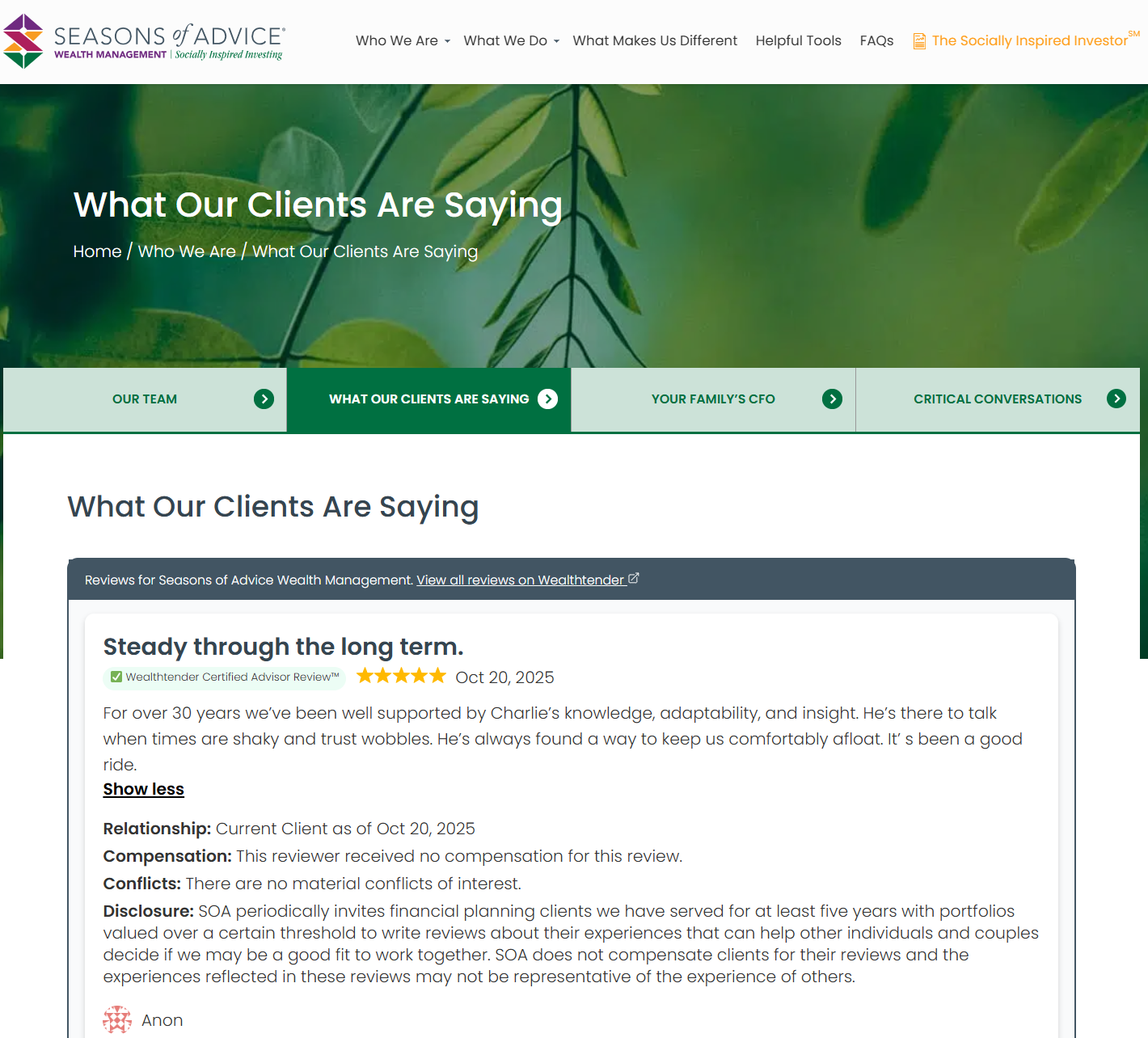
A website page titled "What Our Clients Are Saying" displays a client testimonial about the advisor’s knowledge and adaptability, dated Oct 20, 2025, with a 5-star rating and disclaimer below the review.

6. Update your LinkedIn “About” section, Featured section, and Services section with a reviews link. Many prospects research advisors via LinkedIn before scheduling. Make sure your reviews are one click away from your profile.

7. Upload compliant testimonial image graphics to your Google Business Profile and/or LinkedIn Profile. This is an underused tactic in advisor marketing. While you can’t promote your Google Reviews directly, you can upload branded image graphics showcasing a testimonial – designed with the required disclosures baked into the image itself – as “photos” on your Google Business Profile. Wealthtender’s Testimonial Marketing Studio makes this easy or you can create compliant images yourself in a tool like Canva by adding the proper disclosures. The image becomes a persistent, compliant testimonial in a high-visibility property you already own. Similarly, you can implement a similar approach on your LinkedIn profile by adding a testimonial graphic with compliant disclosures as a featured post.

Tier 2: Intermediate Plays (Compounding Returns)

These tactics require ongoing effort or process, but they’re where testimonial marketing starts meaningfully moving the needle on lead volume and conversion.

1. Single-testimonial social media posts (the cornerstone tactic). A well-designed social media post featuring a single client testimonial with required disclosures is one of the most effective promotional formats in modern advisor marketing. The challenge most advisors face isn’t the idea, it’s understanding the disclosure particulars. For Wealthtender subscribers, Testimonial Marketing Studio handles disclosure layout automatically across a growing library of professionally designed templates.

2. A curated testimonial carousel on your homepage (3–5 reviews). Particularly popular among multi-advisor firms. Display a rotating selection of standout reviews with the required “not representative” disclosure and link to your full reviews immediately below the carousel. Prioritize reviews whose content aligns with your Ideal Client Profile.
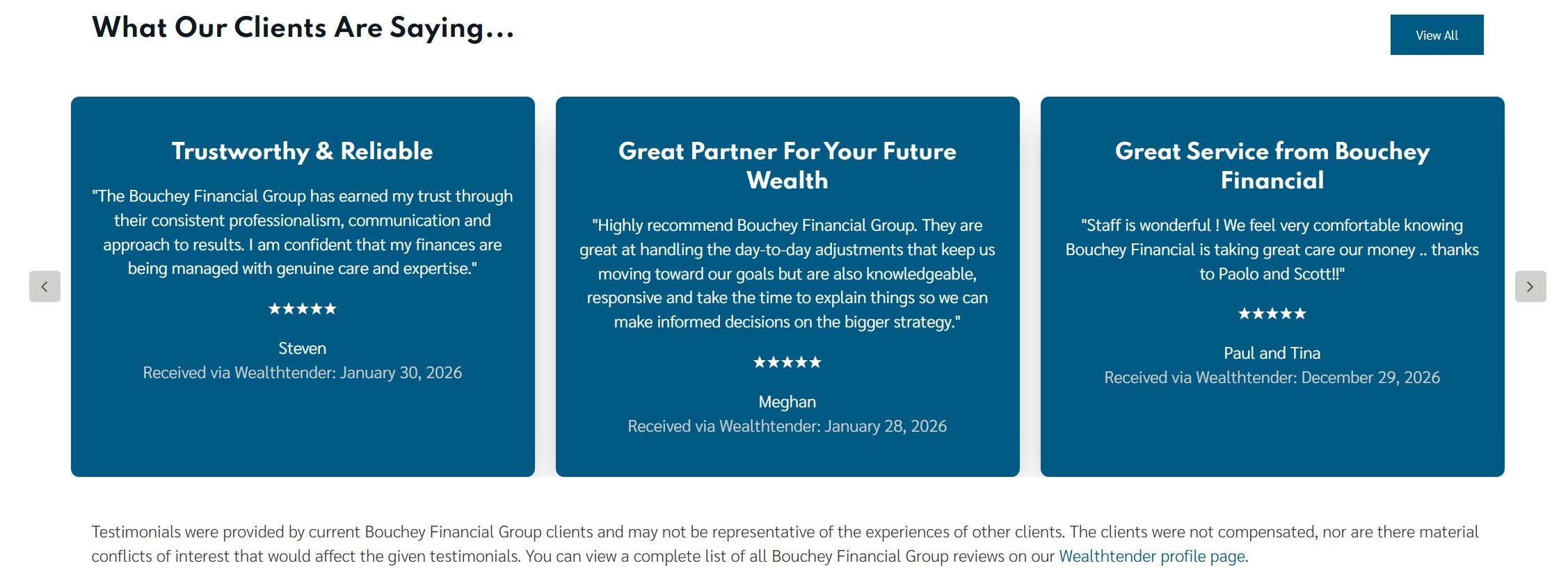
Three client testimonials for Bouchey Financial Group are displayed, each in a blue box, highlighting trustworthiness, expert guidance, and great service, with client names and Weatherbiter dates shown at the bottom.
Example of a compliant carousel feature displaying a curated selection of testimonials on the homepage of an advisor’s website. The three ‘clear and prominent’ disclosures are conveyed in the first two sentences within the disclosure area. The first sentence also addresses the ‘views not representative’ disclosure requirement. And the last sentence lets consumers know where they can go with a link to read a complete list of all of the firm’s reviews “on our Wealthtender profile page”. Screenshot from bouchey.com

3. Contextually relevant testimonials placed inline on service pages and niche landing pages. This is among the highest-leverage tactics in the entire guide. If you have a landing page on specialized services you provide like retirement planning for physicians, a single testimonial from a physician praising your work on that exact topic is exponentially more persuasive than a generic review and validates that what you say about your expertise in your own words is backed up by clients saying it in theirs. Same for business owners visiting your exit planning page, women visiting your widow/divorce transition page, or executives visiting your equity compensation page. The testimonials on these pages provide social proof at the precise moment of intent, and using Studio designs offers an easy way to handle the inline disclosure layout cleanly.

4. Contextually relevant testimonials embedded inline in blog articles. Apply the same principle to your content marketing. An article about funding a child’s college education becomes substantially more persuasive with an inline testimonial from a parent praising your education-funding work. An article on tax-efficient retirement income gains weight with a retiree’s review. Treat every blog post as an opportunity to ask: “Do I have a review that proves this expertise in a client’s own words?”

5. Niche-specific lead nurturing campaigns featuring testimonials from clients in that niche. Generic nurture sequences underperform compared to niche-specific sequences featuring social proof from clients who look like the prospect. A nurture sequence for “women navigating divorce” that surfaces reviews from women you’ve helped through divorce converts at a different rate entirely. Pairs naturally with your niche landing pages.

6. Reviews in newsletters and prospect drip campaigns. Rotate a featured client review (with disclosures and a link to your full set) into your email newsletter cadence. Re-engages existing audience and warms prospects already in your funnel.

7. Reviews in seminar and webinar marketing. Include a relevant testimonial in the seminar invitation email. Display testimonials on slides during the event or printed on flyers provided to attendees upon their arrival. Send a post-event follow-up that includes a relevant review with appropriate disclosures. Seminars and webinars often attract cold prospects – Your testimonials quickly close the trust gap and warm up the room.

8. Testimonials embedded as proof points inside educational webinar content. Don’t relegate testimonials to the opening or closing of webinars – weave them in as evidence at the moment a particular benefit or service is discussed. After explaining tax-loss harvesting, briefly display and read a review from a client who benefited from it. After describing your retirement income planning approach, share a testimonial from a retiree client. This is the webinar equivalent of inline contextual placement on a landing page.

9. Reviews in printed prospect kits, neighborhood postcard mailings, and pre/post-seminar flyers. Online reviews don’t have to stay online. A postcard mailing to a target neighborhood featuring a testimonial from a nearby client is highly impactful. A flyer at an educational seminar (or mailed to seminar attendees afterward) featuring a contextually relevant testimonial reinforces the trust built in person. QR codes make compliance straightforward (link to all reviews).

10. Repurpose written reviews into short video assets. Audio of the review (or text-on-screen animations of the review) with disclosures rendered on screen. Video gets disproportionate algorithmic reach on LinkedIn and Facebook. Studio templates support the creation of animated graphics, or consider using tools like Canva or partnering with a marketing agency who can offer professional support.

11. Ask third-party directories where you’re listed to embed your Wealthtender reviews. Your Wealthtender reviews are portable. Just as you’re able to use Wealthtender widgets to compliantly display client reviews on your website, if you’re listed on other advisor directories, ask each one if they will embed your Wealthtender reviews on your profile. By sharing your Wealthtender widget embed code, the process shouldn’t take more than 5 minutes for your reviews to be displayed. This ensures your reviews work for you across each of the platforms where prospects are most likely researching you, increases click-through rates and improves the effectiveness of all of your online profiles to generate more introductory calls.

Tier 3: Advanced & Sustained Testimonial Marketing Tactics (Market Leadership)

These are the initiatives implemented by advisors likely to experience the greatest growth over the next decade from those who take a more passive approach with their testimonials.

1. Build a recurring testimonial content series. A weekly “Testimonial Tuesday” or “Five Star Friday” campaign on LinkedIn (or whatever frequency and platform fits your marketing mix) builds a library of compliant assets, establishes consistency, and signals confidence to prospects and algorithms alike. Consistency beats episodic effort, and the cadence itself becomes a brand signal.

2. Identify your “biggest fans” for deeper-format content. As your testimonial library grows, you’ll discover which clients are most enthusiastic. These are candidates for long-form content: a podcast interview about their experience, a written Q&A case study, a longer-form video testimonial (tip: their online review offers a great starting point for a script). Long-form social proof converts the most skeptical prospects and creates assets that work for years.

3. Compliantly use testimonials in paid advertising. Google Ads, Meta Ads, and sponsored LinkedIn content can all incorporate testimonials when structured with proper disclosures. This tactic is rare in advisor marketing precisely because so few advisors understand the disclosure requirements, which is exactly why it’s a competitive opportunity.

4. Layer testimonials with awards, press, and earned media. If you or your firm has earned a Wealthtender Voice of the Client Award for consistently exceptional reviews, layer that recognition on top of your individual testimonials. See our companion guide on how to promote your Voice of the Client Award for tactics specific to award promotion.

5. Train every client-facing team member to incorporate testimonials in communications. Marketing tactics fall short when your entire team isn’t enlisted to execute them in a coordinated manner. A 30-minute internal training that walks every team member through where reviews live, how to point prospects to them, and what compliance guardrails apply turns your entire team into testimonial promoters.

6. Conduct a testimonial integration audit across every marketing channel. This is the capstone tactic and the framework that ties everything together. Map every prospect touchpoint your firm operates (e.g., website pages, email sequences, paid ads, lead generation platforms, intake workflows, proposal templates, voicemail follow-ups, even your physical office) and ask of each: “Where could a contextually relevant testimonial plug in here and how could it magnify our marketing?”

This audit is especially valuable for advisors using paid lead generation platforms like SmartAsset. When ~90% of advisors lack any reviews whatsoever, including a relevant testimonial in your cold lead nurturing emails immediately distinguishes you from other advisors competing concurrently for the very same lead. For a deeper dive into this topic, check out our related article: How Financial Advisors Using SmartAsset Can Drive Greater ROI with Wealthtender.

The audit also becomes the framework for your testimonial marketing prioritization roadmap, a living document that should be revisited quarterly.

Testimonial Promotion Playbook

Your Prioritized Action Plan

Tier Tactic Why It Matters Effort
⚡ Tier 1 — Quick Wins (Implement This Week)
T1 Add a “Read My Reviews” link to your email signature Every email becomes passive testimonial promotion. Zero ongoing effort; touches every client, prospect, and COI interaction. Low
T1 Add reviews link to auto-responders & booking confirmations Captures prospects at peak research intent — right after they book a discovery call and are most receptive to social proof. Low
T1 Use your Wealthtender QR code in printed materials Bridges offline introductions — business cards, brochures, office signage — to your full body of online social proof. Low
T1 Embed a Wealthtender widget displaying all reviews on your website The easiest compliant homepage option. Displaying all reviews automatically satisfies the “representative sample” requirement. Low
T1 Build a dedicated /reviews or /testimonials page Gives prospects a destination, gives SEO a target page, gives you the URL to use as your “representative sample” link. Low
T1 Update LinkedIn About, Featured, and Services with reviews link Many prospects research advisors on LinkedIn before scheduling. Make your reviews one click from your profile. Low
T1 Upload a compliant testimonial image to your Google Business Profile Underused workaround that adds compliant testimonial content to a high-visibility property. Low
📈 Tier 2 — Intermediate Plays (Compounding Returns)
T2 Single-testimonial social media posts (with disclosures) The cornerstone modern tactic. Testimonial Marketing Studio handles disclosure layout so advisors can focus on the story. Medium
T2 Curated testimonial carousel on homepage (3–5 reviews) High-impact homepage placement. Prioritize reviews aligned with your Ideal Client Profile for maximum conversion lift. Medium
T2 Place contextually relevant testimonials inline on niche landing pages ⭐ Among the highest-leverage tactics in the guide. A physician’s review on your physician landing page is E-E-A-T evidence at the moment of intent. Medium
T2 Embed contextually relevant testimonials inline in blog articles ⭐ A college funding article paired with a parent’s review of your college planning work is proof-in-context. Multiply your content’s persuasion. Medium
T2 Build niche-specific lead nurturing campaigns featuring relevant testimonials A “women in transition” sequence featuring reviews from women you’ve helped converts at a different rate than a generic sequence. Medium
T2 Rotate featured reviews into newsletters and prospect drip campaigns Re-engages your existing audience and warms prospects already in your funnel without adding new content overhead. Medium
T2 Integrate testimonials into seminar & webinar marketing Closes the trust gap with cold prospects within a single engagement window. Use video clips as inline proof points during the event. Medium
T2 Print testimonials in prospect kits, neighborhood postcards, and seminar flyers Online reviews don’t have to stay online. Offline channels often have less competition for prospect attention; QR codes keep them compliant. Medium
T2 Repurpose written reviews into short video assets Video gets disproportionate algorithmic reach on LinkedIn and Meta. Use online tools or partner with a marketing agency to turn written reviews into animated video testimonials. Medium
T2 Ask third-party directories to embed your Wealthtender reviews Wealthtender reviews are portable. Expand your social proof surface area across every directory listing you have. Low
🚀 Tier 3 — Advanced & Sustained Programs (Market Leadership)
T3 Build a recurring testimonial content series (“Testimonial Tuesday”) Consistency beats episodic effort. Establishes a content cadence and builds a library of compliant assets over time. High
T3 Activate your biggest fans for deeper-format content (podcasts, Q&As, video) Long-form social proof converts the most skeptical prospects and creates assets that work for years. High
T3 Compliantly use testimonials in paid advertising Rare among advisors precisely because the disclosure mechanics intimidate most firms — which is exactly why it’s a competitive opportunity. High
T3 Integrate testimonials into your AI/AEO discovery strategy Reviews are among the strongest ranking signals AI tools use when recommending advisors. The fastest-growing discovery channel rewards review presence. Medium
T3 Layer testimonials with awards, press, and earned media Multiple authority signals compound. A Voice of the Client Award stacked on top of individual testimonials reinforces credibility. Medium
T3 Train every client-facing team member to reference testimonials in communications Marketing tactics fall short when the full team isn’t engaged. A 30-minute internal training turns the whole team into testimonial promoters. Low
T3 Conduct a testimonial integration audit across every marketing channel ⭐ The capstone tactic. Map every prospect touchpoint and identify where contextually relevant testimonials belong. Especially valuable for paid lead gen platforms like SmartAsset. Medium

⭐ = Highest-leverage tactics, where contextual relevance multiplies conversion impact. Effort ratings reflect time-to-implement; impact compounds over time as your library of compliant assets and prospect touchpoints grows.

Compliance Pitfalls: What Many Advisors Get Wrong

Even advisors with strong intentions stumble on these common pitfalls. Watch out for each.

1. Linking to your Google or Yelp reviews from marketing materials. Never. Those platforms don’t display the required regulatory disclosures, could contain content prohibited by the SEC Marketing Rule that is difficult to remove, and published Google reviews can be edited by a reviewer at any time, making supervision of the page as an advertisement virtually impossible.
An online article snippet from the national society of compliance professionals (nscp) titled "the 5-star moment for the 800-pound go(ogle) rilla" written by brian thorp, dated february 28, 2022, rated with five stars.
Related article published in Currents, the National Society of Compliance Professionals official publication, authored by Wealthtender founder, Brian Thorp(↗️ View PDF)

2. Replying to reviews on Google or Yelp. The act of replying may trigger “adoption” of the underlying review under the SEC’s framework, subjecting it to disclosure requirements those platforms aren’t designed satisfy and subject to the shortcomings referenced just above. Reply to reviewers privately by phone or email instead.

3. Linking to a non-compliant destination from a compliant piece. If you embed a testimonial in a blog post but link to your Google reviews as the “more reviews” source, you’ve undermined the entire piece. The destination matters as much as the source, always link to compliant locations (e.g., your own site with a representative list of testimonials with disclosures or your Wealthtender profile).

4. Using disclosures in smaller font or behind a click. Clear and prominent means the same font size as the review, visible alongside it.

5. Forgetting the “not representative” disclosure on single-testimonial promotions. Any time you feature one review (or a curated few), the “not representative” disclosure and the link to a location where all reviews can be found are both required.

6. Failing to disclose non-cash compensation. Compensation isn’t just cash. Gift cards, charitable donations made in a reviewer’s name, advisory fee reductions, and incidental gifts near the time of a review can all qualify. When in doubt, disclose.

7. Treating social media as exempt from disclosure requirements. Character limits aren’t a regulatory excuse. If a post promotes a testimonial, the disclosures apply. Image-based posts make this easy to handle, though most platforms offer sufficient character counts in text blocks to display the necessary disclosures as well.

The Bottom Line on Promoting Testimonials Compliantly

If you take only one idea from this guide, take this: testimonial marketing is less about volume and more about contextual relevance. A single, well-placed review on a niche landing page can outperform a hundred reviews stacked on a generic testimonials page. A relevant testimonial inside a lead nurturing email can warm a cold lead in a way no subject line can. And contextually relevant reviews tell search engines and AI tools like ChatGPT and Gemini that there’s social proof validating that what you say you do on your website and online profiles is what clients say you have done for them as well.

The advisors positioned to win the next decade of consumer attention and show up more frequently and prominently in AI search tools won’t necessarily be the ones with the most reviews. They’re likely the ones with a consistent stream of reviews integrated into every meaningful prospect touchpoint and across online profiles, strategically, contextually, and compliantly.

If you’re an advisor in the Wealthtender community, every tool referenced in this guide, including the embed widgets, Testimonial Marketing Studio, your QR code, etc., is available to you today. Log into your dashboard, sign into Studio, and start with Tier 1 tactics this week.

If you’re not yet partnering with Wealthtender, our Modern Advisor Marketing platform was built specifically to help financial advisors and wealth management firms collect, display, and promote client reviews compliantly. To get in touch: schedule a Zoom call here or email us at yourfriends@wealthtender.com.

For more on related topics, see our guides on how to display testimonials on financial advisor websites, crafting compliant disclosures, and promoting your Wealthtender Voice of the Client Award.

Want to see how individual advisors and leading wealth management firms are successfully using Wealthtender to grow their business? Visit Wealthtender.com/grow or schedule a demo to learn how you can start converting more prospects into clients with the industry’s first digital marketing platform for AI-optimization and compliant online reviews.

Brian Thorp

About the author

Brian Thorp

Founder & CEO and Editor-in-Chief, Wealthtender

Brian Thorp is the founder and CEO of Wealthtender and its Editor-in-Chief. With more than 25 years in the financial services industry, he is applying his experience and passion at Wealthtender to help more people enjoy life with less money stress.

Brian and his wife live in Austin, Texas.

Do you work at Merck?

Get expert insights from financial advisors who specialize in helping Merck employees and executives make the most of their compensation package and benefits.

Looking for a financial advisor who specializes in working with Merck employees? You’re in the right place. Below, you’ll find advisors who understand Merck benefits and compensation — along with their answers to common financial questions from Merck employees and executives.

Whether you recently joined Merck or you’ve advanced into a management or executive leadership role over a multi-year career, making smart decisions about your income and Merck benefits can have a lasting impact on your financial future. For example:

  • Do you know the right moves to get the greatest value from the Merck benefits available to you?
  • If you’re thinking about leaving Merck for another job or planning to retire in a few years, are you taking the right steps today to receive all the compensation and benefits you’ve earned?

Key Takeaways

1

Merck Stock in Your 401(k) May Qualify for Net Unrealized Appreciation Tax Treatment

When company stock with a low cost basis is distributed from the 401(k) under a Net Unrealized Appreciation strategy, the gain can be taxed at capital gains rates rather than as ordinary income. The advisors below describe using this strategy in a lower-income first year of retirement to reduce a concentrated Merck position tax-efficiently.

2

Plan Your Merck Pension Payout Choice Years Before You Retire

Eligible Merck employees must choose between a lump sum and monthly pension options at retirement, and waiting until the last minute limits the choices. One advisor below recommends starting that planning five to 15 years before retirement so the pension fits a coordinated income and tax strategy.

3

RSUs, Performance Shares, and the Merck Stock Fund Can Quietly Concentrate Your Wealth

Restricted stock units, performance share units, and Merck stock held inside the 401(k) can together build a larger single-stock position than employees realize. The advisors below recommend a coordinated, tax-aware selling plan rather than holding by default.

Why Merck Employees Work with a Specialist Financial Advisor

Throughout the year, Merck provides its employees and executives with updates about their benefits, ranging from health insurance and health savings accounts to retirement plans like a 401(k), a pension plan for eligible employees and, for senior leaders, a deferred compensation plan — along with equity compensation such as restricted stock units and performance share units. While the company offers many useful resources and access to knowledgeable staff who can assist with questions, you’ll also find financial professionals not affiliated with Merck who specialize in helping Merck employees make the most of their income and benefits.

Merck’s global headquarters is in Rahway, New Jersey, where the company consolidated its New Jersey operations after leaving its former Kenilworth campus, and its largest U.S. manufacturing and research presence outside New Jersey is in West Point, Pennsylvania. The company also has research sites in the Boston area and South San Francisco. Whether you work at one of those sites, in a field role, or remotely from home, you may have questions about your compensation package and benefits better suited for a financial professional who can offer unbiased advice and guidance.

Sensitive topics — like the steps you should take before quitting your job at Merck to work elsewhere, protecting yourself in advance of a corporate layoff, or deciding when you should plan to retire — are all conversations that may be more comfortable with a trusted financial advisor.

Should You Hire a Merck Specialist or a Local Financial Advisor?

You’ll likely find dozens of nearby financial advisors well-suited to help you reach your money goals with a personalized plan. But it can be harder to find a financial advisor who specializes in serving Merck employees. Fortunately, many financial advisors offer virtual services, so you can meet online no matter where you (or they) live — which means you can hire a specialist financial advisor who lives hundreds of miles away if their knowledge and experience working with Merck employees is the better fit for your unique needs.

In the Q&A below, you’ll gain insights from financial advisors who work with Merck employees to help them make smart decisions, get the most value from their compensation and benefits, reduce their money stress, and prepare for a comfortable retirement.

Have a question not yet answered? Use the form below to submit your question. You can also contact financial advisors directly to set up an introductory call or contact them with your questions.

Q&A: Financial Planning Tips for Merck Employees & Executives

In this section, you’ll learn how you can make the most of your Merck employee benefits and gain valuable tips from financial advisors who specialize in working with Merck employees and executives.

Financial Advisor Q&A  ·  Merck Employees

Albania Espinal, CFP®, Financial Advisor for Merck Employees at Alegre Wealth

Albania Espinal, CFP®

Alegre Wealth  ·  Wayne, PA  ·  Serves clients nationwide

Fee-Only Financial Planning for Hardworking Professional Women | Fiduciary
Book Intro Call

Albania Espinal is a financial advisor based in Wayne, Pennsylvania who specializes in offering financial planning services to Merck employees. Albania helps her clients get the most value from their Merck benefits and compensation package so they can enjoy life and feel confident about their financial future.

QAs a financial advisor with experience helping Merck employees save for their retirement, how do you help them make the most of their employee benefits?

When I work with employees from Merck & Co., the first step is helping them understand how all of their benefits work together as part of a long-term financial plan. Merck offers a strong benefits package, including a competitive 401(k), equity compensation for many employees, and in some cases legacy pension benefits. My role is to help employees make thoughtful decisions around how to maximize those opportunities.

Many Merck employees receive Restricted Stock Units (RSUs) as part of their compensation, which typically vest over several years and are taxed as ordinary income at vesting. Depending on role and seniority, employees may also receive Performance Share Units (PSUs) that vest based on company performance metrics. In addition, Merck has offered an Employee Stock Purchase Plan (ESPP) at times, allowing employees to purchase company shares at a discount through payroll deductions.

Because Merck has had periods of strength over the years, I often see employees accumulate a significant portion of their net worth in company stock without realizing how large that exposure has become. Over time, RSU vesting and performance shares can quietly build a concentrated position.

My role is to help employees look at their full financial picture and make thoughtful decisions about how much company stock to hold, when diversification may make sense, and how these equity benefits fit into their long-term retirement plan and tax strategy. When used intentionally, Merck’s equity compensation can be a powerful wealth-building tool, but it’s important to ensure it stays aligned with the employee’s broader financial goals rather than becoming an unintended concentration risk.

QIs there anything that comes up frequently in your initial meeting with Merck employees that surprises you?

One thing that often surprises me when I first meet with employees from Merck & Co. is how strong their saving habits are, yet how uncertain many of them feel about whether they have “enough.”

Merck employees tend to be very disciplined savers. Over the years they may have accumulated significant assets across several accounts, such as their 401(k), brokerage accounts, company stock from equity compensation, and in many cases a pension. Despite this, many still feel unsure about how all these pieces translate into a reliable retirement income plan.

What often brings them peace of mind is shifting the conversation from how much they have saved to how their savings can support the life they want in retirement. Together I walk through how income might realistically come from different sources, such as retirement accounts, company stock, Social Security, and other savings, and how those pieces can work together over time.

For many Merck employees, simply seeing how their years of disciplined saving can turn into a clear and sustainable income strategy is one of the most reassuring parts of the planning process.

QFor highly compensated Merck employees and executives, are there any special benefits you believe it’s important to take into consideration when preparing their financial plan?

For highly compensated employees and executives at Merck & Co., one benefit that often deserves special attention in the financial planning process is participation in a nonqualified deferred compensation (NQDC) plan.

These plans allow employees to defer a portion of their salary or bonus beyond the limits of traditional retirement plans such as a 401(k). While this can be a powerful tool for managing taxable income during peak earning years, it also requires thoughtful planning because the deferred income is fully taxable when it is distributed.

One of the most important decisions employees make when enrolling is selecting the timing of future distributions. Those elections are typically locked in well in advance, so it’s important to think carefully about how those future payments may align with retirement, other income sources, and potential tax brackets. Without planning, it’s possible for deferred compensation distributions to overlap with other income sources, such as RSU vesting, retirement account withdrawals, or consulting income, which can push someone into a higher tax bracket than expected.

When working with Merck employees, I often model how different distribution schedules might interact with their broader retirement income plan. The goal is to use deferred compensation strategically to smooth taxable income over time, rather than creating large spikes in income during retirement. When coordinated thoughtfully with the rest of a client’s benefits and savings, these plans can be a very effective tool for long-term tax efficiency.

QIs there a particularly memorable experience or a moment you recall with a client who worked at Merck when you realized they have unique opportunities and circumstances when it comes to their financial planning needs?

One experience that stands out involved a Merck employee who had built significant wealth through years of disciplined saving and long tenure at Merck & Co.. When we reviewed their accounts together, I discovered they held a substantial amount of Merck stock in several places, including shares from equity compensation in a brokerage account as well as a large position in the Merck stock fund within their 401(k).

Because the shares inside the 401(k) had a very low cost basis, I explored whether a Net Unrealized Appreciation (NUA) strategy could make sense. In this client’s case, it did. They were planning to have relatively limited income in their first year after leaving the company, which created a favorable window to implement the strategy.

By distributing the company stock using NUA, they were able to reduce a concentrated position in a tax-efficient manner, while also using the proceeds from gradually selling those shares to help fund their first several years of retirement income. It was a great example of how understanding the nuances of an employer’s benefits plan can turn what initially looks like a concentration risk into a thoughtful planning opportunity.

Considering a financial advisor who specializes in working with Merck Employees?

Financial Advisor Q&A  ·  Merck Employees

Michael Rosenberg, RFC, CPFA, Financial Advisor for Merck Employees at Diversified Investment Strategies, LLC

Michael Rosenberg, RFC, CPFA

Diversified Investment Strategies, LLC  ·  Florham Park, NJ  ·  Serves clients nationwide

Dedicated to providing experienced guidance on all aspects of wealth management.
Book Intro Call

Michael Rosenberg is a financial advisor based in Florham Park, New Jersey who specializes in offering financial planning services to Merck employees. Michael helps his clients get the most value from their Merck benefits and compensation package so they can enjoy life and feel confident about their financial future.

QAs a financial advisor with experience helping Merck employees save for their retirement, how do you help them make the most of their employee benefits?

The biggest benefit I see for Merck employees working with me, is coordinating their Merck benefits with their personal financial goals and objectives, this is further exemplified when we address retirement planning. Many Merck employees have Restricted Stock Unites (RSU) as an important part of their compensation plan as well as the companies Employee Stock Purchase Plan (ESPP), overtime these plans become a significant portion of the employee’s assets. These plans are great way to save for the future, the one pitfall I see is the employee’s assets are over concentrated in one stock, something they wouldn’t do with an individual portfolio. Therefore it is important to coordinate the holdings with their individual portfolio and have a plan to sell stock, before gains become to prohibitive to sell. A tax mitigation strategy should be in place to handle lowering taxes on gains from the sale of company stock. Selling company stock, should be within a coordinated plan with emphasis on tax mitigation. Additionally, Merck has a Pension Plan for employees, most employees do not address this until it is too late. Upon retirement, the employee must select between a lump sum or various pension options. Waiting until retirement, limits the employees options, therefore careful planning should take place for each employees between 5 and 15 years before retirement.

QWhen you first speak with a Merck employee, what questions do you like to ask to better understand their unique circumstances and determine how you can best help them achieve their goals?

I want to understand and know their short term and long term goals, what their risk tolerance is and when they plan to retire. I also want to know what they are doing outside the company, so we can better coordinate – savings within employee benefits program with personal savings they are doing currently.

QIs there a particular benefit available to Merck employees you feel isn’t as well utilized or understood by employees as it should be?

I would say the Back Door Roth, too often i see employees of Merck maxing out 401k plan which could be a good thing, but they are setting themselves up in retirement of not being able to control taxes, this makes them vulnerable to future tax increases. My goal is to do planning now, so we can minimize taxes in retirement. Essentially and back door Roth, is where employee makes a non-deductible contribution to the company 401k, and then converts it to a Roth, the only tax would be any gain made inside the 401k before converting it.

QBeyond Merck employee benefits for retirement savings, are there other types of benefits offered by the company that you find valuable to discuss with your clients?

Educational savings accounts available through Merck are a great way to save for college, the company offers scholarships as well, in addition they have a special savings plan for children of employees through Merck Credit Union. The difference between a Health Savings Account and Flexible Health Savings Account can be confusing. One thing I see is lack of planning, especially when it comes to retirement. I always suggest maxing out Health Savings Accounts because it isn’t a use it or lose it scenario. In addition, if your planning to retire within 10 years, maxing out the HSA for retirement is important, as the HSA funds can be used for dental cost, Medicare deductibles, as well as insurance premiums for Medicare supplemental insurance.

QFor Merck employees thinking about leaving the company to accept a job elsewhere, what actions do you recommend they take before resigning and shortly thereafter?

I would advise meeting with a financial advisor that is familiar with corporate benefits and compare current benefits package and compensation to potential new employer. One area we have had success, is utilizing deferred compensation, suppose someone is looking to move to new employer and the increase in pay might equate to $80,000. We actually created a deferred compensation plan, where the employee deferred 50% ($40,000) of compensation to receive the deferred income when retired. Also makes sense to weigh keeping 401k and present employer compared to rolling over to new employer or rolling over to an Individual Retirement Account. Thus once employee resigns or shortly thereafter they can have the decision already made to what to do with retirement funds. I would also suggest a review of current company stock owned in either inside 401k as well as through company stock options.

QFor Merck employees approaching retirement age, how do you recommend they prepare to make the transition from living off their salary to relying upon other sources of income?

First thing I would suggest is to meet with a Wealth Manager who specializes in working with people who are transitioning to retirement. Most people make the big mistake of not seeking advice, especially if they have been managing their own finances throughout their working careers. The reason I find it so important is because managing money in the accumulation stage is totally different in the withdrawal stage. Managing risk is so crucial, as well as selecting the right withdrawal strategy, a mistake here and the employee could face longevity risk, or the risk of outliving their money. Market risk needs to be considered, here it is creating a balance between managing risk, but also seeing growth. a mistake in this and the employee can suffer sequence of return risk. Also paramount, is determining a withdrawal strategy, does one take from personal funds first, may consider a Roth Conversion, and then take RMDs and Roth Income later, taking social security earlier than waiting to Full Retirement Age could make sense as well to let other funds grow. Again each person is going to be different and their circumstances are going to be different why it is so important as a first step to seek professional advice.

QWhat are some of the unique financial planning challenges you commonly see among your clients who are Merck employees and how do you help them overcome these obstacles?

I find Merck employees tend to be very diligent, organized when it comes to their personal financial planning needs. They also tend to be good savers. One thing I do note, they tend not to do a lot of forward thinking, for example – they may not adjust their portfolio to reflect their time horizon. another is over emphasis on tax deferral and not focus on future taxes. While working, most employees can handle inflation, taxes, even healthcare risks. But once retired these risks can be devastating, so the plan you lay out today for your future will dictate how comfortable your retirement will be. So when I work with an employee of Merck, we focus on three things, short term goals, mid-term goals and long-term goals.

QWhat questions do you recommend Merck employees ask financial advisors they’re considering hiring to help them decide if they’re a good fit?

I think experience is so important, the advisors commitment to education is also equally important. Really the most crucial detail one needs to ask though – does this person understand me and what I want to accomplish, if the advisor doesn’t understand his client, there will be no client success story. So make sure the advisor has a process to gain a full understanding of his or her client. I would start by asking the question, beyond me just showing you my numbers, what is your process to understand me?

QIs there anything that comes up frequently in your initial meeting with Merck employees that surprises you?

I am also surprised about questions about 401k plans, I frequently get asked should I contribute and how much should I contribute. I would say that employees should contribute up to the match, and then establish a personal savings plan on a systematic basis outside of that.

QFor highly compensated Merck employees and executives, are there any special benefits you believe it’s important to take into consideration when preparing their financial plan?

Company stock held inside 401k plan provides unique opportunity in that once ready to retire or after attaining age 591/2 , although there are some planning opportunities for those at age 55 to 59. But suppose someone has $100,000 in company stock in there 401K, with a $20,000 cost basis. If they transfer the 401k (like kind) to a brokerage IRA. They pay tax on the cost basis, but only pay capital gains on the balance. Typically all 401k withdrawals are taxable at ordinary income rates, this provides opportunity to pay less tax on your 401k through company stock ownership.

QIs there a particularly memorable experience or a moment you recall with a client who worked at Merck when you realized they have unique opportunities and circumstances when it comes to their financial planning needs?

I have worked with many Merck employees and three areas we really provided assistance on; 1) helping employees understand the importance of Roth IRA planning and assisting them in formulating a backdoor Roth strategy through their Merck 401K. 2) Assistance with Stock inside their 401k and how to minimize taxes and utilize the unique advantage of holding company stock inside their 401k. 3) Providing coordination, between company benefits and their personal financial planning goals and objectives.

Considering a financial advisor who specializes in working with Merck Employees?

Financial Advisor Q&A  ·  Merck Employees

Shikha Mittra, AIF®, CFP®, CMFC®, CRPS®, PPC®, RMA®, CEPA®, MBA, Financial Advisor for Merck Employees at Retire Smart Consulting, LLC

Shikha Mittra, AIF®, CFP®, CMFC®, CRPS®, PPC®, RMA®, CEPA®, MBA

Retire Smart Consulting, LLC  ·  Princeton, NJ  ·  Serves clients nationwide

Princeton, NJ Fiduciary Fee-Only Financial Planner
Book Intro Call

Shikha Mittra, AIF®, CFP®, CMFC®, CRPS®, PPC®, RMA®, MBA is a financial advisor based in Princeton, New Jersey who specializes in offering financial planning services to Merck employees. Shikha helps her clients get the most value from their Merck benefits and compensation package so they can enjoy life and feel confident about their financial future.

QAs a financial advisor with experience helping Merck employees save for their retirement, how do you help them make the most of their employee benefits?

Making sure they are maximizing their benefits package and prevent overlap of benefits hence reduce costs.

QWhen you first speak with a Merck employee, what questions do you like to ask to better understand their unique circumstances and determine how you can best help them achieve their goals?

How long have you worked for the company , pension, executive benefits. When would they like to retire.

QIs there a particular benefit available to Merck employees you feel isn’t as well utilized or understood by employees as it should be?

Retirement packages, stock options, lumpsum versus monthly benefits.

QBeyond Merck employee benefits for retirement savings, are there other types of benefits offered by the company that you find valuable to discuss with your clients?

Stock options, RSUs, HSAs.

QFor Merck employees thinking about leaving the company to accept a job elsewhere, what actions do you recommend they take before resigning and shortly thereafter?

Evaluate your total financial picture before taking that step.

QFor Merck employees approaching retirement age, how do you recommend they prepare to make the transition from living off their salary to relying upon other sources of income?

Get an independent fee only financial plan to see how income and expenses stack up.

QFor Merck employees who have managed their finances on their own to this point, what would you suggest they consider to help them decide if they should begin working with a financial advisor at this stage in their lives?

Evaluate what they have done and find if there are any gaps, if there are, point it out and if they want the advisor’s help, that’s their mutual decision.

QWhat are some of the unique financial planning challenges you commonly see among your clients who are Merck employees and how do you help them overcome these obstacles?

Loading up on target date funds or select two or three mutual funds for their 401k. By educating on importance of diversification.

QWhat questions do you recommend Merck employees ask financial advisors they’re considering hiring to help them decide if they’re a good fit?

Are they fiduciary, fee only? Will they put it in writing? Do they know how will the sunset on Tax Laws impact the executives?

QIs there anything that comes up frequently in your initial meeting with Merck employees that surprises you?

They think brokers/sales rep are financial advisors.

QFor highly compensated Merck employees and executives, are there any special benefits you believe it’s important to take into consideration when preparing their financial plan?

Comb through their executive packages to see what benefits go away at retirement. Some companies pay for executive financial planning as a perk.

Considering a financial advisor who specializes in working with Merck Employees?

Are you a financial advisor who specializes in working with employees at Merck or another large company?

Join Wealthtender and get featured as a specialist financial advisor based on your knowledge and experience working with employees at Merck or another large company. (Subject to availability and terms.) Sign up today and join financial advisors attracting their ideal clients on Wealthtender.

Ask an advisor

Ask a Financial Advisor Your Merck Benefits & Career Questions

Keep exploring

Find the Right Financial Advisor for You

Browse specialists, compare advisors near you, or find advisors who know your employer’s benefits.

Brian Thorp

About the author

Brian Thorp

Founder & CEO and Editor-in-Chief, Wealthtender

Brian Thorp is the founder and CEO of Wealthtender and its Editor-in-Chief. With more than 25 years in the financial services industry, he is applying his experience and passion at Wealthtender to help more people enjoy life with less money stress.

Brian and his wife live in Austin, Texas.

Are you a real estate investor ready to step back from being a landlord?

For real estate investors who are tired of active property management, Delaware Statutory Trusts, 721 exchanges, and 1031 strategies offer a path to passive ownership — without surrendering a large share of your gains to taxes. But these strategies are complex, the DST industry has long been dominated by commissioned salespeople rather than fiduciaries, and the difference between the right structure and the wrong one can cost far more than the tax bill you were trying to avoid. Here’s what you need to know — and what the most common mistakes look like — from a fee-only fiduciary who works exclusively in this space.

If you’ve spent years building wealth through investment real estate, you know what it costs to be a landlord, not just in dollars, but in time, stress, and the 2 a.m. phone calls you’ll never get back. What’s less obvious is what it could cost to stop.

Selling an appreciated investment property can trigger capital gains taxes (federal, state, and depreciation recapture combined) that claim a substantial portion of everything you’ve built. For many long-term real estate investors, that tax liability isn’t a number they’re willing to accept, which is why Delaware Statutory Trusts (DSTs), 721 UPREIT exchanges, and 1031 exchange strategies have grown increasingly popular as tools for transitioning from active property ownership into passive real estate without an immediate and painful tax event.

But these strategies aren’t simple, and the DST industry has historically been driven by commissioned salespeople rather than fiduciaries. The wrong advice (or advice from the wrong kind of advisor) can cost far more than the tax bill you were trying to avoid.

That’s why finding a specialist who works exclusively with real estate investors navigating complex exit strategies matters so much. While you’ll find many nearby financial advisors who can help with general financial planning, identifying one with deep, specific expertise in DSTs, 721 exchanges, and fiduciary-first real estate exit planning is a different search entirely.

Key Takeaways

1

A Delaware Statutory Trust lets real estate investors exit active property management through a 1031 exchange — without an immediate capital gains tax bill.

DSTs allow investors to exchange out of actively managed properties and into professionally managed real estate — multifamily communities, industrial assets, medical offices, and net-lease portfolios — while deferring taxes through a 1031 exchange. For many tired landlords, the appeal isn’t the legal structure itself; it’s the simplification, diversification, and freedom from active management it provides.

2

Whether a DST or 721 UPREIT exchange is right for you depends on your long-term goals — not just your tax situation.

A traditional DST preserves your ability to complete future 1031 exchanges, while a 721 exchange converts your interest into operating partnership units of a larger REIT — offering potential advantages in diversification, liquidity, and multigenerational estate planning. The right choice starts with a clear understanding of what you’re actually trying to accomplish, not which structure defers the most tax today.

3

The most costly DST mistake isn’t choosing the wrong structure — it’s waiting too long to start planning.

Investors who don’t begin the planning process until a property is already under contract face tighter timelines, narrower options, and reactive decision-making. Starting the conversation months before a sale — and working with a fee-only fiduciary rather than a commissioned broker — gives you the time and unbiased guidance needed to choose the structure that genuinely fits your goals.

Why Real Estate Investors Work with a DST and 721 Exchange Specialist

Selling an investment property you’ve owned for years can trigger federal and state capital gains taxes plus depreciation recapture. Strategies like 1031 exchanges, Delaware Statutory Trusts, and 721 UPREIT exchanges may help defer those taxes, but each comes with strict timelines, complex rules, and long-term tradeoffs. A financial advisor who specializes in these strategies can help you understand how they fit into your broader financial and estate plan.

Who gives that advice matters, too. Many DST investments have historically been sold through commission-based channels, so working with a fee-only fiduciary can help ensure recommendations are based on your goals rather than on how a product pays. An advisor focused on real estate investors can help you evaluate your options well before the clock starts ticking.

Should You Hire a DST Specialist or a Local Financial Advisor?

The good news: advisors like Carl E. Sera, CMT, of Sera Capital in Annapolis, Maryland, offer virtual services nationwide, meaning geography doesn’t have to limit your access to genuine expertise.

In the Q&A below, you’ll gain insights from a financial advisor who specializes in helping real estate investors transition from active property ownership into passive real estate through Delaware Statutory Trusts, 721 exchanges, and 1031 exchange strategies while minimizing tax exposure and simplifying long-term estate planning.

Do you have questions not answered below? Use the form on this page to submit your questions. You can also contact the financial advisors featured in this article directly to set up an introductory call or ask your questions by email.

Q&A: Financial Planning Insights for DST and 721 Exchange Investors

In this section, you’ll gain valuable tips from a financial advisor who specializes in working with real estate investors exploring DSTs and 721 exchanges.

Financial Advisor Q&A  ·  DST and 721 Exchange Investors

Carl E. Sera, CMT, Financial Advisor for DST and 721 Exchange Investors at Sera Capital

Carl E. Sera, CMT

Sera Capital  ·  Annapolis, MD  ·  Serves clients nationwide

Helping Real Estate Investors Plan Tax-Efficient Exits | Independent & Fee-Only
Book Intro Call

We asked Annapolis, Maryland-based financial advisor Carl E. Sera, CMT, who works exclusively with real estate investors navigating complex exit strategies, to answer the questions his clients ask most often when they’re ready to stop managing properties and start planning what comes next. As president and managing principal of Sera Capital, a fee-only fiduciary firm, Carl advises high-net-worth individuals, families, and financial advisors nationwide on 1031 exchanges, DSTs, and 721 UPREIT structures.

QWhat exactly is a Delaware Statutory Trust (DST), and why are more real estate investors using them?

Most people don’t wake up wanting to invest in a Delaware Statutory Trust. They reach a point where they’re simply tired of being landlords. Over the past several years, we’ve seen more real estate investors looking for a way to transition from active property management into passive real estate ownership without immediately triggering a large capital gains tax bill. That’s where DSTs have become increasingly popular.

A DST allows investors completing a 1031 exchange to move from active property management into professionally managed real estate ownership through assets such as multifamily communities, industrial properties, medical offices, and net-lease portfolios. For many of our clients, it’s less about the legal structure itself and more about what it represents: simplification, diversification, and freedom from active management.

QWhat’s the difference between a DST and a 721 UPREIT, and when does one make more sense than the other?

Many investors mistakenly think the DST is the end goal. Increasingly, we view it as one step in a broader transition from direct property ownership into professionally managed real estate. A traditional DST is typically designed to help investors complete a 1031 exchange and remain in real estate ownership. A 721 exchange goes a step further by allowing investors, over time, to convert into operating partnership units of a larger REIT structure.

For some families, that creates meaningful advantages around diversification, estate planning, liquidity, and simplifying multigenerational wealth management by moving from one or two concentrated properties into exposure across hundreds or even thousands of properties. That said, there’s no universal answer. Some investors prefer traditional DSTs because they want to preserve the ability to continue completing future 1031 exchanges. Others are more focused on long-term passive ownership and estate simplification, where a 721 structure may be more appropriate.

The key is understanding what the investor is actually trying to accomplish before choosing the structure.

QWhy does it matter whether your 1031 and DST advisor is a fee-only fiduciary rather than a commission-based broker?

This is one of the most important and least discussed aspects of the DST industry. Historically, many DST investments were sold through commission-based broker-dealers, where advisors may be compensated differently depending on which product or sponsor they recommend. Investors should understand exactly how their advisor is being compensated before making a multi-million dollar real estate decision.

As a fee-only fiduciary firm, we waive commissions entirely and work solely on behalf of the client. That changes the dynamic of every conversation. Instead of asking “which product pays the highest commission,” the focus becomes “what structure actually makes the most sense for this client’s goals, tax situation, liquidity needs, and long-term plan?”

It also allows us to work collaboratively with existing financial advisors, CPAs, attorneys, and family offices, many of whom simply want a trusted fiduciary partner to help navigate the complexity while they maintain the long-term client relationship.

QHow can a DST be used as part of an estate planning strategy, and what happens to a DST investment when the owner passes away?

For many of our clients, estate planning eventually becomes just as important as tax deferral. One reason DSTs and 721 structures have grown more popular is that they can help older investors simplify ownership while creating a smoother transition for heirs. Instead of leaving behind multiple actively managed properties, investors may be able to consolidate into professionally managed real estate with centralized reporting and administration.

Generally speaking, when a DST investor passes away, their heirs receive a step-up in cost basis based on the fair market value at the date of death, which can significantly reduce or even eliminate the deferred capital gains tax burden for the next generation. Every family’s situation is different, and these strategies should always be coordinated with an estate planning attorney and CPA.

But for many clients, the conversation gradually evolves from “How do I defer taxes today?” to “How do I simplify this for my family long term?”

QWhat’s the most common mistake you see real estate investors make when approaching a 1031 exchange or DST, and how can they avoid it?

Waiting too long.

A surprising number of investors don’t start planning until their property is already under contract or about to close. At that point, the clock is ticking, options narrow quickly, and decisions become reactive rather than strategic. The investors who tend to have the best outcomes start the conversation earlier, sometimes months before a sale, which gives them time to evaluate structures thoughtfully, coordinate with their CPA and attorney, and determine whether a DST, a 721 exchange, an Opportunity Zone strategy, or simply paying the tax is actually the right fit.

The other common mistake is focusing only on tax deferral rather than the bigger picture. Taxes matter, but the investment itself matters more. A good strategy should improve the investor’s overall quality of life and financial position, not just postpone a tax bill.

Carl E. Sera, CMT, Financial Advisor for DST and 721 Exchange Investors at Sera Capital

Considering a financial advisor who specializes in working with DST and 721 Exchange Investors?

Carl E. Sera, CMT, is President and Managing Principal of Sera Capital Management, a fee-only fiduciary firm focused on complex real estate exit planning. He works with high-net-worth individuals, families and financial advisers to navigate the transition from concentrated real estate positions into more diversified, portfolio-oriented investments in a tax-efficient manner.

Carl advises financial advisers and their clients nationwide on complex real estate decisions, including 1031 and 721 exchanges, and how those transitions integrate with broader portfolio construction and long-term investment strategy.

Are you a financial advisor who specializes in DSTs and 721 Exchanges?

Join Wealthtender and get featured as a specialist financial advisor based on your knowledge and experience (subject to availability and terms). Sign up today and join financial advisors attracting their ideal clients on Wealthtender, or request more information by email:

  • This field is for validation purposes and should be left unchanged.
Ask an advisor

Have Questions About DSTs and 721 Exchanges?

Keep exploring

Find the Right Financial Advisor for You

Browse specialists, compare advisors near you, or find advisors who know your employer’s benefits.

Brian Thorp

About the author

Brian Thorp

Founder & CEO and Editor-in-Chief, Wealthtender

Brian Thorp is the founder and CEO of Wealthtender and its Editor-in-Chief. With more than 25 years in the financial services industry, he is applying his experience and passion at Wealthtender to help more people enjoy life with less money stress.

Brian and his wife live in Austin, Texas.

What this article covers

Discover financial advisors trusted by residents of Palm Springs, California in the only local directory featuring 5-Star Certified Advisor Review™ recipients and Wealthtender Voice of the Client Award™ winners, recognition earned for exceptional client feedback. Compare fiduciary, fee-only advisors, CFP® professionals, and specialists to find the right fit for your unique financial needs.

Financial Advisor Directory for Palm Springs, California

📍 Map: Financial Advisors with their Primary Office Location in Palm Springs

Double-click (or pinch the map on mobile devices) to zoom in and expand the details for financial advisors whose primary office location is in Palm Springs.

📍Double-click or pinch pins to view more.

Showing

Key Takeaways

1

You can compare Palm Springs financial advisors by credentials, specialty and verified client reviews before you contact anyone.

The map shows advisors whose primary office is in Palm Springs. Profiles include Certified Advisor Reviews™, designations such as the CFP® and the services each advisor offers.

2

In Palm Springs, extreme heat, earthquake risk and a tight insurance market belong in every household’s financial plan.

Record summer heat and the nearby San Andreas fault make home insurance, earthquake coverage and cooling costs real budget items, and some owners end up relying on the California FAIR Plan. The local economy runs on health care and tourism, and many owners rent out homes or live here part of the year, which has its own California tax rules.

3

Interview more than one advisor and confirm how each one is paid.

Ask about services, fees and whether the advisor acts as a fiduciary, then check their background for free on the SEC’s Investment Adviser Public Disclosure website before you hire.

Financial Planning Considerations for Palm Springs Residents

Every city has its own financial landscape. Here are a few local factors worth discussing with a Palm Springs financial advisor.

Extreme heat and home insurance

Palm Springs sees long stretches of triple-digit heat each summer, and 2020 was on pace for a record number of 100-degree days (as reported at the time), so cooling bills and air conditioning replacement deserve a line in any budget. Insurance is another pressure point. When a homeowner can’t get coverage from a regular insurer, the California FAIR Plan offers a limited fire policy with limits up to $3 million for homes, and coverage such as liability and water damage requires a separate difference-in-conditions policy.

Earthquake risk on the San Andreas

Palm Springs sits near the southern San Andreas fault, and U.S. Geological Survey research near Thousand Palms dates the last large rupture on this section to around 1676. Standard homeowners policies generally don’t cover earthquake damage, so earthquake insurance is a separate choice. For retirees with much of their net worth in a paid-off home, weighing the deductible against cash reserves is part of the decision.

A health care and tourism economy

Health care and social assistance is the city’s largest employment sector with about 9,067 jobs, followed by accommodation and food services with 8,217, per JobsEQ data as of mid-2025, and the city has called Desert Care Network its largest employer. Regionally, visitors supported about one in four Greater Palm Springs jobs in 2024, per a Tourism Economics study. Clinicians often focus on retirement plans and disability insurance, while hospitality workers plan around seasonal income.

Renting out a Palm Springs home

Many Palm Springs homes are owned by part-year residents or rented to visitors. California’s Franchise Tax Board guidelines tax nonresidents on California-source income, including net rent from a California property and the gain when it’s sold. A resident is presumed to be anyone who spends more than nine months a year in the state. Owners who live elsewhere should plan for a California nonresident return, and California excludes Social Security benefits from taxable income for those who are residents.

The Benefits of Hiring a Financial Advisor in Palm Springs

Hiring a financial advisor can be a great move to help you build a long-term investing strategy. Advisors can help you build an investment portfolio to meet your financial goals and help you plan appropriately for retirement.

As a resident living in Palm Springs, hiring a financial advisor who lives nearby and understands the local economy, cost of living, and regional employers can be quite valuable, especially if your individual circumstances are deeply tied to such factors.

When you reach out to financial advisors you’re considering hiring, let them know where you work and ask if they are familiar with your employer’s unique benefits and compensation structure.

Types of Financial Advisors You’ll Find on Wealthtender

Thousands of people visit Wealthtender each month to find and compare financial advisors based on their location, education, experience, areas of specialization and online reviews. Wealthtender’s Certified Advisor Reviews™ help consumers make informed hiring decisions with important details about the relationship between reviewers and advisors always displayed to ensure you gain the transparency you deserve when your life savings could be at stake.

On Wealthtender, you can explore a diverse range of financial advisors and wealth management firms that include:

  • Fiduciary advisors committed to acting in clients’ best interests
  • CFP® professionals with advanced financial planning credentials
  • Fee-only advisors compensated solely by clients
  • Advisors for growing families, people nearing retirement, and business owners
  • Specialists across multiple categories (e.g., life stage, occupation, ethnicity, lifestyle, religion)
  • Highly-rated advisors with positive client reviews
  • Firms of varying sizes with advisors who can meet with you in person or online
  • Fee-based advisors who offer access to insurance and alternative investments

How to use this directory: Compare financial advisors in the Palm Springs area based on what matters most to you. Use the directory to:

  • View advisor profiles to evaluate credentials, services, and areas of specialization
  • Read Certified Advisor Reviews™ to learn what clients value most
  • Identify advisors recognized with Wealthtender Voice of the Client Awards™
  • Contact advisors and schedule free introductory video calls

Wealthtender Voice of the Client Awards™: Top Rated Palm Springs Financial Advisors

Wealthtender Voice of the Client Awards™ recognize financial advisors and firms that consistently earn exceptional client feedback. Below are Palm Springs-area advisors and firms that have met the criteria for Highly Rated recognition.

Firm/Advisor Firm City State Voice of the Client Award Website

To qualify for a Highly Rated award, advisors and firms must achieve an average client review rating of 4.75 or higher (on a scale of 1 to 5) based on a minimum number of eligible client reviews published on Wealthtender within a defined timeframe for each particular award (Timeframe for 2025 Award: 1/1/24 – 12/31/25; Timeframe for Subsequent Year Awards: July 1 of the preceding year through December 31 of the Award Year (e.g., Timeframe for 2026 Award 7/1/25 – 12/31/26). Eligible reviews are limited to clients (as of the review submission date) that advisors/firms must self-attest have no material conflicts of interest and received no compensation in exchange for their reviews. ↗️ View full award methodology & FAQs

Although financial advisors and wealth management firms compensate Wealthtender for marketing services (including eligibility to be considered for awards), Wealthtender’s award criteria is objective and not influenced by compensation. Wealthtender Voice of the Client Awards are not a guarantee of future performance or success and client reviews may not be representative of the experience of all past or future clients.

Quick Tips For Hiring a Palm Springs Financial Advisor

Before hiring a financial advisor in Palm Springs, here are a few quick tips to help you find the best advisor for you.

1

Decide Which Services You Need

Before hiring an advisor, determine what services you need from them. Whether it’s full-service investment management or a plan focused on a specific area of your finances, put together a list of what you’d like help with before contacting an advisor.

Though most people use a financial planner simply to invest for retirement, this is only a small part of what many advisors offer. Here’s a quick rundown of potential services a financial advisor may offer you:

  • Budgeting and money management
  • Debt management
  • Insurance planning
  • Retirement planning
  • Other investment planning
  • Inheritance planning
  • Estate planning
  • Tax planning

As you can see, financial advisors can help you with your entire financial picture, not just investing. As you start to plan for life’s bigger milestones, you should consider finding a financial advisor who specializes in those areas.

Finding the right advisor can help you minimize risk, maximize gains and take advantage of tax breaks while investing for your future. They can also help you protect your assets with the right kinds of insurance and help you pass on your financial legacy with a proper estate plan.

2

Consider Your Budget and Payment Preferences

Once you have a list of services you would like, review the fee structures financial advisors offer. Finding a balance between the services you need and the cost of those services will help narrow down the field of advisors you may want to work with.

If you are looking for a full-service advisor to manage all of your investments, consider searching among fee-based financial advisors. If you want to manage your money yourself, consider the flat fee and monthly subscription advisors for ongoing support.

3

Interview Multiple Financial Advisors

Once you have chosen the services and fee structure you prefer, it’s time to contact a few advisors and interview them. Here are questions to ask financial advisors:

  • What services do you provide?
  • What are all the ways you get paid? (fee transparency)
  • What is your investment strategy?
  • How do you measure investment performance?
  • How do we communicate about my plan?

Interview multiple advisors to get a feel for who you want to work with. A combination of fees, services, and customer service will help you determine the best fit for your financial advice.

4

Review Financial Advisor Credentials

Once you find an advisor (or two) you feel comfortable with, it’s always a good practice to check their credentials and the firm’s details. You can do this at the Investment Adviser Public Disclosure (IAPD) website. 

You can check both the individual and the firm to view their background and experience details, as well as any disciplinary action taken against them or their firm.

As licensed financial professionals, there is oversight into how financial advisors conduct business, so running a quick (free) check on them is recommended.

For additional information about advisor credentials, read our article to learn the most popular designations held by financial advisors, as well as specialized credentials which may be important to consider if you have unique financial planning needs.

Frequently Asked Questions

What makes a financial advisor “trusted”?
A trusted financial advisor typically earns positive client feedback over time, operates transparently, and clearly explains how they’re compensated. On Wealthtender, trust is reflected through Certified Advisor Reviews™ that combine insights into the client experience and character of advisors with important disclosures about each reviewer to ensure you gain the transparency you deserve when your life savings could be at stake.

Financial advisors and wealth management firms that consistently receive superior client reviews can also qualify for Wealthtender’s Voice of the Client Awards™ designed to recognize America’s most trusted advisors. Learn More About Wealthtender Voice of the Client Awards™
What are Certified Advisor Reviews™?
Certified Advisor Reviews™ from Wealthtender help consumers make smarter hiring decisions when choosing a financial advisor.

Clients and other individuals can submit reviews for financial advisors and wealth management firms that have turned on the reviews feature. Before each review is publicly displayed, financial advisors agree to disclose important information about their relationship with the reviewer to ensure consumers gain the transparency they deserve when their life savings could be at stake. These disclosures also help financial advisors satisfy compliance with industry regulations.

After financial advisors provide the required disclosures, Wealthtender publishes the review with the Certified Advisor Review™ mark. Learn More About Certified Advisor Reviews™
Can I find fiduciary financial advisors on Wealthtender?
Yes, you’ll find hundreds of fiduciary financial advisors on Wealthtender. Fiduciary financial advisors must act in their clients’ best interest. Before hiring an advisor, always ask if they will act in your best interest as a fiduciary.

For example, financial advisors who have earned their Certified Financial Planner (CFP) designation are fiduciaries. To hold themselves out as a CFP, these credential holders must acknowledge they will adhere to the CFP Board’s Code of Ethics and Standards of Conduct and act as a fiduciary when providing financial advice to their clients. Learn More About Fiduciary Financial Advisors
Can I find fee-only financial advisors on Wealthtender?
Yes, you’ll find hundreds of fee-only financial advisors on Wealthtender. Fee-only financial advisors are paid directly by their clients. Since they aren’t compensated based on the products and services they recommend (e.g., commissions), their compensation model helps reduce potential conflicts of interest.

When viewing financial advisor profiles on Wealthtender, look for the Compensation Methods section that shows ways each financial advisor can be paid for their services, including if they offer fee-only financial planning services. Learn More About Fee-Only Financial Advisors
What distinguishes Wealthtender Voice of the Client Awards™ from other advisor recognition programs?
Wealthtender’s Voice of the Client Awards™ recognize financial advisors and wealth management firms that consistently receive superior client reviews. Unlike award programs with ranking factors that favor financial institutions with the most assets and the fastest revenue growth, the Wealthtender Voice of the Client Awards provide both local financial advisors who choose to remain small and large wealth management firms with the opportunity to be recognized on a metric that matters more to consumers – actual client feedback reflecting the quality of their experience. Learn More About Voice of the Client Awards™
How do I know if I’m ready to hire a financial advisor?
You should strongly consider hiring a financial advisor if you have a significant amount of money available for saving or investing. This could occur after years of making annual contributions to a retirement plan like a 401(k) through your employer or suddenly if you receive a large inheritance or sell your house for a large profit. But even if you don’t have a lot of money saved, many financial advisors and planners provide reasonable pricing options and valuable services you should consider, especially if you’re facing a significant life event. For example, if you’re starting a new job, getting married, starting a family, getting divorced, lost your job, starting or selling a business, or approaching retirement age, working with a trusted financial advisor or planner may prove worthwhile.
Before I hire a new financial advisor, should I fire my current advisor?
You don’t need to fire your current advisor before beginning your search for a new financial advisor. In fact, your new advisor can help coordinate the transition of your assets from your previous financial advisor.
Where can I read reviews about financial advisors written by their clients to help me decide if I should hire them?
After 60 years of regulatory prohibition of financial advisor reviews in the US, a rule issued by the Securities and Exchange Commission (SEC) became effective on May 4, 2021 that means both financial advisors and directory websites that help consumers search for a financial advisor can collect and display financial advisor reviews, an important factor worth considering when choosing who you’ll hire to manage your investments and life savings. Wealthtender is the first independent advisor review platform designed to be fully compliant with the new SEC rule, and we look forward to helping you evaluate financial advisors based on reviews written by their clients.
I’m a Palm Springs financial advisor interested in being featured in this guide. How do I get started?
Thanks for your interest. We look forward to learning more about your practice and helping you attract your ideal clients where you may be a good fit based on their individual needs and circumstances. Learn how to get featured

Please note: Wealthtender may be compensated by financial advisors featured on our site and within this guide. Learn more about how we operate with integrity to earn your trust.

Watch

How Much Does a Financial Advisor Cost?

Brian Thorp

About the author

Brian Thorp

Founder & CEO and Editor-in-Chief, Wealthtender

Brian Thorp is the founder and CEO of Wealthtender and its Editor-in-Chief. With more than 25 years in the financial services industry, he is applying his experience and passion at Wealthtender to help more people enjoy life with less money stress.

Brian and his wife live in Austin, Texas.

What this article covers

Not every financial advisor is legally required to act in your best interest — and the difference can cost you thousands of dollars over a lifetime of investing. The term “fiduciary” describes advisors who are held to a higher standard than merely recommending “suitable” products. This article explains what the fiduciary standard means in practice, which credentials and affiliations reliably signal fiduciary status, how to verify whether your current or prospective advisor is a fiduciary, what working with a fiduciary actually costs, and how to find one on Wealthtender.

What is a Fiduciary Financial Advisor?

In short, a fiduciary financial advisor must recommend the best investment solutions for their clients. It is not enough that a product is simply “suitable.” A higher standard applies to a fiduciary advisor.

You shouldn’t assume a financial advisor is a fiduciary, and before you hire an advisor, you should ask explicitly if they will always act in your best interest as a fiduciary. Fortunately, you can easily find fiduciary financial advisors today if you know what to look for and the right questions to ask.

Key Takeaways

1

A fiduciary financial advisor is legally required to act in your best interest — not merely recommend products that are “suitable” — and this distinction can significantly affect the quality of advice you receive.

The suitability standard only requires that an advisor’s recommendation be appropriate for your general situation. The fiduciary standard is meaningfully higher: the advisor must recommend the best option available for you specifically, fully disclose any conflicts of interest, and act with care, skill, and prudence. In practice, a non-fiduciary advisor could legally recommend a higher-fee investment that pays them a larger commission as long as it’s “suitable” — a fiduciary cannot.

2

CFPs, CFAs, NAPFA members, and RIAs registered with the SEC are among the most reliable indicators that an advisor is held to a fiduciary standard — but you should still ask directly.

The CFP Board’s Code of Ethics requires all CFP professionals to act as fiduciaries when providing financial advice. CFA charterholders agree to a similar fiduciary duty. NAPFA membership requires fee-only fiduciary status. SEC-registered RIAs are held to a fiduciary standard by regulation. However, some advisors hold fiduciary credentials in only some contexts — so the safest step is to ask explicitly: “Will you always act as a fiduciary in our relationship?” and get the answer in writing.

3

Working with a fiduciary doesn’t necessarily cost more — and the fee-only model, where fiduciaries are most common, is often the most cost-transparent arrangement available.

Fiduciary advisors frequently work on a fee-only basis — charging a flat fee, hourly rate, or percentage of assets with no commission income — which means their compensation isn’t tied to the products they recommend. A quality fiduciary advisor working under the AUM model typically charges around 1% annually or less, comparable to non-fiduciary advisors. The real cost difference often comes from avoided losses: the products a fiduciary steers you away from may cost far more over time than the advisory fee itself.

How CFPs, CFAs, and Other Credentialed Advisors Meet the Fiduciary Standard

One way you can be sure your financial advisor will act as a fiduciary includes hiring a Certified Financial Planner, often referred to as a CFP. Upon earning the Certified Financial Planner designation, each CFP acknowledges they will adhere to the CFP Board’s Code of Ethics and Standards of Conduct and act as a fiduciary when providing financial advice to their clients.

This means the CFP professional places each client’s well-being above their own and that of the firm for whom they work. Moreover, the fiduciary duty requires the proper disclosure of material conflicts. In practice, the advisor must act with care, skill, prudence, and diligence so that they can best serve the client’s objectives. Finally, the advisor must comply with all laws and regulations.

Why “Fiduciary” Can Be Hard to Verify — and What to Watch Out For

What is problematic today is that the term “fiduciary” is still not widely known and understood. Many investors are fooled by generic terms such as “financial advisor” and “senior planner” when seeking an advisor. Be careful. Believe it or not, there are so-called certification programs that can be completed in a few days that some advisors use to suggest expertise.

Making it all the more challenging to research and find a fiduciary advisor is that the onus is on the individual. Most people are not financial experts. They also do not have the time to sift through dozens of advisory firms to find the right fiduciary for their situation.

Stay connected

See more of Wealthtender when you search Google

Add us as a preferred source, and our guides to personal finance and choosing a financial advisor can appear more often in your Google results, with a “Preferred” label in AI Overviews.

What’s at Stake When Your Advisor Isn’t a Fiduciary

Why is it so important that your financial advisor be a fiduciary? If your advisor is not working in your best interests, then he or she might attempt to sell you a product that is not the best for your individual situation.

For example, a sub-optimal investment solution might line the advisor’s pocket with commissions and high-fund fees, more than it helps you achieve your long-term goals. Or a non-fiduciary advisor could recommend complex products and portfolios uneasy to understand, in hopes clients won’t call their strategy into question.

How Do Fiduciary Financial Advisors Mitigate Conflicts of Interest?

In order to reduce conflicts of interest, many fiduciary financial advisors may choose to not offer certain products directly, and instead, recommend their clients purchase products elsewhere. In other instances, when fiduciary advisors offer their clients certain products or services, they will disclose any conflicts of interest regarding their recommendation, place their clients’ interests ahead of their own, and most importantly, act without regard to their financial interests.

We asked fiduciary financial advisors if there are products or services they don’t offer directly as a fiduciary but do sometimes recommend their clients consider purchasing. Here’s what they had to say:

I might sometimes recommend a SPIA for a small portion of a retirees income plan. Although annuities are often complex, these are very simple. In exchange for a lump sum of money the client receives a fixed payment for life. It’s quoted before purchase so the tradeoff is known with no surprises.

These can be useful for providing a certain amount of income that the client can rely on regardless of what happens in the market or how long they might live. These might be good for retirees that have adequate savings in a 401k or IRA, but no pension, or a Social Security benefit that is smaller than they would like.

Find Fiduciary Advisors by Credential and Affiliation

You’ll find hundreds of fiduciary financial advisors featured on Wealthtender ready to help you develop a personalized plan to achieve your long-term goals.

Credentials and Affiliations That Signal Fiduciary Status

Financial advisor credentials and affiliations that require a fiduciary duty including CFP, CFA, NAPFA membership, XY Planning Network affiliation, and SEC-registered RIA status, with explanations of why each signals fiduciary status and links to find advisors on Wealthtender
Credential / Affiliation Why It Signals Fiduciary Status Find on Wealthtender
CFP® (Certified Financial Planner) ✔CFP professionals must adhere to the CFP Board’s Code of Ethics and Standards of Conduct, which includes a binding fiduciary duty when providing financial advice. They must act with care, skill, and prudence — and always place the client’s interests above their own. Find a CFP →
CFA® (Chartered Financial Analyst) ✔CFA charterholders agree to the CFA Institute’s Code of Ethics, which requires placing client interests above their own and the firm’s. The CFA designation is one of the most rigorous investment credentials in the industry. Find a CFA →
NAPFA Member ✔NAPFA (National Association of Personal Financial Advisors) requires all members to be fee-only fiduciaries. They accept no commissions and must comply with a comprehensive, client-centered code of conduct. NAPFA membership is one of the clearest fiduciary signals available. Find a NAPFA Advisor →
XY Planning Network (XYPN) Member ✔Every XYPN-affiliated advisor takes a fiduciary oath as a condition of membership. XYPN specializes in fee-only financial planners who work with Gen X and Gen Y clients, many of whom offer flexible, subscription-based pricing. Find an XYPN Advisor →
SEC-Registered RIA ✔Registered Investment Advisers (RIAs) registered with the SEC are held to a fiduciary standard by regulation — not just by a voluntary code. Their Form ADV, publicly available via the SEC IAPD, discloses business practices, conflicts of interest, and background. Browse Advisors →

Watch

Should You Hire a NAPFA Affiliated Financial Advisor?

Are You Ready to Hire a Financial Advisor?

You’ll find a growing number of financial advisors featured on Wealthtender. You can search based on the areas of specialization most important to you and where they’re located, or browse our financial advisor directory for more search options to find advisors who may be a good fit for you.

As you consider hiring a financial advisor, we’ll offer one more due diligence tip: review an advisor’s Form ADV via the SEC Investment Adviser Public Disclosure IAPD website. A Registered Investment Advisor (RIA) must register with the SEC. That relationship requires upholding a fiduciary duty to clients. An added step, though, is to dig into the RIA’s form ADV. The ADV form simply discloses business practices, conflicts of interest, and the background of the advisory firm and its employees who give advice. Reading client reviews adds another perspective, and our guide explains how to weigh a negative review if you find one.

Find Fiduciary Financial Advisors on Wealthtender

📍 Click on a pin in the map view below for a preview of financial advisors who can help you reach your money goals with a personalized plan. Or choose the grid view to search our directory of financial advisors with additional filtering options, including the ability to narrow your search to fiduciary financial advisors based on credentials held by advisors like the Certified Financial Planner and Chartered Financial Analyst designations.

📍Double-click or pinch pins to view more.

Showing

How Much Should It Cost to Work With a Fiduciary?

The good news is that the cost of hiring a fiduciary advisor may not be any more expensive than hiring a non-fiduciary. Often, fiduciaries work on a fee-only basis, which often means an annual planning charge of a few thousand dollars per year. Many advisors’ fee structure is based on “assets under management” whereby you pay a percentage of your portfolio to the advisor each year. In general, you should pay no more than 1% per year.

Should You Hire a Fiduciary Financial Advisor?

A fiduciary advisor is required to act solely in their clients’ best interests. They agree to put the client’s financial circumstances above their own. With so many opaque investment products available these days, working with a fiduciary is more important than ever.

Frequently Asked Questions About Fiduciary Financial Advisors

Are All Fiduciary Financial Advisors “Fee Only”?

Not all fiduciary financial advisors hold themselves out to be “fee only” financial advisors. While a fiduciary financial advisor does not need to be “fee only”, many advisors choose to exclusively earn income from fees, and not commissions, based on a belief that the “fee only” method of compensation is the most transparent and objective method available.

NAPFA, an organization of financial advisors that requires its members only work with a “fee only” structure states it this way:

NAPFA’s position is that the Fee-Only method of compensation is the most transparent and objective method available. This model minimizes conflicts and ensures that your financial planner acts as a fiduciary. Fee-Only planners are compensated directly by their clients for advice, plan implementation and for the ongoing management of assets. All NAPFA members are required to work only within the Fee-Only structure, accepting no commissions for their work.

Fee-Only financial advisors may be paid hourly, as a retainer, as a percentage of assets (AUM), or as a flat fee, depending upon the planner you choose.

Source: NAPFA – What is Fee-Only Financial Planning

Is Edward Jones a Fiduciary?

Edward Jones offers a diverse mix of financial products and services to its clients, at times acting in a fiduciary capacity. You can visit the Edward Jones website to learn how their financial advisors are compensated and the types of fees and commissions you may incur for each of the products and services they offer. You should also ask your Edward Jones financial advisor how they will be compensated for any products and services.

Read this article to learn moreIs Edward Jones a Fiduciary?

What is the difference between the fiduciary standard and the suitability standard?

The suitability standard only requires that a recommendation be appropriate for your general situation, so an advisor could recommend a higher-cost product that pays them more as long as it is suitable. The fiduciary standard is higher: the advisor must act in your best interest, put your interests ahead of their own, disclose material conflicts of interest and act with care, skill and prudence.

Is Regulation Best Interest the same as a fiduciary duty?

Not exactly. Since June 30, 2020, the SEC’s Regulation Best Interest (Reg BI) has required broker-dealers to act in a retail customer’s best interest when they make a recommendation, which raised the bar above the old suitability rule. But Reg BI applies at the moment of each recommendation, while a registered investment adviser owes a fiduciary duty of care and loyalty across the entire advisory relationship. That is why it still pays to ask whether an advisor will act as a fiduciary at all times, and to get the answer in writing.

How can I check whether my financial advisor is a fiduciary?

Start by asking directly: “Will you act as a fiduciary at all times in our relationship?” and ask for the answer in writing. Then verify it. Look up the advisor and firm on the SEC’s Investment Adviser Public Disclosure (IAPD) website, where a registered investment adviser’s Form ADV discloses its fees, conflicts of interest and disciplinary history. If the advisor is also registered as a broker, FINRA BrokerCheck shows that side of their record. Credentials such as the CFP® mark carry their own fiduciary commitment, which you can confirm with the CFP Board’s verification tool.

Can a financial advisor be a fiduciary for some accounts but not others?

Yes. Many advisors are “dual registered,” meaning they can act as an investment adviser representative for some accounts and as a broker for others. In an advisory account they generally owe you a fiduciary duty, while in a brokerage account they are held to Regulation Best Interest. The firm’s Form CRS (client relationship summary) explains which services it offers and how it is paid for each, so ask which role your advisor is playing for every account you open.

Does a fiduciary financial advisor cost more?

Not necessarily. Fiduciary advisors often work on a fee-only basis, charging a flat or hourly planning fee or a percentage of the assets they manage, and those fees are typically comparable to what non-fiduciary advisors charge. Our guide to how much a financial advisor costs breaks down the common fee models.

Mike Zaccardi

About the author

Mike Zaccardi, CFA®, CMT

Contributing Writer, Wealthtender

Mike is a freelance writer for financial advisors and investment firms. He’s a CFA® charterholder and Chartered Market Technician®, and has passed the coursework for the Certified Financial Planner program.

By: Jacob Wade | Edited By: Brian Thorp

What this article covers

Most people assume financial advisors charge 1% of the assets they manage — and many do. But that’s just one of the eight most popular ways advisors can be compensated, and for many clients it’s not the most cost-effective option. This guide explains every major financial advisor fee structure in plain terms: what you pay, what you get, who it’s best for, and what actual advisors say about when each model makes sense. Whether you’re comparing advisors for the first time or wondering if you’re overpaying an existing one, this is the starting point.

Hiring a financial advisor can be a great move to help you achieve your financial goals and establish an investing strategy based on your individual needs and circumstances. Advisors can work with you to develop a personalized financial plan and build an investment portfolio to meet your longer-term goals, as well as help you plan appropriately to enjoy a comfortable retirement.

But how much does a financial advisor cost, and how can you ensure that you’re not paying too much?

Over the years, financial advisor fees have evolved as the industry has moved to a more transparent pricing structure. However, there is still considerable confusion about how financial advisors make money and what a reasonable amount to pay is.

We’ve prepared this guide to explain how financial advisors make money so you can make an informed decision about who to hire and how to pay for their services.

Key Takeaways – How Much Does a Financial Advisor Cost?

1

Most financial advisors charge around 1% of assets annually, but that’s just one of eight fee models.

The AUM (assets under management) model remains the most common way advisors are compensated, but it’s far from the only option. Financial advisors today also charge flat fees, hourly rates, one-time fees, subscription fees, income-based fees, and commissions — giving you meaningful choices about how you pay.

2

Alternative fee structures can save high-net-worth clients thousands of dollars per year compared to AUM pricing.

As your portfolio grows, the dollar cost of a 1% AUM fee rises even if the work your advisor does for you stays the same. Flat fee and advice-only advisors offer comparable services at a predictable, often lower cost — a distinction that can significantly improve your long-term investment outcomes.

3

Understanding how a financial advisor gets paid is just as important as knowing what you’ll pay.

Compensation models shape advisor incentives — commission-based advisors, for example, may have conflicts of interest that fee-only advisors do not. Before hiring, ask advisors to disclose all the ways they’re compensated, verify their credentials through the SEC’s IAPD database, and interview multiple candidates to find the best fit for your needs and budget.

Before we talk about how you can pay for a financial advisor, let’s review what an advisor can do for you and why hiring one can be a worthwhile investment.

What Services Do Financial Advisors Provide?

Though many people use a financial planner simply to invest for retirement, this is only a small part of what many advisors offer. Here’s a quick rundown of possible services a financial advisor may offer you:

  • Budgeting and money management
  • Funding college and higher education
  • Debt management
  • Insurance planning
  • Retirement planning
  • Investment planning
  • Inheritance planning
  • Estate planning
  • Tax planning

As you can see, financial advisors can help with your entire financial picture, not just investing. As you start to plan for life’s bigger milestones, you should consider finding a financial advisor who specializes in the areas most important to you.

By finding the right financial advisor, you’re more likely to minimize risk, maximize gains, and take advantage of tax breaks while investing in your future. They can also help you protect your assets with the right kinds of insurance and pass on your financial legacy with a proper estate plan.

Now that we know a financial advisor can help you build a plan for your entire financial life, let’s talk about how much you can expect to pay to work with a financial advisor.

Stay connected

See more of Wealthtender when you search Google

Add us as a preferred source, and our guides to personal finance and choosing a financial advisor can appear more often in your Google results, with a “Preferred” label in AI Overviews.

The Eight Ways Financial Advisors Charge for Their Services

The cost of hiring a financial advisor can vary significantly based on the services provided. Paying a 1% fee on your assets managed by a financial advisor is quite common, but there are at least eight ways financial advisors are compensated by clients, each with varying costs:

  1. Percentage of Assets Under Management (AUM)
  2. Flat Fee
  3. Hourly Fee
  4. One-Time Fee (Modular Pricing)
  5. Advice-Only
  6. Subscription-Based
  7. Percentage of Your Income
  8. Commissions

Before we review each compensation model in greater detail to explain the costs you can expect to pay a financial advisor for their services, you may find the table just below useful for quick reference.

Summary of Eight Financial Advisor Compensation Models

Use this quick reference to compare how financial advisors can be compensated, what you can expect to pay, and which model may be the best fit for your situation.

Comparison of eight financial advisor compensation models including percentage of assets under management, flat fee, hourly, one-time, advice-only, subscription, percentage of income, and commission-based, showing typical costs and best use cases for each
Compensation Model Description Typical Cost Best For
1 Percentage of Assets (AUM) Advisor charges an annual fee based on a percentage of the assets they manage for you. ~1% annually; discounts common above $500K–$1M Those seeking comprehensive investment management and full-service financial planning.
2 Flat Fee Advisor charges a fixed annual fee for specific services, regardless of assets managed. $1,000–$10,000+ per year depending on scope and complexity Clients with larger asset balances who want predictable, transparent costs.
3 Hourly Fee Advisor bills by the hour for services rendered, often with an upfront retainer block. $150–$400+ per hour Those who need specific advice or a financial plan without ongoing asset management.
4 One-Time Fee (Modular) Advisor charges a one-time fee for a specific service or focused financial plan. Typically starting at $500; varies by service Clients needing help with a particular financial issue without a comprehensive plan.
5 Advice-Only Advisor provides guidance without managing investments; client implements recommendations independently. Often hourly or flat fee; typically lower than full-service DIY investors who want professional guidance without delegating asset management.
6 Subscription-Based Clients pay a recurring monthly or annual fee for ongoing access to advisory services. ~$50–$500+/month depending on service tier Those with limited investable assets who still want ongoing advisor access and support.
7 Percentage of Income Advisor’s fee is based on a percentage of the client’s annual income rather than assets. ~1% of annual income (e.g., $1,500/yr on $150K income) Higher earners early in their financial journey who don’t yet meet typical AUM minimums.
8 Commission-Based Advisor earns commissions from selling financial products such as mutual funds or insurance. Costs embedded in product fees; varies by product (e.g., front-load fees up to 5.5%) Clients who prefer not to pay direct fees and are comfortable with transaction-based compensation.

1. Financial Advisors Who Charge a Percentage of Assets Under Management (AUM)

While paying an advisor a fee based on a percentage of the assets they manage for you remains the most common compensation method, alternative compensation models are growing rapidly, as we discuss later in this article.

Paying an advisor a percentage fee is called the “assets under management “ or “AUM” fee model. The current industry standard is to charge anywhere from 0.50% – 2% of the assets being managed on an annual basis. Most advisors will fall somewhere around the 1% fee mark and will often charge a discounted rate above certain tiers or asset thresholds.

This means if you deposit $500,000 with a financial advisor at a 1% fee, they will charge you $5,000 annually to handle your investments. Or, if they charge 1% on the first $250,000 of your assets they manage and .75% for assets above $250,000, your annual cost for a $500,000 portfolio would be $4,375 ($2,500 + $1,875).

While the price you pay to a financial advisor under the AUM fee model is calculated based on the assets they manage for you, you will likely receive additional services, such as the development of a financial plan, for no additional cost. This fee pays the advisor to invest your money for you based on your risk tolerance, goals, timelines, and other factors of your financial plan.

Finding a full-service advisor who will manage your funds for 1% or less is generally considered attractive, while paying significantly more may cost you a large portion of your potential returns over time.

As your assets managed by an AUM advisor grow, you should also expect the percentage fee you pay to decline. For example, many advisors will lower their charge below 1% once the assets they manage for you exceed a certain threshold, e.g., $500,000 or $1 million.

You should be aware that under the AUM model, an advisor could earn considerably more when the stock market performs well, even if they haven’t done any additional work for you. Of course, the opposite is also true. When the stock market declines, an advisor may earn considerably less while still providing you with all of the services you should expect from them, no matter the market conditions.

Best For – If you want an advisor who provides financial planning and investment management services for around 1% of the assets they manage for you, finding a good fee-only advisor who charges based on AUM may be a good fit. As your assets grow, you should ask your advisor if they can offer tiered pricing so you will pay a lower percentage above an agreed-upon threshold.

2. Flat Fee Financial Advisors

A growing number of financial advisors offer services for a flat fee as an alternative to traditional pricing models (e.g., charging you 1% of the value of your portfolio managed by the advisor). Especially as your net worth grows, you may find a flat fee compensation arrangement can save you thousands of dollars each year vs. an advisor who is paid a percentage of the assets they manage for you. And, of course, the less money that goes to your financial advisor means more money available for you to enjoy in retirement.

If you’re thinking about hiring a flat fee financial advisor, it’s important to look under the hood to understand what services are offered and how the fee is calculated. For example, a flat fee charged by some financial advisors may include developing a financial plan for you but not investing your money on your behalf. Other flat fee financial advisors might include investment advisory services.

And just because a financial advisor charges a flat fee doesn’t mean every client will pay the same rate. In many instances, the flat fee might be calculated based on your income, portfolio size, and/or the overall complexity of your individual circumstances.

Watch

Looking for a Flat Fee Financial Advisor?

Flat fee financial advisors will typically outline exactly what is included in this planning service, with different tiers for more comprehensive planning. For example, the flat fee may include creating a detailed financial plan for your debt, goals, investments, and more. Be sure to ask the financial advisor upfront if they will implement the plan for your investments on your behalf or if they will leave it up to you to follow the details of the plan.

In certain instances, you may only require a flat-fee financial advisor’s work one time (in which case, you may want to consider an hourly financial advisor, though the same financial advisor may offer both pricing models and should steer you to the pricing model likely best for your individual needs).

Clients of flat fee financial advisors often work together for many years where the flat fee is often billed quarterly. The cost of hiring a flat fee financial advisor can vary significantly from $1,000 to $10,000 per year (or more), depending on the scope and detail of the financial plan provided, whether or not investment management is involved, and the complexity of your circumstances.

Best For – If you plan to establish a longer-term relationship with a financial advisor who charges you a fixed cost each year, a flat fee financial advisor may be an ideal solution for you. This is especially true for affluent clients with larger asset balances above $1 million who are seeking ongoing investment management and planning in retirement.

ASK THE EXPERTS

We asked flat fee financial advisors to offer their perspectives on when and why people may want to hire a financial advisor who charges a flat fee. Here’s what they said.

Headshot of Don Rudolph
Don Rudolph FLAT FEE CIO is Your Fixed Fee Chief Investment Officer

For affluent investors, your advisor fee can “make or break” your retirement income plan as a 1% fee charged on your investments can devour over 30% of your after tax investment income each year in retirement.

Now, thanks to advancing financial technology, a low fixed fee is rapidly replacing the 30-year-old legacy percentage on asset (AUM) advisor fee and can transform your “income outcome” in retirement.

Today’s low fixed fee offers clients greater transparency and control over their annual fee and, unlike legacy percentage on asset fees, fixed fees do not rise each time the market goes up or when you add to your investment account.

Show more

Don Rudolph | FLAT FEE CIO

Headshot of TJ van Gerven, CFP®
TJ van Gerven, CFP® Helping high-earning professionals in their 30s and 40s align money with meaning

While no type of fee model is perfect, the flat fee model is one of the most transparent and fair advisor-client compensation methods. It helps to remove the conflict of interest of “looking to gather your assets,” as well as a variety of conflicts around paying down debt vs. investing. With a flat fee model, you always know what you’re paying and what you’re paying for. It also allows you to work with an advisor regardless of your assets.

A flat fee model may not make sense for you if you’re looking for a one-off engagement. In that case, you may be better served by an hourly advisor.

Show more

TJ van Gerven, CFP® | Memento Financial Planning

3. Hourly Fee Financial Advisors (with Retainer)

Some advisors work on an hourly basis, with prices ranging from $150 per hour to $400+ per hour. These prices do not change based on your total assets managed, so you only pay for the time you need with the advisor.

Many of these hourly services come with an up-front retainer cost, buying a block of hours upfront for the year for you to use when you want.

For example, if an advisor charges a $2,500 retainer fee at $250 an hour, you’ll have 10 hours of planning services available to use throughout the year. Each additional hour would then be billed at the normal hourly rate.

Watch

Looking for an Hourly Financial Advisor?

Some hourly financial advisors will give you full-service management of your investment portfolio (there may be additional fees for this), while others will only bill for 1:1 time and leave the money management and investing up to you (based on their guidance).

Best For – If you simply want access to a financial advisor to answer questions and help you build a financial plan, paying for an hourly-based financial advisor may be a good fit.

ASK THE EXPERTS

We asked hourly financial advisors to offer their perspectives on when and why people may want to hire a financial advisor who charges by the hour. Here’s what they said.

Headshot of Ryan Firth, CPA/PFS, CFP®, CCFC, GFP Fellow, RLP®
Ryan Firth, CPA/PFS, CFP®, CCFC, GFP Fellow, RLP® Hourly planning that helps you address the financial complexities in your life.

Hourly (or time-based) advice is highly flexible. It tends to make sense for someone who can self-implement recommendations, someone who is hands-on when it comes to their personal finances.

For example, if you’re looking for a second opinion on your investment portfolio or just need one-off financial advice, then a time-based fee for service (i.e., “hourly”) might be just what you’re looking for.

If you tend to delegate tasks or want someone to manage your investments for you, then hourly advice might not be a good fit for you. One of the cool things about hourly planning is that there really aren’t any restrictions on the type of clients that an advisor can work with.

Show more

Ryan Firth, CPA/PFS, CFP®, CCFC, GFP Fellow, RLP® | Mercer Street Financial

4. Financial Advisors who Charge a One-Time Fee (Modular Pricing)

Many financial advisors offer “a la carte” services, allowing you to choose the type of financial planning services you want to focus on. These services include budget planning, college funding, retirement planning, insurance planning, 401(k) review, and many other individual options.

These are typically billed as one-time fees, typically starting at $500. These are not comprehensive financial plans for all of your goals but focus on a specific area of need. Clients pay for the advice and plan, but it is on them to execute the details of the plan.

Best For – If you need help in a specific area and don’t want to spend thousands on a comprehensive plan, consider paying a one-time fee for a specific planning session.

5. Advice-Only Financial Advisors

If you consider yourself a DIY (do it yourself) kind of person, you’re not alone. Millions of Americans successfully start and complete DIY projects every day.

But just because you decide to do a project yourself doesn’t mean you have to learn how to do the task yourself. In fact, most DIY projects start with education in the form of instructional videos, articles, books, or even live demonstrations.  

The same holds true when it comes to managing your personal finances and investing. If you consider yourself a DIY investor and are comfortable managing your own money, you may not want to hire a traditional financial advisor and turn over financial decision-making to someone else. Fortunately, a new breed of advice-only financial advisors has emerged as a popular choice among DIY investors interested in professional guidance at a very attractive cost.

Watch

Looking for an Advice-Only Financial Advisor?

An advice-only financial advisor offers financial planning and investment guidance to their clients, who are responsible for implementing the recommendations independently. Because they do not manage your investments for you, the cost of hiring an advice-only financial advisor is often considerably less than hiring a traditional financial advisor, especially for people with large investment portfolios.

Advice-only financial advisors are Registered Investment Advisors (RIAs) regulated by the Securities and Exchange Commission (SEC) or by state regulators where their services are available. Many advice-only financial advisors will hold their Certified Financial Planner certification and will likely charge an hourly or flat fee for their services.

Best For – DIY investors interested in professional guidance at a very attractive cost.

6. Financial Advisors who Charge Subscription-Based Fees (Annual or Monthly)

Some advisors don’t collect a fee based on the assets they manage for you but instead offer a subscription-like service, charging a monthly or annual fee for advisory services.

These services can range from $50 per month to $500 per month (or more), depending on the level of support needed.

Most of these subscription services charge a one-time fee to sign up and then a monthly (or annual) fee for ongoing support.

Watch

Looking for a Subscription-Based Financial Advisor?

Depending on the level of service you sign up for, there are typically “packages” that offer a limited amount of annual meetings, reviews, and 1:1 time with your advisor. Typically, the more you pay, the more access and guidance you get from your advisor.

Best For – If you don’t have a large balance of investable assets but still want access to a financial advisor, the subscription model may be a good fit.

7. Financial Advisors who Charge Based on a Percentage of Your Income

A newer fee structure has emerged recently called the “percentage of income” model. Instead of charging a fee based on a percentage of your total assets, these advisors are charging a percentage of your current income.

This fee is designed to help those who may have a decent income but are at the beginning of their financial journey and don’t meet the minimum investment threshold for many traditional financial advisory firms (typically, $100,000 – $500,000).

Instead of paying 1% of assets under management, clients instead pay 1% of their annual income for financial advice. In this model, a $150k/yr earner would pay $1,500 per year for financial and investing advice.

Best For – If you have a good income but don’t have a large balance of investable assets and still want access to a financial advisor, the percentage of income model may be a good solution.

8. Commission-Based Financial Advisors

When a financial advisor is commission-based, they make commissions from selling you certain financial products (such as mutual funds, insurance products, and other types of securities). This model is becoming less and less popular, as there may be an inherent conflict of interest involved. There has been pushback against this model, as many clients have been sold financial products that they did not necessarily need, netting the advisor a hefty commission while the products underperformed.

An indicator that your advisor is commission-based is if they offer a financial product, such as a mutual fund, with a “front-loaded” fee structure. For example, if you invest $10,000 in a mutual fund with a 5.50% front-loaded fee, you will pay $550, and the remaining $9,450 will be invested.

Some of these funds claim to outperform the stock market over time, but always research the historical performance and reviews of any fund before you choose to invest.

Best For – If you want to avoid annual fees and don’t mind paying for financial products (as long as you understand them), you may consider a commission-based financial advisor.

↗️ Local Advisors | Specialist Advisors | Highly Rated Advisors

How to Choose a Financial Advisor

Now that you have the details of how most advisors charge for their services, here are a few things to review before choosing your financial advisor.

Decide Which Services You Need

Before hiring an advisor, determine what services you need from them. Whether it’s full-service investment management or a plan focused on a specific area of your finances, put together a list of what you’d like help with before contacting an advisor.

You may also want to consider hiring a financial advisor who specializes in serving clients with particular needs or interests. For example, many XY Planning Network financial advisors are dedicated to a specific niche (e.g., business owners, attorneys, doctors, educators, and more).

Review Fee Structures

Once you have a list of services you would like, review the fee structures offered by financial advisors. Finding a balance between the services you need and their cost will help you narrow down the field of advisors you may want to work with.

If you are looking for a full-service advisor to manage all of your investments, consider searching among fee-based financial advisors who offer the AUM pricing model. If you want to manage your money yourself, consider the flat fee and monthly subscription advisors for ongoing support.

Interview Multiple Advisors

Once you have chosen the services and fee structure you desire, it’s time to contact a few advisors and interview them. Here are a few questions to ask when interviewing a financial advisor:

  • What services do you provide?
  • What are all the ways you get paid? (fee transparency)
  • What is your investment strategy?
  • How do you measure investment performance?
  • How do we communicate about my plan?

➡️ Related Article: Top Questions to Ask a Financial Advisor

Interview multiple advisors to get a feel for who you want to work with. A combination of fees, services, and customer service will help you determine the best fit for your financial advice. And remember, you don’t need to consider working only with local financial advisors. Many advisors work with clients nationwide as virtual advisors, using Zoom calls, email, and chat to stay in touch about your plan. 

Check Advisor Credentials

Once you find an advisor (or two) that you feel comfortable with, it’s always a good practice to check their credentials, such as the financial certifications they hold and the details of their firm. You can do this at the Investment Adviser Public Disclosure (IAPD) website. 

You can check both the individual and the firm to view their background and experience details, as well as any disciplinary action taken against them or their firm. Since financial advisors operate in a highly regulated industry, often acting as fiduciaries, there is oversight into how financial advisors conduct business, so running a quick (free) check on them is recommended. It’s worth reading their client reviews, too. If you find a negative one, our guide explains how to tell whether it matters.

Are You Ready to Hire a Financial Advisor?

You’ll find a growing number of financial advisors featured on Wealthtender. You can search based on the areas of specialization most important to you and where they’re located, or browse our financial advisor directory for more search options to find advisors who may be a good fit for you.

Find Your Next Financial Advisor on Wealthtender

📍 Click on a pin in the map view below for a preview of financial advisors who can help you reach your money goals with a personalized plan. Or choose the grid view to search our directory of financial advisors with additional filtering options.

📍Double-click or pinch pins to view more.

Showing

FAQs: Financial Advisor Costs

Here are some common questions about financial advisor fees.

FAQs

What percentage do most financial advisors charge?
You can typically expect to pay a 1% annual fee on your assets managed by a financial advisor. The percentage charged by financial advisors can vary considerably, so be sure to ask for their rates and any discounts when preparing to hire an advisor. Most financial advisors will also offer a discounted rate above certain tiers or asset thresholds. For example, a financial advisor may charge you 1% a year on the first $500,000 they manage for you, then 0.8% on the next $250,000, then 0.5% above this level. Beyond the percentage you pay, it’s important to understand the breadth of services an advisor will provide you as part of this cost. And you may be better served or pay less by hiring a financial advisor who charges a flat fee, hourly rate, or another payment arrangement discussed in this article, so consider your alternatives carefully to determine the payment option best for you.
What are standard fees for financial advisors?
Historically, standard fees for financial advisors have averaged around 1% annually, calculated as a percentage of the assets managed by an advisor on your behalf. Many advisors charge their clients less when their assets exceed a certain asset level. For example, a financial advisor may charge you 1% a year on the first $500,000 they manage for you, then 0.8% on the next $250,000, then 0.5% above this level. A growing number of financial advisors now offer payment options for their clients ranging from flat fees to hourly rates, so it’s important to know that “standard” fees are increasingly becoming a thing of the past.
Are financial advisor fees tax deductible?
Short answer: No. Financial advisor fees are not currently tax-deductible in the United States. Individuals used to be able to deduct financial advisor fees as a miscellaneous itemized deduction, to the extent those expenses exceeded 2% of adjusted gross income. The Tax Cuts and Jobs Act suspended that deduction starting in 2018, and the One Big Beautiful Bill Act, signed July 4, 2025, made the suspension permanent rather than letting it expire after 2025. That deduction is gone for good, but investing can still give you tax deductions in certain kinds of investment accounts. Your work 401(k) or a traditional IRA account allows you to invest pre-tax dollars. This means that the money invested in those accounts does not count as taxable income. You can also still deduct investment interest charges as an itemized deduction, including interest paid on margin loans.
What is the difference between a fee-only and a fee-based financial advisor?
A fee-only advisor is paid only by clients, through asset-based, flat, hourly or subscription fees, and does not earn commissions. A fee-based advisor charges client fees but may also earn commissions on products such as insurance or annuities. The names sound alike, so ask any advisor directly how they are paid.
Is a 1% financial advisor fee worth it?
It depends on what you receive for the fee and how large your portfolio is. A 1% fee on $500,000 is $5,000 a year, which may be reasonable if it includes comprehensive planning, tax strategy and ongoing guidance, but less so if you only get investment management. Comparing that cost with flat-fee, hourly or subscription alternatives can show whether the asset-based model is the best value for you.
Do financial advisors have account minimums?
Many traditional wealth management firms require $100,000 to $500,000 or more in investable assets to become a client. Flat-fee, hourly, advice-only and subscription advisors often have no minimum at all, which makes professional advice accessible to people who are still building wealth.
How can I find out exactly what my financial advisor charges?
Registered investment advisers must disclose their fees in Form ADV Part 2A, often called the firm brochure, and in a short relationship summary called Form CRS. Both are available on the SEC’s Investment Adviser Public Disclosure website. Your advisory agreement should also list fees, and it is fair to ask for a written estimate of your total annual cost, including fund expenses.

Jacob Wade

About the author

Jacob Wade

Contributing Writer, Wealthtender

Jacob Wade is a nationally recognized personal finance writer. Jacob has written professionally for Money.com, The Balance, Investor Junkie, LendingTree, Investopedia, Money Under 30, GOBankingRates, and other popular sites. He has also been a featured expert on CBS News, MSN Money, Forbes, Nasdaq, Yahoo! Finance, and AOL Finance.

His background includes five years as an Enrolled Agent at an accredited CPA firm, where he prepared tax returns for individuals and small businesses.

Watch

How Much Does a Financial Advisor Cost?

What this article covers

A Life Insurance Retirement Plan (LIRP) is a permanent life insurance policy funded above its required premiums so the cash value can be borrowed against for tax-advantaged retirement income. Opher Ganel explains how cash value and policy loans work, lays out the pros and cons against a 401(k) or IRA, and argues that most people are better off with term insurance plus maxed-out retirement accounts. Two financial advisors weigh in on who LIRPs suit and what the indexed universal life sales pitch tends to leave out.

Key Takeaways

1

A LIRP is an overfunded permanent life insurance policy, not a formal retirement account

Any permanent policy with cash value can serve as a LIRP when you pay in more than the required premiums to build that value faster. In retirement you can typically borrow up to about 90% of the cash value, and loans or withdrawals that don’t exceed what you paid in can provide tax-free income. Outstanding loans plus interest are repaid from the cash value or death benefit when you die.

2

For most people, maxing out a 401(k) and IRA beats a LIRP

Workplace plans and IRAs offer tax-deferred or tax-free growth, possible employer matches, wider investment choices and typically higher returns than any life insurance policy. LIRPs are funded with after-tax dollars, can carry high fees and surrender charges, and permanent premiums typically run 5 to 15 times those of term coverage with the same death benefit.

3

A LIRP makes the most sense for people who already max out every tax-advantaged account and need permanent coverage

The case is strongest if you already max out 401(k), 403(b), 457(b), IRA and possibly HSA contributions, start young, and need lifelong coverage, for example to provide for a disabled child. Jorey Bernstein says LIRPs can suit business owners and clients leaving tax-free money to heirs, while Jeremy Keil warns that indexed universal life pitches of market-like returns rarely mention missing dividends, commissions, fees and surrender penalties.

Featuring insights from financial advisors in the Wealthtender community

If you’ve ever thought of life insurance, it was probably colored by the instinctive unease of thinking about your mortality – the fact that one day you’ll no longer be among the living.

After all, that’s the main reason to buy life insurance – making sure that your passing, as traumatic an emotional loss as it’s likely to be for your loved ones, won’t also be a financial catastrophe.

There are many financial responsibilities life insurance can help cover:

  • Replacing income: With you gone, a significant part of your family’s income will likely also go away.
  • Paying off debts: Paying a mortgage, student loans, auto loans, credit card balances, etc., likely makes up a large part of your family’s budget. Paying these off reduces ongoing income needs.
  • Succession planning for a business: If you’re a key person in a business, life insurance can provide capital to mitigate problems caused by your passing, e.g., hiring a (possibly higher-cost) replacement.
  • Compensating heirs: If your estate comprises assets difficult to split equally, especially if your heirs don’t get along, life insurance can compensate those who don’t get a fair share of such assets.
  • Estate taxes: If your estate is large enough to trigger estate taxes, especially if it comprises mostly illiquid assets (e.g., real estate and/or businesses), a death benefit can cover estate taxes without forced selling of assets at a difficult and potentially inopportune time.
  • Funeral expenses: Your passing will likely be traumatic for those you leave behind. Covering the significant expenses of your funeral and burial avoids making a terrible time even worse.
  • College expenses: If you have young children and haven’t set aside enough to cover the full cost of college attendance, life insurance can let them attend their preferred schools.
  • Charitable giving: If you’re keen on leaving a larger bequest for a charity or your alma mater than your estate allows, a life insurance policy can make that possible.

However, life insurance policies can also help in a variety of ways while you’re still alive, including:

  • Long-term care (LTC): If you lose your ability to carry out for yourself two or more of the six so-called Activities of Daily Living (ADLs: bathing, eating, dressing, transferring (e.g., in/out of bed/chair), continence, and toileting), you’ll need expensive help with these. LTC coverage is often available as a rider on life insurance policies (increasing premiums).
  • Loan collateral: Some policies can be used to secure loans that would otherwise be more expensive or not available.
  • Access to loans: Permanent (not term) life insurance policies typically have a “cash value” associated with them that can be borrowed from.
  • Tax-free retirement income: This is what Life Insurance Retirement Plans (LIRPs) are all about, as explained below.

What Is a LIRP (Life Insurance Retirement Plan)?

Any permanent life insurance policy with a cash value component that will help fund your retirement serves as a LIRP. Since you can borrow or withdraw from the policy’s cash value after age 59½ with no taxes owed except on gains, LIRPs have many of the tax benefits of a Roth IRA. Since term life policies have no cash value, they cannot be LIRPs.

With a LIRP, you pay in more than the required policy premiums, thereby building your cash value faster. Letting that value grow until retirement lets the LIRP be used as part of your retirement planning. LIRPs aren’t formally retirement plans in a legal sense. However, they can serve a similar purpose with similar tax benefits.

How Does Cash Value Work in a Permanent Life Insurance Policy?

As mentioned above, the part of each permanent life insurance policy’s premium payment exceeding what’s needed to cover your death benefit builds up the policy’s cash value – a sort of tax-deferred savings account under your name and linked to the policy. Your policy type determines how returns on that value are calculated.

This may be a set fixed interest rate, or a variable return linked to a market-based index such as the S&P 500, albeit with a ceiling above which returns go to the insurer and a floor that preserves your principal.

The cash value is usually used to pay your premium for you (once it’s high enough) and/or to increase the death benefit. However, once it reaches an amount set by your policy, you can withdraw and/or borrow against a portion of your cash value (typically up to 90%). As long as the withdrawals and/or loans aren’t more than the amounts you paid into your cash value, these withdrawals/loans can provide tax-free retirement income.

Author’s note

One caveat is that if you borrow and die before paying it back, this will decrease the death benefit to your beneficiaries.

Stay connected

See more of Wealthtender when you search Google

Add us as a preferred source, and our guides to personal finance and choosing a financial advisor can appear more often in your Google results, with a “Preferred” label in AI Overviews.

How Do You Use a LIRP for Tax-Free Retirement Income?

First, you build up a large cash value by over-funding your policy.

Then, once you retire, you borrow against (typically up to 90% of) the cash value that built up over your working career. As long as you don’t exceed the policy’s limit, you can borrow any amount(s) you want whenever you want.

For example, if you spend more than your Social Security benefits, portfolio returns, and/or other income sources will cover, you can borrow from your LIRP as needed to cover the gap (e.g., monthly, annually, or periodically). This can be especially helpful if you want to avoid selling shares at depressed prices during a market crash. Then, when the market recovers, you can use excess portfolio returns to pay back the LIRP loans.

Once you die, the insurer will first repay itself for any outstanding balances and accrued interest from the policy’s cash value. If that’s not enough, they’ll take the rest out of the death benefit before paying it out to your beneficiaries.

What Are the Pros and Cons of a LIRP?

As with all things, LIRPs have both pros and cons or limitations, summarized in the following table.

LIRP Pros / Advantages: Loans in retirement are tax- and penalty-free (if you’re 59½ and the account is 15 years old). Can also take loans before retirement at any age (though penalties are possible if classified as MEC).
LIRP Cons / Drawbacks / Limitations: Overfunding beyond IRS-determined annual limits turns the policy into a Modified Endowment Contract (MEC) with tax and penalty implications, especially for withdrawals before age 59½.
LIRP Pros / Advantages: Loans can be taken when markets crash and paid back when markets recover (or not until death).
LIRP Cons / Drawbacks / Limitations: Loans accrue interest that must be paid by you, or by cash value or death benefit if unpaid when you die.
LIRP Pros / Advantages: Loans can be used to reduce your marginal tax rate and/or taxation of Social Security benefits, especially in years with higher spending.
LIRP Cons / Drawbacks / Limitations: Withdrawals and/or loans exceeding contributions may be taxable.
LIRP Pros / Advantages: Loans can be repaid anytime or when you die, unlike 401(k) loans that must be repaid if you leave the employer (or be taxed and penalized if too young).
LIRP Cons / Drawbacks / Limitations: Withdrawals may trigger fees if taken too early.
LIRP Pros / Advantages: In some types of policy, LIRPs get higher returns in years when investment markets go up. In other types, get guaranteed (albeit low) interest.
LIRP Cons / Drawbacks / Limitations: Investment choices are more limited and returns lower than those of most 401(k) plans and IRAs.
LIRP Pros / Advantages: No contribution limits (though above an IRS-set annual threshold, the policy becomes a MEC); cash value grows tax-deferred; and no Required Minimum Distributions (RMDs).
LIRP Cons / Drawbacks / Limitations: Contributions are not tax-deductible.
LIRP Pros / Advantages: Guaranteed tax-free death benefit (LIRPs are life insurance policies). If a large death benefit isn’t needed, you can buy a cheaper policy with a lower death benefit while building the same cash value.
LIRP Cons / Drawbacks / Limitations: Permanent life insurance premiums are typically 5–15× higher than term policies with the same death benefit, and fees may be high. Premiums are ongoing if you want to maximize cash value.
LIRP Pros / Advantages: Depending on riders, may get accelerated living benefits (e.g., in case of terminal illness).
LIRP Cons / Drawbacks / Limitations: May not be needed if the portfolio is large enough; may be a poor choice if you can’t max out 401(k) and IRA.
Table 1.Comparison of Life Insurance Retirement Plan (LIRP) advantages and disadvantages covering tax treatment, loan flexibility, investment returns, contribution limits, death benefit, and cost compared to 401(k) plans and IRAs

Is a LIRP Better Than a 401(k) or IRA?

401(k) plans and IRAs have significant advantages for funding your retirement. These include tax benefits (tax-deferred traditional accounts or tax-free growth for Roth accounts) and possible employer matching contributions for 401(k) plans.

LIRPs, on the other hand, are funded with after-tax dollars like a Roth, but earnings are tax-deferred like in a traditional retirement plan, offering the worst of the two – traditional and Roth.

These dedicated retirement plans also typically offer a wide variety of investment options, and many have far higher average annual returns than offered by any life insurance policy.

For these reasons, most people would be better off maxing out contributions to their 401(k) and/or IRA before considering putting money into a LIRP.

When Does a LIRP Make Sense, and Who Is It For?

The situation that makes a LIRP most beneficial is if you’re already maxing out all tax-advantaged retirement plans available to you, e.g., 401(k)/403(b)/457(b) plans, IRAs, and possibly Health Savings Accounts (HSAs), but want a higher income in retirement than those will allow.

The younger you are, the lower life insurance premiums become for the same death benefit, making LIRPs less expensive.

If you expect to need to provide for your beneficiaries more than your estate will allow regardless of your age at death (e.g., you have one or more disabled children), that makes the case for the LIRP even more compelling since you need a permanent life insurance policy.

This is not the case for most people whose financial obligations and responsibilities decrease over the years as they pay off their mortgage and other debts, their children become independent adults, and their portfolio may grow enough to cover their widow(er)’s needs.

Jorey Bernstein, Executive Director, Wealth Manager, and Founder, Bernstein Investment Consultants, agrees:

A LIRP can be valuable to a client’s retirement portfolio when used appropriately. These policies let you save for retirement in a tax-advantaged way while also providing life insurance protection. LIRPs make the most sense for clients who maximize contributions to standard retirement accounts, own a business, or want to diversify their assets and leave tax-free money to heirs. However, LIRPs have higher fees and less liquidity than other investment vehicles. We always analyze a client’s full financial picture when making recommendations. For the right investor, LIRP can provide supplemental funds to help meet retirement income goals.

What Are the Alternatives to a LIRP?

Assuming you need life insurance and recognize the need to fund your eventual retirement, and unless you fall into the above-mentioned category of people who’d benefit most from a LIRP, your best alternative is likely to buy term life insurance coverage and invest as much as you can in tax-advantaged plans like an IRA and/or 401(k), especially to capture your employer’s full contribution match. Note that the Roth versions are better than traditional accounts for most.

If you want to invest more than the contribution limits allow, consider low-cost deferred annuities and/or tax-efficient investing through a taxable account as alternatives to the LIRP.

Aside from their lower premiums, term policies, as their name implies, have a set term; they can also be dropped without surrender charges or other complications that often arise when canceling permanent life insurance policies.

The Bottom Line: Is a LIRP Right for You?

LIRPs are far more complicated than 401(k) plans and IRAs and come with a raft of pros and cons (see the table above).

For some people, LIRPs provide a good way to set aside more money for tax-deferred growth than formal retirement accounts allow. LIRPs can provide guaranteed interest or variable index-linked returns with a floor that secures their principal and a ceiling beyond which the insurer takes excess returns.

This is especially helpful for people who also expect to always need insurance to provide for beneficiaries such as disabled children who cannot fend for themselves, even as adults.

For most of us, it’s better to buy the right amount of term life insurance only for as long as the death benefit will be needed and invest as much as we can in our 401(k) plans and IRAs. Although contributions to these are limited by the IRS, most people can rarely max those contributions.

And if you don’t expect to need permanent life insurance, even if you regularly max out your formal retirement plans, you may be better served by a tax-efficient taxable portfolio and/or deferred annuities than a LIRP.

Finally, since LIRPs are insurance policies and come with a host of complexities and costs, consult your financial advisor and life insurance agent before making such a major decision.

As Jeremy Keil, CFP, CFA, Financial Planner with Keil Financial Partners, says:

Cash-value life insurance may make sense as an alternative to bonds or CDs since the insurer generally invests in bonds so returns are usually bond-like. Often with LIRPs, the salesperson will tell you that you get ‘market-like returns’ with no chance of losing money. For some reason, they rarely mention the fact that you don’t get dividends from an indexed universal life policy, or that there are commissions, costs, fees, and surrender penalties for exiting the contract. Before buying life insurance, especially an indexed universal policy, do some research, e.g., through theiulexperiment.com and perhaps hire a fee-only insurance advisor to help you make the right decision.

Find Financial Advisors Who Assist with Life Insurance on Wealthtender

📍 Click on a pin in the map view below for a preview of financial advisors who can help you understand which life insurance options may be right for you. Or choose the grid view to search our directory of financial advisors with additional filtering options.

📍Double-click or pinch pins to view more.

Showing

Frequently Asked Questions

What is a Life Insurance Retirement Plan (LIRP)?

A LIRP is any permanent life insurance policy with a cash value component that you use to help fund retirement. You pay in more than the required premiums to build cash value faster, then borrow against it in retirement. LIRPs aren’t legally retirement plans, but they can serve a similar purpose with similar tax benefits. Term life policies have no cash value, so they can’t be LIRPs.

How do you get money out of a LIRP in retirement?

Once the cash value reaches the amount your policy sets, you can withdraw or borrow against a portion of it, typically up to 90%. As long as withdrawals and loans don’t exceed what you paid into the cash value, they can provide tax-free income. Any loan balance and accrued interest left at death is repaid from the cash value and then the death benefit before your beneficiaries are paid.

Is a LIRP better than a 401(k) or IRA?

For most people, no. 401(k) plans and IRAs offer tax benefits, possible employer matching, a wide range of investments and typically higher returns than life insurance. The article recommends maxing out 401(k) and IRA contributions before considering a LIRP.

Who should consider a LIRP?

A LIRP is most beneficial if you already max out all your tax-advantaged retirement plans but want more retirement income than they allow. It is cheaper the younger you start, and the case is even stronger if you need permanent coverage, such as to provide for a disabled child. One advisor interviewed added business owners and people who want to leave tax-free money to heirs.

What are the alternatives to a LIRP?

For most people, the better path is buying term life insurance for as long as it’s needed and investing as much as possible in a 401(k) and IRA, capturing any full employer match. If you want to save beyond contribution limits, low-cost deferred annuities and tax-efficient investing in a taxable account are alternatives.

Find your fit

Find financial advisors who specialize in helping people like you

Search Wealthtender by specialty, location and fee type, compare advisors’ approaches, and read what their clients say before you reach out.

Disclaimer: This article is intended for informational purposes only, and should not be considered financial advice. You should consult a financial professional before making any major financial decisions.

Opher Ganel, Ph.D.

About the author

Opher Ganel, Ph.D.

Contributing Writer, Wealthtender

My career has taken some unexpected turns, from earning a PhD in experimental high-energy physics, to conducting cosmic-ray research in Antarctica, to supporting NASA projects and programs, to running my own consulting business. I also run several other small businesses and help my wife run her Marriage and Family Therapy practice.

Those experiences taught me to question assumptions, think critically, and recognize that real-world decisions of any significance rarely have simple answers that apply to everyone. Today, I bring that perspective to writing about personal finance. Drawing on my analytical background, business experience, and research, I explore financial decisions, challenge conventional wisdom, and help readers understand the tradeoffs that can affect their financial well-being. To complement my own research and experience, I also weave insights from financial professionals into my articles, drawing on their expertise and real-world experience helping clients navigate financial decisions and challenges.

At medium.com/@opher-ganel, you can read more of my articles and subscribe to receive email notifications when new ones come out.

What this article covers

Retirement is one of the most financially complex transitions most people will ever navigate — and it’s one you only get to do once. The Chartered Retirement Planning Counselor (CRPC) designation identifies financial advisors who have completed specialized training focused exclusively on pre- and post-retirement planning: Social Security optimization, Medicare decisions, income distribution strategies, long-term care insurance, tax-efficient withdrawals, and estate planning. This guide explains what the CRPC designation is, what distinguishes it from a generalist financial planner, what it takes to earn it, and how to find a CRPC on Wealthtender who can help you retire confidently.

A Chartered Retirement Planning Counselor (CRPC) is a financial professional focused on retirement planning. The CRPC program is designed for new and experienced advisors who seek to define a “road map to retirement” for their clients. There is a focus on clients’ pre-and post-retirement needs and issues related to asset management and estate planning.

Key Takeaways

1

The CRPC is the industry benchmark for retirement planning credentials — recognized by top financial firms and designed for advisors who specialize in helping clients navigate the transition from work to retirement.

Administered by the College for Financial Planning (now part of Kaplan), the Chartered Retirement Planning Counselor designation focuses on pre- and post-retirement planning, covering Social Security, Medicare, investment strategies, distribution planning, long-term care insurance, tax efficiency, and estate planning. It goes substantially deeper into retirement-specific topics than generalist credentials, making it the right credential to look for when your primary need is retirement income planning rather than broad financial planning.

2

Social Security and Medicare planning are among the most complex — and most costly to get wrong — decisions most retirees will face, and a CRPC specializes in both.

A single misstep in Social Security timing — claiming too early, or missing a spousal benefit strategy — can cost tens of thousands of dollars over a retirement. Medicare decisions, including the interaction between income levels and IRMAA surcharges, add another layer of complexity. A CRPC who handles these federal program decisions daily can deliver meaningful financial value that easily exceeds the cost of their services, particularly for clients approaching or just entering retirement.

3

The CRPC credential requires no prerequisites but demands a rigorous self-study or instructor-led course, a proctored exam, and 16 hours of continuing education every two years — ensuring the designation reflects current retirement planning knowledge.

Candidates must pass the final exam with a score of 70% or higher within two attempts, and the exam grade serves as the overall program grade. Ongoing renewal requires reaffirming professional conduct standards in addition to continuing education — a structure that ensures CRPC holders remain current on Social Security, Medicare, tax law, and investment strategy as they evolve over time.

How the CRPC Designation Works and What Sets It Apart from Other Credentials

Financial professionals who hold the CRPC demonstrate expertise in retirement planning beyond standard industry testing and licensing programs. According to the College for Financial Planning, the credentialing organization, and sponsor of the CRPC designation, individuals must complete an online instructor-led or self-study course program, pass a final designation exam (online and timed), and complete 16 hours of continuing education every two years to earn the right to use the CRPC marks.

CRPCs specialize in a complex niche – retirement planning. Those seeking guidance on preparing for life after full-time employment should consider working with a CRPC since they are retirement planning specialists rather than financial planning generalists.

Advisors holding the CRPC have done the groundwork so they can help retirees and pre-retirees in areas such as Social Security, Medicare options, investment strategies, retirement account distribution strategies, long-term care insurance planning, and even the Affordable Care Act’s rules. The College for Financial Planning states that “the CRPC designation program is designed for both intermediate and experienced advisors who wish to provide more comprehensive retirement planning advice to individual clients and families.“

Find a Chartered Retirement Planning Counselor on Wealthtender

Click on a pin in the map view below for a preview of Chartered Retirement Planning Counselors who can help you reach your money goals with a personalized plan. Or choose the grid view to search our directory of CRPCs with additional filtering options.

📍Double-click or pinch pins to view more.

Showing

Should You Hire a CRPC?

Consider hiring a CRPC for specific assistance with retirement planning. A CRPC helps tailor plans for clients and ensures goals are being met and risks are appropriately managed in retirement. A CRPC designation can complement the Certified Financial Planner (CFP) designation.

The College for Financial Planning boasts that the CRPC designation is recognized as the industry benchmark for retirement planning credentials and is endorsed by top financial firms. The College administers many other professional designation programs, so an advisor with the CRPC marks has a strongly-regarded institution cosigning their prowess.

Individuals and couples should look to the help of a CRPC on such issues as:

Social Security and Medicare Planning 

Few areas of retirement planning are more complicated than navigating the world of Social Security and Medicare. One misstep can mean thousands of dollars (or more) of lost income or increased expenses. A CRPC that handles issues with these federal programs daily can deliver significant value.

Preparing for Retirement

Many individuals and couples underestimate the importance of making the right moves in the years leading up to retirement. Bridging the gap between late career and early retirement helps build the foundation for a secure and long-lasting retirement.

Reducing Financial Risks

Developing new income streams during retirement helps mitigate longevity risks and market risks. Researching and buying the right insurance policies is also critical to reducing financial risks. A CRPC can help in these areas.

Tax and Estate Planning

Leaving a legacy is important to many retirees. A CRPC can work with clients to outline the most effective charitable giving plan and strategies to leave the most money to heirs.

There are many facets to retirement. It’s not as simple as calling it quits from the 9-5 working world and then relaxing on a beach. Careful planning and strategy are required. An experienced financial planner who holds the CRPC designation can help design and manage the right retirement plan.

Watch

Should You Hire a Chartered Retirement Plan Counselor (CRPC)?

What Does it Take to Earn and Maintain the CRPC?

The CRPC professional designation program includes coursework, an exam, successful completion of continuing education, and an ethics component. Candidates begin by taking classes—either live online or in person. There are no prerequisites.

The CRPC’s coursework covers the following areas:

  • Maximizing the Client Experience throughout the Retirement Planning Process
  • Principles and Strategies When Investing for Retirement
  • Making the Most of Social Security Retirement Benefits
  • Bridging the Income Gap: Identifying Other Sources of Retirement Income
  • Navigating Health Care Options in Retirement
  • Making the Emotional and Financial Transition to Retirement
  • Designing Optimal Retirement Income Streams
  • Achieving Income Tax and Estate Planning Objectives in Retirement
  • Fiduciary, Ethical, and Regulatory Issues for Advisors


Upon completion of the coursework, candidates must pass a final exam with a score of 70% or higher. There is a 3-hour time limit, and candidates have a maximum of two attempts to pass the exam. The grade earned on the final exam reflects a candidate’s overall grade for the designation program.

After passing the exam, the candidate may apply for authorization to use the CRPC marks. The application includes committing to Standards of Professional Conduct and disclosing criminal events and investigations into professional conduct.

The certification also requires continuing education. A CRPC professional must apply for renewal of the designation every two years. 16 hours of CE credits are required, along with reaffirming the professional conduct policies mentioned earlier.

Frequently Asked Questions

How Can I Confirm the Financial Professional I’m Working with Holds the CRPC?

Visit the Find a Financial Advisor page on the Kaplan Financial website to see if an advisor has the CRPC designation. Using the search tool, you can find an advisor with the CRPC designation in your area.

What if I Have a Complaint About the CRPC I Hired?

Visit this page to contact the College of Financial Planning regarding issues with an advisor holding the CRPC designation. The Grievances section provides a link to the form to submit a complaint against a designee.

I’m a Chartered Retirement Planning Counselor interested in joining Wealthtender. How should I get started?

Thanks for your interest in joining Wealthtender. We’re excited to help CRPCs connect with people interested in the specialized experience and services you offer to help them achieve their retirement goals. You can learn more about Wealthtender by visiting this page: Modern Advisor Marketing with Wealthtender

Where can I learn more about other professional designations held by financial advisors and coaches?

Refer to this list of popular financial certifications prepared by Wealthtender to help you learn more about each designation. You’ll find a brief description of each certification, plus links to in-depth articles if you want to learn more about a particular designation.

How much does the CRPC designation cost and how long does it take to earn?

The College for Financial Planning, a Kaplan company, currently lists the CRPC Professional Designation Package at $1,495. Candidates have 120 days from the date they receive online access to finish the coursework and pass the final exam, with paid extensions of up to 60 days available. Pricing and program terms can change, so candidates should confirm current details with Kaplan before enrolling.

What is the CRPC exam like?

The CRPC final exam has 85 questions with a three-hour time limit, and candidates need a score of 70% or higher to pass. Each candidate gets a maximum of two attempts. Kaplan has announced that, starting January 5, 2027, the final exam will be remotely proctored by a live proctor and must be scheduled at least 24 hours in advance.

What is the difference between a CRPC and a CFP?

The CRPC is a specialist credential focused on retirement planning, with no prerequisites and 16 hours of continuing education every two years. The Certified Financial Planner certification covers the full scope of financial planning and requires a bachelor’s degree, a comprehensive exam, several thousand hours of qualifying experience and 30 hours of continuing education every two years. Many advisors hold both, using the CRPC to deepen their retirement income and Social Security expertise on top of a broad CFP foundation.

Mike Zaccardi

About the author

Mike Zaccardi, CFA®, CMT

Contributing Writer, Wealthtender

Mike is a freelance writer for financial advisors and investment firms. He’s a CFA® charterholder and Chartered Market Technician®, and has passed the coursework for the Certified Financial Planner program.

What this article covers

As a business owner, you’ve invested years building something valuable — but without a thoughtful exit plan, you may not capture that value when it matters most. The Certified Exit Planning Advisor (CEPA) designation identifies financial professionals who have completed specialized training in helping business owners maximize value, minimize taxes, and plan for a successful transition on their own terms. This guide explains what the CEPA designation is, what it takes to earn it, whether you should hire one, and what CEPA-credentialed advisors and the Exit Planning Institute say about the process — along with a directory of CEPAs featured on Wealthtender.

As a business owner, you’re used to wearing multiple hats every day to ensure your customers are happy and your bottom line is growing. Thinking about selling your business may seem far off, but taking the time now to begin thinking about what a transition might look like ensures you’ll be prepared when you’re ready to sell and can help you maximize the value of your business along the way.

If you’re unsure where to turn for help, you’ll be glad to know there’s an organization dedicated to this very topic with thousands of members you can turn to with the experience and knowledge business owners need to plan for a successful transition.

The Certified Exit Planning Advisor (CEPA) is a unique designation for financial professionals who advise business owners on how to sell or transition their business successfully, a strategy referred to as ‘exit planning’.

The CEPA designation was established in 2007 by the Exit Planning Institute (EPI), a company focused on educating professional advisors globally on how they can support the success of business owners to maximize value and sell on their terms through a business transition.

Let’s take a closer look at what this financial certification is, what it takes to earn it, and how you may benefit from working with a CEPA as a business owner.

Key Takeaways

1

Between 70% and 80% of businesses offered for sale each year don’t sell — making early exit planning one of the most financially critical decisions a business owner can make.

Most business owners wait too long to begin exit planning, leaving little time to maximize valuation, structure the deal tax-efficiently, or prepare emotionally and financially for life after the business. A Certified Exit Planning Advisor (CEPA) helps business owners build and preserve wealth while simultaneously implementing best business practices — ideally beginning three to five years before a planned transition, not the year before.

2

The CEPA designation requires five years of direct experience working with business owners, a rigorous four-day course, and a proctored exam — making it the most widely recognized exit planning credential in the world.

Established in 2007 by the Exit Planning Institute, the CEPA trains advisors in the Value Acceleration Methodology — a framework that integrates business value maximization, personal financial planning, and life-after-business planning into a single cohesive strategy. More than 2,500 professionals hold the designation, drawn from financial advisory, accounting, legal, banking, and insurance backgrounds.

3

You don’t need to be planning an imminent sale to benefit from working with a CEPA — the earlier you start, the more value they can help you build and protect.

A CEPA can help you maximize business value, minimize taxes through provisions like the QSBS exemption, and prepare for unplanned events like disability, divorce, or death — regardless of when you ultimately intend to exit. Research shows 76% of business owners feel regret after their exit; working with a CEPA who plans for both the financial and personal dimensions of a transition significantly improves outcomes on both counts.

Find a CEPA on Wealthtender

With more than 2,500 CEPA designation holders, you’ll likely find several who may be a good fit for your business planning needs and unique circumstances.

You’ll find a growing number of CEPAs featured on Wealthtender listed below, and you can also search the directory of CEPA designation holders on the EPI website.

Find Certified Exit Planning Advisors on Wealthtender

Click on a pin in the map view below for a preview of financial advisors who have earned their CEPA designation and can help you reach your money goals with a personalized plan. Or choose the grid view to search our directory of financial advisors with additional filtering options.

📍Double-click or pinch pins to view more.

Showing

What is a Certified Exit Planning Advisor (CEPA)?

The CEPA designation is for financial advisors and other professionals (e.g., attorneys, business brokers, Certified Public Accountants, etc.) who wish to support business owners with exit planning. At its core, exit planning allows business owners to maximize value and successfully transition their business on their own terms. 

Professionals who hold the CEPA designation learn how to blend exit strategy into the business as well as the personal and financial goals of business owners. They use the Value Acceleration Methodology, a proprietary framework developed by EPI, which focuses on three major components including:

  • Maximizing Business Value
  • Personal Financial Planning
  • Life After Business Planning

Through the Value Acceleration Methodology, advisors are able to educate business owners on how to build and preserve their wealth while simultaneously implementing the top business practices into their day-to-day operations.  

CEPAs are often financial advisors, accounting, banking, insurance, or legal professionals who have undergone a rigorous four-day course, which is taught by experts in exit planning and held several times a year in various cities throughout the U.S. 

In addition to completing four days of courses, CEPAs have passed a proctored exam.  The CEPA is known as the most widely accepted and recognized exit planning program in the world. 

“We work with a number of business owners, and there is a slew of issues to address,” said Joe Dunat MBA, CEPA Sturkie Wealth Management Group of Stratos Wealth Partners. 

“From properly valuing the company, to tax planning around the liquidity event (several strategies available prior to the sale to minimize tax impact), to the final use of the proceeds to replace the business owner’s income, a financial advisor skilled at serving business owners is key.”

Watch

Should You Hire a Small Business Financial Advisor?

Should You Hire a CEPA?

A CEPA has the advanced exit planning expertise and depth of financial knowledge that may help you if you own a privately held business.

If you’re a business owner, a CEPA can guide you through the process of transitioning out of your business. You can expect them to help you figure out your goals on a professional, financial and personal level.

Once you’ve determined your goals, they’ll work with you to design a strategy to help you meet them by the time you transfer your business. You’ll find that a CEPA has greater knowledge of exit planning than a traditional financial advisor more knowledgeable in the general financial planning needs of business owners. 

Even if you’re just preparing to launch your business or don’t have plans to exit your business in the near future, a CEPA can help ensure you’re prepared in the event of an unplanned event like disability, divorce, or death. Their support may allow you to maximize the value of your business, minimize your taxes through special provisions for small business owners like the QSBS exemption, and pursue a happy exit that satisfies your goals, regardless of what they may be. In addition, a CEPA may reduce uncertainty for your key stakeholders, employees, and family. 

What CEPAs and Exit Planning Experts Say About Why Early Planning Matters

For many business owners, their identity is deeply intertwined with the company they have built. That’s why helping them plan for what comes next is so meaningful to me.


The CEPA® designation gives me the tools to support that full journey, from increasing the value of the business to creating a personal plan for life beyond it. Because it isn’t just about an exit, it’s about designing the next chapter that brings you JOY. With 76% of owners feeling regret after their exit, we focus on making sure the transition reflects what matters most to them, their values, and their ideal version of life after the sale.”

Selling a business that you built from the ground-up isn’t cut and dry. You have many options as a business owner, and it’s wise to get strong counsel from an experienced advisor who can help you navigate the complexities of a business sale. In fact, between 70% and 80% of privately held businesses that are offered for sale each year do not ultimately sell.

A Certified Exit Planning Advisor (CEPA) is specially trained to help you maximize the value of your business as you prepare to sell. Some CEPAs are focused on optimizing business operations, but a financial advisor who is also a CEPA can help you figure out an optimal sales price to ensure your personal cash flow and legacy goals are met during retirement. And if you’re charitably inclined, there are advanced strategies you can take as the business owner to give the most to charities of your choice.

Deborah Meyer, CFP®, CPA/PFS, CEPA
Deborah Meyer, CFP®, CPA/PFS, CEPAWorthyNest

What Does it Take to Earn and Maintain the CEPA?

Those who hope to earn a CEPA designation must fulfill certain requirements set forth by the EPI. Here’s a brief overview of what they are.

CEPA Experience Requirements

To be eligible for the CEPA, candidates must have at least five years of full-time work experience working with business owners directly. They often come from industries such as banking, insurance, accounting, estate planning, and law. 

CEPA Education and Affiliation Requirements

CEPA candidates are required to hold at least an undergraduate degree and be a member in good standing with the Exit Planning Institute. In addition, they must complete an intense four-day course taught by exit planning experts. 

The course focuses on a variety of topics, such as estate planning, private equity, and Value Acceleration Methodology. It’s held six times a year and offers an interactive, collaborative environment where participants are encouraged to share their experiences and learn from one another. 

Here’s an example of what is discussed during each day of the course:

Day 1

  • Exit Planning Reinvented
  • The Need for Exit Planning
  • Value Acceleration Methodology™
  • Financial Planning for Business Owners
  • Advanced Estate Planning Concepts• Integrating Charitable Intent

Day 2

  • Introduction to Value Enhancement
  • Exit Planning Deliverables
  • Basics of Business Valuation
  • Ignition Controls Case Study

Day 3

  • Goals and Objectives
  • Creating Action Plans
  • Delivering Action Plans
  • Importance of Teams
  • Exit Options Analysis

Day 4

  • Understanding Private Equity
  • Third-Party Sales and the M&A Process
  • ESOPs as an Exit Strategy
  • Family Transitions

CEPA Exam

At the end of the four-day course, candidates must take and pass a proctored final exam. The exam is a closed book and takes about three hours to complete. 

CEPA Continuing Education Requirements

To maintain their designation, CEPA holders are required to complete 40 hours of continuing education every three years. 

Slide Show: What is a Certified Exit Planning Advisor (CEPA)?

Why the Exit Planning Institute Says Business Owners Shouldn’t Wait

We asked EPI President, Scott Snider, to offer his perspective on the value of hiring a CEPA as a business owner.

For business owners thinking about how to rapidly grow value in their company and even integrate some of their personal financial goals into that growth plan, hiring a financial advisor who is trained with in the Value Acceleration Methodology, a CEPA, is critical.

Certified Exit Planning Advisors bring a different perspective. They bring a holistic mindset. To have not just a successful company, and a successful exit where you harvest that value, you need to have a significant one.

I think many of us as owners have successful companies, but when we go to grow or go to sell, we fall short on significance.

A CEPA Financial Advisor allows us to see the full picture and build a strategy and plan to achieve all goals in the business, personal and personal financial aspects of our company and life. This allows us not only to have a successful company and exit but have a significant one.

Scott Snider
Scott SniderPresident, Exit Planning Institute

Frequently Asked Questions

How can I confirm the financial professional I’m working with holds the Certified Exit Planning Advisor designation?

You can confirm the status of a CEPA designation holder in the member directory on the EPI website.

What if I have a complaint about the Certified Exit Planning Advisor I’m working with?

If you have a complaint about a CEPA, submit your matter in writing to EPI President Scott Snider at the following address:
14701 Detroit Avenue, Suite 430
Lakewood, OH 44017

I’m a Certified Exit Planning Advisor interested in joining Wealthtender. How should I get started?

Thanks for your interest in joining Wealthtender. We’re excited to help CEPAs connect with business owners interested in the specialized experience and services you offer to help them optimize the value and efficiency of their business.

As a member of the Exit Planning Institute, you’re eligible to choose any subscription plan and enjoy a lifetime discount when you join Wealthtender.

Learn how in this article published by the Exit Planning Institute: How CEPAs Can Utilize Wealthtender

Where can I learn more about other professional designations held by financial advisors and coaches?

Refer to this list of popular financial certifications prepared by Wealthtender to help you learn more about each designation. You’ll find a brief description of each certification, plus links to in-depth articles if you want to learn more about a particular designation.

What does a Certified Exit Planning Advisor do?

A Certified Exit Planning Advisor helps business owners prepare for the day they leave their company, whether through a sale, a family transition or another path. CEPAs are trained in the Exit Planning Institute’s Value Acceleration Methodology, which ties together building business value, personal financial planning and planning for life after the business. Because a well-run exit planning process touches taxes, legal structure and valuation, CEPAs often coordinate with attorneys, CPAs and business brokers.

How long does it take to become a CEPA?

The core CEPA program from the Exit Planning Institute is a five-day online course built around 17 modules, live faculty sessions and self-study. Candidates then take a proctored, closed-book exam within a set testing window shortly after the program ends. To keep the credential, CEPAs complete 40 hours of continuing education every three years.

How much does the CEPA certification cost?

The Exit Planning Institute’s current CEPA brochure lists registration at $3,500, which includes the exam fee and a one-year membership. Active CEPAs must also keep an EPI membership after that first year, with the basic CEPA tier listed at $495 per year. Pricing can change, so check the Exit Planning Institute’s website for current fees.

When should a business owner start exit planning?

Exit planning experts generally recommend starting three to five years before a planned sale or transition. That runway gives an owner time to strengthen the business’s value, reduce dependence on the owner and put tax and estate strategies in place before a deal is on the table. A financial advisor who works with business owners can help coordinate those steps with your personal financial goals.

Brian Thorp

About the author

Brian Thorp

Founder & CEO and Editor-in-Chief, Wealthtender

Brian Thorp is the founder and CEO of Wealthtender and its Editor-in-Chief. With more than 25 years in the financial services industry, he is applying his experience and passion at Wealthtender to help more people enjoy life with less money stress.

Brian and his wife live in Austin, Texas.