On May 4, 2021, the Securities and Exchange Commission (SEC) repealed its 60-year prohibition of client testimonials for financial advisors. That same day, Wealthtender launched the first find-an-advisor directory to feature online reviews with accompanying disclosures to satisfy regulatory requirements. Since then, hundreds of advisors and wealth management firms have invited thousands of clients to submit reviews about their experiences working together.

Our team at Wealthtender enjoys front row seats to a digital parade of client testimonials published every day on the profiles of financial advisors across the US. These reviews bolster the reputation of advisors who have worked hard to earn their accolades, setting themselves apart from the 90% of advisors not yet utilizing testimonials¹. More importantly, online reviews provide consumers who are preparing to hire advisors with the peer validation they’re seeking to feel more confident in deciding which advisors will make their short list.

Reading thousands of client stories published on Wealthtender reinforces our conviction about the value of professional advice and the important role financial advisors play in the lives of their clients. In an age where Artificial Intelligence dominates the headlines, it’s reassuring to see the value Americans continue to place on the human experience.

Brian Thorp
Wealthtender Founder and CEO
LinkedIn | brian@wealthtender.com | Join Wealthtender


Footnotes: ¹ Ficomm 2024 Financial Advisor Growth Marketing Study (PDF) | ² Unlike their federally registered counterparts, state-registered financial advisors who operate reputable small businesses in ~25 states remain prohibited by state regulators from inviting their clients to write online reviews that could help consumers make smarter hiring decisions. As I wrote in this NAPFA article, it’s beyond time for these holdout states to follow in the footsteps of the SEC by repealing their prohibition of advisor testimonials. Update: On July 29, 2025, the North American Securities Administrators Association (NASAA) issued a news release seeking public comment on a model rule that could pressure the remaining holdout states to permit advisor use of testimonials.


In April 2025, with the fourth anniversary of the SEC Marketing Rule effective date approaching, the Wealthtender team took a deep dive into our treasure trove of financial advisor reviews to uncover new insights, identify common themes, and better understand what clients appreciate most in their advisor relationships.

This study summarizes findings derived from 2,568 online reviews published on Wealthtender between May 2021 and April 2025 for more than 200 financial advisors and wealth management firms across 35 states and the District of Columbia. In our effort to purely capture ‘the voice of the client’, we only included reviews identified as current or former clients of advisors, and excluded reviews submitted by non-clients (e.g., professional acquaintances, friends, centers of influence, etc.).

Below the Key Findings, the study dives deeper into the data, with commentary and charts that include a mix of objective analysis, noteworthy observations, and the opinions of our team.

We look forward to updating this study in 2026 with year over year comparisons and deeper insights made possible as a growing number of advisory firms and national networks embrace online reviews and implement compliant testimonial marketing programs in partnership with Wealthtender. If you have questions about the 2025 study or interest in learning how financial advisors with online reviews are winning business and converting a higher percentage of prospects into clients, please email yourfriends@wealthtender.com.

Republishing Guidelines: You are welcome to republish or reference any part of this Wealthtender study, including embedded graphics. We kindly ask that you include attribution and a link back to the original research.
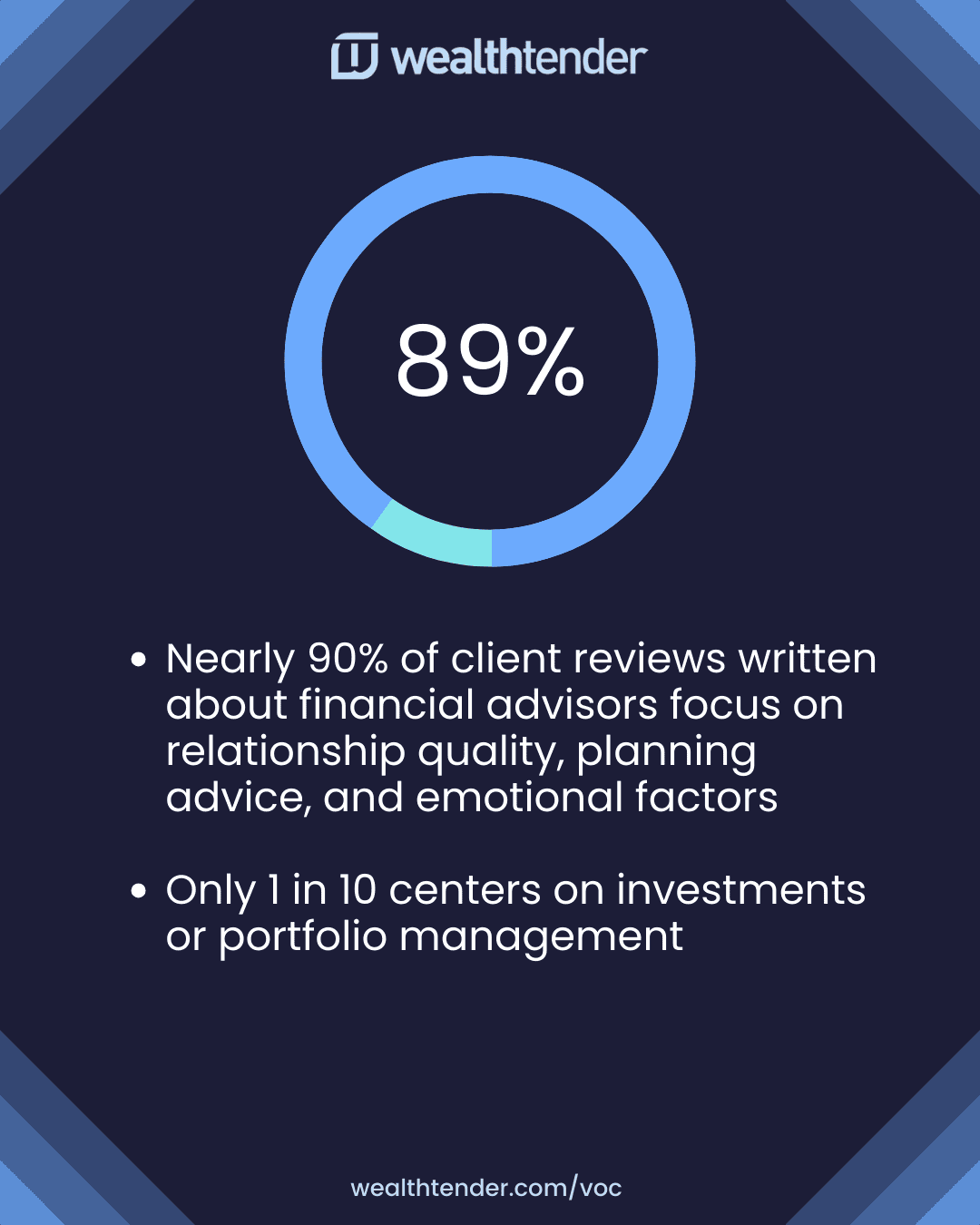

A dark blue graphic shows a ring chart with "89%" in the center, representing client reviews of financial advisors focused on relationships and emotional factors rather than investments or portfolio management.

86% of reviews convey strongly positive sentiment, underscoring widespread client trust and satisfaction.

89% of reviews center on relationship quality, planning advice, and emotional factors; just 1 in 10 focus on investments or portfolio management.

Personalized financial planning and long-term relationships rank highest among the services that clients value most from their financial advisors.

Clients use an average of 86 words per review, with many sharing detailed, story-like testimonials, a sign of deep emotional investment.

Trust, communication, and personalization consistently emerge as major drivers of client loyalty and satisfaction.

Client reviews are nearly 25 times more likely to mention an advisor by name than just a firm, reinforcing the personal nature of relationships.


We’ll be the first to say it – Those gold stars accompanying online reviews play an incredibly important role in strengthening the Search Engine Optimization (SEO) for the advisors and wealth management firms that have earned them; but what matters most to consumers preparing to hire financial advisors is less about the stars and more about the stories.

Online reviews tell stories that help consumers learn firsthand how clients feel about their experiences with financial advisors. For this study, we wanted to look beyond the star ratings to better understand how thousands of clients feel about their financial advisors, utilizing text-based sentiment analysis³ to group each review in one of three classifications: Positive, Neutral, or Negative.
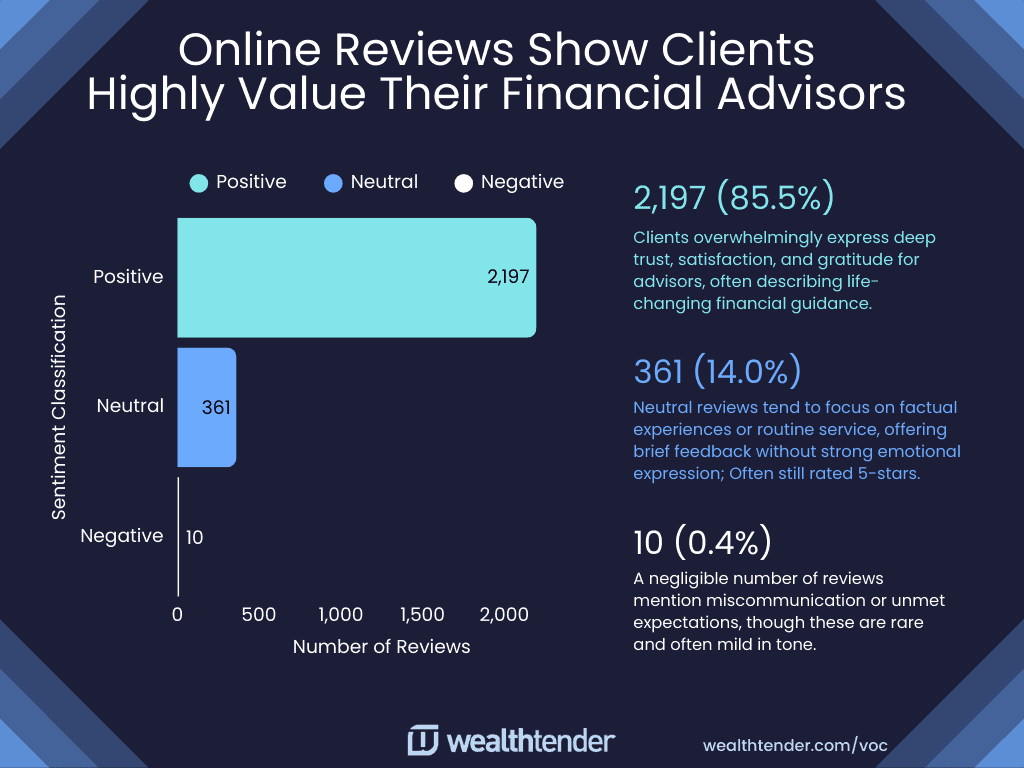
Bar chart showing financial advisor reviews: 2,197 are positive, often with emotional praise; 361 are neutral, focusing on facts or routine service; and 10 are negative, citing rare and mild complaints. Wealthtender logo included.

Sentiment Analysis Summary of 2,568 Financial Advisor Reviews:

  • Positive Sentiment: 2,197 (85.5%)
  • Neutral Sentiment: 361 (14.0%)
  • Negative Sentiment: 10 (0.4%)

This sentiment analysis clearly demonstrates that clients feel strongly about the value their financial advisors deliver. Further, it’s interesting to note that most reviews categorized with neutral sentiment received a 5-star rating. While sentiment scoring offers useful insights based on the aggregation of thousands of reviews, we believe it’s important for financial advisors and wealth management firms to evaluate each review on its own merits to truly understand what clients value most. Just below, we’ve included examples of reviews in each sentiment classification.

Positive Sentiment:

The analysis reveals exceptionally positive sentiment, with over 85% of reviews reflecting high levels of satisfaction, trust, and strong emotional connections between clients and their financial advisors. These reviews classified as ‘positive’ often describe advisors as trustworthy partners who bring peace of mind, clarity, and a sense of control over their financial future.

Examples of reviews with positive sentiment:

  • “Like many people, my life is complicated. Matt was able to help me with that complicated situation and simplify my financial approach so that it gave me comfort and confidence but did not add to my load. I have been completely satisfied with the service, genuine, caring, and amount of attention Matt has provided. I recommend him with a whole heart. He is worthy of your trust.” (5 Stars)

  • “Brett is an experienced advisor that provides me with the tools and guidance so that my retirement goals will be achieved. He provides me with suggestions that will improve the return on my investments as well as advice on moves I should take to avoid probate and make sure my estate plan is complete. Brett is a great resource and is very responsive. I highly recommend Brett!” (5 Stars)

  • “Deb pairs her credentials and experience with a genuine interest in our wellbeing. She invested tremendous time listening and learning about our vision for our family’s future. She helped us create a clear plan to achieve our goals and our ongoing collaboration along that path is invaluable.” (5 Stars)

Neutral Sentiment:

Reviews classified as ‘neutral’ (14.0%) tended to be shorter or factual, offering praise without strong emotional language. In some cases, clients mention a shortcoming in their experience that can help financial advisors identify areas for improvement. While the sentiment of these reviews fell short of receiving a ‘positive’ classification, it’s worth noting that a five-star rating accompanies the vast majority of these reviews.

Examples of reviews with neutral sentiment:

  • “The onboarding process was organized. Some meetings felt a little rushed, but overall a positive experience.” (5 Stars)

  • “My advisor reviewed my 401(k) options and helped me consolidate accounts. Still early in the relationship but a good start.” (5 Stars)

  • “The team was very professional and helpful. Planning went smoothly, although some processes were slower than I hoped.” (5 Stars)

Negative Sentiment:

Less than half a percent of reviews were classified as negative, and these were generally mild, focused on communication gaps or service expectations. In fact, we feel this is an area where the sentiment analysis falls short as our manual evaluation of reviews with a negative classification included positive reviews that may have been misclassified based on ‘trigger’ words taken out of context. In rare instances, reviews reflect truly negative sentiment expressing the frustration of former clients.

Example of a review with negative sentiment:

  • “While I’d love to give this company 5 stars, they decided to drop me suddenly as a client – arbitrarily and insensitively increasing their minimum portfolio. They also raised their rate / fee for me halfway through our working together. Would not recommend.” (2 Stars)

Sentiment Analysis Key Takeaway:

Clients express considerable satisfaction and feelings of gratitude in their reviews, suggesting that financial advisors should feel proud of their value proposition, the level of trust they have established, and the quality of relationships they have cultivated. Further, these findings reinforce what we fervently believe at Wealthtender – money is an emotional topic, deeply personal, and when trust is established, clients respond with loyalty and advocacy.

³ Sentiment Analysis Methodology

To evaluate how clients feel about their experiences with financial advisors, we applied text-based sentiment analysis to the full body of 2,568 reviews utilizing ChatGPT. Here’s how the analysis was conducted:

Natural Language Processing (NLP) Engine:

We used the TextBlob Python library, a popular NLP tool that evaluates the sentiment of written language by calculating a “polarity score” for each review:

  • Polarity Range: -1.0 (most negative) to +1.0 (most positive)

Classification Logic:

Each review was automatically scored and categorized based on its polarity:

  • Positive: Polarity > +0.1
  • Neutral: Polarity between -0.1 and +0.1
  • Negative: Polarity < -0.1

This rule of thumb ensures minor fluctuations in language don’t overrepresent sentiment swings. For instance, a review like “It was okay” would remain neutral, while “I felt confident, supported, and grateful” would clearly register as positive.

Aggregate Insights:

  • The majority of reviews (85.5%) scored positive, indicating that most clients feel satisfied or highly appreciative of their advisor relationship.
  • Only 0.4% of reviews were classified as negative, reflecting an overall high level of trust and satisfaction among financial advisors across the Wealthtender platform.
  • 14.0% of reviews were neutral, typically offering objective or factual commentary without strong emotion.


Analyzing the word count of financial advisor reviews allows us to understand not just what clients are saying, but how willing they are to share details about their experience.

While reviews under 30 words in length are common and typically express satisfaction succinctly, the majority of reviews fall between 30 and 150 words, suggesting a deeper level of thought and emotional investment. These reviews frequently highlight personalized service, trust, and a partnership focused on long-term outcomes.

Notably, a meaningful number of clients wrote reviews exceeding 150 words, indicating they felt compelled to elaborate on their experiences, often with an emotional tone. This level of engagement reflects more than satisfaction; it reveals that many clients view their advisor relationship as impactful enough to warrant storytelling. The willingness to write thoughtful, in-depth feedback speaks to the strength of advisor-client relationship. The stronger the relationship, the more clients want to share.
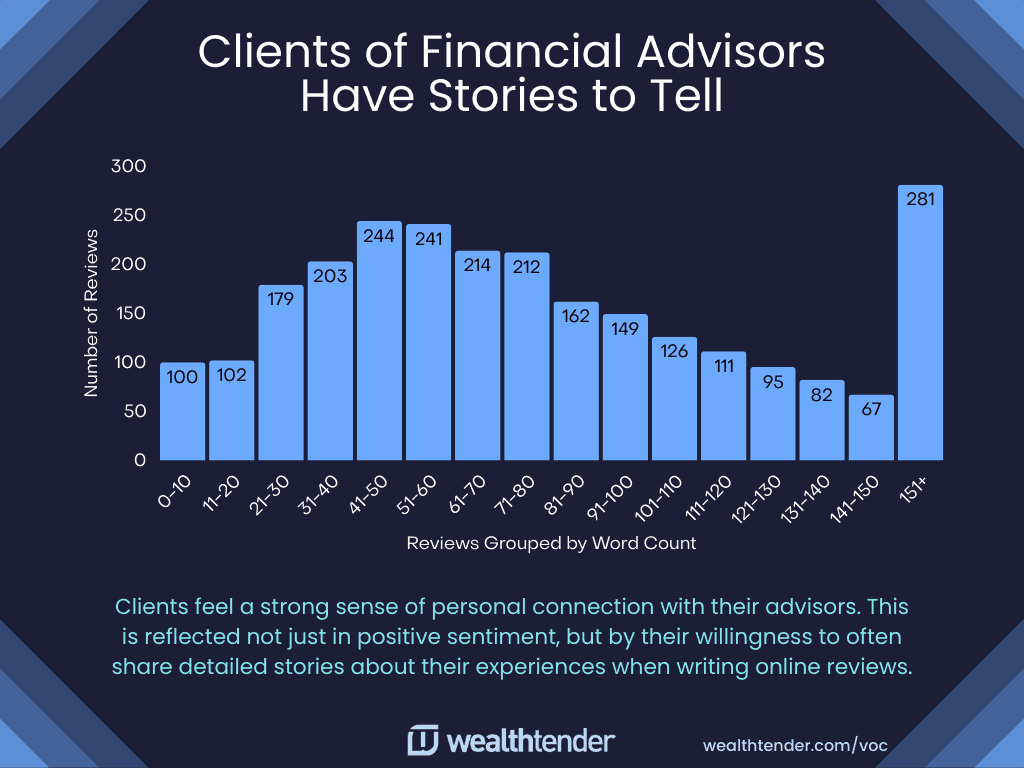
Bar chart showing the number of financial advisor reviews by word count groups, with the highest number (281) in the 151+ word count range. The chart highlights that clients often write detailed stories.

Word Count Analysis of 2,568 Financial Advisor Reviews

  • Average Word Count: 86 words
  • Average Sentence Count: 6 sentences

Here’s what the data reveals:

Depth of Engagement:

  • The average review contains 86 words and 6 sentences, indicating that clients are not leaving simple one-line feedback, they’re investing time and effort to reflect on their experiences.
  • Reviews with over 150 words make up a meaningful portion of the dataset, showing that many clients feel deeply enough to share detailed, story-like testimonials.

Distribution by Word Count:

  • A sizable number of reviews fall in the 21–50 word range, which often includes concise but impactful praise.
  • A healthy number land between 51–150 words, offering rich insight into the advisor’s strengths, communication style, and client impact.
  • The presence of both very short (under 20 words) and very long (150+ words) reviews shows a spectrum of expression, from brief accolades to emotional stories.

Word Count Key Takeaway:

Many reviews read more like mini case studies or letters of recommendation than simple comments, reflecting the deep trust clients place in their advisors.


In an effort to understand the topics that clients most frequently discuss when writing reviews about financial advisors, we identified seven distinct themes based on patterns observed in the reviews. While longer reviews may have covered multiple topics, we assigned each review to a single theme based on the dominant emotional and experiential factors expressed by clients.⁴
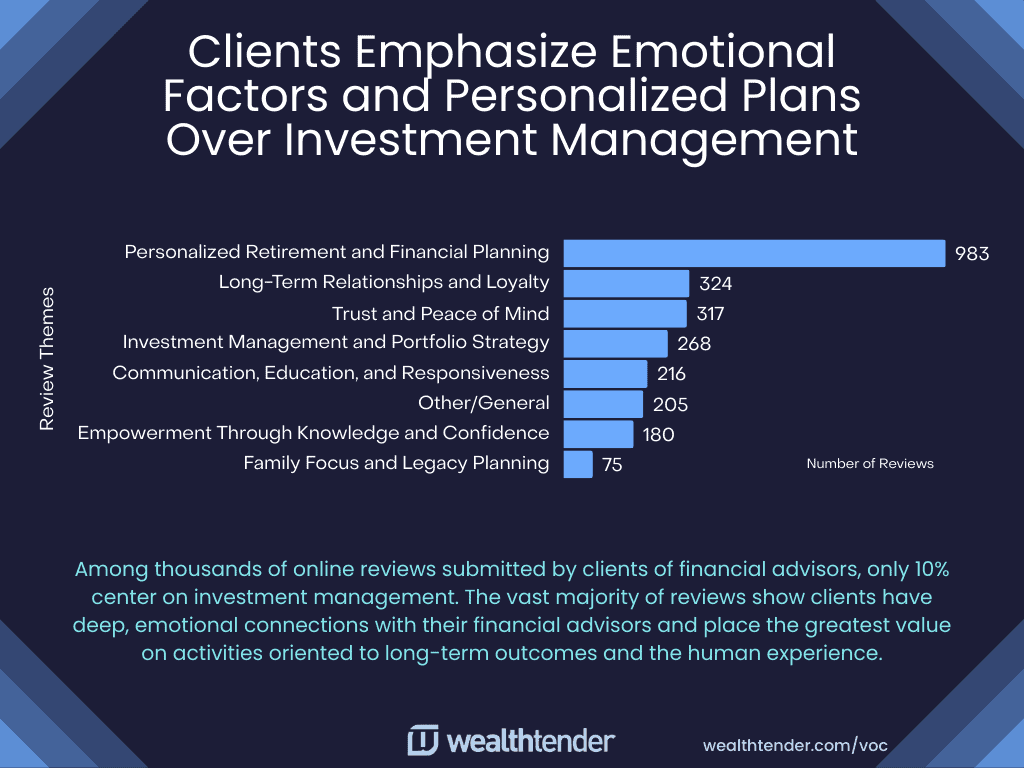
A bar chart ranking review themes by number of mentions shows "Personalized Retirement and Financial Planning" as most common, followed by "Long-Term Relationships and Loyalty." Text below highlights clients' focus on personal experience.

Online Reviews Organized Into Seven Themes (% of Reviews)

  1. Personalized Retirement and Financial Planning (38%)
  2. Long-Term Relationships and Loyalty (13%)
  3. Trust and Peace of Mind (12%)
  4. Investment Management and Portfolio Strategy (10%)
  5. Communication, Education, and Responsiveness (8%)
  6. Empowerment Through Knowledge and Confidence (7%)
  7. Family Focus and Legacy Planning (3%)

With just 1 out 10 reviews flagged with investment management or portfolio strategy as a theme, it’s abundantly clear that clients find the greatest value from financial advisors comes from long-term planning services and emotional factors that produce peace of mind.

To provide a deeper understanding of the types of reviews that fit into each of the seven themes, you’ll find excerpts of actual reviews below (with minor edits for brevity and clarity).

Personalized Retirement and Financial Planning (38%)

Clients deeply value advisors who offer personalized, forward-looking financial strategies that align with their unique life goals, preparing them for a confident retirement. The key takeaway is that personalization and proactive planning consistently drive client satisfaction and trust.

  • “He has been very helpful in preparing for my retirement and explaining things in a way I can understand.”
  • “They have helped me set up a financial plan for retirement that fits my needs and goals.”
  • “After working with him, I feel confident in my retirement plan and future financial security.”
  • “She explained different retirement options and helped me create a plan to maximize my income.”
  • “The guidance we received on 401(k) rollovers and pension planning made our retirement transition stress-free.”
  • “They listened carefully to my retirement goals and designed a personalized plan that gives me peace of mind.”

Long-Term Relationships and Loyalty (13%)

Many clients highlight decades-long partnerships with their advisors, emphasizing consistency, loyalty, and trust. The key takeaway is that advisors who stay committed over time earn deeper trust and advocacy from clients.

  • “I have been working with my advisor for over 20 years, and I trust him completely.”
  • “We’ve been with them for almost 15 years, and their advice has always been solid and dependable.”
  • “I have trusted them with my financial planning needs for decades and they have never let me down.”
  • “They have been by our side through many market ups and downs for more than 25 years.”
  • “Our family has relied on their expertise for two generations, and we couldn’t be happier.”
  • “They have helped guide me through life events from buying my first home to planning for retirement.”

Trust and Peace of Mind (12%)

Clients consistently emphasize that trust, and the peace of mind it brings, is a vital factor in maintaining a strong advisor relationship. The key takeaway is that clients seek advisors they can trust with both their money and their future life decisions.

  • “I completely trust my advisor to guide me through all stages of my financial life.”
  • “He always acts in my best interest and gives me great peace of mind.”
  • “They have earned my trust by consistently providing sound advice over the years.”
  • “Knowing I have someone who truly cares about my financial well-being helps me sleep at night.”
  • “She has my complete trust and has helped me feel secure about my retirement plans.”
  • “Their honest and straightforward approach gave me peace of mind during uncertain times.”

Investment Management and Portfolio Strategy (10%)

Clients appreciate advisors who provide thoughtful, strategic investment management, but they value it most when it is tied to their broader life goals rather than just performance metrics. The key takeaway is that clients want investments managed wisely but as part of a bigger, meaningful life plan.

  • “They have developed an investment strategy that fits my risk tolerance and retirement timeline perfectly.”
  • “My portfolio has been managed with great attention to my personal financial goals.”
  • “He always takes the time to explain investment options and why they make sense for me.”
  • “They helped me diversify my investments and protect my portfolio during market downturns.”
  • “I appreciate that they align my investment plan with both my short-term needs and long-term goals.”
  • “Their advice on asset allocation and rebalancing has helped me stay on track even in volatile markets.”

Communication, Education, and Responsiveness (8%)

Clients highly value advisors who are easy to reach, responsive to questions, and proactive in educating them about financial decisions. The key takeaway is that clear communication builds trust and empowers clients to make informed choices.

  • “He is always quick to respond to any questions I have, no matter how small.”
  • “They take the time to educate me about my financial options in a way that is easy to understand.”
  • “I appreciate how clearly they explain complex financial concepts so I can make informed decisions.”
  • “Their responsiveness and willingness to answer all of my questions made a huge difference in my experience.”
  • “I never feel rushed. They take time to ensure I truly understand every recommendation.”
  • “Their consistent communication keeps me informed and reassured, especially during uncertain market conditions.”

Empowerment Through Knowledge and Confidence (7%)

Clients appreciate advisors who help them feel more knowledgeable, in control, and empowered about their financial lives. The key takeaway is that clients don’t just want advice, they want to grow their own confidence and understanding.

  • “They have given me the confidence to manage my financial future independently.”
  • “Thanks to their guidance, I feel empowered to make smarter financial decisions.”
  • “I now have a clear understanding of my investments and feel much more confident discussing my finances.”
  • “They encouraged me to learn about my options rather than just telling me what to do.”
  • “After working with them, I feel knowledgeable enough to ask better questions and be more involved in my financial planning.”
  • “They empowered me by teaching me how my financial plan works instead of keeping me in the dark.”

Family Focus and Legacy Planning (3%)

Clients express immense gratitude toward advisors who help them protect their family’s future and plan meaningful legacies for generations to come. The key takeaway is that clients value advisors who understand that wealth planning is ultimately about family, not just finances.

  • “They helped us set up an estate plan to ensure our children will be taken care of.”
  • “Our advisor guided us through planning for our family’s future generations with care and understanding.”
  • “I feel confident that my family’s financial security is protected thanks to the planning we’ve done together.”
  • “They made the complicated process of legacy planning simple and manageable for our family.”
  • “We were able to create a trust for our grandchildren with their expert guidance.”
  • “Their thoughtful approach made sure that our family values are reflected in our financial plans.”

Review Themes Key Takeaway:

The results of this analysis reinforce that clients value financial advisors who instill confidence in their ability to achieve long-term goals and reflect meaningful relationships built on a foundation of trust. Notably, only 10% of clients emphasized ‘investment management’ in their reviews, implying what clients value most about their financial advisors is a reflection of the human experience and emotional factors, not asset allocation or portfolio strategy perhaps now considered as commoditized and table stakes, especially among mass affluent Americans.

⁴ Review Theme Methodology

The top client themes were identified through a multi-step categorization process designed to extract meaningful insights from the narrative content of client reviews:

1. Initial Text Preparation

  • Each client review was cleaned and standardized.
  • Basic formatting issues were resolved (punctuation, spacing) without altering client meaning.

2. Keyword and Phrase Exploration

  • Common words, phrases, and emotional tones were reviewed.
  • Natural Language Processing (NLP) keyword techniques were lightly referenced (like frequency counts), but human reading was primary to capture nuance beyond just word frequency.

3. Theme Development

  • Based on patterns observed in the reviews, seven broad themes were defined to capture the human-centered dimensions of client feedback:
    • Trust and Peace of Mind
    • Personalized Retirement and Financial Planning
    • Communication, Education, and Responsiveness
    • Investment Management and Portfolio Strategy
    • Family Focus and Legacy Planning
    • Long-Term Relationships and Loyalty
    • Empowerment Through Knowledge and Confidence

These themes were validated to ensure they were:

  • Mutually exclusive as much as possible (each review fits best into one dominant theme)
  • Collectively exhaustive (together covering all meaningful client experiences)

4. Review Categorization

  • Each review was manually evaluated for dominant thematic content.
  • Reviews were assigned to the theme that best reflected the primary emotional or practical takeaway from the client’s perspective.
  • If a review referenced multiple areas, the most emotionally emphasized theme was prioritized.

5. Data Aggregation and Charting

  • The number of reviews assigned to each theme was tallied.
  • Results were presented in a simple bar chart showing the relative frequency of each theme across all client reviews.



Certified Advisor Reviews - Wealthtender Introducing Wealthtender Voice of the Client Awards™

The first award program to celebrate financial advisors and wealth management firms with consistently exceptional client reviews.

When clients mention names in their reviews, they are nearly 25 times more likely to highlight an advisor than just a firm, reinforcing the value clients place on personal relationships.
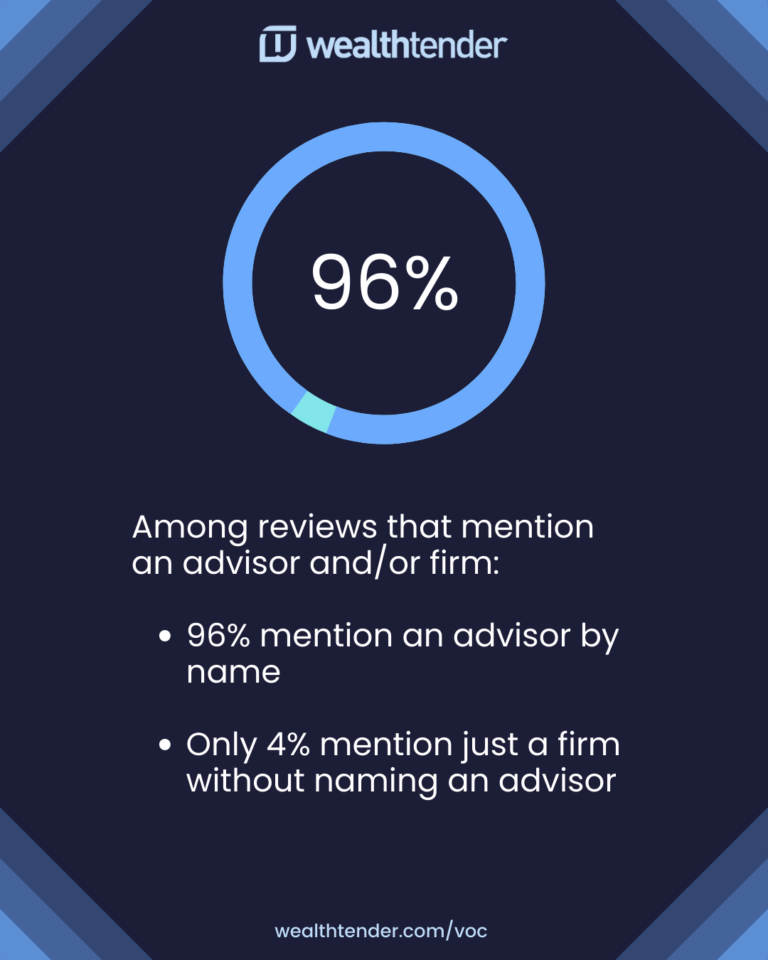
A graphic shows a large "96%" inside a blue circle. Text below reads: "Among reviews that mention an advisor and/or firm: 96% mention an advisor by name; Only 4% mention just a firm without naming an advisor.

Of course, financial advisors typically serve as the face of the firms they represent, so positive accolades about an advisor imply a favorable opinion of their firm, too.

Regardless, we feel it’s especially noteworthy for wealth management firm leaders to consider how proactive campaigns to gather client reviews can elevate the online reputation of individual advisors who do often serve as the face of the brand. Just as consumers write reviews much more frequently about the professionals they work with over the firms that employ them (e.g., consumers write reviews about doctors, not hospitals; lawyers, not law firms), it’s not surprising that clients write reviews about the financial advisors they work with, not the advisory firms that employ them.

This observation shouldn’t diminish the importance of wealth management firms to build brand awareness and maintain a pristine reputation in the communities they serve. Rather, this suggests wealth management firms that treat their advisors as brand ambassadors and encourage them to establish a strong online presence that includes a healthy mix of client reviews can position their advisors to win a disproportionate percentage of business over advisors without online reviews and/or who work at firms that only collect ‘firm’ reviews.

While smaller advisory firms with clients who know the entire team can centralize the function of inviting clients to write reviews and still expect deeply personal feedback, larger wealth management firms that want to optimize their testimonial collection strategy should have advisors send review invitations to clients individually. This personal touch will generate a higher response rate and result in clients sharing more emotional stories and detailed experiences. Firms can then aggregate and curate individual advisor reviews to promote at the corporate level to both humanize their brand and reinforce their company culture.


Since the first online review platforms began to appear in 1999, consumers have turned to the internet to express their opinions about products and services. For many consumers with grievances to share, writing online reviews to vent their frustrations about businesses represents one of the most popular and potentially effective ways for their voices to be heard.

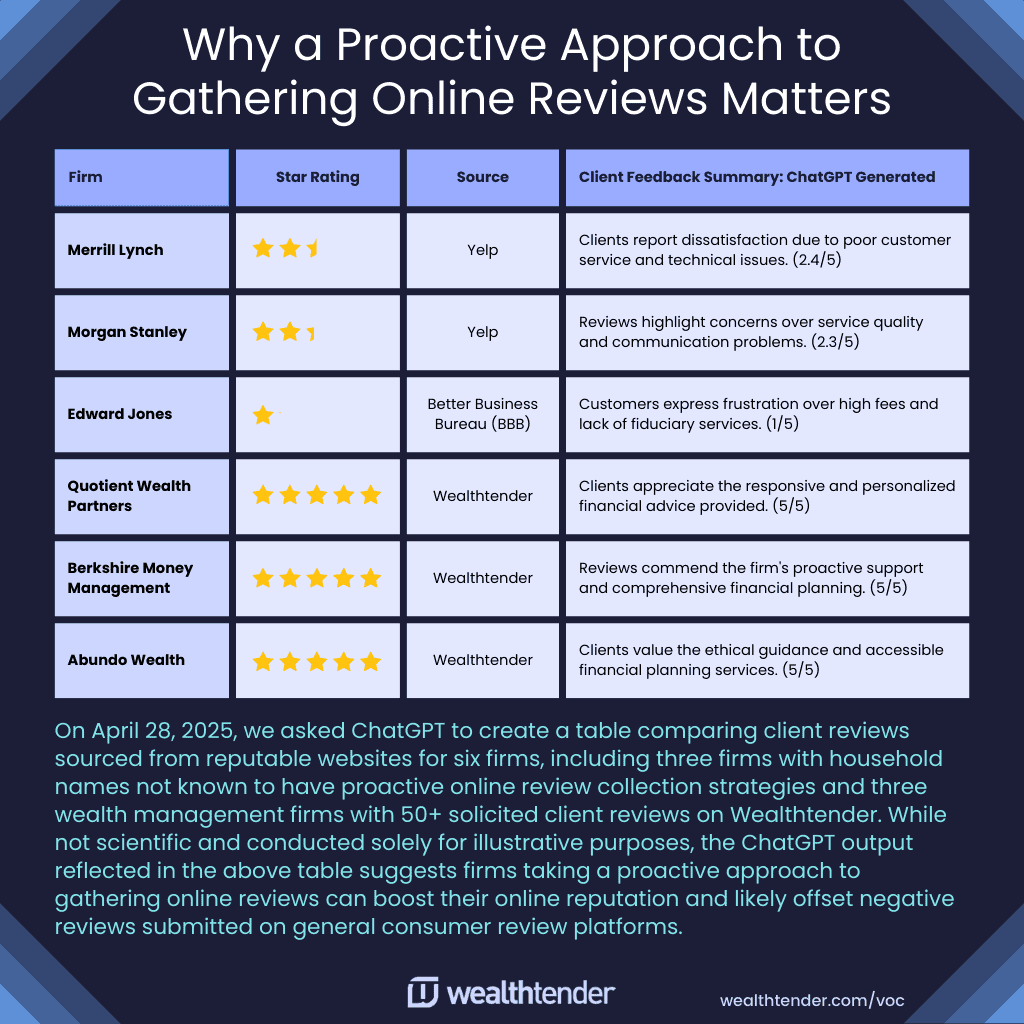
Large financial institutions have experienced this firsthand, with a mix of both legitimate complaints and bogus rants resulting in very low consumer ratings on review platforms that appear prominently in search results. Wealth management firms with household names have experienced this as well, typically with an average rating close to the lowest end of the range.

While the SEC Marketing Rule (in combination with related FINRA guidelines) opened the door for regulated advisory and brokerage firms to offset this negativity by taking a proactive approach to gather online reviews from current clients likely to share positive sentiments, we have yet to see the largest firms embrace the opportunity.

Beyond damaging consumer brand perception and weakening SEO (as illustrated in the graphic below), a lack of positive reviews attributable to the advisors at these firms is now resulting in lost business.

Smaller advisory firms and national RIAs proactively collecting online reviews and implementing testimonial marketing strategies are tilting the playing field in their favor and winning business over advisors whose home offices don’t yet permit them to gather client reviews. Anecdotal feedback we’re hearing from advisory firms like this RIA in New York demonstrates the power of social proof to steer prospects into the arms of advisors with positive client reviews over well-established national firms whose advisors lack client feedback online.

Our inaugural Voice of the Client Study paints a bright picture for the future of the financial planning profession and illuminates what really matters most to clients: trusted relationships with financial advisors who provide the guidance needed to achieve long-term goals with emotional support that results in greater peace of mind.

Across 2,568 online reviews, clients overwhelmingly expressed deep appreciation for advisors who prioritize long-term planning, communication, and the human side of wealth management over investment strategy and portfolio management, suggesting the latter represent table stakes perhaps viewed as commoditized among mass affluent Americans.

Client reviews frequently read like short stories, describing highly personal experiences and reflecting strong emotional feelings they hold about their relationships with advisors. Advisors who take the time to understand personal goals, communicate openly, and build lasting trust are not only earning higher client satisfaction but also inspiring loyalty and advocacy.

Moreover, the findings demonstrate that financial advisors themselves, not just the firms they represent, are at the center of client loyalty and praise. Clients mention their advisor by name nearly 25 times more often than the firm, reinforcing the critical role individual relationships play in a client’s perception of value and satisfaction. Leaders of wealth management firms who recognize their advisors as brand ambassadors can increase the quantity and quality of client reviews by implementing an online review collection strategy at the advisor level and enjoy a more impactful testimonial marketing program at the firm level.

With more than 80% of consumers stating that online reviews play an “important” or “very important” role when evaluating financial service providers⁵, wealth management firms that empower their advisors to proactively gather and showcase authentic client feedback are gaining a clear competitive advantage, while larger institutions that delay embracing these strategies risk falling behind. Further, as the next generation of Americans embraces artificial intelligence in their advisor evaluation process, wealth management firms should consider how their online reviews published on reputable third party platforms can improve their rankings and visibility in popular tools like ChatGPT.

Looking ahead, Wealthtender remains committed to partnering with financial advisors and wealth management firms interested in strengthening their digital marketing strategy with a compliant online review collection and testimonial marketing strategy.

We are excited to update this study in 2026 with even deeper insights, as more advisors and firms embrace testimonial marketing and as online reviews become an increasingly integral part of the advisor selection process for millions of American consumers.
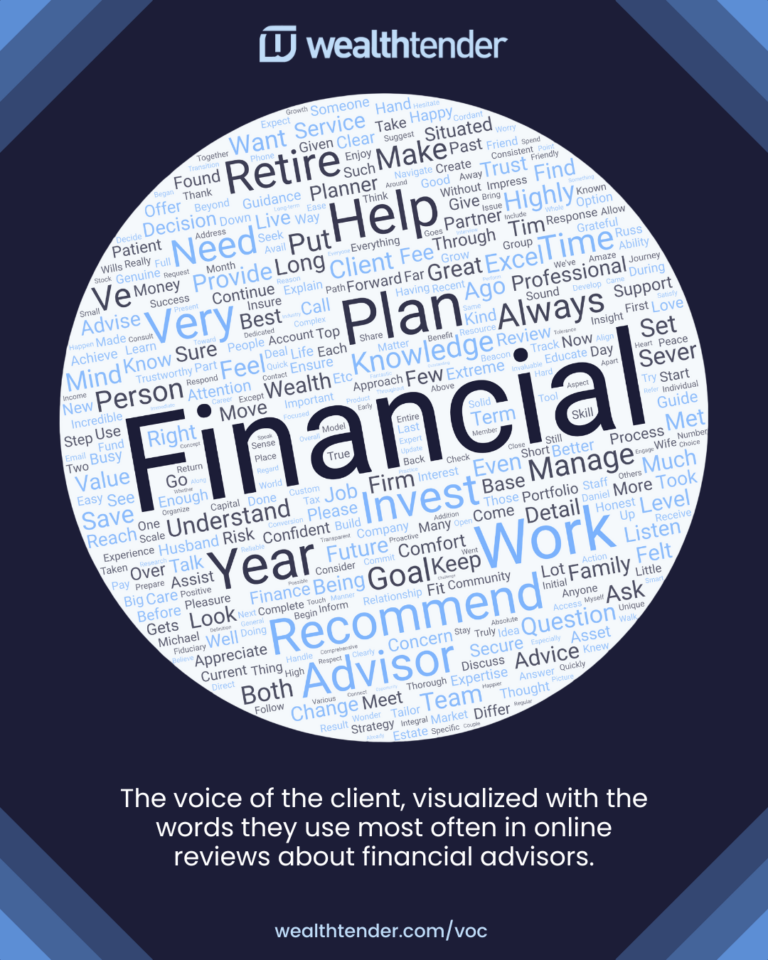
A word cloud shaped like a circle, with “Financial” as the largest word, surrounded by words like “Plan,” “Help,” “Advisor,” and “Recommend.” Caption below reads: “The voice of the client, visualized with the words they use most often in online reviews about financial advisors.” Wealthtender logo appears at the top.

We asked ChatGPT to write one hypothetical review that best summarizes the experiences shared across our dataset of 2,568 reviews. Here’s what it suggested:

“Working with my advisor has been one of the best decisions I’ve made for my financial future. They took the time to truly understand my goals and created a personalized plan that gave me clarity and peace of mind. Throughout the ups and downs of life and the markets, they have been a steady and trusted guide. I appreciate their responsiveness whenever I have questions and the way they explain complex topics in simple terms. I feel empowered, confident, and excited about what lies ahead.”


Are you ready to convert more prospects into clients with online reviews?

The SEC Marketing Rule opens the door to new opportunities. And new risks.

We prepared this step-by-step playbook to help you compliantly turn your online reviews into an evergreen source of digital referrals.

A spiral-bound book titled "Testimonial Marketing Playbook" by Wealthtender lies on a table. Nearby are a pair of glasses, a cup of coffee, and a notepad. The cover features marketing-themed images and a star rating graphic.


Confident professional smiles in a headshot with a nature-inspired backdrop.

“Wealthtender is one of the best decisions we have made as a firm. I wish we had done it sooner.”

Gerry Barrasso

President, United Financial Planning Group

Find financial advisors in Clarksville, Tennessee ready to help with your financial planning needs so you can enjoy life more with less money stress.

Whether you have lived in Clarksville for years or recently moved to town, you may need help finding the right financial advisor in the community best suited for your individual needs.

It’s important to first consider your own financial planning priorities before choosing an advisor. Here are a few quick tips to help you get started along with financial advisors in Clarksville featured on Wealthtender you may want to add to your shortlist.

As you prepare to interview financial advisors in Clarksville who may be right for you, get to know local financial advisors featured on Wealthtender.

📍 Map: Financial Advisors with their Primary Office Location in Clarksville

Double-click (or pinch the map on mobile devices) to zoom in and expand the details for financial advisors whose primary office location is in Clarksville,

📍Double-click or pinch pins to view more.

Showing

The Benefits of Hiring a Financial Advisor in Clarksville

Hiring a financial advisor can be a great move to help you build a long-term investing strategy. Advisors can help you build an investment portfolio to meet your financial goals and help you plan appropriately for retirement.

As a resident living in Clarksville, hiring a financial advisor who lives nearby and understands the local economy, cost of living, and regional employers can be quite valuable, especially if your individual circumstances are deeply tied to such factors.

Who are the largest employers in Clarksville?

Do you work for one of the largest employers in Clarksville? If so, there’s a good chance the local financial advisor you hire will also have other clients who work there. This knowledge could prove valuable if they are already familiar with your employee benefits, such as a 401(k) plan, Health Savings Accounts, and other components of your total compensation package.

When you reach out to financial advisors you’re considering hiring, let them know where you work and ask if they are familiar with your employer’s unique benefits and compensation structure.

Quick Tips For Hiring a Clarksville Financial Advisor

Before hiring a financial advisor in Clarksville, here are a few quick tips to help you find the best advisor for you.

1. Decide Which Services You Need

Before hiring an advisor, determine what services you need from them. Whether it’s full-service investment management or a plan focused on a specific area of your finances, put together a list of what you’d like help with before contacting an advisor.

Though most people use a financial planner simply to invest for retirement, this is only a small part of what many advisors offer. Here’s a quick rundown of potential services a financial advisor may offer you:

  • Budgeting and money management
  • Debt management
  • Insurance planning
  • Retirement planning
  • Other investment planning
  • Inheritance planning
  • Estate planning
  • Tax planning

As you can see, financial advisors can help you with your entire financial picture, not just investing. As you start to plan for life’s bigger milestones, you should consider finding a financial advisor that specializes in those areas.

Finding the right advisor can help you minimize risk, maximize gains and take advantage of tax breaks while investing for your future. They can also help you protect your assets with the right kinds of insurance and help you pass on your financial legacy with a proper estate plan.

2. Consider Your Budget and Payment Preferences

Once you have a list of services you would like, review the fee structures financial advisors offer. Finding a balance between the services you need and the cost of those services will help narrow down the field of advisors you may want to work with.

If you are looking for a full-service advisor to manage all of your investments, consider searching among fee-based financial advisors. If you want to manage your money yourself, consider the flat fee and monthly subscription advisors for ongoing support.

3. Interview Multiple Financial Advisors

Once you have chosen the services and fee structure you prefer, it’s time to contact a few advisors and interview them. Here are questions to ask financial advisors:

  • What services do you provide?
  • What are all the ways you get paid? (fee transparency)
  • What is your investment strategy?
  • How do you measure investment performance?
  • How do we communicate about my plan?

Interview multiple advisors to get a feel for who you want to work with. A combination of fees, services, and customer service will help you determine the best fit for your financial advice.

4. Review Financial Advisor Credentials

Once you find an advisor (or two) you feel comfortable with, it’s always a good practice to check their credentials and the firm’s details. You can do this at the Investment Adviser Public Disclosure (IAPD) website

You can check both the individual and the firm to view their background and experience details, as well as any disciplinary action taken against them or their firm.

As licensed financial professionals, there is oversight into how financial advisors conduct business, so running a quick (free) check on them is recommended.

For additional information about advisor credentials, read our article to learn the most popular designations held by financial advisors, as well as specialized credentials which may be important to consider if you have unique financial planning needs.

Frequently Asked Questions & Additional Resources

How do I know if I’m ready to hire a financial advisor?

You should strongly consider hiring a financial advisor if you have a significant amount of money available for saving or investing. This could occur after years of making annual contributions to a retirement plan like a 401(k) through your employer or suddenly if you receive a large inheritance or sell your house for a large profit.

But even if you don’t have a lot of money saved, many financial advisors and planners provide reasonable pricing options and valuable services you should consider, especially if you’re facing a significant life event. For example, if you’re starting a new job, getting married, starting a family, getting divorced, lost your job, starting or selling a business, or approaching retirement age, working with a trusted financial advisor or planner may prove worthwhile.

Before I hire a new financial advisor, should I fire my current advisor?

You don’t need to fire your current advisor before beginning your search for a new financial advisor. In fact, your new advisor can help coordinate the transition of your assets from your previous financial advisor.

Where can I read reviews about financial advisors written by their clients to help me decide if I should hire them?

After 60 years of regulatory prohibition of financial advisor reviews in the US, a rule issued by the Securities and Exchange Commission (SEC) became effective on May 4, 2021 that means both financial advisors and directory websites that help consumers search for a financial advisor can collect and display financial advisor reviews, an important factor worth considering when choosing who you’ll hire to manage your investments and life savings. 

Wealthtender is the first independent advisor review platform designed to be fully compliant with the new SEC rule, and we look forward to helping you evaluate financial advisors based on reviews written by their clients.

I’m a local financial advisor interested in being featured in this guide. How do I get started?

Thanks for your interest. We look forward to learning more about your practice and helping you attract your ideal clients where you may be a good fit based on their individual needs and circumstances. Please click here to learn how you can join local financial advisors featured on Wealthtender.

How Much Does a Financial Advisor Cost?

➡️ How Much Does a Financial Advisor Cost? Read the Article

About the Author
A headshot of Brian Thorp, the founder and CEO of Wealthtender

About the Author

Brian Thorp

Brian is CEO and founder of Wealthtender and Editor-in-Chief. He and his wife live in Austin, Texas. With over 25 years in the financial services industry, Brian is applying his experience and passion at Wealthtender to help more people enjoy life with less money stress. Learn More about Brian

Find financial advisors in Eau Claire, Wisconsin ready to help with your financial planning needs so you can enjoy life more with less money stress.

Whether you have lived in Eau Claire for years or recently moved to town, you may need help finding the right financial advisor in the community best suited for your individual needs.

It’s important to first consider your own financial planning priorities before choosing an advisor. Here are a few quick tips to help you get started along with financial advisors in Eau Claire featured on Wealthtender you may want to add to your shortlist.

As you prepare to interview financial advisors in Eau Claire who may be right for you, get to know local financial advisors featured on Wealthtender.

📍 Map: Financial Advisors with their Primary Office Location in Eau Claire

Double-click (or pinch the map on mobile devices) to zoom in and expand the details for financial advisors whose primary office location is in Eau Claire.

📍Double-click or pinch pins to view more.

Showing

📍 Additional Advisors Who Serve Clients in Eau Claire

In addition to the advisors featured above, these advisors can also meet with you in person in Eau Claire.

The Benefits of Hiring a Financial Advisor in Eau Claire

Hiring a financial advisor can be a great move to help you build a long-term investing strategy. Advisors can help you build an investment portfolio to meet your financial goals and help you plan appropriately for retirement.

As a resident living in Eau Claire, hiring a financial advisor who lives nearby and understands the local economy, cost of living, and regional employers can be quite valuable, especially if your individual circumstances are deeply tied to such factors.

Who are the largest employers in Eau Claire?

Do you work for one of the largest employers in Eau Claire? If so, there’s a good chance the local financial advisor you hire will also have other clients who work there. This knowledge could prove valuable if they are already familiar with your employee benefits, such as a 401(k) plan, Health Savings Accounts, and other components of your total compensation package.

When you reach out to financial advisors you’re considering hiring, let them know where you work and ask if they are familiar with your employer’s unique benefits and compensation structure.

Quick Tips For Hiring a Eau Claire Financial Advisor

Before hiring a financial advisor in Eau Claire, here are a few quick tips to help you find the best advisor for you.

1. Decide Which Services You Need

Before hiring an advisor, determine what services you need from them. Whether it’s full-service investment management or a plan focused on a specific area of your finances, put together a list of what you’d like help with before contacting an advisor.

Though most people use a financial planner simply to invest for retirement, this is only a small part of what many advisors offer. Here’s a quick rundown of potential services a financial advisor may offer you:

  • Budgeting and money management
  • Debt management
  • Insurance planning
  • Retirement planning
  • Other investment planning
  • Inheritance planning
  • Estate planning
  • Tax planning

As you can see, financial advisors can help you with your entire financial picture, not just investing. As you start to plan for life’s bigger milestones, you should consider finding a financial advisor that specializes in those areas.

Finding the right advisor can help you minimize risk, maximize gains and take advantage of tax breaks while investing for your future. They can also help you protect your assets with the right kinds of insurance and help you pass on your financial legacy with a proper estate plan.

2. Consider Your Budget and Payment Preferences

Once you have a list of services you would like, review the fee structures financial advisors offer. Finding a balance between the services you need and the cost of those services will help narrow down the field of advisors you may want to work with.

If you are looking for a full-service advisor to manage all of your investments, consider searching among fee-based financial advisors. If you want to manage your money yourself, consider the flat fee and monthly subscription advisors for ongoing support.

3. Interview Multiple Financial Advisors

Once you have chosen the services and fee structure you prefer, it’s time to contact a few advisors and interview them. Here are questions to ask financial advisors:

  • What services do you provide?
  • What are all the ways you get paid? (fee transparency)
  • What is your investment strategy?
  • How do you measure investment performance?
  • How do we communicate about my plan?

Interview multiple advisors to get a feel for who you want to work with. A combination of fees, services, and customer service will help you determine the best fit for your financial advice.

4. Review Financial Advisor Credentials

Once you find an advisor (or two) you feel comfortable with, it’s always a good practice to check their credentials and the firm’s details. You can do this at the Investment Adviser Public Disclosure (IAPD) website

You can check both the individual and the firm to view their background and experience details, as well as any disciplinary action taken against them or their firm.

As licensed financial professionals, there is oversight into how financial advisors conduct business, so running a quick (free) check on them is recommended.

For additional information about advisor credentials, read our article to learn the most popular designations held by financial advisors, as well as specialized credentials which may be important to consider if you have unique financial planning needs.

Frequently Asked Questions & Additional Resources

How do I know if I’m ready to hire a financial advisor?

You should strongly consider hiring a financial advisor if you have a significant amount of money available for saving or investing. This could occur after years of making annual contributions to a retirement plan like a 401(k) through your employer or suddenly if you receive a large inheritance or sell your house for a large profit.

But even if you don’t have a lot of money saved, many financial advisors and planners provide reasonable pricing options and valuable services you should consider, especially if you’re facing a significant life event. For example, if you’re starting a new job, getting married, starting a family, getting divorced, lost your job, starting or selling a business, or approaching retirement age, working with a trusted financial advisor or planner may prove worthwhile.

Before I hire a new financial advisor, should I fire my current advisor?

You don’t need to fire your current advisor before beginning your search for a new financial advisor. In fact, your new advisor can help coordinate the transition of your assets from your previous financial advisor.

Where can I read reviews about financial advisors written by their clients to help me decide if I should hire them?

After 60 years of regulatory prohibition of financial advisor reviews in the US, a rule issued by the Securities and Exchange Commission (SEC) became effective on May 4, 2021 that means both financial advisors and directory websites that help consumers search for a financial advisor can collect and display financial advisor reviews, an important factor worth considering when choosing who you’ll hire to manage your investments and life savings. 

Wealthtender is the first independent advisor review platform designed to be fully compliant with the new SEC rule, and we look forward to helping you evaluate financial advisors based on reviews written by their clients.

I’m a local financial advisor interested in being featured in this guide. How do I get started?

Thanks for your interest. We look forward to learning more about your practice and helping you attract your ideal clients where you may be a good fit based on their individual needs and circumstances. Please click here to learn how you can join local financial advisors featured on Wealthtender.

How Much Does a Financial Advisor Cost?

➡️ How Much Does a Financial Advisor Cost? Read the Article

About the Author
A headshot of Brian Thorp, the founder and CEO of Wealthtender

About the Author

Brian Thorp

Brian is CEO and founder of Wealthtender and Editor-in-Chief. He and his wife live in Austin, Texas. With over 25 years in the financial services industry, Brian is applying his experience and passion at Wealthtender to help more people enjoy life with less money stress. Learn More about Brian

Artificial Intelligence is taking over every aspect of our lives, but should you be relying on it when it comes to the really important stuff, like running your personal finances?

The short answer is no. The longer, more nuanced answer is that there are powerful AI tools that can really help in the personal finances space. In fact, AI is probably already a big part of your financial life and you’re probably already using it on a daily basis without really thinking about it.

There are many areas where AI is already all up in your finances, and it’s almost certainly making your life easier. Here are a few of the areas where AI can be of use in the personal finance space.

Budgeting

If you’re still sitting down with a pen and paper to work out your monthly budget, then you’re probably in the minority. AI based budgeting apps like Mint and You Need A Budget are a common way that many of us are now using AI in our personal financial lives without really thinking about it as AI.

Most of these apps link to your bank account, and then use AI to do things like categorize transactions, analyze spending patterns and even make budgeting suggestions, often delivered by a chat bot acting as a friendly financial advisor who resides in your phone.

There are also apps like Tend, which uses AI to predict your future spending, and Pocket Guard, an AI powered tool that can help you calculate your net worth, devise a debt repayment plan, improve your spending decisions, and even find unused subscriptions you might want to cancel.

Investing

Robo-investing is nothing new. It’s been on the radar of most regular investors for much longer than AI has been a buzz word in the mainstream news.

Platforms like Vanguard and Fidelity Go use AI to build their clients’ portfolios, based on their stated goals and risk tolerance, and optimized for tax efficiency.

Copy trading platforms like eToro and AvaTrade use AI to allow less experienced traders to follow and copy the trades of other more successful and experienced investors, without having to use their own brains to monitor the markets or make trading decisions.

Many investors also use tools like Magnifi, an AI powered platform that links to your brokerage and helps you find new, personalized-by-AI investment opportunities you might otherwise have overlooked.

Improving Habits

I’m a fan of using AI tools, such as the built-in habit tracker that comes with Notion, to build, track, and improve all my habits, including those related to personal finance.

Using specifically finance-focused tools can be even better. Tend, for example, can use AI based analysis to study your income, expenses, debts, and goals to produce a score of your financial wellness, and then offer you advice on the habits you need to cultivate to improve that score. Loqbox is a tool that specifically hones in on the habits you need to build credit and improve your credit score.

So Is AI Powered Advice All You Need?

In my opinion, no. I’m a big fan of keeping your own very human brain fully engaged with your financial planning, and consulting professionals about more complex decisions. Please don’t go replacing your human financial advisor, estate planner, or tax consultant fully with AI options right now.

With personal finance, as with so many aspects of twenty-first century life, the trick is to learn to use the AI tools to your advantage, while still understanding how they work, so you can feel in control of your finances but supported by the technology.

Karen Banes is a freelance writer specializing in entrepreneurship, parenting and lifestyle. She writes articles, website content, ebooks and the occasional award winning short story. Her work has appeared in a range of publications both online and off, including The Washington Post, Life Info Magazine, Transitions Abroad, Brave New Traveler, Natural Parenting Group, and Copia Magazine. Learn More About Karen

When you contribute to a 401(k), your investments grow tax deferred. But when you start taking distributions, you typically pay ordinary income taxes on the entire amount withdrawn.

However, if you own your employer’s publicly traded stock inside your 401(k) — and that stock has appreciated in value — you may be able to use a strategy called Net Unrealized Appreciation (NUA) to lower the taxes you pay.

NUA allows you to instead pay the lower long-term capital gains rates when you sell the shares. This can result in significant tax savings, but strict IRS rules must be followed.

How to Qualify for the NUA Tax Strategy

To take advantage of NUA, you must meet three important requirements:

1. Experience a Qualifying Event

To unlock the NUA tax benefit, you must experience one of the IRS-defined “triggering” events. These include:

  • Separation from service (i.e., you leave your employer, whether through retirement, resignation, or termination).
  • Reaching age 59½, even if you continue working.
  • Death (in which case, beneficiaries can utilize the NUA strategy under specific rules).

2. Distribute Employer Stock Shares In-Kind

The employer stock must be transferred directly to a taxable brokerage account without selling it first.

  • You cannot liquidate the stock inside the 401(k) and move cash instead — this would disqualify the stock from NUA treatment.
  • The shares must move “in-kind,” meaning as-is, to preserve their original purchase cost (known as your “cost basis”).

3. Complete a Lump-Sum Distribution

You must distribute the entire balance of your employer-sponsored retirement plan within one calendar year.

  • “Lump-sum” doesn’t necessarily mean cashing out all investments; it means you must move all assets (stock, mutual funds, etc.) out of the plan to reach a $0 balance.
  • Any assets not related to employer stock (like mutual funds) can be rolled into an IRA to maintain their tax-deferred status.

Partial or phased distributions would disqualify your ability to claim NUA tax treatment.

Example

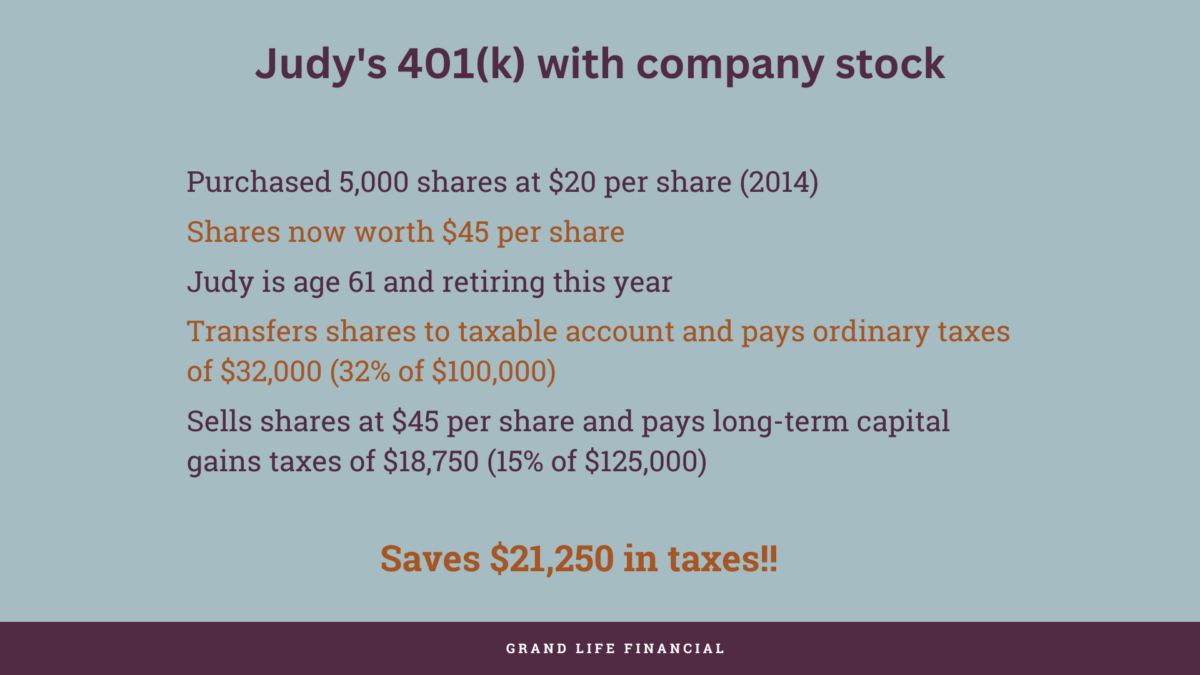
Judy participates in her company’s 401(k) and owns 5,000 shares of her employer’s stock.

  • She bought the stock at $20 per share in 2014.
  • Today, the shares are worth $45 each.

Judy is 61 and retiring this year — a qualifying event. She decides to use the NUA strategy.

When Judy transfers the shares in-kind to her taxable brokerage account:

  • She pays ordinary income tax on the $100,000 cost basis (5,000 shares × $20).
  • She does not pay tax yet on the $125,000 of appreciation (5,000 × ($45 – $20)).

Later, when Judy sells the shares, she will pay long-term capital gains tax on the $125,000 of growth — saving her over $21,000 in taxes compared to if she had taken a normal 401(k) withdrawal.

A financial slide explains Judy's 401(k) with company stock, showing share prices, tax strategies, and how she saves $21,250 in taxes by transferring and selling shares at retirement.
Image Credit: Grand Life Financial.

Final Thoughts

If you have highly appreciated company stock inside your 401(k), using the NUA tax strategy can be a powerful way to cut your future tax bills.

However, the rules are strict — missing any one step can disqualify you from the benefit. Make sure you work closely with a financial professional to properly execute the NUA distribution.

This article was originally published here and is republished on Wealthtender with permission.

Headshot of John Foligno, CMC®
John Foligno, CMC® Providing tax-efficient financial counsel to professionals and business owners.

John Foligno, CMC® | Grand Life Financial

In today’s unpredictable economic environment, many Americans are feeling financially frozen—uncertain of what steps to take, overwhelmed by decision fatigue, and unsure whom to trust. According to recent research, over half of U.S. adults report feeling paralyzed by their finances. The emotional toll of financial stress is real, and it often leads to inaction.

Financial paralysis doesn’t just happen overnight. It builds over time through information overload, fear of making mistakes, or past negative experiences. For business owners, divorcees, and those nearing retirement, the pressure can feel even more acute.

Step 1: Break Down the Overwhelm

When everything feels urgent, it’s easy to shut down. The key is to break financial goals into manageable steps. Start with one area, such as organizing monthly expenses or reviewing your credit report. Tackling small, achievable goals builds momentum and restores confidence.

Step 2: Clarify Your Financial Priorities

Rather than focusing on everything at once, zero in on what matters most right now. That might be building an emergency fund, eliminating high-interest debt, or creating a retirement income plan. Clarity reduces stress and gives your financial planning a defined direction.

Step 3: Create a Decision Framework

Many people stall on financial decisions because they fear making the wrong choice. Establishing a personal framework—guided by your values, risk tolerance, and long-term goals—can make complex choices more approachable. When decisions align with your priorities, confidence increases.

Step 4: Seek Expert Guidance

Sometimes, financial paralysis stems from simply not knowing where to start. A trusted financial advisor can help you prioritize, clarify your options, and create a step-by-step plan tailored to your situation. Whether you’re approaching retirement, recovering from divorce, or managing a business, professional guidance can be the catalyst for action.

Reclaiming Control

Overcoming financial anxiety is not about perfection; it’s about progress. With clarity, support, and a simple plan of action, it’s possible to move from feeling frozen to financially empowered.

This article was originally published here and is republished on Wealthtender with permission.

Headshot of Mitchell J. Thompson, CFP®, CDFA®, ChSNC®, AEP®
Mitchell J. Thompson, CFP®, CDFA®, ChSNC®, AEP® Family | Fixer | Fiduciary | Advisor | Wealth Manager

Mitchell J. Thompson, CFP®, CDFA®, ChSNC®, AEP® | MJT & Associates Financial Advisory Group

Ever wondered why billionaires don’t seem 1000x happier than millionaires? If you believe money doesn’t make you happy, this won’t surprise you at all, of course. But studies show that money does make you happy — it’s just that more money doesn’t always translate to more happy. Whether you have an ultra-high net worth, or a relatively low one, it’s worth learning to be happy with what you have. Here’s how.

Minimize Money Stress

Anyone who says “more money, more problems” can seem to be mocking you if you’re struggling to get by. But it’s true that you can have a lot of money and a lot of stress or a little money and relatively low stress.

Your stress around money can be more linked to things like your debt to income ratio, your monthly expenses, your income security and your personal values, rather than your actual income or net worth. A significant amount of high income households still live pay check to pay check while some low income households are living happily below their means.

You can minimize stress by improving your financial literacy and learning to manage what money you do have well. Financial education is priceless, and can mean you’re living with less stress on a low budget than those with a high income whose personal finances are out of control.

Deal with Debt

This is linked to the above point. Stress over money is often stress over debt, or more specifically a feeling of being out of control of your finances because of debt. Most of us carry some debt, and eliminating it overnight isn’t an option, but you don’t have to.

You’ll gain control over your debt by putting in place a solid plan to pay it off, even if that’s a five-year, 10-year, or 20-year plan. And you’ll feel happier knowing exactly how you’re going to get from where you are now to where you need to be.

Putting a plan in place might involve consolidating or moving debt, finding lower interest rates, or ring fencing future one-off payments (like a bonus or previously locked-in investment about to pay out) to go fully or partially towards debt repayment. It doesn’t really matter what the plan is, as long as you’re happy with it.

Earn Your Own Money

This may seem like an obvious one, but earning money makes you happy. Specifically, there’s evidence that earned money actually makes you happier than inherited money. Maybe this explains why the billionaires aren’t always happy. An awful lot of them inherited their wealth. They may have never really experienced the satisfaction of earning their own money.

It’s very easy however, to forget to truly enjoy the money we earn. That’s another reason to set a budget and make a plan to pay off debt. You’ll be more satisfied with your pay check when you’ve given each dollar a job, know what you can afford, and feel secure in the sustainability of your debt repayment plan. Then you can enjoy your money. We’ll cover that next.

Don’t Forget Your Fun Money

If you’re on a tight budget it’s easy to forget to include fun money in your budget. But living a fun-free life is not desirable or sustainable. It’s fine (and important) to budget for some fun to ensure some of the money you earn really is making you happy.

I used to know someone who was on a pretty low income, who justified fun money by always trying to get a full day’s fun out of an hour’s worth of pay. Not easy, but an interesting game to play. They took their $10 or sometimes $15 an hour and found a way to have a day out on it. It invariably involved things like national parks, free or very-low-cost attractions, picnics, barbecues, or special deals. Get creative. Just don’t miss out on fun completely.

Compare Carefully

A recent study found that almost a third of Americans have money dysmorphia. That is, they believe in a distorted version of reality whereby everyone else is doing much better than them financially. This is an age-old phenomenon, but definitely made worse by modern day technology and the ability to constantly compare your own life with the highlight reel that your acquaintances post online.

Being happy with what you have is easier when you’re not comparing it to what everyone else has. Try to stay off social media as much as possible, and be very aware of the distorted reality it can present you with when you’re on there.

Even better, use comparison to your advantage by volunteering for an organisation that helps those who are worse off than you. Volunteers tend to be happier and healthier, not only because giving in general tends to improve happiness, but also because being around those less fortunate can make you re-assess your own life and appreciate it more.

Money doesn’t necessarily buy happiness, but stress and concern around money can certainly leech the happiness out of your life, so learning to be happy with the money you have is a skill worth cultivating.

Karen Banes is a freelance writer specializing in entrepreneurship, parenting and lifestyle. She writes articles, website content, ebooks and the occasional award winning short story. Her work has appeared in a range of publications both online and off, including The Washington Post, Life Info Magazine, Transitions Abroad, Brave New Traveler, Natural Parenting Group, and Copia Magazine. Learn More About Karen

Ask an Advisor: Small Business Retirement Plans: Which One Fits Your Goals?

A bald man in a blue suit and pink tie smiles in an office setting. The background is blurred, showing a modern workspace with bright lighting and glass walls.
Image Credit: Wealthtender

Choosing the right retirement plan for your small business starts with understanding your goals. Do you want to attract and retain employees with strong benefits? Or are you focused on maximizing your personal retirement savings and reducing taxes? Whether you have employees or are a solo entrepreneur, there’s a retirement plan designed to fit your needs.

Below are the most common small business retirement plan options and what you should know about each.

SIMPLE IRA (Savings Incentive Match Plan for Employees)

A SIMPLE IRA is an easy-to-manage retirement plan for businesses with 100 or fewer employees. Both business owners and employees can contribute to a traditional IRA under this plan. As an employer, you must either:

  • Match 100% of employee contributions up to 3% of their compensation, or
  • Contribute 2% of each eligible employee’s compensation.

As the owner, you benefit by contributing both as the employer and the employee. SIMPLE IRAs have lower contribution limits compared to 401(k)s but are easier to set up and maintain, with no annual IRS filings or complex compliance testing required. This plan is ideal if you prefer a straightforward, low-maintenance option.

SEP IRA (Simplified Employee Pension)

The SEP IRA is another simple retirement plan where only the employer can contribute. Contributions must be made equally — the same percentage — to all eligible employees, including yourself. One major advantage is the flexibility: you can vary your contribution amounts year-to-year based on your business’s cash flow.

Like SIMPLE IRAs, SEP IRAs are easy to administer and do not require annual IRS filings or complex testing. They work particularly well for businesses with fluctuating profits.

401(k) and Profit-Sharing Plans

A 401(k) plan allows both employees and employers to contribute to individual accounts and offers higher contribution limits than SIMPLE or SEP IRAs. Employers can customize plans with features such as:

  • Safe Harbor contributions to avoid IRS testing
  • Roth 401(k) options for after-tax savings
  • Automatic enrollment
  • Profit-sharing options or discretionary matching contributions

Businesses are not required to make employer contributions every year but there must be a “substantial and recurring” contribution within three of the last five years.

Traditional 401(k)

A traditional 401(k) can significantly boost retirement savings due to higher contribution limits. Employers can also add profit-sharing contributions to reward key employees and strengthen retention by using vesting schedules.

However, business owners must act as fiduciaries under the Employee Retirement Income Security Act (ERISA), ensuring the plan is administered correctly. It’s essential to fully understand the administrative responsibilities and fees — both direct and indirect — which may include recordkeeping, investment management, and third-party administration costs. As many as 75% of small businesses are unaware of some plan fees, so careful evaluation of providers is critical.

Safe Harbor 401(k)

A Safe Harbor 401(k) plan simplifies compliance by automatically passing non-discrimination testing requirements. Employers must make mandatory contributions, either as a matching contribution or a nonelective contribution for all eligible employees.

This option is ideal for businesses with highly compensated employees who want to maximize their 401(k) contributions without restrictions.

Solo 401(k) (Individual 401(k))

If you are self-employed with no employees (or just your spouse), a Solo 401(k) allows you to contribute as both employee and employer, maximizing your retirement savings. Solo 401(k)s have the same benefits as traditional 401(k)s, including the ability to add a Roth component and take loans from the plan.

Cash Balance Plan

For profitable businesses led by owners over 50 who need to catch up on retirement savings, a Cash Balance Plan can be a game-changer. This type of defined benefit plan allows large tax-deductible contributions well beyond the limits of 401(k) and profit-sharing plans.

Cash balance plans can be paired with a 401(k) and profit-sharing structure to supercharge retirement savings while providing hefty tax deductions. Although contributions must be made for employees, owners typically receive the largest share.

Conclusion

Selecting the right retirement plan for your small business depends on your goals, business size, cash flow, and whether you have employees. Whether you want simplicity, flexibility, or maximum savings, there’s a plan that fits your situation. Consult with a retirement planning professional to customize the best strategy for you and your business.

Have a Question to Ask a Financial Advisor?

When you’re uncertain about money matters, submit your question to Wealthtender, and it may be answered by a financial advisor in an upcoming article or in the Wealthtender Expert Answers Forum.

Need personalized help? Visit wealthtender.com to find the right financial advisor for your unique needs.

This article was originally published on Wealthtender and is intended for informational purposes only and should not be considered financial advice. You should consult a financial professional before making any major financial decisions. Wealthtender earns money from financial professionals, which creates a conflict of interest when these professionals are featured in articles over others. Read the Wealthtender editorial policy and terms of service to learn more. Wealthtender is not a client of these financial services providers.

About the Author

Headshot of John Foligno, CMC®
John Foligno, CMC® Providing tax-efficient financial counsel to professionals and business owners.

John Foligno, CMC® | Grand Life Financial

A man in a checkered shirt smiles while sitting in a modern office with glass walls, blurred chairs, and desks in the background.
Image Credit: Wealthtender.

Ask an Advisor: What are the best strategies for financially preparing for the education costs of young children while maintaining retirement goals?

Wealth accumulators have a myriad of opportunities and challenges to make the most of their wealth building years. Imagine this, you’re 38, you have two young kids, you have double income, and an ever-growing list of expenses. Childcare costs, tee ball, dance, vacations, etc. are all adding up! You think to yourself, “Managing my family’s finances is not part of my day job.” Below are steps you can work through as you navigate saving for your and your spouse’s retirement, your kids’ education costs, and the growing list of expenses.

Step 1: Get clear on your priorities.

You and your spouse should define what “financial success” means to your family. Some questions to ask are: 1) When do we want the option to stop working and 2) Is college 100% on our tab? Finance is deeply personal so this will look different for every family.

It is also important to revisit your plan as your priorities change. Maybe one child doesn’t want to go to college. Maybe you start your own business and want to work until you’re 75. All these factors substantially impact the financial path you and your spouse should follow.

Step 2: Figure out your cashflow.

Know what comes in every month and what goes out every month. Count your monthly fixed expenses (rent, mortgage, car, etc.). Subtract that number from your monthly take home pay and the result is what you can split between savings and your variable spending.

Step 3: Prioritize retirement savings first.

After subtracting fixed costs, take care of yourself. You can’t borrow for retirement.  Allocate a significant portion of your monthly net income to your retirement accounts! Now is the time you get to trade your human capital for your investment capital. Don’t miss these prime years to get in the market and let compounding interest do the rest for you. After all, Albert Einstein did refer to it as the 8th wonder of the world.

Step 4, Plan for education expenses.

After accounting for your fixed spending and your retirement savings from your monthly net income, consider how much you want to invest for education costs. Small monthly contributions add up over 18 years!

529s are a great savings vehicle for this goal. They grow tax free and are withdrawn tax free if used for qualified education expenses. Try not to overfund them since withdrawals for non-qualified expenses are taxed as ordinary income AND they are penalized an extra 10%. If you do overfund, you can move the account under another child’s name. You may also be able to roll the excess investments into an IRA in your child’s name up to current limits.

Step 5: Don’t forget to PROTECT what you are building.

Both parents should have adequate life insurance coverage, disability insurance coverage, and a comprehensive estate plan to protect your family from a catastrophe. One unfortunate instance could ruin the entire plan.

For insurance, be sure to work with a fee-only advisor. Fee-only financial advisors CANNOT be paid insurance commissions. They are fiduciaries so they can help you navigate what policies are best for your family. Too many insurance brokers are compensated in the wrong ways, and they are NOT incentivized to put you and your family first.

Managing your finances is not part of your job description. Hopefully this list takes work off your family’s plate.

Have a Question to Ask a Financial Advisor?

When you’re uncertain about money matters, submit your question to Wealthtender, and it may be answered by a financial advisor in an upcoming article or in the Wealthtender Expert Answers Forum.

Need personalized help? Visit wealthtender.com to find the right financial advisor for your unique needs.

This article was originally published on Wealthtender and is intended for informational purposes only and should not be considered financial advice. You should consult a financial professional before making any major financial decisions. Wealthtender earns money from financial professionals, which creates a conflict of interest when these professionals are featured in articles over others. Read the Wealthtender editorial policy and terms of service to learn more. Wealthtender is not a client of these financial services providers.

About the Author

Headshot of Evan Luongo, CFP®
Evan Luongo, CFP® Your parents’ advisor hates me!

Evan Luongo, CFP® | NoDa Wealth Management