[Digital assets, like most emerging asset classes, have been on an inexorable march through fits and starts, scandals and successes, to be acknowledged and accepted as a legitimate financial asset class and major positive disruptor for many industries across the planet. Through the trials, tribulations, and noise, a very strong pattern of maturity has been forming with experienced players and leadership from other industries pushing the blockchain and digital assets industry into the mainstream. They are addressing the pitfalls and where the strategic focus and legitimate needed investments in this industry need to be centered to propel it forward.

To learn about the evolution of investing in blockchain and digital assets as a legitimate asset class, we spoke with Ruairi Hanafin, PhD, Chief Investment Officer, Jim Hwang, CFA, Chief Operating Officer, and Jay Vyas, CFA, Chief Strategy Officer of Firinne Capital – an investment firm with a vision to create a trusted investment space to bridge the gap between the emerging world of digital assets and traditional finance. Their name Firinne is Gaelic for “truth” which they chose to emphasize that digital assets are underpinned by the immutable truth of blockchain technology.

Their Firinne Liquid Digital Assets Fund provides its Limited Partners the opportunity for capital appreciation and income generation by investing primarily in a diversified portfolio of digital assets. Their investing strategy and research offers a unique combination informed by the experiences of early and ongoing digital asset adopters with the disciplined, measured hand of institutional investment management expertise. Recently winning the 2024 Hedgeweek Award in performance in the Directional Fund (1+ Years category), their goal is to ensure every investor has the opportunity to be part of this groundbreaking revolution and generational growth opportunity in blockchain and digital assets.]

Hortz: What exactly is the generational growth opportunity in digital assets?

Jay: Jim and I have been in the institutional investment industry for three and a half decades. We have seen that every 10 or 15 years something comes along, either a new technology, which could be a new industry, or a new risk premium that eventually becomes part of the investment landscape, occupying a space that did not exist previously. The people who recognize it and invest in it early have an uncommon opportunity to reap exceptional returns, but nothing is ever a straight line. Everything has risk.

The internet had a huge ramp up in the 1990’s and then a crash. But, if you look at where it is now, it has become ingrained in everything we do to the point that would have been inconceivable to people back in the 1990’s. That is an example of a type of a once-in-a-generation opportunity for participation. We will use the language of modern finance and call it an emerging risk premium. But you could call it a new technology that becomes an industry. And that is what we are seeing here with digital assets and the underlying technology called “blockchain”.

With the early internet era you could buy internet-based companies, but you could not invest in the underlying plumbing. What is really fascinating about this period of time we are in with the blockchain and digital assets is that you can invest in the underlying blockchain technology as well as the digital  projects that sit on top of it. This is actually novel in terms of investment opportunities.

Blockchain technology is not going to go away. It is a technology that has myriad uses in banks and insurance companies, in payments, in digital identity, and that is barely scratching the surface.

Hortz:  Why are you so confident about the growth of this new technology and investment risk premium? How do you see blockchain and digital assets will be accepted and deployed?

Jay:  There is a growing mainstream acceptance of digital assets as an investment choice in a global portfolio of risk assets. As a recent example, we have seen large investment organizations releasing digital asset investment products like Bitcoin ETFs. Ten years ago, investing in digital assets was a high-risk proposition or venture capital opportunity. Exact figures are hard to pin down, but we have seen some surveys that indicate that the percentage of people who own crypto now is not far from the percentage of people who own dogs. Suffice it to say, crypto is becoming more and more mainstream.

So blockchain and digital assets went from an anarchist or libertarian tool to a multi-purpose technology with great utility in many areas. Look at the idea of smart contracts on the Ethereum and similar chains. They allow us to do things that we could not do before, such as creating autonomous organizations. These growing applications give you the sense that this will be lasting. Regulations are also moving in a positive direction, and governments are talking about adopting digital assets as reserves. This all points to increasing stability or the fact that this will remain in the landscape of investment options. It is well beyond just a flash in the pan.

Ruairi : Just a little bit extra on those points. Looking at a chart of the market capitalization of crypto over the past decade or more, you can see it growing through orders of magnitude every couple of years. If you look at what the total addressable market growth is, crypto may start becoming commonplace with regular usage and adoption of stable coins and other applications. If you just continue that trajectory on that Market Cap Chart, you can reasonably imagine where it could go over the next decade or two. There is plenty of room for growth, I would say.
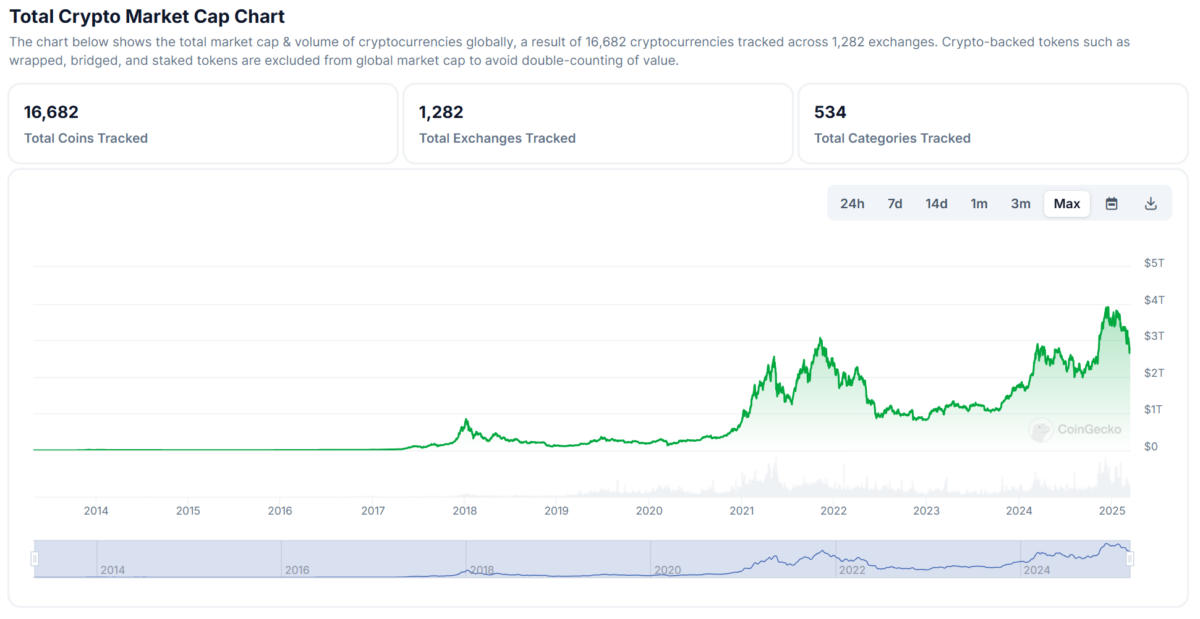
A line chart showing the total cryptocurrency market cap from 2013 to 2025, with notable growth spikes in 2018 and 2021. Data includes 16,682 coins, 1,282 exchanges, and 534 categories tracked.

Crypto assets market cap, as of 13-Mar-2025. Source: CoinGecko

Jay: There are plenty of new application ideas where people who are issuing bonds or offering custody are saying, Hey, we can replace our existing process with something on a blockchain, and it’ll be more reliable. It’ll be immutable. It’ll be more secure. That is all true. There is a growing interest of replacing what we do now operationally with something that uses a blockchain.

What is more exciting is that we also have a new generation of young people who will grow up not knowing a world without blockchain. They will come up with ideas for projects that somebody my age would never have conceived of, and it is those innovations that can be supported and be brought to fruition to reality by the blockchain and by digital assets. This is a key driver that led us to move from TradFi to digital assets. There is a certain amount of optimism in what we say. We will be honest. But the blockchain and digital assets have definitely grown from a fringe tech idea to a mainstream technology   whose impact is just beginning to be realized as well as a legitimate investment option.

Hortz: How exactly does your asset management firm combine the blockchain and digital asset innovation experience with an institutional investment management perspective?

Jay: Jim and I have been in the institutional investment management space since the 1980s, and we have managed significant AUM at Barclays Global Investors, say north of $80 billion in actively managed strategies, and at the CPP Investment Board with $24 billion in global market neutral portfolios. When you are running money in these types of sophisticated organizations, you are always thinking about risk management from all angles – operational risk, investment risk, counterparty risk. Relative to the exciting growth and development of the crypto space, risk management seems really quite boring, but it is critically important in institutional asset management.

With our team, each member has institutional investment management and crypto experience. That gives us a unique perspective. Jim and I have seen a million things that can go wrong in investment management, and Ruairi, who has a long history in the space, has seen all the bumps and crises on the rise and implementation of blockchain and crypto. Compare this to managers who only have experience since the global financial crisis where markets have basically gone up, or to people who jumped into crypto just a few years ago.

We have also all worked together before at a global investment firm and have risk management in our joint DNA. We perform a lot of due diligence on what we are going to invest in and who our partners will be, which has already helped us avoid major blowups in crypto like FTX and 3 Arrows Capital. In short, we are very skeptical in our investment selection process and sensible in our execution.

Ruairi: The funny thing is our performance – for all its defensive and institutional risk management approach – has still been in the top bracket of performance in our investment space of crypto and blockchain. I think the key to this space is that you know you are in a space that is developing and rising exponentially. It is very important not to take excessive risks to try and boost performance by a few percentage points. There are a lot of options to reach for short-term performance which generally have worked out poorly.

Jim: Let me add that our focus is on what we call informed risk taking. One of the things we talk about, when we think about investing is What is the investment horizon needed to realize investment returns? This is particularly important to us. As Jay mentioned, when we came into the crypto space, we saw other investors that were focused on the really short-term horizon. I am referring to orders of magnitude of within one to a couple of days. These managers were looking to arbitrage the pricing inefficiencies among the different exchanges. But, by doing so, they were not focusing on the long horizon returns that one can capitalize on – looking for Who are the builders of this new infrastructure? Who is laying down the pipes? Who is building the useful applications? So that is a competitive difference in our thinking, and how we are considering investment decisions.

Given this starting point, we then attempt to add to alpha by also capitalizing on short term inefficiencies. This is something we bring over from traditional finance where you actually layer different strategies together to form a complete portfolio. That becomes a form of diversification and risk control across different time horizons. It is not clear that a lot of people in crypto investing think about horizon diversification.

Hortz : Another component of your management style is to manage the portfolio to generate some income. Can you explain your strategies for yield enhancement?

Ruairi: There are a number of ways in crypto to generate yield on assets and boost returns. One of them is participating in what is called staking. It is essentially the consensus mechanism for these blockchains which we participate in. Another is called liquidity provisioning which is basically supplying assets into automated market makers. We participate judiciously and carefully in some of these activities. Let us just say, via these types of mechanisms, we are making more efficient use of our portfolio’s capital. We are managing the liquidity aspect of the portfolio. It is a form of multi-dimensional management, looking at all different aspects of the portfolio.

Hortz: What is the backstory on the benchmark you chose?

Jim: Related to traditional investment management, we brought an index into the picture so our fund can be compared to a market benchmark, and we can aim over time to beat that performance. The Bitwise 10 Large Cap Crypto Index represents a capitalization-weighted index that tracks the largest crypto assets including established giants like Bitcoin and Ethereum, as well as some up-and-coming assets. The benchmark has 10 names, but we can invest in names outside the benchmark. We typically stay to the largest 50 or 100 names in the crypto space. Remember for context that there are millions of tokens available for investment. Our universe is going to be the largest and most-in-play names that will comprise 80 or 90% of the portfolio. We use the index as a guide, not a constraint.

Ruairi: I think the point is that we wanted to choose a benchmark that we felt was as fair as possible, and given that Bitcoin and Ethereum together represent well over 50% of the entire crypto market cap, we picked one that gave us relatively broad market exposure. We believe that the crypto market is one of the most inefficient markets that we have seen in our careers, and we want to take advantage of that for our investors. I personally would never passively invest in a market cap weighted index in this space. I think you can, in the long run, do quite a bit better than passive investing in crypto.

Hortz: How would you explain to advisors and asset allocators your differentiated value proposition?

Ruairi: We are a conservatively run fund in a space that is anything but conservative. It is a rapidly evolving technology and asset class that is appealing by offering a generational investment opportunity as we discussed, but there are concerns and fears in the back of many investors’ minds as to the growing pains and abuses of some players they read about along the way. Investors need to know that the high-profile collapse of FTX was not a digital assets issue. It was good old-fashioned fraud that we avoided with our thorough due diligence and risk management processes.

That is an important aspect of our value proposition that our combined investment expertise from crypto and institutional expertise will not allow us to swing for the fences, because sometimes in this space, if you swing for the fences, you might have the ball just come up and smack you in the face.

We are the tortoise in the “tortoise and the hare” race. It is a dynamic and evolving space, but we remain humble, and we remain diligent. We clearly have far-sighted vision of where the technology and asset class opportunities can take us, but we carefully look out for excesses and traps along the way. Our differentiated approach backed by two dimensions of management – crypto and institutional investment expertise – is what we feel will help our investors be able to participate in this generational investment opportunity.

This article was originally published here and is republished on Wealthtender with permission.

About the Author
A middle-aged man, Bill Hortz, with short dark hair wearing a dark pinstripe suit, white dress shirt, and a maroon tie, posing against a plain gray backdrop. He has a slight smile and is looking directly at the camera.

Bill Hortz

Founder Institute for Innovation Development
Bill Hortz is an independent business consultant and Founder/Dean of the Institute for Innovation Development- a financial services business innovation platform and network. With over 30 years of experience in the financial services industry including expertise in sales/marketing/branding of asset management firms, as well as, creatively restructuring and developing internal/external sales and strategic account departments for 5 major financial firms, including OppenheimerFunds, Neuberger&Berman and Templeton Funds Distributors. His wide ranging experiences have led Bill to a strong belief, passion and advocation for strategic thinking, innovation creation and strategic account management as the nexus of business skills needed to address a business environment challenged by an accelerating rate of change.

Do you work at Tesla? Get the resources you need and expert insights from financial professionals who specialize in helping Tesla employees make the most of their compensation package and benefits.

Whether you’re a new Tesla employee or you’ve moved up the ranks into a management or executive leadership role over a multi-year career, it’s important to make smart money moves with your income and employee benefits. For example:

✅ Do you know the right moves to make to get the greatest value from the Tesla benefits available to you?

✅If you’re thinking about leaving Tesla for another job or planning to retire from the company in a few years, are you taking the right steps today to ensure you will receive all of the compensation and benefits that you’ve earned?

Get the Most Value from Your Tesla Benefits and Compensation Package

Throughout the year, Tesla provides its employees and executives with updates about their benefits ranging from health insurance and health savings plans to retirement plans like a 401(k), deferred compensation plans, and stock options. While the company offers many useful resources and access to knowledgeable staff who can assist with questions, you’ll also find financial professionals not affiliated with Tesla who specialize in helping Tesla employees make the most of their income and benefits.

Whether you work with Elon in the Tesla headquarters in Austin, Texas, another office location or gigafactory around the country, or remotely from home, you may have questions about your compensation package and benefits better suited for a financial professional who can offer unbiased advice and guidance.

For example, sensitive topics like discussing the steps you should take before quitting your job at Tesla to work elsewhere, protecting yourself in advance of a corporate layoff, or deciding when you should plan to retire are all conversations that may be more comfortable with a trusted financial advisor.

Should you hire a Tesla specialist financial advisor or an advisor close to home?

You’ll likely find dozens of nearby financial advisors well-suited to help you reach your money goals with a personalized plan. But it may be more difficult to find a financial advisor who specializes in serving Tesla employees.

Fortunately, many financial advisors offer virtual services so you can meet online no matter where you (or they) live.

This means you can choose to hire a specialist financial advisor who lives hundreds of miles away if you decide their knowledge and experience working with Tesla employees is a better fit to help with your unique needs.

💡 In the Q&A below, you’ll gain insights from financial advisors who work with Tesla employees to help them make smart decisions to get the most value from their compensation and benefits, reduce their money stress, and prepare for a comfortable retirement.

🙋‍♀️ Do you have questions not yet answered? Use the form below to submit questions anonymously and watch this article for updates with answers to your questions. You can also reach out to the financial advisors below to set up an introductory call or contact them with your questions by email.


💸 Smart Money Insights for Tesla Employees & Executives

This page is organized into sections to help you quickly find the information you need and get answers to your questions:

  1. Q&A: Financial Planning Tips for Tesla Employees & Executives
  2. Get Answers to Your Questions About Your Tesla Benefits and Career
  3. Quick Facts & Resources for Tesla Employees
  4. Browse Related Articles

Q&A: Financial Planning Tips for Tesla Employees & Executives

In this section, you’ll learn how you can make the most of your Tesla employee benefits and gain valuable tips from financial advisors who specialize in working with Tesla employees and executives.

Answers to Employee Questions with Ryan Goldenhar, CFA®, CFP®

Ryan Goldenhar is a financial advisor based in San Diego, California who specializes in offering financial planning services to Tesla employees. Ryan helps his clients get the most value from their Tesla benefits and compensation package so they can enjoy life and feel confident about their financial future.

Q: As a financial advisor with experience helping Tesla employees save for their retirement, how do you help them make the most of their employee benefits?

Ryan: Tesla has some great benefits and we make sure that you are taking advantage of all that they offer. This includes helping you with your equity compensation (ISOs, NSOs, RSUs, ESPP), retirement accounts, health insurance and family benefits within their overall corporate benefits package.

Q: When you first speak with a Tesla employee, what questions do you like to ask to better understand their unique circumstances and determine how you can best help them achieve their goals?

Ryan: Tesla is a publicly traded company which means you either need to sell during open windows or a 10b5-1 selling plan with E-Trade/Morgan Stanley. We help you to strategize around the best way to diversify with the lowest possible taxes based on your unique situation and goals.

This leads to questions such as:

  • What are your goals in life?
  • How long do you hope to stay with Tesla?
  • How would you like your wealth to support your family and legacy?
  • How well do you feel you understand your equity compensation?
  • Do you have an idea of how much in taxes you will owe with your total compensation package?

Q: Is there a particular benefit available to Tesla employees you feel isn’t as well utilized or understood by employees as it should be?

Ryan: Incentive Stock Options (ISOs) are still occasionally issued by Tesla and if you have them, they can be confusing since they do have tax benefits but you have to be careful around generating Alternative Minimum Tax (AMT) if you exercise-and-hold shares via an ISO exercise. We help clients navigate this issue with a structured plan of potentially exercising them early in a calendar year and then revisiting the buy-and-hold decision during the last trading window of the calendar year before AMT might become due on the phantom benefit value from exercising the following April. If the decision to buy-and-hold TSLA shares from an ISO exercise no longer makes economic sense during the last trading window of the year, we help clients explore what’s called a “disqualifying disposition” which works like a “mulligan” in golf…it’s a do over.

et to Know Ryan Goldenhar Financial Advisor for Tesla Employees:

View Ryan’s profile page on Wealthtender or visit his website to learn more.

Q: Beyond Tesla employee benefits for retirement savings, are there other types of benefits offered by the company that you find valuable to discuss with your clients?

Ryan: Tesla has a nice legal benefit that can allow you to create an estate plan for little to no cost. Many employees might not know about this benefit but it’s one we encourage our clients to use since we focus on much more than just investments. We help review our clients’ corporate benefits, estate plans, tax returns, insurance (property & casualty term life, etc.), college savings plans, debt management and review job offers as they explore moving to a new employer.

Q: For Tesla employees thinking about leaving the company to accept a job elsewhere, what actions do you recommend they take before resigning and shortly thereafter?

Ryan: If you’re thinking of leaving Tesla, you should consider the financial impact of losing your UNVESTED equity which will be forfeited when you leave. In addition, you may have a short window to exercise and remaining vested options when you leave and need to factor this economic decision into all of the other financial choices that come with leaving Tesla to join a new company. Another consideration is health insurance. Health insurance will end at month-end of your employment. Knowing you have another job starting in a few weeks vs. a few days may leave you open to a medical emergency if coverage is not continuous. Finally, 401(k) employee contributions and HSA contributions are a zero sum game across employers. If you contribute the maximum to the Tesla 401(k) and then move to a new employer, you might need to wait until the next year to start contributing to the new 401(k) to make sure you don’t overcontribute to a 401(k) plan for the calendar year and then need to fix it later to avoid a tax penalty.

Q: For Tesla employees approaching retirement age, how do you recommend they prepare to make the transition from living off their salary to relying upon other sources of income?

Ryan: Many of our tech professional clients look to make work optional around age 50 to age 55. Because they’re not 59 1/2 yet which would allow them to pull funds penalty free from an IRA or 401(k), we need to assess the level of outside retirement account assets to support the client’s lifestyle and to budget potentially higher costs for medical insurance until they reach age 65 to qualify for lower cost Medicare coverage.

We work with our clients to understand COBRA and health exchange options years in advance, so we have a good year of emergency savings ready for the first big moment of this next phase in life. Then, it’s really about seeing how you can lean into your values and passions while keeping the finances in mind. Some of our clients go on to create their own startups or decide on consulting or volunteer work, etc. For our clients, we’ve discovered that a traditional ‘retirement’ to lounge by the pool with a Mai Tai isn’t of interest. They want “financial freedom” to explore new and different life adventures that may require cash needs to get going. We make sure we understand what will be going out the door by helping our clients imagine what their new lives will look like. Then we work to structure their portfolio cash flow so they can see how they are doing spending-wise compared to what we planned for.

Q: For Tesla employees who have managed their finances on their own to this point, what would you suggest they consider to help them decide if they should begin working with a financial advisor at this stage in their lives?

Ryan: An advisor can help with short-term decision-making such as equity compensation decisions, tax planning guidance, etc. and also with bigger-picture thinking (i.e. creating a framework so you can see the direction all your hard work is taking you, and make sure your money behaviors are aligning with your life goals). A client is often already doing many of the right things, moving in a positive direction and the value of working with an advisor/coach is to serve as an execution and accountability partner to allow the client to achieve more than they can do on their own.

Our planning process helps to put things in a broader framework to allow our clients to confidently make decisions that are proactive and intentional while we serve as a sounding board for the client about ideas they’re not sure about.

We encourage DIY investors to consider the cost of NOT getting a second opinion. Investment management is one thing, but retirement planning has incredible nuance to it that many people overlook such as:

  • How will my investments be taxed? Can I minimize my lifetime taxation? Am I taking too much (or not enough) risk in the markets?
  • What is my plan to turn my assets into income? What are the tax implications of doing that?
  • Am I going to run out of money? How should I deal with Inflation?
  • What about long-term care?
  • Are my beneficiary designations up to date? Do I understand what’s going to happen to my assets when I pass?
  • Do I need life insurance? Do I have enough or too much? Should I keep these old policies?

There are a number of different areas that a Certified Financial Planner (CFP) can provide incredible value to a recent retiree, even if they choose to continue to manage their own investments.

Q: What are some of the unique financial planning challenges you commonly see among your clients who are Tesla employees and how do you help them overcome these obstacles?

Ryan: A good, high-paying job in tech can feel a bit like golden handcuffs sometimes and it can be hard to imagine walking away. But, if you want to prepare for an exit or a shift to a different industry, we can create a pathway to ease the transition. In a role with equity compensation, a challenge can be to define how much to rely on that compensation in the plan. It’s variable and can be hard to quantify, but can be significant. So, having a firm structure based on a client’s comfort with the exposure and how it’s treated in the plan is important.

Q: What questions do you recommend Tesla employees ask financial advisors they’re considering hiring to help them decide if they’re a good fit?

Ryan: How does the advisor think about and approach decisions to complicated financial choices? We’ve found that sometimes the best choice for a particular client isn’t the one with the highest possible economic value because “sleep at night” and emotional factors might be more important than the biggest number on a spreadsheet. Your advisor should be able to clearly articulate how they arrived at their recommendations in a way that you can understand in plain English with no salesy finance gibberish. They should understand that trust must be earned over time and isn’t going to be granted immediately. Beyond these philosophical points, you should ask if the advisor is a fiduciary legally required to put your economic interests before his or her own? Will the advisor be providing comprehensive financial planning or just investment management? What will you pay in fees? Are there any hidden fees in the products the advisor is recommending?

Q: Is there anything that comes up frequently in your initial meeting with Tesla employees that surprises you?

Ryan: Maybe not surprising in the current political climate, but Tesla employees can feel conflicted in their feelings about their company stock. Most employees of other companies where we have clients LOVE their company stock…it’s their favorite investment. With Tesla, some love it and some not so much. I suppose it makes it easier to discuss diversifying Tesla than it is at other clients’ companies.

Q: For highly compensated Tesla employees and executives, are there any special benefits you believe it’s important to take into consideration when preparing their financial plan?

Ryan: For highly compensated employees at Tesla, we encourage them to look at and explore the potential benefits of a deferred compensation plan if they get invited to participate in the following calendar year. It’s a good tool to defer income taxes but comes with some tradeoffs that we help our clients explore before participating.

Q: Is there a particularly memorable experience or a moment you recall with a client who worked at Tesla when you realized they have unique opportunities and circumstances when it comes to their financial planning needs?

Ryan: We have found that many Tesla company employees that are single when they join are more interested in getting married if their significant other doesn’t also have a high amount of compensation. In these situations where our Tesla client makes a high income and their significant other does not, filing their tax returns as “married filing jointly” instead of as a single taxpayer might be just enough of an economic benefit nudge to get clients to say “I do.”

Quick Facts & Resources for Tesla Employees

Tesla Quick Facts & ResourcesDetails / Useful Links
Tesla Corporate Headquarters Address1 Tesla Road Austin, TX 78725 (📍 Google Maps)
How much do Tesla employees Make?View Tesla Salary Research on Glassdoor
Where can I learn more about careers at Tesla?Visit tesla.com/careers
How many people work for Tesla?Tesla has around 100,000 employees worldwide (Source: Teslarati)
What is the ticker symbol for Tesla stock?The Tesla ticker symbol is TSLA.


🙋‍♀️ Have Questions About Your Tesla Benefits or Career?


Are you ready to enjoy life more with less money stress?

Sign up to receive weekly insights from Wealthtender with useful money tips and fresh ideas to help you achieve your financial goals.

  • This field is for validation purposes and should be left unchanged.

About the Author
Brian Thorp, Founder and CEO of Wealthtender profile picture

Brian Thorp

Founder and CEO, Wealthtender

Brian and his wife live in Texas, enjoying the diversity of Houston and the vibrancy of Austin.

With over 25 years in the financial services industry, Brian is applying his experience and passion at Wealthtender to help more people enjoy life with less money stress.

Connect with Brian on LinkedIn

Do you work at Tesla? Get the resources you need and expert insights from financial professionals who specialize in helping Tesla employees make the most of their compensation package and benefits.

Whether you’re a new Tesla employee or you’ve moved up the ranks into a management or executive leadership role over a multi-year career, it’s important to make smart money moves with your income and employee benefits. For example:

✅ Do you know the right moves to make to get the greatest value from the Tesla benefits available to you?

✅If you’re thinking about leaving Tesla for another job or planning to retire from the company in a few years, are you taking the right steps today to ensure you will receive all of the compensation and benefits that you’ve earned?

Get the Most Value from Your Tesla Benefits and Compensation Package

Throughout the year, Tesla provides its employees and executives with updates about their benefits ranging from health insurance and health savings plans to retirement plans like a 401(k), deferred compensation plans, and stock options. While the company offers many useful resources and access to knowledgeable staff who can assist with questions, you’ll also find financial professionals not affiliated with Tesla who specialize in helping Tesla employees make the most of their income and benefits.

Whether you work with Elon in the Tesla headquarters in Austin, Texas, another office location or gigafactory around the country, or remotely from home, you may have questions about your compensation package and benefits better suited for a financial professional who can offer unbiased advice and guidance.

For example, sensitive topics like discussing the steps you should take before quitting your job at Tesla to work elsewhere, protecting yourself in advance of a corporate layoff, or deciding when you should plan to retire are all conversations that may be more comfortable with a trusted financial advisor.

Should you hire a Tesla specialist financial advisor or an advisor close to home?

You’ll likely find dozens of nearby financial advisors well-suited to help you reach your money goals with a personalized plan. But it may be more difficult to find a financial advisor who specializes in serving Tesla employees.

Fortunately, many financial advisors offer virtual services so you can meet online no matter where you (or they) live.

This means you can choose to hire a specialist financial advisor who lives hundreds of miles away if you decide their knowledge and experience working with Tesla employees is a better fit to help with your unique needs.

💡 In the Q&A below, you’ll gain insights from financial advisors who work with Tesla employees to help them make smart decisions to get the most value from their compensation and benefits, reduce their money stress, and prepare for a comfortable retirement.

🙋‍♀️ Do you have questions not yet answered? Use the form below to submit questions anonymously and watch this article for updates with answers to your questions. You can also reach out to the financial advisors below to set up an introductory call or contact them with your questions by email.


💸 Smart Money Insights for Tesla Employees & Executives

This page is organized into sections to help you quickly find the information you need and get answers to your questions:

  1. Q&A: Financial Planning Tips for Tesla Employees & Executives
  2. Get Answers to Your Questions About Your Tesla Benefits and Career
  3. Quick Facts & Resources for Tesla Employees
  4. Browse Related Articles

Q&A: Financial Planning Tips for Tesla Employees & Executives

In this section, you’ll learn how you can make the most of your Tesla employee benefits and gain valuable tips from financial advisors who specialize in working with Tesla employees and executives.

Get to Know:

✅ Emily Rassam (Charlotte, NC) and Richard Archer (Austin, Texas)

✅ Ryan Goldenhar (San Diego, CA)


Answers to Tesla Employee Questions with Emily Rassam and Richard Archer (Archer Investment Management)

With a focus on serving professionals in the technology industry, the financial advisors at Archer Investment Management help their clients get the most value from their benefits and compensation package so they can enjoy life and feel confident about their financial future. Based in Charlotte, North Carolina, and Austin, Texas, respectively, Emily Rassam and Richard Archer specialize in offering financial planning services to Tesla employees.

Q: As a financial advisor with experience helping TESLA employees save for retirement, how do you help them make the most of their employee benefits?

Emily: At Archer Investment Management, we specialize in working with mid-career technology professionals. We have several TESLA employees as clients and are familiar with the company’s employee benefit plans, retirement plans, equity compensation packages, and ancillary benefits.

More importantly, we are acutely aware of the financial planning needs of technology professionals and how their TESLA benefits fit into an overall financial plan, including long-term planning, goal setting, tax planning, and estate planning. We start by building a financial personality profile and risk tolerance assessment to understand your relationship with money and your comfort level with risk.

Q: When you first speak with a TESLA employee, what questions do you like to ask to better understand their unique circumstances and determine how you can best help them achieve their goals?

Richard: Our detailed onboarding process includes conversations about your life goals, how your finances play a role in maximizing happiness, and what it means to be intentional with money. We gather information about your benefits and compensation package, spending plan, short-term and long-term goals, taxes, estate plans, and insurance.

This detailed planning process allows us to build a comprehensive picture of your financial life and how each piece of the puzzle fits together. You cannot make recommendations without examining the whole picture.

Q: Is there a particular benefit available to TESLA Technologies employees you feel isn’t as well utilized or understood by employees as it should be?

Richard: Many of the TESLA health care plans are high-deductible health care plans (HDHPs) that allow you to save in a Health Savings Account (H.S.A.). An H.S.A. is a very powerful savings vehicle that can be triple-tax-free and allows you to build long-term savings for future health care costs.

In 2023, a single individual can save up to $3,850 in an H.S.A. and a married couple can save $7,750. For TESLA employees over age 50, you may save an additional $1,000 as a catch-up contribution. Once your H.S.A. reaches a minimum balance threshold, you can then invest the assets in a brokerage account. This is an underutilized benefit we regularly advise our TESLA clients to maximize and build over time. It’s often advantageous to avoid tapping your H.S.A. for health care costs so that you can allow the H.S.A investment account to compound over time; If you have the means, paying out-of-pocket for health care expenses can be a savvy tax move.

Q: Beyond the TESLA employee benefits for retirement savings, are there other types of benefits offered by the company that you find valuable to discuss with your clients (e.g., stock, education savings, health savings)?

EmilyVirtually all employees are eligible to join the employee stock purchase plan (ESPP) through E*TRADE. So long as you are scheduled to work for more than 5 months[MZ1]  for TESLA, are employed at the beginning and end of the offer period, and work 20 hours or more per week, you may join the plan at the start of the next offer period.

This plan allows you to purchase TESLA stock at a discount and build additional wealth beyond the 401(k) plan by saving up to 15% of your pay into the ESPP plan. Each year, the offer period typically opens on August 1st for the September 1 – February 28 purchase period and you may make elections throughout the month of February for the purchase period of March 1 – August 31. As mentioned earlier, you can also invest your H.S.A. money like you would a retirement account.

Get to Know Emily Rassam, Financial Advisor for Tesla Employees:

View Emily’s profile page on Wealthtender or visit her website to learn more.

Q: For TESLA employees thinking about leaving the company to accept a job elsewhere, what actions do you recommend they take before resigning and shortly thereafter?

Emily: Your matched 401(k) dollars vest at 25% each year over four years. If you have not yet met four years of service, you may want to review the employer dollars you are leaving on the table. You may have received employee stock options or restricted stock units (RSUs) that are unvested. Look carefully at the dates on your grants and vesting schedules to determine when each RSU grant vests; this may impact your timing to leave TESLA. You have 90 days after departing the company to exercise your stock options. Work with an advisor to determine which grants to exercise and the best way to fund this purchase.

Q: For TESLA employees approaching retirement age, how do you recommend they prepare to make the transition from living off their salary to relying upon other sources of income?

Richard: Our detailed retirement planning process includes:

·       A spending strategy tailored to your income goals

·       Social Security timing recommendations

·       Coordination of health care benefits

·       Discussion around how your spending will change throughout retirement

·       Stress-testing your retirement projection with many what-if scenarios

·       Timing your exit to maximize any unvested incentive stock options (ISOs), non-qualified stock options (NSOs), or RSUs

Q: For TESLA employees who have managed their finances on their own to this point, what would you suggest they consider to help them decide if they should begin working with a financial advisor at this stage in their lives?

Emily: There are many online tools and calculators. Where we find TESLA employees get stuck is understanding how to prioritize goals and seeing the big picture. We help TESLA employees organize their financial lives and provide accountability for reaching goals.

Understanding whether you should use surplus dollars to pay down debt, save towards a short-term goal, or work towards a long-term aspiration (such as retirement or college education savings) can be challenging. For TESLA employees planning with a spouse or partner, an advisor helps facilitate difficult conversations and moves the ball forward in your planning process.

Q: What are some of the unique financial planning challenges you commonly see among your clients who are TESLA employees and how do you help them overcome these obstacles?

Richard: One common obstacle we find is knowing when to diversify away from the concentration risk of holding a high percentage of your net worth in one company’s shares. Many of our TESLA employee clients struggle with selling positions; it requires coaching, recognizing natural human biases, an evaluation of the risks, and careful diversification away from an outsized position.

Get to Know Richard Archer, Financial Advisor for Tesla Employees:

View Richard’s profile page on Wealthtender or visit his website to learn more.

Q: What questions do you recommend TESLA employees ask financial advisors they’re considering hiring to help them decide if the relationship would be a good fit?

Richard: If you were granted ISOs or RSUs, be sure to work with an advisor who understands how to incorporate those into your overall picture. Seek an advisor who can model the alternative minimum tax (AMT), understands the rules around qualifying and disqualifying dispositions, and knows how and when to diversify away from sizeable single stock positions, if appropriate.

Q: Is there anything that comes up frequently in your initial meeting with TESLA employees that surprises you?

Richard: We enjoy finding opportunities to help TESLA employees maximize their ESPP plans, H.S.A. plans, and understand their non-traditional benefits such as tuition reimbursement, legal services, vision insurance refunds, fitness benefits, and generous life insurance benefits.

Q: For highly compensated TESLA employees and executives, are there any special benefits you believe are important to take into consideration when preparing their financial plan?

Emily: Highly compensated employees at TESLA are more likely to have been awarded stock options and/or RSUs. It’s important to evaluate your equity compensation as part of your overall offer for employment and understand how they fit into your multi-year financial plan.

Q: Is there a particularly memorable experience or a moment you recall with a client who worked at TESLA when you realized they have unique opportunities and circumstances when it comes to their financial planning needs?

Emily: In recent meetings with a TESLA employee, we modeled multiple stock option exercise strategies to reduce lifetime AMT. In some cases, it makes sense to exercise options slowly over many years. In this case, it made the most sense to exercise all vested options within three years. We determined which vested RSU shares we could sell to help fund the cost of exercising those shares.


Answers to Employee Questions with Ryan Goldenhar, CFA®, CFP®

Ryan Goldenhar is a financial advisor based in San Diego, California who specializes in offering financial planning services to Tesla employees. Ryan helps his clients get the most value from their Tesla benefits and compensation package so they can enjoy life and feel confident about their financial future.

Q: As a financial advisor with experience helping Tesla employees save for their retirement, how do you help them make the most of their employee benefits?

Ryan: Tesla has some great benefits and we make sure that you are taking advantage of all that they offer. This includes helping you with your equity compensation (ISOs, NSOs, RSUs, ESPP), retirement accounts, health insurance and family benefits within their overall corporate benefits package.

Q: When you first speak with a Tesla employee, what questions do you like to ask to better understand their unique circumstances and determine how you can best help them achieve their goals?

Ryan: Tesla is a publicly traded company which means you either need to sell during open windows or a 10b5-1 selling plan with E-Trade/Morgan Stanley. We help you to strategize around the best way to diversify with the lowest possible taxes based on your unique situation and goals.

This leads to questions such as:

  • What are your goals in life?
  • How long do you hope to stay with Tesla?
  • How would you like your wealth to support your family and legacy?
  • How well do you feel you understand your equity compensation?
  • Do you have an idea of how much in taxes you will owe with your total compensation package?

Q: Is there a particular benefit available to Tesla employees you feel isn’t as well utilized or understood by employees as it should be?

Ryan: Incentive Stock Options (ISOs) are still occasionally issued by Tesla and if you have them, they can be confusing since they do have tax benefits but you have to be careful around generating Alternative Minimum Tax (AMT) if you exercise-and-hold shares via an ISO exercise. We help clients navigate this issue with a structured plan of potentially exercising them early in a calendar year and then revisiting the buy-and-hold decision during the last trading window of the calendar year before AMT might become due on the phantom benefit value from exercising the following April. If the decision to buy-and-hold TSLA shares from an ISO exercise no longer makes economic sense during the last trading window of the year, we help clients explore what’s called a “disqualifying disposition” which works like a “mulligan” in golf…it’s a do over.

et to Know Ryan Goldenhar Financial Advisor for Tesla Employees:

View Ryan’s profile page on Wealthtender or visit his website to learn more.

Q: Beyond Tesla employee benefits for retirement savings, are there other types of benefits offered by the company that you find valuable to discuss with your clients?

Ryan: Tesla has a nice legal benefit that can allow you to create an estate plan for little to no cost. Many employees might not know about this benefit but it’s one we encourage our clients to use since we focus on much more than just investments. We help review our clients’ corporate benefits, estate plans, tax returns, insurance (property & casualty term life, etc.), college savings plans, debt management and review job offers as they explore moving to a new employer.

Q: For Tesla employees thinking about leaving the company to accept a job elsewhere, what actions do you recommend they take before resigning and shortly thereafter?

Ryan: If you’re thinking of leaving Tesla, you should consider the financial impact of losing your UNVESTED equity which will be forfeited when you leave. In addition, you may have a short window to exercise and remaining vested options when you leave and need to factor this economic decision into all of the other financial choices that come with leaving Tesla to join a new company. Another consideration is health insurance. Health insurance will end at month-end of your employment. Knowing you have another job starting in a few weeks vs. a few days may leave you open to a medical emergency if coverage is not continuous. Finally, 401(k) employee contributions and HSA contributions are a zero sum game across employers. If you contribute the maximum to the Tesla 401(k) and then move to a new employer, you might need to wait until the next year to start contributing to the new 401(k) to make sure you don’t overcontribute to a 401(k) plan for the calendar year and then need to fix it later to avoid a tax penalty.

Q: For Tesla employees approaching retirement age, how do you recommend they prepare to make the transition from living off their salary to relying upon other sources of income?

Ryan: Many of our tech professional clients look to make work optional around age 50 to age 55. Because they’re not 59 1/2 yet which would allow them to pull funds penalty free from an IRA or 401(k), we need to assess the level of outside retirement account assets to support the client’s lifestyle and to budget potentially higher costs for medical insurance until they reach age 65 to qualify for lower cost Medicare coverage.

We work with our clients to understand COBRA and health exchange options years in advance, so we have a good year of emergency savings ready for the first big moment of this next phase in life. Then, it’s really about seeing how you can lean into your values and passions while keeping the finances in mind. Some of our clients go on to create their own startups or decide on consulting or volunteer work, etc. For our clients, we’ve discovered that a traditional ‘retirement’ to lounge by the pool with a Mai Tai isn’t of interest. They want “financial freedom” to explore new and different life adventures that may require cash needs to get going. We make sure we understand what will be going out the door by helping our clients imagine what their new lives will look like. Then we work to structure their portfolio cash flow so they can see how they are doing spending-wise compared to what we planned for.

Q: For Tesla employees who have managed their finances on their own to this point, what would you suggest they consider to help them decide if they should begin working with a financial advisor at this stage in their lives?

Ryan: An advisor can help with short-term decision-making such as equity compensation decisions, tax planning guidance, etc. and also with bigger-picture thinking (i.e. creating a framework so you can see the direction all your hard work is taking you, and make sure your money behaviors are aligning with your life goals). A client is often already doing many of the right things, moving in a positive direction and the value of working with an advisor/coach is to serve as an execution and accountability partner to allow the client to achieve more than they can do on their own.

Our planning process helps to put things in a broader framework to allow our clients to confidently make decisions that are proactive and intentional while we serve as a sounding board for the client about ideas they’re not sure about.

We encourage DIY investors to consider the cost of NOT getting a second opinion. Investment management is one thing, but retirement planning has incredible nuance to it that many people overlook such as:

  • How will my investments be taxed? Can I minimize my lifetime taxation? Am I taking too much (or not enough) risk in the markets?
  • What is my plan to turn my assets into income? What are the tax implications of doing that?
  • Am I going to run out of money? How should I deal with Inflation?
  • What about long-term care?
  • Are my beneficiary designations up to date? Do I understand what’s going to happen to my assets when I pass?
  • Do I need life insurance? Do I have enough or too much? Should I keep these old policies?

There are a number of different areas that a Certified Financial Planner (CFP) can provide incredible value to a recent retiree, even if they choose to continue to manage their own investments.

Q: What are some of the unique financial planning challenges you commonly see among your clients who are Tesla employees and how do you help them overcome these obstacles?

Ryan: A good, high-paying job in tech can feel a bit like golden handcuffs sometimes and it can be hard to imagine walking away. But, if you want to prepare for an exit or a shift to a different industry, we can create a pathway to ease the transition. In a role with equity compensation, a challenge can be to define how much to rely on that compensation in the plan. It’s variable and can be hard to quantify, but can be significant. So, having a firm structure based on a client’s comfort with the exposure and how it’s treated in the plan is important.

Q: What questions do you recommend Tesla employees ask financial advisors they’re considering hiring to help them decide if they’re a good fit?

Ryan: How does the advisor think about and approach decisions to complicated financial choices? We’ve found that sometimes the best choice for a particular client isn’t the one with the highest possible economic value because “sleep at night” and emotional factors might be more important than the biggest number on a spreadsheet. Your advisor should be able to clearly articulate how they arrived at their recommendations in a way that you can understand in plain English with no salesy finance gibberish. They should understand that trust must be earned over time and isn’t going to be granted immediately. Beyond these philosophical points, you should ask if the advisor is a fiduciary legally required to put your economic interests before his or her own? Will the advisor be providing comprehensive financial planning or just investment management? What will you pay in fees? Are there any hidden fees in the products the advisor is recommending?

Q: Is there anything that comes up frequently in your initial meeting with Tesla employees that surprises you?

Ryan: Maybe not surprising in the current political climate, but Tesla employees can feel conflicted in their feelings about their company stock. Most employees of other companies where we have clients LOVE their company stock…it’s their favorite investment. With Tesla, some love it and some not so much. I suppose it makes it easier to discuss diversifying Tesla than it is at other clients’ companies.

Q: For highly compensated Tesla employees and executives, are there any special benefits you believe it’s important to take into consideration when preparing their financial plan?

Ryan: For highly compensated employees at Tesla, we encourage them to look at and explore the potential benefits of a deferred compensation plan if they get invited to participate in the following calendar year. It’s a good tool to defer income taxes but comes with some tradeoffs that we help our clients explore before participating.

Q: Is there a particularly memorable experience or a moment you recall with a client who worked at Tesla when you realized they have unique opportunities and circumstances when it comes to their financial planning needs?

Ryan: We have found that many Tesla company employees that are single when they join are more interested in getting married if their significant other doesn’t also have a high amount of compensation. In these situations where our Tesla client makes a high income and their significant other does not, filing their tax returns as “married filing jointly” instead of as a single taxpayer might be just enough of an economic benefit nudge to get clients to say “I do.”

Are you a financial advisor who specializes in working with employees at Tesla or another large company?

✅ Join Wealthtender and get featured as a specialist financial advisor based on your knowledge and experience working with employees at Tesla or another large company. (Subject to availability and terms.)
Sign up today and join financial advisors attracting their ideal clients on Wealthtender
✅ Or request more information by email:

  • This field is for validation purposes and should be left unchanged.

Quick Facts & Resources for Tesla Employees

Tesla Quick Facts & ResourcesDetails / Useful Links
Tesla Corporate Headquarters Address1 Tesla Road Austin, TX 78725 (📍 Google Maps)
How much do Tesla employees Make?View Tesla Salary Research on Glassdoor
Where can I learn more about careers at Tesla?Visit tesla.com/careers
How many people work for Tesla?Tesla has around 100,000 employees worldwide (Source: Teslarati)
What is the ticker symbol for Tesla stock?The Tesla ticker symbol is TSLA.


🙋‍♀️ Have Questions About Your Tesla Benefits or Career?


Are you ready to enjoy life more with less money stress?

Sign up to receive weekly insights from Wealthtender with useful money tips and fresh ideas to help you achieve your financial goals.

  • This field is for validation purposes and should be left unchanged.

About the Author
Brian Thorp, Founder and CEO of Wealthtender profile picture

Brian Thorp

Founder and CEO, Wealthtender

Brian and his wife live in Texas, enjoying the diversity of Houston and the vibrancy of Austin.

With over 25 years in the financial services industry, Brian is applying his experience and passion at Wealthtender to help more people enjoy life with less money stress.

Connect with Brian on LinkedIn

Do you work at NXP Semiconductors? Get the resources you need and expert insights from financial professionals who specialize in helping NXP Semiconductors employees make the most of their compensation package and benefits.

Whether you’re a new NXP Semiconductors employee or you’ve moved up the ranks into a management or executive leadership role over a multi-year career, it’s important to make smart money moves with your income and employee benefits. For example:

✅ Do you know the right moves to make to get the greatest value from the NXP Semiconductors benefits available to you?

✅If you’re thinking about leaving NXP Semiconductors for another job or planning to retire from the company in a few years, are you taking the right steps today to ensure you will receive all of the compensation and benefits that you’ve earned?

Get the Most Value from Your NXP Semiconductors Benefits and Compensation Package

Throughout the year, NXP Semiconductors provides its employees and executives with updates about their benefits ranging from health insurance and health savings plans to retirement plans like a 401(k), deferred compensation plans, and stock options. While the company offers many useful resources and access to knowledgeable staff who can assist with questions, you’ll also find financial professionals not affiliated with NXP Semiconductors who specialize in helping NXP Semiconductors employees make the most of their income and benefits.

Whether you work in the NXP Semiconductors wafer fabrication facilities in Austin, Texas, or Chandler, Arizona, or remotely from home, you may have questions about your compensation package and benefits better suited for a financial professional who can offer unbiased advice and guidance.

For example, sensitive topics like discussing the steps you should take before quitting your job at NXP Semiconductors to work elsewhere, protecting yourself in advance of a corporate layoff, or deciding when you should plan to retire are all conversations that may be more comfortable with a trusted financial advisor.

Should you hire a NXP Semiconductors specialist financial advisor or an advisor close to home?

You’ll likely find dozens of nearby financial advisors well-suited to help you reach your money goals with a personalized plan. But it may be more difficult to find a financial advisor who specializes in serving NXP Semiconductors employees.

Fortunately, many financial advisors offer virtual services so you can meet online no matter where you (or they) live.

This means you can choose to hire a specialist financial advisor who lives hundreds of miles away if you decide their knowledge and experience working with NXP Semiconductors employees is a better fit to help with your unique needs.

💡 In the Q&A below, you’ll gain insights from financial advisors who work with NXP Semiconductors employees to help them make smart decisions to get the most value from their compensation and benefits, reduce their money stress, and prepare for a comfortable retirement.

🙋‍♀️ Do you have questions not yet answered? Use the form below to submit questions anonymously and watch this article for updates with answers to your questions. You can also reach out to the financial advisors below to set up an introductory call or contact them with your questions by email.


💸 Smart Money Insights for NXP Semiconductors Employees & Executives

This page is organized into sections to help you quickly find the information you need and get answers to your questions:

  1. Q&A: Financial Planning Tips for NXP Semiconductors Employees & Executives
  2. Get Answers to Your Questions About Your NXP Semiconductors Benefits and Career
  3. Browse Related Articles

Q&A: Financial Planning Tips for NXP Semiconductors Employees & Executives

Answers to Employee Questions with Stu Sneen, CFP®, CFA

Stu Sneen is a financial advisor based in Austin, Texas who specializes in offering financial planning services to NXP Semiconductors employees. Stu helps his clients get the most value from their NXP Semiconductors benefits and compensation package so they can enjoy life and feel confident about their financial future.

Q: As a financial advisor with experience helping NXP Semiconductors employees save for their retirement, how do you help them make the most of their employee benefits?

Stu: NXP employees are well educated and earn high incomes, which creates tremendous savings and investing opportunities. NXP offers many financial benefits to help employees save for retirement such as the 401(k), Mega Back Door Roth, ESPP, RSUs, and more. Yet, each employee has a unique financial situation. And it can be complicated to understand how to maximize the personal financial benefits and reduce taxes. I help NXP employees maximize their benefits and equity, reduce taxes, and invest wisely through a personal financial planning approach. Read more in this guide.

Q: When you first speak with a NXP Semiconductors employee, what questions do you like to ask to better understand their unique circumstances and determine how you can best help them achieve their goals?

Stu: Five Questions For Financial Planning:

  1. Are you financially organized and prepared with a plan to protect your family and assets from an untimely event?
  2. What role does your equity play in the achievement of your financial goals?
  3. How do navigate your equity awards to make prudent and timely decisions?
  4. What proactive tax planning do you initiate each year to reduce taxes and avoid costly mistakes?
  5. How are you managing your stock concentration risk to ensure you are diversifying properly and investing wisely?

Q: Is there a particular benefit available to NXP Semiconductors employees you feel isn’t as well utilized or understood by employees as it should be?

Stu: Yes! The Mega Backdoor Roth is for high earners who have maxed out their 401(k) and want to save more to create tax-free growth and tax-free withdrawals in retirement. There are misconceptions on how the Mega Backdoor Roth works, the limitations, and who can take advantage of it. This benefit is underutilized by many employees, which results in a lost savings opportunity. But there is no income limit and you can still participate even if you are unable to contribute to a Roth IRA or by having existing Traditional/Roth IRA balances.

Q: Beyond NXP Semiconductors employee benefits for retirement savings, are there other types of benefits offered by the company that you find valuable to discuss with your clients?

Stu: The Health Savings Account (HSA) offers triple tax advantages:

  • Tax-free withdrawals for qualified medical expenses
  • Tax deduction in the year of contribution
  • Tax-deferred growth

Q: For NXP Semiconductors employees thinking about leaving the company to accept a job elsewhere, what actions do you recommend they take before resigning and shortly thereafter?

Stu: Prior to leaving, it is important to consider the implications of your RSUs and ESPP. Unvested shares will likely be forfeited.

Q: For NXP Semiconductors employees who have managed their finances on their own to this point, what would you suggest they consider to help them decide if they should begin working with a financial advisor at this stage in their lives?

Stu: NXP employees are smart and highly educated. Many of them could (and do) handle their own financial affairs. I find that NXP employees seek a financial planner if they lack one or more of the following items regarding their personal financial management:

  1. Desire
  2. Skill
  3. Time
  4. Discipline

Not everyone needs a financial planner. But mid-career tech professionals often get to the point where they realize that their financial situation is becoming more complex:

  • They are providing for their family.
  • Insurance protection is needed.
  • Estate planning becomes important.
  • RSUs get complicated, especially in higher tax brackets.
  • High income leads to high taxes, so they want to find ways to reduce taxes.
  • Now they find themselves with significant assets, and they want to ensure they are properly invested and not making a big mistake.

These are typical situations that lead an NXP employee to seek out a financial planner.

Q: What are some of the unique financial planning challenges you commonly see among your clients who are NXP Semiconductors employees and how do you help them overcome these obstacles?

Stu: Here are the main financial planning challenges I find with NXP employees:

  1. Having a large portion of net worth tied up in company stock and not being properly diversified, which can create unnecessary risk exposure.
  2. Organizing, managing, and navigating the complexities of equity compensation (RSUs, ESPP, Deferred Comp, etc.) and avoiding unwanted tax bills.
  3. High income can lead to higher taxes. Most tech employees miss out on proactive tax planning strategies to reduce their taxes.

Q: What questions do you recommend NXP Semiconductors employees ask financial advisors they’re considering hiring to help them decide if they’re a good fit?

Stu: NXP employees may want to consider asking these questions to any financial advisor:

  • What is your investment philosophy?
  • Are you a fiduciary 100% of the time or only some of the time?
  • How are you compensated?
  • How long have you been in the financial business, and what higher education/designations to you hold?
  • Do you specialize in the unique needs of people in tech, such as equity compensation?

Q: Is there anything that comes up frequently in your initial meeting with NXP Semiconductors employees that surprises you?

Stu: I often find that tech people have many different holdings (stocks, ETFs, etc.) scattered across their accounts without having a real strategy, like a ship without a rudder. They have accumulated lots of different investments but they have not considered their financial goals, risk tolerance, or how the investments fit into their overall plan. Tech people would benefit from having an Investment Policy Statement (IPS), a stated investment philosophy, and sound reasoning for selecting their individual investment holdings.

Q: For highly compensated NXP Semiconductors employees and executives, are there any special benefits you believe it’s important to take into consideration when preparing their financial plan?

Stu: For Level G8+ employees who want to save more and defer a portion of income to reduce current year taxable income, they are able to participate in the Deferred Compensation Plan. The plan is 100% vested immediately, but there is no NXP deferral match.

Get to Know Stu Sneen Financial Advisor for NXP Semiconductors Employees:

View Stu’s profile page on Wealthtender or visit his website to learn more.

Are you a financial advisor who specializes in working with employees at NXP Semiconductors or another large company?

✅ Join Wealthtender and get featured as a specialist financial advisor based on your knowledge and experience working with employees at NXP Semiconductors or another large company. (Subject to availability and terms.)
Sign up today and join financial advisors attracting their ideal clients on Wealthtender
✅ Or request more information by email:

  • This field is for validation purposes and should be left unchanged.


🙋‍♀️ Have Questions About Your NXP Semiconductors Benefits or Career?


Are you ready to enjoy life more with less money stress?

Sign up to receive weekly insights from Wealthtender with useful money tips and fresh ideas to help you achieve your financial goals.

  • This field is for validation purposes and should be left unchanged.

About the Author
Brian Thorp, Founder and CEO of Wealthtender profile picture

Brian Thorp

Founder and CEO, Wealthtender

Brian and his wife live in Texas, enjoying the diversity of Houston and the vibrancy of Austin.

With over 25 years in the financial services industry, Brian is applying his experience and passion at Wealthtender to help more people enjoy life with less money stress.

Connect with Brian on LinkedIn

A bald man in a blue suit and pink tie smiles in an office setting. The background is blurred, showing a modern workspace with bright lighting and glass walls.
Image Credit: DepositPhotos.

Not All Financial Advisors Operate Under the Same Standards

The way a financial advisor is compensated can impact their recommendations—and ultimately, your financial future. There are three main compensation models:

  • Commission-Based: Advisors earn commissions on financial products they sell.
  • Fee-Based: A mix of fees and commissions, which can create conflicts of interest.
  • Fee-Only: Advisors are paid solely by their clients and do not receive commissions.

Commission-based and fee-based advisors may be incentivized to recommend certain products that generate higher commissions, even if they’re not the best fit for you. This inherent conflict of interest can make it difficult for them to prioritize your needs.

In contrast, fee-only, fiduciary financial advisors are legally required to act in their clients’ best interests – meaning their recommendations are based solely on what benefits you, not what earns them a commission.

What Sets a Fiduciary Financial Advisor Apart?

A fiduciary financial advisor should, at a minimum:

  • ✅ Ask insightful questions and actively listen.
  • ✅ Provide comprehensive financial planning beyond just investments.
  • ✅ Keep in touch proactively and adjust strategies as needed.
  • ✅ Offer creative solutions, such as the best way to claim Social Security.
  • ✅ Stay informed on the latest tax laws and financial strategies.
  • ✅ Review tax returns for potential savings opportunities.
  • ✅ Understand your concerns and financial goals.
  • ✅ Help you set priorities when facing competing financial needs.
  • ✅ Develop a clear roadmap to achieve your goals.
  • ✅ Collaborate with attorneys, CPAs, and other professionals.
  • ✅ Have a clean record with no regulatory violations or complaints.

Why a Fee-Only, Fiduciary Financial Advisor Is the Best Choice

Choosing a fee-only, fiduciary financial advisor ensures:

Highest Standard of Duty & Loyalty: They are legally bound to act in your best interests at all times.
Fewer Conflicts of Interest: They do not earn commissions or accept incentives from third parties.
Transparent Fee Structure: You’ll always know exactly how they are compensated.

A Holistic Approach to Financial Planning

What sets fiduciary financial advisors apart is their ability to go beyond investments and address all aspects of your financial life. At Grand Life Financial, we take a comprehensive approach, integrating your goals and values into every recommendation.

Financial Planning for Every Life Stage

Financial planning is an ongoing process that supports you through various life stages – not just major transitions like career changes or retirement. Whether you’re building wealth, managing risk, or preparing for the unexpected, a fiduciary financial advisor can help you stay on track.

Additionally, financial planning helps protect your family from uncertainties such as:

  • Market downturns
  • Emergency expenses
  • Long-term care costs
  • Outliving your retirement income

The Bottom Line

A fiduciary financial advisor provides objective, client-first advice that helps you build a secure financial future. By choosing a fee-only, fiduciary financial advisor, you gain a collaborative partner who is fully committed to your financial success – without hidden commissions and fewer conflicts of interest.

Have a Question to Ask a Financial Advisor?

When you’re uncertain about money matters, submit your question to Wealthtender, and it may be answered by a financial advisor in an upcoming article or in the Wealthtender Expert Answers Forum.

Need personalized help? Visit wealthtender.com to find the right financial advisor for your unique needs.

This article was originally published on Wealthtender and is intended for informational purposes only and should not be considered financial advice. You should consult a financial professional before making any major financial decisions. Wealthtender earns money from financial professionals, which creates a conflict of interest when these professionals are featured in articles over others. Read the Wealthtender editorial policy and terms of service to learn more. Wealthtender is not a client of these financial services providers.

About the Author

Headshot of John Foligno, CMC®
John Foligno, CMC® Providing tax-efficient financial counsel to professionals and business owners.

John Foligno, CMC® | Grand Life Financial

This article aims to help you understand foreign inheritances, including how to correctly report and manage these assets in compliance with US tax laws. By understanding the different types of inheritances and the related tax responsibilities, you can plan ahead and avoid unforeseen tax liabilities.

Types of Inheritance 

When inheriting assets from another country, it is important to distinguish between different asset types and understand their legal and tax implications. Each type, whether it is business ownership, real estate, or financial assets, comes with specific rules. This section outlines the main types of inheritances to help you manage these assets more effectively.

Company Ownership

Inheriting shares in foreign businesses come with various legal and tax responsibilities. First, you must comply with the regulations in the country where the business is located. In the US, specific tax rules also apply. 

For instance, if you inherit foreign stocks or securities not held in a financial account, you must report them on IRS Form 8938 if their value exceeds a certain threshold.

However, if these inherited foreign stocks or securities are held within a financial account, you do not need to report them on Form 8938. Additionally, if you hold shares of a US mutual fund that invests in foreign stocks, you are not required to report either the mutual fund or its holdings on Form 8938.1

Land and Real Estate

Different countries have varying inheritance tax rates and exemptions. It’s important to be aware of how these might impact your unique situation. However, in the US, there is no federal inheritance tax on real estate you inherit.. 

It’s important to note that in America, the property’s fair market value at the decedent’s death becomes your new cost basis (i.e., a “stepped-up” basis), affecting future capital gains taxes upon sale. 

Cash and Financial Assets

Inheriting cash involves specific tax and reporting obligations. However, these only kick in on the federal level if you’re receiving a large enough amount. The US mandates the filing of forms like Form 3520 if you receive a gift that’s greater than $100,000.2

You may have to pay an inheritance tax on the state level, depending on where you live in the country. Accurate reporting is also important to avoid penalties. You will also want to consider the impact of exchange rates and potential foreign taxes on these assets.

US Taxes on Overseas Inheritance 

It’s important to determine whether the United States imposes taxes on foreign assets and how to comply with all relevant reporting requirements. This section will cover the tax implications, such as inheritance taxes, the responsibilities of US citizens and green card holders, and the details of selling inherited property overseas.

Inheritance Tax from Overseas 

The United States does not impose a federal inheritance tax on assets received from abroad. However, state-level taxes may apply depending on where you reside.

States that have an inheritance tax include:

  • Nebraska
  • Pennsylvania
  • New Jersey
  • Maryland 
  • Kentucky

Please Note: Iowa also imposes an inheritance tax. However, the state is phasing out its inheritance tax after its 2021 repeal. From 2021 to 2024, some beneficiaries will still need to pay a reduced inheritance tax on estates during the transition period.3

What is the Tax for Selling Inherited Property Overseas?

Selling property inherited from another country may result in capital gains tax in the United States. Remember, in the US, the property’s fair market value at the decedent’s death becomes your new “stepped-up” cost basis. The gain is then calculated based on the difference between the sale price and the property’s cost basis. 

Please Note: Inheriting assets without a stepped-up basis could result in high tax liabilities on gains accrued by the previous owner. While US tax law provides a stepped-up basis for inherited foreign assets, local taxes may still apply. Some countries tax inheritances based on the recipient, not the estate, and may not recognize the step-up in basis. Tax treaties can also affect how the basis is calculated for inherited assets.4

Treatment Of Gifts and Inheritance By Other Countries 

Different countries have distinct rules for taxing inheritances and gifts, so understanding the differences is important.

Inheritances generally refer to assets received after someone’s death, while gifts can be transferred at any time. These differences can significantly impact your tax obligations and how you manage these assets.

Please Note: If you have questions about receiving foreign gifts in cash, check out our blog “Do I Pay Taxes On Gifts From Overseas Family?” for more detailed information.

Different nations have unique ways of handling and taxing gifts and inheritances. Understanding these variations is crucial as they affect how you manage and report inherited assets.

This section will discuss how various countries distinguish between inheritance and estate gifts and how the deceased’s residency can influence the inheritance process.

Inheritance vs. Estate Gifts

Countries differ significantly in how they classify and tax inheritances versus estate gifts. Some nations treat inheritances and estate gifts under the same tax framework, while others impose different tax rules for each.

Inheritance typically refers to assets passed down after someone’s death, while estate gifts can include transfers of assets both before and after death.

For example, in the United Kingdom, inheritance tax is applied on the value of the deceased’s estate above a specified threshold. In contrast, the United States does not impose a federal inheritance tax but has an estate tax that applies to the transfer of the deceased’s assets.

The differences in these tax treatments can impact how much tax is owed and who is responsible for paying it.

Moreover, understanding these distinctions is vital for accurate reporting and tax compliance. Failing to classify and report these assets correctly can result in significant penalties. 

To further complicate matters, some countries may allow exemptions or provide tax reliefs for specific types of inheritances or gifts, affecting the overall tax burden.

Claiming Inheritance from Overseas

Claiming an inheritance from another country requires navigating legal and bureaucratic challenges. This section offers a step-by-step guide to claiming inheritance from overseas and emphasizes key legislative considerations.

How to Claim Inheritance from Overseas 

You’ll need to work through several key steps to claim inheritance from abroad. Here’s an overview of the process at a high level:

  1. Obtain a Death Certificate: Get an official death certificate from the country where the deceased passed away. 
  2. Gather Testamentary Documents: Collect relevant documents, such as a will or probate court orders. These documents confirm your right to inherit the assets and outline how the estate should be distributed.
  3. Comply with Foreign Legal Requirements: Research and follow the inheritance laws in the country where the assets are located. This may involve paying any inheritance or estate taxes and fulfilling other legal obligations specific to that country.
  4. File Necessary Forms and Documents: Ensure all required forms and documents are correctly completed and submitted (see next section). This step is vital for legally transferring the assets to your name.

Declaring Inheritance 

When you inherit assets from overseas, it’s important to declare them correctly to comply with US tax laws and avoid penalties. This section covers when you need to declare an inheritance from abroad, the specific forms you must file, and the penalties for failing to comply.

Do I Need to Declare Inheritance from Overseas? What Are the Penalties If I Fail to Do So?

Understanding whether you need to report an overseas inheritance to the IRS involves recognizing specific criteria and reporting requirements. Here’s an outline to guide you through the process:5

Foreign Trusts: If your inheritance is placed in a foreign trust and you are a US beneficiary, specific reporting requirements come into play. The foreign trust must submit an annual information return by March 15th. If the trust fails to do so, you are responsible for filing a substitute form. Inaccurate or late filing can result in significant fines, including a penalty of $10,000 or 5% of the gross value of the inheritance, whichever is greater.

Foreign Bank Accounts: When the total value of your foreign financial accounts exceeds $10,000 at any time during the year, you must report these accounts. The due date for reporting is April 15th of the following year, with an automatic extension to October 15th if needed.

Bringing Inherited Funds to US Accounts: Generally, transferring inherited money to US bank accounts doesn’t require additional reporting. The ideal situation is to move the funds to your account overseas and then bring it to the US. However, you must file a declaration form if you bring the money into the US as cash. This helps the US Department of the Treasury monitor illegal activities such as money laundering.

Large Foreign Gifts: If you receive an inheritance or gift valued at over $100,000 from a foreign individual or their estate, you must inform the IRS. This rule applies even if the total amount from multiple sources adds up to more than $100,000 in a single year. For example, receiving $30,000 from one foreign source and $80,000 from another within the same year necessitates reporting the combined amount. Identify each gift over $5k, including a description, receipt date, and the gift’s FMV on that day. Failure to report can result in a fine of up to 35% of the gross value of the gift or inheritance.

Offshore Assets: US taxpayers living abroad must report if their offshore assets are more significant than $200,000 at the end of the year or $300,000 at any point during the year. If living in the US, report if more than 50k on the last day of the year or 75k at any point during the tax year. Accurate and timely reporting is essential to avoid penalties, including an initial fine of $10,000, with additional fines up to a maximum of $50,000 for continued non-compliance.

Reporting Requirements 

Not every US taxpayer has to report foreign assets. Your reporting duty arises only if you meet certain conditions. Here’s a general guide to help you understand when you need to report your inheritance and how you will need to do so:6

Complete FinCEN Form 114 (FBAR): If the total value of your foreign financial accounts surpasses $10,000 at any point during the year, you need to file FinCEN Form 114, also known as the Report of Foreign Bank and Financial Accounts (FBAR). This form is submitted electronically to the Financial Crimes Enforcement Network (FinCEN).

Submit IRS Form 8938: For those with foreign financial assets above certain thresholds, IRS Form 8938, Statement of Specified Foreign Financial Assets, must be included with your annual federal income tax return (typically Form 1040). This form provides comprehensive details about your foreign financial assets.

Declare Foreign Income On Your Tax Return: Income earned from foreign assets, such as interest, dividends, rental income, and capital gains, must be reported on your US tax return.

Account for Other Necessary Forms: Additional forms might be required depending on your specific situation. For instance, if you are interested in a foreign corporation, Form 5471 may be necessary. You might need to file Form 3520 or Form 3520-A for foreign trust interests.

Specific Considerations for Different Statuses 

The requirements for reporting and paying taxes on an overseas inheritance differ depending on whether you are a US citizen, green card holder, or covered expatriate. Each status carries specific responsibilities and potential tax implications.

 This section details the considerations for these statuses to help you understand your obligations and comply with the relevant laws.

US Citizens and Green Card Holders

Though there are no US taxes or restrictions on US citizens or green card holders, such individuals will still need to report their foreign inheritance to the IRS when certain thresholds are met using various forms. 

Failing to file these forms can result in severe penalties, as the IRS vigilantly tracks new assets entering the US tax system and their potential income. Proper and timely reporting protects against these penalties, ensuring you stay compliant with US tax laws and avoid future entanglements.

Please Note: Refer to this article’s ‘Declaring Inheritance’ section to understand when you need to report your inheritance and what forms you will need to do so. 

Covered Expatriates 

A “covered expatriate” is a term used in US tax law for individuals who give up their US citizenship or long-term resident status and meet specific criteria. To qualify as a covered expatriate, an individual must meet at least one of the following conditions:7

High Net Worth: Their net worth is at least $2 million when they expatriate. 

High Tax Liability: Their average yearly net income tax liability over the five years prior to expatriation exceeds a specific threshold, which is adjusted annually. 

Non-Compliance: They are unable to certify that they have met all US federal tax obligations for the five years leading up to their expatriation.

Additionally, there are specific tax rules that apply to covered expatriates, which include: 

An Exit Tax: Covered expatriates might be subject to an “exit tax.” This tax treats their worldwide assets as if they were sold the day before expatriation, taxing any unrealized gains. However, the first $767,000 of these gains is exempt from the tax​​.8

An Inheritance Tax on US Recipients: If a covered expatriate leaves an inheritance to a US citizen or resident, the recipient may have to pay a special tax on the value of the inheritance. This tax may be applied at the highest gift tax rate (currently 40%). This rule ensures that the US collects tax revenue from the wealth transferred by expatriates.9

Practical Tips and Best Practices

Managing an overseas inheritance requires meticulous planning and compliance with both US and international tax laws. By following practical guidelines and best practices, you can handle your inherited assets more effectively and avoid common pitfalls.

 This section stresses the importance of consulting with professionals and staying informed about tax law changes.

Consulting with Experts 

Getting professional help is advisable when dealing with an inheritance from another country. These experts can help you navigate tax responsibilities, legal issues, and the best ways to manage your assets. Consider consulting with these professionals:

Tax Attorneys: Tax attorneys specialize in legal tax matters. They help you interpret complex tax laws related to your inherited assets, ensuring you fulfill all legal obligations.

Financial Advisors: Financial advisors assist in managing inherited assets and will bring in other experts if necessary. They create strategies to optimize the benefits of your inheritance while minimizing tax burdens. They will also help align your decisions with short to long-term financial goals. 

Accountants: Accountants manage detailed financial reporting and filing required by US and foreign tax authorities. Their expertise ensures that all financial documents are accurate and submitted on time.

Please Note: Our financial advisory team can assist you with navigating these complexities and working with other professionals on your team. We can also recommend experts from our vetted professional network to help you manage your overseas inheritance.

Staying Informed 

Tax regulations can change frequently, and staying informed helps you remain compliant and avoid penalties. Subscribing to tax updates, attending relevant seminars, or regularly consulting with your financial advisor can help you stay current.

For most people, working with the right team of professionals like the ones listed above is the best course of action. Their job is to stay informed on some issues and to keep their clients in the loop. 

Please Note: A recent example of major tax law changes comes in the form of the Tax Cuts and Jobs Act. This legislation is set to expire at the end of 2025. Starting in 2026, the federal gift and estate tax exemption will return to its pre-2018 level ($5,000,000 for individuals), adjusted for inflation.10

Handling an inheritance from another country can be challenging, but with the proper guidance, you can manage it effectively. This post has detailed the various types of inheritance, US tax obligations, and the importance of adhering to reporting requirements. Grasping these concepts is crucial to avoid unnecessary tax liability and penalties.

Sources:

  1. https://www.irs.gov/businesses/corporations/basic-questions-and-answers-on-form-8938#stocks
  2. https://www.irs.gov/businesses/gifts-from-foreign-person
  3. https://www.nolo.com/legal-encyclopedia/state-inheritance-taxes.html
  4. https://www.jdkatz.com/a-comprehensive-guide-for-u-s-citizens-inheriting-assets-from-abroad/
  5. https://www.greenbacktaxservices.com/knowledge-center/foreign-inheritance-tax/#:~:text=The%20IRS%20won’t%20tax,what%20state%20you%20live%20in
  6. https://tax.thomsonreuters.com/blog/foreign-asset-reporting-and-form-8938-explained/#:~:text=technology%20can%20help.-,What%20foreign%20assets%20should%20be%20reported%20to%20the%20IRS%3F,these%20assets%20on%20Form%208938.
  7. https://www.irs.gov/individuals/international-taxpayers/expatriation-tax
  8. https://1040abroad.com/blog/exit-tax-explained-a-us-expats-guide-to-expatriation-tax/
  9. https://www.expatriationattorneys.com/covered-expatriate/
  10. https://www.irs.gov/newsroom/estate-and-gift-tax-faqs

This article was originally published here and is republished on Wealthtender with permission.

About the Author

Headshot of Jane Mepham, CFP®
Jane Mepham, CFP® Simplifying US Finances for Foreign-born Families & Work Visa Holders

Jane Mepham, CFP® | Elgon Financial Advisors

A man wearing a "5-hour Energy" vest stands against a plain background with his arms crossed. He looks directly at the camera, and his expression is neutral. The image is in black and white.
Manoj Bhargava | Image Credit: Institute for Innovation Development

[With the accelerating rate of the financial industry’s ongoing evolution and new product development, it is interesting to explore how this process of creation and innovation happens. Far from being a mystical process or coming from the realm of scary smart people in R&D departments or initiatives, innovation is more of a human process driven by an open mindset that looks for new approaches and solutions. Any change that makes things better can be an innovation. It also does not necessarily have to be technology driven, but it does have to be client-focused and meet client expectations and needs in order for the solution to be accepted as “innovative”.

To better understand this innovation mindset and an innovative product development approach, we were introduced to the MBX Group – a family office led by successful serial entrepreneur Manoj Bhargava who is behind 5-hour ENERGY and other multibillion-dollar businesses. His efforts have expanded into financial services with MBX Clearing – a proprietary trading group specializing in SPX Options on the CBOE – and launching MBX Hedge Funds owned and managed by MBX Group. They are launching two new funds that are structured to prioritize the investor and challenge the traditional hedge fund structure by charging zero fees to the investor and offering returns that are backstopped with their own capital at work.

The flagship fund they are launching is called the TPlus3 Fund which offers investors a Treasury return, plus 3%. Investors receive fixed-income exposure through T-Bills with an SPX options overlay that generates the 3% plus return. In today’s market with Treasury yields at  approximately 4.3%, the fund offers over 7%. For equity exposure, they are launching the Plus2 Fund which provides investors with equity exposure through the SPY ETF with the same SPX options overlay generating the 2% plus return.

For both funds, MBX provides a 10% investment match, acting as a backstop that secures the plus returns. MBX capital is subordinated to the investor acting as a first loss piece absorbing any losses and offers 60-day liquidity. In a world of fee-based AUM growth and many funds having poor investor-manager alignment, these funds are unique.

We sat down with the Founder and Principal behind MBX Hedge Funds, Manoj Bhargava to better understand how a serial entrepreneur mindset works and how he applied it to building innovative hedge funds.]

Hortz: Not coming from an investment or portfolio manager background, what was your motivation in launching two very innovative hedge funds?

Bhargava: When we started this journey, we had no grand plans to innovate the wealth management industry. We had our own family office and we were not satisfied with investment options that we saw as empty promises. We asked ourselves, can we do better? The purpose was just to have our money invested better and provide us – the investor – with clarity and more certain expectations. When we found out that we could do better, we realized that we could offer our investment strategy to other qualified investors, family offices, etc.

The innovation came from taking a different perspective and taking out the parts of the hedge fund investment structure that we saw as “not good”. In other words, you innovate for the better; you do not innovate for worse. We just wanted to invest well, and then we unintendedly created a business, which is to say, we can do this for other people.

Like many innovations, our hedge fund business was created almost as an accident. It all evolved from asking a question and trying to solve a problem of how do you make this better?

Hortz: How exactly did you go about building and designing your investment products to be innovative? What initial steps did you take?

Bhargava: One of the first things I looked at was that anybody can make money in a good market, except for that bad day which wipes away a meaningful part of your investment. So, I started looking at how do we make money through different markets; up, down, and sideways and have a strategy that can lean in and take advantage of those bad days, in particular. I did not accept the old mantra in the investment world that higher risk equals higher return. I was looking for something unique that offered attractive returns with limited risk.

I was not bound by constraints that restrict traditional fund managers. There was no specific mandate we had to adhere to, no set return hurdle, no bias on where to invest. We were willing to try different things, invest in different asset classes across different markets. We were working with our own capital. We took an entrepreneurial mindset to developing the right investment strategy.  I think all of this worked in our favor.

Early on, we took advantage of dislocations in traditional debt and equity markets and although we had some success, it was not exactly what we were looking for. It was when we began to pivot to options and develop our strategy around index options that we knew we had found something different. What we developed offered us the returns and consistency of returns we wanted, and it was scalable. Similar to a business, we built around it. We set up a formal trading team putting the right risk parameters in place. Two years into it, we established a self-clearing broker dealer, which is not an easy feat for a family office, and today we are one of the largest traders of SPX options in the world.

From there, we were able to develop our funds that we can offer up to outside investors.

Hortz: What specific approach did you have in building your hedge funds that helped you address some of the problems you saw in the wealth management industry?

Bhargava: Like many other industries, the wealth management industry loves to make everything so complicated. On the other hand, I am a student of “simple”. We have an invention shop on our campus called the Obvious Factory where we develop different products, where I say, if you do not get it down to simple, you have not finished yet.

Our key decision overall in addressing the industry was to make everything focused around “simple”. You build around a simple proposition to the customer – offer a clear, stated return and do not lose money. For us that means offering a product where the investor gets paid their return first, and our invested capital acts as a backstop and gets paid last.

Additionally, in our fund, the investor pays no annual fee and no carried interest on profits. I do not like to pay manager fees when I invest so we removed traditional complicated fee structures and prioritized the investor. All of this seems like simple and obvious things to do but is rarely, if ever offered. Similarly, when it comes to liquidity, I do not like to tie up capital. For this reason, our hedge funds are designed to offer the investor good liquidity, 60 days. Again, simple stuff.

This philosophy of keeping it simple is everywhere in our organization, not just our product offering but in the way we fundamentally operate. A good example of this in practice is in our trading. We have a team of six-traders; however, they do not operate independently in silos doing different things. They work as one cohesive unit. They decide on a single trade, together. We have a simple system that says we will make large trades, but they are going to be well thought out and each one runs through our risk models before we execute.

We do not believe in the need for high speed, algorithmic, or technology driven traders, using AI, etc. We use technology as a tool to direct us to the most favorable trades, but people decide and transact. I frequently say to people, I am still looking for real intelligence, not artificial intelligence. It Is important to know what the right questions are. All the algorithms in the world can give you great answers, but if you ask the wrong question, the answers are irrelevant.

Hortz: What would you say are some of your main product differentiators?

Bhargava: Probably the biggest difference in our hedge funds comes from the fact that we are fundamental thinkers while most hedge fund managers tend to be very technical in their thinking. Our specific design decisions helped us address the problems we saw in the asset management industry. One of the biggest is paying large fees regardless of outcome. We structured our hedge products so clients do not have that kind of experience.

It is well understood that hedge funds make most of their money on their industry standard 2% fee. Whether they make any money or not for the client, it does not matter. Hedge funds get their 2% and are then supposed to be responsible for making the client money. That makes no sense to me. From my perspective, your fee should be paid from what you make – if you are any good at it, if you have any confidence. Otherwise, it would be saying in any other profession, like a plumber, give me a thousand dollars and I may fix the leak, I may not, but I want my fee. That is the typical hedge fund approach, which is a great approach for making money for hedge funds, but it is not for the client.

In building a business, I always think from the client side first. I built an investment product, a hedge fund, where I am plainly saying upfront that you are making a profit and what that profit specifically is – which is our stated payment of 3% over T-bills in TPlus3, which we pay the client. I can do that because we are confident, through years of trading and our own expertise, that we can make a profit beyond that, but we put that risk on us, not the client. If there is any shortfall, it is made up by us, not the investor. I know that is unique in Wall Street where targeting returns and delivering returns are two different things. We, on the other hand, give you a specific promise and then we stick with it. We are sort of old-fashioned in that regard.

As in all the businesses I built in different industries, you have to meet the expectations of the client. Do not put out there crazy expectations, alluring return goals, because no matter what, clients are going to be disappointed and going to be mad at you. Then what you have to go through is churn and hope that the client has too much inertia to move their money. You have to admit you had a bad year and you just pray that the client feels that next year will be much better based on the slew of reasons you can provide them with. If I am the client, I would want somebody to put their money where their mouth is. Are you going to stand behind your product or not?

Hortz: How did having a very successful serial entrepreneur mindset help you through this product development and determine how to redefine what investors can expect from hedge funds?

Bhargava: I built three companies that are worth over a billion dollars and in completely different industries. The one thing I have seen consistently is that you go into an industry and all the incumbents say, What do you know about it? What I say is Well, I don’t know a damn thing! And that is my advantage.

It is so easy to come into an industry and see what and how things are being done and then ask Why are you guys doing things this way? And usually, industry players do not have an answer except that is the way they have been doing it for years. And so, you can come in and look at it and go, that does not make any sense.

We approach it from a common-sense point of view. Our investment clients will be Qualified Investors who are more inclined to common sense than they are to the alpha, beta, algorithms, standard deviations, and all the buzzwords that the bigger players love where they need to check all the boxes. We are meant for those who just use common sense. They want a simple product with a stated return and a manager that is willing to put up their own capital: T-bills plus 3%  with a 10% backstopThere are some details to that, but it is really that simple. It is not like Wall Street always making it more complicated or making it seem more complicated. That is not the answer.

Hortz: Can you further explain your backstop feature and how it works?

Bhargava: The backstop is us putting money where our mouth is. We are confident in our ability to execute but if there is a scenario where we underperform, the investor should not be impacted. After all it was not their fault. We as a Manager should absorb that and protect the investor. That is what the backstop is about. It acts as a first loss piece, offering downside protection for the investor. It is what we would want from an Investment Manager who is managing our money.

For our funds, it is established on Day 1 through an investor match. For every dollar the investor puts in, we match 10% of our own capital. That 10% is funded in cash from the beginning and acts as a backstop for the investor. If there are any losses, or shortfalls in achieving stated returns, the backstop is there to absorb that. It is fundamental in what it offers, but it is also critical in what it stands for to our investor, that we are accountable.

Hortz: How would you see that financial advisors and asset allocators can employ these hedge funds in their client portfolios?

Bhargava: The TPlus3 is for those investors looking to increase fixed income returns with zero fees and good liquidity. They want the stable return that fixed income provides but with something that consistently beats inflation. It can be used for something as basic as cash management given the ability to redeem within 60 days but can also be seen as an attractive alternative to some of the more traditional fixed income products out there such as investment grade or high yield bonds. In today’s market our TPlus3 Fund yields over 7% materially beating yields offered in many of those products. In some cases, it can compete against higher yielding private credit funds when fees are netted.

The Plus2 Fund is an equity product. It is for investors looking for enhanced returns within equities again at a zero-fee cost and with good liquidity. It is perfect for investors that are looking to gain exposure to a passive index, such as the S&P 500, but want to beat the market every year. The Plus Return(2%) in our fund acts as the alpha kicker to the underlying index, and through the power of compounding, can add material value over time to investor capital. Again, given its redemption features, it is especially attractive for investors that want flexibility of capital within equity investing.

Both funds can be used as first loss strategies in any portfolio given the backstop. They could also be used as part of interval funds given the attractive liquidity features. We view them as versatile and frankly we are still learning all the ways they can be applied to a broader investment portfolio. In all cases these products are for qualified investors only.

This article was originally published here and is republished on Wealthtender with permission.

About the Author

A middle-aged man, Bill Hortz, with short dark hair wearing a dark pinstripe suit, white dress shirt, and a maroon tie, posing against a plain gray backdrop. He has a slight smile and is looking directly at the camera.

Bill Hortz

Founder Institute for Innovation Development

Bill Hortz is an independent business consultant and Founder/Dean of the Institute for Innovation Development- a financial services business innovation platform and network. With over 30 years of experience in the financial services industry including expertise in sales/marketing/branding of asset management firms, as well as, creatively restructuring and developing internal/external sales and strategic account departments for 5 major financial firms, including OppenheimerFunds, Neuberger&Berman and Templeton Funds Distributors. His wide ranging experiences have led Bill to a strong belief, passion and advocation for strategic thinking, innovation creation and strategic account management as the nexus of business skills needed to address a business environment challenged by an accelerating rate of change.

Find financial advisors specializing in serving travel lovers who are ready to help with your financial planning needs so you can enjoy seeing the world with less money stress.

You have unique financial planning needs as someone who loves to travel, whether you’re younger and working as a digital nomad, or planning to travel the world with your spouse throughout your golden years.

But can you afford the travel lifestyle you hope to achieve? To figure out the answer, you may want to hire a financial advisor who understands the unique financial planning challenges and opportunities of travel lovers. Fortunately, an increasing number of financial advisors specialize in serving individuals and clients with a wanderlust to see the world.

Before hiring a financial advisor, it’s important to first consider your own financial planning priorities. In this guide, we’ll share a few quick tips to help you get started in your search and introduce you to financial advisors featured on Wealthtender you may want to add to your shortlist.

How Much Does a Financial Advisor Cost?

➡️ How Much Does a Financial Advisor Cost? Read the Article

Smart Tips for Finding a Financial Advisor

Before hiring a financial advisor, here are a few quick tips to help you find the best advisor for you.

1. Decide Which Services You Need

Before hiring an advisor, determine what services you need from them. Whether it’s full-service investment management or a plan focused on a specific area of your finances, put together a list of what you’d like help with before contacting an advisor.

Though most people use a financial planner simply to invest for retirement, this is only a small part of what many advisors offer. Here’s a quick rundown of potential services a financial advisor may offer you:

  • Budgeting and money management
  • Debt management
  • Insurance planning
  • Retirement planning
  • Other investment planning
  • Inheritance planning
  • Estate planning
  • Tax planning

As you can see, financial advisors can help you with your entire financial picture, not just investing. As you start to plan for life’s bigger milestones, you should consider finding a financial advisor that specializes in those areas.

Finding the right advisor can help you minimize risk, maximize gains and take advantage of tax breaks while investing for your future. They can also help you protect your assets with the right kinds of insurance and help you pass on your financial legacy with a proper estate plan.

2. Consider Your Budget and Payment Preferences

Once you have a list of services you would like, review the fee structures financial advisors offer. Finding a balance between the services you need and the cost of those services will help narrow down the field of advisors you may want to work with.

If you are looking for a full-service advisor to manage all of your investments, consider searching among fee-based financial advisors. If you want to manage your money yourself, consider the flat fee and monthly subscription advisors for ongoing support.

3. Interview Multiple Financial Advisors

Once you have chosen the services and fee structure you prefer, it’s time to contact a few advisors and interview them. Here are questions to ask financial advisors:

  • What services do you provide?
  • What are all the ways you get paid? (fee transparency)
  • What is your investment strategy?
  • How do you measure investment performance?
  • How do we communicate about my plan?

Interview multiple advisors to get a feel for who you want to work with. A combination of fees, services, and customer service will help you determine the best fit for your financial advice.

4. Review Financial Advisor Credentials

Once you find an advisor (or two) you feel comfortable with, it’s always a good practice to check their credentials and the firm’s details. You can do this at the Investment Adviser Public Disclosure (IAPD) website

You can check both the individual and the firm to view their background and experience details, as well as any disciplinary action taken against them or their firm.

As licensed financial professionals, there is oversight into how financial advisors conduct business, so running a quick (free) check on them is recommended.

For additional information about advisor credentials, read our article to learn the most popular designations held by financial advisors, as well as specialized credentials which may be important to consider if you have unique financial planning needs.

Get to Know Financial Advisors for Travel Lovers

📍 Click on a pin in the map view below for a preview of financial advisors specializing in serving travel lovers and who can help you reach your money goals with a personalized plan. Or choose the grid view to search our directory of financial advisors with additional filtering options.

📍Double-click or pinch pins to view more.

Showing

Have Questions About Financial Planning for Travel Lovers?

Frequently Asked Questions & Additional Resources

How do I know if I’m ready to hire a financial advisor?

You should strongly consider hiring a financial advisor if you have a significant amount of money available for saving or investing. This could occur after years of making annual contributions to a retirement plan like a 401(k) through your employer or suddenly if you receive a large inheritance or sell your house for a large profit.

But even if you don’t have a lot of money saved, many financial advisors and planners provide reasonable pricing options and valuable services you should consider, especially if you’re facing a significant life event. For example, if you’re starting a new job, getting married, starting a family, getting divorced, lost your job, starting or selling a business, or approaching retirement age, working with a trusted financial advisor or planner may prove worthwhile.

Before I hire a new financial advisor, should I fire my current advisor?

You don’t need to fire your current advisor before beginning your search for a new financial advisor. In fact, your new advisor can help coordinate the transition of your assets from your previous financial advisor.

Where can I read reviews about financial advisors written by their clients to help me decide if I should hire them?

After 60 years of regulatory prohibition of financial advisor reviews in the US, a rule issued by the Securities and Exchange Commission (SEC) became effective on May 4, 2021 that means both financial advisors and directory websites that help consumers search for a financial advisor can collect and display financial advisor reviews, an important factor worth considering when choosing who you’ll hire to manage your investments and life savings. 

Wealthtender is the first independent advisor review platform designed to be fully compliant with the new SEC rule, and we look forward to helping you evaluate financial advisors based on reviews written by their clients.

I’m a financial advisor interested in being featured in this guide. How do I get started?

Thanks for your interest. We look forward to learning more about your practice and helping you attract your ideal clients where you may be a good fit based on their individual needs and circumstances. Please click here to learn how you can join local financial advisors featured on Wealthtender.

About the Author
A headshot of Brian Thorp, the founder and CEO of Wealthtender

About the Author

Brian Thorp

Brian is CEO and founder of Wealthtender and Editor-in-Chief. He and his wife live in Austin, Texas. With over 25 years in the financial services industry, Brian is applying his experience and passion at Wealthtender to help more people enjoy life with less money stress. Learn More about Brian

A man in a suit and tie is smiling at the camera. The background is blurred and features warm lighting, suggesting an indoor setting. The image is circularly cropped.
Christopher Cameron | Image Credit: Institute for Innovation Development

[A rare but distinctive business structure crafted by certain investment management firms warrants further exploration – the “vertically integrated” business model. The operational and strategic synergies of this business structure can provide unique competitive positioning and investment advantages over other more traditionally structured investment managers. The due diligence question that comes to mind is how should you weight vertical integration as a differentiator and a potential contributor to the investment process?

To learn more about the structure and advantages that this business model brings to the private real estate market, we were introduced to Christopher Cameron, CFO of Rincon Partners, LLC – a vertically integrated, full service real estate investment and management firm. We asked him questions to share how they built their firm to provide competitive advantages across the full real estate lifecycle and stronger risk-adjusted returns for their investors.]

Hortz: What do you see as the competitive advantages of being a vertically integrated real estate firm?

Cameron: Our vertically integrated approach allows us to control and optimize every aspect of the real estate lifecycle – from acquisition to management and eventual disposition – resulting in enhanced returns and reduced risks for our investors. Some of the competitive positioning advantages include:

Enhanced Market Intelligence – Integration provides us with comprehensive, real-time market insights across all stages of the real estate lifecycle. This deep understanding allows us to identify promising investment opportunities that others may overlook and make more informed decisions throughout the investment process.

Operational Efficiency – Managing all aspects of our investments in-house can streamline operations, reduce costs, and allow us to respond quickly to market changes. This operational agility gives us a significant edge over competitors who rely on third-party service providers.

Quality Control -The ability to manage for quality outcomes across the full real estate lifecycle enables us to maintain consistent, high-caliber standards across all our properties and services. This level of control is crucial for maintaining tenant satisfaction, property values, and ultimately, investor returns.

Hortz: Can you go a little deeper into the particular investment advantages of being vertically integrated?

Cameron: As to the investment advantages, the following applies:

Cost Savings – Our integrated model allows us to benefit from economies of scale and eliminate intermediary costs. These savings translate directly into improved returns for our investors.

Risk Mitigation – By controlling all aspects of the investment process, we can better manage and mitigate risks. Our comprehensive oversight allows us to identify potential issues early and address them proactively.

Value Creation Opportunities – Our in-house expertise in property management and construction allows us to identify and execute value-add strategies more effectively. This capability is particularly valuable in our multifamily focus where strategic improvements can significantly boost property values and rental income.

Accelerated Timelines – With all necessary expertise under one roof, we can execute projects and implement strategies more quickly than firms relying on external partners. This speed-to-market can be a crucial factor in capitalizing on market opportunities and maximizing returns.

Aligned Incentives – Our integrated structure ensures that all teams within our organization are working towards the same goal – maximizing investor returns. This alignment of incentives leads to more cohesive strategies and better overall performance.

Also strategically important, our vertically integrated approach at Rincon Partners not only optimizes our competitive positioning and  investment returns but also significantly enhances the living experience for our residents. By controlling all aspects of property acquisition, renovation, and management, we can create multifamily communities that truly meet the needs and expectations of modern renters, fostering long-term satisfaction, and loyalty among our resident base which translates to more consistent and growing revenue and investment payouts for our investors.

Hortz: How is your real estate deal process different from other sponsors?

Cameron: While many steps in our process may be similar to other sponsors, there are several key differences that set Rincon Partners apart:

Vertically Integrated Approach – Our in-house property management and construction teams are involved from the beginning, providing valuable insights into operational improvements and renovation costs.

Data-Driven Decision Making – We utilize advanced data analytics and proprietary market research to inform our investment decisions, allowing us to identify opportunities that others might miss.

Focus on Secondary Markets – We specialize in identifying opportunities in secondary markets with strong economic fundamentals, which may be overlooked by larger institutional sponsors.

Value-Add Expertise – Our team has deep experience in executing value-add strategies in the multifamily sector, allowing us to accurately assess and plan for property improvements.

Relationship-Based Sourcing – Our strong industry relationships often allow us to access off-market deals or get an early look at properties before they hit the market.

Flexible Investment Criteria – While we have defined investment parameters, we are able to consider unique opportunities that might not fit the rigid criteria of larger institutional sponsors.

Hands-On Asset Management – Our asset management team is involved from the initial stages, ensuring that our business plans are realistic and achievable.

Hortz: What does going “full cycle” on your properties look like and how do you create value along the way?

Cameron: Going “full cycle” on our multifamily properties involves a comprehensive process that spans from acquisition to disposition and focusing on creating value at every stage. Process steps include:

1.Value Creation – Once acquired, we implement our value-add strategy, which typically includes property improvements to justify higher rents and improve the overall tenant experience, operational efficiencies that our in-house property management team implements to reduce expenses and increase net operating income (NOI), and market positioning where we reposition the property through targeted marketing efforts and community engagement to attract high-quality tenants and improve occupancy rates.

2.Asset Management – Throughout the hold period, our asset management team closely monitors property performance, market conditions, and investment metrics. We make data-driven decisions to optimize operations and adjust strategies as needed.

3.Refinancing – When appropriate, we may pursue refinancing opportunities to take advantage of improved property values and favorable interest rates. This allows us to return capital to investors while maintaining ownership of the appreciating asset.

4.Disposition – As we approach the end of our targeted hold period, we evaluate market conditions and property performance to determine the optimal time for sale. Our team prepares the property for disposition, ensuring all documentation is in order and the asset is positioned to attract qualified buyers.

5.Full Cycle Completion – The full cycle concludes with the successful sale of the property. At this point, we distribute the proceeds to our investors according to the predetermined waterfall structure, realizing the full value created throughout the investment period.

Hortz: What kind of returns have you been able to achieve on average on your properties and how does that competitively stack up?

Cameron: Rincon Partners has consistently delivered strong returns for our investors across our multifamily portfolio. Since our inception in 2015, we have acquired 25 multifamily properties and achieved an average gross IRR of 39.1% and an average gross multiple of 2.25x on our realized investments.

These returns significantly outperform industry averages. Typical multifamily syndications aim for 15-20% IRRs and 1.7x-2.5x equity multiples over a 3-5 year hold period. Our average 39.1% IRR and 2.25x multiple places well above these benchmarks.

Our success stems from our value-add strategy approach across carefully selected markets with strong growth fundamentals and leveraging our vertically integrated platform where we are able to closely control the execution of our business plans and maximize returns.

While past performance does not guarantee future results, our track record demonstrates our ability to consistently outperform in the multifamily sector.

Hortz: What investment strategies and vehicles do you offer?

Cameron: Rincon Partners offers a range of investment strategies and vehicles tailored to capitalize on opportunities in the multifamily real estate sector mainly in the Southwestern and Southeastern United States. This regional specialization allows us to leverage our deep market knowledge and local relationships to identify attractive opportunities. Here is an overview of our key investment strategies and vehicles:

Value-Add Strategy – Acquiring well-located Class B/C multifamily properties built between 1980-2010 with potential for repositioning to Class B+ by implementing strategic renovations and operational improvements to enhance property value.

Core-Plus Strategy – Acquiring high-quality, stabilized properties in prime locations implementing minor improvements and operational enhancements focusing on steady cash flow and moderate appreciation.

Investment Vehicles include Single-Asset Investments in individual property acquisitions, providing targeted exposure to specific assets and markets, Joint Ventures for larger institutional investors, and Multi-Asset Funds that invest in a portfolio of properties, providing diversification across multiple assets and geographic locations including the Rincon Multifamily Fund II that we are currently in market with and is available to accredited investors.

Our focus on value creation, strategic improvements, and operational excellence underpins all our investment offerings, aiming to deliver solid risk-adjusted returns across various market conditions.

Hortz: What do advisors and their clients need to know about your private multifamily real estate investment approach and how it may benefit an overall investment portfolio?

Cameron: For a more comprehensive understanding of the current landscape and opportunities in private multifamily real estate investing, advisors should refer to our “Investing in Private Multifamily RE Today” white paper. This guide provides up-to-date market analysis, trends, and strategies specific to the multifamily sector, which can be invaluable for advisors looking to incorporate these investments into their clients’ portfolios.

By understanding these aspects of private multifamily real estate investments, financial advisors can better assess whether this approach aligns with their clients’ investment objectives, risk tolerance, and overall financial strategy. It is an investment vehicle that can potentially enhance portfolio diversification, provide steady income, and offer attractive risk-adjusted returns in the current market environment.

This article was originally published here and is republished on Wealthtender with permission.

About the Author

A middle-aged man, Bill Hortz, with short dark hair wearing a dark pinstripe suit, white dress shirt, and a maroon tie, posing against a plain gray backdrop. He has a slight smile and is looking directly at the camera.

Bill Hortz

Founder Institute for Innovation Development

Bill Hortz is an independent business consultant and Founder/Dean of the Institute for Innovation Development- a financial services business innovation platform and network. With over 30 years of experience in the financial services industry including expertise in sales/marketing/branding of asset management firms, as well as, creatively restructuring and developing internal/external sales and strategic account departments for 5 major financial firms, including OppenheimerFunds, Neuberger&Berman and Templeton Funds Distributors. His wide ranging experiences have led Bill to a strong belief, passion and advocation for strategic thinking, innovation creation and strategic account management as the nexus of business skills needed to address a business environment challenged by an accelerating rate of change.