You opened a certificate of deposit (CD) when rates were attractive, and now it’s maturing. You have a decision to make and it’s one that deserves more thought than simply letting it auto-renew.
Whether you’re in your prime earning years, transitioning toward retirement, or managing a windfall from a life change like divorce or inheritance, understanding your CD maturity options can help you make the most of your money.
This guide walks through what happens when a CD matures, your reinvestment choices, and how to decide what’s right for your financial plan.
What Happens When a CD Matures?
When your CD reaches its maturity date, the bank or credit union returns your principal plus any accrued interest. At that point, you typically have a grace period, usually 7 to 10 days, to decide what to do next.
During the grace period, you can:
Withdraw your funds penalty-free
Reinvest in a new CD (often at current rates)
Move your money to a different account type
Do nothing and allow the CD to automatically renew
If you don’t take action during the grace period, most institutions will automatically roll your CD into a new term at whatever rate they’re currently offering, which may be lower than what you originally earned.
Important: Once the grace period ends and the CD renews, withdrawing early typically triggers a penalty (often several months’ worth of interest).
Your CD Maturity Options: A Clear Breakdown
Option 1: Reinvest in a New CD
If you don’t need immediate access to the cash and current CD rates are competitive, reinvesting can make sense. You lock in a new rate for a set term and continue earning predictable, FDIC-insured returns.
When this works:
Current rates are equal to or better than your maturing CD
You have other liquid savings for emergencies
You’re comfortable with the term length (6 months to 5 years)
Watch out for: Lower rates than your original CD, or tying up money you might need sooner than expected.
Option 2: Build a CD Ladder
A CD ladder is a strategy where you divide your money across multiple CDs with staggered maturity dates. For example, instead of putting $25,000 into one 5-year CD, you might open five CDs of $5,000 each, maturing in 1, 2, 3, 4, and 5 years.
Why this works:
You gain access to a portion of your funds each year
You reduce interest rate risk by not locking everything in at once
You maintain higher average returns than keeping everything in savings
As each CD matures, you can either withdraw the funds or reinvest at the current rate for a new 5-year term, keeping the ladder going.
Option 3: Move to a High-Yield Savings Account or Money Market
If you value flexibility over maximizing returns, moving your matured CD into a high-yield savings account or money market account can be a smart move.
When this makes sense:
You might need the money within the next 6–12 months
Interest rates are rising and you want to avoid locking in a lower CD rate
You’re building or replenishing your emergency fund
You’re in a transition period (career change, pending home purchase, divorce settlement)
Today’s high-yield savings accounts often offer competitive rates without the commitment or penalties of a CD.
Option 4: Invest for Growth
If your CD was part of a longer-term savings strategy and you don’t need the funds soon, you might consider moving some or all of it into investments like stocks, bonds, or a diversified portfolio.
When this could work:
You have a solid emergency fund in place (3–6 months of expenses)
Your time horizon is 5+ years
You’re comfortable with market fluctuations
You’re saving for retirement or other long-term goals
Caution: Unlike CDs, investments are not FDIC-insured and carry the risk of loss. This option is best suited for money you won’t need in the short term.
You might also consider using matured CD proceeds to fund or top off retirement accounts like a Roth IRA or 401(k), especially if you have contribution room and want to take advantage of tax-deferred or tax-free growth.
Option 5: Use It Strategically
Sometimes the best use of matured CD funds is tactical, paying off high-interest debt, funding a home improvement that adds value, or covering a major planned expense like a wedding or education costs.
Consider this option if:
You’re carrying credit card debt or other high-interest loans
You have a specific goal or purchase planned within the next year
The opportunity cost of keeping the money in a CD outweighs the interest earned
How to Decide What’s Right for You
Here’s a simple framework to guide your decision:
Step 1: Assess your liquidity needs Do you have an adequate emergency fund? Will you need this money in the next 1–2 years?
Step 2: Compare current CD rates to alternatives Are new CD rates competitive? How do they compare to high-yield savings, money markets, or short-term bonds?
Step 3: Evaluate your overall financial plan Where does this money fit in your bigger picture? Are you saving for retirement, a home, or simply preserving wealth?
Step 4: Consider your timeline and risk tolerance Are you comfortable with market risk, or do you prefer the safety and predictability of FDIC-insured options?
Step 5: Act during the grace period Don’t let inertia make the decision for you. Mark your calendar and set a reminder before your CD’s maturity date.
Common Mistakes to Avoid
Letting your CD auto-renew without reviewing rates. You might lock in a lower rate than what’s available elsewhere.
Withdrawing early and paying penalties. Plan ahead so you can access funds during the grace period.
Ignoring inflation. If your CD rate doesn’t keep pace with inflation, your purchasing power erodes over time.
Forgetting to diversify. Keeping too much in CDs, especially in a rising rate environment, can limit your financial flexibility and growth potential.
Not shopping around. Banks and credit unions vary widely in the rates they offer. A quick comparison can sometimes boost your return significantly.
Frequently Asked Questions
What is the grace period for a maturing CD?
Most financial institutions provide a 7- to 10-day grace period after maturity during which you can withdraw or reinvest your funds without penalty. Check your CD’s terms to confirm.
Can I withdraw my CD at maturity without penalty?
Yes. During the grace period, you can withdraw your principal and interest with no early withdrawal penalty. After the grace period, if the CD has renewed, early withdrawal penalties typically apply.
Should I roll over my CD or move to a high-yield savings account?
It depends on your goals. If you won’t need the money soon and current CD rates are attractive, rolling over makes sense. If you need flexibility or rates are rising, a high-yield savings account may be better.
How does a CD ladder work?
A CD ladder spreads your money across multiple CDs with different maturity dates. This gives you regular access to portions of your savings while maintaining higher average interest rates than a single savings account.
Can I use matured CD funds to contribute to my IRA or 401(k)?
Yes, as long as you meet IRA or 401(k) contribution requirements and limits. This can be a smart way to move money from a taxable CD into a tax-advantaged retirement account.
What happens if I do nothing when my CD matures?
Most institutions automatically renew your CD at the current rate for a similar term. This may or may not be in your best interest, especially if rates have dropped or your needs have changed.
Final Thoughts
A maturing CD isn’t just a renewal notice, it’s a financial checkpoint. It’s an opportunity to reassess your goals, compare your options, and make an intentional choice about where your money goes next.
Whether you reinvest, ladder, move to savings, or invest for growth, the key is making a decision that aligns with your broader financial plan and life stage.
When choosing a financial advisor, Americans prioritize trust. Yet many advisors struggle to effectively convey their trustworthiness when prospects research them online. Advisors using Nitrogen’s growth platform to deliver data-driven client experiences can amplify that advantage with Wealthtender’s online reputation features, creating a competitive edge to drive outsized growth in 2026 and beyond.
In the Nitrogen 2025 Advisor Growth Survey of over 1,000 investors and 425 advisory firms, one finding in particular caught the attention of our team at Wealthtender: 30% of investors cited “trust and personal rapport” as the single most important factor when choosing a financial advisor, ranking it higher than investment track record, credentials, fee structure, or range of services offered.
Later in the year, our Wealthtender 2025 Study of $100K+ Households Seeking Financial Advice produced a related finding, showing that 83% of people want to find and read online reviews about advisors before making a hiring decision. This overwhelming majority is essentially saying: “I need to know what other clients think. I need proof that this advisor can be trusted.”
But here’s the challenge both surveys uncovered: while advisors excel at building trust through face-to-face client interactions, many have struggled to demonstrate that same sense of trust with prospects who are increasingly finding and researching advisors online, even after a personal referral.
The solution? A powerful combination of proven client-facing technology and authentic social proof, powered by Nitrogen and Wealthtender.
Nitrogen’s survey found that organic marketing (content and SEO) has overtaken referrals as the top lead source for the first time, with 28% of advisors citing it as their primary channel. This shift reflects a fundamental change in consumer behavior, particularly among the next generation of prospective clients who are much more likely to research advisors online before ever picking up the phone.
Wealthtender’s research confirms and amplifies this trend with compelling data:
97% of people plan to contact multiple advisors before making a hiring decision
96% will still research an advisor online even when that advisor comes highly recommended
83% want to read online reviews about advisors before making their decision
61% consider positive online reviews on independent websites essential for determining an advisor’s reputation
Think about what this means: Nearly everyone is comparison shopping, almost everyone is doing their own research regardless of referrals, and four out of five won’t seriously consider you without reading what your current clients have to say about working with you.
When prospects evaluate financial advisors today, they’re trying to answer one question: “Can I trust this person with my financial future?” And they’re looking to other clients’ experiences for that answer.
Why This Matters for Nitrogen Users
If you’re already leveraging Nitrogen’s growth platform with its popular Risk Number®, proposal generation, and client engagement tools, you’re positioned for success.
But here’s the opportunity many advisors are still missing: How do prospects discover this about you before they become clients? And more importantly, how do they see proof that other clients trust and value your approach?
You could have the most thoughtful risk assessment process in place, but if prospects can’t find reviews from clients praising that process or the experience they can expect if they hire you, you’re invisible in the research phase where 96% are actively looking and 83% are specifically seeking reviews.
The Missing Piece: Making Trust Visible
This is where the combination of Nitrogen and Wealthtender becomes incredibly powerful for advisors looking to accelerate their growth.
Think about it: You’re using Nitrogen to deliver exceptional, technology-driven portfolio management. You’re having meaningful conversations about risk tolerance. You’re providing data-driven insights that build trust with every interaction. Your clients appreciate the modern, transparent experience. But prospects can’t see that. And according to Wealthtender’s research, 83% of them are actively looking for it.
The Wealthtender Advantage for Nitrogen Users
Wealthtender was built specifically to solve this visibility problem for financial advisors. Here’s how it works in tandem with Nitrogen to position you for growth this year:
1. Capture Authentic Client Feedback
Your clients already trust you. Nitrogen’s Check-ins feature even shows that client portfolio sentiment improves over time, even during market downturns. Wealthtender makes it easy to systematically collect and showcase this feedback through verified client reviews.
Given that 83% of prospects are actively seeking these reviews, every satisfied client who doesn’t leave a review represents missed opportunity with dozens of potential prospects.
2. Demonstrate Your Technology Edge
When prospects visit your Wealthtender profile, your client testimonials may offer insights into the client experience enhanced by Nitrogen-powered tools. For example, clients writing reviews about their experience working with you might touch on:
How your risk assessment process helped them understand their portfolio
The clarity and transparency your technology-driven approach provides
The confidence they feel seeing data-driven insights backing your recommendations
The value of your proactive communication during market volatility (which 85% of investors in Nitrogen’s survey said they find valuable)
Remember: Wealthtender’s research found that 61% of people consider positive online reviews on independent websites essential for determining an advisor’s reputation. This means your client reviews aren’t just nice-to-have, they’re a critical factor in a prospect’s decision-making process.
3. Build Trust Before the First Meeting
Nitrogen’s research found that 68% of investors would consider switching to an advisor who provides more personalized communication and technology-driven insights, if the benefits were made clear. Your Wealthtender profile offers an opportunity to make those benefits crystal clear to prospects before they ever reach out.
And since 96% of prospects will research you online even if you come recommended, your Wealthtender profile is likely one of the first substantive impressions of your practice beyond a simple referral, whether they view your profile directly or discover insights sourced by Google or AI search tools from your Wealthtender profile.
4. Stand Out in the Comparison Process
Here’s a critical insight from Wealthtender’s research: 97% of people plan to contact multiple advisors before making a hiring decision. This means you’re always competing against at least one or two other advisors.
When prospects are comparing their options, those with strong online reviews have a decisive advantage. If two advisors seem equally qualified on paper, but one has several detailed client reviews and the other has none, the choice becomes obvious.
5. Convert More Leads
Remember that 45.7% of advisors in the Nitrogen study identified “managing client investment performance expectations” as their biggest barrier to landing new clients? When prospects read reviews from current clients that convey their satisfaction with their experience, that barrier dissolves.
A Real-World Scenario
Let’s say you’re a Nitrogen user in Denver. A 45-year-old technology executive searching online for a local financial advisor who specializes in equity compensation finds three options:
Advisor A: Professional website, list of services, bio. No reviews visible. The executive moves on.
Advisor B: Similar website, plus mentions they use “cutting-edge technology” (but no specifics about what or why it matters). Two Google reviews from three years ago. The executive remains skeptical.
Advisor You (Nitrogen + Wealthtender): Professional website and Wealthtender profile showcasing verified client reviews with specific feedback like:
“My advisor uses tools that help me understand why my portfolio is structured the way it is.”
“When markets are rocky, my advisor proactively reaches out with data showing why we shouldn’t panic. That level of communication and insight is exactly what I was looking for.”
“I’ve worked with three advisors over the years, but this is the first time I’ve really understood my investments. Her communication style and the technology she uses makes everything so clear.”
The executive is part of the 83% who want to read reviews and the 96% who will research online. Your Wealthtender profile provides them exactly what they’re looking for: proof that other clients trust you, specific examples of your technology-driven approach, and validation that you deliver on your promises.
Who do you think that executive calls first?
Nitrogen Got It Right: Your Roadmap for Growth
The annual Nitrogen Advisor Growth Survey is a great read for advisors planning and recalibrating their growth strategy to grow faster than peers. Combined with Wealthtender’s research on how Americans actually find and hire advisors, these studies provide a complete picture of both what consumers value and how they search for advisors.
The surveys’ key findings create your roadmap for success in 2026:
Trust is paramount (30% rank it #1, and 83% seek proof through reviews)
Online research is universal (96% research online even after referrals)
Reviews are critical (83% want to read them; 61% view them as essential)
Risk tolerance understanding is critical (91.6% rate it 8+ out of 10)
Technology creates differentiation (when prospects can see how you use it through client reviews)
Data-driven insights build confidence (90% trust advisors more when they use advanced analytics)
Fee transparency matters (73% consider it crucial for establishing trust)
Take Action: Turn Insight Into Growth This Year
If you’re already a Nitrogen user, you’re delivering an exceptional client experience backed by sophisticated technology. The question is: are you capturing and showcasing that value in a way that meets prospects where they are: online, researching advisors, and looking for proof that you can be trusted?
Here’s your action plan for the year ahead:
1. Join Wealthtender (it takes just 2 minutes and we’ll create your profile for you)
Remember: 96% of prospects research online even after getting referrals
83% want to read reviews before deciding
Your profile puts you in front of both groups
2. Implement a Systematic Review Collection Process
After client check-ins or conversations using Nitrogen tools
On your birthday and/or anniversary of your firm
After a set period of time upon becoming a client (e.g., at a 6-month milestone)
Every review you don’t collect is opportunity lost with the 83% of prospects seeking them
3. Highlight Your Technology-Driven Process
Showcase how you use risk tolerance assessment
Feature your data-driven investment approach
Emphasize your proactive communication strategies
Let clients describe these benefits in their own words
4. Let Your Results Speak
Share authentic client stories about their experience
Demonstrate the value of your Nitrogen-powered process
Build trust with prospects before the first conversation
Remember: 61% view positive independent reviews as essential
The Nitrogen-Wealthtender Advantage
Nitrogen’s 2025 Firm Growth Survey confirms what investors value most. Wealthtender’s 2025 research reveals how they search for it. Together, these studies paint a clear picture: the advisors who will thrive in 2026 and beyond are those who combine genuine trust, technological sophistication, and authentic social proof, and make it all visible where prospects are actually looking.
If you’re already using Nitrogen to deliver an exceptional, data-driven client experience, it’s time to make sure the 96% of prospects who are researching advisors online can find you, and the 83% who want to read reviews before deciding can see proof that other clients trust you.
The firms that experienced 11%+ organic growth last year (57% of survey respondents) didn’t succeed by accident. They aligned what they deliver with what investors actually want, and they found ways to make that value visible to prospects in the channels where decisions are actually made.
As we move through 2026, this alignment will become even more critical. The advisors who win will be those who not only deliver excellence but make it impossible for prospects to miss.
If Nitrogen is your growth platform for client delivery, Wealthtender should be your growth platform for client acquisition.
Ready to amplify your Nitrogen advantage in 2026?Join Wealthtender today and start converting the trust you’ve built into the visibility you need to grow.
Want to see how individual advisors and leading wealth management firms are successfully using Wealthtender to grow their business? Visit Wealthtender.com/grow or schedule a demo to learn how you can start converting more prospects into clients with the industry’s first digital marketing platform for AI-optimization and compliant online reviews.
About the Author
Brian Thorp
Brian is CEO and founder of Wealthtender and Editor-in-Chief. He and his wife live in Austin, Texas. With over 25 years in the financial services industry, Brian is applying his experience and passion at Wealthtender to help more people enjoy life with less money stress. Learn More about Brian
Book a Demo
Select a day in the calendar below to schedule a meeting with Brian Thorp, Wealthtender founder and CEO.
Find financial advisors in Hanover, New Hampshire ready to help with your financial planning needs so you can enjoy life more with less money stress.
Whether you have lived in Hanover for years or recently moved to town, you may need help finding the right financial advisor in the community best suited for your individual needs.
It’s important to first consider your own financial planning priorities before choosing an advisor. Here are a few quick tips to help you get started along with financial advisors in Hanover featured on Wealthtender you may want to add to your shortlist.
Featured Hanover Financial Advisors
As you prepare to interview financial advisors in Hanover who may be right for you, get to know local financial advisors featured on Wealthtender.
📍 Map: Financial Advisors with their Primary Office Location in Hanover
Double-click (or pinch the map on mobile devices) to zoom in and expand the details for financial advisors whose primary office location is in Hanover.
The Benefits of Hiring a Financial Advisor in Hanover
Hiring a financial advisor can be a great move to help you build a long-term investing strategy. Advisors can help you build an investment portfolio to meet your financial goals and help you plan appropriately for retirement.
As a resident living in Hanover, hiring a financial advisor who lives nearby and understands the local economy, cost of living, and regional employers can be quite valuable, especially if your individual circumstances are deeply tied to such factors.
Do you work for one of the largest employers in Hanover? If so, there’s a good chance the local financial advisor you hire will also have other clients who work there. This knowledge could prove valuable if they are already familiar with your employee benefits, such as a 401(k) plan, Health Savings Accounts, and other components of your total compensation package.
When you reach out to financial advisors you’re considering hiring, let them know where you work and ask if they are familiar with your employer’s unique benefits and compensation structure.
Quick Tips For Hiring an Hanover Financial Advisor
Before hiring a financial advisor in Hanover, here are a few quick tips to help you find the best advisor for you.
1. Decide Which Services You Need
Before hiring an advisor, determine what services you need from them. Whether it’s full-service investment management or a plan focused on a specific area of your finances, put together a list of what you’d like help with before contacting an advisor.
Though most people use a financial planner simply to invest for retirement, this is only a small part of what many advisors offer. Here’s a quick rundown of potential services a financial advisor may offer you:
Budgeting and money management
Debt management
Insurance planning
Retirement planning
Other investment planning
Inheritance planning
Estate planning
Tax planning
As you can see, financial advisors can help you with your entire financial picture, not just investing. As you start to plan for life’s bigger milestones, you should consider finding a financial advisor that specializes in those areas.
Finding the right advisor can help you minimize risk, maximize gains and take advantage of tax breaks while investing for your future. They can also help you protect your assets with the right kinds of insurance and help you pass on your financial legacy with a proper estate plan.
2. Consider Your Budget and Payment Preferences
Once you have a list of services you would like, review the fee structures financial advisors offer. Finding a balance between the services you need and the cost of those services will help narrow down the field of advisors you may want to work with.
If you are looking for a full-service advisor to manage all of your investments, consider searching among fee-based financial advisors. If you want to manage your money yourself, consider the flat fee and monthly subscription advisors for ongoing support.
3. Interview Multiple Financial Advisors
Once you have chosen the services and fee structure you prefer, it’s time to contact a few advisors and interview them. Here are questions to ask financial advisors:
What services do you provide?
What are all the ways you get paid? (fee transparency)
What is your investment strategy?
How do you measure investment performance?
How do we communicate about my plan?
Interview multiple advisors to get a feel for who you want to work with. A combination of fees, services, and customer service will help you determine the best fit for your financial advice.
4. Review Financial Advisor Credentials
Once you find an advisor (or two) you feel comfortable with, it’s always a good practice to check their credentials and the firm’s details. You can do this at the Investment Adviser Public Disclosure (IAPD) website.
You can check both the individual and the firm to view their background and experience details, as well as any disciplinary action taken against them or their firm.
As licensed financial professionals, there is oversight into how financial advisors conduct business, so running a quick (free) check on them is recommended.
For additional information about advisor credentials, read our article to learn the most popular designations held by financial advisors, as well as specialized credentials which may be important to consider if you have unique financial planning needs.
Frequently Asked Questions & Additional Resources
How do I know if I’m ready to hire a financial advisor?
You should strongly consider hiring a financial advisor if you have a significant amount of money available for saving or investing. This could occur after years of making annual contributions to a retirement plan like a 401(k) through your employer or suddenly if you receive a large inheritance or sell your house for a large profit.
But even if you don’t have a lot of money saved, many financial advisors and planners provide reasonable pricing options and valuable services you should consider, especially if you’re facing a significant life event. For example, if you’re starting a new job, getting married, starting a family, getting divorced, lost your job, starting or selling a business, or approaching retirement age, working with a trusted financial advisor or planner may prove worthwhile.
Before I hire a new financial advisor, should I fire my current advisor?
You don’t need to fire your current advisor before beginning your search for a new financial advisor. In fact, your new advisor can help coordinate the transition of your assets from your previous financial advisor.
Where can I read reviews about financial advisors written by their clients to help me decide if I should hire them?
After 60 years of regulatory prohibition of financial advisor reviews in the US, a rule issued by the Securities and Exchange Commission (SEC) became effective on May 4, 2021 that means both financial advisors and directory websites that help consumers search for a financial advisor can collect and display financial advisor reviews, an important factor worth considering when choosing who you’ll hire to manage your investments and life savings.
Wealthtender is the first independent advisor review platform designed to be fully compliant with the new SEC rule, and we look forward to helping you evaluate financial advisors based on reviews written by their clients.
I’m a local financial advisor interested in being featured in this guide. How do I get started?
Thanks for your interest. We look forward to learning more about your practice and helping you attract your ideal clients where you may be a good fit based on their individual needs and circumstances. Please click here to learn how you can join local financial advisors featured on Wealthtender.
Brian is CEO and founder of Wealthtender and Editor-in-Chief. He and his wife live in Austin, Texas. With over 25 years in the financial services industry, Brian is applying his experience and passion at Wealthtender to help more people enjoy life with less money stress. Learn More about Brian
Every year, Morningstar Research reviews medium-term market return projections from several Wall Street firms.
The 2026 Morningstar Research report was just published, and, if you believe the projections, your financial plan may require some significant revisions.
I know I’ll consider how my plan may need to be adjusted.
What the Report Includes and Caveats to Note
The report is information-dense and, used correctly, lets us tailor our financial plans to what’s coming, rather than simply assuming market returns over the coming decade will match long-term historic ones.
However, there are some important caveats.
Time Frames Vary Between Projections
For each of four asset classes, the report provides the returns for the next 7-10 years by several Wall Street firms, including Morningstar Multi-Asset Research (Morningstar MAR), though some financial firms provide 10-15-year projections (JP Morgan), 20-year projections (Fidelity), or even 30-year projections (BlackRock and Vanguard, with the latter providing a range of returns for each asset class) instead. As a result, these projections should inform our medium-to-long-term planning, not what to do this year or next, nor what to expect over the long term, unless you concentrate on the three firms offering such projections.
Projections Aren’t Prophecies
The author cautions that these are projections, not guarantees. They’re intended to inform your planning, but you can’t count on them unfolding exactly as projected.
The Numbers Don’t Directly Address What You’ll Experience – They’re Nominal and Pretax
The projected returns are in nominal (except for Grantham Mayo Van Otterloo, or GMO) and pre-tax terms, which means that your plan needs to account for inflation that’s relevant to your personal basket of goods and services, as well as what your personal tax situation will be in retirement.
The Numbers Aren’t Exactly Apples-to-Apples
The different firms don’t necessarily look at the exact same asset classes. For example, JP Morgan, Research Affiliates, and Schwab only include large-cap equities in their US equity projections, BlackRock’s developed-market equities are limited to European companies, etc.
And Now, to the Numbers
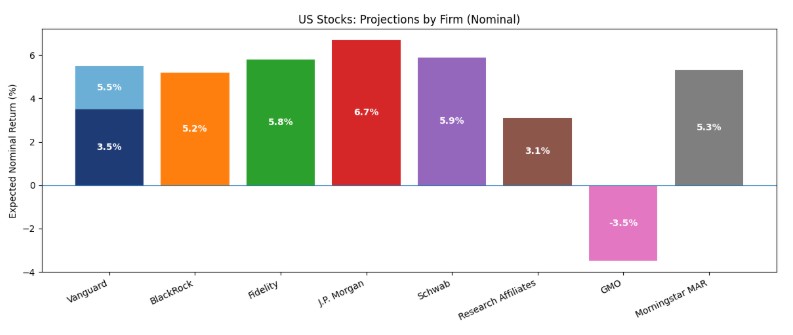
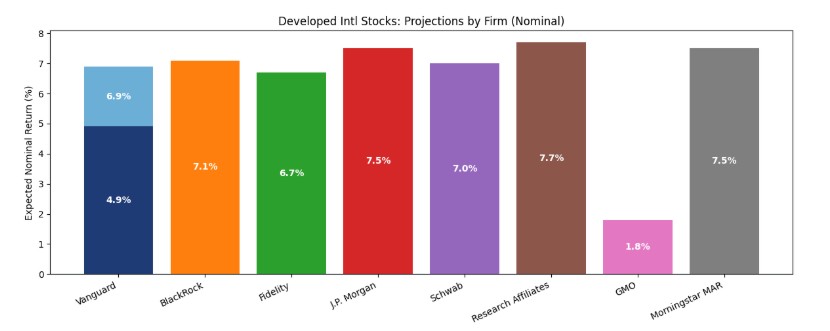
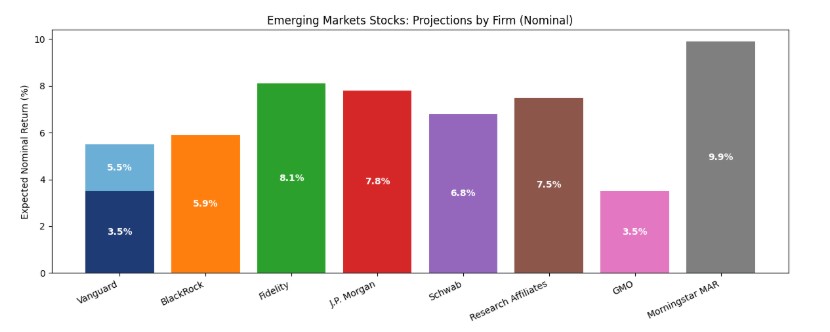
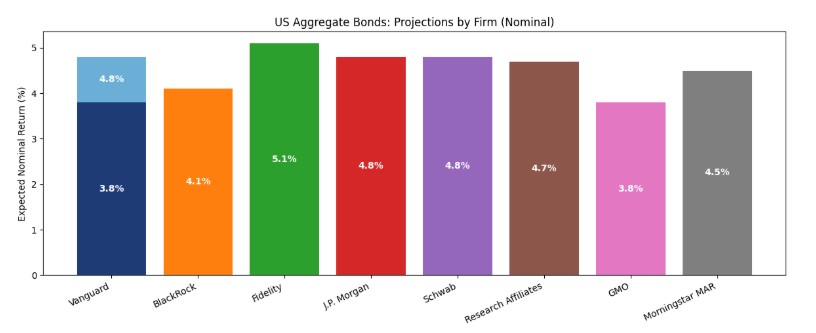
Here are the market projections from the eight firms for each of the four asset classes. Note that, just for this section, I converted GMO’s numbers from the real (inflation-adjusted) returns quoted in the report to nominal numbers to better correlate with the other seven firms’ numbers, all of which were nominal.
Fig. 1. Medium-to-long-term market return projections for US equities (graphic created with ChatGPT).Fig. 2. Medium-to-long-term market return projections for developed-market equities (graphic created with ChatGPT).Fig. 3. Medium-to-long-term market return projections for emerging-market equities (graphic created with ChatGPT).Fig. 4. Medium-to-long-term market return projections for US bonds (graphic created with ChatGPT).
Now that we’ve seen the numbers, we’ll look at what they mean for you. As we’ll discover below, taken together, these projections throw three major curveballs for investors. Instead of basing your financial plan on long-term historical returns, you should plan on a decade or so of (1) a dramatic collapse in expected US equity returns, (2) international stocks outpacing US stocks, and (3) bonds offering returns so close to equities that stocks’ risk premium becomes minimal.
If you’re still planning based on long-term historical averages, these projections suggest you may be planning for the wrong future. Here’s why these curveballs are heading our way, what they mean, and what you can do to prepare.
How We’ll Interpret the Above Numbers
How much can we trust these projections?
To answer that, here’s a quote I often share: “It’s really hard to make accurate predictions, especially about the future.”
It sounds like something Yogi Berra could have said (and is often misattributed to him), but it was actually a quip by 1922 Nobel prize laureate, Danish physicist Nils Bohr, paraphrasing an old Danish folk saying.
With that in mind, I’ll borrow an analysis tool I used as a grad student doing research at the European high-energy physics lab (CERN) back in the 1980s. Since physicists don’t know how the universe works, the best we can do is make educated predictions and test them against experimental results.
One way to assess our systematic errors is to use multiple methods to make the same prediction and see how widely the results diverge. The more they diverge, the less accurate we believe them to be, and unless we have reason to believe outliers more than other results, we end up with less uncertainty if we discard those outliers.
Since the different firms use different methodologies, we can do the same here, discarding the highest and lowest predictions for each asset class, and assessing how much the remaining six projections vary.
Before we decide which number is highest or lowest, we’ll average Vanguard’s conservative and optimistic numbers to arrive at a single point prediction, giving it the same weight as the other firms’ projections.
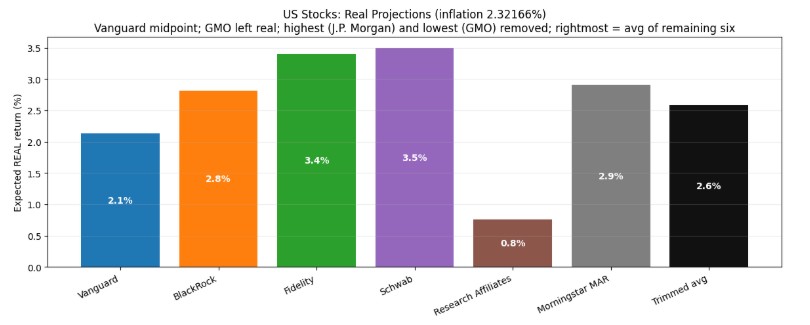
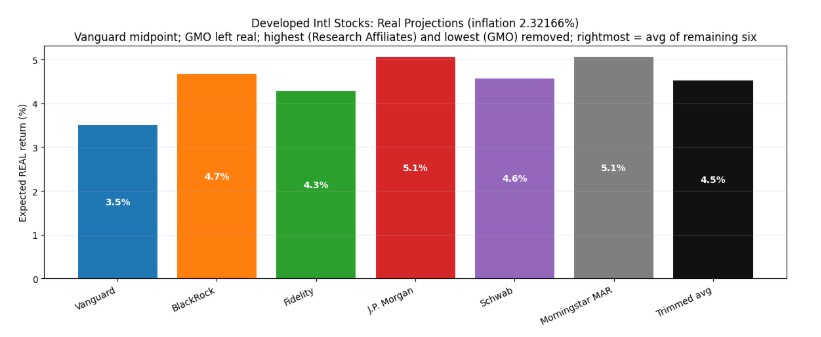
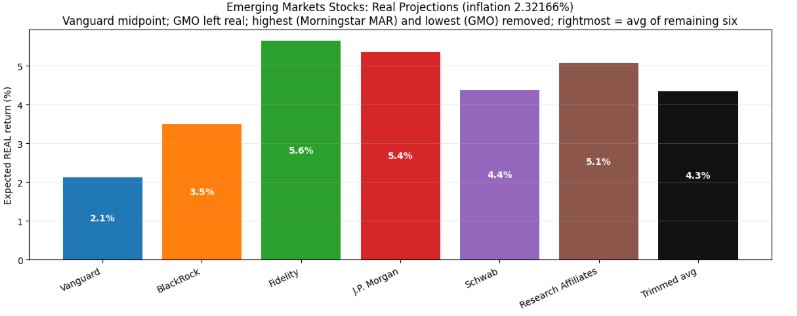
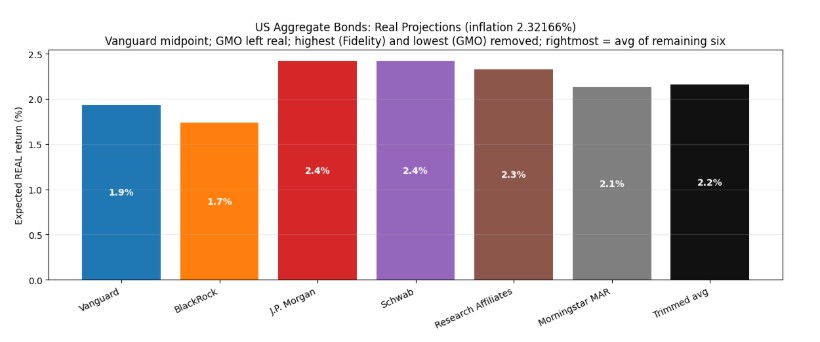
The following four graphs give us these projected annual returns for the four asset classes, with the “trimmed average” returns in the black bar at the right. However, since what matters most is how your portfolio does in inflation-adjusted, or real, terms, we show real returns, after correcting for the St. Louis Fed’s projected inflation for the next decade, 2.32166%.
Fig. 5. Medium-to-long-term real average annual market return projections for US stocks, using the mid-point for Vanguard’s projections and removing the highest and lowest “outlier” projections to arrive at a “trimmed average” projection given by the right-most, black bar (graphic created with ChatGPT).
Here, for US stocks, even after removing the outliers, we see a spread between 0.8% and more than four-fold higher, 3.5%, projected real returns. This suggests to me that the eventual returns may be more likely to stray further from the 2.6% trimmed average projected real return.
Fig. 6. Medium-to-long-term real average annual market return projections for developed-market stocks, using the mid-point for Vanguard’s projections and removing the highest and lowest “outlier” projections to arrive at a “trimmed average” projection given by the right-most, black bar (graphic created with ChatGPT).
The spread between the second lowest and second highest projected real returns is much smaller for developed market stocks, between 3.5% and 5.1%. The second highest is only 46% greater than the second-lowest projection. This suggests to me that this asset class’s eventual real returns may end up closer to the trimmed average number of 4.5% than will be the case with US stocks.
Fig. 7. Medium-to-long-term real average annual market return projections for emerging-market stocks, using the mid-point for Vanguard’s projections and removing the highest and lowest “outlier” projections to arrive at a “trimmed average” projection given by the right-most, black bar (graphic created with ChatGPT).
Emerging market stock real return projections aren’t as widely spread as those of US stocks, but are more spread out than the numbers for developed markets. They vary from 2.1% to 2.7× higher, 5.6%. Thus, I expect the eventual return may stray from the 4.3% trimmed average more than will be the case for developed markets but less than for US stocks.
Fig. 8. Medium-to-long-term real average annual market return projections for US bonds, using the mid-point for Vanguard’s projections and removing the highest and lowest “outlier” projections to arrive at a “trimmed average” projection given by the right-most, black bar (graphic created with ChatGPT).
Here, the projected real returns vary from a second lowest 1.7% to a second highest 2.4%, just 41% higher. This suggests that the eventual bond return may stray from the trimmed average of 2.2% by the smallest amount, compared to the three stock asset classes.
To see how this may affect people’s investment results, let’s consider three hypothetical investors:
An investor aged 50, with more than a decade to continue accumulating.
An investor aged 60, who’s looking to retire in the next few years.
An investor aged 70, who’s already retired.
For each of the three, we’ll assume an appropriate asset allocation, starting with the “equity allocation equals 120 minus age” rule. We’ll then break down the equity allocation further between US stocks, developed-market stocks, and emerging-market stocks in a plausible way, and examine what overall portfolio returns they can expect if the projections are to be believed.
Here are the allocations we’ll use, by age:
Illustrative sample portfolio asset allocations for investors aged 50, 60, and 70.
Note that these are not “recommended” portfolios, but rather simplified, plausible, realistic example allocations to illustrate how different investors will likely be affected by the quoted medium-to-long-term return projections.
The resulting projected real returns for the three hypothetical investors can be seen in the following three graphs.
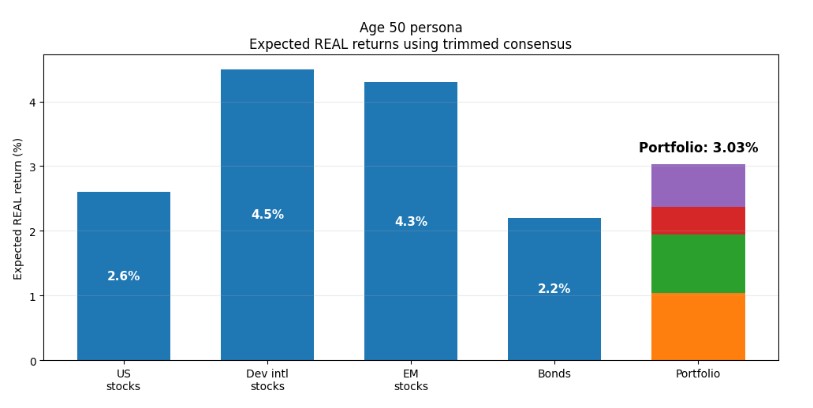
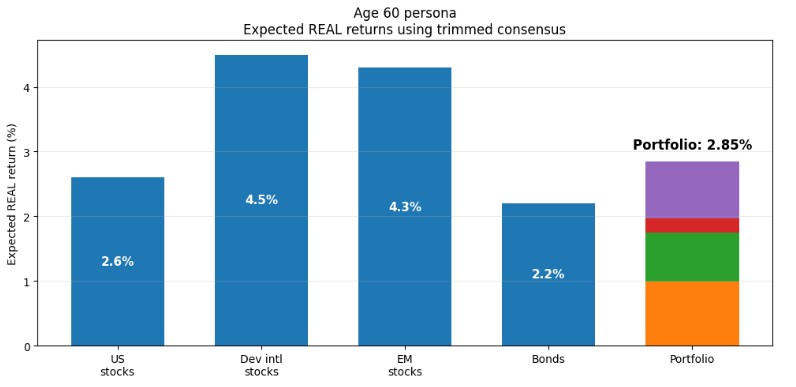
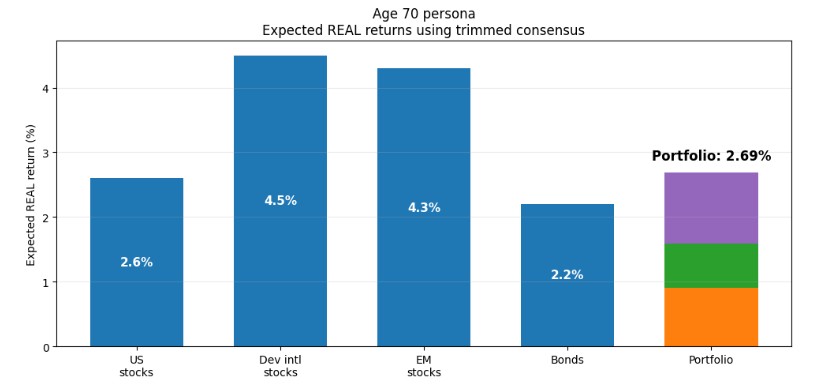
Fig. 9. Projected medium-to-long-term real average annual market returns for a 50-year-old investor’s model asset allocation, using trimmed averages, seen in the right-most, stacked bar (graphic created with ChatGPT).Fig. 10. Projected medium-to-long-term real average annual market returns for a 60-year-old investor’s model asset allocation, using trimmed averages, seen in the right-most, stacked bar (graphic created with ChatGPT).Fig. 11. Projected medium-to-long-term real average annual market returns for a 70-year-old investor’s model asset allocation, using trimmed averages, seen in the right-most, stacked bar (graphic created with ChatGPT).
The results project a likely annual real return of 3.03% for the 50-year-old’s allocation, 2.85% for the 60-year-old’s allocation, and 2.69% for the 70-year-old’s allocation.
How Does All This Compare to Historic Returns?
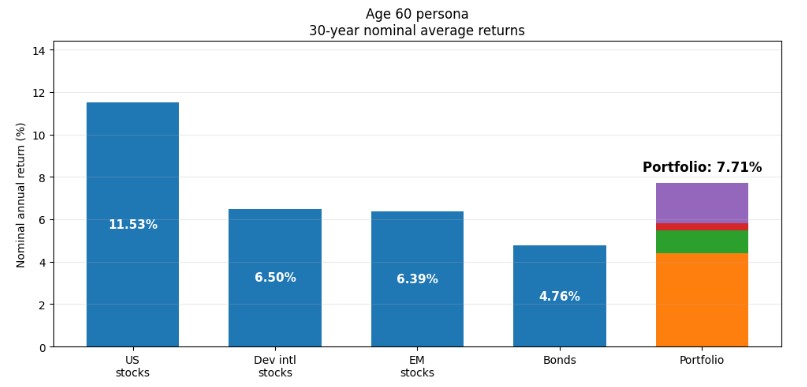
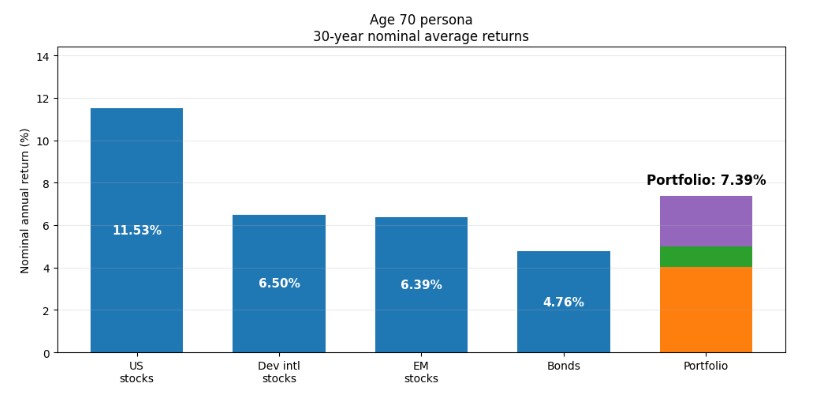
According to NovelInvestor, the four asset classes posted the following average annual nominal returns over the past 30 years:
US large-cap stocks: 11.53%
International (developed market) stocks: 6.50%
Emerging-market stocks: 6.39%
US bonds: 4.76%
Using these historic returns, we see in the next three graphs how our three investors would have fared.
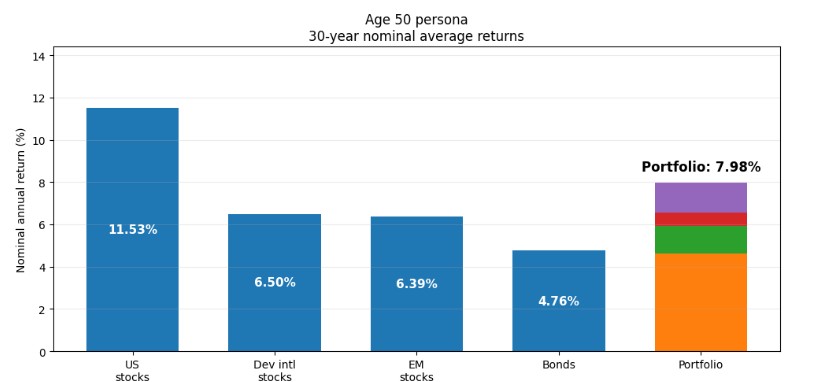
Fig. 12. Historic (30 years) nominal average annual market returns for a 50-year-old investor’s model asset allocation, seen in the right-most, stacked bar (graphic created with ChatGPT).Fig. 13. Historic (30 years) nominal average annual market returns for a 60-year-old investor’s model asset allocation, seen in the right-most, stacked bar (graphic created with ChatGPT).Fig. 14. Historic (30 years) nominal average annual market returns for a 70-year-old investor’s model asset allocation, seen in the right-most, stacked bar (graphic created with ChatGPT).
The 50-year old’s more-aggressive portfolio would have had the highest projected nominal average annual return of 7.98%, the 60-year-old’s more conservative portfolio would have achieved a somewhat lower 7.71% portfolio nominal return, and the 70-year-old’s, the most conservative, would have led to the lowest projected nominal return, at 7.39%.
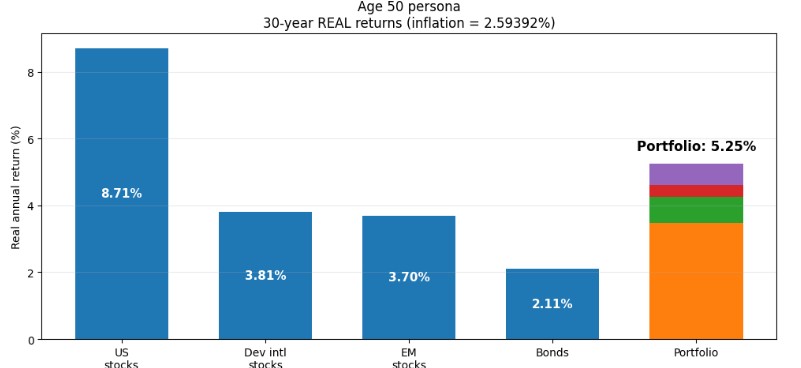
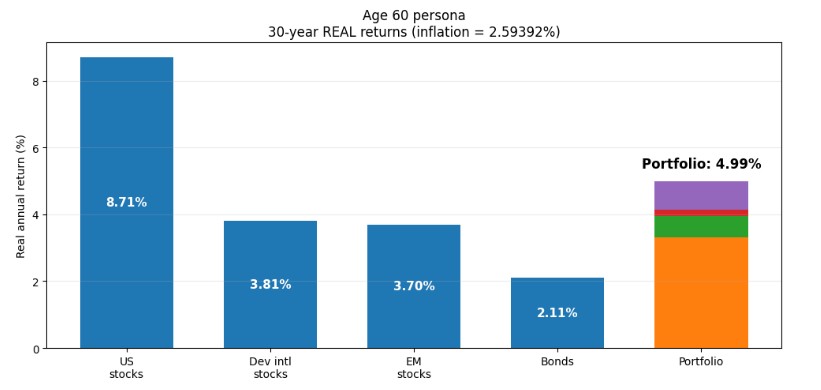
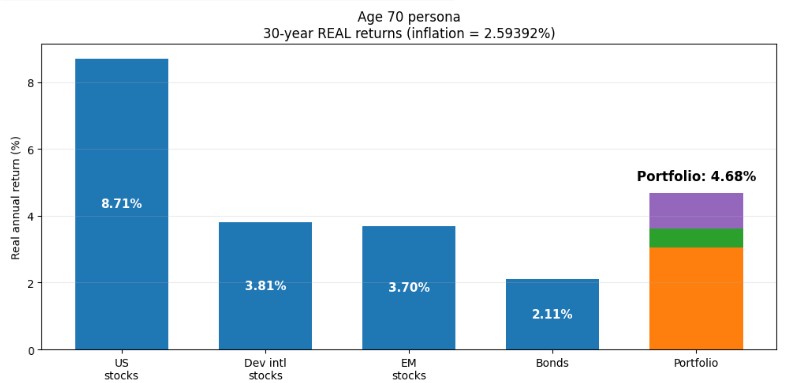
During that time, according to the Bureau of Labor Statistics (BLS), inflation, as measured by the Consumer Price Index for All Urban Consumers (CPI-U), averaged 2.59%. Thus, the real (inflation-adjusted) returns for those four asset classes over the past 30 years were 8.71%, 3.81%, 3.70%, and 2.11%, respectively.
Fig. 15. Historic (30 years) real average annual market returns for a 50-year-old investor’s model asset allocation, seen in the right-most, stacked bar (graphic created with ChatGPT).Fig. 16. Historic (30 years) real average annual market returns for a 60-year-old investor’s model asset allocation, seen in the right-most, stacked bar (graphic created with ChatGPT).Fig. 17. Historic (30 years) real average annual market returns for a 70-year-old investor’s model asset allocation, seen in the right-most, stacked bar (graphic created with ChatGPT).
This would have led to real portfolio returns of 5.25%, 4.99%, and 4.68%, respectively, for the three hypothetical investors.
Takeaways from the Above Analysis and the Resulting Curveballs
Over the last three decades, investors saw outsized real returns from US stocks averaging 8.7%, far higher than the more typical ~7% seen over the very long term (say, from 1926 to date). International equities, however, underperformed when considering the last three decades.
However, as alluded to above, blindly expecting the same historical returns to play out into the medium-term future is akin to driving forward with your eyes firmly fixed on the rearview mirror. This is why it’s crucial to consider projections of likely future returns when constructing your financial plan.
The new projections diverge sharply from the results of the past 30 years in three major ways:
US stock real average annual returns are expected to be 70% lower(!) 2.6% vs. 8.7%.
International (developed market and emerging market) returns are projected to be higher, at 4.5% and 4.3%, respectively, compared to the last 30 years’ 3.8% and 3.7%.
US bond returns are expected to be much closer to US stock returns, 2.2% vs. 2.6%, instead of the last 30 years’ 2.11% vs. 8.71%. Thus, instead of gaining a massive risk premium of nearly 6.5%, experts think investors should now expect a risk premium of under 0.4%. This implies that more conservative portfolios may well have better risk-adjusted returns than more aggressive ones, in the medium term.
What to Consider If You Believe the Experts Are Directionally Right
As I stated above, projections are not guaranteed to materialize exactly as we think. Nobody knows how the future will turn out until it’s no longer the future.
However, when we put together our plans, we have to make assumptions as to what we think is likeliest to happen. Then, we need to consider how we will mitigate if things turn out less rosy than our assumptions lead us to believe.
I think we’d do best to use these expert projections as a plausible basis for planning. Doing that, the numbers show that whether you’re a 50-year-old, 60-year-old, or 70-year-old investor, you should expect your real average annual returns over the coming decade to be lower than long-term historical returns by about 2%, a 42% – 43% reduction.
Here are some things to consider doing as a result, depending on your risk-aversion and personal situation.
If you expect to retire in the next decade, reduce your expectation of safe withdrawal rates to no more than 3%, at least until you’re out of the sequence-of-return danger zone, from a few years before you retire to a few years after. This is when market losses are most likely to derail your retirement plan because, to cover expenses, you’re forced to sell more of your investments at depressed prices.
To make that work, you’d need to reduce your planned spending, continue working longer to increase the size of your nest egg, bring in a part-time income for at least the first few years of your retirement to cover spending above what the 3% draw would allow, and/or trim your retirement budget to fit that lower draw.
Increase your financial flexibility by maximizing the discretionary portion of your retirement budget vs. your fixed expenses. Then, game out how you’d reduce your retirement spending, so you’d be able to get by if you had to reduce your annual draw by at least 10%. This would allow you to use the so-called “Guardrails Approach,” which lets you safely draw up to 33% more (say, 4% instead of 3%) initially, if you trim your draw by 10% if the planned draw would exceed your planned rate by over 20% (e.g., 4.8% of your nest egg instead of 4%). On the flip side, if things go especially well and your planned draw ends up being lower than the planned level by 20% (say, 3.2% instead of 4%), you can bump your draw up by 10%.
What the Pros Say
I asked several financial advisors for their opinions as to whether or not expert projections offer value, how to best mitigate the risks of inaccurate projections, and what we should keep in mind when trying to use such projections.
Here’s what they had to say.
Dr. Steven Crane, Founder of Financial Legacy Builders, kicks things off, “Market return projections can be useful, but they should never be treated as a plan. I use them as guardrails, not gospel. Projections help frame expectations, but real financial planning is about building resilience when reality does not cooperate, because it rarely does.
“The best hedge against bad projections is flexibility. I focus on controlling what we can: savings rate, spending behavior, diversification, tax strategy, and income planning. If returns disappoint, a well-built plan adjusts without blowing up someone’s life.
“Always remember that projected returns are inputs, not promises. The mistake people make is anchoring their future lifestyle to a single number. The smarter approach is planning for a range of outcomes and asking, ‘What still works if markets underperform?’ That mindset matters more than hitting the exact return.”
Brady Lochte, Financial Advisor and Founder at Axon Capital Management, agrees that expert projections can be useful, “Expert return projections have a place in retirement and financial planning, but they should be treated as planning inputs, not predictions. Projections give us a structured way to model expectations and test potential outcomes, but markets rarely follow any single forecast. Good planning uses projections as one of many tools to stress-test goals and assumptions, rather than as a guaranteed outcome.
“Risk from mis-forecasted returns is real, but not unpredictable. We mitigate it through scenario analysis, diversification, and dynamic planning. Instead of relying on a single expected return, we model a range of outcomes: low, base, and high, and regularly revisit assumptions as markets and personal circumstances change. We also focus on cash-flow resiliency, ensuring clients can live through down markets without forced selling, and stress-test plans for longevity, sequence of returns risk, and changing spending needs. Planning isn’t static, and neither are markets, so adaptability is core to managing return uncertainty.
“The most important thing to remember is that projected returns are estimates, not guarantees. They’re rooted in historical norms and current inputs, but they can’t capture future shocks, regime changes, or human behavior. People should use these figures as planning guideposts to inform savings rates, retirement timing, and asset allocation, but always build plans that are robust across scenarios, not just optimized for a single forecast.”
Ben Simerly, CFP®, Financial Advisor and Founder of Lakehouse Family Wealth, offers a different take, “Experienced high-net-worth investors who created their own wealth will tell you that financial planning isn’t about market predictions. Instead, they focus on what investments and asset classes are a fit for them, whether the market goes up significantly or down significantly. Experienced investors assume both significant increases and declines will happen. And if markets don’t move much, that’s ok too.
“As the old saying goes, the wealthy act as if they are poor, the poor act as if they are wealthy; those who’ve earned extensive wealth ignore market predictions the most. We recommend that our clients of all ages and asset levels do the same. Not because they can afford the losses. In fact, they often behave as if they cannot. Instead, they focus on ensuring they’re comfortable with their portfolio, no matter what any asset class does in a given time frame. There will always be ups and downs. It’s about creating a portfolio that fits your comfort levels in both up and extended-down markets.
“Before technology made active and unique investment strategies more accessible, we mitigated risk using bonds for bad times and stocks for good times. There was more to it for accredited investors, but that was the high-level strategy for most Americans. Now, countless investment strategies are available to everyone that help mitigate risk on the downside and allow significant returns on the upside. There’s nothing wrong with classic passive funds. But now, a myriad of options are available in the form of active Exchange Traded Funds (ETFs) and mutual funds, buffered ETFs, and other strategies, because of technologies we didn’t have 5-10 years ago. These new investment models entirely changed how we structure portfolios to fit a client’s risk tolerance and comfort with different market cycles.
“We do recommend clients read prediction articles sometimes, but not for the predictions themselves. What I find most interesting about market-prediction articles is the unique points of view they take on why one outcome or another may come about. The key is that it’s often a different point of view than our own, and that challenge to our way of thinking is useful in reevaluating our own portfolios and growing our knowledge as investors.
“As advisors, we often learn a lot about a client’s comfort levels when they read these articles and give us feedback. The key for nervous investors, though? Never read these articles at all. For many, they do far more harm than good.”
Anthony Ferraiolo, CFP®, Partner Advisor at AdvicePeriod, sums things up, “Leveraging market predictions, whether for a year or 10 years, is a fickle task. Many of the plans I build for my clients involve already conservative tilts that include lower market returns, as well as things like longer life expectancy, long-term care events, dynamic spending guardrails, and more. “What we can take away from these projections is that retirement planning isn’t a ‘set it and forget it’ exercise. A good plan involves updating, testing, and monitoring through good times and bad. Sometimes what feels right in a spreadsheet isn’t necessarily reality. You cannot look at things in a silo and make big decisions like this.Taking it day by day or year by year might be a better alternative, because there will be years when returns are higher, and spending is lower, and vice versa. Being nimble and course-correcting are the keys to long-term planning.”
The Bottom Line
Good retirement planning is an incredibly challenging exercise because you need to make decisions now based on assumptions about how things will unfold decades from now, over a period that may last several more decades.
Since none of us knows how things will play out tomorrow, let alone in three decades or more, we have to come up with plausible assumptions. That’s the best way I know to use expert projections of market returns.
However, we must always keep in mind that things may turn out worse than we hope or better than we fear. That’s why a dynamic withdrawal strategy such as the Guardrails Approach is superior to any static plan that doesn’t allow for modifications in the face of the future unfolding differently than we assumed it would.
Research shows that using such a dynamic approach significantly increases your safe initial draw, allows you to safely spend more of your nest egg, and dramatically reduces your risk of financial retirement failure, i.e., running out of money before dying.
Disclaimer: This article is intended for informational purposes only, and should not be considered financial advice. You should consult a financial professional before making any major financial decisions.
About the Author
Opher Ganel, Ph.D.
My career has had many unpredictable twists and turns. A MSc in theoretical physics, PhD in experimental high-energy physics, postdoc in particle detector R&D, research position in experimental cosmic-ray physics (including a couple of visits to Antarctica), a brief stint at a small engineering services company supporting NASA, followed by starting my own small consulting practice supporting NASA projects and programs. Along the way, I started other micro businesses and helped my wife start and grow her own Marriage and Family Therapy practice. Now, I use all these experiences to also offer financial strategy services to help independent professionals achieve their personal and business finance goals. Connect with me on my own site: OpherGanel.com and/or follow my Medium publication: medium.com/financial-strategy/.
Get expert insights from financial advisors who specialize in helping Compass employees and executives make the most of their compensation package and benefits.
Looking for a financial advisor who specializes in working with Compass employees? You’re in the right place. Below, you’ll find advisors who understand Compass benefits and compensation — along with their answers to common financial questions from Compass employees and executives.
Whether you recently joined Compass or you’ve advanced into a management or executive leadership role over a multi-year career, making smart decisions about your income and Compass benefits can have a lasting impact on your financial future. For example:
✅ Do you know the right moves to get the greatest value from the Compass benefits available to you?
✅ If you’re thinking about leaving Compass for another job or planning to retire in a few years, are you taking the right steps today to receive all the compensation and benefits you’ve earned?
Key Takeaways
1
Equity Compensation Is a Significant Part of Compass Pay
Because so much compensation comes through equity, the advisor below helps employees use open trading windows to manage tax exposure and follow a multi-year plan.
2
Decide How Much of Your Plan Should Rely on Compass Equity
Equity compensation is variable and hard to quantify but can be significant. Setting clear rules for how it’s treated in the plan keeps goals on track.
3
A High-Paying Compass Role Can Feel Like Golden Handcuffs
Modeling potential exit or career-change paths ahead of time makes it easier to decide whether and when to move on.
Why Compass Employees Work with a Specialist Financial Advisor
Throughout the year, Compass provides its employees and executives with updates about their benefits, ranging from health insurance and health savings accounts to retirement plans like a 401(k) — along with equity compensation, health insurance, and family benefits. While the company offers many useful resources and access to knowledgeable staff who can assist with questions, you’ll also find financial professionals not affiliated with Compass who specialize in helping Compass employees make the most of their income and benefits.
Compass is headquartered in New York City, and its agents and employees work in offices across the United States. Whether you work at headquarters, another office, or remotely from home, you may have questions about your compensation package and benefits better suited for a financial professional who can offer unbiased advice and guidance.
Sensitive topics — like the steps you should take before quitting your job at Compass to work elsewhere, protecting yourself in advance of a corporate layoff, or deciding when you should plan to retire — are all conversations that may be more comfortable with a trusted financial advisor.
Should You Hire a Compass Specialist or a Local Financial Advisor?
You’ll likely find dozens of nearby financial advisors well-suited to help you reach your money goals with a personalized plan. But it can be harder to find a financial advisor who specializes in serving Compass employees. Fortunately, many financial advisors offer virtual services, so you can meet online no matter where you (or they) live — which means you can hire a specialist financial advisor who lives hundreds of miles away if their knowledge and experience working with Compass employees is the better fit for your unique needs.
💡 In the Q&A below, you’ll gain insights from financial advisors who work with Compass employees to help them make smart decisions, get the most value from their compensation and benefits, reduce their money stress, and prepare for a comfortable retirement.
🙋♀️ Have a question not yet answered? Use the form below to submit your question. You can also contact financial advisors directly to set up an introductory call or contact them with your questions.
Q&A: Financial Planning Tips for Compass Employees & Executives
In this section, you’ll learn how you can make the most of your Compass employee benefits and gain valuable tips from financial advisors who specialize in working with Compass employees and executives.
Jackie Lewis is a financial advisor based in San Diego, California who works with Compass employees on financial planning considerations related to their benefits and compensation. Jackie helps clients understand and evaluate their Compass benefits and compensation within the context of their broader financial picture so they can make informed decisions about their financial future.
QAs a financial advisor with experience helping Compass employees save for their retirement, how do you help them make the most of their employee benefits?
Compass has some great benefits and we help you understand and evaluate the benefits available to you. This includes helping you with equity compensation, retirement accounts, health insurance and family benefits within their overall corporate benefits package.
QWhen you first speak with a Compass employee, what questions do you like to ask to better understand their unique circumstances and determine how you can best help them achieve their goals?
Compass provides robust equity compensation packages so we help you to strategize around ways to manage equity compensation and evaluate tax considerations when liquidating stock based on your unique situation and needs. This leads to questions such as: What are your goals in life? How long do you hope to stay with Compass? What would you like to do for your family? How well do you feel you understand your equity compensation? Do you have an idea of what taxes you may owe with your total compensation package?
QBeyond Compass employee benefits for retirement savings, are there other types of benefits offered by the company that you find valuable to discuss with your clients?
Compass provides a significant portion of your compensation through their equity compensation so we guide you through how to leverage this during an open window with the goal of managing tax exposure and we help you develop a multi-year plan that you can reference over time.
QFor Compass employees who have managed their finances on their own to this point, what would you suggest they consider to help them decide if they should begin working with a financial advisor at this stage in their lives?
An advisor can help with short-term decision-making such as equity compensation decisions, tax advantaged guidance, etc. and also with bigger-picture thinking (i.e. creating a framework so you can see the direction all your hard work is taking you, and make sure your money behaviors are aligning with your life goals). A client is often already doing many of the right things and the value of the planning process is to put things in a broader framework to allow for proactive/intentional decisions to be made as well as being a sounding board and accountability coach for the client.
We encourage DIY investors to consider the potential cost of NOT getting a second opinion. Investment management is one thing, but retirement planning often involves significant nuance to it that many people may overlook such as:
How will my investments be taxed? Can I minimize my lifetime taxation? Am I taking too much (or not enough) risk in the markets?
What is my plan to turn my assets into income? What are the tax implications of doing that?
Am I going to run out of money? How should I deal with Inflation? What about long-term care?
Are my beneficiary designations up to date? Do I understand what’s going to happen to my assets when I pass?
Do I need life insurance? Do I have enough or too much? Should I keep these old policies?
There are a number of different areas that a Certified Financial Planner® professional may be able to provide value to a recent retiree, even if they choose to continue to manage their own investments.
QWhat are some of the unique financial planning challenges you commonly see among your clients who are Compass employees and how do you help them overcome these obstacles?
A good, high-paying job can feel a bit like golden handcuffs sometimes and it can be hard to imagine walking away. But, if you want to prepare for an exit or a shift to a different industry, we can help model potential pathways for the transition. In a role with equity compensation, a challenge can be to define how much should you rely on that compensation in the plan. It’s variable and can be hard to quantify but can be significant. So, having a firm structure based on a client’s comfort with exposure and how it’s treated in the plan is important.
QWhat questions do you recommend Compass employees ask financial advisors they’re considering hiring to help them decide if they’re a good fit?
Are you a fiduciary? Do you have to act in my best interest? Will you be providing comprehensive financial planning or just investment management? What will I pay in fees? Are there any hidden fees in the products you’re recommending?
Considering a financial advisor who specializes in working with Compass Employees?
Are you a financial advisor who specializes in working with employees at Compass or another large company?
✅ Join Wealthtender and get featured as a specialist financial advisor based on your knowledge and experience working with employees at Compass or another large company. (Subject to availability and terms.) ✅ Sign up today and join financial advisors attracting their ideal clients on Wealthtender
Ask a Financial Advisor Your Compass Benefits & Career Questions
Get answers from the Wealthtender network of financial professionals and educators.
Are you ready to enjoy life more with less money stress?
Sign up to receive weekly insights from Wealthtender with useful money tips and fresh ideas to help you achieve your financial goals.
Brian Thorp is the founder and CEO of Wealthtender and serves as Editor-in-Chief. With over 25 years in the financial services industry — including nearly 22 years at Invesco, where he led strategic partnerships with wealth management firms representing more than $100 billion in assets — Brian founded Wealthtender to help people find financial advisors they can trust and make more informed money decisions.
A member of the National Society of Compliance Professionals and its SEC Marketing Rule Working Group, Brian was recognized by WealthManagement.com as one of its “Ten to Watch in 2024” for his work reshaping how financial advisors market their services. He holds a B.B.A. in Finance from The University of Texas at Austin.
Many employees see a pay raise as an excuse to immediately upgrade their lifestyle. The extra money soon disappears, because for many of us when we have more, we spend more. The raise goes on everyday spending, or perhaps a big upgrade like a new car (along with a new, bigger-than-ever monthly car payment).
What this means is that more money simply becomes more stuff, rather than more financial stability and security. The raise gets absorbed by lifestyle inflation, rather than actually improving your finances.
If your aim is financial security and wealth building, you need to treat raises a little differently. Here are three strategies to consider.
Invest
The best thing to do with a raise is pretend you didn’t get it. Don’t spend it. Don’t plan to spend it. Don’t even save it (at least not in to a traditional savings account). Invest it.
For many this is hard to do. You want to reward yourself for that raise with something tangible. But if you can tweak your mindset and learn to see a growing investment account as something tangible, future you will thank you. Take the raise, invest it, and allow your spending to stay exactly the same.
There are exceptions of course. If you have high interest debt or no emergency fund whatsoever, then the extra money should go to this first, but the principle remains the same. You’re still not using the raise on stuff. You’re using it to buy more financial security.
Splurge, but with a Delay
Some people choose to enjoy their new income increase, but with a delay. This is the concept of living ‘one raise behind’. At the beginning of your career, you invest your first big raise, and with the next one you upgrade to the lifestyle someone on your previous salary might have.
There are no hard and fast rules for how to do this. We all need some flexibility with our finances, but embracing the general concept means you are always living within your means, rather than living at the edge of comfort, waiting for the next raise.
Whereas those who invest every raise will continue to live a simple lifestyle long-term, those living one raise behind will allow for lifestyle inflation, just at a slower rate, delaying gratification and building wealth slowly.
If you can let four or five raises go entirely into building wealth, you’ll see big growth and eventually financial freedom. If you live one raise behind, you buy yourself a financial cushion and less day-to-day stress.
Sometimes, of course, the choice isn’t yours. Changes in lifestyle mean changes in expenses that can eat up new raises whether you like it or not. Some people manage to invest every raise easily until they have children for example. Then things get expensive. So if you’re currently childfree but planning to have a family in the future, all the more reason to invest those raises now.
Upgrade, but Strategically
You can really tell when some people get a raise. New car. New phone. New designer handbag. Luxury vacation pics on Instagram. But did they really need (or even want) all those upgrades, all at once?
If you really feel the need to, you can of course spend at least part of your raise on life upgrades, but why not do it strategically? Your best strategy is probably to upgrade just one or two areas that will make a huge difference to your life, regardless of whether they’re the areas other people would upgrade. And — this one is important — even if nobody else will know what you upgraded.
I’m talking things like a new gym membership, a regular housekeeper, a better health insurance policy, or maybe even a weekly massage. Something that will have a big impact on your health, wellbeing, or time use in a way that matters to you, even if you can’t flaunt it in front of the neighbours or post it online.
The strategic upgrade is basically something that significantly improves your life, but doesn’t necessarily impress anyone else.
However you use your next raise, give it the thought and planning that future you deserves. Resist the reflex to immediately turn it into stuff. Let the gap between your income and your lifestyle grow bigger, while your investments and financial freedom do too. Try and avoid the all too common trap of being financially constrained even on a high income, constantly one raise away from truly feeling secure.
About the Author
Karen Banes is a freelance writer specializing in entrepreneurship, parenting and lifestyle. She writes articles, website content, ebooks and the occasional award winning short story. Her work has appeared in a range of publications both online and off, including The Washington Post, Life Info Magazine, Transitions Abroad, Brave New Traveler, Natural Parenting Group, and Copia Magazine.
Learn More About Karen
Do you work at the University of Central Missouri?
Get expert insights from financial advisors who specialize in helping University of Central Missouri faculty and staff make the most of their compensation package and benefits.
Looking for a financial advisor who specializes in working with University of Central Missouri faculty & staff? You’re in the right place. Below, you’ll find advisors who understand University of Central Missouri benefits and compensation — along with their answers to common financial questions from University of Central Missouri faculty and staff.
Whether you recently joined the University of Central Missouri or you’ve advanced into a faculty leadership or senior administrative role over a multi-year career, making smart decisions about your income and benefits can have a lasting impact on your financial future. For example:
✅ Do you know the right moves to get the greatest value from the University of Central Missouri benefits available to you?
✅ If you’re thinking about leaving the University of Central Missouri for another position or planning to retire in a few years, are you taking the right steps today to receive all the retirement and health benefits you’ve earned?
Key Takeaways
1
Coordinate Your Personal Savings with Your MOSERS Pension
Building savings alongside the pension creates flexibility to choose the MOSERS payout option that best fits you, your spouse, and your heirs.
2
Know Whether You’re Under MSEP, MSEP 2000, or MSEP 2011
Your plan depends on when you were first hired by a qualifying university, and it affects eligibility, payout amounts, and options such as BackDROP.
3
Coordinating MOSERS and KPERS Can Be Powerful
Employees who have worked on both sides of the state line may be able to combine Missouri and Kansas pension benefits through careful planning.
Why University of Central Missouri Faculty & Staff Work with a Specialist Financial Advisor
Throughout the year, the University of Central Missouri provides its faculty and staff with updates about their benefits, ranging from health insurance to retirement plans like the MOSERS pension, along with optional 457 and 403(b) savings plans — plus an educational development program for employees and their dependents. While the university offers many useful resources and access to knowledgeable staff who can assist with questions, you’ll also find financial professionals not affiliated with the University of Central Missouri who specialize in helping University of Central Missouri faculty and staff make the most of their income and benefits.
The University of Central Missouri is in Warrensburg, Missouri, southeast of Kansas City, and also serves students at its Lee’s Summit campus. Whether you work on campus, at another location, or remotely from home, you may have questions about your compensation package and benefits better suited for a financial professional who can offer unbiased advice and guidance.
Sensitive topics — like the steps you should take before leaving your job at the University of Central Missouri for another institution, weighing a buyout or early retirement offer, or deciding when you should plan to retire — are all conversations that may be more comfortable with a trusted financial advisor.
Should You Hire a University of Central Missouri Specialist or a Local Financial Advisor?
You’ll likely find dozens of nearby financial advisors well-suited to help you reach your money goals with a personalized plan. But it can be harder to find a financial advisor who specializes in serving University of Central Missouri faculty & staff. Fortunately, many financial advisors offer virtual services, so you can meet online no matter where you (or they) live — which means you can hire a specialist financial advisor who lives hundreds of miles away if their knowledge and experience working with University of Central Missouri faculty & staff is the better fit for your unique needs.
💡 In the Q&A below, you’ll gain insights from financial advisors who work with University of Central Missouri faculty & staff to help them make smart decisions, get the most value from their compensation and benefits, reduce their money stress, and prepare for a comfortable retirement.
🙋♀️ Have a question not yet answered? Use the form below to submit your question. You can also contact financial advisors directly to set up an introductory call or contact them with your questions.
Q&A: Financial Planning Tips for University of Central Missouri Faculty & Staff
In this section, you’ll learn how you can make the most of your University of Central Missouri benefits and gain valuable tips from financial advisors who specialize in working with University of Central Missouri faculty and staff.
Financial Advisor Q&A · University of Central Missouri Faculty & Staff
Aaron Sloan is a financial advisor based in Harrisonville, Missouri who specializes in offering financial planning services to University of Central Missouri employees. Aaron helps his clients get the most value from their University of Central Missouri benefits and compensation package so they can enjoy life and feel confident about their financial future.
QAs a financial advisor with experience helping University of Central Missouri faculty and staff save for their retirement, how do you help them make the most of their employee benefits?
We make the most of your UCM employee benefits by coordinating your individual retirement savings plans with your MOSERS pension benefits. Proper planning can help create flexibility to choose the option that best maximizes your MOSERS payout in retirement.
QWhen you first speak with a University of Central Missouri employee, what questions do you like to ask to better understand their unique circumstances and determine how you can best help them achieve their goals?
Questions I like to ask:
What other Universities have you worked for previously?
Have you worked for any Universities outside of Missouri?
Based on when you were first employed by a qualifying University, are you under MSEP, MSEP 2000, or MSEP 2011?
Have you contributed to a 457 plan or 403(b) plan?
QIs there a particular benefit available to University of Central Missouri faculty and staff you feel isn’t as well utilized or understood by employees as it should be?
MOSERS can be pretty confusing for some employees. Eligibility for retirement, payout amount, payout options, and BackDROP each act differently depending on an individual employee’s situation. Each employee’s situation and pension can be maximized by having a financial plan in place that works alongside this retirement benefit.
QBeyond University of Central Missouri employee benefits for retirement savings, are there other types of benefits offered by the company that you find valuable to discuss with your clients?
UCM’s Educational Development Program can be impactful both for an employee who wants to continue their education, or for an employee’s dependents. Higher education costs continue to rise. This benefit offers an opportunity to reduce or even completely remove those costs for employees and their family.
QFor University of Central Missouri employees thinking about leaving the company to accept a job elsewhere, what actions do you recommend they take before resigning and shortly thereafter?
Review your current eligibility for MOSERS. If you are moving to a new University, will your service years continue to accrue for MOSERS. If the University is outside of Missouri, does that state have it’s own pension that needs to be reviewed?
QFor University of Central Missouri employees approaching retirement age, how do you recommend they prepare to make the transition from living off their salary to relying upon other sources of income?
Have flexibility in “where” retirement income comes from. Don’t rely only on your MOSERS pension. Maximize your payout by building a financial plan that creates more flexibility for you, your spouse, your family, and your heirs. We also may need to review options for BackDROP, if you qualify, to see if it makes sense to take a lump sum in addition to starting your income.
QFor University of Central Missouri employees who have managed their finances on their own to this point, what would you suggest they consider to help them decide if they should begin working with a financial advisor at this stage in their lives?
My purpose as a financial planner is to take what you’re already doing and make it better. We need to create efficiency in your financial life. I’m here to answer questions, take some of the stress and uncertainty around money out of your financial life. Working with me can help you feel like a weight has been lifted off your shoulders, knowing you don’t have to go through your financial life all alone.
QWhat are some of the unique financial planning challenges you commonly see among your clients who are University of Central Missouri employees and how do you help them overcome these obstacles?
Many are unclear or unsure of exactly what their retirement income will look like. We can estimate or review your retirement income and position assets to maximize your retirement life.
QIs there anything that comes up frequently in your initial meeting with University of Central Missouri employees that surprises you?
I often see employees that have worked at other universities across the state line, on the Kansas side or that may be considering finishing out their careers in Kansas. The combination of MOSERS and KPERS together can be very powerful if we coordinate both pension benefits through the financial planning process.
Considering a financial advisor who specializes in working with University of Central Missouri Faculty & Staff?
Are you a financial advisor who specializes in working with faculty and staff at the University of Central Missouri or another college or university?
✅ Join Wealthtender and get featured as a specialist financial advisor based on your knowledge and experience working with faculty and staff at the University of Central Missouri or another college or university. (Subject to availability and terms.) ✅ Sign up today and join financial advisors attracting their ideal clients on Wealthtender
Ask a Financial Advisor Your University of Central Missouri Benefits & Career Questions
Get answers from the Wealthtender network of financial professionals and educators.
Are you ready to enjoy life more with less money stress?
Sign up to receive weekly insights from Wealthtender with useful money tips and fresh ideas to help you achieve your financial goals.
Brian Thorp is the founder and CEO of Wealthtender and serves as Editor-in-Chief. With over 25 years in the financial services industry — including nearly 22 years at Invesco, where he led strategic partnerships with wealth management firms representing more than $100 billion in assets — Brian founded Wealthtender to help people find financial advisors they can trust and make more informed money decisions.
A member of the National Society of Compliance Professionals and its SEC Marketing Rule Working Group, Brian was recognized by WealthManagement.com as one of its “Ten to Watch in 2024” for his work reshaping how financial advisors market their services. He holds a B.B.A. in Finance from The University of Texas at Austin.
Stepping into retirement can create a whole host of feelings. Excitement is the most common outward expression, but financial fear and anxiety can creep into the background. There are several actions and checks you can make to ensure you’re ready for retirement.
Preparing for retirement can feel a lot like closing the door on steady income and stability. It’s not always as simple as “just starting” to withdraw money from accounts you’ve spent your whole life building. This is why getting started well in advance (2-5 years before retirement) and having a thought-out plan can make all the difference.
Phase 1: The Reality Check (Cash Flow & Budgeting)
Understanding your cash flow needs is the first step to preparing for retirement. It’s impossible to guess your way to success. You need real numbers for how much money you need to live comfortably.
Once you know your monthly and annual spending, we can work backwards to make sure you won’t run out of money.
The “Retirement Dry Run”
Understanding cash flow needs is even more important if you’ve been planning on spending less during retirement. It’s a good idea to try living on your projected retirement budget for three to six months while you’re still working.
Better yet, try a couple of “dry run” weeks or months. A mini retirement to calibrate spending and lifestyle can be helpful. It’s better to uncover surprises before you step off into retirement.
Identifying “Needs” vs. “Wants”
Although it seems simple, it’s important to distinguish between essential expenses like housing, food, and healthcare, and discretionary wants like travel and hobbies. You’ll want to cover both.
This isn’t the time to deprive yourself, but you need to be realistic. You’ve worked hard your whole life to get where you are. It’s best to retain some flexibility so you can keep yourself active, happy, and financially stable throughout retirement.
Accounting for Taxes
You’ve focused on accumulating a sizeable nest egg and deferring taxes for later when your income would be lower. Remember, your traditional 401(k) balance is before taxes. Unless you’ve been putting away money in a Roth IRA or Roth 401k, Uncle Sam is going to take his cut.
There are many strategies to save money on taxes, but you can’t avoid them forever. The IRS is impatiently waiting to collect. You’ll have to contend with required minimum distributions and complicated tax laws on inherited assets.
Phase 2: Shore Up the Safety Net
Next, you’ll want to plan for the bumpy roads ahead. Not because we’re focused on the negative, but because we want to get back on track as soon as possible when the inevitable rough patches happen.
The Short-term Cash Bucket
Staying invested long-term requires you to weather the storms when markets swing low. If you’ve been saving for many decades, you already know markets will recover, but market dips feel different when you’re relying on your investments for income.
This is why you need a solid emergency fund and “safer” portions of your portfolio. If you have a safe bucket of bonds and cash, you can avoid selling stocks during a market downturn. This is commonly referred to as your sequence-of-returnsrisk.
Aggressive Debt Reduction
It’s highly recommended to have minimal high-interest consumer debt in retirement. You’ll want to reduce or eliminate any ongoing debt payments above the “safe” return rate, often considered the 30-year treasury index. This includes credit card balances, installment accounts, and most car loans.
A common question is whether you should pay off the mortgage. Obviously, this depends, but for many folks, math works out to pay on schedule and let your investments continue to grow.
Phase 3: The Income Strategy (Social Security & Pensions)
For retirees, a steady stream of retirement income is vital. This can take the form of Social Security, a pension, or an annuity. Knowing the checks will keep coming helps you spend without fear.
Developing a Solid Social Security Strategy
There’s no one-size-fits-all answer to Social Security, but you should research how Social Security is calculated. You might be surprised at the difference between drawing at 62 versus waiting until 70. There’s no perfect answer because we don’t have perfect information.
Consider when you’ll need the income. Also, plan Social Security alongside other tax strategies, such as Roth conversions. The taxes can get complicated quickly.
Pension Election Decisions
If you’ve put in the time to earn a pension, choosing between a lump sum payout and annuity payments is vital. Most pension plans offer some calculators to help you decide, but once again, we won’t have all the information needed to make a perfect decision until after your retirement is over.
Just make sure you’ve done your research, so you know you made the decision with the best information possible.
The Bridge Strategy
For many retirees, you may want to use personal savings to delay drawing your pension or Social Security to maximize the monthly benefit. Or, in some cases, you might be retiring early. There are ways to tap into your retirement savings, but those may not be ideal or even necessary.
Phase 4: Healthcare – The Great Unknown
Healthcare is one of the most important and expensive variables in retirement. You’ll need to carefully build a healthcare plan to ensure you get the best care for the best price throughout retirement.
The Medicare Milestone
Medicare is a requirement at age 65 unless you meet specific criteria. You don’t want to miss your enrollment window because there are permanent increases to your Medicare premiums if you don’t sign up in time. At a minimum, you’ll need to decide between Medicare Part B & D and Medicare Advantage. You might also want to enroll in a Medicare supplement or “Medigap” policy.
Be careful about comparing costs first. There’s no “free lunch” with Medicare, so even though a Medicare Advantage plan might have lower premiums, your total costs might be higher. However, you may be able to get better quality or access to care.
Covering the Gap
If you’re retiring before Medicare eligibility, you’ll need to look at other options for healthcare. You’ll need to consider COBRA, the ACA Marketplace, or using your healthcare savings account (HSA) funds. Just make sure you’re prioritizing your care before strictly comparing costs.
The Long-Term Care Conversation
For many retirees, long-term care seems far away. However, your options for covering long-term care decrease over time. Make sure you evaluate your insurance or self-funding for potential care needs later in life.
Phase 5: Legacy and Estate Planning
Although our own mortality is the least fun subject possible, it’s better to make decisions early and get back to enjoying life.
Getting Organized
The passing of a loved one is often unexpected and chaotic. You can minimize confusion for yourself and your family by organizing your wills, trusts, and power-of-attorney documents. Having a safe yet accessible place to keep everything is best.
Beneficiary Audit
It’s a good idea to check beneficiary designations every year or when there’s a major change. It’s vital to ensure that all the correct names are listed on your retirement accounts and insurance policies. You also need to ensure your assets are titled to your trust in accordance with your estate plan.
Be sure everything matches everything else. If your trust, beneficiary designations, or wills don’t match, it can cause some serious headaches.
The Family Meeting
Finally, no estate plan is complete until everyone knows the plan. Communicating the plan directly to everyone involved prevents future conflict. Once again, it’s not fun, but talking things through is necessary.
Last Step: Setting Your Retirement Plan in Motion
Retirement is a beginning, not an end. It’s a new phase of life with unique challenges and opportunities. You’ll be adjusting and learning about yourself and your new lifestyle. It’s a similar shift to when you got your first job out of high school or college.
No matter where retirement takes you, having a solid financial plan keeps things running. If you haven’t already, consider adding a financial planner to your retirement team to help guide you into retirement. The first years of retirement are often the most critical, so make sure you take your time, plan accordingly, and get it right.
This article reflects the insights and opinions of its author and is not a recommendation or endorsement of their views or services.
About the Author
Clint Haynes, CFP®Helping you build a retirement with pleasure, purpose, and peace of mind.
There’s no doubt that the vast majority of ultra high wealth individuals inherited their money. Or were perhaps part of an high-growth, high-tech, start-up situation so unusual that there’s little likelihood of any of us following in their footsteps.
There are however a simple set of skills that any of us can develop that will take us from low net worth to high net worth over the course of a lifetime. If that’s your perfectly reasonable goal, focus on learning how to do the following exceptionally well.
Budgeting
Knowing — and controlling — where your money goes is the first step to financial security and freedom. There are various ways to budget and you may want to experiment with what works for you. The important thing is to learn the basics and apply them, starting right now.
Budgeting is probably the simplest skill to learn, though not necessarily the easiest to implement, and the one you should start with, especially if you have debt to pay off before you can feel stable and start to invest.
It has the added benefit that you can start right now, regardless of your financial situation. You don’t need a lot of money or time to learn to budget, you just need some kind of income to work with.
Investing
Investing is a more complicated skill, but it’s very possible to start simple and then slowly learn more about the more complex and risky types of investment. Your options — from super simple to more complicated — include things like:
Bank products such as interest bearing accounts
Employee pension and savings schemes
CDs
Bonds
Index funds
ETFs
Stocks
Real estate
Options and futures
Forex
Cryptocurrency and other digital assets
Hedge funds, private equity, and other alternative investments
If you have no idea what any of these actually entail, then you have a lot of learning to look forward to. Take it one small step at a time and make sure you fully understand each option.
You’ll want to seek out professional help before making any significant moves, but you’ll also want to understand the basics before finding a financial professional. Otherwise you’ll have no idea what the options they’re suggesting are and will have to waste big chunks of time in explanations.
Environment Design
This is another simple topic to learn about in order to avoid the scenarios that make you over-spend, spend impulsively, or spend on unneeded extras. Environmental design simply refers to designing your surroundings and lifestyle to make it easier for you to meet your goals.
If healthy eating is your goal, for example, you’d keep sugary snacks out of the house and avoid fast food joints. If saving money is your goal you might:
Automate savings and investments
Put longer-term savings in accounts that aren’t easy access
Improve and automate home energy settings so you don’t have to think about them
Leave your credit card at home most of the time
Use a round-up app
Avoid retail settings during leisure time
Avoid the people in your life that you always overspend with
Unsubscribe from marketing emails
Use an ad blocker on all your devices
Create a vision board of everything you’re saving for
Negotiation
This one is vital. Good negotiations skills can help you get a raise, enter a new job on a higher salary, secure higher rates if you’re a freelancer or consultant, buy property (and other big-ticket items) cheaper, and secure loans at a better interest rate.
Many people don’t think about the importance of good negotiation skills until they’re needed, by which point it’s often too late. Learn them in advance so when you’re on the spot — anywhere from a job interview to a car showroom — you already know the basics of how to walk away with a favorable deal.
There’s no need to devote huge chunks of time to learning these skills. Just one hour, once or twice a week, spent learning money skills can compound fast and start having an impact quickly. And you don’t have to do anything too drastic either. That hour could be listening to a money podcast, watching a video or reading a book. You could even listen while driving or or watch while exercising.
About the Author
Karen Banes is a freelance writer specializing in entrepreneurship, parenting and lifestyle. She writes articles, website content, ebooks and the occasional award winning short story. Her work has appeared in a range of publications both online and off, including The Washington Post, Life Info Magazine, Transitions Abroad, Brave New Traveler, Natural Parenting Group, and Copia Magazine.
Learn More About Karen