Given the current economy and the uncertain political landscape in the USA, It may not surprise anyone that people are having to tighten their belts.
The cost of groceries, education, and healthcare tends to hit the headlines constantly. The cost of retirement is perhaps discussed less often. The result is that those of us being forced to cut back in this area can feel like we’re alone.
In fact we’re in the majority (just). A recent study from Allianz Life indicates that just over half of respondents had either reduced retirement savings, or stopped them altogether in the last six months.
The Allianz Center for the Future of Retirement found that 51% of those surveyed said they’ve stopped or reduced their retirement savings in the past six months, with younger workers far more likely to be in that number. (62% of Gen Z and Millennials compared to 46% of Gen X and 36% of Boomers.)
Even more concerning, 47% reported having to dip into their retirement savings in the past six months. So for almost half of us, our savings aren’t just stagnating. They’re actually diminishing.
The reasons are varied, but include concerns about increasing healthcare premiums, uncertainties about inflation in general — and rising grocery prices in particular — and concerns about various policies such as the burden of tariff policies on American consumers.
If you’re among the 51% cutting back on retirement savings, there are a few things to consider.
Are There Other Areas You Can Cut Back On?
This may seem obvious, but there are dozens if not hundreds of ways to cut back that don’t involve reducing or dipping into retirement saving.
However, retirement savings will often seem like the easiest option, especially for younger workers. You can reduce your contributions, or even withdraw from your retirement savings, and it has no impact on your current lifestyle. Plus you’re far enough away from retirement to think you’ll just make it up later on.
Just remember there’s a reason it’s wise to pay into retirement savings from an early age: the simple concept of compound interest. Saving early means you can generally save less than if you leave it later. Don’t cut back on retirement savings as a first resort. Go over your budget first and at least consider where else you can make savings.
Are You Sacrificing an Employer Match?
There’s a reason many financial gurus will tell you to max out your retirement savings to whatever level your employer will match. That match is, of course, free money. But again, it’s free money you don’t see — and won’t see for a long time — so it seems easy to just let it go.
Go over your retirement accounts and really crunch the numbers to see what you’ll be losing. This may be enough to motivate you to find other ways to save money or increase income.
Are You Worried About ‘Maybes’?
Respondents to the above survey cited a few reasons to reduce or stop paying into retirement saving. They included ‘anticipated premium hikes’ in healthcare insurance and a general low level of confidence that the economy will improve in the coming year, as well as worries about a market correction in the stock market and fears around their own job security.
While these are real fears and valid concerns, it’s also important to be aware that decisions taken due to fear of what might happen in the future are not always the right ones.
The best course of action for any worker considering reducing, stopping, or cashing in retirement savings is probably to talk to a specialised financial advisor. Professional advice can help you get a really clear picture of the pros and cons of adjusting retirement contributions, given your age, income, and goals, as well as your current circumstances and financial options.
About the Author
Karen Banes is a freelance writer specializing in entrepreneurship, parenting and lifestyle. She writes articles, website content, ebooks and the occasional award winning short story. Her work has appeared in a range of publications both online and off, including The Washington Post, Life Info Magazine, Transitions Abroad, Brave New Traveler, Natural Parenting Group, and Copia Magazine.
Learn More About Karen
Rocco Pellegrinelli, CEO of Trendrating | Image Credit: Institute for Innovation Development
[The SP500 index is up 90% since October 2022 – a solid 3-year bull market without any major lasting correction and change of market regime. Investing in indices and passive products proved to be rewarding, but the obvious question now is – can this continue in 2026?
We reached out to Rocco Pellegrinelli, CEO of Trendrating, a leading provider of advanced analytics and investment research technology to 300+ firms in the institutional, asset, and wealth management business, to get his view on how to prepare for managing this year’s market.]
Hortz:What do you feel we can expect in 2026?
Pellegrinelli: A simple analysis of market cycles across the last decades demonstrates that after a sequence of years in a bull trend, there is a high probability of either a bear phase or an extended sideways market. These are possible scenarios, and in these cases, active management is the only way to generate returns.
Betting on indices and passive products is now risky. We recommend being prepared by adding active investing methodologies that are designed to manage risk and capture the opportunities in those types of markets.
For instance, a great opportunity for active investors is the consistent presence of extremely broad performance dispersion across equity markets. The ability to capture more of the outperformers and avoid the underperformers has a big impact on investment performance. Even in 2022, with the S&P 500 down 18%, the top 25% performers in the index recorded an average profit of 22%.
Hortz: How can active management best perform in those market environments?
Pellegrinelli: We believe that using advanced technology to discover factual insights and access better market intelligence makes a big difference. It’s knowing what the difference is between information that makes sense and information that makes money. Knowledge of what works and what is useless is the foundation of successful investment strategies.
The key is in determining the investment rules, parameters, and price trends that can best capture the outperformers and avoid the losers that always occur in equity markets. In order to do so, professional investors need and deserve the best possible information flow, with real value added, based on fact-finding, historical validation, and respect for price trends.
Hortz:How can managers uncover the most effective investment selection parameters?
Pellegrinelli: The answer is in fact-finding. Working on assumptions, ideas, and opinions that lack sound, documented evidence of the true value in capturing alpha is unsafe and risky. The ability to run a rigorous historical test and validate the parameters and the rules governing an active investment strategy is wise. Advanced technology makes it possible to run rigorous historical tests and assess the actual contribution to performance of any investment rules that one is used to implementing.
For example, it is interesting to discover the differential across diverse fundamental parameters in any market and sector. It is also possible to explore any combination of rules across fundamental, quantitative, and technical analytics and discover the winning mix in delivering superior returns in a consistent way across market cycles.
Leveraging investment technology can help you discover what you can trust to perform. Knowledge of hard facts is gold and avoids the traps of assumptions. Ignoring where real value lies is a recipe for underperformance.
Hortz: Any useful guidelines to validate and execute this investment selection process?
Pellegrinelli: We recommend running a robust 10-year test and combining the most productive fundamentals with trend validation metrics to select only good companies that are also good stocks. Good stocks can be determined through running research for advanced fundamental alpha discovery combined with price trend capture analytics, uncovering factual insights and market analytics with a measurable impact on performance.
The performance dispersion across stocks is a great opportunity for active investors to beat the benchmarks in any market cycle, if they use the right information flow to unveil factual insights that have substantial, documented value. Performance dispersion is always at work and selected stocks with strong validated price trends will have a higher likelihood of posting gains.
Hortz: What is your formula for maximizing investment performance?
Pellegrinelli: Use a rigorous research testing platform that combines fundamental intelligence with real-time price trend validation and capture:
Fundamentals Intelligence – learn which fundamental parameters work best providing a potential performance differential of 10%.
Trend Validation – respect & exploit price trends to maximize returns. Trend dispersion magnitude can be above 20%.
Our Strategy Builder tool and AI assistant can help you discover the best investment parameter mix for alpha generation, create your selected lists using our real-time price trend analytics, and build your model portfolios.
We currently invite and offer managers extended free trials to demonstrate and prove with facts how our advanced AI price trend analytics and alpha discovery research platform can provide enhanced market intelligence, strengthen risk management, and improve investment performance for any manager, using any investment methodology.
Bill Hortz is an independent business consultant and Founder/Dean of the Institute for Innovation Development- a financial services business innovation platform and network. With over 30 years of experience in the financial services industry including expertise in sales/marketing/branding of asset management firms, as well as, creatively restructuring and developing internal/external sales and strategic account departments for 5 major financial firms, including OppenheimerFunds, Neuberger&Berman and Templeton Funds Distributors. His wide ranging experiences have led Bill to a strong belief, passion and advocation for strategic thinking, innovation creation and strategic account management as the nexus of business skills needed to address a business environment challenged by an accelerating rate of change.
For investors, this shift raises important questions: how should we approach emerging technologies, such as wearables, without chasing hype? How big is this market? Are we missing out on major opportunities? How quickly is it poised to grow?
Why Investors Are Watching Wearables
It’s easy to see why this space continues to attract attention. According to Precedence Research, the global wearable technology market is valued at over $200 billion in 2025 and is projected to grow to more than $635 billion by 2034, representing a compound annual growth rate of over 13%. And North America currently leads adoption, accounting for roughly 39% of market share. Consumer electronics and wrist-wear have been dominant, but faster growth is expected in newer segments such as eyewear and head-worn devices over the next decade. [1]
Given the potential, should you be trying to predict the next hot device? We’re seeing growth fueled by rising demand for meaningful, data-driven applications in fitness and wellness, workplace safety, and medical monitoring, as well as by wearable technology that increasingly extends human capability. But note that the impact of wearable technology isn’t shaped by individual products. Instead, keep an eye on broader shifts in health, productivity, and human capability.
The real opportunity for investors lies in understanding how innovation becomes embedded into everyday life and how to participate thoughtfully over time.
What “Emerging Technology” Really Means and Why It Matters
As an investor, when you hear the term “emerging technology,” you might picture unproven startups or speculative ideas. In reality, a better way to think about emerging technology is to view it as the next phase of adoption within an already dominant sector.
Technology is the largest segment of the equity market and touches nearly every corner of the modern economy, including healthcare, manufacturing, finance, logistics, and consumer life. Innovation isn’t optional here; it’s the engine that keeps productivity and growth moving forward. [2]
Emerging technologies build on the technologies we already use, which is why they can evolve so quickly. Competition is intense, product cycles are short, and leadership can change faster than in most industries, creating both opportunity and risk.
For investors, the goal is to understand how innovation spreads across the ecosystem. Staying apprised of trends is the best way to support long-term growth without relying on hype or guesswork.
The Evolution of Wearable Technology
One helpful way to understand the wearable technology market as an investor is to view it as an evolution rather than a single trend. You may even recognize your own evolution or that of those around you, and this will help you recognize what to look out for going forward. [3]
Phase 1: The Quantified Self
The first phase focused on measurement devices that enabled users to track steps, activity, and basic health metrics.
Early devices like Fitbit popularized step counting, sleep tracking, and calorie tracking, while the Apple Watch expanded wearables into multifunction platforms. As adoption surged, wrist-wear continued to develop, setting the stage for new growth beyond basic tracking.
Phase 2: The Augmented Human
The next phase expands capability, with wearables supporting healthcare monitoring, workplace safety, and real-time data use.
Healthcare devices now monitor conditions such as heart rhythm and glucose levels, and workplace wearables enhance safety and performance. Tools such as biosensors, real-time translation earwear, and augmented reality glasses are expanding how people work, learn, and stay healthy.
Phase 3: The Cyborg Integration
Looking ahead, a third phase is beginning to take shape, where technology more directly augments human ability through advanced assistance and interface-driven tools.
Early exoskeletons are already helping workers lift heavy loads, reduce fatigue, and lower the risk of injury in physically demanding jobs. Sensor-embedded clothing is being designed to detect strain and overuse before injuries occur. In the future, brain–computer interfaces, such as those being developed by Neuralink, will enable direct interaction between the human brain and digital systems. While still early, these advances hint at a future where technology meaningfully expands human capability rather than simply supporting it.
Each phase builds on the last. We’ve seen wearables move from novelty to necessity, and now we can monitor and continue to gain a better understanding of how their long-term potential unfolds. This will provide the insight needed to make confident investments.
Is Wearable Tech Investing for You?
Wearable technology and human augmentation highlight how innovation often unfolds gradually, unevenly, and with real-world utility over time.
When emerging technologies move from experimentation to adoption, investors who ignore them may miss how growth compounds across industries. The goal isn’t to chase breakthroughs, but to recognize when innovation becomes durable enough to influence long-term economic and portfolio outcomes.
The smart approach is to focus on broader technology ecosystems, diversify exposure, and remain aligned with personal goals and risk tolerance. This allows portfolios to benefit from progress without relying on perfect timing or bold forecasts. A healthy balance of optimism and discipline will help you stay engaged without being swept up in hype.
Extreme athletes thrive on pushing limits. Whether it’s dropping into a backcountry chute, free climbing a granite face, or sending a downhill trail at full throttle, you know that risk is baked into the lifestyle. It’s part of the adrenaline, the story, the calling. But here’s the difficult truth: when gear fails, we can easily replace it and only have a dent to our wallet that is recoverable from. Now, when bones break, the fallout isn’t simply physical; that wallet takes a lot bigger of a hit. It can crush your finances, and it can really set you back if you’re not prepared. Medical bills and lost income can snowball faster than an avalanche. That’s why emergency planning isn’t just for accountants in suits. It’s for riders, climbers, skiers, divers, skaters, snowboarders and anyone whose idea of fun puts their body on the line in the outdoors.
The goal isn’t to completely eliminate risk because that isn’t realistic. It’s not too stop being an adventure athlete. The goal is to make sure your money doesn’t get wiped out like you did when you pushed the envelope. Let’s break down the essentials of money for extreme athletes: emergency funds, disability insurance, and liability coverage — explained in language that suits the way you live.
Why Financial Safety Nets Matter in Extreme Sports
In your world, risk is calculated. You check the weather, scout the line, train the body and inspect your gear. That same mindset needs to apply to your finances. Think of financial planning as a crash pad, a safety harness, or an avalanche beacon. You may have it on you ready to go, but you don’t use it every day. When the unexpected moment arrives, it can save your life — or at least keep your future intact.
Situations to think about:
• Professional athletes can lose weeks or months of income by not competing. It may wipeout the critical competition time. • Medical bills can stack up to tens of thousands, even with insurance. Don’t forget you have a deductible and out-of-pocket costs you have to meet. • Competing out of the country can mean an even more complex situation where you are navigating paying bills with a different medical system. If you don’t have travel insurance, you may be paying thousands of dollars back to the US. • Career-ending injuries can mean you need to find another way to make money. Emergency planning makes sure those risks don’t translate into financial ruin.
The First Line of Defense: The Emergency Fund
An extreme athlete should treat their emergency fund as if it were their backup gear. A spare tire for the mountain bike. Spare parts for your bindings. A headlamp with fresh batteries. Your finances need the same redundancy, and that’s where the emergency fund comes in. An emergency fund is cash you can tap when life blindsides you. You don’t want to be the person that taps into credit cards, loans, and pulls on family strings. That’s stressful.
How much do you need?
• The standard advice is 3–6 months of living expenses. • For extreme athletes whose income isn’t consistent 6–12 months is smarter. That way, if you blow an ACL and can’t work a season, you can survive.
What makes up a monthly emergency expense?
• Mortgage or rent plus utilities. • Food. • Insurance premiums. • Pet food and supplies. • Gas and car expenses. You can use a simple calculator or get help from a financial advisor.
Where to keep it?
• High-yield savings accounts (accessible and earning interest). • Money market accounts (liquid, common at brokerages).
It is typically unwise to put emergency savings in stocks or crypto or even a basic checking account where inflation can eat away at the dollar’s value. This isn’t money to gamble. It’s your crash cushion.
Protecting Your Income with Disability Insurance
Here’s a reality check: you are your most valuable gear. If your body can’t perform, your ability to earn tanks. That’s why disability insurance is a must-have for adventure athletes. Disability insurance replaces part of your income if an injury or illness keeps you from working. Think of it as a paycheck parachute.
Short-Term vs. Long-Term Disability
• Short-term disability: Covers weeks to months after an injury. Good for something like a fractured wrist. • Long-term disability: Covers years or even a lifetime. This may protect you if you can’t get work in another industry. What to be aware of and discuss with a financial planner and insurance provider. • How long do you have to be considered disabled before you can get paid? • How much of the lost income will it replace? • If you can work, but not in your profession, do you still qualify for disability? • How long will the disability insurance last? • Do the policies exclude your line of work?
Like with everything, when you upgrade, you get more protection, but your premiums will go up. Find the balance that fits your budget and covers your butt. Err on the more, not the less. Your financial planner can work with you to determine what limits to set and the types of policies that may work best in your given situation as a professional athlete. An advisor can, in some ways, serve as your liaison with the insurance agent or broker.
Protecting Your Back: Liability Coverage
Sometimes the danger isn’t your body — it’s the fallout from an accident involving others.
Think about this:
• You’re backcountry skiing, trigger a slide, and someone else gets injured. • You’re leading a group climb, gear fails, and another climber gets hurt. • You’re mountain biking and collide with a hiker on the trail.
Whether you’re at fault or not, you could face lawsuits or liability claims. That’s where liability coverage steps in.
Umbrella Insurance
Umbrella policies extend liability protection beyond what standard renters, homeowners, or car insurance covers. As the name suggests, it is an overarching protection for you. For a relatively low annual cost, you can protect yourself against six- or seven-figure lawsuits.
Professional Liability
If you guide, coach, or instruct, you may also need professional liability insurance. This protects you if clients claim negligence.
Liability coverage isn’t glamorous, but it’s another component of the sport. You may never have thought about it, but in your sport, you may be less risk-averse than most and don’t see the point, but think of it as a tactic that may prevent a financial catastrophe.
The Role of Health Insurance
Extreme athletes often assume their health insurance will cover the bills. Sometimes it does. Sometimes it doesn’t. Pay attention to the fine print:
• Does your plan cover out-of-network hospitals (like the one nearest your mountain base)? • What’s the deductible? What’s the total out of pocket costs? • Does is qualify for HSA account?
If you’re constantly on the move, consider travel insurance with medical evacuation. Helicopter rescues and overseas hospital stays can cost more than a year’s salary.
Building the Financial Kit: A Checklist
Just as you wouldn’t hit a big line without the right gear, don’t face life’s unknowns without a financial kit. Here’s the essential pack list:
Emergency Fund: 6–12 months of expenses in cash savings is very healthy.
Disability Insurance: Both short- and long-term, customized for athletes.
Liability Insurance: Umbrella and professional, depending on your role.
Health Insurance: With clarity on exclusions and out-of-network rules.
Life Insurance: If you have dependents or debt others would inherit.
Estate Basics: Will, healthcare directive, power of attorney — because risk is real.
Extreme athletes pride themselves on resilience. However, resilience isn’t just pushing through pain — it’s planning ahead so you don’t break financially when you break physically. Think of financial prep as another form of training. You wouldn’t show up at the start line unconditioned. Why show up for life unprotected?
When you know your financial foundation is solid, you ride harder, climb higher, and send it without the mental drag of “what if.” Continue learning the unique financial problems that extreme sports athletes navigate, such as ‘taxes on winning a snowboard or mountain bike competition.’
This article reflects the insights and opinions of its author and is not a recommendation or endorsement of their views or services.
About the Author
Nathan Mueller, MBA, CFP®Your Money. Your Goals. Your Adventure- Financial Planning For Gen XY & Families
Find financial advisors in Albany, New York ready to help with your financial planning needs so you can enjoy life more with less money stress.
Whether you have lived in Albany for years or recently moved to town, you may need help finding the right financial advisor in the community best suited for your individual needs.
It’s important to first consider your own financial planning priorities before choosing an advisor. Here are a few quick tips to help you get started along with financial advisors in Albany featured on Wealthtender you may want to add to your shortlist.
Featured Albany Financial Advisors
As you prepare to interview financial advisors in Albany who may be right for you, get to know local financial advisors featured on Wealthtender.
📍 Map: Financial Advisors with their Primary Office Location in Albany
Double-click (or pinch the map on mobile devices) to zoom in and expand the details for financial advisors whose primary office location is in Albany.
The Benefits of Hiring a Financial Advisor in Albany
Hiring a financial advisor can be a great move to help you build a long-term investing strategy. Advisors can help you build an investment portfolio to meet your financial goals and help you plan appropriately for retirement.
As a resident living in Albany, hiring a financial advisor who lives nearby and understands the local economy, cost of living, and regional employers can be quite valuable, especially if your individual circumstances are deeply tied to such factors.
Do you work for one of the largest employers in Albany? If so, there’s a good chance the local financial advisor you hire will also have other clients who work there. This knowledge could prove valuable if they are already familiar with your employee benefits, such as a 401(k) plan, Health Savings Accounts, and other components of your total compensation package.
When you reach out to financial advisors you’re considering hiring, let them know where you work and ask if they are familiar with your employer’s unique benefits and compensation structure.
Quick Tips For Hiring an Albany Financial Advisor
Before hiring a financial advisor in Albany, here are a few quick tips to help you find the best advisor for you.
1. Decide Which Services You Need
Before hiring an advisor, determine what services you need from them. Whether it’s full-service investment management or a plan focused on a specific area of your finances, put together a list of what you’d like help with before contacting an advisor.
Though most people use a financial planner simply to invest for retirement, this is only a small part of what many advisors offer. Here’s a quick rundown of potential services a financial advisor may offer you:
Budgeting and money management
Debt management
Insurance planning
Retirement planning
Other investment planning
Inheritance planning
Estate planning
Tax planning
As you can see, financial advisors can help you with your entire financial picture, not just investing. As you start to plan for life’s bigger milestones, you should consider finding a financial advisor that specializes in those areas.
Finding the right advisor can help you minimize risk, maximize gains and take advantage of tax breaks while investing for your future. They can also help you protect your assets with the right kinds of insurance and help you pass on your financial legacy with a proper estate plan.
2. Consider Your Budget and Payment Preferences
Once you have a list of services you would like, review the fee structures financial advisors offer. Finding a balance between the services you need and the cost of those services will help narrow down the field of advisors you may want to work with.
If you are looking for a full-service advisor to manage all of your investments, consider searching among fee-based financial advisors. If you want to manage your money yourself, consider the flat fee and monthly subscription advisors for ongoing support.
3. Interview Multiple Financial Advisors
Once you have chosen the services and fee structure you prefer, it’s time to contact a few advisors and interview them. Here are questions to ask financial advisors:
What services do you provide?
What are all the ways you get paid? (fee transparency)
What is your investment strategy?
How do you measure investment performance?
How do we communicate about my plan?
Interview multiple advisors to get a feel for who you want to work with. A combination of fees, services, and customer service will help you determine the best fit for your financial advice.
4. Review Financial Advisor Credentials
Once you find an advisor (or two) you feel comfortable with, it’s always a good practice to check their credentials and the firm’s details. You can do this at the Investment Adviser Public Disclosure (IAPD) website.
You can check both the individual and the firm to view their background and experience details, as well as any disciplinary action taken against them or their firm.
As licensed financial professionals, there is oversight into how financial advisors conduct business, so running a quick (free) check on them is recommended.
For additional information about advisor credentials, read our article to learn the most popular designations held by financial advisors, as well as specialized credentials which may be important to consider if you have unique financial planning needs.
Frequently Asked Questions & Additional Resources
How do I know if I’m ready to hire a financial advisor?
You should strongly consider hiring a financial advisor if you have a significant amount of money available for saving or investing. This could occur after years of making annual contributions to a retirement plan like a 401(k) through your employer or suddenly if you receive a large inheritance or sell your house for a large profit.
But even if you don’t have a lot of money saved, many financial advisors and planners provide reasonable pricing options and valuable services you should consider, especially if you’re facing a significant life event. For example, if you’re starting a new job, getting married, starting a family, getting divorced, lost your job, starting or selling a business, or approaching retirement age, working with a trusted financial advisor or planner may prove worthwhile.
Before I hire a new financial advisor, should I fire my current advisor?
You don’t need to fire your current advisor before beginning your search for a new financial advisor. In fact, your new advisor can help coordinate the transition of your assets from your previous financial advisor.
Where can I read reviews about financial advisors written by their clients to help me decide if I should hire them?
After 60 years of regulatory prohibition of financial advisor reviews in the US, a rule issued by the Securities and Exchange Commission (SEC) became effective on May 4, 2021 that means both financial advisors and directory websites that help consumers search for a financial advisor can collect and display financial advisor reviews, an important factor worth considering when choosing who you’ll hire to manage your investments and life savings.
Wealthtender is the first independent advisor review platform designed to be fully compliant with the new SEC rule, and we look forward to helping you evaluate financial advisors based on reviews written by their clients.
I’m a local financial advisor interested in being featured in this guide. How do I get started?
Thanks for your interest. We look forward to learning more about your practice and helping you attract your ideal clients where you may be a good fit based on their individual needs and circumstances. Please click here to learn how you can join local financial advisors featured on Wealthtender.
Brian is CEO and founder of Wealthtender and Editor-in-Chief. He and his wife live in Austin, Texas. With over 25 years in the financial services industry, Brian is applying his experience and passion at Wealthtender to help more people enjoy life with less money stress. Learn More about Brian
January 14, 2026
For many high earners, especially those with additional income streams, the bigger challenge is finding ways to continue saving beyond these limits in a tax-efficient way.
At the same time, it’s becoming increasingly more common for full-time employees to earn income outside their primary job. If you offer freelancing or consulting services, or maybe you’re turning your favorite hobby into an income source, you may need an LLC. This is especially true for 1099 contractors who earn meaningful self-employment income alongside a W-2 job. Not only can an LLC provide critical legal protections for business owners, but it also allows sole proprietors and their spouses to access additional retirement savings opportunities—as long as certain conditions are met.
One of the most compelling benefits is the ability to make post-tax contributions and convert them to Roth within a properly structured Solo 401(k), potentially creating a powerful source of tax-free retirement income.
Here’s why it may be worth establishing a separate retirement account, called a Solo 401(k), under your LLC.
What Is a Solo 401(k)?
A Solo 401(k) is a retirement plan, similar to a traditional 401(k), that’s designed specifically for self-employed individuals or business owners with no full-time employees (other than a spouse). This includes business owners and 1099 contractors who earn self-employment income, even if they also participate in an employer-sponsored retirement plan through a W-2 job. To be eligible to open and contribute to a Solo 401(k) under your LLC, you must earn income.
A Solo 401(k) can be an especially advantageous offering for solopreneurs since it enables you to contribute as both the employee and the employer. As the employee, you can make contributions up to the annual limit. As the employer, your business can make additional profit-sharing contributions, subject to IRS limits tied to income and compensation.
Importantly, you can own and contribute to both a traditional 401(k) and a Solo 401(k), but both are subject to the same annual contribution limit—meaning your combined pre-tax contributions to both accounts cannot exceed $24,500 in 2026. However, this limit applies only to employee deferrals, not total contributions.
Solo 401(k) Strategies
While they can certainly work in tandem, each plan may serve a slightly different purpose within your retirement savings strategy. Your traditional plan can help you capture benefits tied to your employment, including employer matching, while your Solo 401(k) allows your business income to fund its own retirement strategy, often with more flexibility and higher overall contribution potential. For many high-income business owners and 1099 earners, that flexibility is what makes advanced Roth strategies possible.
Here are a few ways to leverage a Solo 401(k) alongside your traditional plan.
Hire Your Spouse
If your spouse can contribute to the business in a legitimate, documented role, paying them a reasonable wage is one way to increase access to tax-advantaged retirement savings. As an employee of the LLC, your spouse may be eligible to contribute to the Solo 401(k) up to the annual employee deferral limit. The business can also make employer contributions on their behalf.
By including your spouse as an employee, you may be able to meaningfully increase household retirement savings while keeping your business income within the family.
Optimize Your Employer Matching
Most employers who offer 401(k)s to employees will include contribution matching to incentivize participation. Often, the matching contributions are limited to a certain percentage or dollar amount, say 3% of the employee’s salary.
If you or your spouse receives an employer match through a W-2 job, continue contributing up to the matching limit. This is essentially free money from your employer, which can compound greatly between now and retirement.
Once you reach the employer matching limit, consider then focusing your contributions on your Solo 401(k) instead. You can direct additional employee deferrals into the Solo 401(k) and layer in employer contributions from your business, essentially achieving tax-deferral benefits from both plans.
Customize Your Investment Options
Employer 401(k)s are often limited to a few predetermined funds or strategies, often target-date mutual funds. They’re trying to find the most generally beneficial solution for a wide range of people. With a Solo 401(k), however, you have the flexibility and control to create a tailored investment lineup that fits your investment needs, comfort level with risk, and timeline towards retirement. Depending on the custodian and structure, you may have access to a much broader investment universe, including ETFs, private investments, and alternative strategies.
Create Potential Tax-Free Retirement Income with Roth Conversions
Certain 401(k) plan structures allow participants to make post-tax contributions, which can be converted into Roth accounts through a Roth conversion or mega backdoor Roth conversion. Over time, this can help build a pool of tax-free retirement assets alongside traditional, tax-deferred savings. This is one of the most powerful planning opportunities available to high-income business owners and 1099 contractors.
When designed correctly, a Solo 401(k) may allow you to contribute beyond standard pre-tax limits by making post-tax contributions and converting them to a Roth. The maximum allowable contribution to a 401(k) is $72,000 in 2026. This includes both employee and employer contributions and may also include post-tax contributions depending on plan design.
Roth conversions can be technically complex and often require certain stipulations or criteria to be effective. Check with your advisor and plan provider first before pursuing a conversion.
Making the Most of Your 401(k) in 2026 and Beyond
If you tend to meet the maximum contribution limits on your workplace retirement plan before the year is over, a Solo 401(k) through your LLC could offer additional planning opportunities. This can be especially valuable for 1099 contractors and business owners who want greater control over how and where they save for retirement. If you’re considering opening and contributing to a new plan, speak with a financial advisor first. Our team at Envision can help you understand the contribution rules, investment options, tax considerations, and more. Schedule a call to get started.
Looking for financial advice can be confusing and overwhelming. But it doesn’t have to be. The financial industry uses ambiguous and overlapping terms, but what do they really mean?
If you’re like most people, you just need an honest answer to tough financial questions. Yet, when you start looking for help, you’re met with a variety of terms like adviser, advicer, manager, and planner – all with the words financial, wealth, fiduciary, and investment added to spice things up.
It feels like a bad Wizard of Oz parody, “Advisors and Managers and Planners. Oh, my!” So, let’s pull back the curtain and see what these terms mean, the real differences, and who you actually need to work with.
Why These Titles Are So Confusing
Part of the confusion stems from marketing, and part from regulation. Financial professionals want to highlight their expertise and customize their titles to attract potential clients. State and Federal regulators, like FINRA and the SEC, want to ensure consumers get what they pay for.
The title itself doesn’t matter as much as legal registration and professional designations. The first thing you need to check to see if a financial planner is “legit” is if they’re registered. You can check on the FINRA BrokerCheck site or the SEC Investment Adviser Public Disclosure website (both link to each other).
What Does Registration as an Adviser Mean
Just because someone is registered doesn’t mean they have a ton of expertise or knowledge. Being registered simply means the advisor has passed a test about investments and what they can legally do as an adviser. They also have to pass a background check.
What Are “Series” Licenses?
You’ll often see licenses with terms like Series 7, Series 65, etc. FINRA administers several securities exams. Each of these exams and accompanying licenses is required to trade financial products and/or to receive compensation for providing investment advice.
The Terms Broker, Dealer, and Broker-Dealer
Unfortunately, there are even more legal terms to muddy the waters. The series licenses are typically for people who buy and sell securities. If the advisor holds a Series 6, Series 7, Series 63, or Series 66 license, they can legally sell financial products.
If the person is registered with a broker-dealer, they’ll need these licenses. However, the Series 65 or equivalent designation is required to give advice. In short, if the person holds a Series 6, Series 7, Series 63, or Series 66, they probably have products to sell you and get paid, at least partially, on commission.
They are trained to advise on the purchase of investments and insurance products. Some offer more, but many do not.
What About Credentials and Designations Like the CFP® Marks?
In addition to actual legal licenses, advisors may have designations from one or more organizations. These are governed by the individual organizations or institutions who grant them. Most of these certifications require some form of education, an exam, and continuing education (and fees) to remain in good standing.
To become a CFP® professional, individuals must have a minimum of a bachelor’s degree, complete the minimum financial planning courses (seven total college-level courses), have several thousand hours of experience, and pass a rigorous 6-hour test (65% pass rate). It’s not an easy process.
The “F-Word” – Fiduciary
The best financial advice is fiduciary in nature. A fiduciary simply means the person advising you is required to place your needs above their own and always recommend what’s best for you. Technically, all financial advisors are required to act as fiduciaries.
However, some advisors also wear another hat as a broker-dealer when they sell insurance or investment products. The standards of a broker-dealer are confusing. Someone who is licensed to sell insurance or investment products is supposed to be held to what’s called a “best interest” standard. This is like a fiduciary standard, but not as good.
Conflicts of Interest
All financial transactions have inherent conflicts of interest. Any time there’s an exchange between a person and another person or business, conflicts of interest can happen. By law, advisors and broker-dealers are required to disclose any “material conflicts of interest” when doing business with consumers.
You know all those long documents nobody reads? There are usually disclosures about conflicts of interest in there. However, just telling you they exist doesn’t eliminate them.
One Step Further
Some advisors take it a step further and actively work to eliminate as many conflicts of interest as possible. These advisors are transparent about fees, often don’t sell any investment or insurance products, and make recommendations to benefit the client, even if it means the advisor makes less money.
Common Terms: Advisor, Wealth Manager, Financial Planner
Separate from the legal terms and professional designations, financial professionals call themselves a variety of names. We’ll broadly discuss the more common uses of the terms financial advisor, financial planner, and wealth or investment manager.
What Is a Financial Advisor?
The most common is adviser or advisor, which is also the legal term for someone licensed to give advice for a fee (investment adviser). This term can be spelled either with an “er” or “or,” but they mean the same thing. To be even more confusing, some popular personalities in the financial planning space even use another variation, advicer.
In short, a financial advisor is simply someone who is in the business of providing investment advice. The minimum bar to call yourself an advisor is relatively low. As long as you are registered, you can legally charge for investment advice.
Typical Services Offered
Most advisors will make specific investment recommendations, help set up investment accounts, perform trades and rebalancing for clients, and potentially offer brokerage and trading services. Many will also give guidance on retirement accounts. Many will also sell insurance products such as life insurance and annuities.
How Financial Advisors Are Paid
Historically, most advisors are paid on commissions, advisory fees on assets under management (AUM), or hybrid compensation models. The exact compensation for an advisor will vary depending on whether they’re a solo practitioner, work for a larger firm or broker-dealer, or work for a Registered Investment Advisor (RIA).
Pros and Cons
The term advisor is very broad and can apply to just about anyone with a license. For advisors who are paid on commission, there are many inherent conflicts of interest. The term advisor doesn’t really tell you what service you’ll receive for the money you pay.
What Is a Wealth Manager or Investment Manager?
In many cases, a Wealth Manager or Investment Manager focuses on High-Net-Worth-Investors (HNWI). They are licensed the same as any other financial advisor (Series licenses), but try to market themselves as having some type of additional investing expertise.
Many who market themselves as wealth managers try to work with families who have $1 million or more in investable assets. They will typically focus more on market performance, overall returns, and accumulating more and more money.
Services Offered by Wealth Managers
Most wealth managers will offer similar services to the broader array of financial advisors, such as ongoing investment management and product recommendations. They may add some specialty offerings such as advanced tax planning strategies, estate planning, and business and succession planning.
They may have a larger team with a dedicated investment analyst (usually a Chartered Financial Analyst® (CFA®), Certified Public Accountant (CPA), and other “back office” staff.
How Wealth Managers Are Paid
Wealth managers may also be compensated in a variety of ways. It’s common to see commission-based compensation, but there is a shift to more ongoing investment management and charging a percentage of assets under management. You may also see some flat-fee models.
What Is a Financial Planner?
The term financial planner is often used for professionals who focus on comprehensive financial planning. They’ll offer a variety of niche specialties with a comprehensive suite of services. Most financial planners create detailed strategies covering retirement, cash flow, taxes, insurance, and estate planning.
Most financial planners use a structured planning process to help their clients stay on track and take a more comprehensive approach.
Common Qualifications
Most CFP® professionals fall into this category. It’s literally in the name of the designation. However, there may be other professionals and designations with similar attitudes toward financial planning.
How Financial Planners Are Paid
Financial planners have the widest variety of fee and compensation models. Many operate as fee-only planners for increased transparency. However, the world of fee-only is still broad. Fee-only models may include:
Flat-fee or project-based planning (one-time or ongoing engagements)
Hourly or subscription (flat fee per month or quarter)
Assets Under Management (AUM)
Advice only (no investment management)
Firm Structure and Service Delivery
Many financial planners work in independent Registered Investment Advisor (RIA) arrangements. They may be registered with their state or the SEC. They could work as solo practitioners or as a large team.
Many financial planners will leverage outside professionals to offer a broader range of services such as asset management, tax planning, and estate planning. Some will even offer coaching or long-term care planning services. The services offered will vary by the individual firm.
When a Financial Planner Is Ideal
A financial planner may be best if you’re looking for a long-term relationship, ongoing management, accountability, efficient delegation, and proactive planning support. Many financial planners get most excited about being your lifelong guide into and throughout retirement.
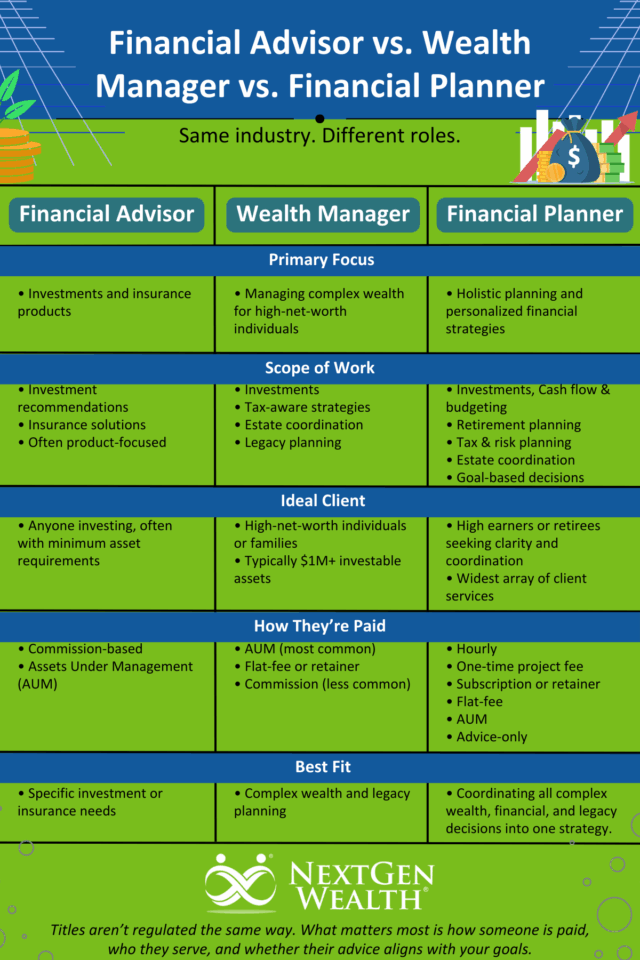
Image Credit: NextGen Wealth.
Key Differences at a Glance
We’ve done our best to help narrow down these broad categories, but it’s difficult to fit 15,000 different investment advisers into narrow categories. After all, there is a human behind each one of them. We’ll try to narrow it down by “typical” scope of work, typical clients, and fee structures.
Scope of Work
Financial Advisor: Focused on investments and insurance.
Legal term for financial advisers.
Wealth Manager: Focused on complex, high-net-worth individuals.
May expand offerings beyond investments and insurance.
Usually offers specialized advice with a narrow focus on a specific type of client.
Ideal Client Profile
A financial advisor can serve anyone, but will often focus on selling their own products and investment offerings. They may have a minimum level of investment assets to work with them.
Wealth managers are typically focused on high-net-worth individuals. They’re often looking for individuals or families with $1 million or more in investable assets.
Financial planners will offer the broadest range of service models for a wide range of people. They often work with high-earners or high-net-worth individuals.
Fee Structures
Financial Advisor: Typically, commission-based or AUM.
Could technically offer any number of compensation models.
Wealth Manager: Typically, AUM, but could be flat-fee, retainer, or commission-based.
Financial Planner: Broadest array of compensation models. May offer:
Hourly
One-Time Fee
Recurring Subscription (typically monthly or quarterly)
Advice-Only
Fee-Only
Flat-Fee
AUM
Some may still have insurance licenses and/or earn commissions from investments, but this is not as common.
How to Tell What Kind of Professional You’re Working With
The only way to be sure about who and what is behind the financial professional you’re talking to is to look at their regulatory paperwork. Many advisors list their fees and services directly on their websites. If they don’t, you can look up their “Form Adv Part 2A Brochure” or “Part 2 Brochures” document filed with the state (FINRA) or the SEC.
You’ll see a listing of the business structure, fees, types of clients they serve, if they’ve had any complaints or disciplinary actions taken against them, as well as a variety of other information.
Which Professional Is Right for You?
We highly recommend starting your search for a financial professional by thinking through exactly what you need help with.
Do you only want investment management?
Would you prefer to get financial planning included?
Do you want ongoing support throughout retirement?
What will you need as you age or have cognitive decline?
What about support when one spouse passes away?
Do you require tax or estate planning and coordination?
Does your asset level necessitate a more specialized service model?
If you’re a do-it-yourself (DIY) investor and just want a second set of eyes and no ongoing support, maybe a one-time engagement is right for you. Or maybe you’ve done a great job as a DIY-er and are ready to delegate those responsibilities so you can spend time enjoying retirement instead.
Do you sell financial products or earn commissions for recommendations?
In many cases, you’ll be paying ongoing fees for service, so it’s essential to know exactly what you’ll get in return. If you don’t feel comfortable, keep asking questions until you do. If you run out of questions and still don’t feel comfortable, follow your gut, and walk away; it’s just not a good fit.
Clarity Leads to Confident Decisions
The landscape of financial professionals can be confusing at best. Understanding the real difference between them will help you choose the right professional for your retirement team. Titles matter a whole lot less than the actual services offered, trust and transparency, and the professional’s fiduciary commitment to you.
Find financial advisors in Lehi, Utah ready to help with your financial planning needs so you can enjoy life more with less money stress.
Whether you have lived in Lehi for years or recently moved to town, you may need help finding the right financial advisor in the community best suited for your individual needs.
It’s important to first consider your own financial planning priorities before choosing an advisor. Here are a few quick tips to help you get started along with financial advisors in Lehi featured on Wealthtender you may want to add to your shortlist.
Featured Lehi Financial Advisors
As you prepare to interview financial advisors in Lehi who may be right for you, get to know local financial advisors featured on Wealthtender.
📍 Map: Financial Advisors with their Primary Office Location in Lehi
Double-click (or pinch the map on mobile devices) to zoom in and expand the details for financial advisors whose primary office location is in Lehi.
The Benefits of Hiring a Financial Advisor in Lehi
Hiring a financial advisor can be a great move to help you build a long-term investing strategy. Advisors can help you build an investment portfolio to meet your financial goals and help you plan appropriately for retirement.
As a resident living in Lehi, hiring a financial advisor who lives nearby and understands the local economy, cost of living, and regional employers can be quite valuable, especially if your individual circumstances are deeply tied to such factors.
Do you work for one of the largest employers in Lehi? If so, there’s a good chance the local financial advisor you hire will also have other clients who work there. This knowledge could prove valuable if they are already familiar with your employee benefits, such as a 401(k) plan, Health Savings Accounts, and other components of your total compensation package.
When you reach out to financial advisors you’re considering hiring, let them know where you work and ask if they are familiar with your employer’s unique benefits and compensation structure.
Quick Tips For Hiring an Lehi Financial Advisor
Before hiring a financial advisor in Lehi, here are a few quick tips to help you find the best advisor for you.
1. Decide Which Services You Need
Before hiring an advisor, determine what services you need from them. Whether it’s full-service investment management or a plan focused on a specific area of your finances, put together a list of what you’d like help with before contacting an advisor.
Though most people use a financial planner simply to invest for retirement, this is only a small part of what many advisors offer. Here’s a quick rundown of potential services a financial advisor may offer you:
Budgeting and money management
Debt management
Insurance planning
Retirement planning
Other investment planning
Inheritance planning
Estate planning
Tax planning
As you can see, financial advisors can help you with your entire financial picture, not just investing. As you start to plan for life’s bigger milestones, you should consider finding a financial advisor that specializes in those areas.
Finding the right advisor can help you minimize risk, maximize gains and take advantage of tax breaks while investing for your future. They can also help you protect your assets with the right kinds of insurance and help you pass on your financial legacy with a proper estate plan.
2. Consider Your Budget and Payment Preferences
Once you have a list of services you would like, review the fee structures financial advisors offer. Finding a balance between the services you need and the cost of those services will help narrow down the field of advisors you may want to work with.
If you are looking for a full-service advisor to manage all of your investments, consider searching among fee-based financial advisors. If you want to manage your money yourself, consider the flat fee and monthly subscription advisors for ongoing support.
3. Interview Multiple Financial Advisors
Once you have chosen the services and fee structure you prefer, it’s time to contact a few advisors and interview them. Here are questions to ask financial advisors:
What services do you provide?
What are all the ways you get paid? (fee transparency)
What is your investment strategy?
How do you measure investment performance?
How do we communicate about my plan?
Interview multiple advisors to get a feel for who you want to work with. A combination of fees, services, and customer service will help you determine the best fit for your financial advice.
4. Review Financial Advisor Credentials
Once you find an advisor (or two) you feel comfortable with, it’s always a good practice to check their credentials and the firm’s details. You can do this at the Investment Adviser Public Disclosure (IAPD) website.
You can check both the individual and the firm to view their background and experience details, as well as any disciplinary action taken against them or their firm.
As licensed financial professionals, there is oversight into how financial advisors conduct business, so running a quick (free) check on them is recommended.
For additional information about advisor credentials, read our article to learn the most popular designations held by financial advisors, as well as specialized credentials which may be important to consider if you have unique financial planning needs.
Frequently Asked Questions & Additional Resources
How do I know if I’m ready to hire a financial advisor?
You should strongly consider hiring a financial advisor if you have a significant amount of money available for saving or investing. This could occur after years of making annual contributions to a retirement plan like a 401(k) through your employer or suddenly if you receive a large inheritance or sell your house for a large profit.
But even if you don’t have a lot of money saved, many financial advisors and planners provide reasonable pricing options and valuable services you should consider, especially if you’re facing a significant life event. For example, if you’re starting a new job, getting married, starting a family, getting divorced, lost your job, starting or selling a business, or approaching retirement age, working with a trusted financial advisor or planner may prove worthwhile.
Before I hire a new financial advisor, should I fire my current advisor?
You don’t need to fire your current advisor before beginning your search for a new financial advisor. In fact, your new advisor can help coordinate the transition of your assets from your previous financial advisor.
Where can I read reviews about financial advisors written by their clients to help me decide if I should hire them?
After 60 years of regulatory prohibition of financial advisor reviews in the US, a rule issued by the Securities and Exchange Commission (SEC) became effective on May 4, 2021 that means both financial advisors and directory websites that help consumers search for a financial advisor can collect and display financial advisor reviews, an important factor worth considering when choosing who you’ll hire to manage your investments and life savings.
Wealthtender is the first independent advisor review platform designed to be fully compliant with the new SEC rule, and we look forward to helping you evaluate financial advisors based on reviews written by their clients.
I’m a local financial advisor interested in being featured in this guide. How do I get started?
Thanks for your interest. We look forward to learning more about your practice and helping you attract your ideal clients where you may be a good fit based on their individual needs and circumstances. Please click here to learn how you can join local financial advisors featured on Wealthtender.
Brian is CEO and founder of Wealthtender and Editor-in-Chief. He and his wife live in Austin, Texas. With over 25 years in the financial services industry, Brian is applying his experience and passion at Wealthtender to help more people enjoy life with less money stress. Learn More about Brian
Discover financial advisors trusted by Austinites in the only local directory featuring 5-Star Certified Advisor Review™ recipients and Wealthtender Voice of the Client Award™ winners—recognition earned for exceptional client feedback. Compare fiduciary, fee-only advisors, CFP® professionals, and specialists to find the right fit for your unique financial needs.
Thousands of people visit Wealthtender each month to find and compare financial advisors based on their location, education, experience, areas of specialization and online reviews. Wealthtender’s Certified Advisor Reviews™ help consumers make informed hiring decisions with important details about the relationship between reviewers and advisors always displayed to ensure you gain the transparency you deserve when your life savings could be at stake.
Types of Financial Advisors You’ll Find on Wealthtender
On Wealthtender, you can explore a diverse range of financial advisors and wealth management firms that include:
Fiduciary advisors committed to acting in clients’ best interests
CFP® professionals with advanced financial planning credentials
Fee-only advisors compensated solely by clients
Advisors for growing families, people nearing retirement, and business owners
Specialists across multiple categories (e.g., life stage, occupation, ethnicity, lifestyle, religion)
Highly-rated advisors with positive client reviews
Firms of varying sizes with advisors who can meet with you in person or online
Fee-based advisors who offer access to insurance and alternative investments
Financial Advisor Directory for Austin, Texas
How to use this directory: Compare financial advisors in the Austin area based on what matters most to you. Use the directory to:
View advisor profiles to evaluate credentials, services, and areas of specialization
Read Certified Advisor Reviews™ to learn what clients value most
Identify advisors recognized with Wealthtender Voice of the Client Awards™
Contact advisors and schedule free introductory video calls
📍 Map: Financial Advisors with their Primary Office Location in Austin
Double-click (or pinch the map on mobile devices) to zoom in and expand the details for financial advisors whose primary office location is in Austin.
Wealthtender Voice of the Client Awards™: Top Rated Austin Financial Advisors
Wealthtender Voice of the Client Awards™ recognize financial advisors and firms that consistently earn exceptional client feedback. Below are Austin-area advisors and firms that have met the criteria for Highly Rated recognition.
To qualify for a Highly Rated award, advisors and firms must achieve an average client review rating of 4.75 or higher (on a scale of 1 to 5) based on a minimum number of eligible client reviews published on Wealthtender within a defined timeframe for each particular award (Timeframe for 2025 Award: 1/1/24 – 12/31/25; Timeframe for Subsequent Year Awards: July 1 of the preceding year through December 31 of the Award Year (e.g., Timeframe for 2026 Award 7/1/25 – 12/31/26). Eligible reviews are limited to clients (as of the review submission date) that advisors/firms must self-attest have no material conflicts of interest and received no compensation in exchange for their reviews. ↗️ View full award methodology & FAQs
Although financial advisors and wealth management firms compensate Wealthtender for marketing services (including eligibility to be considered for awards), Wealthtender’s award criteria is objective and not influenced by compensation. Wealthtender Voice of the Client Awards are not a guarantee of future performance or success and client reviews may not be representative of the experience of all past or future clients.
Frequently Asked Questions
What makes a financial advisor “trusted”?
A trusted financial advisor typically earns positive client feedback over time, operates transparently, and clearly explains how they’re compensated. On Wealthtender, trust is reflected through Certified Advisor Reviews™ that combine insights into the client experience and character of advisors with important disclosures about each reviewer to ensure you gain the transparency you deserve when your life savings could be at stake.
Financial advisors and wealth management firms that consistently receive superior client reviews can also qualify for Wealthtender’s Voice of the Client Awards™ designed to recognize America’s most trusted advisors. Learn More About Wealthtender Voice of the Client Awards™
What are Certified Advisor Reviews™?
Certified Advisor Reviews™ from Wealthtender help consumers make smarter hiring decisions when choosing a financial advisor.
Clients and other individuals can submit reviews for financial advisors and wealth management firms that have turned on the reviews feature. Before each review is publicly displayed, financial advisors agree to disclose important information about their relationship with the reviewer to ensure consumers gain the transparency they deserve when their life savings could be at stake. These disclosures also help financial advisors satisfy compliance with industry regulations.
After financial advisors provide the required disclosures, Wealthtender publishes the review with the Certified Advisor Review™ mark. Learn More About Certified Advisor Reviews™
Can I find fiduciary financial advisors on Wealthtender?
Yes, you’ll find hundreds of fiduciary financial advisors on Wealthtender. Fiduciary financial advisors must act in their clients’ best interest. Before hiring an advisor, always ask if they will act in your best interest as a fiduciary.
For example, financial advisors who have earned their Certified Financial Planner (CFP) designation are fiduciaries. To hold themselves out as a CFP, these credential holders must acknowledge they will adhere to the CFP Board’s Code of Ethics and Standards of Conduct and act as a fiduciary when providing financial advice to their clients. Learn More About Fiduciary Financial Advisors
Can I find fee-only financial advisors on Wealthtender?
Yes, you’ll find hundreds of fee-only financial advisors on Wealthtender. Fee-only financial advisors are paid directly by their clients. Since they aren’t compensated based on the products and services they recommend (e.g., commissions), their compensation model helps reduce potential conflicts of interest.
When viewing financial advisor profiles on Wealthtender, look for the Compensation Methods section that shows ways each financial advisor can be paid for their services, including if they offer fee-only financial planning services. Learn More About Fee-Only Financial Advisors
What distinguishes Wealthtender Voice of the Client Awards™ from other advisor recognition programs?
Wealthtender’s Voice of the Client Awards™ recognize financial advisors and wealth management firms that consistently receive superior client reviews. Unlike award programs with ranking factors that favor financial institutions with the most assets and the fastest revenue growth, the Wealthtender Voice of the Client Awards provide both local financial advisors who choose to remain small and large wealth management firms with the opportunity to be recognized on a metric that matters more to consumers – actual client feedback reflecting the quality of their experience. Learn More About Voice of the Client Awards™
The Benefits of Hiring a Financial Advisor in Austin
Hiring a financial advisor can be a great move to help you build a long-term investing strategy. Advisors can help you build an investment portfolio to meet your financial goals and help you plan appropriately for retirement.
As a resident living in Austin, hiring a financial advisor who lives nearby and understands the local economy, cost of living, and regional employers can be quite valuable, especially if your individual circumstances are deeply tied to such factors.
Do you work for one of the largest employers in Austin? If so, there’s a good chance the local financial advisor you hire will also have other clients who work there. This knowledge could prove valuable if they are already familiar with your employee benefits, such as a 401(k) plan, Health Savings Accounts, and other components of your total compensation package.
When you reach out to financial advisors you’re considering hiring, let them know where you work and ask if they are familiar with your employer’s unique benefits and compensation structure.
Quick Tips For Hiring an Austin Financial Advisor
Before hiring a financial advisor in Austin , here are a few quick tips to help you find the best advisor for you.
1. Decide Which Services You Need
Before hiring an advisor, determine what services you need from them. Whether it’s full-service investment management or a plan focused on a specific area of your finances, put together a list of what you’d like help with before contacting an advisor.
Though most people use a financial planner simply to invest for retirement, this is only a small part of what many advisors offer. Here’s a quick rundown of potential services a financial advisor may offer you:
Budgeting and money management
Debt management
Insurance planning
Retirement planning
Other investment planning
Inheritance planning
Estate planning
Tax planning
As you can see, financial advisors can help you with your entire financial picture, not just investing. As you start to plan for life’s bigger milestones, you should consider finding a financial advisor that specializes in those areas.
Finding the right advisor can help you minimize risk, maximize gains and take advantage of tax breaks while investing for your future. They can also help you protect your assets with the right kinds of insurance and help you pass on your financial legacy with a proper estate plan.
2. Consider Your Budget and Payment Preferences
Once you have a list of services you would like, review the fee structures financial advisors offer. Finding a balance between the services you need and the cost of those services will help narrow down the field of advisors you may want to work with.
If you are looking for a full-service advisor to manage all of your investments, consider searching among fee-based financial advisors. If you want to manage your money yourself, consider the flat fee and monthly subscription advisors for ongoing support.
3. Interview Multiple Financial Advisors
Once you have chosen the services and fee structure you prefer, it’s time to contact a few advisors and interview them. Here are questions to ask financial advisors:
What services do you provide?
What are all the ways you get paid? (fee transparency)
What is your investment strategy?
How do you measure investment performance?
How do we communicate about my plan?
Interview multiple advisors to get a feel for who you want to work with. A combination of fees, services, and customer service will help you determine the best fit for your financial advice.
4. Review Financial Advisor Credentials
Once you find an advisor (or two) you feel comfortable with, it’s always a good practice to check their credentials and the firm’s details. You can do this at the Investment Adviser Public Disclosure (IAPD) website.
You can check both the individual and the firm to view their background and experience details, as well as any disciplinary action taken against them or their firm.
As licensed financial professionals, there is oversight into how financial advisors conduct business, so running a quick (free) check on them is recommended.
For additional information about advisor credentials, read our article to learn the most popular designations held by financial advisors, as well as specialized credentials which may be important to consider if you have unique financial planning needs.
What Do Financial Advisors Love About Austin?
We invited financial advisors in the Wealthtender community to share their favorite places and things to do in Austin. Here’s what they said.
What does Richard Archer love about Austin?
Favorite Local Restaurant: Uchi. It’s a tough call, though, since there are many great Austin restaurants now.
Favorite Local Sports Team: The Longhorns. You’ll also find me regularly cheering my other favorite team Liverpool.
Favorite Family Activity: Weekend wake and foil surfing on Ladybird Lake
Favorite Local Attraction: The Alamo Drafthouse. I love movies and their creative preview content
Favorite Place to Show Out of Town Guests: Tiny Boxwoods Milk & Cookies. Their bakery and coffee are simply amazing.
Frequently Asked Questions & Additional Resources
How do I know if I’m ready to hire a financial advisor?
You should strongly consider hiring a financial advisor if you have a significant amount of money available for saving or investing. This could occur after years of making annual contributions to a retirement plan like a 401(k) through your employer or suddenly if you receive a large inheritance or sell your house for a large profit.
But even if you don’t have a lot of money saved, many financial advisors and planners provide reasonable pricing options and valuable services you should consider, especially if you’re facing a significant life event. For example, if you’re starting a new job, getting married, starting a family, getting divorced, lost your job, starting or selling a business, or approaching retirement age, working with a trusted financial advisor or planner may prove worthwhile.
Before I hire a new financial advisor, should I fire my current advisor?
You don’t need to fire your current advisor before beginning your search for a new financial advisor. In fact, your new advisor can help coordinate the transition of your assets from your previous financial advisor.
Where can I read reviews about financial advisors written by their clients to help me decide if I should hire them?
After 60 years of regulatory prohibition of financial advisor reviews in the US, a rule issued by the Securities and Exchange Commission (SEC) became effective on May 4, 2021 that means both financial advisors and directory websites that help consumers search for a financial advisor can collect and display financial advisor reviews, an important factor worth considering when choosing who you’ll hire to manage your investments and life savings.
Wealthtender is the first independent advisor review platform designed to be fully compliant with the new SEC rule, and we look forward to helping you evaluate financial advisors based on reviews written by their clients.
I’m a local financial advisor interested in being featured in this guide. How do I get started?
Thanks for your interest. We look forward to learning more about your practice and helping you attract your ideal clients where you may be a good fit based on their individual needs and circumstances. Please click here to learn how you can join local financial advisors featured on Wealthtender.
Brian is CEO and founder of Wealthtender and Editor-in-Chief. He and his wife live in Austin, Texas. With over 25 years in the financial services industry, Brian is applying his experience and passion at Wealthtender to help more people enjoy life with less money stress. Learn More about Brian