Alyssa Dalbey, CPWA®, CFP® and Wealth Manager at Schultz Financial Group | Image Credit: Institute for Innovation Development
[While the history of single family offices take us from the major domus of ancient Rome, to the major-domo of great households in the Middle Ages, to the “superintendent” of rich families from the 14th to 18th centuries, it was not until 1838 that the House of Morgan ushered in the formation of one of the first modern family offices. This model was then also applied by the Guggenheim, Dupont, and Vanderbilt families.
Since the purpose of the family office was to serve the specific needs of a particular family’s wealth that could comprise multiple businesses, global properties, and complex assets, it is safe to say that there were as many different family offices as there were families that needed them. Some single-family offices became so well structured and effectively managed that they offered their services to a few other rich families creating the first multi-family office and providing an outsourced option versus building your own family office. But this was a very limited option among the wealthiest families.
Today’s technological and innovation revolutions have similarly created substantial wealth across many industries. Most maybe not to the extent of the dominating families of previous centuries that necessitated the uber-wealthy’s single family office haven. But an interesting evolution – driven by a comprehensive or holistic financial planning advisor movement – is driving the formation and growing access of multi-family office services from ultra-high-net-worth to high-net-worth clients and successful business owners.
To better understand this comprehensive financial planning movement and its emerging family office business structure, we reached out to Alyssa Dalbey, CPWA®, CFP® and Wealth Manager at Schultz Financial Group (SFG) – an independent RIA firm with a decades-long commitment to deepening client relationships by offering a unique integrated package of services to create a working partnership with their clients. This belief shaped their conscious firm development decisions to provide their clients with a more holistic and carefully integrated family and business wealth planning approach that covers what they term as the “Four Capitals of Wealth” – Financial Matters, Physical Well-being, Intellectual Engagement, and Psychological Space.
We asked her questions from a practice management and business development perspective to learn from the firm’s leadership mindset and experience on how they built their firm for stronger and more extensive wealth management engagements with their clients that go beyond just asset management.]
Hortz: Did the concept of a multi-family office structure come to mind as you were consciously choosing to expand the range of your services and working relationships with clients? When did you realize you were approaching a multi-family office structure?
Dalbey: Early on, we found ourselves working with high-net-worth individuals and business owners who started families. As these families and their businesses grew and expanded, the complexities of our wealth management relationships with them increased.
The decision to expand our range of services and working relationships was driven by the need to offer more holistic and integrated wealth management solutions, ultimately leading us to adopt a more comprehensive wealth management model. There was not a single moment in time that we realized we were operating under a multi-family office model. This growth and expansion of our services happened organically.
Hortz: From your experience, why do high-net-worth and successful business owners need a more comprehensive family office structure than traditional wealth management services?
Dalbey: In working with our clients, it became clear to us that high-net-worth (“HNW”) families, not just billionaires, require a family office service structure to manage the complexities of their wealth and ensure long-term financial security and well-being. A family office provides a centralized approach to wealth management, offering personalized services that address the unique needs of HNW individuals beyond just money. By consolidating these services, a family office helps streamline decision-making and enhances the efficiency of managing wealth.
Additionally, a family office offers confidentiality and security, compiling and protecting sensitive financial information. It provides continuity and stability, ensuring that wealth is preserved and transferred across generations. For families with diverse assets and interests, a family office acts as a trusted advisor, guiding them through financial and business decisions and helping them achieve their goals across time and generations.
Hortz: What services did you determine that a family office approach should provide?
Dalbey: By asking a lot of probing questions and listening intently to our clients, many made it clear that their goals were not solely about money. Over time we learned and compiled client concerns to a more expansive redefinition of wealth and a new client dialogue into the “Four Capitals of Wealth” – Financial Matters, Physical Well-being, Intellectual Engagement, and Psychological Space – which offer the following:
Financial Matters – we gather and analyze information from the client and their other advisors (such as their CPA, estate planning attorney, etc.), to develop customized investment strategies that incorporates investments (including alternative investments), detailed financial planning, thorough tax planning and optimization coordinated with the client’s CPA, estate planning, legal advisory relating to estate and business issues, risk management mitigated through insurance and other protective measures, and philanthropic advisory. Furthermore, we can share those plans with the next generation so that their children and grandchildren may be good stewards of the family’s wealth.
Physical Well-being – we provide clients with a subscription to the Tufts Health & Nutrition Letter, which has prompted clients to engage deeper in health-related discussions with our Physical Capital Resource Manager. We also provide access to articles and resources on diet & nutrition, health & fitness, and healthy recipes, and guide clients to the information that relates specifically to their Physical Well-being goals.
Intellectual Capital – is an invaluable asset, and we recognize that it evolves throughout life. As such, we help clients identify opportunities and resources to harness their natural desires and maximize their intellectual capital during their high-earning years. Then, we help them transform it to their next career, avocation or hobby using their personal skills and experience to positively impact their future.
Psychological Space – we work with clients to identify what brings them joy and how they can share that with others, whether that be family, friends, or their community. We also help clients identify how they want to contribute to society, as giving back can enhance psychological well-being. Legacy planning is another important pillar of our Psychological Space family office services.
Most importantly, we learned that the key differentiating service we could provide HNW clients was in carefully integrating all aspects of a family’s needs and goals which informed all our decisions and recommendations. Thereby, we were given the ability to truly go beyond the traditional euphemisms of “personalized” services into uniquely tailored and bespoke solutions. The resulting Four Capitals Plan we develop together with our clients serves as the foundation for an ongoing, interactive, and personal relationship. It helps us understand our clients holistically and serve them in a meaningful way.
Hortz: How are family office services different for business owner clients?
Dalbey: While there are many areas of need for HNW families, this can be heightened for the business owner that carries the weight of the business and family livelihood on his or her back. The emotional, motivational, physical, and psychological forces need to be aligned and managed as well as the financial cash flow.
This entails even more in-depth “Four Capitals of Wealth” management and a family office structure to handle complex business needs that can also include human capital management, property management, diverse business assets, intellectual property/trademark protections, retirement/benefits programs, business/personal tax planning optimization, succession planning, eventual business sale, family/business balance, etc.
Family office services can bring together a team of highly skilled professionals, including tax specialists, legal experts, and investment bankers. Business owners benefit from this diverse range of expertise, receiving comprehensive and informed advice.
Hortz: How is investment management different for family office clients?
Dalbey: Investment management for a family office differs significantly from traditional investment management due to the unique needs and goals of high-net-worth families. Here are some key distinctions:
Family offices tailor investment strategies to the specific objectives, risk tolerance, and time horizons of the family. This personalized approach ensures that the investment portfolio aligns with the family’s overall financial plans and legacy goals. This may include separating the portfolio out into different sub-portfolios, each with their own goals and objectives.
One of the significant differences in investment management for family offices is the inclusion of alternative investments including private equity, private credit, hedge funds, commodities, real estate, art and collectibles. HNW individuals can also access exclusive investment opportunities that may not be available to the general public. This includes private deals, co-investments, and bespoke investment vehicles tailored to the family’s needs.
Family offices can also play a crucial role in educating family members about investment principles and involving them in the decision-making process. This helps ensure that future generations are prepared to manage and preserve the family’s wealth while also carrying on the family’s mission and values. We find great joy in working with the multiple generations of our clients’ families.
Hortz: Can you share with us a brief client case study that demonstrates the power of holistic financial planning and the family office model?
Dalbey: We have a business-owner client that was referred to our firm for our wealth management and business consulting services by an existing client. This business owner is single and owns and operates a successful business that is cash flow positive and has been in existence for over ten years.
Despite receiving a few million dollars of cash flow every year, this client lacked a personal investment portfolio, retirement savings, and college savings for his children. Additionally, his business had no formal operational procedures, career paths, or incentive plans. We worked with the client to develop a cash flow management plan that would satisfy both business and personal goals by accumulating investment savings in accounts for his own future, the future expansion of his business, and his children’s college education.
We also consulted with him and his management team to write job descriptions, create career paths, develop a new employee training program, put together an incentive plan, and implement an operational checklist for ensuring the business consistently delivers the quality of goods and services customers have come to expect.
We have brought in personal and business attorneys to address business succession issues and estate planning. We have consulted with bankers to establish long-term banking relationships and secure financing for business expansion. We also coordinated tax planning with both his CPA and bookkeeper.
Hortz: Are prospects that you are seeing aware of and seeking family office services or is there more education needed to explain this service model?
Dalbey: There are several reasons why many HNW clients might not be aware of family office services:
Lack of Awareness and Education – Family office services are often not widely advertised or discussed in mainstream financial education. Many HNW individuals may not be aware of the existence or benefits of family offices simply because they have not been exposed to this information. Family office services are still relatively new in being accessible for the HNW individuals and business owners as these services were exclusive to the ultra HNW families for a long time.
Traditional Financial Services – Many HNW individuals rely on traditional financial services provided by banks, brokerage firms, and independent financial advisors. These traditional services may meet their needs to a certain extent. However, once a family’s net worth starts to exceed $10-$15 million and they start prioritizing things like family legacy and business succession, family office services are critical to meeting their needs.
Limited Marketing and Outreach – Family offices often operate with a low profile and rely on word-of-mouth referrals rather than extensive marketing campaigns. This limited outreach means that potential clients may not come across family office services unless they are specifically looking for them or are referred by someone in their network.
Focus on Business Interests – For business owners, the primary focus is often on managing and growing their business. They may not prioritize or even consider the additional benefits that a family office can provide in terms of personal wealth management, succession planning, and risk management.
Bill Hortz is an independent business consultant and Founder/Dean of the Institute for Innovation Development- a financial services business innovation platform and network. With over 30 years of experience in the financial services industry including expertise in sales/marketing/branding of asset management firms, as well as, creatively restructuring and developing internal/external sales and strategic account departments for 5 major financial firms, including OppenheimerFunds, Neuberger&Berman and Templeton Funds Distributors. His wide ranging experiences have led Bill to a strong belief, passion and advocation for strategic thinking, innovation creation and strategic account management as the nexus of business skills needed to address a business environment challenged by an accelerating rate of change.
You’re working hard, saving for retirement, and maybe even helping your kids launch—but now your parents need help, too. For many couples in their forties and fifties, the financial squeeze is real.
It’s a season of life that can feel both meaningful and overwhelming. You want to be there for your parents, to honor everything they’ve done for you. At the same time, you’re navigating your own financial goals, career demands, and family responsibilities. It’s not about choosing one priority over another—it’s about finding a path forward that supports your loved ones across generations with compassion and clarity.
When you’re balancing elder care and retirement planning, it’s easy to feel stretched thin—financially and emotionally. The good news? With thoughtful planning, you can care for your family and stay on track for the future you’ve worked so hard to build.
Remember to Put Your Oxygen Mask on First
This isn’t just about the rising cost of care; it’s also about the emotional weight of setting financial boundaries with the people who raised you. That can be hard, even when you know it’s what’s best for everyone in the long run.
Supporting your parents doesn’t mean covering every cost yourself. Instead, look for ways to help them make the most of the resources they already have, whether that’s retirement income, home equity, or other assets. The goal is to preserve their dignity and quality of life while protecting your own financial stability.
As the saying goes, you need to put your own oxygen mask on first. Prioritizing your financial well-being isn’t selfish. It’s a necessary step toward being able to care for others with confidence and resilience, both now and in the years ahead.
Consider a Rental Setup That Works for Everyone
There often comes a time when the family home simply doesn’t fit anymore. Perhaps it has stairs that have become difficult to navigate or bathrooms and entryways that aren’t designed for changing mobility needs. The yard and upkeep may have once been a source of pride, but now feel overwhelming or even unsafe. And if your parents live far from family, especially potential caregivers, distance can add layers of stress and complication during an already challenging season of life.
In these situations, a move may be the best solution, whether to bring your parents closer to family or simply to place them in a home that better suits their needs. One option to consider: purchasing a small condo or townhouse and setting it up as a rental. Rather than gifting the home outright, you can charge fair market rent, ideally covered by your parents’ Social Security or other retirement income. This approach helps maintain their independence, eases day-to-day challenges, and gives you a long-term asset that may come with potential tax benefits.
Use Existing Home Equity Wisely
If your parents already own a home, you may be able to strategically leverage the equity it’s built up over time (especially considering the rapid rise in home valuations in recent years). As they age, consider how the equity in that home can be used to provide for their future care needs.
With your parents and the help of an advisor, explore potential options including:
Home equity loan or line of credit (HELOC)
Selling and downsizing
Possibly moving and renting the home for extra income.
Home equity can be used to fund part-time care, pay for home modifications, or cover other expenses.
Tapping into your parents’ existing equity also helps preserve more of your own savings. Rather than covering care costs out-of-pocket, you’re using the assets your parents have already built to support their quality of life.
Use Other Resources Strategically
When deciding which funds to draw from first, try to follow a thoughtful order that balances tax efficiency with long-term planning.
For example, start by making full use of your parents’ guaranteed income sources, such as Social Security or pension payments. These benefits typically can’t be passed on and are meant to support their needs during retirement, so it makes sense to use them first before tapping into other savings or investments.
Withdrawals from retirement accounts like IRAs or 401(k)s are taxed as ordinary income. However, depending on your parents’ overall income in retirement, they may fall into a lower tax bracket than you, especially if you’re still working. Strategically drawing from their accounts now could reduce the long-term tax burden on your family and preserve more of your own assets.
If you eventually inherit your parents’ tax-deferred retirement accounts, you could face a significant tax bill. Under current rules, most non-spouse beneficiaries must empty inherited IRAs or 401(k)s within 10 years—and all withdrawals are treated as taxable income. If you’re in your peak earning years when this happens, those extra distributions could push you into a higher tax bracket.
Rather, it may be a more tax-efficient option for your parents to spend those funds on their own needs now. Meanwhile, other assets—like taxable investment accounts or real estate—that may qualify for a step-up in basis at death can be preserved as part of a more tax-efficient legacy plan.
What to Do When Assets Are Limited
Not every parent enters retirement with a cushion of savings, home equity, or reliable income beyond Social Security. When resources are tight, it’s important to explore alternative strategies that can still provide the care and support they need.
In some cases, Medicaid may offer essential help with long-term care costs. However, eligibility comes with strict income and asset limits. To navigate this, families sometimes use tools like irrevocable trusts to preserve assets while still allowing parents to qualify for benefits. The key is timing: these strategies often need to be in place at least five years before care is required, due to Medicaid’s look-back rules.
If your family is in this situation, consider consulting a financial advisor or elder law attorney. With the right guidance and early planning, you can help ensure your parents receive the support they need, without creating additional financial strain on yourself or your family.
Don’t Neglect Your Own Needs
It’s easy to fall into the mindset that you need to do it all, especially when you’re caring for an aging loved one. But if supporting your parents starts to derail your retirement savings, the entire family could end up with fewer options down the road. You’re not helping anyone if you end up financially vulnerable in your own later years.
Keep contributing to your own investment accounts. Have enough cash on hand for upcoming needs. And whenever possible, rely on your parents’ resources, rather than your own, to cover their expenses. Protecting your financial future is part of protecting your family’s stability.
Remember, You Don’t Have to Do It Alone
Balancing your own goals with the needs of aging parents is no small task. It takes time, heart, and a plan.
Congratulations! Earning a Wealthtender Voice of the Client Award™ is an achievement worth celebrating. We created this guide to help you maximize the value of your award.
Increase visibility in AI tools (Answer Engine Optimization)
Reinforce client loyalty
Achieve a higher business valuation
Your award offers more benefits than you think
Consumers preparing to hire financial advisors are looking for signs that they can trust the advisors they hire. When they look beneath the surface of your Voice of the Client Award to discover how your recognition was earned, they will find real clients sharing stories about their experiences working with you. Unlike other award programs with criteria heavily weighted on a firm’s size or revenue growth that could raise eyebrows among skeptical consumers, even the name of your “Voice of the Client” award conveys that this award is special.
Increasing Client Loyalty & Referability
Beyond the impression your Voice of the Client Award makes in the minds of prospects, your award also reminds your current clients that they’re in good hands. Especially among clients who took the time to write a review about their experience working with you, they will take pride in knowing the feedback they shared contributed to your recognition for an award they believe you deserve.
Other clients who haven’t yet written a review may be more inclined to do so as they learn of your award and feel greater validation that choosing you as their advisor was a smart move. Ultimately, your award reinforces to all of your clients that they made a wise choice in hiring you, increasing their loyalty as well as the likelihood that they will refer you to family, friends and others in their network.
Enhancing Your Visibility in Search Engines and AI Tools
Another benefit of receiving a Voice of the Client Award includes strengthening your SEO (Search Engine Optimization) to rank higher in traditional search engines like Google, improving your AEO (Answer Engine Optimization) to raise your visibility in AI tools like ChatGPT, Perplexity, and Gemini, and even aiding your ZCO (Zero-Click Optimization) efforts where traditional search engines display AI summaries above all other search results.
Motivating Your Team and Boosting Morale
Your award also helps you recruit and retain top-caliber employees who prefer to work for an organization that’s been recognized for exceptional client service and where they feel they’re part of a winning team. Celebrating your award as a team boosts morale and motivates your staff to continue delivering a client experience that sets your firm apart.
For a more complete discussion regarding the regulatory disclosures required when promoting third-party ratings, please read this article.
Please remember, you must first sign a licensing agreement with Wealthtender and agree to the terms of use to display the Wealthtender award logo in digital or print format beyond your Wealthtender profile page. This article is provided for educational purposes and is not intended to replace the guidance of your compliance officer/consultant. Please speak with your compliance counterpart before getting started promoting your award. Questions? Contact yourfriends@wealthtender.com. We’re always happy to help.
Impactful Ways to Promote Your Voice of the Client Award™
Just below, you will discover several practical ways you can promote your award to convert more prospects into clients, improve client retention, strengthen your visibility online, enhance your company culture, and ultimately increase the value of your business.
1. Display Award on Your Wealthtender Profile
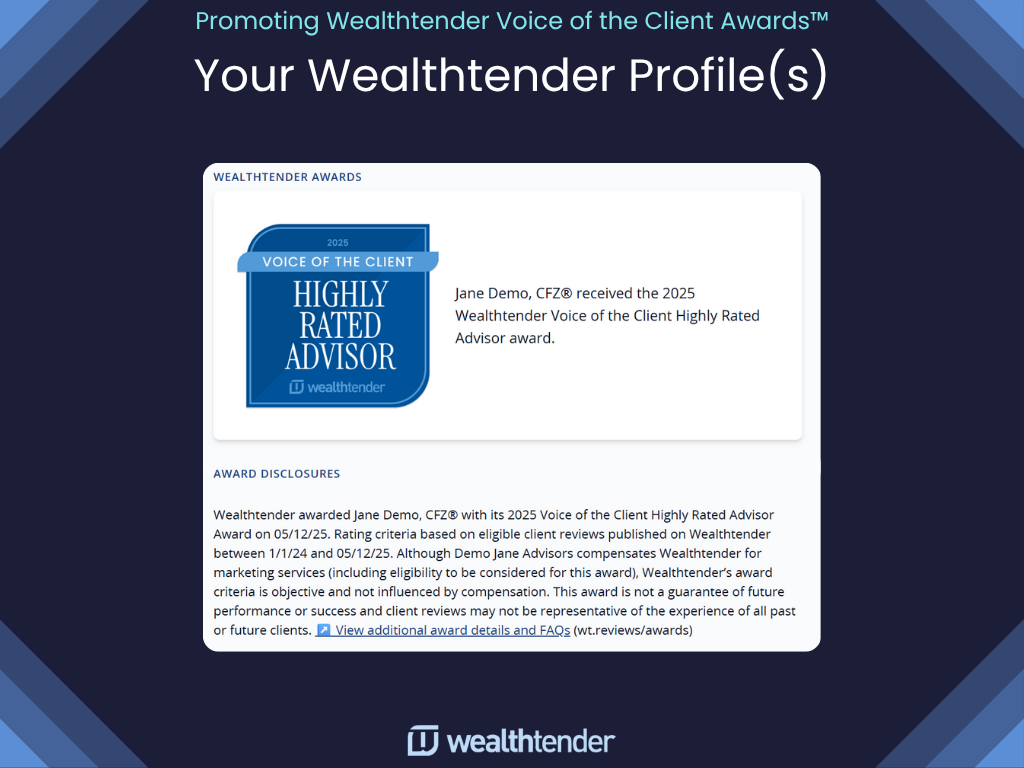
Shortly after accepting your award from Wealthtender, your Wealthtender profile will display the award logo with the disclosures necessary to satisfy SEC and FINRA requirements. Your award is displayed with coding that helps search engines and AI tools validate your status as an award recipient. This can lead to you appearing more prominently and frequently when prospects are searching for advisors or evaluating the advisor names on their short list. No action is required on your part. Wealthtender staff will set this up automatically for you.
2. Display Award on Your Website
Your Wealthtender Voice of the Client Award is not only a meaningful recognition of the outstanding client experience you deliver, it’s also a highly effective trust signal that can influence prospects at “moments that matter” when they’re deciding if they should contact you or another advisor. Your website is often one of the final touchpoints for prospects deciding whether you are the right financial advisor or firm that can meet their needs. Prominently displaying your award on your website can help strengthen your credibility and differentiate you from competitors.
➡️ Why This Is Important:
Builds Immediate Trust: Awards based on authentic client feedback resonate strongly with prospects. Seeing your Wealthtender recognition demonstrates that your clients have enjoyed their experience, reinforcing confidence among prospects in choosing you over other advisors.
Enhances First Impressions: Among many prospects, your website serves as a digital billboard they will quickly scan upon their initial visit. The inclusion of third-party recognition instantly elevates your credibility, places prospects at ease, and helps ensure you land on their short list.
Supports SEO & AI Discovery: As search engines and AI-powered tools like ChatGPT and Gemini increasingly look for professional credentials, online reviews and awards when deciding which advisors to show in search results, displaying your award on your homepage, bio page and contact pages may increase how frequently and prominently you appear in search results.
➡️ How to Implement:
Compliance Tip: When displaying the award logo on your website, remember to include the disclosures required for regulatory compliance. These disclosures can be added as a text block near the award logo, or consider using an image design (like the example below) that incorporates disclosures alongside the award logo.
Homepage Feature: If you have earned a Highly Rated Firm award, place the Wealthtender Voice of the Client Award logo prominently on your home page where visitors will see it as they scan to learn more about your firm and services. Or add a section to your homepage featuring the advisors who have received a Highly Rated Advisor award. Consider adding a link to your Wealthtender profile or the testimonials page on your website where prospects can “Read the client reviews that helped us earn this award“.
Sample design created in Canva that includes regulatory disclosures.
Advisor Bio Pages: Include the Highly Rated Advisor award on your award-winning advisor biography pages, ideally with a short explanation (e.g., “Recognized by Wealthtender for exceptional client satisfaction based on client reviews.”) This provides another opportunity to link directly to your Wealthtender profile or testimonials page to encourage prospects to read what your clients have shared about their experience working with you. (Or use a Wealthtender widget to display your client reviews on your bio page alongside the award logo.)
About Us Section: If you’re a multi-advisor firm, highlight collective awards and recognitions as part of your firm’s broader value proposition, including your Wealthtender Highly Rated award(s).
Blog Post: Consider writing a brief blog post announcing your award, which can create fresh content for your site while providing additional keyword-rich copy for SEO benefits.
💡 Use These Resources to Create a Blog Post Announcing Your Award
Just below, you’ll find a sample blog post and a few prompts you can enter into AI tools like ChatGPT to help you craft a blog post that you can personalize and then publish. Before publishing, remember you’ll need to add the required disclosures into the blog post, too.
AI Prompt 1: Award Announcement & Gratitude
I am a financial advisor who has recently won the Wealthtender Voice of the Client Highly Rated Advisor Award. I want to write a blog post for my firm’s website announcing the award to existing and prospective clients.
I am a financial advisor who has recently won the Wealthtender Voice of the Client Highly Rated Advisor Award. I want to write a blog post for my firm’s website announcing the award to existing and prospective clients.
Please write a warm, professional, and client-centric blog post that:
Announces the award and briefly explains what it means.
Expresses gratitude to my clients for their online reviews and trust.
Recognizes and celebrates my team for their contribution to client service.
Includes a tactful, non-pushy reminder that referrals are always appreciated.
Subtly reinforces to prospects that choosing my firm is a smart decision.
The tone should be authentic, friendly, professional, and convey our firm’s commitment to exceptional client service.
AI Prompt 2: Personal Story Approach
I recently received the Wealthtender Voice of the Client Highly Rated Award thanks to the reviews and feedback from my clients.
Please write a blog post that:
Shares a personal reflection on what this award means to me as an advisor.
Thanks my clients for their trust and partnership.
Acknowledges the efforts of my team.
Gently includes a message that referrals are welcome and appreciated.
Sends a positive message to prospective clients about our firm’s values.
Keep the tone warm, sincere, and relatable, while also maintaining a professional image.
AI Prompt 3: Celebrating Our Clients & Team
Create a blog post for my firm’s website to celebrate winning the Wealthtender Voice of the Client Highly Rated Award.
The blog post should:
Make the clients feel like they are part of this achievement.
Highlight how client feedback helps us continue to improve.
Recognize the dedication of our team.
Use language that builds trust with prospective clients.
Include a call to action encouraging referrals in a respectful, tactful way.
The tone should balance professionalism with warmth and gratitude.
Sample Blog Post: Using Prompt 1 Above
We’re Honored! Celebrating Our Wealthtender Voice of the Client Highly Rated Award
We are thrilled to share some exciting news with you.
[Firm Name] has been recognized with the Wealthtender Voice of the Client Highly Rated Firm Award!*
or
[AdvisorName] has been recognized with the Wealthtender Voice of the Client Highly Rated Advisor Award!*
This award is especially meaningful to us because it is driven by feedback from the people who matter most: our clients. Your thoughtful reviews and testimonials played a key role in earning this recognition, and we are deeply grateful for the trust and confidence you continue to place in us.
At [Firm Name], we believe that financial planning is not just about numbers, it’s about relationships. Every conversation, every meeting, every plan we create is rooted in understanding your goals, dreams, and values. This award is a reflection of the strong partnerships we’ve built together.
We also want to take this opportunity to recognize our incredible team. Their dedication, professionalism, and genuine care for our clients are what make honors like this possible. From our client service team to our financial planners and support staff, each person plays a vital role in delivering the personalized experience you deserve.
As we celebrate this milestone, we’re reminded that the greatest compliment we can receive is your referral. If you have friends, family members, or colleagues who could benefit from our services, we would be honored to offer them the same level of care and expertise that earned us this award.
To our clients: thank you for your trust, your kind words, and your continued partnership. We’re proud to serve you and look forward to helping you achieve your financial goals for many years to come.
Thank you for choosing us as your partner to achieve your financial goals.
[Advisor Name] [Firm Name]
* Award Disclosures: Wealthtender awarded Jane Demo, CFZ® with its 2025 Voice of the Client Highly Rated Advisor Award on 05/12/25. Rating criteria based on eligible client reviews published on Wealthtender between 1/1/24 and 05/12/25. Although Demo Jane Advisors compensates Wealthtender for marketing services (including eligibility to be considered for this award), Wealthtender’s award criteria is objective and not influenced by compensation. This award is not a guarantee of future performance or success and client reviews may not be representative of the experience of all past or future clients. ↗️ View additional award details and FAQs (wt.reviews/awards)
↗️ Check out this award-winning advisor’s blog post as an example:
By integrating your award into your website in a visible and authentic way, you’re helping prospects quickly gain confidence that your firm delivers not just promises, but proven client satisfaction.
3. Issue a Press Release Announcing Your Award
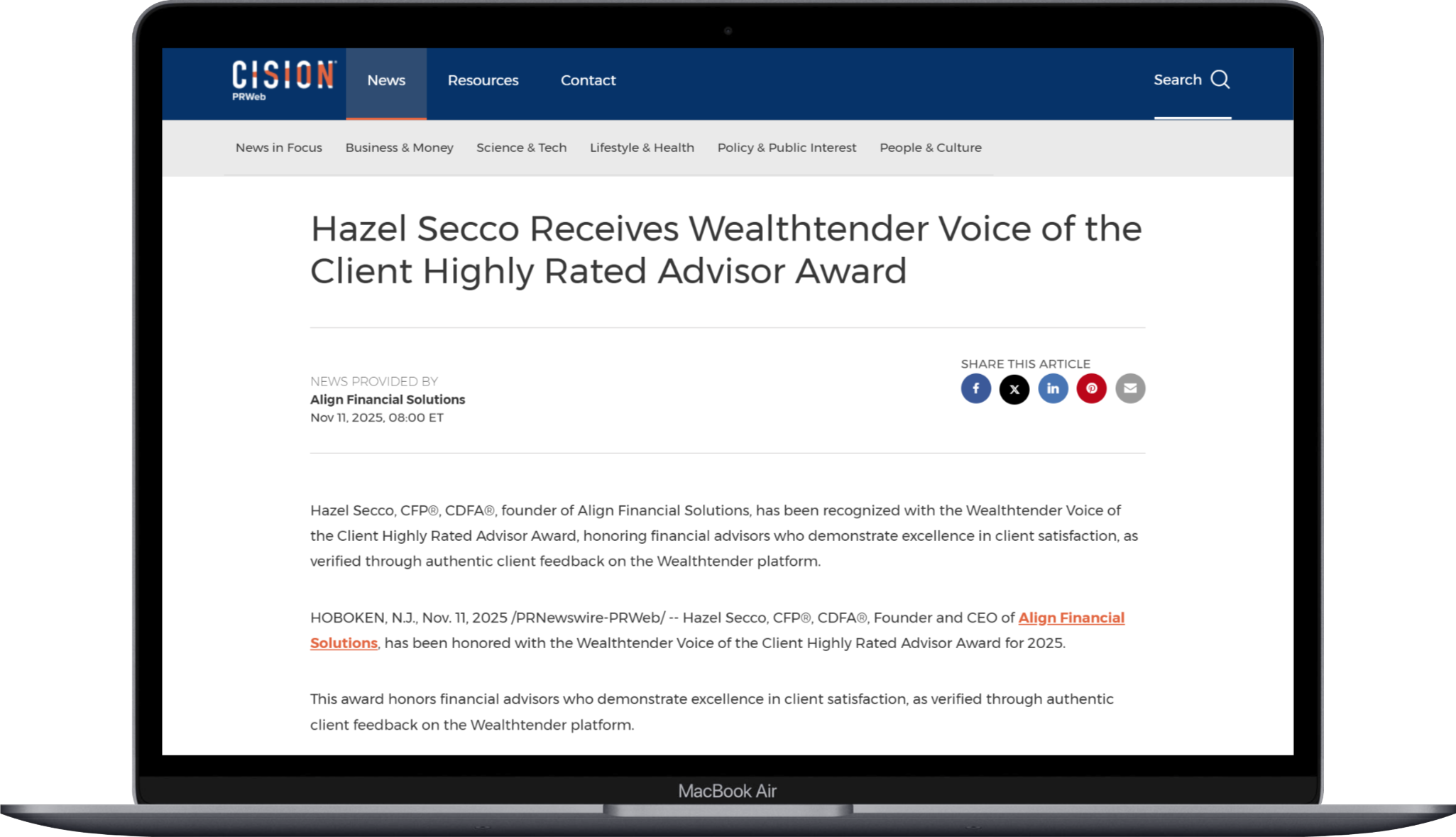
Issuing a press release announcing your Wealthtender Voice of the Client Award allows you to publicly acknowledge your recognition and amplify visibility beyond your existing network. By issuing a press release through a reputable distribution outlet, your announcement could be syndicated (published) in a local newspaper that could be useful to share in your marketing efforts. We’re also seeing search engines like Google and AI tools like ChatGPT sourcing press releases in their search results which could pay dividends down the road.
With this said, publishing a blog post announcing your award as described in the section above can provide many of the benefits of a press release without the additional cost. But if you’re willing to spend a couple hundred dollars on a formal press release, it could strengthen your SEO and visibility in AI tools.
➡️ Why This Is Important:
Strengthens Credibility with Third-Party Validation: A press release adds an additional layer of legitimacy to your award by showcasing that the recognition is significant enough to merit public announcement. It signals to prospects, centers of influence, and referral partners that your client experience is truly noteworthy.
Boosts SEO & Online Visibility: Press releases often get syndicated across multiple online news platforms, financial publications, and press wire services. These additional mentions contribute to your online presence, improve search engine optimization (SEO), and may increase the likelihood that AI-powered search tools reference your achievements in future client research.
Creates Shareable Content: A press release provides content you can link to from your website, email campaigns, newsletters, and social media posts, giving you multiple touchpoints to highlight your recognition over time.
➡️ How to Implement:
Draft a Concise Announcement: Your press release should briefly explain what your Wealthtender Voice of the Client Award represents, why it’s meaningful (e.g., based on authentic client reviews), and what it says about your firm’s commitment to client satisfaction. Refer to the resources below to help you get started and remember to include the required regulatory disclosures.
Include Quotes: Consider adding a brief quote from yourself (or your firm’s leadership) expressing gratitude for your clients’ trust, a quote from Wealthtender explaining the significance of the award (you’re welcome to source quotes directly from our press release announcing the award program or contact us and we’ll be happy to assist), and/or examples of client testimonials that contributed to your qualification for the award.
Distribute Strategically: Submit your press release through a reputable press wire service, such as PRWeb. Wealthtender uses PRWeb for its corporate press releases and we believe their Standard Package at a cost of $230 (as of June 2025) is a fair price to pay for the reach and visibility. (Note: Don’t get lured into more expensive packages or vendors where the costs can leap by hundreds of dollars or significantly more.) Additionally, share the release directly with local media outlets/reporters, your chamber of commerce, industry trade publications, and professional organizations to which you belong. Remember to link to the press release from your website (e.g., “In the News” section) and consider sharing a link to the release in your client/prospect newsletter and social media outlets.
💡 Use These Resources to Create a Press Release About Your Award
Just below, you’ll find a sample press release and a few prompts you can enter into AI tools like ChatGPT to help you craft a press release that you can personalize and then publish. Before publishing, remember you’ll need to add the required disclosures into the press release, too.
AI Prompt 1: Standard Press Release
I am a financial advisor whose firm recently won the Wealthtender Voice of the Client Highly Rated Award.
Please write a press release that:
Is written in a professional tone appropriate for media distribution.
Announces the award.
Briefly explains what the Wealthtender Voice of the Client Highly Rated Award represents.
Includes a quote from me expressing gratitude to our clients and our team.
Reinforces the firm’s commitment to exceptional client service.
AI Prompt 2: Press Release with Community Focus
My wealth management firm has been awarded the Wealthtender Voice of the Client Highly Rated Award.
Please write a press release that:
Is suitable for submission to local media and industry publications.
Announces the award.
Highlights how client feedback and online reviews contributed to earning this award.
Emphasizes our firm’s commitment to serving our local community and building trusted relationships.
Includes a quote from me, expressing gratitude to clients, recognition of the team, and inviting prospective clients to learn more.
AI Prompt 3: Celebrating Our Clients & Team
Our firm just received the Wealthtender Voice of the Client Highly Rated Award.
Please draft a press release that:
Is formatted in standard press release style.
Announces the award in a way that strengthens our brand reputation.
Includes brief background on our firm’s services.
Contains a client-centric quote from me as the firm leader.
Subtly positions the firm as a smart choice for prospective clients seeking trusted financial guidance.
Includes boilerplate language at the end about our firm.
Sample Press Release: Using Prompt 1 Above
FOR IMMEDIATE RELEASE
[Firm Name] Receives Wealthtender Voice of the Client Highly Rated Award
[City, State] | [Date] | [Firm Name], a [describe your firm: independent wealth management / financial planning firm / advisory firm], is proud to announce it has been recognized with the Wealthtender Voice of the Client Highly Rated Award*, an honor driven by outstanding feedback from the firm’s clients.
The Wealthtender Voice of the Client Award highlights financial advisors who have received consistently exceptional ratings and reviews from their clients on the Wealthtender platform, a trusted source for online reviews in the financial services industry.
“We are deeply honored to receive this recognition,” said [Advisor Name], [Title] of [Firm Name]. “This award is particularly meaningful because it reflects the trust and confidence our clients have placed in us. Their candid feedback inspires us to continually improve and deliver the highest level of service every day. I’m also incredibly proud of our dedicated team, whose professionalism and genuine care make achievements like this possible.”
The award underscores [Firm Name]’s ongoing commitment to delivering personalized, values-based financial guidance to individuals and families seeking clarity and confidence in their financial lives.
For more information about [Firm Name] and the services provided, please visit [website URL] or call [phone number].
About [Firm Name] [Insert 2-3 sentence firm boilerplate: when founded, services provided, key differentiators, mission, etc.]
Media Contact: [Name] [Title] [Firm Name] [Email Address] [Phone Number]
* Award Disclosures: Wealthtender awarded Jane Demo, CFZ® with its 2025 Voice of the Client Highly Rated Advisor Award on 05/12/25. Rating criteria based on eligible client reviews published on Wealthtender between 1/1/24 and 05/12/25. Although Demo Jane Advisors compensates Wealthtender for marketing services (including eligibility to be considered for this award), Wealthtender’s award criteria is objective and not influenced by compensation. This award is not a guarantee of future performance or success and client reviews may not be representative of the experience of all past or future clients. View additional award details and FAQs (wt.reviews/awards)
By issuing a press release, you’re not only celebrating your award but also distributing authoritative content that reinforces your expertise and client-first reputation in search engines, AI tools, and in the minds of future clients.
↗️ Check out this award-winning advisor’s press release as an example:
4. Update Directory Listings & Social Media Profiles
Winning the Wealthtender Voice of the Client Award gives you an important credential that should be integrated across all of your digital profiles, especially on high-visibility platforms where prospects may research you before making initial contact. Updating your online profiles ensures consistent messaging and maximizes the visibility and credibility benefits of your award.
➡️ Why This Is Important:
Meets Prospects Where They Research: Before contacting an advisor, many prospects will review your online profiles (e.g., LinkedIn, Wealthtender, Facebook, and other listings that appear when they google your name). Seeing third-party awards on these platforms reinforces trust and reduces friction in a prospect’s decision-making process.
Enhances Local SEO: Adding award mentions to your Google Business Profile can improve your appearance in local search results. Google factors client reviews, awards, and third-party citations into its algorithm, potentially helping you rank higher when local prospects search for financial advisors.
Increases AI Discovery Signals: Many AI-powered search tools scan multiple online sources to assess an advisor’s credibility. Including your Wealthtender award across your directory listings helps build a stronger online reputation profile that may be recognized and surfaced by these tools.
Creates Consistency Across Channels: Consistent messaging across all platforms reinforces professionalism and makes your award visible to anyone researching you, regardless of which platform(s) they visit.
➡️ How to Implement:
Google Business Profile: Consider adding mention of your Wealthtender award in your business description if you’re permitted the ability to include the necessary disclosure language. If available to you, create a post on your Google profile announcing your recognition. And upload an image design that includes the award logo and required disclosures as part of your Google Business Profile photo gallery.
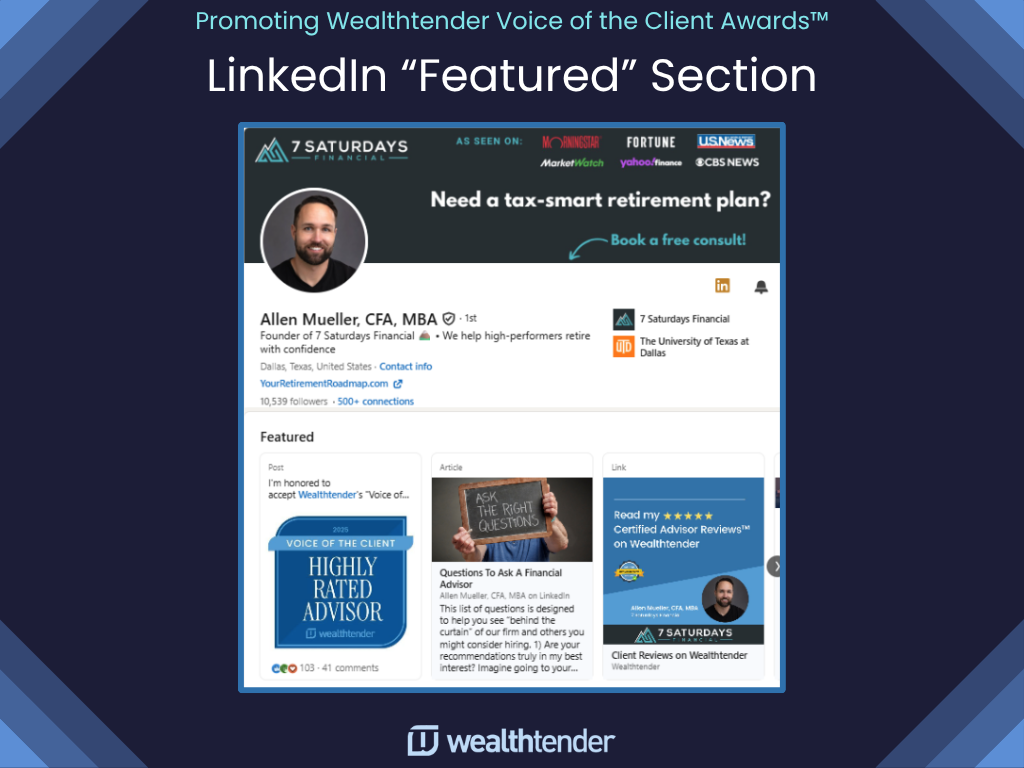
LinkedIn “Featured” Section: After creating a LinkedIn social post announcing your award, set the post as “Featured” to prominently appear on your applicable LinkedIn profile(s). This will then be one of the first things prospects will likely see when visiting your profile. You can also reference your award in the “About” section, along with the required disclosures.
Industry Directory Listings: Many industry-specific platforms (e.g., NAPFA, XYPN, Fee Only Network, CFP Board, etc.) provide one or more ways you may be able to promote your award, including uploading an image design that includes the award logo and required disclosures, or updating the “About” section to reference your award.
Social Media Profiles: Reference your award in your bio or profile descriptions on platforms like Facebook, X, and Instagram that provide the ability to incorporate the necessary disclosures or upload image designs that include the disclosures.
By updating your directory listings and online profiles, you’re ensuring your Wealthtender Voice of the Client Award remains visible to every prospect — no matter where they encounter you online — while also strengthening your discoverability in search and AI-powered platforms.
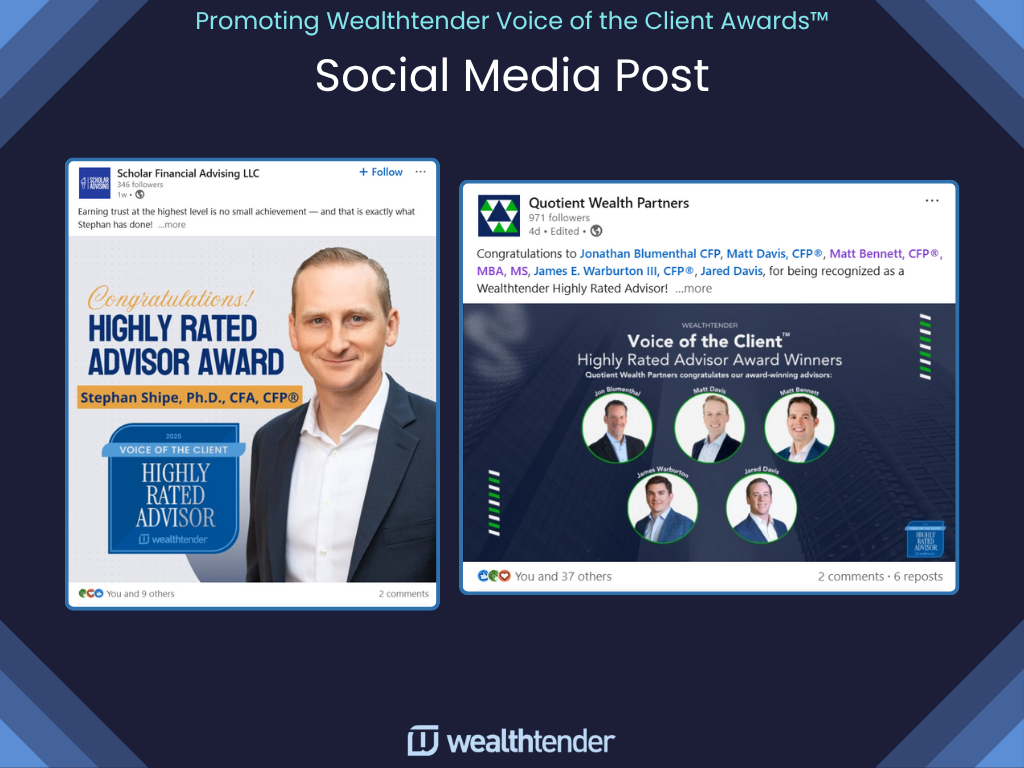
5. Create Social Media Posts
Social media offers one of the most effective and repeatable ways to amplify your Wealthtender Voice of the Client Award recognition. It allows you to reach both your captive audience (clients, prospects, friends, centers of influence) and an extended network of potential new clients, all while reinforcing your professional credibility and client-first focus.
➡️ Why This Is Important:
Reinforces Trust and Social Proof: Sharing your award publicly demonstrates to your followers that your clients value their partnership with you, which is especially powerful coming directly from verified client feedback. This kind of visible social proof helps build trust with both prospects and centers of influence who may feel reinvigorated to send more people your way.
Boosts Brand Awareness: Social posts allow you to increase visibility with a broader audience, many of whom may not be actively searching for an advisor but will take notice of third-party recognition when they see it in their feed.
Encourages Engagement and Sharing: Award posts often generate strong engagement (likes, comments, shares), giving your content greater organic reach while signaling your success to your network.
Provides Versatile, Reusable Content: Your award announcement isn’t just a one-time post, it can be repurposed into a variety of formats (static posts, stories, reels, carousel posts, short videos), allowing you to keep the momentum going over time. Mark your calendar with reminders to send posts commemorating your award around the date of your firm’s anniversary, holidays when you can express gratitude to your clients (e.g., Thanksgiving, New Year’s, Valentine’s Day), and other special events like staff appreciation days.
➡️ How to Implement:
Use Multiple Formats: Create a variety of posts, including static image announcements, short videos, stories, and reels. Use Canva templates, leverage your marketing team, or prompt AI tools with the award logo image and required disclosures to generate compliant image designs.
Include Engaging Copy: Express gratitude to your clients for their support and highlight that the award is based on verified client reviews, reinforcing its credibility. Use strong, attention-grabbing headlines (e.g., “You Spoke. I’m Honored.” or “Awarded for Client Experience Excellence”). Always be sure to include the required disclosures with your copy as well. Check out the sample copy ideas below that you can use to create social media content about your award.
Tag Staff and COIs: Consider tagging members of your staff to express gratitude for their contributions to delivering an exceptional client experience that contributed to earning the award. Beyond the sense of pride this instills among them, their engagement and sharing of the post with their network further elevates your professional brand and raises awareness among more people who may be searching for the types of services you offer. In addition to your staff, tagging the outsider partners/agencies and/or centers of influence and professional associations that support your business could extend your post’s impact and reach even further.
Pin Key Posts: On platforms like LinkedIn or Facebook, pin your award announcement post to the top of your profile to maximize ongoing visibility.
💡 Use These Resources to Create Social Media Content About Your Award
Just below, you’ll find samples of text you can use to create social media posts, along with CTAs (Calls to Action) that encourage prospects to get in touch with you to learn more about your services. You can also use the sample AI prompts in tools like ChatGPT to help you brainstorm social media content ideas tailored to your own brand voice. Before publishing, remember you’ll need to add the required disclosures into your social media posts, too, unless you’re sharing an image design that incorporates the disclosures.
Sample Social Media Post Text
Here are a few ideas of sample text you can use when creating a post to accompany an image (e.g., your award logo). In some cases, you may want to incorporate the text below into an image design that includes the award logo.
Heading
Sub-Heading
Social Post Text
Thank You for Trusting Me
Your reviews made this possible.
Grateful for my amazing clients whose kind words helped me earn this Wealthtender Voice of the Client Award! Your trust means the world to me.
Highly Rated By Those Who Matter Most
My clients.
Honored to be named a Wealthtender Voice of the Client Award recipient. Thank you for your trust in me to guide your financial journey.
Your Confidence. My Commitment.
Awarded for client satisfaction.
This award belongs to you, my incredible clients. Thank you for your confidence and for allowing me to serve you every day.
Grateful. Honored. Inspired.
Recognized through client reviews.
I’m deeply honored to receive this Wealthtender recognition based on the words of my valued clients. Your success is my greatest reward.
Awarded for Client Experience Excellence
Powered by your reviews.
Thank you for taking the time to share your experiences. Your trust has earned me this Voice of the Client Award and inspires me to keep raising the bar.
Earning Your Trust Is My Greatest Achievement
Recognized by Wealthtender.
This recognition reflects what matters most: my clients’ satisfaction. Thank you for your continued trust and kind words.
My Clients Make This Possible
Recognized for outstanding service.
So grateful for my clients whose kind words earned me this distinction. Your success drives my work and this recognition.
You Like Me, You Really Like Me!
Thank you for your kind words!
Feeling the love! Thanks to my incredible clients for the reviews that made this award possible! ❤️
High Fives All Around!
Client feedback made it happen.
Big thanks to all my amazing clients! Your kind reviews earned this Wealthtender award. 🙌
Recognized for Distinction
Celebrating client satisfaction.
Grateful for the privilege to serve clients who place their trust in me. This award is a reflection of our partnership.
You Shared. I’m Honored.
Thank you for your kind words!
Thank you for trusting me and for your kind reviews that earned this award!
Sample CTAs (Calls to Action)
Not every social post needs to include a CTA, but sharing your recognition in a social post does provide an opportunity to encourage prospects to reach out. Here are a few CTAs to consider for posts where you feel it is appropriate:
If you’re looking for a trusted financial partner, I’d love to talk about how I can help you, too.
Let’s work together to write your financial success story.
Your goals. My expertise. Let’s build your financial future together.
The greatest recognition is the trust of my clients. If you’re ready to take control of your finances, I’m here to help.
Recognized for client excellence. Ready to help you achieve your goals with award-winning service.
Curious what working with an award-winning advisor feels like? Let’s chat!
Sample Text + CTAs
Here are a few examples of social media posts that incorporate text and a call to action:
🏆 Honored to receive the Wealthtender Voice of the Client Highly Rated Award!
This recognition reflects what matters most: the trust and satisfaction of my incredible clients. Thank you for your kind words, your loyalty, and for allowing me to be part of your financial journey.
If you’re ready to take your financial plan to the next level, let’s connect!
🎉 You spoke up. Wealthtender listened. And now… we get to celebrate together 😄
Big thanks to my amazing clients for your kind words and reviews that made this award possible. Your success is my success!
If you’re looking for an advisor who listens, I’d love to meet you.
🌟 Discretion. Trust. Results.
I am honored to receive this Wealthtender Voice of the Client Award, earned through the feedback and experiences of my valued clients.
Thank you for your trust. Your success is my purpose.
🚨 Client Satisfaction Alert🚨
The Wealthtender Voice of the Client Award is special because it comes directly from my clients’ feedback.
Thank you for your trust. Let’s keep building your financial future.
AI Prompts to Generate Social Media Content
Use an AI tool like ChatGPT to enter prompts similar to the examples below to generate ideas of social media content you can personalize to create posts in your own professional voice. Be sure to add the required disclosures as well.
“Write a grateful LinkedIn post announcing I won the Wealthtender Voice of the Client Award thanks to my client reviews.”
“Write a casual Instagram caption celebrating my client-powered Wealthtender award, include emojis.”
“Write a caption highlighting that client trust is my greatest achievement after earning the Wealthtender award.”
“Create a caption that positions me as a trustworthy financial advisor receiving the Wealthtender award based on client satisfaction.”
“Write a short caption celebrating my Wealthtender award and inviting new clients to schedule a consultation.”
By promoting your Wealthtender award consistently on social media, you create a highly visible stream of trust-building content that not only celebrates your success but also positions you as an advisor trusted and endorsed by real clients.
↗️ Check out the social media posts by these advisors for examples:
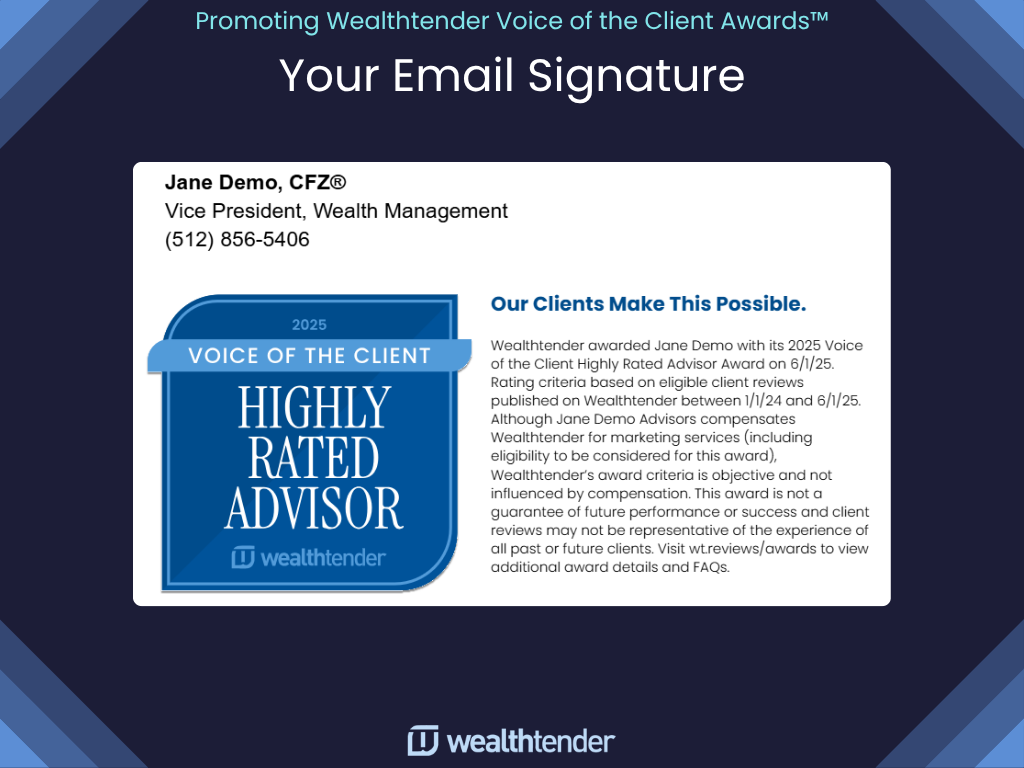
Your email signature is one of the most overlooked, yet highly valuable, pieces of digital real estate in your marketing toolkit. You send dozens, if not hundreds, of emails every week to clients, prospects, friends, and centers of influence. Incorporating your Wealthtender Voice of the Client Award into your email signature allows you to passively reinforce your credibility and client satisfaction every time you hit “send.”
➡️ Why This Is Important:
Ongoing Trust Reinforcement: Every email you send becomes a subtle reminder of your recognition and commitment to exceptional client service, without being intrusive or salesy. It helps keep your professional credibility top-of-mind for both clients and prospects.
Strengthens Professional Brand: A polished, up-to-date signature reflects attention to detail and positions you as a credible, award-winning professional.
Encourages Conversation Starters: Recipients may ask about your award, providing natural opportunities to discuss your client-centered approach during meetings or follow-up conversations.
Consistent Exposure Over Time: Unlike social posts that may only be seen for a brief period, your email signature delivers consistent visibility, week after week, to your audience.
➡️ How to Implement:
Add Award Language: Include a simple statement below your signature, such as: “Recipient of the Wealthtender Voice of the Client Award, based on verified client reviews.” followed by the required disclosures, and consider linking to more information about your award published on your website (e.g., a blog post or press release).
Incorporate the Award Logo: If your email platform and IT/compliance teams allow an image in your signature, add a small version of the Wealthtender award logo (ensure it’s properly sized to maintain a professional appearance, generally 75–125px wide) followed by the required disclosures (or create an image design like the example shown below with your award logo placed next to the required disclosures incorporated into the design itself.)
Keep it Subtle but Visible: Avoid overwhelming your signature with too much design. The award mention should complement your existing contact information and professional certifications.
By adding your Wealthtender Voice of the Client Award to your email signature, you’re transforming an everyday communication tool into a consistent trust-building asset that works automatically with every email you send.
7. Share in Client Communications and Prospect Newsletters
Naturally, your clients who represent a primary source of referrals and prospects currently in your pipeline rank among the most important audiences to share the news with about your Wealthtender Voice of the Client Award. Your regularly scheduled communications like monthly newsletters and company updates that reach this audience provide the perfect opportunity to reach them. Sharing your award in this manner keeps your clients informed, reinforces their confidence in your service, and gives prospects an additional reason to engage with you.
➡️ Why This Is Important:
Strengthens Client Loyalty: Sharing the award with existing clients gives them a sense of shared pride, as their reviews and feedback contributed to your recognition. It reinforces that they made the right choice in selecting you as their advisor.
Nurtures Prospects Through Trust Signals: For prospective clients, seeing that your current clients have endorsed your work through their online reviews provides powerful social proof. It helps reduce the perceived risk of engaging with you and shortens the trust-building timeline.
Creates Natural Referral Opportunities: Proud clients may be more likely to share your recognition with friends and family, creating organic referral opportunities.
Provides Authentic, Non-Salesy Content: Recognition like your Wealthtender award give you a meaningful reason to reach out to clients and prospects without feeling promotional or sales-driven.
➡️ How to Implement:
Client Emails: Send a dedicated email to your current clients thanking them for their support and sharing news of your award. Express gratitude for the role their feedback played in earning this recognition and reinforce your ongoing commitment to providing outstanding service.
Prospect & General Newsletters: Include a short announcement in your next scheduled email newsletter. Highlight that your award is based on client reviews to emphasize credibility and thank your clients for taking the time to share their feedback that resulted in your recognition. This also provides a great opportunity to praise members of your team who contribute to the exceptional service your team delivers.
Add to Automated Email Campaigns: If you have automated drip sequences for new leads or prospects, include your award recognition as part of your nurture campaign.
By sharing your Wealthtender Voice of the Client Award in your client communications and newsletters, you reinforce existing relationships while quietly building trust and momentum with future clients who may be evaluating you over time.
💡 Use This Resource for Inspiration to Send a “Thank You” Email
Just below, you’ll find an example of a “thank you” email you can send to your clients (or copy you can share in your next client/prospect newsletter). Don’t forget to add the required disclosures and consider taking this opportunity to recognize your team for their contributions, too.
Sample “Thank You” Email to Clients
Dear [Client Name],
I’m excited to share that I’ve been recognized with the Wealthtender Voice of the Client Highly Rated Award*, based entirely on feedback from clients like you.
Your trust, partnership, and kind words mean the world to me. This award isn’t just about recognition, it reflects the relationships we’ve built and the work we do together every day to pursue your financial goals.
Thank you for allowing me to be part of your financial journey. I’m honored by your confidence and committed to continuing to serve you with care and excellence.
Sincerely,
[Your Name]
[Signature]
* Award Disclosures: Wealthtender awarded Jane Demo, CFZ® with its 2025 Voice of the Client Highly Rated Advisor Award on 05/12/25. Rating criteria based on eligible client reviews published on Wealthtender between 1/1/24 and 05/12/25. Although Demo Jane Advisors compensates Wealthtender for marketing services (including eligibility to be considered for this award), Wealthtender’s award criteria is objective and not influenced by compensation. This award is not a guarantee of future performance or success and client reviews may not be representative of the experience of all past or future clients. View additional award details and FAQs (wt.reviews/awards)
8. Update Printed Marketing Materials
While digital marketing gets most of the attention today, printed materials may represent an important component of your marketing efforts, especially in face-to-face meetings, community events, seminars, and prospect kits. Incorporating your Wealthtender Voice of the Client Award into your printed collateral provides another high-impact way to reinforce your client-first reputation in every in-person interaction.
➡️ Why This Is Important:
Reinforces Credibility: Printed materials often accompany some of the most high-stakes conversations many advisors have with prospective clients (e.g., initial consultations, onboarding meetings, educational seminars, etc.). Incorporating reference to your award in these materials helps prospects feel more confident in your credibility and client satisfaction track record.
Creates Tangible Social Proof: For prospects that spend less time online, physically seeing a printed third-party award logo in your brochures, folders, or event materials adds an extra level of authenticity that builds trust.
Supports Brand Consistency: Including your Wealthtender award across all marketing channels, both digital and print, reinforces your emphasis on client satisfaction wherever your audience engages with you.
Extends Shelf Life of Award Visibility: Printed materials may remain with prospects and clients for weeks, months, or even years, keeping your award recognition working on your behalf long after the initial meeting.
➡️ How to Implement:
Firm Brochures & One-Pagers: Add the Wealthtender Voice of the Client Award logo to your firm overview brochures, service descriptions, and any printed one-pagers you provide to prospects. Consider including brief language such as: “Recognized for exceptional client satisfaction by Wealthtender based on verified client reviews.” Be sure to include the required disclosures as well.
Client & Prospect Welcome Packets: Incorporate the award logo and description into any welcome packets or onboarding folders you provide to new clients.
Event & Seminar Materials: Feature your award on flyers, handouts, or presentation slides at any workshops, seminars, or speaking engagements.
By thoughtfully updating your printed marketing materials, you maximize every opportunity, both digital and physical, to position yourself as a trusted advisor recognized for outstanding client satisfaction.
9. Include in Prospect Nurturing Campaigns
Earning the Wealthtender Voice of the Client Award is a valuable asset not just for attracting attention, but for nurturing prospects who may be evaluating their options over weeks or months. Integrating your award into your prospect nurturing campaigns helps build trust and confidence over time, gently reinforcing why you’re a trusted, credible, and client-focused choice.
➡️ Why This Is Important:
Builds Trust at Multiple Touchpoints: Prospects often require several touches with you and your brand before deciding to hire you. Highlighting your Wealthtender award throughout your nurturing campaigns reinforces your credibility at every step.
Differentiates You from Competitors: Many prospects are considering multiple advisors simultaneously. A third-party award based on client reviews provides objective differentiation that may tip undecided prospects in your favor.
Reduces Decision Anxiety: Financial decisions are highly personal and often involve fear of making the wrong choice. Your award serves as reassurance that your clients trust you and have enjoyed positive experiences.
Supports Conversion Readiness: Consistent trust-building signals like your Wealthtender award help move prospects through your sales funnel toward the point where they feel ready to schedule an introductory meeting.
➡️ How to Implement:
Lead Nurturing Email Sequences: Incorporate your Wealthtender Voice of the Client Award into your automated email drip campaigns for new leads. Include a brief, confidence-building message such as: “Named a Wealthtender Voice of the Client Award recipient — based on the experiences of clients just like you.” Be sure to add the required disclosures and consider linking to your Wealthtender profile or award announcement page for those interested in learning more.
Downloadable Resources: If you have created lead magnets (e.g., free guides, checklists, or financial planning tools in exchange for prospect contact information), include the award logo and accompanying disclosures on these documents.
Retargeting Ads & Lead Magnets: Use the award logo with the required disclosures in retargeting ads to remind prospects who have visited your website and engaged with your content that you’re a trusted advisor recognized by your clients.
Discovery Meeting Follow-Ups: Mention your award in any follow-up emails or handouts you provide after initial prospect meetings, reinforcing your credibility.
By integrating your Wealthtender Voice of the Client Award throughout your prospect nurturing campaigns, you create a steady drumbeat of trust-building signals that guide prospects naturally and confidently toward becoming clients.
10. Leverage in Referral Conversations & COI Relationships
Your Centers of influence (COIs) like CPAs, estate attorneys, industry/niche thought leaders, and other trusted referral partners, can play an important role in generating new leads and introducing you to prospective clients. Sharing your award with these professional partners offers a powerful trust-building tool that strengthens the value of your referral network.
➡️ Why This Is Important:
Two-Way Reputation Management: COIs are often highly protective of their own reputations; sharing your award reassures them that you reflect positively on them as well when they refer you to people in their networks.
Third-Party Validation: Referral partners want confidence that their clients are being referred to a highly trusted advisor. Your Wealthtender award gives them a credible, third-party endorsement they can rely on.
Enhances Prospective COI Relationships: When meeting with new (potential) COI partners, your third-party recognition from Wealthtender helps differentiate you and positions you as a credible, proven partner.
➡️ How to Implement:
Direct Outreach to Existing COIs: Personally share news of your award with your current COI network via email and/or during one-on-one meetings. Provide a short explanation of the award’s client-review basis to emphasize its credibility.
Include in COI Presentations: If you offer continuing education events, joint webinars, or lunch-and-learns with COIs, reference your award in your introduction slides or handouts.
Incorporate in New COI Development: When approaching prospective COIs, reference your award as part of your introductory materials to differentiate yourself from other advisors.
Create Co-Branded Materials: If appropriate, develop handouts or digital resources for COIs to share with their clients that feature your award recognition.
By proactively sharing your Wealthtender Voice of the Client Award with referral partners and COIs, you strengthen both new and existing relationships, and position yourself as a highly referable, trusted resource for their clients and the audiences they reach.
11. Include in Proposals, RFPs, and Onboarding Materials
In addition to attracting individual clients, many financial advisors pursue business, nonprofit, institutional, or family office clients that require formal proposals or request-for-proposal (RFP) document completion. Including your Wealthtender Voice of the Client Award in these materials offers an immediate and highly credible differentiator that supports your firm’s professionalism and client service excellence.
➡️ Why This Is Important:
Strengthens Competitive Differentiation: When multiple advisors compete for the same opportunity, an award based on exceptional client reviews provides objective evidence of superior client satisfaction.
Reduces Perceived Risk: Institutional or committee-based decision makers often seek objective measures of an advisor’s quality. Your award demonstrates that your current clients have validated your service and increases their confidence to select you over other advisors.
Enhances Brand Reputation with Decision Makers: Awards create a positive psychological bias in favor of candidates who are externally recognized, giving you a competitive edge.
➡️ How to Implement:
Add to Proposal Cover Pages: Feature the Wealthtender award logo and a brief award description on the cover or executive summary of your proposal documents.
Incorporate in RFP Submissions: When submitting formal RFP responses, include your award recognition as part of your service quality credentials and client satisfaction track record.
Highlight in Onboarding Presentations: During initial onboarding or discovery meetings, reference your award as one of the ways you demonstrate your commitment to exceptional service.
Include in Capability Statements: If your firm uses a capabilities brochure for institutional prospects or COIs, prominently feature the award in relevant sections.
By showcasing your Wealthtender Voice of the Client Award in proposals, RFPs, and onboarding presentations, you provide institutional decision makers with compelling evidence that client satisfaction isn’t just a promise, it’s a result you have delivered, recognized by an independent third party.
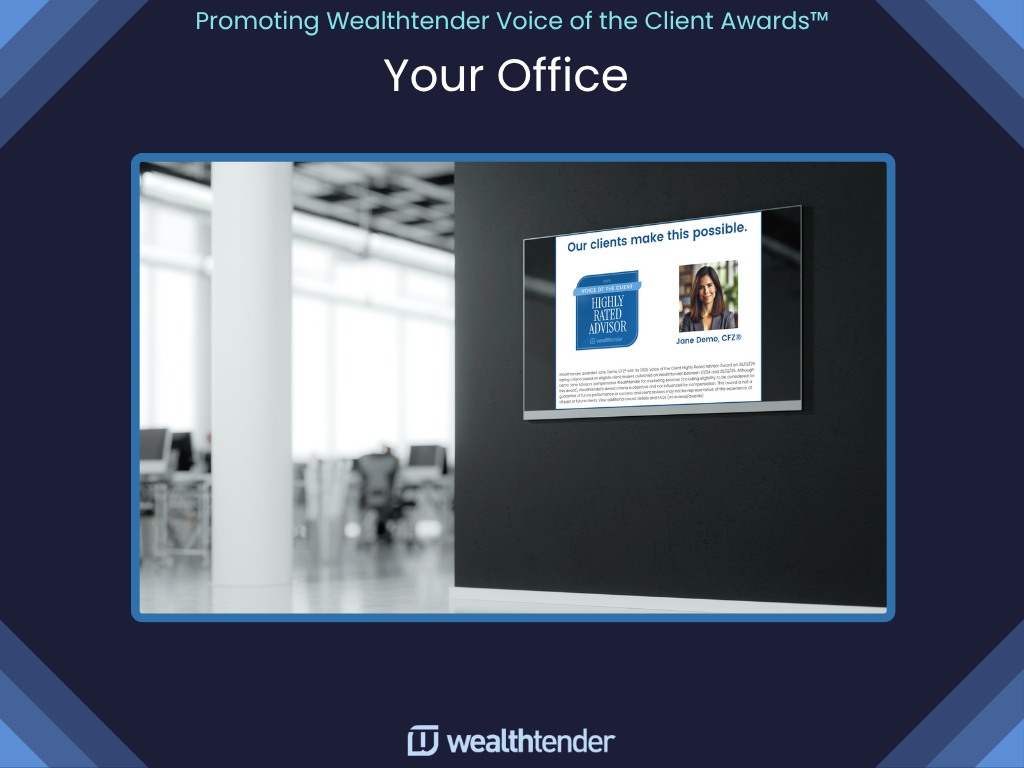
12. Display Your Award in Your Office
While much of the client decision-making process today may be based on what they find online, in-person interactions remain extremely important, especially for financial advisors, where trust, credibility, and personal relationships are paramount. Displaying your Wealthtender Voice of the Client Award in your office offers a simple, powerful, and highly visible way to reinforce your commitment to client satisfaction the moment someone walks through your door.
➡️ Why This Is Important:
Creates Instant Credibility: When prospects or clients visit your office, visible third-party awards immediately signal that others trust and endorse your services. This can set a positive tone for meetings and strengthen their perception of your professionalism.
A Subtle Trust Cue: Awards displayed on your office wall, reception area television monitor, and/or meeting rooms communicate success without you needing to actively promote yourself. The visual presence speaks for itself.
Enhances Client Pride and Loyalty: Existing clients who contributed reviews leading to your recognition may feel a sense of pride when they see the award displayed. This reinforces loyalty and their positive feelings about working with you.
Impresses Referral Partners & Centers of Influence: Professionals who refer clients to you (CPAs, attorneys, estate planners, etc.) may feel even more confident recommending you when they see your award recognition prominently displayed.
➡️ How to Implement:
Framed Certificate or Plaque: Professionally print and frame the Wealthtender award logo in a design that includes the required disclosures, then place it in a prominent location, such as your reception area or conference room.
Award Wall or Display Case: If you have multiple designations, certifications, and awards, create an “awards wall” where your Wealthtender recognition takes its rightful place alongside your other credentials.
Reception Desk Display: Use a small plaque or tabletop stand displaying the award near your reception area where it’s easily visible to anyone checking in.
By showcasing your Wealthtender Voice of the Client Award in your physical (and virtual) office environment, you’re providing a subtle but highly effective visual trust signal that reinforces your client-first commitment with every interaction.
13. Celebrate Your Award as a Team
While the Wealthtender Voice of the Client Award celebrates consistently positive client feedback, it’s also a reflection of your entire team’s commitment to delivering exceptional service. Taking the time to celebrate your award internally fosters a strong team culture, reinforces shared values, and empowers every staff member to take pride in the client experience they help create on a daily basis.
➡️ Why This Is Important:
Boosts Team Morale: Recognition is motivating. Publicly celebrating your team’s role in earning the award helps everyone feel valued and appreciated for their contribution to client satisfaction.
Strengthens Client Service Culture: Acknowledging that client feedback drives recognition reinforces your firm’s focus on delivering outstanding client experiences every day.
Inspires Future Performance: Celebrations tied to client-centered achievements help maintain high service standards and motivate your team to continue striving for excellence.
Builds Internal Brand Pride: When your team takes pride in the firm’s achievements, they become even stronger ambassadors of your brand, which shows in client interactions and future referrals.
➡️ How to Implement:
Team Meeting: Host a special team meeting to announce and celebrate receiving the Wealthtender Voice of the Client Award. Use this opportunity to share some of the actual client feedback/reviews that contributed to the recognition and spotlight the individuals who played a role in the client experiences.
Internal Recognition: Consider small awards, certificates, or personalized thank-you notes recognizing individual team members for their role in achieving client satisfaction that resulted in the recognition from Wealthtender.
Celebrate with Clients: Invite clients to join in your celebration by sharing the award announcement via email, social media, or as part of a client appreciation event.
Reinforce Shared Values: Use the award celebration to revisit your firm’s service standards, mission, and commitment to client care, connecting your day-to-day work with meaningful client outcomes.
Document the Celebration: Capture photos or video clips of your internal celebration to share on social media, demonstrating your team’s pride and culture of service (while also reinforcing your award messaging externally).
By celebrating your Wealthtender Voice of the Client Award as a team achievement, you strengthen the culture that made it possible and ensure that every team member feels personally invested in maintaining the client experience that sets your firm apart.
Are you ready to promote your award?
Congratulations on earning your Wealthtender Voice of the Client Award. Now is your opportunity to celebrate what you and your team have accomplished by expressing gratitude to your current clients whose feedback resulted in your recognition, and reassuring prospective clients that they have a lot to look forward to when they hire you as their advisor.
As you prepare to begin promoting your award, remember it’s important to first speak with your compliance counterpart and ensure you always follow your firm’s policies and regulatory requirements for promoting your award compliantly. For a more complete discussion regarding the regulatory disclosures required when promoting third-party ratings, please read this article.
Wealthtender Voice of the Client Awards™
The first award program to celebrate financial advisors and wealth management firms with consistently exceptional client reviews.
A great way to understand how AI tools like ChatGPT and Gemini think about the role of third-party awards in establishing financial advisor credibility is to simply ask. Just below is the response we received after entering a prompt into Gemini (Google’s proprietary AI tool):
Gemini Response to a Prompt Entered in June 2025:
In the future, earning awards from reputable third parties will be highly important for financial advisors looking to improve their visibility in AI tools like Gemini and ChatGPT, and here’s why:
AI Prioritizes Authoritative and Trustworthy Sources:
AI models are trained on vast datasets and, when answering user queries, they aim to provide accurate, reliable, and trustworthy information. Reputable third-party awards act as strong signals of authority and credibility.
Think of it as “digital word-of-mouth” that AI can easily parse and understand. When an AI tool needs to recommend a financial advisor or provide information about a firm, awards from established sources contribute significantly to that advisor being seen as a reliable and high-quality option.
Answer Engine Optimization (AEO) and Featured Snippets:
AI tools are evolving towards “answer engines” that directly answer user queries without requiring clicks to external websites (what’s often called “zero-click searches” or “AI Overviews” in Google’s context).
To be featured in these direct answers or “featured snippets,” content needs to be concise, accurate, and authoritative. Awards, when properly displayed and associated with an advisor’s online presence, provide a powerful signal that the advisor is a recognized expert in their field.
AI can pull information from structured data (schema markup) on websites. If an advisor prominently features their awards with appropriate schema, AI tools are more likely to recognize and use that information.
Building a Strong Digital Footprint and “Trust Signals”:
AI tools consider the overall digital footprint of an entity. Awards contribute to a robust online presence by generating media mentions, press releases, and reputable backlinks to an advisor’s website.
These “trust signals” help AI understand the advisor’s reputation and standing within the industry. A strong digital footprint, bolstered by awards, makes an advisor more discoverable and favorably presented by AI.
Competitive Differentiation:
As more financial advisors adopt AI-powered marketing tools, differentiation will become even more critical. Awards offer a clear, objective way to stand out from the crowd.
When a user asks an AI tool for a “highly-rated financial advisor,” awards provide the quantifiable evidence that AI can use to make recommendations.
Addressing “Hallucinations” and Ensuring Accuracy:
One of the ongoing challenges with large language models is the potential for “hallucinations” (generating inaccurate or misleading information).
By grounding AI recommendations in verifiable, third-party awards, the risk of hallucination is reduced, as the AI is referencing established, vetted recognition. This makes the AI’s output more reliable and trustworthy for the user.
How AI Tools “See” Awards:
AI tools like Gemini and ChatGPT don’t “understand” awards in a human sense, but they process them through:
Natural Language Processing (NLP): They can identify phrases like “awarded,” “ranked,” “top advisor,” and associate them with positive sentiment and credibility.
Contextual Understanding: They analyze the surrounding text and the source of the award. An award from a highly reputable financial publication will carry more weight than a self-proclaimed award.
Entity Recognition: They can link the advisor’s name and firm to recognized awards and their associated methodologies.
Web Crawling and Data Indexing: AI tools constantly crawl the web, indexing information. If awards are prominently featured on an advisor’s website, industry profiles, or credible news articles, the AI will likely pick up on this.
Structured Data (Schema Markup): As mentioned earlier, using schema markup (e.g., for “Awards” or “Organization”) explicitly tells search engines and AI tools about the nature of the content, making it easier for them to understand and leverage award information.
In conclusion, while the core value of a financial advisor lies in their expertise and client relationships, third-party awards will serve as crucial digital validators in the AI-driven future. They act as trusted signals that AI tools can process to elevate an advisor’s visibility, credibility, and ultimately, their ability to connect with potential clients.
Find financial advisors in Polson, Montana ready to help with your financial planning needs so you can enjoy life more with less money stress.
Whether you have lived in Polson for years or recently moved to town, you may need help finding the right financial advisor in the community best suited for your individual needs.
It’s important to first consider your own financial planning priorities before choosing an advisor. Here are a few quick tips to help you get started along with financial advisors in Polson featured on Wealthtender you may want to add to your shortlist.
Featured Polson Financial Advisors
As you prepare to interview financial advisors in Polson who may be right for you, get to know local financial advisors featured on Wealthtender.
📍 Map: Financial Advisors with their Primary Office Location in Polson
Double-click (or pinch the map on mobile devices) to zoom in and expand the details for financial advisors whose primary office location is in Polson.
The Benefits of Hiring a Financial Advisor in Polson
Hiring a financial advisor can be a great move to help you build a long-term investing strategy. Advisors can help you build an investment portfolio to meet your financial goals and help you plan appropriately for retirement.
As a resident living in Polson, hiring a financial advisor who lives nearby and understands the local economy, cost of living, and regional employers can be quite valuable, especially if your individual circumstances are deeply tied to such factors.
Do you work for one of the largest employers in Polson? If so, there’s a good chance the local financial advisor you hire will also have other clients who work there. This knowledge could prove valuable if they are already familiar with your employee benefits, such as a 401(k) plan, Health Savings Accounts, and other components of your total compensation package.
When you reach out to financial advisors you’re considering hiring, let them know where you work and ask if they are familiar with your employer’s unique benefits and compensation structure.
Quick Tips For Hiring an Polson Financial Advisor
Before hiring a financial advisor in Polson, here are a few quick tips to help you find the best advisor for you.
1. Decide Which Services You Need
Before hiring an advisor, determine what services you need from them. Whether it’s full-service investment management or a plan focused on a specific area of your finances, put together a list of what you’d like help with before contacting an advisor.
Though most people use a financial planner simply to invest for retirement, this is only a small part of what many advisors offer. Here’s a quick rundown of potential services a financial advisor may offer you:
Budgeting and money management
Debt management
Insurance planning
Retirement planning
Other investment planning
Inheritance planning
Estate planning
Tax planning
As you can see, financial advisors can help you with your entire financial picture, not just investing. As you start to plan for life’s bigger milestones, you should consider finding a financial advisor that specializes in those areas.
Finding the right advisor can help you minimize risk, maximize gains and take advantage of tax breaks while investing for your future. They can also help you protect your assets with the right kinds of insurance and help you pass on your financial legacy with a proper estate plan.
2. Consider Your Budget and Payment Preferences
Once you have a list of services you would like, review the fee structures financial advisors offer. Finding a balance between the services you need and the cost of those services will help narrow down the field of advisors you may want to work with.
If you are looking for a full-service advisor to manage all of your investments, consider searching among fee-based financial advisors. If you want to manage your money yourself, consider the flat fee and monthly subscription advisors for ongoing support.
3. Interview Multiple Financial Advisors
Once you have chosen the services and fee structure you prefer, it’s time to contact a few advisors and interview them. Here are questions to ask financial advisors:
What services do you provide?
What are all the ways you get paid? (fee transparency)
What is your investment strategy?
How do you measure investment performance?
How do we communicate about my plan?
Interview multiple advisors to get a feel for who you want to work with. A combination of fees, services, and customer service will help you determine the best fit for your financial advice.
4. Review Financial Advisor Credentials
Once you find an advisor (or two) you feel comfortable with, it’s always a good practice to check their credentials and the firm’s details. You can do this at the Investment Adviser Public Disclosure (IAPD) website.
You can check both the individual and the firm to view their background and experience details, as well as any disciplinary action taken against them or their firm.
As licensed financial professionals, there is oversight into how financial advisors conduct business, so running a quick (free) check on them is recommended.
For additional information about advisor credentials, read our article to learn the most popular designations held by financial advisors, as well as specialized credentials which may be important to consider if you have unique financial planning needs.
Frequently Asked Questions & Additional Resources
How do I know if I’m ready to hire a financial advisor?
You should strongly consider hiring a financial advisor if you have a significant amount of money available for saving or investing. This could occur after years of making annual contributions to a retirement plan like a 401(k) through your employer or suddenly if you receive a large inheritance or sell your house for a large profit.
But even if you don’t have a lot of money saved, many financial advisors and planners provide reasonable pricing options and valuable services you should consider, especially if you’re facing a significant life event. For example, if you’re starting a new job, getting married, starting a family, getting divorced, lost your job, starting or selling a business, or approaching retirement age, working with a trusted financial advisor or planner may prove worthwhile.
Before I hire a new financial advisor, should I fire my current advisor?
You don’t need to fire your current advisor before beginning your search for a new financial advisor. In fact, your new advisor can help coordinate the transition of your assets from your previous financial advisor.
Where can I read reviews about financial advisors written by their clients to help me decide if I should hire them?
After 60 years of regulatory prohibition of financial advisor reviews in the US, a rule issued by the Securities and Exchange Commission (SEC) became effective on May 4, 2021 that means both financial advisors and directory websites that help consumers search for a financial advisor can collect and display financial advisor reviews, an important factor worth considering when choosing who you’ll hire to manage your investments and life savings.
Wealthtender is the first independent advisor review platform designed to be fully compliant with the new SEC rule, and we look forward to helping you evaluate financial advisors based on reviews written by their clients.
I’m a local financial advisor interested in being featured in this guide. How do I get started?
Thanks for your interest. We look forward to learning more about your practice and helping you attract your ideal clients where you may be a good fit based on their individual needs and circumstances. Please click here to learn how you can join local financial advisors featured on Wealthtender.
Brian is CEO and founder of Wealthtender and Editor-in-Chief. He and his wife live in Austin, Texas. With over 25 years in the financial services industry, Brian is applying his experience and passion at Wealthtender to help more people enjoy life with less money stress. Learn More about Brian
Eric Kuby, Chief Investment Officer of North Star Investment Management | Image Credit: Institute for Innovation Development
[With over two decades of underperformance to their larger brethren, small-cap and micro-cap stocks are due for a deep dive review and reappraisal. This divergent performance has created significant relative valuation benefits and has opened up some compelling investment bargains in the small-cap stock universe. This may be a good time to rethink your overall portfolio asset allocation strategy.
To explore these markets more deeply, we were introduced to Eric Kuby Chief Investment Officer of North Star Investment Management – a Chicago-based investment and financial planning firm with family office services. While many money managers have focused their investment analysis on the larger complexities of the market and large-cap stocks, North Star built an expertise on applying a value lens to the intricacies of the small and micro-cap markets and developing non-traditional small-cap investment strategies.
Besides just having traditional exposure to the small-cap market, North Star seemed to keep finding other opportunities in that area of the market. Their small-cap North Star mutual fund investment line-up includes their Small-Cap Value Fund, Micro-Cap Fund, a small-cap focused Dividend Fund, and a Bond fund focusing on fixed-income investments primarily from small-cap companies with an equity capitalization of less than $2.5 billion. This specialized knowledge has also helped them shape their overall “micro to macro” investment approach in their more broad-based Opportunity Fund and separate account investment strategies.
We asked Eric questions to better understand their unique perspective on micro- and small-cap companies and how that informs their overall investment strategies.]
Hortz: Can you give us a brief overview of the micro-cap and small-cap marketplace from your vantage point? Are there any particular misconceptions about these markets that you feel investors should be aware of?
Kuby: The micro- and small-cap landscape remains some of the most overlooked but opportunity-rich areas of the public equity landscape. These companies operate across every industry, from logistics to specialty manufacturing to household name consumer brands. The universe of publicly traded small- and micro-cap companies is far larger than that of mid and large caps, yet most investors focus exclusively on those larger companies, particularly the mega cap darlings such as the “Magnificent 7”.
A common misconception is that small-caps are inherently more fragile or financially stretched. In reality, many small-cap companies we research have strong balance sheets with appropriate debt levels and disciplined capital allocation. Another myth is that small-caps operate only in obscure markets. Companies like Boot Barn (BOOT) and Build-A-Bear Workshop (BBW), or ABM Industries (ABM), are nationally recognized; others like Barrett Business Services (BBSI) and LSI Industries (LYTS) operate in large, growing markets that provide long runways for expansion.
Hortz: Can you share with us what led you to spend decades analyzing companies and developing investment strategies in these markets? What are the overriding benefits you see that focused you into the small- and micro-cap markets?
Kuby: My interest in investing started early. A close friend, mentor, and high-school basketball teammate first sparked my curiosity about the stock market – and specifically about small-cap investing. He was fixated on opportunities that exist in the less followed corners of the market.
A few years later when I was a student at business school, Rolf Banz of the University of Chicago published research pointing to a so-called “size effect.” The research showed that smaller-capitalization stocks in the US tended to have higher returns than larger-capitalization names. Additionally, my career progressed during the Warren Buffett and Benjamin Graham era, when value investing and bottom-up fundamental research were at the forefront of investment thinking. All those factors together shaped the framework for me as a small cap value investor. It has been four decades now, and whereas the methodology has evolved, the core principles remain the same.
Small- and micro-cap investing rewards hands-on research and allows you to develop a true informational edge. These companies often fly under the radar with little or zero Wall Street analyst coverage, yet many fit our framework of purchasing durable businesses with strong balance sheets, capable leadership, attractive long-term growth prospects, and reasonable valuations.
Our research team embodies somewhat of an entrepreneurial spirit. We build relationships with the management teams, ask detailed questions, and pursue ongoing conversations that inform our portfolio management process. With literally thousands of companies to evaluate, we are always learning something new anchored by our repeatable framework.
Hortz: How do you apply your value investing approach to these markets? Is there a meaningful differential in selecting companies in the micro-cap versus small-cap universe?
Kuby: The core principles do not change. We focus on quality companies with strong balance sheets, consistent and transparent cash flow, seasoned leadership, and attractive valuations. What does differ is the size of the universe and some level of inefficiency.
Particularly in the micro-cap space, inefficiencies abound. Information can be scarce, but this creates an opportunity for those willing to do the work. We require greater discounts to our expected values for the micro caps to compensate for the illiquidity challenges.
Hortz:Has the growth of private equity affected the dynamics of the micro- and small-cap investment markets?
Kuby: Private Equity has certainly changed the landscape. There is more competition for choice businesses, which has pushed buyout multiples higher in certain sectors (like services, technology, and healthcare), where recurring revenues, scalable platforms, and strong customer retention attract aggressive bidding.
Many small-caps grow through bolt-on or tuck-in M&A, targeting smaller private businesses to expand. PE buyers force higher deal multiples, but we remain confident in our portfolio companies’ long-term ability to identify accretive deals and practically deploy capital.
At the same time, many of our holdings have directly benefitted from strategic partnerships or joint ventures with private equity sponsors. We have seen this many times even in the last 6-12 months with companies like GATX and AZZ engaging in transactions that help fuel growth in creative ways.
Another important dynamic is that being a public company carries meaningful regulatory and financial costs. For many companies – especially in lower middle markets – reporting tasks, compliance requirements, and short-term performance pressures of public markets can be a strain. As a result, some companies choose simply to remain private, which has also contributed to the shrinking number of listed micro- and small-cap companies over time.
Hortz: What was it about the dividends and fixed-income instruments of small-cap stocks that made you integrate a large proportion of small-cap companies into your Dividend and Bond strategies?
Kuby: Many investors do not realize how many small-cap companies pay meaningful, sustainable dividends. When the Fed took interest rates down to near zero percent in response to the 2008 Financial Crisis, yield-oriented investors flocked to the large cap “Dividend Aristocrats” as an alternative to bonds.
We did a comprehensive study and identified a universe of small-cap dividend payers that offer attractive yields, strong free cash flow, and controlled payouts. It turns out that there are far more companies with market caps under $2.5 billion with those characteristics than those with larger market caps. From that universe we created the North Star Dividend Fund.
Beyond common dividends, many of our holdings are sophisticated users of the capital markets. We often see them issue attractive preferred shares, high-grade corporate bonds, or other hybrid securities. In essence, there are several ways investors can participate in high-quality small-cap businesses while diversifying income streams. This depth of capital market activity often goes underappreciated in the small-cap space, but it provides a valuable layer for income-oriented investors which we look to capitalize on in our North Star Bond Fund.
Hortz: Any companies you can discuss as good representative type of companies you look for in micro versus small cap markets?
Kuby: Here’ a few examples:
Acme United (ACU) is a great example, and one of our longest held positions (we have owned it since 2013). Acme operates in niche consumer and industrial markets with highly defendable positions, particularly in first aid, cutting tools (most notably the Westcott scissor brand), and other school/office supplies. The business itself is highly resilient, with over 100 years of operating history and steadily growing both organically and via tuck-in acquisitions, deepening relationships with major distributors and retailers and building market leadership in the first-aid space. They have introduced service elements of their business model through technology that automatically restocks first aid supplies for business customers, adding recurring revenue and customer stickiness.
Valuation remains attractive – shares trade at roughly 15x normalized earnings and 8x EV/EBITDA. Free cash flow is stable and has consistently funded acquisitions. Walter Johnson, the long-time CEO, owns 8% of the company. What has kept us invested for over a decade is consistency: simple business models, excellent stewardship of capital, diversified end markets, and a well-positioned balance sheet.
Westwood Holdings Group (WHG) is another micro-cap name we know particularly well because its core business model closely resembles our own business at North Star. WHG is a boutique asset manager with growing wealth management and institutional franchises with no debt and roughly $45 million in net cash.
Importantly, the business is inflecting positively across multiple fronts: 1) They successfully launched several alternative energy investment products, gaining strong traction with institutions and RIAs; 2), client retention is at an all-time high; and 3) the new account pipeline is robust with significant onboard activity underway.
Valuation is attractive as the stock trades at less than 0.7x AUM, 1.3x book value, and 10x free cash flow with insider ownership of 28%, including 5% personally held by the CEO. This provides strong alignment.
Postal Realty Trust (PSTL) is a small-cap REIT that exclusively owns and manages U.S. Postal Service-leased properties – a highly unique asset class. They own 1,720 properties with only one vacancy currently. The core attraction is the extremely stable tenant profile – the USPS operates strategic mission-critical facilities that are essential to maintaining nationwide logistics infrastructure. Lease payments represent less than 1.5% of the total USPS budget, a fact management consistently highlights when discussing potential policy risk under new administrations and why USPS facility leases are not likely to be meaningfully impacted by political changes.
In terms of growth, PSTL operates in a highly-fragmented market, creating a long runway for continued acquisitions while maintaining a low-leverage, predictable cash flow profile with newer and transitioning lease agreements being written with annual rent escalators, steadily improving embedded rent growth across the portfolio.
Financially, the balance sheet is in excellent shape with no maturities until 2027 and the average cost of debt being approximately 4.5%. The ~6.5% dividend yield is well-covered by AFFO, providing a stable and growing income stream for shareholders.
Cantaloupe Inc (CTLP) is a small-cap name where our thesis recently played out. CTLP provides payment processing software and hardware solutions for the unattended retail market (vending machines, kiosks, micro markets, etc.) where cashless adoption continues to expand. As part of a deliberate effort to add more technology exposure to our small-cap strategies, we added CTLP.
In February, reports emerged that Cantaloupe was exploring strategic alternatives which ultimately culminated in the agreement to be purchased by 365 Retail Markets for $11.20/share, almost a 34% premium to its trading price at the announcement. The takeout reflects the value of CTLP’s SaaS-like recurring revenue model, technology leadership, and growing leadership across multiple verticals.
Hortz: Does your expertise in the micro and small cap markets inform or provide a relative perspective that supports and benefits your overall “micro to macro” investment approach?
Kuby: We believe the deep research we do at the company level often gives us early insight into wider market themes. While many “all-cap” strategies technically include small caps, in practice, they tend to gravitate and weight analysis towards the more liquid, well-known names. Because we are willing to do the work, we often see emerging trends before they show up in the broader indices.
Hortz: Any thoughts or perspectives that you can share with investors about investing in the microcap and small cap markets at this juncture?
Kuby: We think this is a compelling time to allocate to small- and micro-caps. Balance sheets are strong, business fundamentals remain healthy, and we could be entering a period of moderating interest rates.
Historically, small caps have often outperformed coming out of periods of tighter monetary policy, particularly when investors begin looking for growth outside of the mega-cap FAANG trade or COW trade. For long-term investors willing to be selective, there are plenty of high-quality small-cap companies trading at compelling valuations today.
Bill Hortz is an independent business consultant and Founder/Dean of the Institute for Innovation Development- a financial services business innovation platform and network. With over 30 years of experience in the financial services industry including expertise in sales/marketing/branding of asset management firms, as well as, creatively restructuring and developing internal/external sales and strategic account departments for 5 major financial firms, including OppenheimerFunds, Neuberger&Berman and Templeton Funds Distributors. His wide ranging experiences have led Bill to a strong belief, passion and advocation for strategic thinking, innovation creation and strategic account management as the nexus of business skills needed to address a business environment challenged by an accelerating rate of change.
For business owners, effective tax management and strategic financial planning are essential to building and preserving wealth. While tax preparation ensures compliance, tax planning positions you for future success. Yet too many business owners have these managed by different professionals who are not strategically aligned. When you have an experienced advisor who has owned businesses and understands that tax preparation and tax planning go hand-in-hand, only then can you optimize your goals.
Tax Prep vs. Tax Planning
Tax prep (i.e. preparing to file taxes)is largely historical – it involves gathering documents, organizing deductions, estimating quarterly tax payments and filing returns to satisfy IRS requirements. It’s essential, but it is only one piece of the puzzle.
Tax planning, on the other hand, is proactive and forward-looking. It focuses on making strategic decisions throughout the year – such as entity selection (LLC, S-Corp, etc.), compensation structure, retirement plan contributions, and income deferral tactics. Smart tax planning allows you to align your financial strategy with your broader business and life goals.
As a CPA colleague once told me, “CPAs look to the past, while Tax Planners look toward the future.” The most effective strategy comes from integrating both perspectives – working with someone who can prepare your taxes and help you chart a long-term financial path.
Why Business Owners Need a Holistic Tax Strategy
Owning a business adds layers of complexity to your financial life. You’re not just filing a tax return – you are managing business deductions, payroll taxes, depreciation schedules, and more. That’s why working with an experienced advisor who understands business ownership and the impact of taxes is crucial.
I’ve personally owned multiple businesses and advised many successful entrepreneurs. I understand how difficult it can be to balance short-term operational needs with long-term wealth-building strategies. My approach helps ensure that you’re not overpaying taxes while also building a plan for financial freedom – whether that means retirement, reinvestment, or a business exit.
Exit Planning: The Overlooked Key to Long-Term Wealth
Far too often, business owners wait too long to think about how they’ll eventually exit their business. Whether you’re considering selling to a private equity firm, transitioning ownership to family, or structuring an internal succession, exit planning should start years in advance.
Why? Because maximizing the value of your business – and minimizing the taxes you’ll pay on a sale – requires careful planning. There are countless strategies to enhance enterprise value, optimize your tax position, and ensure a smooth transition for both your team and your customers.
Some common strategies include:
Establishing the right business structure well in advance of sale
Creating compensation models that reward key employees and retain talent
Utilizing tax-advantaged vehicles for wealth transfer or charitable giving
Coordinating with estate planning to protect heirs and reduce tax exposure
Integrating exit planning with tax strategy ensures that when the time comes to sell, you’re positioned to capture the full value of what you’ve built.
Work with a Partner Who Understands the Full Picture
When tax preparation, tax planning, and exit strategy are aligned, business owners gain clarity, control, and confidence in their financial future. Having a trusted wealth advisor and financial planner who understands the nuances of entrepreneurship can make all the difference.
This article reflects the insights and opinions of its author and is not a recommendation or endorsement of their views or services.
About the Author
John Foligno, CMC®Providing tax-efficient financial counsel to professionals and business owners.
Most of us crave increased financial security, while also failing to get any lasting happiness from it when it happens. The momentary joy of a pay increase, windfall, or even a big lottery win can often be surprisingly short-lived.
Scientists and wellbeing experts often explain this with the concept of hedonic adaptation, also sometimes known as the hedonic treadmill, which suggests that when either positive or negative life events happen, we adapt to our new reality, and return — often pretty quickly — to whatever our baseline of happiness was.
There’s an argument that hedonic adaptation is necessary for our wellbeing. It’s how we get over negative life events and manage to thrive again. It’s what people are essentially referring to when they say that ‘time heals.’ Over time we adapt to a negative event and create a new normal where we’re not sad all the time, even though the results of the event are still present in our lives.
What’s interesting though, is that we generally seem to adapt much more quickly and completely to positive events. In other words when something good happens our happiness is much more transitory than our sadness when something bad happens — which can really get in the way of achieving lasting happiness.
This is particularly relevant with monetary gains. The joy of a small windfall, raise, or bonus at work is soon over, and in the case of a raise we’ll often immediately let a little lifestyle inflation eat it up. But there are a few things we can do, to get off the hedonic treadmill.
Spend Your Money on What Actually Makes You Happy
This is harder than we realize, because our brains are surprisingly bad at predicting what will make us happy. But we can try. Studies show that for many of us experiences make us happier than other purchases, so consider spending that bonus on doing something amazing to make memories with those you love.
Remember too that science has actually put a price on happiness, to a certain extent. This study shows for example that outsourcing a chore you hate (that may only cost, say, $200 or less each month), can be worth up to $18,000 in true increased happiness levels. So it could well be worth using that sudden windfall or raise for that.
Control Lifestyle Inflation
One of the simplest ways to feel the benefit of a pay raise is to pretend you didn’t get it. That is, continue living as before and save the extra money each month into a completely separate account.
That way you can avoid immediate lifestyle inflation, and use that money (eventually) on something that’s really important to you, whether that’s a family vacation, a dream wedding or a house deposit, rather than extra small things on a daily basis that will have no impact on baseline happiness.
Practice Intentional Gratitude
This is one of the oldest pieces of advice around when it comes to happiness, and it’s backed by science.
Cultivating a sense of gratitude has been linked to increased happiness and life satisfaction, and focusing on gratitude for something very specific, like a pay raise, can mean it takes you longer to adapt to it and take the extra money for granted.
Focus on Inherent Preferences Rather Than Learned Preferences
There’s evidence that things we value inherently make us happier than things we’ve learned to value due to societal norms. So going for a daily swim (if we truly love being in the water) will make us happier than buying a designer purse (assuming we don’t have any inherent connection to the purse but rather value it because we’ve learned to put a value on it).
This ties into the ‘happiness per dollar’ concept discussed in The Simple Path To Wealth. The amount of happiness we get in return for each dollar spent depends entirely on our personal preferences. Spending a lot of money on things we don’t value, even if the rest of society does, rarely brings true happiness, unless of course our personality is such that the main thing that brings us happiness is the approval of society.
There’s no magic trick to cheat hedonic adaptation in every area of life and find everlasting happiness, but try out these strategies and see if you can try and step off the hedonic treadmill when it comes to money, if nothing else.
About the Author
Karen Banes is a freelance writer specializing in entrepreneurship, parenting and lifestyle. She writes articles, website content, ebooks and the occasional award winning short story. Her work has appeared in a range of publications both online and off, including The Washington Post, Life Info Magazine, Transitions Abroad, Brave New Traveler, Natural Parenting Group, and Copia Magazine.
Learn More About Karen
If you’re on a tight budget but still crave an overseas vacation, pick your destination carefully. International flights don’t tend to come cheap (though there are ways to make them affordable) but once in your destination, you can potentially stretch your US dollars a lot further than you can at home.
Consider these vacation spots if you’re looking for big adventures on limited vacation savings.
Asia
Asian countries like Thailand, Indonesia, and Vietnam have long been a popular choice for pretty much all Westerners, offering culture, beaches, delicious food, and a lot of bang for your (US) buck.
You can still get a decent meal in Bangkok, Bali or Hanoi for less than $10, especially if you like to eat like the locals rather than hitting all the tourist spots. Accommodation is these areas can be very affordable too, with AirBnB rooms available in places like Chang Mai in Thailand and Ubud in Bali for $20 a night.
What may surprise you however is that some travel experts are suggesting now might be a good time for US visitors to visit more expensive Asian destinations too. Japan, for example, is known for being expensive, but right now the US dollar is relatively strong against the Yen, meaning you’ll find your dollars go a lot further than they once did.
Europe
Cities like Paris and Rome are full of American tourists and you won’t find many bargains, but there are still some European destinations where travel is a lot cheaper. Consider less popular destinations like Croatia. It’s one of the countries that’s only recently adopted the Euro (in 2023) and as is usually the case, while the country is still transitioning to its new currency you’ll find it’s very affordable.
Turkey is another European destination worth considering, not least because the US dollar’s value against the Turkish lira has more than quintupled in the last five years, meaning your dollar will go five times further.
Other options for travellers who want an unusual European country on their ‘travelled-to’ list include Slovenia, Lithuania or Latvia. All are much cheaper than more popular European destinations.
South America
With South America the trick, again, is to avoid the most popular destinations and seek out more budget friendly towns or resorts that still cater to tourists, but with a lower price tag.
A week in Rio de Janeiro during Carnival might cost a small fortune, but countries like Peru and Argentina still have a lot to offer for a much lower price, especially in popular but affordable destinations like Pucón and Valparaíso in Chile or Cusco in Peru.
South American currencies can be quite volatile against the US dollar so bear this in mind, and consider buying the currency in advance if it weakens against the dollar and you’re definitely planning a trip to a specific destination.
More Tips for Making Those Dollars Go further
Keep an eye on currency fluctuations when you have a destination in mind, or track the value of the dollar against all other currencies at a site like this one.
Stay up to date on world news. There are always countries on the ‘not safe to travel’ list for American citizens, and this can change quickly, especially in the current volatile political climate. Never travel anywhere against US Department of State Travel Advisories.
Invest in reputable travel insurance in case things do change at the last moment and prevent you from traveling.
Use our favorite travel hacks to make travel anywhere in the world less expensive, and potentially more enjoyable.
Do your research and know what you want to do before you hit your destination, and then weigh up the pros and cons of booking online in advance or paying when you get there in local currency (either one can be the cheapest option).
In an uncertain economy, international travel might seem out of reach for many. But currency volatility can actually work in your favor if you really want to travel outside of the US right now. Just think ahead and plan carefully to make the most of it.
About the Author
Karen Banes is a freelance writer specializing in entrepreneurship, parenting and lifestyle. She writes articles, website content, ebooks and the occasional award winning short story. Her work has appeared in a range of publications both online and off, including The Washington Post, Life Info Magazine, Transitions Abroad, Brave New Traveler, Natural Parenting Group, and Copia Magazine.
Learn More About Karen
Ask an Advisor: Is there a better way to invest in digital assets than just HODLing, and how can tactical asset allocation help me manage risk while still capturing the upside?
Image Credit: Wealthtender.
Beyond HODL: Why Tactical Asset Allocation Is the Smarter Way to Invest in Digital Assets
The digital asset world is full of bold promises and passionate believers. Nowhere is this more evident than in the HODL (hold on for dear life) mentality, a near-religious conviction that your chosen coin will always bounce back no matter how wild the ride. HODL is like a wedding vow: “for better or worse, until death do us part.” For some, that unwavering faith is empowering. For astute risk managers, this appears like foolish optimism based on previous investment battle scars or general skepticism in the hot new thing.
But what if you believe in or are curious about the future of digital assets, yet have no interest in taking a buy-and-hope approach? What if you want to capture the upside but are not willing to risk everything on blind faith? How do you balance adopting a new technology or emerging trend without the real risk of catastrophic losses?
HODL: Faith or Folly?
HODLing requires absolute confidence that your digital asset will always recover. It’s an all-or-nothing approach that exposes you to gut-wrenching volatility and the possibility of holding a losing asset for years. This “till death do us part” mentality can lead to sleepless nights and missed opportunities. There’s a better path if you’re not a true believer or simply want a smarter way to manage risk.
“Good investing is not a matter of buying good things but of buying things well.” — Howard Marks, Oaktree Capital
Tactical Asset Allocation: Investing with Conviction and Discipline
Tactical Asset Allocation (TAA) offers a way to participate in the digital asset revolution without the emotional rollercoaster of HODLing. TAA is a dynamic, rules-based approach that adjusts your exposure based on market trends and momentum. Instead of holding an asset through every storm, you own it when the trend is strong and step aside when it’s not.
Key Advantages of TAA for Digital Asset Investors
Risk Management with Upside Potential: TAA strategies like channel breakout and momentum models have delivered returns comparable to buy-and-hold, but with significantly less volatility and smaller drawdowns. You get exposure to the upside, but with a safety net.
Statistically Favorable Exposure: Rather than relying on hope, TAA uses data to determine when it’s statistically advantageous to be invested. You’re in the market when the odds are in your favor, and out when they’re not.
Freedom from FOMO and Regret: Following a disciplined, repeatable process, you avoid the emotional pitfalls of chasing rallies or panic selling during crashes.
Real World Results: The Power of Tactical Models
Research and real-world results back up the case for TAA:
Momentum Models Work: Channel breakout systems and momentum-based strategies have been successful for over a century in traditional markets and have translated well to digital assets like Bitcoin and blockchain ETFs.
Synergy Through Diversification: Combining tactical models for Bitcoin, Ethereum, and blockchain technology stocks creates a synergistic effect, resulting in higher returns, lower drawdowns, and steadier performance. Gary Antonacci of OptimalMomentum.com is one of the industry leaders who brings attention to these opportunities.
Risk Management Built In: Tactical models can move to traditional stocks, bonds, or cash when trends weaken, providing a built-in defense mechanism that pure HODL can’t match. The best strategies allow you to sit in other assets when the digital asset trend is weak, so you’re not stuck in cash for long periods.
Balancing Optimism and Prudence
You don’t have to be a zealot to benefit from digital assets. TAA lets you invest optimistically, participating in the upside when trends are strong while maintaining prudence through risk management and diversification. You can believe in the future of blockchain and crypto without betting everything on a single coin or enduring every crash.
Conclusion: Invest Smarter, Not Harder
When investing in an unknowable future, the digital asset landscape is too dynamic and risky for blind faith alone. Tactical Asset Allocation offers a smarter, risk-managed approach that allows you to capture much of the upside when trends are strong and step aside when they’re not. It’s the best of both worlds’ exposure to innovation, with risk management built in.
If you want to invest in digital assets without the stress of “till death do us part,” consider replacing HODL with a tactical, data-driven strategy. You’ll sleep better at night and still have the chance to reap the rewards of this transformative asset class.
Have a Question to Ask a Financial Advisor?
When you’re uncertain about money matters, submit your question to Wealthtender, and it may be answered by a financial advisor in an upcoming article or in the Wealthtender Expert Answers Forum.
Need personalized help? Visit wealthtender.com to find the right financial advisor for your unique needs.
This article was originally published on Wealthtender and is intended for informational purposes only and should not be considered financial advice. You should consult a financial professional before making any major financial decisions. Wealthtender earns money from financial professionals, which creates a conflict of interest when these professionals are featured in articles over others. Read the Wealthtender editorial policy and terms of service to learn more. Wealthtender is not a client of these financial services providers.
About the Author
Nate Byers, CPA/PFSHelping families navigate the retirement transition
Areas of Focus
Estate PlanningInvestment ManagementRetirement PlanningRetiring Early (F.I.R.E)Tax-Smart Distribution Planning