Find financial advisors in College Station, Texas ready to help with your financial planning needs so you can enjoy life more with less money stress.
Whether you have lived in College Station for years or recently moved to town, you may need help finding the right financial advisor in the community best suited for your individual needs.
It’s important to first consider your own financial planning priorities before choosing an advisor. Here are a few quick tips to help you get started along with financial advisors in College Station featured on Wealthtender you may want to add to your shortlist.
Featured College Station Financial Advisors
As you prepare to interview financial advisors in College Station who may be right for you, get to know local financial advisors featured on Wealthtender.
📍 Advisors Who Serve Clients in College Station
These advisors can meet with you in person in College Station.
The Benefits of Hiring a Financial Advisor in College Station
Hiring a financial advisor can be a great move to help you build a long-term investing strategy. Advisors can help you build an investment portfolio to meet your financial goals and help you plan appropriately for retirement.
As a resident living in College Station, hiring a financial advisor who lives nearby and understands the local economy, cost of living, and regional employers can be quite valuable, especially if your individual circumstances are deeply tied to such factors.
Do you work for one of the largest employers in College Station? If so, there’s a good chance the local financial advisor you hire will also have other clients who work there. This knowledge could prove valuable if they are already familiar with your employee benefits, such as a 401(k) plan, Health Savings Accounts, and other components of your total compensation package.
When you reach out to financial advisors you’re considering hiring, let them know where you work and ask if they are familiar with your employer’s unique benefits and compensation structure.
Quick Tips For Hiring an College Station Financial Advisor
Before hiring a financial advisor in College Station, here are a few quick tips to help you find the best advisor for you.
1. Decide Which Services You Need
Before hiring an advisor, determine what services you need from them. Whether it’s full-service investment management or a plan focused on a specific area of your finances, put together a list of what you’d like help with before contacting an advisor.
Though most people use a financial planner simply to invest for retirement, this is only a small part of what many advisors offer. Here’s a quick rundown of potential services a financial advisor may offer you:
Budgeting and money management
Debt management
Insurance planning
Retirement planning
Other investment planning
Inheritance planning
Estate planning
Tax planning
As you can see, financial advisors can help you with your entire financial picture, not just investing. As you start to plan for life’s bigger milestones, you should consider finding a financial advisor that specializes in those areas.
Finding the right advisor can help you minimize risk, maximize gains and take advantage of tax breaks while investing for your future. They can also help you protect your assets with the right kinds of insurance and help you pass on your financial legacy with a proper estate plan.
2. Consider Your Budget and Payment Preferences
Once you have a list of services you would like, review the fee structures financial advisors offer. Finding a balance between the services you need and the cost of those services will help narrow down the field of advisors you may want to work with.
If you are looking for a full-service advisor to manage all of your investments, consider searching among fee-based financial advisors. If you want to manage your money yourself, consider the flat fee and monthly subscription advisors for ongoing support.
3. Interview Multiple Financial Advisors
Once you have chosen the services and fee structure you prefer, it’s time to contact a few advisors and interview them. Here are questions to ask financial advisors:
What services do you provide?
What are all the ways you get paid? (fee transparency)
What is your investment strategy?
How do you measure investment performance?
How do we communicate about my plan?
Interview multiple advisors to get a feel for who you want to work with. A combination of fees, services, and customer service will help you determine the best fit for your financial advice.
4. Review Financial Advisor Credentials
Once you find an advisor (or two) you feel comfortable with, it’s always a good practice to check their credentials and the firm’s details. You can do this at the Investment Adviser Public Disclosure (IAPD) website.
You can check both the individual and the firm to view their background and experience details, as well as any disciplinary action taken against them or their firm.
As licensed financial professionals, there is oversight into how financial advisors conduct business, so running a quick (free) check on them is recommended.
For additional information about advisor credentials, read our article to learn the most popular designations held by financial advisors, as well as specialized credentials which may be important to consider if you have unique financial planning needs.
Frequently Asked Questions & Additional Resources
How do I know if I’m ready to hire a financial advisor?
You should strongly consider hiring a financial advisor if you have a significant amount of money available for saving or investing. This could occur after years of making annual contributions to a retirement plan like a 401(k) through your employer or suddenly if you receive a large inheritance or sell your house for a large profit.
But even if you don’t have a lot of money saved, many financial advisors and planners provide reasonable pricing options and valuable services you should consider, especially if you’re facing a significant life event. For example, if you’re starting a new job, getting married, starting a family, getting divorced, lost your job, starting or selling a business, or approaching retirement age, working with a trusted financial advisor or planner may prove worthwhile.
Before I hire a new financial advisor, should I fire my current advisor?
You don’t need to fire your current advisor before beginning your search for a new financial advisor. In fact, your new advisor can help coordinate the transition of your assets from your previous financial advisor.
Where can I read reviews about financial advisors written by their clients to help me decide if I should hire them?
After 60 years of regulatory prohibition of financial advisor reviews in the US, a rule issued by the Securities and Exchange Commission (SEC) became effective on May 4, 2021 that means both financial advisors and directory websites that help consumers search for a financial advisor can collect and display financial advisor reviews, an important factor worth considering when choosing who you’ll hire to manage your investments and life savings.
Wealthtender is the first independent advisor review platform designed to be fully compliant with the new SEC rule, and we look forward to helping you evaluate financial advisors based on reviews written by their clients.
I’m a local financial advisor interested in being featured in this guide. How do I get started?
Thanks for your interest. We look forward to learning more about your practice and helping you attract your ideal clients where you may be a good fit based on their individual needs and circumstances. Please click here to learn how you can join local financial advisors featured on Wealthtender.
Brian is CEO and founder of Wealthtender and Editor-in-Chief. He and his wife live in Austin, Texas. With over 25 years in the financial services industry, Brian is applying his experience and passion at Wealthtender to help more people enjoy life with less money stress. Learn More about Brian
[The creation rate of ETFs has demonstrated great industry and investor interest signaling rapidly expanding growth and innovation. The U.S. has led this accelerating charge with 746 new ETFs launches in 2024 and 481 launches in the first half of 2025.
Fueling this growing movement has been new ETF participation from active investment managers, alternatives going mainstream, advisors running model portfolios, and family offices. Also adding to the rising momentum is a more modernized turnkey process into this marketplace through time- and cost-efficient platform launch capabilities that help new ETF sponsors gain entry with a speed-to-market approach.
To better understand the mechanics of ETF creation and how you can launch your own ETF, we were introduced to J. Garrett Stevens, Chief Executive Officer of Exchange Traded Concepts – an SEC registered investment adviser that created the first white-label ETF firm in the world specializing in helping new ETF sponsors create, launch, and manage custom ETF vehicles as a turnkey solution.
We asked him questions to learn more about his ETF-IN-A-BOXTM launch solution and how financial firms can participate strategically in the continued growth and diversification of the ETF marketplace.]
Hortz: What motivated you back in 2011, in the still early days of ETFs, to launch the first white-label ETF platform?
Stevens: My motivation for launching a white-label ETF platform came from my personal experience launching my own family of ETFs. We made our initial filings in 2008, and what we learned was that it took twice as long and cost twice as much as it was supposed to in getting those first ETFs to market. That process was extremely painful. We put all the infrastructure in place – built our own trust, our own board of directors/trustees, engaged all the service providers, and paid lawyers nearly a million dollars just to get all the legal filings done.
The pivotal moment was when we were closing three of our ultimately unsuccessful ETFs, I actually got several phone calls from people saying, ‘Hey, we want to buy you. We just want to take advantage of the SEC exemptive relief application process and your place in line. You already have the infrastructure fully built out. We want to launch our own ETFs, but we do not want to wait a year.'”
That is really where the white label idea came to me. Since we already had everybody and everything structurally in place, why don’t we help other people launch their funds? So, we essentially turned our ETF experience into a service business that can help other ETF sponsors avoid the painful, expensive, and time-consuming process we have experienced and be able to leverage the infrastructure we already had built to create a more efficient path to market for new ETF issuers.
Hortz: Can you review what are the major component functions behind creating and launching an ETF that new sponsors need to plan for?
Stevens: The major ETF component functions of launching an ETF include:
Legal and Regulatory – you need attorneys doing filings for the ETFs, the ongoing reporting, and compliance.
Board of Trustees – you are required under the 40 Act to have an independent board of trustees.
Trading and Portfolio Management – the infrastructure and team of traders and portfolio managers that will actually do all of the trading in the funds.
Regulatory Requirements – you have to have a liquidity risk management program, and if you have derivatives, you have to have a derivative risk management program. Everything has to be filed with FINRA. Your distributor has to review it and approve it before you can use it.
Custom Basket Process – the custom basket process makes ETFs tax efficient. Most firms have no idea how to do that process.
Marketing and Distribution Considerations – once you get into the 40 Act world, it is a whole other can of worms from a regulatory perspective and what you can and cannot say. Distribution is a complex process that a lot of people do not fully understand or get confused with what strategy to pursue.
Many firms underestimate the complexity of these components, particularly the custom basket process and regulatory requirements unique to ETFs.
Hortz: How and to what extent does a turnkey platform approach ring out time and expenses from launching an ETF?
Stevens: The main benefit of a turnkey approach is offering an already pre-built comprehensive ETF infrastructure where the organizational work is all done, essentially eliminating the lengthy setup process required when starting from scratch. This results in game-changing, dramatically faster launch timelines.
To illustrate this, when you come to launch an ETF on our platform, we can draft your prospectus in about two weeks, and get it filed with the SEC, which has a 75-day review period. That means we can have you ready to go in 90 to 100 days to full launch of your ETF. If you do that on your own, it is going to take six months to a year to get all that done.
As to cost savings, a platform can leverage and negotiate wide-spread cost reductions through its economies of scale representing its collective client base. In our case, we have over 110 ETFs that we advise or sub-advise right now that represents about $15.5 billion in Assets Under Management (UAM). So, we get favorable pricing from the various service providers, much less than if individual ETF sponsors negotiated on their own. We are also able to spread costs across all funds which means our clients are paying a fraction of the organizational costs, instead of all of them.
Also, having an experienced independent board made up of a wide range of ETF professionals with specialized knowledge that understand ETFs, how they work, and the lay of the land of ETF vendors and needed specialty services, is another key factor in reducing costs, accelerating speed to market, and delivering expertise and quality to the platform and our ETF sponsor clients. It is not that easy to find board members who have been in the ETF world for a long time.
For all the reasons mentioned above, that is why a turnkey approach provides such significant value.
Hortz: Besides creating & launching an ETF product, can you explain your ongoing portfolio management services?
Stevens: We decided to offer ongoing ETF portfolio management services since we saw that many traditional investment firms lack the experience and expertise with ETF-specific investment processes, like custom baskets, which are critical for maintaining tax efficiency.
We can also act in a sub-advisory role, we have a trading desk with a team of traders and portfolio managers that can do all of the trading in the funds for our clients, we can do the custom basket process, as well as index tracking, rebalances, security selection support, and tax efficiency management.
Hortz: What are some of the major misconceptions or inaccurate assumptions that some investment/asset managers have about launching ETFs that they should be aware of?
Stevens: There seems to be a persistent series of key misconceptions that investment and asset managers have about launching ETFs that relate to the regulatory environment, marketing limitations, and the reality of building a successful ETF in today’s crowded marketplace. These include:
“If You Build It, They Will Come”Mentality – One of the biggest misconceptions out there is that there is a ready market waiting to take advantage of your ETF investment opportunity. We have to remind people all the time that this is not that kind of an industry or marketplace like the early ETF days. We now have over 4,500 ETFs out there and we are in the midst of an ETF explosion of new launches.
Launch Day is Just the Beginning – With all the work that goes into launching the ETF, many get excited on that first trade date and look at that as the finish line, but they need to realize that is only the starting line…. That is when the hard work really begins.
Distribution and Marketing Challenges – The hard work of sales, marketing, and distribution of ETFs has its own dynamics and challenges that a lot of sponsors new to this marketplace do not fully understand or get confused about.
Wirehouse Approval Process – For new ETF sponsors, you should not count on the big wirehouses as a key part of your initial strategy as they have high asset minimums and track record requirements before they will even start the due diligence. They are likely not going to approve your ETF for years.
Because of these continuing misconceptions and others, we set up ETC Marketing Services to offer personalized marketing and distribution services to help more strategically raise the profile, visibility, and engagement for your ETF products.
Hortz: What are the most meaningful ETF trends you have been seeing from your vantage point?
Stevens: I think the major shift that has happened is from ETF Index Funds to Custom ETF Strategies to mirror existing active strategies. When we first got into this business, it was mostly index funds. They proliferated around new indices and ideas for a theme, whether it was on trends, robotics, country/regional/industry focuses, you name it, there was and continues to be endless variations being created.
The current propulsion of new ETF creation is being driven to some extent by active investment managers creating tax efficient versions of their existing strategies offering clients the option of putting their taxable money in the ETF and the non-taxable money in the SMA account. Advisors running model portfolios are also creating ETF versions because anytime they make portfolio changes in their model, currently they are creating taxable events, and it does not generate any, or at least minimal capital gains in the ETF investment vehicle.
New market participants we see increasingly launching ETFs are family offices and hedge funds. The latter because of their frustrations in not being able to market their hedge funds due to sophisticated investor rules. They are realizing they can do their active strategy or a light version strategy in an ETF.
An interesting trend I am seeing emerge is a new focus on client-specific ETF products rather than the mass market. If you can get $30-$40 million in an ETF, it is breakeven, covering its own expenses, and so then you can build and offer the ETF vehicle specifically for your clients. I think you are going to continue to see this trend expand of advisors building custom ETF products just for their client base or demographic.
Bill Hortz is an independent business consultant and Founder/Dean of the Institute for Innovation Development- a financial services business innovation platform and network. With over 30 years of experience in the financial services industry including expertise in sales/marketing/branding of asset management firms, as well as, creatively restructuring and developing internal/external sales and strategic account departments for 5 major financial firms, including OppenheimerFunds, Neuberger&Berman and Templeton Funds Distributors. His wide ranging experiences have led Bill to a strong belief, passion and advocation for strategic thinking, innovation creation and strategic account management as the nexus of business skills needed to address a business environment challenged by an accelerating rate of change.
Most wealthy Americans work with a financial advisor. In fact, over 76% of people with at least $500,000 in investable assets report working with one. Advisors focus on planning strategies to achieve their long-term financial goals, from legacy and succession planning to philanthropy, allowing high-net-worth individuals to focus on their family, career, and enjoying life while delegating wealth management to professionals.
Have you ever thought about hiring a financial advisor? According to a 2025 Wealthtender study of 500 U.S. adults with household incomes over $100,000, it’s clear that many Americans believe that hiring a financial advisor is a smart move to achieve their long-term goals and aspirations for a comfortable retirement.
If you have a significant net worth, you’ve almost certainly received solicitations from financial advisors looking to sell you their services. I typically receive such letters, often inviting my wife and me to a free dinner at a nearby Ruth’s Chris Steak House. Should we go, we’d doubtless have to sit through a long presentation trying to convince us to hire them.
But should we?
What Is a Financial Advisor?
Before we continue, let’s start by defining “Financial advisor”. “Financial advisor” is a very broad term.
I looked through a (fairly random) list of about 170 financial advisors and found 40 titles (some pros listed multiple titles).
Just for grins, here they all are (feel free to jump past the whole list!)
Accredited Asset Management Specialist (AAMS)
Accredited Financial Counselor (AFC®)
Accredited Investment Fiduciary(AIF®)
Accredited Investment Fiduciary Analyst (AIFA®)
Accredited Wealth Management Advisor (AWMA®)
Behavioral Financial Advisor (BFA®)
Certified Digital Asset Advisor (CDAA®)
Certified Divorce Financial Analyst (CDFA®)
Certified Elder Law Attorney (CELA®)
Certified Exit Planning Advisor (CEPA®)
Certified Financial Education Instructor (CFEI®)
Certified Financial Planner (CFP®)
Certified Financial Therapist (CFT-I®)
Certified Investment Management Analyst (CIMA®)
Certified Kingdom Advisor (CKA®)
Certified Private Wealth Advisor (CPWA®)
Certified Public Accountant (CPA)
Certified Retirement Counselor(CRC®)
Certified Student Loan Professional (CSLP®)
Certified Wealth Strategist (CWS®)
Chartered Alternative Investment Analyst (CAIA®)
Chartered Financial Analyst (CFA®)
Chartered Financial Consultant (ChFC®)
Chartered Life Underwriter (CLU®)
Chartered Retirement Planning Counselor (CRPC®)
Chartered SRI Counselor (CSRIC®, where SRI is sustainable, responsible, and impact investing)
Enrolled Agent (EA)
Financial Solutions Advisor (FSA®)
Master of Business Administration (MBA)
Master of Science in Financial Planning (MSFP®)
Master of Science in Personal Financial Planning (MSPFP®)
Master of Science in Taxation (MST®)
Master Planner Advanced Studies (MSAPTM)
Military Qualified Financial Planner (MQFP®)
Personal Financial Specialist (PFS®)
Registered Financial Consultant (RFC®)
Registered Investment Advisor (RIA®)
Registered Life Planner (RLP®)
Retirement Income Certified Professional (RICP®)
Wealth Management Certified Professional (WMCP®)
Each of these implies a different education, training, and/or focus.
Some are academic degrees, while others are professional certifications.
Some take years to acquire, while others can be attained through short programs.
Some get paid by the hour, others by the type of service, and yet others by commissions and/or assets-under-management fees. Some even charge a combination of the above.
Some require the professional to be a fiduciary – putting their client’s best interest ahead of their own, while others don’t (though this doesn’t preclude them from acting with professional integrity).
Image Credit: Depositphotos.
What Do Financial Advisors Do for You?
In the broadest terms, a financial advisor will help you manage some, most, and potentially all aspects of your money. Some examples include:
A recent survey conducted online by Logica Research for First Citizens Bank asked 1000 Americans with at least $500k investable assets (putting them in the 79thnet worth percentile or higher) various questions, including several about working with financial advisors.
Of the 1000 surveyed, 764 (over 76 percent) said they worked with a financial advisor.
The answer is thus “Yes” much more often than “No.”
Of those 764, 89 percent believe their advisor helped them grow their wealth faster than they would have on their own.
Only three percent disagreed with that (the rest had no opinion).
In my case, the answer is also yes, because I work with an accountant.
What Are the Biggest Benefits of Working with an Advisor?
Asking the 764 who work with advisors what were the biggest benefits they derived, they answered:
Feeling better prepared for the future (66 percent)
Reducing stress (58 percent)
Saving time (45 percent)
Allowing them to focus on the important things in their life (43 percent)
Having a plan for passing on wealth to heirs (29 percent)
Not worrying about what happens when they die (15 percent)
Not worrying about taxes (12 percent)
Of all these, if I ever hire a CFP, for example, feeling better prepared would rank highest for me, followed by not worrying about taxes.
I’m too much of a detail-oriented-to the-nth-degree control freak to ever feel less stress or not worry if I handed our investment management and other financial planning matters to someone else.
I’d likely duplicate their work and if my conclusions were different from theirs, they’d better have a pretty darn compelling case!
What’s the Most Important Criterion When Picking an Advisor?
All 1000 were asked what they thought would be the most important thing to consider when choosing an advisor. Their answers were:
Reputation (52 percent)
Credentials/Certifications (48 percent)
Fee structure (47 percent)
Transparency (43 percent)
Recommended by trusted people (33 percent)
Confidentiality (25 percent)
Personability (24 percent)
Philosophical alignment (19 percent)
Why They Hired an Advisor
Those 764 who work with an advisor stated several reasons that led them to hire their advisor:
Growing wealth (41 percent)
Preparing for retirement (23 percent)
Creating a financial plan (23 percent)
Managing taxes (6 percent)
Building an inheritance (6 percent)
Personally, I’d rank them differently: transparency in the top slot, philosophical alignment, personability, reputation (especially among people I know who have similar financial circumstances), confidentiality, credentials, and fee structure.
When Did They Hire Their Advisor?
Those who work with an advisor first hired their advisor when they were, on average, 37 years old. There was some differentiation between generations – the 251 Millennials averaged age 29, the 208 Gen-Xers averaged age 36, and the 158 Boomers averaged age 43.
All 1000 were then asked what age they thought would be best to start working with an advisor. The most common answer was “Any age” at 38 percent. Another 32 percent recommend ages 26 to 40. The age range up to 25 was suggested by 26 percent. The remaining four percent thought the proper time would be at age 41 or older.
The overall average recommended age was 30.
Looking From the Other Side
I thought it would be interesting to see this from the perspective of financial advisors.
So, I asked them.
The following are my questions and answers from several financial advisors.
Q1. In your experience, why do the wealthy use financial advisors?
Answers:
Chris Wilbratte, Echelon Financial responds, “The wealthy use financial advisors because they focus on their area of genius and delegate wealth management to advisors who are subject matter experts in their field. The wealthy want to be good stewards of their money. They often don’t have the time to focus on the markets and managing their money, so they hire advisors to ensure their money grows and is protected.”
Vincent D’Eletto, COO at Investment Insight Wealth Management points out, “Affluent Americans do use financial advisors, but their approach is often distinct from those who are still working toward financial independence. While many may seek advice on investments and retirement planning, affluent individuals tend to focus on more complex goals. These include philanthropy, managing multi-generational wealth, establishing succession plans, and fulfilling altruistic aims. For them, it’s not just about growing their assets but ensuring that their wealth aligns with their values and legacy for future generations. They seek a broader, more strategic approach that covers a wide range of financial and personal objectives.”
He continues with an example, “We’re currently working with a long-term affluent client who has already achieved financial independence. At this stage, the focus has shifted from traditional wealth building to establishing a philanthropic foundation that his family can oversee for generations. What’s particularly interesting is that he wants to remain actively involved in the investment decisions for the fund, so we’re creating a structure that allows him to guide the investment strategy while maintaining the foundation’s long-term objectives. This type of goal reflects how affluent clients often prioritize legacy planning and the integration of personal values into their financial strategies.”
Ray Prospero, Partner Advisor, AdvicePeriod agrees, “I’ve found that affluent investors choose to use a financial advisor because they tend to lead busy lives and prefer to delegate their financial management to a professional. By doing this, they are free to focus on their other priorities such as their career, family, and hobbies. Additionally, depending on the complexity of their finances, they can use the specialized expertise of their advisor to address areas such as tax planning and estate planning.”
Chris Magaña, Strategic Advisor & Principal, IMS Capital Management shares an interesting experience, “Our clients are incredibly sharp; they hire us because they know their time is better spent elsewhere, like growing their business, spending time with family, or diving into their passions. Lately, though, we’ve been attracting a different breed: business owners by day and hedge fund managers by night (or so I suspect). Their financial IQs are off the charts, and they genuinely enjoy digging into market details and Roth conversions. At first, I felt a little insecure; I didn’t believe our value proposition was strong enough for these clients, so I asked. Their responses surprised me. They said, ‘Sure, I love this stuff, but I won’t be around forever. What I need is peace of mind, knowing there’s a team I trust implicitly once I am gone.’ These folks know something about the meaning of true wealth, building a legacy with people you trust.”
Q2. What services do advisors offer beyond those listed above?
Answers:
Carman Kubanda, CFP®, ChFC®, Financial Planner at Innovative Wealth Building mentions one such service, “Good advisors are now incorporating tax planning into their routine services. Tax considerations are broad, and include, e.g., tax-loss harvesting strategies, Roth conversions, and even ‘I’m buying a new car what account should I pull from?’”
Jen Swindler, CFP®, CDFA®, AFC®, Owner & Advisor at Money Illustrated elaborates, “When doing consultation calls with prospects, I often tell people that hiring an advisor is not a net-worth-driven decision, but more of a feeling. For example, you may have reached a point where you don’t feel like you can manage their finances fully on your own due to lack of sufficient time, interest, or knowledge; they have an awareness of their gaps in knowledge and feel they’re missing financial opportunities; you feel a sense of financial overwhelm and don’t know where to start. Because so many advisors today offer planning options where an asset minimum isn’t required, it’s become much more approachable to the mass affluent. If you’re experiencing financial overwhelm, searching for an advisor who offers what you need at a price you can afford is much more doable.”
She then lists several lower-cost or free options, “Many people assume that financial advisors are primarily for asset management, but today, many advisors offer behavioral coaching, budgeting, debt management planning, student loan analysis, and advising while you’re building wealth. If you’re in a situation where you’re struggling to pay bills, are taking on debt to make ends meet, and can’t afford a financial advisor’s fees, an AFC®, qualified financial coach, or free counseling center would likely be better options. Looking for an AFC® through a program like AFCPE is a great place to start.”
Stephan Shipe, Ph.D., CFA, CFP®, CEO, Financial Advisor, Scholar Financial Advising says, “Tax strategy and efficiency are important considerations for wealthy clients. Many wealthy clients require advice on non-financial market assets such as real estate, alternative investments, or closely held businesses. Legacy goals also include the advisor helping prepare family members for inherited wealth.”
Q3. What is the profile of the ideal client for an advisor?
Answers:
Kubanda says, “An ideal client would be responsive and willing to listen to the advice they’re given.”
Omen Quelvog, MQFP®, Financial Advisor with Clear Insight Wealth Management offers an interesting take on this, saying, “The classic answer to matching an ideal client to an advisor is, ‘It depends.’ That’s the beauty of the financial advising profession. As a client with a need, their ideal advisor is often related to the client’s profession or background. Whether a doctor, military veteran, business owner, farmer, etc., each profession has nuanced benefits an advisor would be expected to know to be deemed competent and trusted. The most advantageous service offered that is difficult to articulate in any marketing campaign, is the intangible benefits of an unemotional third party assessing your overall financial health. With that assessment comes the provision of permission, assurance, and comfort, knowing you have a trusted resource in your corner.”
Lawrence D. Sprung, CFP®, Founder, Wealth Advisor at Mitlin Financial shares his take, “When starting with a financial advisor the fit should be high on your list. If there’s no fit, there’s no relationship. What I mean by this is that you want to be sure the challenges and goals you are looking to work through with the advisor are things they have experience helping other families work through too. If the advisor has little or no experience in the areas where you want help, that advisor will not be a good fit. Our firm will not move forward with a family unless we feel confident that we can assist them through the opportunities and challenges they face. This allows us to build long-term meaningful relationships with the family and ensure we do not create a situation where we over-promise and under-deliver. We prefer to under-promise and over-deliver.”
David Nash, CFP®, founder of Tend Wealth says, “The ideal client for a financial advisor is someone who values saving time and achieving peace of mind, particularly as their income and wealth grow. Small mistakes or missed opportunities can have compounding effects, leading to more significant issues down the road. A good advisor is patient and available to explain your options, helping you make more informed decisions about the trade-offs involved in various tax-saving and investment strategies. Even W-2 employees with high earnings can benefit from working with an advisor who applies a tax-sensitive investment approach. Effective tax planning around retirement contributions and withdrawals, spanning both their working and retirement years, can result in significant tax savings over time.”
Matthew R. Pogirski, CFP®, AAMS™, founder of Unburdened Financial Planning offers a more spiritual approach, “Our ideal client is someone who knows that peace is not found in possessions or things. Peace is found in knowing and being known. As a Christian, this starts with a relationship with Jesus, but also our relationship with ourselves and others. Our ideal client knows they are not at peace but need help in achieving peace by being known and having a plan that helps them realize who they truly are.”
Q4. Who should not hire an advisor?
Answers:
Pogirski is clear on this, “Someone who is trying to beat the market, buy a hot stock, or pursue quick gain as their goal in life is not a good fit for us as advisors.”
Nash agrees and cautions, “You shouldn’t hire an advisor if you expect them to help you get rich quickly through exclusive investments unavailable to you otherwise. Some advisors may try to promote their ‘proprietary’ approach or sell you complex investment products that often come with higher fees or commissions. It’s easy for advisors to make promises and then take unnecessary risks with your money, hoping for positive outcomes.”
Q5. What should a client expect when starting to work with an advisor?
Kubanda says, “When starting to work with an advisor, you should expect to dive into all matters financial and familial. The more information your advisor has, the better they can guide you and help you reach your goals.”
Pogirski agrees, “A new client should expect their advisor to take time, a lot of time, to get to know them. To understand who they are. This involves asking deep questions about how they feel about money.”
Nash expands, “When starting with a financial advisor, you should expect a series of meetings to review your current financial situation and explore your short-term and long-term financial goals. During this process, the advisor will gather all the necessary information to create a personalized financial roadmap that guides you from where you are to where you want to be. While the initial process might feel intense, once it’s complete, the advisor can alleviate much of the burden, offering you sound financial guidance and a clear path forward.”
Magaña gives his take, “A great advisor sets clear expectations from the jump. Their focus should be helping clients master what’s within their control, like tax efficiency, smart diversification, strategic gifting, and proper asset allocation. A great advisor shouldn’t waste time obsessing over what’s beyond your control, like short-term market wiggles, inflation spikes, or today’s panic-inducing market headlines. That’s why capitalism gave us the Wall Street Journal and the Financial Times.”
Is a Financial Advisor Right for All Wealthy Americans?
Not everyone will need a financial advisor.
If your only income is from W2 wages, your tax returns are likely so simple that preparing your returns with the help of tax prep software would be quick, easy, and just as good as what you’d get by paying a CPA much more than the cost of the software.
If your investing philosophy is that low-cost index ETFs are all you need since you don’t believe active investing can beat the market over the long haul, why would you want to pay an investment manager?
However, if your financial situation is complex, if you want to try and beat the market over years and decades (a tall order), or if you have a significant net worth and want to protect that wealth, hiring a financial advisor of one sort or another (or several different professionals) would be very helpful.
Disclaimer: This article is intended for informational purposes only, and should not be considered financial advice. You should consult a financial professional before making any major financial decisions.
About the Author
Opher Ganel, Ph.D.
My career has had many unpredictable twists and turns. A MSc in theoretical physics, PhD in experimental high-energy physics, postdoc in particle detector R&D, research position in experimental cosmic-ray physics (including a couple of visits to Antarctica), a brief stint at a small engineering services company supporting NASA, followed by starting my own small consulting practice supporting NASA projects and programs. Along the way, I started other micro businesses and helped my wife start and grow her own Marriage and Family Therapy practice. Now, I use all these experiences to also offer financial strategy services to help independent professionals achieve their personal and business finance goals. Connect with me on my own site: OpherGanel.com and/or follow my Medium publication: medium.com/financial-strategy/.
Whether you’re a foreign national living in the US with a green card or working on a non-immigrant visa (H-1B, TN, E-3, O-1, L-1, H-1B1), you have unique needs when it comes to financial planning. If you’re on a path toward US citizenship or planning to return to your home country, the financial decisions you make today can have a significant impact on your financial future.
It can feel overwhelming for immigrants to try and navigate the complexities of the US tax system, not to mention making sense of the numerous retirement and savings accounts and their potential tax benefits. Beyond taxes, understanding how to make the most of your employee benefits, saving for retirement, and funding your children’s education are additional priorities that can take a lot of time to figure out on your own.
Fortunately, there are financial advisors who have walked in your shoes and know what it’s like to arrive in the United States feeling confused and unsure about money matters. By hiring a financial advisor who specializes in working with immigrants and foreign nationals, you’ll feel more confident knowing you can ask questions and get answers that other advisors simply wouldn’t know or understand.
It’s easier today than ever before to find a specialist financial advisor dedicated to working with immigrants and foreign nationals in the US. Beyond researching financial advisors in your neighborhood, which could significantly limit your access to specialists, you may find the best financial advisor for you lives several states away and is easy to work with virtually, often via Zoom online meetings, for example.
So is a financial advisor who specializes in serving immigrants right for you?
Let’s learn more by getting answers from financial advisors featured on Wealthtender who offer their perspectives on the potential benefits of working with a specialist for immigrants.
👩💼 Get to Know Financial Advisors Who Specialize in Serving Immigrants
This page is organized into sections to help you quickly find the information you need and get answers to your questions:
Q&A with Financial Advisors Who Specialize in Serving Immigrants
Get Answers to Your Questions About Financial Planning for Immigrants
Browse Related Articles
– Financial Advisors Who Specialize in Serving Immigrants –
We asked Austin-based financial advisor Jane Mepham to answer three questions she often hears from the immigrants she serves when helping them develop a financial plan for their future.
Q: I’m currently in the US on a work visa. Why should I consider hiring a financial advisor in the US?
Jane: The US financial system is complex and can be very confusing to somebody new to the country. A good financial advisor is invaluable, as they can guide you not only in setting yourself up financially but also in helping you prioritize competing financial needs. You are going to have a lot of questions, especially in the first year: for example, setting up a budget (which might include supporting your family overseas), choosing the right kind of retirement plan (critical especially when you don’t know where you are going to retire), health, life (not every company will agree to insure you), or disability insurance. A financial advisor can easily guide you through these issues.
One of the most significant issues you are likely to face is the tax implications of being a US person, keeping in mind that the US taxes you on worldwide income and your immigration status. You’ll need to figure out if you should be filing taxes as a tax resident or non-resident.
Additionally, you may have reporting requirements if you hold overseas accounts, due to the FBAR and FATCA filing requirements. At this juncture, a financial advisor becomes critical, as they can help you figure out these issues. Picking the right advisor and working with them over a couple of years may prove to be the best decision you’ll make in your life in the US.
Here are some resources that may answer some of your questions as you begin your work visa journey in the U.S.
Q: What should I consider before participating in my US employer’s 401 (k) plan?
Jane: The 401 (k) plan is a retirement plan offered by many US employers. Every employee, including those on work visas, is eligible to participate. Different companies have different waiting periods. Here are some things to consider before participating:
Regardless of how long you intend to stay in the country (work visas are not permanent), contributing to the 401 (k) plan reduces your taxable income, meaning you get to pay lower taxes now.
Typically, we’d recommend maxing out the plan. In 2025, you can invest up to $23,500 if you are under the age of 50. Over 50, you can add $7,500 (catch-up contributions), and if between 60 and 63, your catch-up contribution is $11,250. If you’re unsure about being able to max it out, consider whether your company offers a match and plan to save up to that amount to receive the free money (employer match).
The goal is to take advantage of compound interest and keep your money in the market for an extended period.
If your company offers a Roth 401 (k), or a mega backdoor Roth IRA, tread lightly. This is because many countries do not recognize the tax-free nature of the account, and therefore, if you leave the US with the account, they may end up taxing these accounts. A good conversation to have with your advisor.
Another thing to consider are the investment options offered in the plan. If there are life-strategy or target-date funds, those are the easiest ones to start with. If the investment options are below par, again consider saving up to the employer match.
Q: If I’m planning for my children to attend college in the US, what’s the best way for me to save for their education?
Jane: Immigrants tend to value education greatly, and they are willing to do whatever it takes to help their kids attend the best schools. To accomplish this goal, start saving for college as soon as possible. There are several ways to do this, and each has its own advantages and disadvantages.
529 plan – This is a government-provided plan specific to education and, in this case, college. The money goes in after taxes, grows tax-free, and comes out tax-free if it’s used for education-related expenses.
Every state has its own plan and most of them will allow non-residents to open a plan there. There are about six states that don’t allow outsiders into their plan. In terms of location, if your state offers a tax break (deduction or tax credit), then it makes sense to consider opening a plan in that state.
Finally, please note that the beneficiary must be a citizen or a permanent resident to utilize the funds in the plan. If the intended beneficiary is not yet a citizen, you can open the account with yourself as the beneficiary and change it later to the children when they become citizens or permanent residents.
There are schools outside the US that honor the accounts, so if you end up leaving before your kids have a chance to use the funds, this is a possibility.
The latest tax bill OBBBA signed this year (2025) has expanded the list of expenses that the 529 plan can fund.
If you end up not using the money for education-related expenses, you’ll pay taxes and a 10% penalty fee on the earnings. Here is a blog post that answers a question I see come up a lot in this space about opening a 529 plan if on a work visa.
Roth IRA Account – We typically think of this as a retirement account, but it can also be used for saving for college. Your income must be below a certain threshold to open the account, but with the backdoor Roth option, the income threshold is no longer an issue. But keep in mind the issue discussed above about how your home country may treat this account if you end up leaving the US at some point.
In 2025, the max that can be put into the account is $7,000 ($8,000 if over 50). Ideally, both parents should open separate accounts. The initial contribution can be withdrawn anytime, penalty-free, for education-related expenses while allowing the earnings to continue growing for retirement. If you withdraw the earnings for college expenses, the 10% penalty does not apply; however, you will still pay taxes on that amount.
At age 59 and ½, the earnings can also be withdrawn tax-free and penalty-free to pay for college expenses.
Brokerage Account – There are no tax advantages to this account, but it gives you a lot of freedom in what you do with the money, how you invest it, etc. If the funds are held in the account for more than a year, you’ll pay capital gains taxes, which are lower than ordinary income tax. It’s the most flexible account for those who are not sure where they’ll be over the next couple of years.
In applying for college aid, the account is included as the parents’ assets.
Custodial Accounts – The two main accounts in this space are UGMA (Uniform Gift to Minors Act) and UTMA (Uniform Transfer to Minors Act). Keep in mind that even though you are the account owner, the child legally owns the money in the account. They gain control of the account when they reach the legal age as defined by the state. It’s a great way to start gifting kids’ money early on in life, but consider that at the legal age, they may choose not to use the account for college education, and there is nothing you can do about it. It’s considered a child’s asset for college funding considerations.
Coverdell Education Savings Accounts (ESA) – This account is very similar to a 529 plan, but is limited in how much you can contribute. You can save up to $2,000 per year, per beneficiary, and use it only if your income is below $110,000 ($220,000 if married).
All the above plans can be combined to create something ideal for each family, depending on their unique situation. A financial advisor can help you pick the best plan, keeping in mind your immigration status, your income, your needs, and other issues specific to your family.
Question: Besides the retirement and college funds, what else should I be thinking about as a foreign national in the US?
There are a couple of other areas you want to consider and take care of before you can sit back and relax.
Emergency Fund: Plan to have 12 months of living expenses plus the cost of a return ticket for the family. It’s even more critical for foreign nationals on work visas, where losing your job can cause you to have to leave the country in a rush.
Estate Planning: Ensure your US estate plan is complete, especially if you have young children. You can have international guardians (especially if your family is overseas), but this may be based on your state. In such cases, you may need to have local guardians. If you have assets overseas, consider a country-specific will for that country.
Along the estate planning line, if you start to accumulate wealth, and there is a possibility of leaving some of it behind, it’s crucial to plan how you are going to deal with estate taxes. Typically, if you are an NRA with US-situs assets, your estate tax exemption is a low $60,000; therefore, it is advisable to be proactive about planning for these estate taxes.
Overseas Investments: If you have overseas assets of any kind (rental, stock, etc.), they need to be reported in your US tax filing. Failure to file can result in substantial penalties, which may significantly impact your US finances. You also want to be sure about what the investments are – avoid foreign-registered funds at all cost, and they are likely to cost you a lot in taxes in the US.
Three Questions with Tamara Witham, CFA, CFP®:
Tamara Witham is a financial planner based in Harrison, New York, who specializes in serving first-generation Americans and foreign-born families. She answered three questions that she frequently tackles when meeting with her clients.
Q: What is a common financial planning challenge unique to first-generation Americans and foreign-born individuals and families that you frequently encounter when working with your clients? How do you work with them to overcome this challenge?
Tamara: First-generation Americans and foreign-born individuals are often overwhelmed by the complexities of the U.S. financial system. After helping foreign-born families for many years, we’ve learned the importance of a customized approach that respects our clients’ cultural backgrounds and values. We aim to address the confusion by explaining key terms and strategies in plain language while creating a financial plan tailored to their retirement dreams and goals.
Whether they plan to retire here or abroad, we can help them navigate investment and tax considerations to develop a strategy for building long-term savings. Suppose a client plans to retire outside of the U.S. Certain tax-advantaged retirement accounts may not provide the same advantages as if they stayed stateside. We’re here to simplify the process and help clients make informed decisions to save and prepare for the lifestyle they envision.
A concrete example is understanding and simplifying the decision to purchase insurance. Insurance needs can vary significantly between the U.S. and other countries. Adequate coverage is crucial to protecting loved ones financially. Many employers provide basic life insurance between one- and two-times base salary. In our experience, this base benefit may not be enough to adequately protect a family in the event of a premature death. Additionally, employer policies may not be portable if an employee leaves. Many families utilize private insurers to guarantee complete customizable protection. We explain options to find the right amount and type of policy based on each situation.
Navigating U.S. health insurance also poses challenges. We help compare company, private, and public exchange plans so families can obtain optimal coverage. We also explore the options of associated Health Savings Accounts (HSA) and Flexible Spending Accounts (FSA).
Disability insurance can replace income lost to injury or illness. However, supplemental policies are expensive, pricing out some families. Also, many insurers deny claims for those residing abroad, even with premiums paid, which may be necessary for someone looking to return to his or her native country in the event of a disability.
Every family has unique priorities and risk tolerance. Through discussion, we craft tailored recommendations on available coverage to suit our clients’ finances and safety needs. We aim to educate clients about offerings so they will make informed choices to safeguard their families’ financial security.
Q: How do the services you offer first-generation Americans and foreign-born individuals and families distinguish your firm from other advisory firms?
Tamara: According to research by Herbers and Company, nine in ten investors want their advisors to help with tax planning, and three-quarters want help with retirement planning services. However, few advisory firms offer both services, and even fewer do it well. GreenLife has focused on concrete solutions for our clients’ tax planning and retirement needs.
The U.S. income tax system is often more complex than many of our clients’ respective native country’s tax systems, especially concerning reporting foreign-held income. In the U.S., full income tax reporting of worldwide financial assets and income is required, meaning the IRS may tax assets held abroad. Tax residency status is not the same as immigration status. As a U.S. resident with overseas assets, several complex reporting requirements may apply, which can trigger U.S. tax residency status.
We use tax planning software to incorporate a client’s tax profile into our financial planning services. We’re excited to offer tax planning as part of our firm’s comprehensive financial planning because taxes impact virtually every aspect of one’s finances.A client’s tax return is a financial fingerprint: it’s unique for that person, complete with valuable clues and information, all buried in dozens of pages and hundreds of numbers. Understanding the return equips us to have more valuable and actionable conversations with our clients. Additionally, we demystify the world of income taxes and help clients understand this vital piece of their unique financial picture.
Tax planning includes reviewing a tax return in depth to identify potential opportunities, both now and in the future, to minimize lifetime tax liabilities. Tax planning differs from tax preparation, which may focus on compliance with current tax laws and rules.By analyzing a client’s current and prior tax returns, we can recommend steps to potentially lower the next year’s tax bill and uncover other long-term planning opportunities.
Here are some of the ways we may be able to leverage a client’s return during financial planning and investing strategies:
Tax-Efficient Portfolio Management: Being fluent in a client’s tax status informs better investment strategies, such as realizing capital gains rather than ordinary income for greater tax efficiency.
Retirement Optimization: Knowing a client’s tax details helps us determine the role of each retirement account in his or her overall financial planning strategy. Conversations often focus on Roth IRA conversions.
Tax-Sensitive Withdrawal Strategies: Taxes are one factor when withdrawing retirement funds. We can illustrate how proper tax management is critical for withdrawal decisions.
Coordination with a Client’s CPA: Understanding a client’s tax profile allows us to collaborate effectively on an integrated financial strategy with tax professionals.
Ongoing Tax Management: Tax laws change frequently. We can suggest adjustments to address new laws and regulations by reviewing returns. We can run projections to see how potential changes (e.g., filing status, dependents, the sale of a business, stock option exercises, etc.) may impact a client’s upcoming tax liability and model how potential changes may impact upcoming tax liabilities.
Q: For first-generation Americans and foreign-born individuals who are unsure whether or not they should hire a financial advisor at the current point in their lives, what guidance can you provide to help them make a more informed and educated decision?
Tamara: For first-generation Americans and foreign-born individuals who are navigating the complex financial landscape of a new country, hiring a knowledgeable financial advisor sooner rather than later can provide significant advantages. An advisor well-versed in cultural differences can offer tailored guidance aligned with each client’s values and goals, helping build a solid financial foundation through comprehensive planning for investment strategies, retirement, and risk mitigation.
Acting now is better than delaying until later if an individual has specific financial planning needs. The earlier he or she implements a plan, the more investments can potentially grow through compounding interest over time. An advisor can also identify and address risks like insufficient insurance coverage and excessive debt before these issues escalate. Setting clear financial goals from the start, whether for retirement, education funding, or a home purchase, increases one’s chances of success with a defined roadmap.
Working with an advisor can save thousands of dollars through optimized tax planning strategies and ensure a client claims eligible deductions and credits. As careers and family dynamics evolve, an advisor can help adapt a client’s plan to manage transitions like job changes, marriage, and having children – a proactive approach that protects long-term financial security.
Not all people need an ongoing relationship with a Certified Financial Planner. Some may already have a good grasp on managing finances and making decisions. While ongoing advisory services may not be necessary, everyone can benefit from at least an initial consultation. Most advisors, including our firm, offer complimentary meetings to assess if there is a good fit and explore how the advisor can provide value based on the individual’s circumstances. There is little downside to contacting an advisor for this initial consultation.
Ultimately, procrastinating on financial planning can harm those who need it. Starting sooner allows one to capitalize on wealth-building opportunities while avoiding costly mistakes. The earlier one works with an advisor, the better positioned they will be to achieve their financial objectives.
Are you a financial advisor who specializes in serving family-oriented professionals?
✅ Get added as a specialist in this area in our next monthly update (Subject to availability and qualification criteria.) ✅ Sign up today and join financial advisors attracting their ideal clients on Wealthtender ✅ Or request more information by email:
Slide Show: Financial Advisors for Immigrants & Foreign Nationals
🙋♀️ Have Questions About Financial Planning for Immigrants?
Get answers from the Wealthtender network of financial professionals and educators.
Brian and his wife live in Texas, enjoying the diversity of Houston and the vibrancy of Austin.
With over 25 years in the financial services industry, Brian is applying his experience and passion at Wealthtender to help more people enjoy life with less money stress.
Wealthtender Study of $100K+ Households Seeking Financial Advice
August 2025: A survey of 500 U.S. adults with household incomes over $100,000 reveals that most consumers will use online resources to find or compare financial advisors before making a hiring decision even after receiving a referral, and most won’t shy away from advisors using Artificial Intelligence (AI) tools.
If you’re thinking about hiring a financial advisor, you may want to know how others plan to approach the process. In late July 2025, Wealthtender surveyed 500 U.S. adults earning over $100,000 who plan to hire an advisor within the next five years to understand exactly how they intend to start their search, create a shortlist, and choose one advisor over another.
This report reveals how the advisor search is evolving, the online tools people trust most, and what clients think about advisors using AI. You’ll also find practical tips to guide your own search, so you can confidently find and hire the right advisor for your unique needs.
Five Key Takeaways:
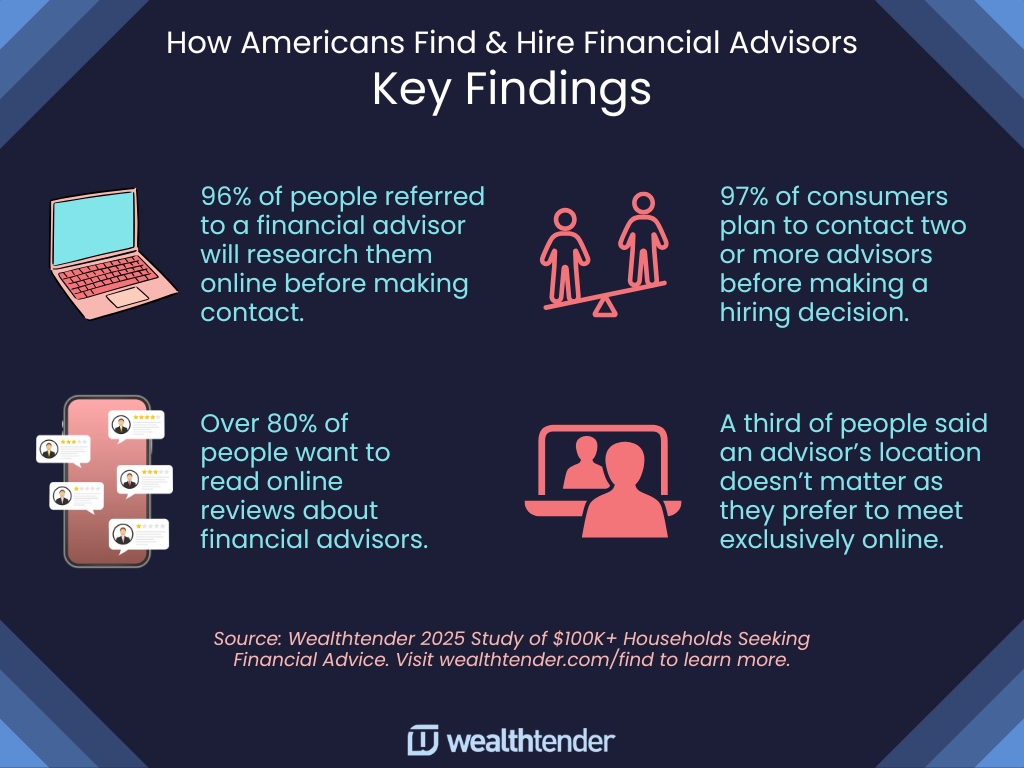
1. While many Americans start their search for a financial advisor with a referral from friends or family, almost everyone will dig deeper: 97% plan to interview multiple advisors and 96% will do further research online before making a hiring decision.
2. To decide if an advisor is the right fit, the most popular next step for 83% of respondents is to research the advisor’s reputation by looking for online reviews and awards, followed by an introductory call with the advisor (73%) and visiting the advisor’s website (72%).
3. Before contacting an advisor, survey respondents said the two most important pieces of information they want to know are the advisor’s areas of specialization (64%) and fee/pricing structure (62%).
4. Most respondents are generally comfortable with advisors using artificial intelligence (AI) tools to streamline admin tasks, somewhat comfortable with AI to help generate personalized financial plans, though uncomfortable with investment decisions outsourced to AI.
5. A third of respondents said an advisor’s location is not a factor as they prefer to meet exclusively online.
Republishing Guidelines: You are welcome to republish or reference any part of this Wealthtender study, including embedded graphics. We kindly ask that you include proper attribution to “Wealthtender 2025 Study of $100K+ Households Seeking Financial Advice” and include a link back to the full study at wealthtender.com/find.
Before we dive into the details, it’s important to note that this study intentionally excluded many respondents who work with a financial advisor today and said they are satisfied with no plans of making a change. (This finding is not a surprise as our 2025 Voice of the Client Study reflects overwhelming consumer satisfaction with advisors based on their online reviews.)
1. Where People Start Their Search for a Financial Advisor
Finding the right financial advisor can feel overwhelming, but you’re not alone in wondering where to begin. The good news? Most Americans start their search in predictable places, and you can follow a similar roadmap to find the right advisor for you, too.
In the chart below, you’ll see how people said they plan to start their search for an advisor. Survey participants were not limited to a single response since many people plan to use multiple resources to find and evaluate advisors.
Personal connections lead the way… When it’s time to find a financial advisor, 62% of people will turn to their most trusted source first: friends and family. There’s something reassuring about getting a recommendation from someone you know and trust, especially when it comes to your financial future. Nearly half (49%) will also reach out to other professionals in their network (e.g., accountants, attorneys, or their bank) recognizing that these experts often have valuable insights about reputable advisors.
… But technology is catching up fast. Online search is quickly becoming just as important as word-of-mouth recommendations. Half of all survey participants plan to use traditional search engines like Google or Bing to find potential advisors. This isnt surprising as people want to know what’s out there beyond just the one or two names of advisors they may hear recommended by family or friends.
Online directories and social media platforms gain popularity. Online advisor directories like Wealthtender will be used as a starting point by about one-third of consumers (32%), while social media platforms like LinkedIn, Reddit, and Facebook influence about 22% of people.
Many people appreciate opportunities to learn. Educational events like online webinars (19%) and in-person seminars (18%) hosted by advisors in their local communities also play a valuable role, especially for those who want to get a feel for an advisor’s expertise and communication style before arranging an introductory meeting.
Key Takeaway & Section Resources:
Most people use multiple approaches to find advisors, and you should too. Start with your personal and professional network if they have advisors to suggest, but don’t stop there. The combination of trusted recommendations and your own online research will give you the best foundation for identifying a handful of advisors you feel may be worth contacting.
🔎 Find a Financial Advisor on Wealthtender
Thousands of people visit wealthtender.com each month to find and evaluate financial advisors. When you’re ready to start your search, consider the resources below that can help you find an advisor nearby, one who specializes in areas that may be important to you, and hundreds of advisors whose clients have submitted thousands of reviews to help you make a more informed hiring decision.
Knowing that most people will use multiple approaches to find a financial advisor, it’s important to diversify your sources for client acquisition to improve your likelihood of getting found.
While referrals remain the top source for consumers to find advisors (62%), the data reveals a critical insight: the most successful firms employ a multi-channel approach. With 50% of prospects using search engines and 25% leveraging AI tools like ChatGPT, advisors who only rely on referrals are missing significant opportunities.
Immediate Action Items:
Optimize for AI Search Tools: Create content to answer common financial planning questions in formats that AI tools can easily reference (e.g., using FAQ schema). ChatGPT and Gemini often cite authoritative, well-structured content when making advisor recommendations and implementing an AEO (Answer Engine Optimization) strategy can enhance your visibility in AI search tools.
Search Engine Visibility: Invest in SEO/AEO-optimized content targeting local and niche-specific categories (e.g., “retirement planning advisor in Austin for Dell employees” or “CFP for tech executives with equity compensation”).
Social Media Strategy: With 22% of prospects using social media to start their search, develop a consistent presence on one or more platforms focusing on educational content combined with posts showcasing your client testimonials to accelerate the trust-building process with prospects.
Leverage Educational Events for Lead Generation The 19% of consumers showing up to online webinars and 18% attending in-person events represent high-intent prospects. These individuals are actively investing time to learn, indicating serious consideration of hiring an advisor.
Partner with Wealthtender for Search Optimization:
Joining Wealthtender directly addresses multiple data points from this section:
Professional Credibility: Profiles with verified client reviews enhance your digital authority, whether prospects are initiating their search online or received a personal referral and looking to validate your credibility before making contact.
32% Directory Usage: Wealthtender is visited by ~50,000 consumers each month, many of whom are actively looking for a financial advisor. As the leading find-an-advisor directory and industry’s first compliant testimonial collection platform, your profile on Wealthtender ensures you’re getting found.
Search Engine Amplification: Wealthtender profiles are optimized for SEO and AI to increase your likelihood of appearing more frequently in Google searches and in answers generated by AI tools like ChatGPT.
AI Tool Integration: Wealthtender’s structured data format (e.g., financial services schema, review schema, FAQ schema) makes advisor profiles more likely to be referenced in Google AI Overviews and AI tools like ChatGPT when prospects ask for advisor recommendations.
🤓 Dive Deeper into the Data
wdt_ID
Which resource(s) do you plan to use to find a financial advisor?
Referrals from professionals (e.g., accountant, attorney)
49.20%
14.11%
246
9
Attend an in-person event (e.g., educational seminar, lunch & learn)
17.80%
5.11%
89
10
Attend an online event (e.g., educational webinar)
19.00%
5.45%
95
11
Other
0.60%
0.17%
3
2. Almost Everyone Will Research Multiple Advisors Online Before Hiring One
Even if your best friend or next door neighbor raves about their financial advisor, you shouldn’t hire them without doing your homework first. And you’ll be in good company as 96% of people in our survey said they would still research an advisor even if that advisor came highly recommended.
Referrals Matter, But Consumers Will Still Do Their Own Homework
A related insight worth considering is that almost all survey participants plan to evaluate multiple advisors before choosing who to hire.
A referral is just the starting point, not the finish line. Your financial situation is unique, and what works for someone else might not be the best fit for you. The advisor who helped your colleague navigate a career change might specialize in something completely different from what you need.
Most people are comparison shopping, and you should too. Only 3% of survey participants said they’d hire an advisor without researching alternatives. The majority (52%) plan to contact three different advisors, while 32% will compare at least two. This approach gives you leverage to ask better questions, understand different fee structures, and ultimately feel more confident about your choice.
Over 80% of People Want to Read Online Reviews About Financial Advisors
While referrals can prove valuable, everyone’s situation is different so it’s important to do your own research to ensure you feel confident about the advisor you ultimately hire.
Online reviews are nearly as important as personal recommendations. More than eighty percent (83%) of people want to read online reviews and look for awards or other trust indicators before making their decision. This makes perfect sense as a personal recommendation is useful, but a single opinion is of limited value on its own. Consumers want to know what others have to say about an advisor to gain a more representative lens into the client experience. Reviews from actual clients can give you insights that even the best marketing materials can’t provide (e.g., how does this advisor really communicate? Do they follow through on promises? What impact do clients say the advisor has made in their lives?).
Nearly three-quarters of people want to speak with an advisor directly. After reading online reviews to learn what other people think about an advisor, consumers are ready to initiate contact with the advisor. 72% of people will visit the advisor’s website to continue their research, while a nearly identical number of people (73%) will schedule an introductory call.
Second opinions matter, too. More than half (55%) of survey participants also plan to seek second opinions from others who might know the advisors on their shortlist.
This multi-layered approach to research shows just how seriously people take this decision, which is understandable since many people will work with their advisor throughout their career and into retirement.
Key Takeaway & Section Resources:
Your financial future deserves more than a casual recommendation. Choosing the right financial advisor can help you plan for retirement, invest more intelligently, reduce money-related stress, and feel more in control of your financial life. It’s worth taking the time to research multiple options, ask thoughtful questions, and trust your instincts. The advisor who feels like the right fit (e.g., someone who listens well, explains complex topics clearly, and demonstrates they understand your goals) is worth the extra research effort.
Even referred prospects will research you online before making contact. This fundamentally changes your marketing priorities as your digital presence now influences every prospect, not just those who find you online initially.
Critical Conversion Improvements:
Review Strategy: 83% of consumers will research you reputation online, and specifically indicated they want to read online reviews. This is your highest-leverage activity for conversion improvement, especially since the 2025 Investment Adviser Industry Snapshot shows that just 9.3% of financial advisor use testimonials/reviews in their marketing activities. (Imagine operating a business in any industry where just 1 out of 10 have online reviews – Guess which ones will attract more clients? This isn’t hypothetical for financial advisors. It’s a reality that’s now steering more clients into the 10% with reviews.)
Website Optimization: 72% visit advisor websites during research. Ensure your site clearly communicates your areas of specialization, credentials, and fee structure within 10 seconds of landing.
Initial Call Preparation: 73% plan to set up introductory calls. Develop a structured consultation process that demonstrates value while gathering prospect information.
The Multiple-Advisor Reality (97% Contact 2+ Advisors)
Since prospects are comparison shopping, your competitive advantage must be immediately apparent. This isn’t about price competition, it’s about demonstrating superior value and fit. Keeping in mind that we just mentioned only 9.3% of advisors use client testimonials in their marketing, it’s easy to set yourself apart from more than 90% of advisors by collecting testimonials and publishing online reviews, increasing your likelihood of becoming a prospect’s first call. Beyond reviews, ensure your value proposition is clear, your fees are transparently shared, and areas of specialization are highlighted.
Competitive Differentiation Tactics:
Response Speed: Implement systems to respond to prospect inquiries within 4 hours.
Value-First Consultations: Provide genuine insights during initial meetings, not just sales presentations.
Specialization Clarity: Make your niche expertise obvious in all marketing materials.
Wealthtender’s Conversion Impact:
Our platform directly addresses the 96% research behavior:
Optimized Profiles: Showcase your specializations, credentials, and experience that prospects expect to find and in structured formats optimized to enhance your visibility in AI tools like ChatGPT and Google AI overviews.
Review Collection System: Take advantage of our compliant solution for gathering and displaying client reviews that 83% of prospects want to read, providing you with an opportunity to stand apart from 90% of advisors not using reviews.
Search Visibility: Gain enhanced placement in both traditional search engines and AI tool responses when prospects research advisors.
Trust Indicators: Verified credentials and regulatory information that prospects seek during evaluation, including opportunities to qualify for Wealthtender Voice of the Client Awards.
3. How People Determine an Advisor’s Reputation and Trustworthiness
When you’re evaluating potential financial advisors, certain factors consistently signal trustworthiness and competence. Understanding what matters most can help you focus your research and avoid potential red flags.
Fee transparency tops the trust list. The most important factor for building trust? Clear, upfront communication about costs. Nearly three-quarters (73%) of survey participants said transparency in fees and services is crucial for establishing an advisor’s credibility. If someone is going to help you manage your money, you need to know exactly what you’ll pay for that service. Hidden fees or vague pricing structures should immediately raise red flags.
Credentials provide objective credibility. Professional certifications like the CFP (Certified Financial Planner) or CFA (Chartered Financial Analyst) designations matter to 63% of people, and for good reason. These certifications require extensive education, rigorous testing, and ongoing professional development. They’re not just letters after a name, they represent a significant commitment to professional standards and ethical behavior.
Responsiveness indicates how you’ll be treated as a client. More than half (57%) of survey participants view quick response times to inquiries as a key trust indicator. Think about it: if an advisor takes days to return your initial call when they’re trying to win your business, what kind of attention will you receive once you’re a client?
Professional presentation matters, but it’s not everything. While 49% value a professional, user-friendly website, this factor ranks lower than substantive credentials and transparency. A sleek website is nice, but it can’t substitute for expertise and ethical behavior. Regardless, as more consumers express comfort with advisors willing to meet online and use AI tools to enhance their service offering, an outdated website could represent a potential red flag if you expect your advisor to make use of newer technologies to improve the client experience.
Reviews from real clients carry significant weight. Just over 60% of participants consider positive online reviews from independent websites like Wealthtender essential for evaluating an advisor’s reputation. Unlike testimonials on an advisor’s own website, independent reviews offer unfiltered perspectives from actual clients. They can reveal how advisors help their clients navigate challenging life transitions, communicate during stressful times, and follow through on commitments. You should also expect to see disclosures that indicate if the person who wrote each review is a client of the firm, if they were compensated to write the review, and if any conflicts exist that may have influenced the reviewer to write a more favorable testimonial. The Securities and Exchange Commission (SEC) that regulates financial advisors requires these disclosures so consumers can determine how much weight to give each review in their overall evaluation.
What about client testimonials on advisor websites? Only 36% of people consider these important for reputation assessment. This lower ranking makes sense as consumers have become accustomed to seeing just the most positive testimonials on business websites that don’t provide the balanced perspective you’d get from independent review sites. With this said, the SEC established a rule in 2021 to address this issue. Specifically, the SEC requires that advisors who choose to display only a handful of self-picked testimonials on their website also link to an online location where you can read all of their reviews (e.g., their Wealthtender profile page). Testimonials you read on an advisor’s website can be useful, but make sure to look for a link to a page where you can read a complete list of their reviews to learn what all clients have to say about their experience, not just a select few.
Key Takeaway & Section Resources:
The bottom line on trust: Focus on advisors who are transparent about their fees, hold relevant professional credentials, have positive independent reviews, and respond promptly to your inquiries. These factors consistently indicate advisors who prioritize their clients’ interests and maintain professional standards.
Beyond Consumers, Are You Trusted by AI Tools like ChatGPT?
It’s not just consumers who are evaluating your online reputation based on the factors discussed in this section. AI tools like ChatGPT also consider most of these same factors to determine if you or another advisor will appear in answers to consumer queries.
We asked ChatGPT to compare the factors it considers when evaluating an advisor’s reputation with the consumer survey responses.
ChatGPT answered by telling us the consumer survey results “actually line up quite a bit with how I (as a search and recommendation system) would weigh factors when surfacing financial advisors — but there are a few key differences in emphasis and in how those factors get evaluated” as reflected in the side-by-side table it generated below.
Factor
Importance to consumer survey respondents
Importance to ChatGPT’s ranking logic
ChatGPT notes on differences
Transparency in fees & services
#1 — 73%
Very high
I prioritize clear, verifiable disclosures because ambiguity in fees is a red flag for trustworthiness. However, I also weigh whether the source is independent or regulatory, not just the advisor’s own claims.
Certifications / credentials (CFP, CFA, etc.)
#2 — 63%
Critical
Strong alignment — credentials are objective and verifiable, so they’re a top ranking signal. I also consider recency of credentials and whether they’re in good standing.
Positive online reviews (independent sites)
#3 — 61%
Moderate-high
I value independent reviews but adjust for potential bias, fake reviews, or small sample sizes. User sentiment is a signal, but not the only one.
Response time to inquiries
#4 — 56.6%
Moderate
I can’t directly measure real-time responsiveness, but I use proxies — like whether the advisor has clear contact info, recent activity, and engagement history.
Professional, user-friendly website
#5 — 49.2%
Moderate-high
Good design signals professionalism and credibility, but I pair it with objective third-party data so I’m not just rewarding “pretty websites.”
Client testimonials on their site
#6 — 36.4%
Low-moderate
I downweight these since they’re curated by the advisor. Consumers value them more than I do.
Educational content (articles, videos)
#7 — 24.8%
High
I value this more than respondents do — consistent, quality educational output signals expertise and thought leadership.
Strong search engine visibility
#8 — 17.8%
Moderate
Visibility helps me find advisors, but it’s not a trust signal by itself — content quality matters more.
Social media presence
#9 — 13%
Low-moderate
I care less about volume of posts and more about whether content is professional, relevant, and consistent.
Featured in media / awards
#10 — 11.8%
Moderate-high
I may weigh credible third-party features more than the public does, since they can indicate peer recognition or vetted expertise.
Source: ChatGPT
Fee Transparency as Competitive Advantage (73% Priority)
Clear fee communication isn’t just ethical, it’s a powerful differentiator. Many advisors avoid discussing fees upfront, creating an opportunity for transparent advisors.
Fee Transparency Implementation:
Website Fee Pages: Create detailed, jargon-free explanations of your fee structure
First-Call Honesty: Address pricing within the first 10 minutes of initial consultations
Written Proposals: Provide clear, written fee estimates after initial meetings
Credentials and Certification Marketing (63% Value)
Professional certifications provide objective credibility, but many advisors don’t effectively communicate their value to prospects.
Credential Communication Strategy:
Education Content: Create content explaining what CFP, CFA, and other credentials actually mean for clients
Continuing Education: Publicize your ongoing professional development efforts
Specialization Certificates: Pursue and promote niche certifications relevant to your target market
Third-Party Validation: Ensure credentials are prominently featured across all marketing channels
Online Review Strategy (61% Importance)
With reviews ranking as the third most important trust factor, a systematic approach to review generation and management becomes essential.
Review Generation System:
Client Communication: Implement regular check-ins that naturally lead to review requests
Compliant Platforms: Collect reviews on sites like Wealthtender, designed for SEC/FINRA compliance and coded with schema that improves the likelihood of your reviews being indexed and cited in search engines like Google and AI tools like ChatGPT.
Success Story Documentation: Follow-up with clients whose online reviews speak to the impactful role you played helping them navigate a financial planning challenge that may resonate with others. Ask if they might consider recording a video testimonial with their review as a starting point for a script, or flesh out the review into a more robust success story to promote on your website and across social media.
Wealthtender’s Trust-Building Platform
Our platform directly supports all top trust factors, and is designed to help advisors demonstrate and convey trustworthiness with a compliance-first approach:
Search Authority: Higher search engine rankings increase perceived credibility and expertise. Your Wealthtender profile(s) are designed to rank prominently in search results and AI tools.
Transparent Profiles: Standardized format for displaying fees, services, and credentials.
Compliant Review System: Proper collection and display of client reviews following industry regulations and tools to promote testimonials compliantly.
Professional Presentation: Consistent, professional profile format that builds credibility.
🤓 Dive Deeper into the Data
wdt_ID
What do you think are important factors in a financial advisor's online reputation?
Respondents(%)
Answers(%)
Count
1
Positive online reviews on an independent website
61.00%
14.97%
305
2
Strong search engine visibility
17.80%
4.37%
89
3
A professional and user-friendly website
49.20%
12.08%
246
4
Social media presence and activity
13.00%
3.19%
65
5
Featured in media outlets / award recognition
11.80%
2.90%
59
6
Educational content (e.g., articles, videos)
24.80%
6.09%
124
7
Response time to inquiries or messages
56.60%
13.89%
283
8
Transparency in fees and services
73.00%
17.92%
365
9
Professional certifications/credentials (e.g., CFP, CFA)
63.40%
15.56%
317
10
Client testimonials on the advisor's website
36.40%
8.93%
182
11
Other
0.40%
0.10%
2
4. From Online Meetings to Artificial Intelligence: Consumer Preferences are Evolving
As consumer preferences for advisor meetings evolve and comfort levels with artificial intelligence increase, financial advisors are embracing new technologies, from video conferencing tools to the use of AI apps in certain areas of their operations.
Location flexibility is becoming the new normal. One-third of survey participants said an advisor’s physical location doesn’t matter because they prefer to meet exclusively online. This represents a fundamental change in how financial relationships can work. For many people, the ability to work with the best advisor for their needs, regardless of geography, outweighs the traditional preference for in-person meetings. Of course, many people still said they want their advisor to be local, but expressed a preference for meetings to be conducted online.
AI as a helpful assistant gets the thumbs up. The survey reveals nuanced but generally positive attitudes toward advisors using artificial intelligence tools. People are most comfortable when AI enhances human capabilities rather than replacing human judgment. For example, 77% of respondents feel comfortable (either very or somewhat) with AI monitoring their accounts for unusual activity to prevent fraud, a clear safety benefit where AI’s pattern recognition excels.
Data analysis and administrative tasks are AI-friendly zones. Nearly three-quarters (74%) are comfortable with AI analyzing market data to inform investment recommendations, and 74% approve of AI drafting routine client communications like email summaries. These applications make sense: AI can process vast amounts of information quickly and handle repetitive tasks, freeing up advisors to focus on financial plans and spend more time in conversations offering personal guidance.
Meeting transcription solves a real problem. A substantial 74% of people are comfortable with AI recording and transcribing meetings for note-taking and accuracy. Anyone who’s ever sat through a complex financial planning discussion knows how valuable it would be to have comprehensive notes afterward. AI can capture the important details while the advisor focuses on the conversation.
Investment decisions still need human oversight. Here’s where comfort levels drop significantly: only 45% feel comfortable with AI making automated investment decisions without direct human oversight. This suggests people want AI to inform and assist, but not to make final calls about their money independently. The preference is clear: AI as a powerful tool in human hands, not as an autonomous decision-maker.
AI-Assisted Financial planning gets cautious approval. About 64% are comfortable with AI generating personalized financial plans and projections for retirement or budgeting, though this drops to the lower end of comfort zones. People seem to recognize AI’s ability to run complex calculations and scenarios while still wanting human interpretation and guidance.
Key Takeaway & Section Resources:
Many people appear ready for AI to make their experience working with an advisor more efficient, more accurate, and more comprehensive. But they still want their advisor, a human professional, making the final calls about their financial future. This balance of technological enhancement with human oversight represents the future of financial advice.
AI Adoption Strategy Based on Consumer Comfort Levels
The data reveals specific AI applications where consumers are comfortable (administrative tasks, data analysis) versus uncomfortable (autonomous investment decisions). This provides a clear roadmap for technology implementation.
High-Comfort AI Applications (70%+ Approval):
Meeting Transcription (74% Comfortable): Implement AI note-taking tools for client meetings to improve accuracy and allow better focus on client interaction.
Market Data Analysis (74% Comfortable): Use AI for research synthesis, market trend identification, and investment opportunity screening.
Fraud Monitoring (77% Comfortable): Promote AI-enhanced account security as a client service benefit.
Communication Drafting (68% Comfortable): Use AI for initial drafts of client communications, with human review and personalization.
Moderate-Comfort AI Applications (60-70% Approval):
Financial Planning (64% Comfortable): Use AI for scenario modeling and projection calculations, but maintain human interpretation and recommendation.
Risk Assessment (67% Comfortable): Implement AI tools for portfolio analysis while emphasizing human oversight.
Tax Optimization (72% Comfortable): Use AI for tax strategy identification with advisor validation.
Practice Efficiency Recommendations:
Client Communication: Market your AI-enhanced efficiency as providing more time for personalized client attention.
Service Quality: Position AI tools as enabling more thorough analysis and more accurate record-keeping.
Competitive Advantage: Early adopters of appropriate AI tools can demonstrate innovation while maintaining the human touch clients value.
The Location-Independence Opportunity (33% Online-Only Preference):
If your strategy is just to show up on a local map, you’re missing out.
One-third of prospects don’t care about advisor location, preferring online meetings exclusively. This creates significant opportunities for practice growth beyond geographic limitations.
People use maps to order pizzas and find plumbers – It’s important that these businesses are nearby and can get to your house quickly. But when it comes to hiring a financial advisor, it’s less about the map and more about the fit. Consumers are increasing looking to first find an advisor “for them” while “near them” is a secondary factor for most, and not a factor at all for many.
Geographic Expansion Strategy:
Virtual Service Models: Develop comprehensive online client service capabilities.
Digital Marketing: Expand marketing efforts beyond local geographic constraints by making optimal use of online marketing tools and resources. With a clearly defined niche, your digital marketing effort becomes even more effective. This doesn’t require pivoting your entire practice to focus on a narrow niche; Rather, identify an area where you have a knowledge or experience advantage, create a landing page on your website and complementary page on Wealthtender formatted for SEO/AEO, and allocate a percentage of time towards cultivating leads from this target audience. For example, if you have clients who are employed at a large firm nearby with other offices around the country, participate in a Wealthtender large employer Q&A to attract employees in offices across the US to hire you as a specialist with knowledge of their unique compensation plan and benefits package.
Technology Investment: Invest in high-quality video conferencing, digital document signing, and client portal systems.
How Wealthtender Helps
Geographic Reach: Gain access to prospects nationwide who prioritize expertise over location. Take advantage of large employer Q&A features or other specialist/niche resources to get found by prospects interested in the unique experience and knowledge you bring to the table.
AI-Friendly Profiles: Structured data formatting of profiles optimizes your presence on Wealthtender for AI tool recognition and recommendations. Add AI-Optimized FAQs to your profile to further increase your likelihood of appearing in AI search tools.
Technology Positioning: Showcase your firm’s technology adoption within your profile to appeal to tech-comfortable prospects.
🤓 Dive Deeper into the Data
wdt_ID
How comfortable would you be with your financial advisor using AI tools for the following tasks?
Very Comfortable
Somewhat Comfortable
Neutral
Somewhat Uncomfortable
Very Uncomfortable
1
Recording and transcribing meetings for note-taking and accuracy
35.00%
39.20%
16.60%
5.80%
3.40%
2
Analyzing market data to inform investment recommendations
31.40%
43.00%
17.80%
4.80%
3.00%
3
Generating personalized financial plans and projections (e.g., retirement, budgeting)
28.40%
35.40%
18.20%
13.20%
4.80%
4
Making automated investment decisions (e.g., buying/selling assets) without direct human oversight
Assessing your risk tolerance and managing portfolio risks
25.80%
41.20%
18.60%
10.80%
3.60%
7
Identifying tax-saving opportunities and optimizing tax strategies
30.40%
42.00%
17.60%
6.80%
3.20%
8
Monitoring for unusual activity to protect your accounts from fraud
38.60%
38.60%
14.40%
5.40%
3.00%
5. Contacting Advisors: What People Expect and Want to Know First
Before you pick up the phone or send that first email to a potential financial advisor, people want to know several key pieces of information to ensure they feel prepared for an initial conversation.
Specialization and pricing top the pre-contact wish list. When people are considering reaching out to an advisor, the two most important pieces of information they want to know first are the advisor’s areas of specialization (64%) and their fee structure (62%). This makes practical sense as you’ll want to know if the advisor actually helps people in situations like yours, and you want to understand what their help will cost.
Experience and services offered are close behind. Nearly six in ten people (58%) want to know about the advisor’s years of experience and credentials, and a similar number (58%) want to understand what services are offered (e.g., estate planning, insurance, tax strategies, etc.). People are looking for both competence and comprehensive service.
Reviews matter as much as referrals. Half of survey participants (50%) want to read reviews from other clients before making initial contact. This reinforces just how important online reputation has become in the advisor selection process. Even if someone recommended an advisor to you, you’ll want to see what other clients have said about their experience and if the reviews resonate with the type of experience you’re looking for in an advisor.
The practical details can’t be ignored. More than a third of respondents want to know about the advisor’s location and meeting options (38%) and regulatory history (34%) before making contact. About one-third (32%) specifically want confirmation that the advisor will act as a fiduciary (e.g., legally bound to put your interests first). While these figures may appear lower than one might expect, we would speculate it’s not that these factors are less important to consumers, rather that a clean regulatory history and an advisor’s commitment to acting in your best interest are table stakes. With this said, these factors are too important to make assumptions, so you should always take the time to review an advisor’s regulatory profile and confirm their stance on acting as a fiduciary before making a hiring decision.
Response time expectations are higher than you might think. When you do reach out to an advisor, nearly half of survey participants expect a response within 24-48 hours. Another significant portion expects even faster responses. This reflects our increasingly connected world where prompt communication signals professionalism and client service orientation.
Most people are comparison shopping, so advisors need to stand out quickly. Remember, 97% of people plan to contact multiple advisors before making a hiring decision. This means advisors are competing not just on expertise and fees, but on how quickly and effectively they respond to initial inquiries. For you as a consumer, this competition works in your favor as you should expect prompt, thorough responses to your questions.
Key Takeaway & Section Resources:
Before contacting advisors, look for information about their specialization, fees, experience, services, and client reviews. Once you do make contact, expect prompt responses and don’t hesitate to ask detailed questions. Remember, you’re not just hiring a service provider, you’re potentially beginning a relationship that could last decades and significantly impact your financial future. This process might take weeks or even months, but it’s time well spent given the importance of the relationship you’re building.
Pre-Contact Information Strategy (Top Priorities: Specialization 64%, Fees 62%)
Prospects want specific information before they contact you. Making this information easily accessible reduces friction and attracts higher-quality leads.
Website Optimization Priorities:
Specialization Clarity: Create dedicated pages for each niche you serve (e.g., retirees, business owners, high-net-worth families, Microsoft employees, etc.)
Fee Structure Pages: Develop clear, comprehensive fee explanations to ensure prospects feel confident they understand what your services may cost before the engage with you further.
Service Descriptions: Detail exactly what services you provide and what clients can expect. “Fear of the unknown” is real, especially among consumers who haven’t worked with an advisor before and don’t know what to expect. Put them at ease with a clear explanation and timeline of your onboarding process and how your team will handhold them throughout the experience.
Experience Documentation: Showcase years of experience, credentials, and client success stories, including testimonials that reflect the genuine experiences of clients whose stories will resonate with prospects and put them at ease.
Response Time Competitive Advantage With nearly 50% expecting responses within 24-48 hours, response speed becomes a differentiator. Many advisors fail to capitalize on this expectation, so this is a great opportunity to set yourself apart.
Response System Implementation:
Automated Acknowledgment: Send immediate confirmation emails when prospects submit inquiries. Include a client testimonial in the confirmation email, ideally reflecting a client’s remarks about the ease of their onboarding. This is a powerful and timely opportunity let your clients’ voices help accelerate the trust-building process with prospects who haven’t spoken with you yet.
Response Protocols: Establish 4-hour response goals during business hours, and strive for faster than that.
Weekend Coverage: Implement systems for acknowledging weekend inquiries by Monday morning.
Quality Standards: Ensure initial responses provide substantive information, not just “we’ll call you”.
Knowing that almost every single prospect will compare multiple advisors changes how you approach initial conversations and follow-up.
Differentiation Tactics:
Consultation Value: Provide genuine insights during initial meetings, not just information gathering.
Follow-Up Excellence: Send detailed meeting summaries and next steps within 24 hours.
Proposal Quality: Create comprehensive, customized proposals that demonstrate your understanding of each prospect’s unique needs.
Testimonial Marketing: With fewer than 10% of advisors using testimonials in their marketing activities, imagine a prospect receiving initial emails from you and two other advisors (who likely don’t use testimonials) where your communications include client testimonials and theirs don’t. This is a subtle way of telling prospects “I don’t just talk the talk, rather here’s a testimonial from my client that shows I walk the walk”. Every advisor can talk abut themselves, but if you’re among the 10% of advisors who choose to let your clients do the talking, too, you can expect to convert a much higher percentage of prospects into clients over other advisors going forward.
Wealthtender’s Lead Generation Advantage: Our platform addresses top pre-contact information needs, including:
Search Optimization: Enhanced visibility when prospects research advisors online. As mentioned earlier in the report, people trust reviews on independent sites more than advisor websites, and reviews on Wealthtender are much more likely to appear in search results and AI tools than testimonials on an advisor’s website.
Comprehensive Profiles: Display specialization, fees, experience, and services in standardized format with structured data to get found in search tools.
Review Integration: Showcase client reviews that 50% of prospects want to read before contact, and that 83% of consumers said they want to read after receiving a referral.
Lead Quality: Prospects who find you on Wealthtender and reach out to you have self-qualified based on their needs matching your ideal client profile.
🤓 Dive Deeper into the Data
wdt_ID
What information would you want to know about a financial advisor before you contacted them?
Respondents(%)
Answers(%)
Count
1
Reviews from other people who hired them
50.20%
10.64%
251
2
Types of clients they typically serve
34.20%
7.25%
171
3
Whether they will act as a fiduciary
32.00%
6.78%
160
4
Fee structure and pricing
61.80%
13.09%
309
5
Years of experience and credentials
58.00%
12.29%
290
6
Regulatory and disciplinary history
34.20%
7.25%
171
7
Location and meeting options (e.g., in-person, virtual)
Areas of specialization (e.g., retirement planning, tax strategies)
64.00%
13.56%
320
10
Investment philosophy
40.60%
8.60%
203
11
Other
0.40%
0.08%
2
wdt_ID
What information is most helpful when looking for a financial advisor?
Respondents(%)
Answers(%)
Count
1
Online reviews/testimonials
48.20%
11.52%
241
2
Pricing and fees
70.60%
16.87%
353
3
Responsiveness and communication style
59.40%
14.20%
297
4
Location
28.60%
6.84%
143
5
Professional certifications/credentials (e.g., CFP, CFA)
59.60%
14.24%
298
6
Specialization (e.g., retirement planning, business owners)
61.00%
14.58%
305
7
Firm size (e.g., large firm, boutique firm)
19.40%
4.64%
97
8
Years of experience and education
70.80%
16.92%
354
9
Other
0.80%
0.19%
4
6. Red Flags and Reasons for Choosing One Advisor Over Another
After you’ve researched several advisors and had initial conversations, how do you make the final decision? The survey reveals clear patterns in what wins people over and what sends them running in the other direction.
Pricing clarity can be a dealbreaker (or deal maker). Nearly half of survey participants (48%) said pricing and overall anticipated costs are among the top three factors that lead them to choose one advisor over others. This isn’t necessarily about finding the cheapest option, it’s about understanding exactly what you’ll pay and feeling confident you’re getting good value. Transparent, reasonable pricing gives you peace of mind and helps you budget for this important expense. If you’re interested in hiring an advisor whose low-cost pricing model resembles what Spirit Airlines might charge if they offered financial advice, think twice about whether you really want to prioritize the absolute lowest cost vs. finding an advisor with the knowledge and capabilities to deliver a value proposition that may be well worth the extra cost.
Responsiveness signals future service quality. More than four in ten people (43%) consider an advisor’s responsiveness and availability among their top decision-making factors. Think about it: if an advisor returns your calls quickly and thoroughly answers your questions during the courtship phase, they’ll likely maintain that level of attention after you become a client. Conversely, if they’re slow to respond while trying to win your business, that’s probably how they’ll treat you later too.
Specialized expertise trumps general knowledge. Just over 41% of participants prioritize “depth of experience or specialization in my situation” when making their final choice. This finding reinforces the importance of finding an advisor who regularly works with people facing similar challenges to yours. The advisor who specializes in helping small business owners navigate retirement planning might be a better choice than a generalist, even if the generalist has more years of experience.
Professional credentials provide objective differentiation. One-third of survey participants (33%) consider professional certifications like CFP or CFA among their top three selection factors. When you’re comparing advisors who seem similar in other ways, credentials can be the tiebreaker that indicates deeper expertise and commitment to professional standards.
Philosophy alignment creates confidence. Nearly 33% of people want their advisor’s investment philosophy to align with their own views and comfort level. Some people prefer conservative, steady approaches while others are comfortable with more aggressive strategies, may prefer socially responsible investments, digital asset knowledge, etc. Finding an advisor whose natural style matches your preferences can prevent conflicts and second-guessing down the road.
The red flags that kill deals: On the flip side, certain advisor behaviors consistently send people looking elsewhere. Pushy or aggressive sales tactics top the list, mentioned by 53% of participants, as a major red flag. Nobody wants to feel pressured into financial decisions, especially by someone asking them to hand over control of their money.
Transparency failures are relationship killers. Just over 38% of people consider lack of transparency about fees or commissions a major red flag. If an advisor can’t or won’t clearly explain their pricing structure, how can you trust them with more complex aspects of your financial life?
Communication problems predict future frustration. Poor communication or responsiveness during the hiring process signals future problems, according to 38% of survey participants. If an advisor is hard to reach, slow to respond, or unclear in their explanations now, these issues are unlikely to improve once they have your business.
Trust your instincts. More than one in four people (27%) said a “bad gut feeling” or lack of trust during the initial meeting would make them hesitant to hire an advisor. Sometimes the credentials look good and the fees seem reasonable, but something just feels off. Trust that instinct as you’ll be sharing intimate financial details with this person, so comfort and confidence are essential.
Key Takeaway & Section Resources:
Look for advisors who are transparent about pricing, respond promptly to your questions, have relevant specialized experience, and make you feel comfortable and confident. Avoid anyone who uses high-pressure tactics, can’t clearly explain their fees, or gives you a bad feeling during initial interactions. Remember, you’re not just hiring expertise, you’re entering into a relationship that could last for decades.
While 48% consider pricing among top factors, the data shows this isn’t about being cheapest, it’s about demonstrating clear value for your fees. This is another area where online reviews and client testimonials can reassure prospects that they’re likely to become your next satisfied client if they hire you, too.
Value-Based Pricing Strategy:
Fee Justification: Clearly articulate what clients receive for your fees compared to lower-cost alternatives.
Service Differentiation: Highlight specialized services that generic providers and robo-advisors can’t offer. Focus on areas where you can deliver value that are unlikely to be commoditized by technology.
ROI Documentation: Provide examples of how your advice has saved or earned clients money that more than justifies the nominal cost of your services.
Responsiveness as Client Service Predictor (43% Top Factor)
Your response time during the sales process signals how you’ll treat prospects as clients. This becomes a powerful competitive differentiator.
Communication Excellence Implementation:
Response Time Tracking: Monitor and improve your average response times to inquiries.
Communication Preferences: Ask prospects how they prefer to communicate and adapt accordingly.
Proactive Updates: Send regular updates throughout the decision-making process.
Accessibility: Provide multiple ways for prospects to reach you (phone, email, scheduling links).
Specialization Depth (41% Value Deep Experience)
Generic financial advice is increasingly commoditized. Specialization commands premium fees and will result in higher close rates.
Niche Development Strategy:
Target Market Definition: Clearly define and communicate your ideal client profile.
Industry Expertise: Develop deep knowledge in specific industries or life situations.
Case Study Development: Create detailed examples of how you’ve helped similar clients. Curate testimonials to share with prospects that reflect the experiences of clients with similar needs or circumstances of each prospect. Yes, there’s a compliant way to do this and Wealthtender can help.
Content Marketing: Produce content that demonstrates specialized knowledge and insights.
Red Flag Avoidance (53% Reject Pushy Sales)
High-pressure tactics don’t just fail, they actively repel prospects. The data shows clear behaviors that kill conversions.
Ethical Sales Process:
Consultative Approach: Focus initial meetings on understanding prospect needs, not presenting solutions.
No-Pressure Environment: Give prospects time to make decisions without artificial urgency.
Educational Focus: Position yourself as an educator first, salesperson second (last).
Transparent Process: Clearly explain your client onboarding and service process.
🤓 Dive Deeper into the Data
wdt_ID
What are the top 3 factors most likely to lead you to choose one advisor over others?
Respondents(%)
Answers(%)
Count
1
Pricing and overall anticipated cost
48.20%
16.07%
241
2
Communication style
22.40%
7.47%
112
3
Professional certifications/credentials (e.g., CFP, CFA)
33.20%
11.07%
166
4
Responsiveness and availability
42.60%
14.20%
213
5
Positive online reviews/testimonials
26.20%
8.73%
131
6
Depth of experience or specialization in my situation
41.40%
13.80%
207
7
Use of technology (e.g., client portal, virtual meetings, AI support)
12.20%
4.07%
61
8
Convenience of location or meeting options (virtual/in-person)
13.00%
4.33%
65
9
Alignment with my investment philosophy
32.80%
10.93%
164
10
Overall "gut feeling" or comfort level
27.80%
9.27%
139
11
Other
0.20%
0.07%
1
wdt_ID
What are the top 3 red flags that would make you hesitant to hire a financial advisor?
Respondents(%)
Answers(%)
Count
1
Lack of transparency about fees or commissions
38.40%
12.80%
192
2
Pushy or aggressive sales tactics
53.00%
17.67%
265
3
Limited credentials (e.g., not a CFP)
19.20%
6.40%
96
4
Poor communication or responsiveness
38.00%
12.67%
190
5
Overpromising returns or unrealistic guarantees
31.60%
10.53%
158
6
Negative online reviews
33.00%
11.00%
165
7
No online reviews
17.40%
5.80%
87
8
One-size-fits-all advice (not personalized)
20.20%
6.73%
101
9
Too little experience or industry background
21.60%
7.20%
108
10
Bad gut feeling or lack of trust during initial meeting
27.40%
9.13%
137
11
Other
0.20%
0.07%
1
7. Why Americans Plan to Hire a Financial Advisor
Understanding why people seek financial advice can help you clarify your own needs and find an advisor who specializes in your particular situation. The survey reveals clear patterns in what drives people to seek professional help.
Retirement planning dominates the priority list. When asked about their most important financial goals, 63% of survey participants mentioned retirement planning and income strategies. Retirement planning involves complex decisions about lifestyle aspirations for your golden years, savings rates, workplace retirement accounts, taxes, investment allocation, Social Security timing, and withdrawal strategies, so it’s not a surprise this continues to rank at the top. Many people recognize they need professional guidance to navigate these decisions confidently.
Investment management follows closely behind. Just over half (53%) of respondents want help with investment management and portfolio growth. While online platforms have made it easier to buy and sell stocks and other types of investments, many people still want professional guidance on asset allocation, risk management, and adapting their strategy as markets and personal circumstances change.
Tax optimization offers concrete value. Nearly 30% of people seek help with tax planning and optimization, an area where professional guidance can often pay for itself. A skilled advisor can help you understand tax-efficient investment strategies, retirement account contributions, and timing of financial decisions to minimize your tax burden.
Estate planning provides peace of mind. About one in four participants want assistance with estate planning and wealth transfer strategies. These decisions can be emotionally charged and legally complex, making professional guidance particularly valuable for ensuring your wishes are properly documented and your family is protected.
The most valuable role an advisor can play: When asked what they see as the most valuable role a financial advisor can play in their life, nearly half (49%) said “helping me plan for long-term goals like retirement and education.” This reinforces that people are looking for strategic, big-picture guidance rather than just stock picking or transactional services.
Expert investment advice ranks second. About 34% consider “providing expert investment advice” the most valuable advisor role. This suggests people want professional insight on portfolio construction and market navigation, but they see it as part of a broader planning relationship.
Reducing financial stress matters significantly. More than one in four people (28%) said “helping me feel less financial stress and anxiety” is the most valuable role an advisor can play. This finding highlights emotional factors that investing apps and robo-advisors can’t provide: The peace of mind that comes from having a professional help you navigate financial decisions. Our 2025 Wealthtender Voice of the Client Study reinforces these findings, as nearly 90% of client reviews written about financial advisors focus on relationship quality, planning advice, and emotional factors, while only 1 in 10 reviews centers on investments or portfolio management.
Planning and optimization round out the priorities. About 27% want help “optimizing taxes and savings,” while 17% value “keeping me accountable and on track.” These responses suggest people recognize that good financial outcomes require both smart strategies and consistent execution.
The holistic value proposition: What emerges from this data is a picture of Americans who want comprehensive financial guidance, not just investment management. They’re looking for professionals who can help them plan for major life goals, optimize their tax situation, reduce financial anxiety, and stay accountable to their long-term objectives.
Finding the right fit for your needs: If retirement planning is your primary concern, look for advisors who specialize in that area and can show you examples of retirement income strategies they’ve developed for other clients. If investment management is your focus, seek out advisors with strong portfolio management credentials and a clear investment philosophy that aligns with your risk tolerance.
Key Takeaway & Section Resources:
The key insight is that most people aren’t just looking for someone to pick stocks, mutual fund, or ETFs; they want a trusted partner who can help them make better financial decisions across all areas of their life, and navigate the best and most challenging events that occur during their working years and throughout retirement.
While investment management remains important, prospects increasingly view it as part of comprehensive planning rather than standalone service.
Holistic Service Positioning:
Integrated Approach: Market investment management as an integral component of comprehensive financial planning.
Technology Integration: Use portfolio management technology to demonstrate impactful analysis capabilities.
Custom Solutions: Highlight personalized investment approaches rather than one-size-fits-all portfolios.
Stress Reduction Value Proposition (28% Seek Less Financial Anxiety)
The emotional benefits of advisor relationships are often undermarketed but highly valued by clients.
Emotional Benefit Marketing:
Peace of Mind Messaging: Develop marketing content that addresses financial anxiety and stress.
Client Testimonials: Collect and share stories about how your guidance reduced client stress.
Behavioral Coaching: Market your role in helping clients make better financial decisions in challenging circumstances.
Accessibility: Emphasize your availability during market volatility and life transitions.
Comprehensive Planning Recognition (49% Value Long-term Goal Planning)
Prospects understand that effective financial advice goes beyond investment selection to encompass life goal achievement.
Service Package Development:
Goal-Based Planning: Structure services around major life goals rather than product categories.
Progress Tracking: Implement systems that show clients their progress toward stated objectives.
Life Event Planning: Develop expertise in major financial transitions (career changes, divorce, inheritance).
Family Financial Education: Offer services that help entire families improve financial literacy (and that can improve your relationship with the next generation to demonstrate your value and increase the likelihood of retaining their business in the future.)
🤓 Dive Deeper into the Data
wdt_ID
What do you see as the most valuable role a financial advisor can play in your life?
Respondents(%)
Answers(%)
Count
1
Providing expert investment advice
34.00%
17.71%
170
2
Helping me plan for long-term goals (e.g., retirement, education)
49.00%
25.52%
245
3
Keeping me accountable and on track
16.00%
8.33%
80
4
Helping me feel less financial stress/anxiety
28.20%
14.69%
141
5
Optimizing my taxes and savings
27.20%
14.17%
136
6
Providing peace of mind in uncertain markets
16.80%
8.75%
84
7
Helping me manage a windfall, inheritance, or life transition
11.60%
6.04%
58
8
Serving as a second opinion / sounding board
9.20%
4.79%
46
wdt_ID
What are your top 2-3 most important financial goals or needs that you would seek a financial advisor's help with?
Respondents(%)
Answers(%)
Count
1
Retirement planning and income strategies
63
23.17%
317
2
Investment management and portfolio growth
53
19.44%
266
3
Debt management and reduction
16
5.92%
81
4
Budgeting and cash flow management
14
5.19%
71
5
Tax planning and optimization
29
10.75%
147
6
Estate planning and wealth transfer
26
9.36%
128
7
Saving for a major purchase (e.g., home, business)
13
4.75%
65
8
Saving for children's education
10
3.58%
49
9
Insurance needs and risk management
11
4.09%
56
10
General financial guidance and accountability
25
9.06%
124
11
Business financial planning (for business owners)
12
4.46%
61
12
Other
1
0.22%
3
8. Are You Ready to Hire an Advisor?
If you’ve made it through this entire report, you’re probably serious about finding a financial advisor sooner rather than later. The data we’ve reviewed provides ample insights into the ways many Americans plan to find and hire advisors, but it’s important to remember that everyone’s circumstance are unique, including yours.
Throughout this survey, we’ve seen that people who work with financial advisors tend to be satisfied with the relationship and our Wealthtender Voice of the Client study shows overwhelming positive sentiment in actual client reviews. Of course, it’s important to ensure you find the right advisor and we hope the insights shared in this report provide you with the confidence to start your own search knowing your odds of hiring the best advisor for you improve dramatically when you take the time to evaluate multiple advisors, ask the right questions, read their reviews, and not feel pressured to making a hiring decision until you find an advisor who you feel enthusiastic about working with for potentially decades to come.
You now have a data-backed search strategy. The survey data provides ideas to inform your own approach to finding the right advisor:
Start with referrals from trusted friends, family members, and professionals in your network
Use online resources to research potential advisors, including search engines like Google, advisor directories like Wealthtender, and AI tools like ChatGPT
Focus on advisors who specialize in your particular needs and life stage
Prioritize fee transparency, professional credentials, and positive client reviews
Plan to contact 2-3 advisors (or more) to compare your options
Trust your instincts about communication style and personal comfort level
The timing might be right. If you’re currently thinking about retirement planning, investment management decisions, tax optimization opportunities, or simply want to reduce financial stress, you’re facing the same challenges that drive most people to seek professional guidance. The fact that you’re researching this topic suggests you’re at a point where professional advice could add significant value.
Your expectations are realistic. You now know that finding the right advisor takes time and research. You understand that most people contact multiple advisors before making a decision. You’re prepared for the fact that good advisors will be transparent about their fees, responsive to your questions, and focused on understanding your specific situation rather than pushing one-size-fits-all solutions.
The technology landscape works in your favor. You’re comfortable with advisors using technology to enhance their service: AI for data analysis, online meeting platforms for convenience, and digital tools for account monitoring. On the other hand, most people still believe that human oversight and personalized guidance remain essential for important financial decisions.
Consider your readiness factors:
Do you have specific financial goals that would benefit from professional guidance?
Are you comfortable investing the time to research and interview multiple advisors?
Do you have realistic expectations about fees and the value a financial advisor can deliver?
Are you ready to be honest about your financial situation and openly communicate your goals with a professional?
Do you understand that working with an advisor is a long-term relationship, not a quick fix?
If you answered “yes” to most of these questions, you’re probably ready to start your search. Use the insights from this report to guide your research, and remember that the goal isn’t just to find any advisor, it’s to find the right advisor for your unique situation and needs.
Get to Know Wealthtender
Wealthtender is a leading personal finance publication and financial professional discovery platform dedicated to helping people like you enjoy life more with less money stress.
In the last year, half a million people visited wealthtender.com looking for financial guidance. Around 50,000 people visit Wealthtender each month to make smarter money moves and discover financial advisors on Wealthtender based on the criteria most important to their unique needs.
Our independence lets us feature financial advisors with a greater diversity of backgrounds and experience than typically found on other find-an-advisor sites.
Thank you for taking time to read our latest study. We hope you found the data and insights useful.
If you haven’t yet joined Wealthtender, we would love to have a conversation and get to know you.
Hundreds of financial advisors and wealth management firms partner with Wealthtender to convert more prospects into clients with digital marketing benefits that strengthen SEO (Search Engine Optimization) and AEO (Answer Engine Optimization), increase their visibility in zero-click searches, generate leads aligned with their ICP (Ideal Client Profile), and collect online reviews with the industry’s first testimonial marketing platform designed for SEC/FINRA compliance.
Wealthtender conducted its 2025 Study of $100K+ Households Seeking Financial Advice through Pollfish during the last week of July 2025. Pollfish uses organic mobile and web app sampling to reach respondents, providing access to a diverse, representative sample of the target demographic.
Establishing the Survey Audience and Eligibility Requirements
In order to achieve our target of 500 participants with the right “fit” for this survey, a total of 1,557 individuals who met audience eligibility requirements (US adults between the ages of 35-64 with an annual household income of at least $100,000) were asked a series of screening questions.
We excluded 516 respondents who indicated they already work with a financial advisor and are very satisfied with no plans to make a change. The remaining 541 individuals excluded from participation included those who indicated they don’t participate in household financial decisions or who didn’t meet employment criteria.
With a sample size of 500 respondents from the target demographic, the margin of error is approximately ±4.4% at a 95% confidence level. This provides reliable insights into the behaviors and preferences of $100K+ households considering financial advisory services.
Responses to Screening Questions Among the 500 Survey Participants:
2025 Study FAQs:
For an in-depth look into the data behind the study findings presented above, please refer to the FAQs below.
Consumer FAQs
General Advisor Search Questions
Q: How long should I expect the advisor search process to take?
A: Based on our survey data, most people contact 2-3 advisors before making a decision, with 96% conducting online research even for referred advisors. Plan for 2-4 weeks to properly research advisors, read their reviews, schedule initial consultations, and compare your options. Remember, this is an important decision that could impact your financial future for decades; taking time to find the right fit is worth the investment.
Q: Should I only consider local financial advisors?
A: Not necessarily. Our study found that 33% of survey participants said location doesn’t matter because they prefer to meet exclusively online. With modern technology, many advisor-client relationships work effectively through virtual meetings. Focus on finding an advisor with the right expertise and specialization for your needs, regardless of location, though if you find two advisors that feel like a similar fit, hiring the advisor who lives nearby may provide added comfort if you do decide you would like to meet in person.
Q: How quickly should I expect a response when I contact a financial advisor?
A: Nearly half of survey participants expect a response within 24-48 hours, with many expecting even faster responses. If an advisor takes more than 2-3 business days to respond to your initial inquiry, this may indicate how responsive they’ll be once you’re a client. Quality advisors typically respond within 4-24 hours during business hours.
Q: Is it normal to interview multiple financial advisors?
A: Absolutely. Our study shows 97% of people plan to contact multiple advisors before making a hiring decision. This is not only normal but strongly encouraged. Comparing 2-3 advisors helps you understand different approaches, fee structures, and specializations, ultimately leading to a better choice for your specific situation.
Fee and Cost Questions
Q: What should I expect to pay for financial advisory services?
A:Financial advisor fees vary significantly based on services provided, your asset level, and the advisor’s fee structure. Common models include asset-based fees (typically 0.5% to 1.5% annually), hourly rates ($150-$500+ per hour), flat project fees, or monthly subscription fees. Always ask for a clear, written explanation of all costs before engaging an advisor. Our study shows 73% of people consider fee transparency the most important trust factor.
Q: Should I be suspicious if an advisor won’t discuss fees upfront?
A: Yes. Lack of fee transparency was identified as a red flag by 38% of survey participants. Reputable advisors should be able to clearly explain their fee structure, what services are included, and provide estimates based on your situation. If an advisor avoids fee discussions or says “we’ll discuss that later,” consider this a warning sign.
Q: Are more expensive advisors necessarily better?
A: Not always. While our study shows pricing is the top factor (48%) in final advisor selection, this doesn’t mean choosing the cheapest option is the best choice. Focus on value: what services you receive for the fees paid, the advisor’s expertise in your specific situation, and their track record of helping clients achieve their goals. Sometimes paying more for specialized expertise saves money in the long run.
Trust and Credibility Questions
Q: How important are professional credentials like CFP or CFA?
A: Our study shows 63% of people consider professional credentials a key factor in determining trustworthiness. Credentials like CFP (Certified Financial Planner) or CFA (Chartered Financial Analyst) require extensive education, rigorous testing, and ongoing professional development. They indicate an advisor’s commitment to professional standards and ethical behavior. Learn more about professional designations held by advisors.
Q: Should I be concerned if an advisor has few or no online reviews?
A: It depends. Our study found that 17% of people consider “no online reviews” a red flag, while 33% are concerned about negative reviews. Newer advisors or those transitioning from large firms may have fewer reviews initially and some advisors remain prohibited from asking their clients to write reviews through no fault of their own – Believe it or not, some states prohibit certain advisors from inviting their clients to share their feedback online. However, if an advisor has been practicing for several years and has no online presence or reviews, this might indicate a lack of focus on client satisfaction or digital sophistication.
Q: What if I get a bad feeling about an advisor during our first meeting?
A: Trust your instincts. Our study shows 27% of people consider a “bad gut feeling” during the initial meeting a red flag that would make them hesitant to hire an advisor. You’ll be sharing intimate financial details with this person, so comfort and trust are essential. If something feels off, even if you can’t pinpoint exactly what, it’s perfectly acceptable to continue your search.
Service and Specialization Questions
Q: Do I need an advisor who specializes in my specific situation?
A: Specialization is increasingly important. Our study shows 64% of people want to know an advisor’s areas of specialization before making contact, and 41% consider “depth of experience or specialization in my situation” a top factor in final selection. An advisor who regularly works with people in your profession, life stage, or financial situation will likely provide more relevant guidance than a generalist.
Q: What’s the difference between a financial advisor and a financial planner?
A: The terms are often used interchangeably, but there can be distinctions. Financial planners typically focus on comprehensive financial planning (retirement, tax strategies, estate planning), while some financial advisors may focus primarily on investment management. Our study shows 49% of people want help with long-term goal planning, so look for advisors who offer comprehensive planning services if that matches your needs.
Technology and AI Questions
Q: Should I be concerned about advisors using artificial intelligence?
A: Our study shows most people are comfortable with advisors using AI for specific tasks. Comfort levels are highest for fraud monitoring (77% comfortable), market data analysis (74%), and meeting transcription (74%). However, only 45% are comfortable with AI making investment decisions without human oversight. The key is ensuring AI enhances your advisor’s capabilities rather than replacing human judgment in important decisions.
Q: Is it okay to work with an advisor who only meets virtually?
A: Absolutely. One-third of our survey participants actually prefer online-only meetings. Virtual advisor relationships can often be just as effective as in-person ones, especially with today’s technology. Focus on the advisor’s communication skills, responsiveness, and expertise rather than meeting format. Many successful advisor-client relationships are conducted entirely online.
FAQs for Reporters and Researchers
Study Methodology and Design
Q: What was the sample size and how were participants selected?
A: The study surveyed 500 U.S. adults with household incomes over $100,000, selected from a larger pool of 1,557 individuals who met basic demographic criteria (ages 35-64, $100K+ household income). Participants were screened to include only those who either don’t currently have a financial advisor or have one but are considering a change, and who anticipate hiring an advisor within the next five years.
Q: Why did you exclude satisfied clients of current advisors?
A: We excluded 516 respondents who indicated they already work with a financial advisor and are very satisfied with no plans to make a change. This study specifically focuses on the search and hiring behavior of people actively considering or planning to hire an advisor. Including satisfied clients would have skewed results away from actual search and evaluation behaviors.
Q: What was the margin of error for this study?
A: With a sample size of 500 respondents from the target demographic, the margin of error is approximately ±4.4% at a 95% confidence level. This provides reliable insights into the behaviors and preferences of $100K+ households considering financial advisory services.
Q: How was the survey administered?
A: The survey was conducted through Pollfish during the last week of July 2025. Pollfish uses organic mobile and web app sampling to reach respondents, providing access to a diverse, representative sample of the target demographic.
Technical and Data FAQs
Q: What demographic factors might influence these findings?
A: Our study focused on adults ages 35-64 with $100K+ household incomes who are decision-makers in their households. This demographic is typically tech-comfortable (explaining high AI tool usage), values transparency and efficiency (busy professionals), and has accumulated enough assets to benefit from professional advice. Results might differ for other age groups or income levels.
Q: How do these findings compare to pre-pandemic advisor search behaviors?
A: While we don’t have direct comparison data, the 33% preference for online-only meetings and 25% usage of AI search tools likely represent significant increases from pre-2020 behaviors. The integration of technology into advisor search and service delivery appears to have accelerated, with consumers now expecting digital-first experiences even for traditional services like financial advice.
Q: What trends might we expect to see in future studies?
A: Based on current data, we anticipate: 1) Continued growth in AI tool usage for advisor searches, 2) Increasing expectation for faster response times and digital-first communications, 3) Greater emphasis on specialization as the advisor market becomes more sophisticated, 4) Continued importance of online reviews and digital reputation management, and 5) Further acceptance of virtual advisor relationships regardless of geographic location.
Q: How reliable are the AI comfort level findings given rapid technology changes?
A: The AI comfort data represents a snapshot from July 2025 and should be interpreted as indicative of current trends rather than permanent preferences. However, the pattern of higher comfort with AI for administrative and analytical tasks versus lower comfort with autonomous decision-making is likely to remain consistent even as specific technologies evolve.
Q: Could selection bias affect the study results?
A: The study design minimizes several potential biases by: 1) Excluding satisfied current clients who aren’t seeking changes, 2) Focusing on people who have demonstrated intent to hire advisors within 5 years, and 3) Using broad demographic criteria rather than narrow target groups. However, results reflect the preferences of higher-income, decision-making adults and may not represent all consumer segments interested in financial advice.
Q: How do economic conditions affect advisor search behaviors?
A: While this study was conducted during a specific economic period (July 2025), the behavioral patterns identified (e.g., preference for research, multiple advisor comparison, fee transparency, and specialization) are likely consistent across different economic conditions. However, economic stress might increase the importance of fee sensitivity and the urgency of financial planning needs.
FAQs for Financial Professionals
Implementation and Application
Q: How should financial advisors prioritize the insights from this study?
A: Focus on the highest-impact findings first: 1) Fee transparency (73% priority) – ensure your pricing is clearly communicated across all marketing materials, 2) Online reputation (83% research reputation) – implement a compliant, systematic review collection process (ahem – join Wealthtender), 3) Response time (50% expect 24-48 hour response) – establish faster response times, and 4) Specialization clarity (64% want specialization info) – clearly communicate your areas of expertise.
Q: What’s the ROI of investing in online reputation management based on these findings?
A: The data strongly supports investing in online reputation management. With 83% of prospects researching advisor reputation online and 61% considering positive reviews essential for trust-building, advisors with strong online reputations have significant competitive advantages. The study shows prospects contact 2-3 advisors, meaning superior online presence directly impacts whether you make the initial shortlist. Anecdotally, we know advisors with reviews on Wealthtender who are winning business over advisors without reviews. If you’re not yet collecting testimonials and publishing online reviews, you’re missing out on an incredibly powerful and proven marketing tactic.
Q: How should smaller advisory firms compete with larger firms based on these insights?
A: The study reveals several advantages for smaller firms: 1) Responsiveness – smaller firms can often respond faster than large institutions, 2) Specialization – boutique firms can develop deeper expertise in specific niches, 3) Personal attention – 33% value good listening and communication skills, 4) Transparency – smaller firms often have simpler, more transparent fee structures. 5) Online reviews – It might be years (decades?) before certain wirehouse firms let their advisors use online reviews, in spite of the data that shows how important online reviews are to prospective clients. Focus on these differentiators rather than trying to compete on brand recognition or marketing budgets.
Q: What does the AI comfort data mean for technology adoption in advisory practices?
A: The data provides a clear roadmap for AI adoption. Implement AI tools for high-comfort applications first: fraud monitoring (77% comfortable), market data analysis (74%), and meeting transcription (74%). Avoid or carefully position AI tools for investment decision-making (only 45% comfortable with autonomous AI decisions). Market AI as enhancing your human expertise rather than replacing it.
Report Republishing Guidelines
Q: Can I reference this study in my own research or articles?
A: Yes, you are welcome to reference and republish any part of this Wealthtender study, including embedded graphics. We ask that you include proper attribution to “Wealthtender 2025 Study of $100K+ Households Seeking Financial Advice” and include a link back to the full study at wealthtender.com/find.
Q: Is the raw data available for additional analysis?
A: Selected aggregate data tables are included in the study report. For additional data requests or custom analysis, please send yourfriends@wealthtender.com a note with the details of your request. We may be able to provide additional insights while maintaining participant privacy and confidentiality.
Q: How does this study compare to other financial advisor research?
A: This study is unique in its focus on the actual search and hiring behaviors of high-income households actively seeking advisory services. Most industry studies survey existing advisor-client relationships or general financial attitudes. Our focus on the 35-64 age group with $100K+ incomes captures the demographic most likely to benefit from and afford professional financial advice.
About the Author
Brian Thorp
Brian is CEO and founder of Wealthtender and Editor-in-Chief. He and his wife live in Austin, Texas. With over 25 years in the financial services industry, Brian is applying his experience and passion at Wealthtender to help more people enjoy life with less money stress. Learn More about Brian
Signed into law on July 4, 2025, the One Big Beautiful Bill Act (OBBBA) represents the most sweeping tax overhaul in recent years—since President Trump’s first-term Tax Cuts and Jobs Act (TCJA). Clocking in at more than 1,000 pages, the bill makes major changes to the U.S. tax code, extending and reshaping key provisions from the 2017 TCJA while introducing new deductions and programs aimed at families, retirees, and working professionals.
With many of the OBBBA provisions already in effect, now’s the time to familiarize yourself with what’s changed and how it could impact your finances or upcoming tax return. Below is a breakdown of some of the most impactful provisions to pay attention to as you review your strategy.
Tax Cuts and Jobs Act Changes Extended
One of the most prominent and sweeping changes enacted in the OBBBA is the decision to make TCJA-era tax rates permanent. Without this update, the lower individual income tax rates would have expired at the end of 2025, reverting back to higher pre-TCJA levels (though income brackets would have likely been adjusted for inflation). Instead, the current seven-bracket structure remains in place, with a top marginal rate of 37% and expanded income thresholds for each bracket.
The standard deduction also remains elevated—even receiving a small boost in 2025 as it increases to $15,750 for single filers and $31,500 for joint filers this year.
The TCJA originally doubled the federal estate tax exemption limit in 2018, and the OBBBA has made that increase permanent. In 2025, the federal estate exemption limit is $13.99 million per person or $27.98 million per couple.
Expanded SALT Deduction Cap
The previous $10,000 state and local tax (SALT) deduction cap, which has long been a pain point for residents of high-tax states, increases to $40,000 starting in 2025. There will be an additional 1% increase each year between 2026 and 2029, meaning the 2026 deduction cap will be $40,400 and so on.
However, taxpayers with a modified adjusted gross income (MAGI) above $500,000 will be subject to a gradual phase-out deduction—though the deduction won’t drop below $10,000 for high earners.
Child Tax Credit Increase
The Child Tax Credit, which was set to revert back to $1,000 per child in 2026, has instead been increased to $2,200 per child beginning in 2025. This credit is indexed for inflation and could offer significant savings for families with multiple dependents. As of now, the higher credit amount is set to expire at the end of 2028.
Charitable Contributions
Taxpayers making small annual donations to charity will now be able to deduct a portion from their tax return, even if they don’t itemize. Starting in 2026, you’ll be able to claim up to $1,000 (or $2,000 if filing jointly) as an above-the-line deduction for contributions to a qualifying charity or organization.
If you choose to itemize instead, you’ll still be able to deduct charitable contributions, but only if they exceed 0.5% of your adjusted gross income (AGI). This new “floor” goes into effect in 2026, so you’ll need to clear that threshold before your deductions start counting. If you’re already planning a sizable gift, accelerating that donation into 2025 may help you avoid the AGI floor and take full advantage of current rules. Donor Advised Funds (DAFs) can also offer flexibility by allowing you to claim the deduction this year while distributing the funds to charities over time.
It’s also worth noting that beginning in 2026, charitable deductions for taxpayers in the top income bracket will be capped at 35%, a drop from the current allowance tied to your marginal rate.
Looking ahead, starting in 2027, taxpayers can also claim a 100% tax credit of up to $1,700 for donations made to eligible scholarship-granting organizations. That means you could directly support access to education for underserved families while receiving a dollar-for-dollar credit on your tax return.
Any unclaimed charitable deductions may still be carried forward to the next tax year, but with new thresholds, caps, and credits taking effect over the next few years, it’s a good idea to revisit your giving strategy now.
New Deductions Introduced in the OBBBA
While some credits and deductions have been revised or expanded, the OBBBA introduced quite a few new provisions as well for qualifying taxpayers.
Super Deduction for Seniors
For taxpayers age 65 and older, the OBBBA introduces a new “super deduction,” which will be available for the 2025 through 2028 tax years. Eligible seniors with income under $75,000 ($150,000 for couples) will be able to claim an additional $6,000 standard deduction. If both spouses are over 65 and within the income limits, they’ll be able to claim $12,000 total. However, if one spouse is over 65 and the other is not, the super deduction will remain at $6,000.
This added deduction phases out gradually for those with higher incomes, but it does create a small tax break for those middle-income retirees who plan on taking the standard deduction (rather than itemizing).
Tips and Overtime Deductions
The OBBBA introduces new above-the-line deductions for service industry tips and qualifying overtime income. Workers, including those who opt for the standard deduction, can now deduct up to $25,000 in reported tips and up to $12,500 ($25,000 for couples) in overtime income. These provisions start to phase out for those with adjusted gross incomes above $150,000 (or $300,000 for joint filers).
Auto Loan Interest Deduction
A first at the federal level, taxpayers earning under $100,000 ($200,000 joint) can deduct up to $10,000 in interest on loans for U.S.-assembled, non-commercial vehicles. This measure is set to expire after 2028, and there is a phase-out for the deduction for those with AGIs between $100,000 and $150,000 (or $200,000 and $250,000 for joint filers).
Trump Accounts for Children
Parents of children born between January 1, 2025, and December 31, 2028, will be able to open a Trump account through the federal government. In doing so, they’ll receive a one-time $1,000 federal contribution and can contribute up to $5,000 per year until the child turns 18.
While there’s no tax deduction for contributions, the funds grow tax-deferred and can be used for higher education, training, first-time home purchases, or small business costs once the child turns 18. Between ages 18 and 25, the child may withdraw up to 50% of the account’s balance for those qualified purposes without triggering taxes or penalties. At age 25, they can withdraw the full amount. And by the age of 30, funds can be used for any purpose without incurring a tax penalty.
Unpacking the Big Beautiful Bill
The One Big Beautiful Bill Act lives up to its name in terms of size and complexity. While it extends popular tax cuts and introduces new planning opportunities, it also makes proactive tax planning more important than ever.
Since many of these changes went into effect immediately, it’s worth revisiting your tax strategy sooner rather than later. Together, we can take a closer look at the provisions mentioned here and find new opportunities to reduce your tax burden and grow your wealth.
Rocco Pellegrinelli, CEO of Trendrating | Image Credit: Institute for Innovation Development
[AI applications have been embedded across all areas of the financial services industry, including investment research. The need is clearly there as the investment markets offer a large quantity of data, research, and tools producing information whose actual value in risk management and generating alpha can be unclear, unproven, and difficult to test and validate.
AI is being added to massive data platforms as an insight tool to explore and extract market intelligence, factual insights, next-best-actions, and now, as AI Agents, it can be designed to personally assist an investment manager in their proprietary investment research process.
To explore how AI is being strategically applied to investment management research, we reached out to Institute Founding member Rocco Pellegrinelli, CEO of Trendrating – a modern investment performance management platform combining leading-edge technology and advanced analytics providing AI-driven factual alpha discovery and risk management. I asked him questions to understand how portfolio managers and advisors can profit from this powerful combination of market intelligence research and AI optimization.]
Hortz: What are the investment management challenges that you are trying to solve through your modernized research platform?
Pellegrinelli: Delivering superior investment performance is the key challenge and the problem is the questionable value produced by conventional data, research, tools, and terminals. Investors need and deserve information whose value is real, measurable, and can be tested and validated. The mission of Trendrating is empowering a sound investment discovery process to unveil critical insights with a demonstrable impact on performance.
Through our advanced analytics, AI-powered technology, and research platform data design, we enable professional investors to filter out market noise, subjective opinions, and disputable research to deliver clear, actionable insights that can be dynamically tested for advanced alpha discovery and validating price trends.
Of particular benefit for investment research is to also strategically redesign the research process for speed and be able to quickly and efficiently, with a few clicks, and now with a dedicated AI Assistant, to unveil factual insights that can have a measurable impact on performance. The impact of our tech-enabled “performance management” research platform is fully measurable and trackable in the Trendrating system.
Hortz: Can you explain your thoughts or mindset behind how you are applying modern tech and redefining the investment research process for equity portfolios?
Pellegrinelli: As a former portfolio manager, I was not satisfied with what traditional tools could offer. Many analytical tools make sense but do they also make money? I wanted to redefine how professional investors approach alpha generation and risk management to introduce a new way to look at portfolio intelligence.
The tools and models used by many investment professionals I feel are outdated. The focus is too much on conventional metrics while ignoring ongoing market dynamics like trend strength/direction and dispersion. While mangers have a wealth of data, most of it explains what happened, not what is happening. The market does not move based soley on fundamentals. It reflects sentiment, momentum, and patterns. It is not about forecasting the future – it is about aligning portfolios with real-time truths that the market is already revealing.
This mindset shift allows professional investors to determine what works and what does not – and the ability to better navigate volatility, detect genuine market signals, and look at alpha as a measurable pursuit and the new defining edge for investment managers.
Hortz: How specifically did you design AI technology into your research platform?
Pellegrinelli: Before we can answer the tech design issue of your question, it is important to know that a key investment research objective is to profit from the performance dispersion across stocks; separating the outperformers from the losers. The probability of success is higher when one combines the most productive fundamentals with the objective validation of price trends.
Fact-finding on fundamentals – Discovering the fundamental parameters that perform best, beyond assumptions and opinions, requires massive historical tests of any possible combinations to unveil the winning mix for different investment universes and a data research platform design to be able to do that quickly and efficiently.
Enhanced price trend validation and capture – Respecting trends is also important. Dismissing a sound trend sanity check is unwise. We assess the actual trends of stocks and sectors using advanced analytics and AI analysis capabilities to discriminate for bull versus bear trends by measuring the buying versus the selling pressures, the foundation of trend developments, and any positive or negative undercurrents of stock activity developing under the surface that may be driven by institutional activity or market disruptions starting to take effect.
Our core belief is simple: understanding and respecting price trends is not optional – it is essential. Market research needs to reflect fundamentals but also sentiment, momentum, and patterns that often precede headline events.
An intelligent combination of the right fundamentals and a filtering out of negative trends is our recipe for better returns, stronger risk control, and enhanced compliance.
Hortz: How did you design your AI Assistant to support managers in their research process?
Pellegrinelli: We recently designed and launched an AI agent to personally assist an investment manager on how to best navigate the vast market data and research capabilities on our platform. Our new AI Assistant is a fully conversational tool crafted to offer guidance of best practices on the selection process, explain the best use of the wealth of information and analytics, provide tips on how to maximize returns and reduce portfolio risks, and make platform navigation faster, easier, and more intuitive.
Unlike traditional help features, this AI Assistant understands plain language, allowing users to ask questions naturally and receive clear, actionable guidance. Whether a manager is looking to validate investment ideas, spotting new risks, wants to build and validate active strategies and bespoke model portfolios, our AI assistant delivers step-by-step instructions tailored to their needs. What sets this AI assistant apart is its ability to continuously learn and improve, adapting to your workflows, and becoming an increasingly valuable resource over time.
The AI Assistant even acts to guide managers towards investment insights that matter, including how to use more dynamic information from the platform for ongoing testing for Alpha Discovery – the alpha impacts from your current investment strategies or to build new rules-based systematic strategies.
Hortz: What do you see as to the trend of new investment technology adoption across the industry?
Pellegrinelli: The asset management industry is definitely evolving toward the use of better tools and solutions as the pressure on performance, fees, and costs are forcing people to adjust the game plan. It is time to give investors a new paradigm of actual, verifiable value.
This is our commitment – better information, better decisions, better performance – and our mission is to inspire investment managers to be open to adopt new investment technologies. We currently offer managers extended free trials to demonstrate and prove with facts how our advanced AI price trend analytics and alpha discovery research platform can provide enhanced market intelligence, strengthen risk management, and improve investment performance for any manager, using any investment methodology, on an ongoing basis.
We are also particularly excited about the launch of our AI Assistant as this tech enhancement represents a significant step forward in how investment professionals can interact with and benefit from a research platform.
Bill Hortz is an independent business consultant and Founder/Dean of the Institute for Innovation Development- a financial services business innovation platform and network. With over 30 years of experience in the financial services industry including expertise in sales/marketing/branding of asset management firms, as well as, creatively restructuring and developing internal/external sales and strategic account departments for 5 major financial firms, including OppenheimerFunds, Neuberger&Berman and Templeton Funds Distributors. His wide ranging experiences have led Bill to a strong belief, passion and advocation for strategic thinking, innovation creation and strategic account management as the nexus of business skills needed to address a business environment challenged by an accelerating rate of change.
Do you work at Silicon Labs? Get the resources you need and expert insights from financial professionals who specialize in helping Silicon Labsemployees make the most of their compensation package and benefits.
Whether you’re a new Silicon Labs employee or you’ve moved up the ranks into a management or executive leadership role over a multi-year career, it’s important to make smart money moves with your income and employee benefits. For example:
✅ Do you know the right moves to make to get the greatest value from the Silicon Labs benefits available to you?
✅If you’re thinking about leaving Silicon Labs for another job or planning to retire from the company in a few years, are you taking the right steps today to ensure you will receive all of the compensation and benefits that you’ve earned?
Get the Most Value from Your Silicon Labs Benefits and Compensation Package
Throughout the year, Silicon Labs provides its employees and executives with updates about their benefits ranging from health insurance and health savings plans to retirement plans like a 401(k), deferred compensation plans, and stock options. While the company offers many useful resources and access to knowledgeable staff who can assist with questions, you’ll also find financial professionals not affiliated with Silicon Labs who specialize in helping Silicon Labs employees make the most of their income and benefits.
Whether you work in the Silicon Labs headquarters in Austin, Texas, another office location around the country, or remotely from home, you may have questions about your compensation package and benefits better suited for a financial professional who can offer unbiased advice and guidance.
For example, sensitive topics like discussing the steps you should take before quitting your job at Silicon Labs to work elsewhere, protecting yourself in advance of a corporate layoff, or deciding when you should plan to retire are all conversations that may be more comfortable with a trusted financial advisor.
Should you hire a Silicon Labs specialist financial advisor or an advisor close to home?
You’ll likely find dozens of nearby financial advisors well-suited to help you reach your money goals with a personalized plan. But it may be more difficult to find a financial advisor who specializes in serving Silicon Labs employees.
Fortunately, many financial advisors offer virtual services so you can meet online no matter where you (or they) live.
This means you can choose to hire a specialist financial advisor who lives hundreds of miles away if you decide their knowledge and experience working with Silicon Labs employees is a better fit to help with your unique needs.
💡 In the Q&A below, you’ll gain insights from financial advisors who work with Silicon Labs employees to help them make smart decisions to get the most value from their compensation and benefits, reduce their money stress, and prepare for a comfortable retirement.
🙋♀️ Do you have questions not yet answered? Use the form below to submit questions anonymously and watch this article for updates with answers to your questions. You can also reach out to the financial advisors below to set up an introductory call or contact them with your questions by email.
💸 Smart Money Insights for Silicon Labs Employees & Executives
This page is organized into sections to help you quickly find the information you need and get answers to your questions:
Q&A: Financial Planning Tips for Silicon LabsEmployees & Executives
Get Answers to Your Questions About Your Silicon LabsBenefits and Career
Browse Related Articles
Q&A: Financial Planning Tips for Silicon Labs Employees & Executives
Answers to Silicon Labs Employee Questions with Britton Gregory, CFP®
Britton Gregory is a financial advisor based in Austin, Texas who specializes in offering financial planning services to Silicon Labs employees. Britton helps his clients get the most value from their Silicon Labs benefits and compensation package so they can enjoy life and feel confident about their financial future.
Q: As a financial advisor with experience helping Silicon Labs employees save for their retirement, how do you help them make the most of their employee benefits?
Britton: Silabs employees have a plethora of benefits, from mega backdoor Roth access to HSA’s to ESPP’s and RSU’s. These can be very useful tools, but like any engineering problem, there are tradeoffs to consider. Tax optimization is good, but liquidity is also important, particularly if you’re looking to retire before 60. Saving for retirement is good, but enjoying your life now is also good (particularly if you enjoy your work, as many Silabs employees do!). Seaborn helps systematically balance all of these tradeoffs in a way that appeals to an engineering mindset.
Q: Is there a particular benefit available to Silicon Labs employees you feel isn’t as well utilized or understood by employees as it should be?
Britton: I’d actually say there are three: the ESPP, HSA’s, and mega backdoor Roths.
Silabs’ ESPP, used properly, provides extremely high expected risk-adjusted returns.
An HSA, again used properly, is actually an excellent retirement savings vehicle, better than either a Roth IRA or Traditional IRA.
Mega backdoor Roths allow you to contribute tens of thousands of dollars per year to an account that grows tax free forever.
All of these are most often underutilized and/or misunderstood because HR can’t give financial advice, and thus many Silabs employees are simply unaware of how to use them optimally.
Q: Beyond Silicon Labs employee benefits for retirement savings, are there other types of benefits offered by the company that you find valuable to discuss with your clients?
Britton: Employer stock is a tricky conversation; analysis paralysis makes it difficult to determine how or when to diversify out, and thus my Silabs clients sometimes end up accumulating SLAB stock through simple inertia. We have a very systematic, Modern Portfolio Theory based approach that seeks to balance taxes on one hand with risk-adjusted returns on the other.
Q: For Silicon Labs employees approaching retirement age, how do you recommend they prepare to make the transition from living off their salary to relying upon other sources of income?
Britton: I personally love the optimization problem of retirement distributions, particularly as it relates to retiring before 65 (or even 60). Do you roll your 401(k) into an IRA? (Have you considered the Rule of 55?) Can you pull your distributions from taxable investments until you’re eligible to pull from retirement accounts penalty-free? If not, can you set up a Roth conversion ladder or 72(t) distributions? Does the 4% rule make sense, if you’re retiring before Social Security age? Should you take Roth conversions, and if so, how much?
Q: For Silicon Labs employees who have managed their finances on their own to this point, what would you suggest they consider to help them decide if they should begin working with a financial advisor at this stage in their lives?
Britton: There are three inflection points I strongly recommend Silabs employees consider:
1) If you’re just starting out, many financial planners (including Seaborn) offer a Quick-Start or 1:1 Office Hours service, where for a few hundred dollars you can sit down with a fee-only fiduciary advisor for 1-2 hours and they can get you pointed in the right direction on a variety of subjects, from investment fundamentals to employee benefits to cash flow management.
2) On the tax planning side, if you find yourself with the liquidity and/or income to potentially take advantage of backdoor/mega backdoor Roths, your ESPP, HSA’s, maxing out your 401(k), and other strategies, but you’re not sure whether you should or how you go about doing it, then I strongly recommend that you find a fee-only fiduciary financial planner who specializes on working with folks in tech; the return on investment for a comprehensive plan in terms of taxes saved alone is quite high!
3) On the investment management side, if you find yourself with over $100K outside of your 401(k), in particular, in a taxable brokerage account or in investable cash — and you’re not sure how to take advantage of tax-efficient asset location (including 401(k) optimization within a portfolio-wide asset location framework), tax-loss harvesting, and opportunistic rebalancing, consider looking for a fee-only fiduciary firm that does financial planning and investment management. They will likely charge a percentage of AUM, but the aforementioned strategies combined with an efficient asset allocation alone could be a net win, as the benefit of those strategies are also proportional to AUM!
Q: What are some of the unique financial planning challenges you commonly see among your clients who are Silicon Labs employees and how do you help them overcome these obstacles?
Britton: To be frank, Silabs folks can have a hard time finding a financial advisor who’s a good fit – a lot of financial advisors don’t like working with clients who ask detail-oriented questions, and Silabs employees tend to fall into that category! As I’m a former Silabs engineer myself, I love answering detail-oriented questions, which I find can be extremely helpful in making sure we build a plan that a Silabs employee can trust.
Q: What questions do you recommend Silicon Labs employees ask financial advisors they’re considering hiring to help them decide if they’re a good fit?
Britton: As a baseline, I recommend all Silabs employees make sure that their financial advisor works for a fee-only fiduciary firm; while you can never completely eliminate conflicts of interest, this is a great way to knock out a lot of them.
Beyond that, ask them to explain their financial planning process and investment management philosophy, and to send you articles that outline both in detail. Look for research- and evidenced-based planning and investing; good keywords to watch for are “Monte Carlo simulations” and “Modern Portfolio Theory” (bonus points for “factor investing”).
Q: Is there anything that comes up frequently in your initial meeting with Silicon Labs employees that surprises you?
Britton: It’s not a surprise, but by far the most frequent thing that comes up in the initial meeting is that either (a) they have a lot of uninvested cash, or (b) they have a lot of unsold stock. Dealing with both of those is in the center of our wheelhouse!
Get to Know Britton Gregory, Financial Advisor for Silicon Labs Employees:
Are you a financial advisor who specializes in working with employees at Silicon Labs or another large company?
✅ Join Wealthtender and get featured as a specialist financial advisor based on your knowledge and experience working with employees at Silicon Labs or another large company. (Subject to availability and terms.) ✅ Sign up today and join financial advisors attracting their ideal clients on Wealthtender ✅ Or request more information by email:
🙋♀️ Have Questions About Your Silicon LabsBenefits or Career?
Get answers from the Wealthtender network of financial professionals and educators.
Are you ready to enjoy life more with less money stress?
Sign up to receive weekly insights from Wealthtender with useful money tips and fresh ideas to help you achieve your financial goals.
About the Author
Brian Thorp
Founder and CEO, Wealthtender
Brian and his wife live in Texas, enjoying the diversity of Houston and the vibrancy of Austin.
With over 25 years in the financial services industry, Brian is applying his experience and passion at Wealthtender to help more people enjoy life with less money stress.
Do you work at The State University of New York (SUNY)? Get the resources you need and expert insights from financial professionals who specialize in helping SUNYfaculty and staff make the most of their compensation package and benefits.
Whether you’re a new SUNY faculty or staff member, or you’ve moved up the ranks into a SUNY leadership role over a multi-year career, it’s important to make smart money moves with your income and benefits. For example:
✅ Do you know the right moves to make to get the greatest value from the SUNY benefits available to you?
✅If you’re thinking about leaving SUNY for another job or planning to retire in a few years, are you taking the right steps today to ensure you will receive all of the compensation and benefits that you’ve earned?
Get the Most Value from Your SUNY Benefits and Compensation Package
Throughout the year, SUNY provides its faculty and professional staff with updates about their benefits ranging from health insurance and health savings plans to retirement plans like a 403(b). While SUNY offers many useful resources and access to knowledgeable staff who can assist with questions, you’ll also find financial professionals not affiliated with SUNY who specialize in helping SUNY faculty and staff make the most of their income and benefits.
Whether you work for SUNY in Albany, New York, another regional location, or remotely from home, you may have questions about your compensation package and benefits better suited for a financial professional who can offer unbiased advice and guidance.
For example, sensitive topics like discussing the steps you should take before quitting your position at SUNY to work elsewhere or deciding when you should plan to retire are all conversations that may be more comfortable with a trusted financial advisor.
Should you hire a SUNY specialist financial advisor or an advisor close to home?
You’ll likely find dozens of nearby financial advisors well-suited to help you reach your money goals with a personalized plan. But it may be more difficult to find a financial advisor who specializes in serving SUNY faculty and staff.
Fortunately, many financial advisors offer virtual services so you can meet online no matter where you (or they) live.
This means you can choose to hire a specialist financial advisor regardless of their location if you decide their knowledge and experience working with SUNY faculty and staff is a better fit to help with your unique needs.
💡 In the Q&A below, you’ll gain insights from financial advisors who work with SUNY faculty and staff to help them make smart decisions to get the most value from their compensation and benefits, reduce their money stress, and prepare for a comfortable retirement.
🙋♀️ Do you have questions not yet answered? Use the form below to submit questions anonymously and watch this article for updates with answers to your questions. You can also reach out to the financial advisors below to set up an introductory call or contact them with your questions by email.
💸 Smart Money Insights for SUNY Faculty & Staff
This page is organized into sections to help you quickly find the information you need and get answers to your questions:
Q&A: Financial Planning Tips for SUNYFaculty & Staff
Get Answers to Your Questions About Your SUNYBenefits and Career
Browse Related Articles
Q&A: Financial Planning Tips for SUNY Faculty and Staff
Answers to SUNY Faculty and Staff Questions with Steve Witter, CFP®, CSLP®
Steve Witter is a financial advisor based in Williamsville, New York who specializes in offering financial planning services to SUNY faculty and staff. Steve helps his clients get the most value from their SUNY benefits and compensation package so they can enjoy life and feel confident about their financial future.
Q: As a financial advisor with experience helping SUNY faculty and professional staff save for their retirement, how do you help them make the most of their benefits?
Steve: Currently they can choose from 4 options (TIAA, Fidelity, Voya and Corebridge), none of which offer the personal financial planning that many are looking for. Here is a list of the things we help with:
Help choosing the best Optional Retirement Program (ORP) provider for your needs
Investment management of your ORP and 403(b) plans
Saving for college
Retirement planning
Tax planning to minimize the taxes paid now and in retirement
Roth conversion guidance
When to claim Social Security
Cash flow, savings, and debt management
Q: When you first speak with a SUNY faculty or staff member, what questions do you like to ask to better understand their unique circumstances and determine how you can best help them achieve their goals?
Steve: How they are managing their retirement plans and what are their retirement goals? Who is managing their ORP and 403(b) plan?
Q: Is there a particular benefit available to SUNY faculty and staff you feel isn’t as well utilized or understood as it should be?
Steve: How the ORP plan works and the need for a 403(b) or 457 as well.
Q: Beyond SUNY benefits for retirement savings, are there other types of benefits offered by SUNY that you find valuable to discuss with your clients?
Steve: Life insurance benefit and health insurance in retirement.
Q: For SUNY employees thinking about leaving to accept a job elsewhere, what actions do you recommend they take before resigning and shortly thereafter?
Steve: Review portability of the retirement plans (ORP, 403b, 457, etc.).
Q: For SUNY faculty and staff approaching retirement age, how do you recommend they prepare to make the transition from living off their salary to relying upon other sources of income?
Steve: Review their retirement plans and have a plan for how they want to withdraw money from the various accounts to minimize taxes paid in retirement.
Q: For SUNY faculty and staff who have managed their finances on their own to this point, what would you suggest they consider to help them decide if they should begin working with a financial advisor at this stage in their lives?
Steve: Accumulating assets in retirement plans is easier then deciding how to withdraw them in retirement and minimize the taxes owed. It is important to have an independent party review decisions so you are not taking too much from your accounts or taking too little and not enjoying your retirement that you worked so hard for.
Q: What are some of the unique financial planning challenges you commonly see among your clients who are SUNY faculty and staff members and how do you help them overcome these obstacles?
Steve: Not saving enough for retirement. Just relying on the ORP plan. We open 403b/457 plans to save for retirement. Not understanding how to maintain the NYS tax free nature of their ORP plan.
Q: What questions do you recommend SUNY faculty and staff ask financial advisors they’re considering hiring to help them decide if they’re a good fit?
Steve: Are you fee-only? Do you work with other SUNY employees? How do you get paid? What is your investment approach?
Q: Is there anything that comes up frequently in your initial meeting with SUNY faculty and staff members that surprises you?
Steve: They are used to being serviced by a 1-800 number or a representative assigned to the entire university, so there is no financial planning being offered to employees who are looking for it.
Q: Is there a particularly memorable experience or a moment you recall with a client who worked at SUNY when you realized they have unique opportunities and circumstances when it comes to their financial planning needs?
Steve: Not many financial advisors can work with SUNY employees while they are still working. Those that can tend to work for the high cost insurance options. We believe in using the low cost options (TIAA and Fidelity) and adding the personal financial planning.
Get to Know Steve Witter, Financial Advisor for SUNY Faculty and Staff:
Are you a financial advisor who specializes in working with faculty and staff at SUNY or another large employer?
✅ Join Wealthtender and get featured as a specialist financial advisor based on your knowledge and experience working with employees at SUNY or another large company. (Subject to availability and terms.) ✅ Sign up today and join financial advisors attracting their ideal clients on Wealthtender ✅ Or request more information by email:
🙋♀️ Have Questions About Your SUNYBenefits or Career?
Get answers from the Wealthtender network of financial professionals and educators.
Are you ready to enjoy life more with less money stress?
Sign up to receive weekly insights from Wealthtender with useful money tips and fresh ideas to help you achieve your financial goals.
About the Author
Brian Thorp
Founder and CEO, Wealthtender
Brian and his wife live in Texas, enjoying the diversity of Houston and the vibrancy of Austin.
With over 25 years in the financial services industry, Brian is applying his experience and passion at Wealthtender to help more people enjoy life with less money stress.