What this article covers

Financial advisors explain why recession-proofing your finances has little to do with predicting markets — and everything to do with reducing fragility, building margin, and making good decisions before economic stress arrives.

Every once in a while, recession fears dominate headlines.

And many people obsess over this kind of doomsday-peddling.

However, as CNN’s David Goldman wrote recently, “Economists have been predicting or warning about a recession every single year for the past eight years, and they were only right once – kinda.

Even the famous yield-curve-inversion recession signal, which correctly signaled 8 out of 8 recessions since 1968, has been signaling a recession for nearly four years now, falsely, so far.

That’s because recessions are impossible to predict reliably.

What we do know is that there will be another recession, and another after that, and more after that one. That’s because, since the end of World War II, the US has experienced 12 recessions. Once every 6.75 years. 

Most lasted less than a year, and the longest was 18 months. But if you make the wrong moves as a result of a recession, or because you fear one, that can impact you for years or decades.

If you’re like most people, you probably bought into the fallacy that preparing for a recession means you have to predict the economy, so you can time the market and make a major “protective” change in your investments before everyone else starts running for the doors and crashing the market.

That’s because the standard recession-prep advice isn’t very helpful.

As professional financial advisors point out, the real issue isn’t forecasting the economy or the market.

It’s addressing financial fragility.

Dr. Steven Crane, Founder of Financial Legacy Builders, says, “I think most recession advice is worthless because it assumes the average person’s biggest problem is their portfolio. It’s usually not. The real issue is fragility. People build lives that only work if everything keeps going perfectly: stable income, rising markets, low stress, no layoffs, no health issues. A recession just exposes the cracks that were already there.

You can appear to be financially successful on paper, but still be one layoff, one medical emergency, or one business slowdown away from making panic-driven decisions.

That’s financial fragility.

Depending on a single paycheck (or both paychecks in a dual-income household), having minimal liquidity, over-concentrated investments, a budget overwhelmed by non-discretionary expenses, and a lifestyle with almost no resilience to disruption.

As Crane says, “One of the most overlooked recession-prep moves has nothing to do with investing. It’s reducing dependency. Dependency on one paycheck, one client, one stock position, one inflated lifestyle, one economic outcome.

This is why financial experts recommend a completely different recession-prep framework. One that focuses less on recession predictions and headlines, and more on building resilience into your financial life, so that it can absorb stress without crumbling.

That means you need to build up your liquidity, flexibility, and emotional discipline so that you avoid panic and forced decisions. 

Key Takeaways

1

The Real Recession Risk Is Financial Fragility, Not Your Portfolio

Most recession-prep advice focuses on investments, but financial advisors say the greater danger is a life built to work only when everything goes perfectly — one income stream, minimal liquidity, and fixed expenses that leave no margin for disruption. Recessions don’t create fragility; they expose it.

2

Building Financial Margin Is the Most Effective Recession Preparation

Financial margin — the sum of savings and discretionary expenses as a share of after-tax income — is the buffer that lets you absorb job loss, take advantage of down-market opportunities, and make decisions from clarity rather than panic. Advisors target 35–40% for clients who want genuine resilience.

3

Your Recession Risk Depends on Your Life Stage and Income Type

W-2 employees, business owners, RSU holders, near-retirees, and retirees each face different recession vulnerabilities — and generic advice rarely addresses the right one. The goal isn’t to predict the next downturn; it’s to identify your specific concentration risks and reduce them before economic stress forces the decision.

The Biggest Recession Risk Usually Isn’t Your Portfolio

When reading recession-fear headlines, many people react as if their biggest risk is how their portfolio is positioned.

Financial advisors argue the real risks are usually elsewhere.

Crane explains, “Honestly, I think emotional decision-making matters more than investment strategy during recessions. Most people already have decent investments. What they don’t have is psychological preparedness. They’ve never stress-tested their lifestyle, marriage, business, or emotions under financial pressure. Recessions are behavioral events disguised as economic events. The real problem is that they don’t have a system for handling fear. A recession exposes behavior, relationships, debt problems, overspending, and unrealistic lifestyles all at once. That’s why resilience matters more than prediction.

He continues, “The most common mistake I see is people trying to predict the economy instead of preparing for uncertainty, trying to ‘outsmart’ recessions instead of outlasting them. They panic sell, move everything to cash, freeze up, stop investing, or make huge financial changes based on headlines and fear. Then, six months later, the world hasn’t ended, and the market recovers without them, but the damage from their reaction is permanent. I’ve seen people sit out rallies for years because they emotionally froze during a downturn. What felt ‘safe’ in the moment destroyed long-term wealth. Fear makes people feel productive while they’re sabotaging themselves.

The real damage from recessions is caused by:

  • Losing your job and being unable to find a new job with a similar income.
  • Being over-concentrated, e.g., when a large part of your portfolio is tied to your employer, so if that employer suffers, you could lose your salary and much of your net worth at the same time.
  • Making panic-driven decisions, or on the flip side, suffering emotional paralysis that prevents you from making rational decisions.
  • Lacking liquidity, which can force you to sell assets at a loss in a bear market.

Crane identifies the things that help survive recessions intact: “The people who survive downturns best are usually the people with margin. Multiple income streams, lower fixed expenses, manageable debt, and cash reserves that buy them time to think clearly, as well as adaptable skills, strong relationships, and the emotional ability to pivot when things get ugly. Everyone focuses on investments, but most financial stress during downturns comes from a lack of flexibility. If your lifestyle requires every dollar of income to survive, even a small disruption feels catastrophic.

The lesson may be uncomfortable, but it’s critical if you want to be in that group Crane describes.

Before anything else, you need to figure out if your financial safety requires everything to work perfectly.

Because recessions expose people’s fragility far more often than they create it.

Stress-Test Your Financial Life Before the Economy Does It for You

Far too often, we take financial success for granted.

We’re so used to our current spending levels and lifestyle that we don’t realize how financially rigid and vulnerable we’ve become.

Until something happens that shakes apart your financial life.

Ryan Veldhuizen, MS, CFP, Founding Principal of Catalyze Wealth Management, advises, “If you want to become more financially resilient over the next 6 to 12 months without making drastic changes or trying to predict the market, the most useful thing you can do is build margin. I define financial margin as the sum of savings and discretionary expenses divided by net after-tax income, and I target 35–40% for my clients. 

While that may initially seem far too big in percentage terms, it actually looks quite reasonable since it only affects the edges of our lives. But it has a huge impact on how cluttered and stressful, or how organized and flexible our lives are. Much like standard one-inch document margins don’t look very large, despite using 37% of the page, and without this margin, the document would be cluttered and overwhelming.

If most of your income is “spoken for” before the month even starts, you’ve painted yourself into a corner, where even a short-term income drop can become a major problem.

If you want to know how vulnerable your financial life is, ask yourself:

  • How concentrated are your income sources? Could you survive six months or longer if you lost a paycheck?
  • How much of your spending is non-discretionary (think mortgage or rent, utilities, health insurance, auto loan payments, and groceries) vs. discretionary (e.g., travel, gifts, donations, etc.)
  • Can you raise money in a hurry, or are your assets mostly illiquid (e.g., home equity)? 

The answers to those three questions will tell you if you’d likely be forced into major financial decisions quickly if conditions worsen (see Table 1).
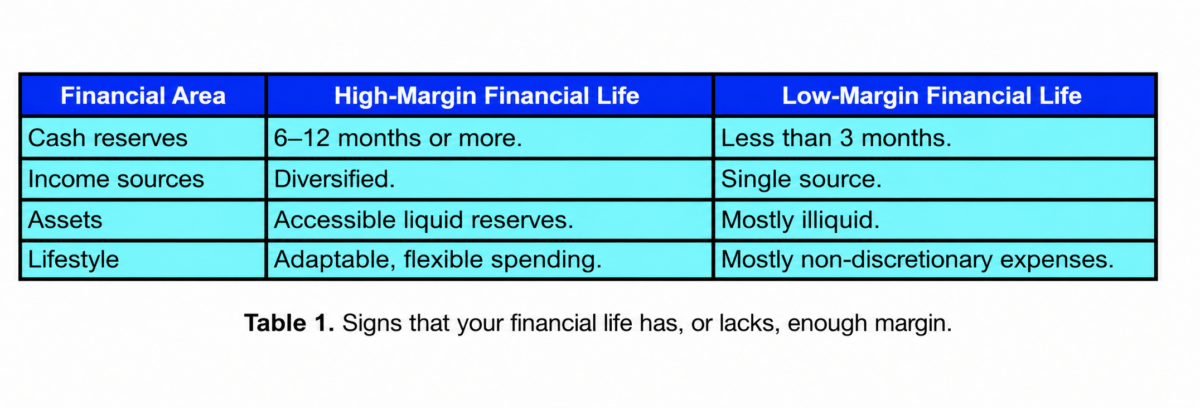
A table compares high-margin and low-margin financial lives by cash reserves, income sources, assets, and lifestyle, highlighting differences in diversification, liquidity, flexibility, and savings duration.

Take paying down debt.

Even with no recession in sight, paying off high-interest debt as quickly as possible should be one of your highest financial priorities.

As Veldhuizen says, “Debt matters more than most people realize, not primarily for the interest savings, but because every liability you eliminate lowers the floor your income has to cover.

However, while paying down debt and lowering your required “income floor” improves resilience, draining your cash reserves to eliminate debt also reduces your liquidity and flexibility, which can be critical if you lose your job before rebuilding your reserves.

Veldhuizen reiterates the importance of having enough margin, saying, “A family with 35% margin can absorb extended unemployment without selling the house, invest opportunistically when others are fearful, and make a career change or weather an emergency without the most important expenses ever being in question. Those who are intentional about building margin in their finances will benefit during economic growth and during economic downturns.

He then adds, “Margin is built in three ways: controlling fixed expenses, maintaining meaningful cash, and diversifying away from your own income concentration.

Once you build that margin, you have more breathing room, adaptability, and space for emotional clarity.

Personally, I never consciously “prepared for a recession.”  In fact, I probably leaned harder into long-term investing and less into liquidity than I should have. 

Yet looking back, the things that protected me during downturns had nothing to do with predicting the economy or timing the market. They had more to do with maintaining my employability, preserving professional relationships, and building adaptable skills, all of which helped when my consulting business suffered an 80% loss of revenue for a year, and avoiding the sort of poor financial decisions, such as high-interest debt, that would have trapped me when my income suddenly changed.

Build an Opportunity Fund Before You Need One

Having a solid emergency fund is a well-known tenet of financial preparedness.

Conventional financial advice says we should have at least 3 months’ worth of expenses in a liquid and low-risk asset, such as a high-yield savings account. 

Depending on how stable your situation is, how strong a safety net you have, and how many responsibilities you carry, that recommendation can grow to 12 months’ worth of expenses or even more.

Yet, the National Association of State Credit Union Supervisors (NASCUS) reports that fewer than half of Americans (47%) can cover a $1000 emergency expense.

As Deb Meyer, Founder of WorthyNest®, says, “Whether a recession is on the horizon or not, cash is king. Most people have an emergency fund of, at best, a few thousand dollars tucked away for unexpected expenses like car repairs, home appliances, or medical bills.

However, she then points out that having greater liquidity results in greater optionality and more freedom. She says, “Yet very few people have a sizable opportunity fund. An opportunity fund allows you to take a mini-sabbatical between jobs, helps you start the business you’ve always dreamed of pursuing, or provides ample breathing room for the home project you’ve been meaning to do for years.

Meyer then expands on the importance of building such an opportunity fund, and the sooner the better: “There will always be items outside of our control. Political unrest, life-threatening weather events, and stock market movements are just a few examples of things we cannot control. However, you do have the power to control your decisions around how much money to save, spend, or give. You can also control how you will react if a recession arrives: either calm or panicked. Having a substantial cash opportunity fund provides peace during a very uncertain time. To improve your financial resilience in 2026, start an opportunity fund.

Indeed, having greater optionality preserves and opens up choices, and it can even help you build wealth.

As T. Casey Loper, CFP®, Wealth Advisor at Cornerstone Wealth Management, points out, “It’s not a matter of if a recession or a market drop comes, it’s a matter of when. We teach all of our clients to expect them to come often and be prepared to take advantage when they come. Having some money in fixed accounts to buy when bargains are available will always help one go from surviving to thriving in the next downturn or recession.

A higher net worth doesn’t automatically provide rapid-response optionality.

For example, if much of your net worth is trapped in your home equity, you’re caught in “cash-poor” vulnerability.

Real estate investments can be very profitable, but they are illiquid, which can pose a challenge in difficult times.

Meyer explains, “Many clients who achieve a certain level of financial success inevitably ask if real estate is a wise investment. And usually, my answer is no. It’s an illiquid asset that can be extremely difficult to sell, especially in a recession. One exception? If it consistently generates income and is an asset that will be passed down to the next generation.

For retired clients or those nearing retirement,” Meyer adds, “I’d much rather see a diversified mix of liquid assets that can be sold at a moment’s notice if necessary. Real Estate Investment Trusts (REITs) provide a similar experience to tangible real estate ownership with greater liquidity.

Other risk factors that make you vulnerable in a downturn include:

  • Concentrated stock compensation that isn’t diversified as quickly as possible.
  • Highly leveraged investments that can result in a dreaded “margin call.”
  • Private business ownership, when the business is in a recession-sensitive industry.
  • A lifestyle built around a permanently high income.

Crane warns against acting on recession fearmongering, “Recession preparation should not feel like hiding in a bunker waiting for collapse. It should feel like building a life that can absorb stress without completely falling apart.

He then suggests a more positive way to prepare: “If you want to become more resilient over the next year, stop obsessing over predictions and start improving adaptability. One thing I strongly encourage people to do over the next 6–12 months is to build optionality into their lives. Build cash flow flexibility. Lower unnecessary stress. Increase liquidity. Reduce unnecessary financial obligations. Improve skills or income streams. Tighten weak areas of your financial life before the economy forces you to.

How Recession Risk Differs for Employees, Business Owners, and Retirees

If you read most recession-prep advice, I’m sure you’ve noticed how generic it all sounds.

It rarely discusses how your strategy should depend on your life stage, your income type, and your existing liquidity and flexibility.

Different people face different risks in a recession, and they often don’t even look at the right ones.

As Jim Crider, CFP®, Founder of Intentional Living FP, says, “Most recession worry is misdirected. The W-2 employee fretting about the S&P 500 is usually overexposed to their employer’s industry, not the overall market. The business owner watching the news is concentrated in an asset that’s both their income and their nest egg. The near-retiree fixated on returns is actually exposed to sequence risk. Good prep starts by naming the real concentration, not the one that’s loudest in the headlines.

He then elaborates on the different risks and how to mitigate them, “Here’s how that plays out in specific situations:

  • Business owners: Recession hits twice. Revenue drops at the same time as the business is worth less if you try to sell. The real prep isn’t trimming portfolio risk. It’s building personal liquidity outside the business so you can ride out 12 to 24 months without forced distributions or panic decisions about staffing, pricing, or your own compensation. If a 2027 sale was your retirement plan, a downturn can push it out three years and cut the price 30%. Plan to be patient by being liquid.
  • High earners with Restricted Stock Units (RSUs) or stock options: The mistake is treating vested shares as diversified wealth. They aren’t. You’re double-concentrated in one company that also pays your salary. Recessions reveal that. The fix isn’t to predict the next downturn; it’s building a disciplined sell-at-vest schedule and a real cash bucket before you need it, so a layoff doesn’t force you to sell vested shares at a five-year low.
  • Near-retirees: Sequence-of-returns risk is the actual enemy, not recession. Two to three years of living expenses outside the market (not just an emergency fund, actual spending cash) keeps you from being a forced seller in Year 1 of retirement. Bonus: a real downturn opens a window for Roth conversions at depressed account values, which is one of the few tax moves that gets better in a bad market.
  • Already retired: Spending flexibility matters more than nailing the withdrawal rate. Clients who can dial back the discretionary line, the travel year, and the truck upgrade recover faster than those running a rigid budget. Build the flex in before you need it.

Crane agrees, “The specific advice changes dramatically depending on the person. A W-2 employee may need greater cash reserves and skill flexibility. A business owner may need to focus on reducing operational fragility and personal lifestyle creep. High earners living off RSUs and stock options often think they’re diversified when they’re actually massively concentrated, so they need to sell during liquidity events. Near-retirees need to focus heavily on sequence risk and income structure, while fully retired people usually need emotional guardrails more than aggressive portfolio changes.

Table 2 captures these different situations, their real recession risks, and ways to mitigate those risks.
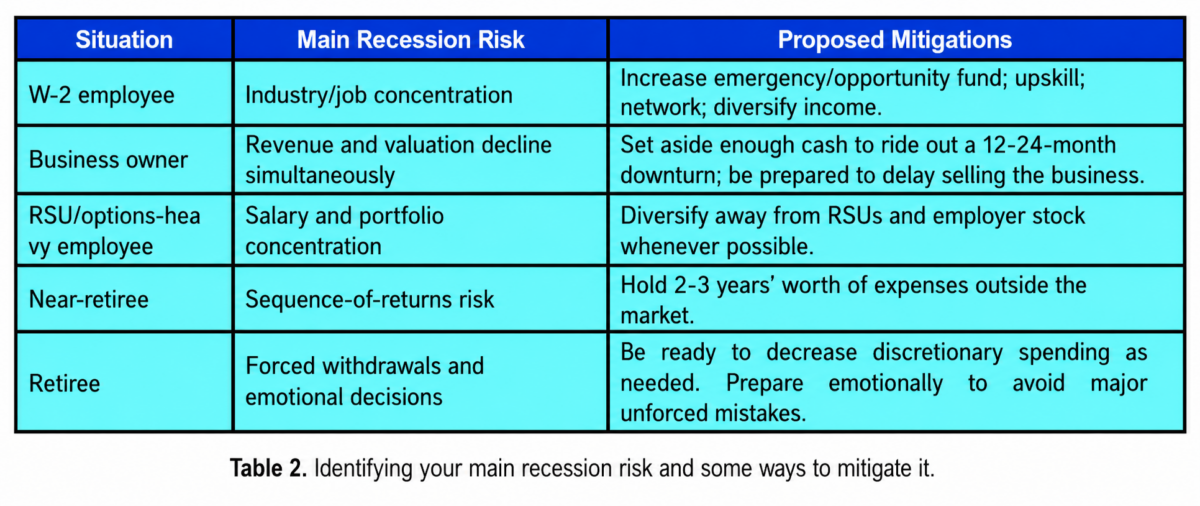
A table showing main recession risks and proposed mitigations for W-2 employees, business owners, RSU/options-heavy employees, near-retirees, and retirees. Mitigations include diversifying income and saving more.

As Veldhuizen puts it, “Every client’s situation is unique, and clients are quick to remind me of this, which always makes for a great discussion during our meetings. Rules of thumb too often assume everyone has the same thumbprint. Targeting a 35–40% margin is a starting point, not a final answer. Its value is in forcing the question: where is the actual flexibility in my financial life? The answer looks different for a retiring professor than for a Series B founder, but the process of intentionally thinking it through and identifying areas to improve your financial margin will build greater financial resilience.

He then explains how his above-mentioned margin formula, “… sum of savings and discretionary expenses divided by net after-tax income…”  applies differently in different situations:

  • The framework applies cleanly to W2 employees. 
  • The framework applies to business owners, too. When distributions are strong, discretionary spending tends to rise, and using the formula might calculate an 80% margin in a good year. That number isn’t the point. The point is that the margin should be calculated on income that is repeatable and spendable, not enterprise value that hasn’t been realized, not a distribution year that tripled because the business had an exceptional quarter. If distributions compress and there’s no personal cushion, the business risk fully transfers to the household. If anything, business owners need either higher margin targets or sufficiently realistic estimates of the durability of their income during a slow year or an economic downturn.
  • Even in cases where the formula might seem inapplicable, the principle still applies. For example, a physician finishing residency with a reasonable expectation of a 5× salary increase in two years is making the most valuable investment available to them, themselves. Maxing out qualified retirement savings on a resident’s salary would be the wrong advice. Even so, I find that discretionary expenses in this phase tend to be proportionally larger, which preserves the spirit of the framework even when one of the variables, savings rate, is likely zero.
  • For retirees in the distribution phase, savings drop to zero, and the formula becomes discretionary expenses divided by after-tax sustainable portfolio withdrawals. Two adjustments are made to get there: savings disappear from the numerator, and the focus is on non-guaranteed income sources, which don’t include Social Security and pensions. It’s a small tweak, but a retiree drawing from their retirement portfolio can still quickly calculate their financial margin using this framework.

How to Improve Your Financial Resilience in the Next 12 Months

As the financial experts quoted throughout this article repeatedly emphasize, the best recession prep is reducing fragility, increasing adaptability, and preparing yourself to make good decisions before economic stress fractures your life.

Here are some specific ideas for each of these.

Steps to Reduce Financial Fragility Before a Recession

  • Reduce fixed obligations and recurring expenses as much as you can, before loss of income makes them hard to cover.
  • Reduce discretionary spending before you need to and use the money that’s freed up to bulk up your emergency and opportunity funds.
  • Diversify over-concentrated investments and compensation.
  • Keep high enough liquid reserves (i.e., the above emergency and opportunity funds).
  • Pay down high-interest debt, but not to the point that you become cash-poor.
  • Take on responsibilities that directly support your supervisor’s priorities, making it less likely that your job will be among the first to be axed.

How to Increase Your Financial Adaptability

  • Update your resume now, before you need it.
  • Network to strengthen professional relationships, especially ones outside your current employer.
  • Build marketable skills to increase your employment flexibility.
  • Consider starting a side gig to diversify your income.

How to Make Better Financial Decisions During a Recession

  • Create financial rules and emotional guardrails for yourself, and practice them before panic arrives.
  • Avoid doomscrolling and headline-driven financial decisions. Remember that the media publishes what they think will get your attention, which is not necessarily what helps you. They also drive attention by sensationalizing and catastrophizing.
  • Recognize that fear often creates urgency that feels rational in the moment, especially when it isn’t.
  • Focus on outlasting downturns rather than trying to outsmart them.

What to Do If Income Drops

Mike Tyson is often (though not accurately) quoted as saying, “Everyone has a plan, until they get punched in the face.”

In that spirit, let’s assume that despite all your planning and preparing, a recession causes the worst to happen to you, and you lose your job. The more you did beforehand along the lines of the above recommendations, the better you’re positioned to survive this. Still, there are things you can do after losing income that can help.

  • Prioritize essential obligations, like your mortgage, rent, auto loan payments, and utilities. However, contact lenders (or your landlord) and your utility providers early to explore hardship programs or temporary and/or partial forbearance.
  • To preserve liquidity, consider making minimum payments where possible and putting off payments of bills that are less likely to damage your credit. For example, if you have medical bills, reach out to the provider(s), explain the situation, and offer to make token payments until you’re employed again. Interest is expensive, but it may be the lesser evil if it’s temporary and helps maintain liquidity as a survival tool.
  • Avoid liquidating long-term investments, especially during a market crash, until and unless it becomes unavoidable. Replacing long-term investments after panic-selling them during a downturn can take years.
  • Avoid isolating yourself professionally. If anything, hard times are a reason to network more actively, not less, and staying on top of developments in your field will make it easier to get your next job (or start your own business).

Table 3 summarizes what’s at risk due to job loss, what priority actions to take, and what to pursue as mitigation and/or solution. 
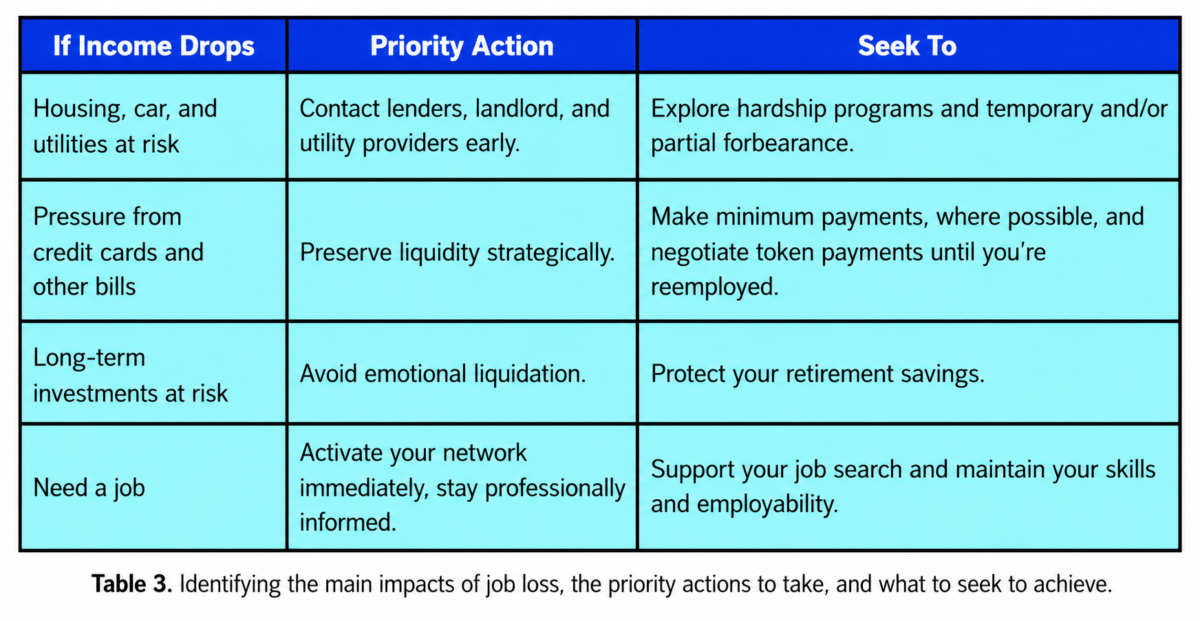
A table listing actions for job loss: For housing/bills, contact providers and seek forbearance; for credit cards, prioritize liquidity; for long-term investments, avoid liquidation; for jobs, network and upskill for employability.

The Bottom Line: Outlast, Don’t Outsmart

Recessions are a normal part of the economic cycle. That’s why it isn’t a matter of if there will be a recession, just when.

And that “when” is impossible to predict accurately.

As Physics Nobel laureate Nils Bohr once quipped, “It’s very hard to make accurate predictions, especially about the future.

Given that, our job isn’t to predict the next recession. It’s to reduce our financial fragility and build enough resilience to survive it with as little damage as possible.

And the fact that recessions are usually shorter than a year makes that doable.

Margins and resilience have to be built ahead of time, not when the downturn already hits. At that point, what you built, or failed to build, gets revealed.

And if you managed to build enough resilience into your finances and emotional preparedness, you’ll do well.

As Crane puts it, “The people who usually come out strongest after difficult economic periods are not the ones who predicted everything perfectly. They’re the ones who stayed adaptable, disciplined, and emotionally steady while everyone else reacted impulsively.

Your goal can’t be to outsmart recessions.

It has to be building a financial life resilient enough to outlast them.

Disclaimer: This article is intended for informational purposes only, and should not be considered financial advice. You should consult a financial professional before making any major financial decisions.

Opher Ganel

About the Author

Opher Ganel, Ph.D.

My career has had many unpredictable twists and turns. A MSc in theoretical physics, PhD in experimental high-energy physics, postdoc in particle detector R&D, research position in experimental cosmic-ray physics (including a couple of visits to Antarctica), a brief stint at a small engineering services company supporting NASA, followed by starting my own small consulting practice supporting NASA projects and programs. Along the way, I started other micro businesses and helped my wife start and grow her own Marriage and Family Therapy practice. Now, I use all these experiences to also offer financial strategy services to help independent professionals achieve their personal and business finance goals. Connect with me on my own site: OpherGanel.com and/or follow my Medium publication: medium.com/financial-strategy/.


Learn More About Opher

Whether you have lived in Germantown for years or recently moved to town, you may need help finding the right financial advisor in the community best suited for your individual needs.

It’s important to first consider your own financial planning priorities before choosing an advisor. Here are a few quick tips to help you get started along with financial advisors in Germantown featured on Wealthtender you may want to add to your shortlist.

As you prepare to interview financial advisors in Germantown who may be right for you, get to know local financial advisors featured on Wealthtender.

📍 Map: Financial Advisors with their Primary Office Location in Germantown

Double-click (or pinch the map on mobile devices) to zoom in and expand the details for financial advisors whose primary office location is in Germantown.

📍Double-click or pinch pins to view more.

Showing

The Benefits of Hiring a Financial Advisor in Germantown

Hiring a financial advisor can be a great move to help you build a long-term investing strategy. Advisors can help you build an investment portfolio to meet your financial goals and help you plan appropriately for retirement.

As a resident living in Germantown, hiring a financial advisor who lives nearby and understands the local economy, cost of living, and regional employers can be quite valuable, especially if your individual circumstances are deeply tied to such factors.

Do you work for one of the largest employers in Germantown? If so, there’s a good chance the local financial advisor you hire will also have other clients who work there. This knowledge could prove valuable if they are already familiar with your employee benefits, such as a 401(k) plan, Health Savings Accounts, and other components of your total compensation package.

When you reach out to financial advisors you’re considering hiring, let them know where you work and ask if they are familiar with your employer’s unique benefits and compensation structure.

Quick Tips For Hiring an Germantown Financial Advisor

Before hiring a financial advisor in Germantown, here are a few quick tips to help you find the best advisor for you.

1. Decide Which Services You Need

Before hiring an advisor, determine what services you need from them. Whether it’s full-service investment management or a plan focused on a specific area of your finances, put together a list of what you’d like help with before contacting an advisor.

Though most people use a financial planner simply to invest for retirement, this is only a small part of what many advisors offer. Here’s a quick rundown of potential services a financial advisor may offer you:

  • Budgeting and money management
  • Debt management
  • Insurance planning
  • Retirement planning
  • Other investment planning
  • Inheritance planning
  • Estate planning
  • Tax planning

As you can see, financial advisors can help you with your entire financial picture, not just investing. As you start to plan for life’s bigger milestones, you should consider finding a financial advisor that specializes in those areas.

Finding the right advisor can help you minimize risk, maximize gains and take advantage of tax breaks while investing for your future. They can also help you protect your assets with the right kinds of insurance and help you pass on your financial legacy with a proper estate plan.

2. Consider Your Budget and Payment Preferences

Once you have a list of services you would like, review the fee structures financial advisors offer. Finding a balance between the services you need and the cost of those services will help narrow down the field of advisors you may want to work with.

If you are looking for a full-service advisor to manage all of your investments, consider searching among fee-based financial advisors. If you want to manage your money yourself, consider the flat fee and monthly subscription advisors for ongoing support.

3. Interview Multiple Financial Advisors

Once you have chosen the services and fee structure you prefer, it’s time to contact a few advisors and interview them. Here are questions to ask financial advisors:

  • What services do you provide?
  • What are all the ways you get paid? (fee transparency)
  • What is your investment strategy?
  • How do you measure investment performance?
  • How do we communicate about my plan?

Interview multiple advisors to get a feel for who you want to work with. A combination of fees, services, and customer service will help you determine the best fit for your financial advice.

4. Review Financial Advisor Credentials

Once you find an advisor (or two) you feel comfortable with, it’s always a good practice to check their credentials and the firm’s details. You can do this at the Investment Adviser Public Disclosure (IAPD) website

You can check both the individual and the firm to view their background and experience details, as well as any disciplinary action taken against them or their firm.

As licensed financial professionals, there is oversight into how financial advisors conduct business, so running a quick (free) check on them is recommended.

For additional information about advisor credentials, read our article to learn the most popular designations held by financial advisors, as well as specialized credentials which may be important to consider if you have unique financial planning needs.


Frequently Asked Questions & Additional Resources

How do I know if I’m ready to hire a financial advisor?

You should strongly consider hiring a financial advisor if you have a significant amount of money available for saving or investing. This could occur after years of making annual contributions to a retirement plan like a 401(k) through your employer or suddenly if you receive a large inheritance or sell your house for a large profit.

But even if you don’t have a lot of money saved, many financial advisors and planners provide reasonable pricing options and valuable services you should consider, especially if you’re facing a significant life event. For example, if you’re starting a new job, getting married, starting a family, getting divorced, lost your job, starting or selling a business, or approaching retirement age, working with a trusted financial advisor or planner may prove worthwhile.

Before I hire a new financial advisor, should I fire my current advisor?

You don’t need to fire your current advisor before beginning your search for a new financial advisor. In fact, your new advisor can help coordinate the transition of your assets from your previous financial advisor.

Where can I read reviews about financial advisors written by their clients to help me decide if I should hire them?

After 60 years of regulatory prohibition of financial advisor reviews in the US, a rule issued by the Securities and Exchange Commission (SEC) became effective on May 4, 2021 that means both financial advisors and directory websites that help consumers search for a financial advisor can collect and display financial advisor reviews, an important factor worth considering when choosing who you’ll hire to manage your investments and life savings. 

Wealthtender is the first independent advisor review platform designed to be fully compliant with the new SEC rule, and we look forward to helping you evaluate financial advisors based on reviews written by their clients.

I’m a local financial advisor interested in being featured in this guide. How do I get started?

Thanks for your interest. We look forward to learning more about your practice and helping you attract your ideal clients where you may be a good fit based on their individual needs and circumstances. Please click here to learn how you can join local financial advisors featured on Wealthtender.

How Much Does a Financial Advisor Cost?

➡️ How Much Does a Financial Advisor Cost? Read the Article

About the Author
A headshot of Brian Thorp, the founder and CEO of Wealthtender

About the Author

Brian Thorp

Brian is CEO and founder of Wealthtender and Editor-in-Chief. He and his wife live in Austin, Texas. With over 25 years in the financial services industry, Brian is applying his experience and passion at Wealthtender to help more people enjoy life with less money stress. Learn More about Brian

What this article covers

Most retirees are told to follow the 4% rule — but a lesser-known strategy called the guardrails approach lets you start with a higher withdrawal rate, spend more over the course of your retirement, and dramatically lower your chances of running out of money. This article explains how the guardrails approach works, walks through real numerical examples, and shares how financial advisors use it with clients today.

I believe there are three main reasons we all need to be concerned about our retirement plans:

  1. Retirement has been getting longer and longer because we’re living longer.
  2. Projected market returns are significantly lower in the coming decades.
  3. Inflation is running at historically high levels [Editor’s Note: Inflation has subsided since this article was first published in 2023].

And I feel the best way to avoid running out of money in retirement is an approach called “guardrails.”

In this article, I offer a deep dive into the guardrails approach, a less well-known, advanced strategy to provide you with the best retirement possible at the lowest risk possible.

Key Takeaways

1

The Guardrails Approach Can Slash Your Risk of Running Out of Money in Retirement

The static 4% rule fails in roughly 13.7% of historical scenarios — meaning about 1 in 7 retirees would outlive their money. Research shows that applying a guardrails strategy reduces that failure rate to somewhere between 0.07% and 3.8%, depending on the specific parameters used.

2

You Can Start with a Higher Withdrawal Rate and Still Protect Your Portfolio

Rather than locking in a fixed 4% draw for life, guardrails let you start at a higher initial rate — research examples use 4.3% to 5% — by building in automatic adjustments. When your portfolio drops significantly, you reduce your draw by 10%; when it grows substantially, you increase it, keeping withdrawals within a defined safe range.

3

A 10% Cut in Your Portfolio Draw Doesn’t Mean a 10% Cut in Your Lifestyle

When guardrails trigger a reduction in your portfolio withdrawal, the hit to actual spending is cushioned on two fronts: your Social Security or pension income is unaffected, and drawing less from tax-deferred accounts lowers your taxable income — which reduces your tax bill and partially offsets the cut.

The 4-Percent Rule and How People Try to Update It

If you’ve been reading about retirement planning, I’m confident you’ve heard of the so-called 4-percent rule.

Published by financial advisor William Bengen in 1994, this “rule” states that if you invest your retirement nest egg in a 50/50 mix of large-cap stocks and intermediate-term Treasury bonds, withdraw 4 percent of the total in your first year of retirement, and then each year thereafter increase the number of dollars you draw by the prior year’s inflation rate, your nest egg will last for at least 30 years.

This was based on Bengen’s analysis of historical investment returns all the way back to the Great Depression.

More recently, Bengen said that by adding small-cap stocks, you could increase your initial draw to 4.5 percent.

On the flip side, research from, e.g., Morningstar suggests that with lower projected returns in the future, you need to reduce your initial draw to 3.3 percent to maintain the safety level of the original 4-percent study. Their main concern is that with lower equity returns, the volatility of stocks poses a greater risk to your portfolio than it did when returns averaged 10+ percent.

Once you start drawing money from your portfolio, if stocks crater and you still need to sell shares to cover your expenses, you’re pulling more shares out of your portfolio for the same number of dollars (i.e., selling low), which hamstrings your portfolio’s ability to recover with the market.

Monte Carlo Simulations: Can They Solve What the 4% Rule Can’t?

Many financial advisors use sophisticated software that runs thousands or tens of thousands of what-if scenarios based on the past behavior of different asset classes.

They plug in assumptions for your specific case, such as:

  • Your portfolio size at retirement
  • Your asset allocation
  • Your age at retirement
  • Your age at death
  • Your proposed draw as a fraction of your portfolio

They then say something like, “Your plan has an 85-percent likelihood of success.”

What does that mean?

It means that in 85 out of every 100 scenarios, you would have died before running out of money.

How about the other 15 percent? In those scenarios, you run out of money and suffer poverty.

So, do you feel lucky?

The problem is, of course, that we don’t know what future investment returns will be, in what order, with what inflation, or even what life will throw at you (e.g., expensive health problems). And unless you want to gamble with your future financial well-being, even a 90-percent likelihood of success (which many professionals see as the “gold standard” of planning) may leave you anxious (it sure does me!).

Of course, if you’re not looking to leave a big bequest to your heirs, the other direction is also not wonderful.

Say you retire with a $1.5 million portfolio and pass away 30 years later with a $10 million portfolio. It would be fair to say in retrospect that you underspent what you could have and had a less enjoyable retirement than you could have had.

As Zack Swad, President & Wealth Manager, Swad Wealth Management, says, “A static spending rate is a huge risk to your retirement because… you could end up broke or not living retirement to the fullest.

Interestingly, a recent Monte Carlo analysis of Bengen’s 4-percent rule shows that it has an 87-percent likelihood of success – not great!

The Guardrails Approach: Adjustable Draws Allow Higher Spending with Lower Risk

Developed by financial planner Jonathan Guyton and business professor William Klinger, the guardrails approach offers a far better, dynamic method for deciding how much you can spend each year in retirement.

In this approach, when your investments do very well, you increase your draw, but when your portfolio value drops a lot, you cut your spending.

Swad explains, “To implement guardrails, you first select an initial withdrawal rate. The higher this rate, the more likely you are to have to adjust your spending later. Let’s say you select 5 percent.

Next, you determine when to adjust your withdrawal rate (a.k.a. your guardrails). Let’s say you set your guardrails to 20 percent above and below your withdrawal rate. If your target rate is 5 percent, your lower guardrail would be 4 percent, and your upper one would be 6 percent.

If your withdrawal rate falls outside your guardrails (after adjusting for inflation), you’d increase or decrease your withdrawal amount by 10 percent, which should get you back into your target withdrawal range of 4-6 percent.”

Swad then gives an example of how things could play out in a bear market.

  • “Year 1: You have a $2 million portfolio, and you draw 5 percent, or $100,000.
  • “Year 2: Inflation in Year 1 was 3 percent, and your portfolio dropped 20 percent to $1.6 million. Your inflation-adjusted withdrawal amount is $103,000 ($100,000 x 1.03). Dividing that by $1,600,000 = 6.4 percent. Since that’s higher than your 6-percent upper guardrail, you need to cut your draw, so you reduce it by 10 percent to $92,700 ($103,000 x 0.9), which is 5.8 percent of your $1.6 million current portfolio value, safely back inside your upper guardrail.
  • Repeat this check at least annually.

If the market has an incredibly good year instead, it might play out like this:

  • Year 1: You start out with the same $2 million portfolio and draw the same 5 percent, or $100,000.
  • Year 2: Inflation in Year 1 was 3 percent, and your portfolio soared 35 percent to $2.7 million. Your inflation-adjusted withdrawal amount is $103,000 ($100,000 x 1.03). Dividing that by $2,700,000 = 3.8 percent. Since that’s lower than your 4-percent lower guardrail, you increase your draw by 10 percent to $113,300 ($103,000 x 1.1), which is 4.2 percent of your $2.7 million current portfolio value, back over your lower guardrail.

In a 2020 Morningstar interview, Guyton said, “…if you think about driving your car down a road, you hit a guardrail, it does two things. It puts a ding in your car, and it changes your momentum so that instead of the momentum pushing you toward the edge of the road, it now starts to shift you back toward the middle where it’s safe…”.

He then goes on to explain that if the guardrails system tells you to cut your draw by 10 percent, that doesn’t translate to cutting your spending by 10 percent! That’s because (a) your Social Security benefits aren’t affected, and (b) drawing less out of your IRA or 401(k) (unless they’re Roth plans) means that your taxable income is lower, so your taxes are lower too.

For example, say your draw is $50,000, your Social Security benefits are $30,000, and your taxes total $10,000. When the market tanks, you hit your upper guardrail and need to cut your draw by 10 percent, to $45,000.

Drawing $5000 less from your portfolio, your taxes could be $1500 lower or $8500. This means that instead of having $70,000 to spend ($50,000 + $30,000 – $10,000), you have $66,500 ($45,000 + $30,000 – $8500).

Just a 5-percent budget cut.

Is it fun to trim nearly $300 from your $5830 monthly budget? No. But it’s no disaster either.

Interesting, I’m thinking. But how much safer are you, and can you draw more on average than you would with the 4-percent rule?

Swad pointed me to two research papers:

  • Guardrails to Prevent Potential Retirement Portfolio Failure (by William Klinger): Here, Swad quotes, “Simulations using the 4 percent rule with the above assumptions failed 13.7 percent of the time… If you used the withdrawal rate ratio applied to the 4 percent rule in the first 15 years (see page 51), the failure rate was only 0.07% for a withdrawal rate ratio increase of 20%.
  • Lifetime Adjustable Income vs. the 4% Rule: Can You Spend More in Retirement with Less Risk? (by Rob Williams, CFP®, CPWA®, Managing Director Eric Tarkin, and Senior Researcher Chris Kawashima, CFP®, Senior Research Analyst): This report uses a slightly different methodology than  Klinger’s but reaches similar conclusions. For example, the initial draw could be 4.3 percent instead of 4 percent, the average annual (inflation-adjusted) draw increases from $39,000 to $49,000, and the probability of running out of money in 30 years drops from 13.2 percent to just 3.8 percent! Note that this study shows the average remaining portfolio at death (in future dollars) drops from $1.3 million to just $618,000.

Depending on the details of how you implement your guardrails, your risk of poverty drops from over 13 percent to somewhere between 0.07 percent and 3.8 percent!

How Financial Advisors Implement the Guardrails Approach with Clients

I asked Swad and other financial professionals questions on how they implement the guardrails approach with their clients.

Q: Do you implement the guardrails approach with all clients, or are there certain types of clients for whom you feel another approach is better?

Swad says, “I implement guardrails for all clients who are in the retirement/distribution phase of life. I believe it’s a fit for all clients as it’s a better approach to helping ensure they don’t run out of money in retirement, which is almost always a top concern for retirees.

With that said, there are different degrees of guardrails that can be used. For example, if a client is relatively conservative and doesn’t want to have to adjust their income as much throughout retirement, we’ll use a relatively conservative income approach, which means starting with a lower withdrawal rate. Also, for clients who want to leave a legacy, we adjust the spending parameters down so they don’t spend as much throughout retirement, allowing them a better chance of leaving the legacy they desire.

Brandon Renfro, a financial advisor with Belonging Wealth in Longview, TX, says, “This is my single favorite approach to taking distributions from a retirement account, but I don’t implement it with every client. For some clients, the potential variability is too stressful, so we stick to a more standard withdrawal rate approach like the 4-percent rule.

Doug Oosterhart, founder & financial planner at Lifepoint Planning, says, “I implement guardrails with as many retirees as possible, as long as they understand that there’s a chance their income could be cut in the future. If clients are adamant that they aren’t willing to take a potential pay cut in the future, I discuss the pros and cons of a fixed withdrawal rate that is often lower than 4 percent.

The guardrail strategy allows for some optionality in the sense that we might be able to start with a withdrawal rate higher than 4 percent, knowing that income could change (up or down) moving forward.

Q: When implementing the guardrails approach, how do you work with clients to determine what their initial withdrawal rate should be?

Swad says, “I discuss how willing and able they are to adjust spending throughout retirement and base the parameters on their answer.

Renfro answers a bit differently, “This is a key piece. To determine the initial withdrawal rate, we start by figuring out what they need to take to make their plan work. To gauge whether it’s an acceptable rate or not, I consider the results of their plan’s Monte Carlo analysis against the backdrop of historical research.

Oosterhart details, “I use a variety of software programs (primarily Income Lab). Rather than a specific starting percentage, Income Lab looks at dynamic guardrails from an actual-dollars standpoint. This makes it easier to convey to the client that if their portfolio hits a certain dollar amount (up or down relative to where we started), that’s when the guardrail change in income would happen.

Locking the client into a starting percentage withdrawal is often too rigid – for example, we might delay claiming social security to age 70, so their withdrawal rate might be high for a few years and then taper off once Social Security benefits start.

Q: Do you work with clients ahead of time to identify where in their budget they could (or should) trim if and when they need to cut 10% off their spending?

Swad sees this as critical, “I believe understanding where a client can adjust is critically important to their plan. There are two ways to address the need to cut: 1) Determine beforehand during a budgeting conversation and exercise exactly what they are willing and able to cut, and/or 2) Consider part-time work during a tough market period. For #2, even a small part-time income will often allow someone to avoid having to cut their spending.

Oosterhart agrees, “Yes. We factor in baseline spending needs and then variable spending needs on top of that. We talk to clients about how it’s possible that they will spend more in the first ‘phase’ of retirement as they check off bucket list items. After that, the next phase might be a time when they spend less as they get into more of a routine. Like everything else in financial planning, there is an art and a science.

Renfro takes the opposite approach, “My clients typically don’t want or need this level of input from me. My role is to help you live your life the way you want to, help you withdraw in the most tax-efficient way possible, and let you know if you’re taking on too much risk. Clients decide where to cut back. However, most of my clients aren’t in a position where a 10-percent cut would be that stressful.

I also like to couple this strategy with a ‘floor’ approach where there’s enough Social Security or pension income to cover necessities, or that their withdrawal is simply way more than enough to cover their lifestyle, and the cuts are made to luxury or leisure spending.

Q: For clients using the guardrails approach, additional discipline is required, especially when the withdrawal rate has to be reduced. How do you help your clients adjust?

Swad: “First, it’s important to understand a client’s willingness to adjust throughout retirement. If a client tells me they don’t want to have to adjust their spending, we’re going to use a much more conservative income approach with a lower withdrawal rate. I use Income Lab, a software package that uses guardrails. As part of my process, I regularly review plans with my clients and monitor them to see if they need to make adjustments.

We know WHEN we need to cut and WHAT we will cut from their budget (or alternative ideas to create more income that we’ve discussed, e.g., part-time work). When an adjustment is needed, I will notify them, and we’ll discuss this in our next meeting to help ensure they stay on track.

Oosterhart says, “It’s important to identify the client’s specific retirement spending style (i.e., are they more safety-first and prefer guarantees OR are they more probability-based and trust the market as a medium to fund their retirement).

Communication is key – some clients are on board with the guardrail approach, but others would rather use guaranteed income sources to fund their retirement. It’s important for financial planners to stay strategy-agnostic to find the best-fit strategy for each client’s ‘style’ in retirement.

In terms of helping clients adjust, the classic question this year has been, “Do we need to change anything?” I like my clients to keep a war chest of cash and short-term investments to make sure we don’t have to sell investments when they’re down, like in 2022.

Is the Guardrails Approach Right for Your Retirement?

There are many well-known strategies to save more for retirement, invest more, build a bigger nest egg, etc. The less well-known strategies have to do with converting your portfolio into a source for a never-ending stream of income to fund your best retirement without ever running out.

The “guardrails” approach does exactly that, and as described above, lets you spend more in retirement with a far lower risk of running out and dropping into poverty when you’re old and can’t recover.

Ready to Work with a Retirement Financial Advisor?

📍 Click on a pin in the map view below for a preview of financial advisors who can help you reach your money goals and retire comfortably with a personalized plan. Or choose the grid view to search our directory of financial advisors with additional filtering options.

📍Double-click or pinch pins to view more.

Showing

Disclaimer: This article is intended for informational purposes only, and should not be considered financial advice. You should consult a financial professional before making any major financial decisions.

Opher Ganel

About the Author

Opher Ganel, Ph.D.

My career has had many unpredictable twists and turns. A MSc in theoretical physics, PhD in experimental high-energy physics, postdoc in particle detector R&D, research position in experimental cosmic-ray physics (including a couple of visits to Antarctica), a brief stint at a small engineering services company supporting NASA, followed by starting my own small consulting practice supporting NASA projects and programs. Along the way, I started other micro businesses and helped my wife start and grow her own Marriage and Family Therapy practice. Now, I use all these experiences to also offer financial strategy services to help independent professionals achieve their personal and business finance goals. Connect with me on my own site: OpherGanel.com and/or follow my Medium publication: medium.com/financial-strategy/.


Learn More About Opher

What this article covers

Firing your financial advisor doesn’t have to be complicated — but without the right preparation, it can get messy. This guide walks you through the four steps to end the relationship professionally and protect your money throughout the transition, along with tips from financial advisors on how to make the switch smoothly.

Has your financial advisor lost you money? Maybe it’s time to lose your financial advisor. Breakups are never easy, and firing your financial advisor is no exception. But if you follow the right steps, the process can be relatively painless.

One of the most important financial decisions we make is who we take financial advice from. This is especially important if you are paying for financial advice. What do you do if you are getting bad advice, and how do you fire a financial advisor?

If you’re unhappy with the advice you’re receiving, it may be time to part ways. Before making any major moves, reflecting first on what may be going wrong is a good idea. The situation could be resolved by talking it over with your advisor. 

Key Takeaways

1

Read Your Contract Before You Do Anything Else

Your original advisor agreement almost certainly spells out the required termination process, notice requirements, and any exit fees — from the advisor, the funds, or both. Understanding these terms upfront prevents surprise charges and ensures the break follows the correct procedure.

2

Know What You’ll Do with Your Money Before You Make the Move

Whether you plan to self-manage, hire a new fiduciary fee-only advisor, or use a robo-advisor, deciding in advance keeps your investments from sitting unsupervised during the transition. Your best path depends on your comfort with managing money and the complexity of your financial situation.

3

You Have More Power in This Breakup Than You Think

Many clients don’t realize they can often remove an advisor simply by contacting the custodian directly — no difficult face-to-face conversation required. And if an advisor refuses to cooperate after written notice, filing a complaint with FINRA or a state regulator is a legitimate and effective path forward.

When You Know It’s Time to Fire Your Financial Advisor

I recently had the chance to catch up with many people I had not seen in quite some time. During one of those conversations, the topic of money came up (as it tends to when someone is speaking with me). One person said they would love my advice on a financial problem that has been stressing them out.

“How do I fire my financial advisor?”

This person did not want to know if they “should” fire their financial advisor. They were quite clear on the fact that the advisor needed to be fired. What they wanted to know was “how” to do it. They were looking for a step-by-step on how to fire their financial advisor and what to do with their money afterward.

I had to admit that I have no experience with the issue as I always have self-managed my finances. The more I thought about it, the more I realized why this is a stressful issue for people.

The power dynamic in an advisor-advisee relationship is tilted heavily toward the advisor. The advisor is the expert on financial matters, that is why you people hire them. This can make it very difficult for some people to challenge their advisors or even ask questions about what the advisor is doing with their money.

“People generally look to avoid confrontation, and firing your advisor can be very uncomfortable,” said Erik Nero, CFP – Founder and President of First Step Wealth Planning. “Most advisor relationships die of neglect rather than failure. It is difficult to break up with someone that the client may have used for years, that they may generally like and feel has done a good job. But if the advisor is no longer proactively exploring for what is relevant to the client, the risk of maintaining the relationship could outweigh keeping it.”  

Before making any major moves, reflecting first on what may be going wrong is a good idea. The situation could be resolved by talking it over with your advisor. 

“Think about why you are unhappy with your adviser. Is it poor performance, irregular communication, high fees, or a misunderstanding? Most advisers want happy clients, so explaining why you are unhappy may easily fix the problem.” said Rob Lloyd, CFA – President at Lloyds Intrepid Wealth Management

“A good financial advisor should have a clear understanding of your needs and be working proactively to meet them,” said David Edmisten, CFP and Founder of Next Phase Financial Planning.

“They should be anticipating changes and providing advice to help you make informed decisions,” he added. “They should be able to clearly articulate the value they provide and demonstrate this value to you on an ongoing basis throughout your relationship. If your current advisor is not meeting your needs and is not able to provide the service you expect, you are always free to look for a new advisor.”

If you are sure it’s time to move on, wait no longer. This is an important issue, and providing a detailed answer would provide tremendous value to my readers. I’ve been researching this question for the past several weeks, and I am pleased to present this brief guide to firing your financial advisor.

The 4-Step Process for Firing Your Financial Advisor

There are four steps you need to take before actually firing your advisor.

Step 1: Review Your Contract for Exit Terms and Fees

When you first hired your financial advisor, you likely had to sign a bunch of paperwork. Read through these documents carefully. There is likely a clause about how to terminate the relationship with the advisor.

If you can’t find the contract, ask your advisor or their administrative assistant for a copy of your contract. There are two particularly important sections of that contract.

  1. Instructions on how to terminate the relationship. Often, you are required to provide the advisor with a signed letter formally terminating the relationship (more on that soon).
  2. Fees. Often, a termination fee or other fees are involved in terminating your relationship with the advisor and pulling your money out. These fees may be charged by the advisor themselves, the investment funds they have you in, or both. It’s critical to ensure you are aware of what those fees are before you fire your advisor.

Step 2: Decide What to Do with Your Money After Firing Your Advisor

Before you fire your advisor, knowing what you will do with your money going forward is a good idea.

You have three options to consider.

  1. DIY. If you are comfortable managing your own money, you could transfer investments to an online broker and handle things yourself.
  2. Find a new advisor. If you want someone to guide you through the process, you’ll want to find a new financial advisor you can trust. I suggest looking at a fiduciary “fee-only” financial advisor. Fee-only advisors charge a predetermined price to provide you with financial advice. This is the best way to get unbiased advice, as fee-only advisors do not have a financial incentive to put your money in a certain fund or sell you insurance.
  3. Robo-advisors. These are a good alternative for people who aren’t quite comfortable managing their investments themselves but aren’t in a position to pay the costs of a fee-only advisor.

Do your homework and choose the path you are most comfortable with moving forward.

Step 3: Request a Copy of Your Investment Records

The final step before firing your advisor is to request a copy of your investment records. You have a right to these files, which have valuable information on your investing history.

Step 4: How to Officially Fire Your Financial Advisor

It’s finally time to fire your advisor. Refer back to your contract with your advisor, as it likely details the exact process that must be followed to terminate the relationship. Odds are you will be required to provide the advisor with a signed letter. You have two options to deliver this letter.

  1. If you are working with a new advisor. Let the new advisor handle the uncomfortable part of firing your previous advisor. They will likely provide you with a few forms to sign and might be able to handle the rest with your old advisor.
  2. If you’re handling your finances moving forward. Be sure to follow the termination instructions in your contract. Include all the necessary information in a letter to your advisor, but keep it brief and professional. You don’t owe them a lengthy explanation, and a quick, clean break is in everyone’s best interest.

If you have a financial salesperson rather than an advisor, be prepared for them to try and talk you out of leaving. Do not feel compelled to engage in a “retention pitch.”

Make it clear your decision is final and stick to the business at hand, the transfer of your assets, and all the necessary paperwork.

There are some steps you can take if the advisor tries to hold on to you. 

“Threaten to file a complaint with the compliance department or state regulator. That always gets people’s attention,” said Lloyd.

Breakups are never easy. Situations involving the heart or the wallet can be very stressful and emotionally draining. It’s essential to do your homework so that you can make the break as clean and painless as possible.

Ready to Find a New Financial Advisor?

📍 Click on a pin in the map view below for a preview of financial advisors who can help you reach your money goals with a personalized plan. Or choose the grid view to search our directory of financial advisors with additional filtering options.

📍Double-click or pinch pins to view more.

Showing

How to Switch Financial Advisors: Tips from the Experts

For additional insights, we invited financial advisors in the Wealthtender community to offer their tips for people thinking about switching to a new advisor. Here’s what they said:

Headshot of Hazel Secco, CFP®, CDFA®
Hazel Secco, CFP®, CDFA® Fee-only wealth management for high-net-worth women with complex finances.

My tips for Switching to a New Financial Advisor:

  1. Acknowledge it as a Professional Relationship: Recognize that your relationship with your financial advisor is professional. If you feel that your current advisor isn’t meeting your needs, it’s okay to explore other options. Trust your instincts and prioritize your financial well-being.
  2. Seek a Good Fit: Look for a financial advisor who aligns with your personality and expertise requirements. Ensure they understand your financial goals and are equipped to guide you effectively. A strong rapport and shared understanding are crucial for a successful partnership.
  3. Initiate Conversation: Once you’ve identified a potential advisor who seems like a good fit, reach out to them for a conversation. Use this opportunity to discuss your financial goals, concerns, and expectations. If you feel comfortable and confident in their abilities, express your interest in working together.
  4. Trust Your Instincts: Trust your intuition when deciding to switch advisors. If you feel a genuine connection and trust with the new advisor, proceed with the transition. Remember that the account transfer process, especially for investment management, is typically seamless and managed by the new advisor.
  5. Embrace the Change: Embrace the opportunity to work with a new advisor who is better suited to support your financial journey. Be open to building a trusting relationship and collaborating with them to achieve your financial goals. Enjoy the fresh perspective and guidance they bring to your financial planning.

For additional insights, check out this article with relevant tips.

Show more

Hazel Secco, CFP®, CDFA® | Align Financial Solutions LLC

Headshot of Stephanie McCullough
Stephanie McCullough Dedicated to women on their own who want a true partner in $$ decision-making.

What should people do if they are unhappy with their current financial advisor?

Definitely shop around. You really want to be clear what you want to get out of working with an advisor, because advisors work in many different ways and can offer a wide range of services – or merely do investments. Know that there are advisors who specialize in serving people with specific financial circumstances, for example women on their own, or young families, or people with equity compensation.

Is it best to move straight on to another advisor or wait for a cooling off period before scouting around again?

I think it depends on what your current advisor is doing. If they are employing a very active investment strategy with lots of changes, it might be best NOT to have your accounts unsupervised for a while – markets could change without someone adjusting. If it’s a broadly-diversified allocation of funds that don’t change much, I think it’s fine to fire your current advisor before you find someone new.

Perhaps some people are best suited to going it alone with their finances?

This is true – it depends what you’re hoping the advisor can do for you. If you feel OK doing your own investments or using a roboadvisor, you can hire a financial planner on an hourly basis to help with specific questions as-needed.

It seems plenty of people would like to fire their financial advisor, but are afraid to. THIS IS TRUE! Why are people often intimidated by their financial advisors? I DON’T KNOW – IT IS A SHAME. Is there an imbalance in the power dynamic here?

For one thing, people often don’t know they CAN fire their advisors! AND you don’t even have to speak with the advisor to do so. You can just leave. If your accounts are at a large custodian like Fidelity or TD Ameritrade, you can simply call that company and ask that your advisor be removed from the accounts. Your advisor will find out and likely contact you, but don’t feel obligated to answer!

If you’re nervous to have the conversation with your advisor, that might be a signal that it’s time to leave! Remember – it’s your money! You should feel comfortable talking about anything with your advisor (in my opinion).

What should one do if the financial advisor tries to talk you out of leaving or does not politely comply with you after you’ve sent them a written notice that you wish to terminate your fiduciary relationship?

You can initiate a transfer without your current advisor’s consent – in most cases I’ve seen, the current advisor does not have veto power over whether you can leave of not!

Show more

Stephanie McCullough | Sofia Financial

Headshot of Zack Swad, CFP®, CWS®, BFA™, AWMA®, AAMS®, RLP®
Zack Swad, CFP®, CWS®, BFA™, AWMA®, AAMS®, RLP® Retirement Planning for People Age 50+

What should people do if they are unhappy with their current financial advisor?

First, think about why you are unhappy. Was it something the advisor could have done better or was it something out of their control (e.g. market fluctuation)? If it was poor service or bad advice, then a conversation with your advisor about what you are unhappy about is called for. If after that call, you still are unhappy, then it is time to start searching for a new advisor.

Is it best to move straight on to another advisor or wait for a cooling off period before scouting around again? Perhaps some people are best suited to going it alone with their finances?

If you want a professional to help guide you through tumultuous markets and provide you advice, then it is best to search for another advisor. If you have the time, will, skill, and emotional fortitude to handle market swings, then by all means, do-it-yourself.

DALBAR has shown that on average, stock mutual fund investors return about 3-4% less per year than the S&P 500 with “investing and savings behavior” being the #1 reason why. That can make or break someone’s financial plan, which is why I believe having a good financial advisor on your side is well worth the fee.

Vanguard has also done a study that shows that an advisor can add up to 3% returns for a client per year.

It seems plenty of people would like to fire their financial advisor, but are afraid to. Why are people often intimidated by their financial advisors? Is there an imbalance in the power dynamic here?

I think this is human nature. Financial advisors are typically in the relationship business. Their clients know, like, and trust them (well, maybe trusted them before they wanted to fire…). It feels bad for a client to fire their advisor they have been working with for years. It’s kind of like changing doctors after a misdiagnosis even though that doctor may have been helping you for years.

What should one do if the financial advisor tries to talk you out of leaving or does not politely comply with you after you’ve sent them a written notice that you wish to terminate your fiduciary relationship?

I believe that the client should speak with their advisor about their unhappiness. Try to see if they can make things right. If they can’t and they persist, that is completely unprofessional of the advisor. I would simply block their email address and phone number.

Show more

Zack Swad, CFP®, CWS®, BFA™, AWMA®, AAMS®, RLP® | Swad Wealth Management

Headshot of Rob Lloyd, CFA
Rob Lloyd, CFA 30+ yrs Investing Experience Helping People Plan Wisely To Protect Their Family

What should you do if you’re unhappy with your financial advisor?

Think about why you are unhappy with your adviser. Is it poor performance, irregular communication, high fees, or a misunderstanding? Most advisers want happy clients, so explaining why you are unhappy may easily fix the problem.

Best to move to another adviser?

It depends. Are you confidant you can manage all the portfolio decisions? If so, you are a candidate to self-manage your account. If you are not sure what you are doing, begin shopping for an advisor before leaving your old adviser. Still not sure? Here is an article I wrote about working with advisers: Why Work With An Adviser? (lloydsintrepid.com). There is a checklist for what to look for in a new adviser.

Don’t be afraid of you adviser. You are the customer, and the customer is always…

Dealing with difficult advisers:

Threaten to file a complaint with the compliance department or state regulator. That always gets people’s attention. Your new adviser can move all your account holdings to a different broker-dealer without any contact to the existing adviser. This process is helpful to avoid a difficult “break-up” meeting.

Show more

Rob Lloyd, CFA | Lloyds Intrepid Wealth Management

Headshot of Nathan Mueller, MBA, CFP®
Nathan Mueller, MBA, CFP® Your Money. Your Goals. Your Adventure- Financial Planning For Gen XY & Families

If you are unhappy with your financial advisor I recommend communicating with your financial advisor about it if you think the situation can be improved. A tough conversation but that might be easier than having to find and move over to a new advisor.

If you just don’t jive with your financial advisor or for one reason or another the situation isn’t mendable then it’s time to move on.

When moving on from a financial advisor most will be professional about it. If the advisor after giving written notice and reasonable time to take action does not comply your next step should be filing a FINRA complaint. Then you will walk through their dispute resolution process.

Show more

Nathan Mueller, MBA, CFP® | Blackbird Finance

Headshot of Erik Nero, CFP®, RICP®
Erik Nero, CFP®, RICP® Financial guidance & investment management for those near and in retirement.

An excellent advisor provides their clients with guidance on how to create their vision of an ideal financial future and how to take the steps needed to achieve it. This is achieved by constantly providing relevant value. If that cannot be offered, then a change may be necessary. It is best to communicate first with the existing advisor regarding to see if the current relationship can be improved.

People generally look to avoid confrontation and firing your advisor can be very uncomfortable. Most advisor relationships die of neglect rather than failure. It is difficult to break up with someone that the client may have used for years, that they generally like and feel as though has done a good job. But if the advisor is no longer proactively exploring for what is relevant to the client, the risk of maintaining the relationship could outweigh keeping it. Especially when the existing advisor may be only focused on narrow aspects of a client’s life. There is much more to someone’s financial life than just investments and insurance.

If an advisor becomes an obstacle in a client making a change, this is evidence that the change needed to occur. This underscores the advisor’s focus on themselves rather than the client’s. Manipulation should never be part of any relationship.

Show more

Erik Nero, CFP®, RICP® | First Step Wealth Planning, LLC


Are you ready to enjoy life more with less money stress?

Sign up to receive weekly insights from Wealthtender with useful money tips and fresh ideas to help you achieve your financial goals.

  • This field is for validation purposes and should be left unchanged.


Ben Le Fort profile pic

About the Author

Ben Le Fort

Ben Le Fort is a personal finance writer and creator of the online publication “Making of a Millionaire.” He has been passionate about personal finance ever since graduating University with $50,000+ in debt.

In the eight years following graduation, he paid off all of the debt and built a seven-figure net worth. Ben holds a Bachelor’s degree in economics from Acadia University and a Master’s degree in Economics & Finance from The University of Guelph.

Ben lives in Waterloo, Ontario, with his wife, son, and cat named Trixie.

For financial advisors & wealth management firms

Generic marketing rarely gets you in front of employees and executives at a specific large company. Wealthtender’s Large Employer Q&A series takes a different approach: it gets you found at the exact moment an employee is searching for help with their equity compensation, retirement plan, or executive benefits, across Google, ChatGPT, and Gemini, and increasingly in AI answers that surface your name without requiring a click.

In this guide
How the series works and reaches prospects other tactics miss
What advisors who participate can realistically expect
How advisor participation resembles a call option: modest cost, asymmetric upside

As a financial advisor interested in growing your business by attracting employees of specific firms where you’re knowledgeable about their compensation and benefit programs, you may be wondering how to stand out as a specialist best suited to meet their financial planning needs.

One highly effective strategy available through Wealthtender is participation in our Large Employer Q&A article series. These articles feature financial advisors answering questions that employees of large companies are likely to have on their mind or be searching online related to their compensation, benefits, retirement plans, equity compensation, health savings accounts, and more.

Key takeaways
1

You get surfaced in Google, ChatGPT, and AI tools at the exact moment an employee or executive is searching for help.

When an employee searches for an advisor who understands their equity compensation, or an executive asks ChatGPT for advisors who specialize in their employer’s benefits, advisors featured in Wealthtender’s Q&A articles are positioned to appear, including in zero-click AI answers where the prospect never clicks through to any website. This is Answer Engine Optimization (AEO) working in practice: visibility and credibility across traditional search and AI tools at once.

2

The right metric is the intent and quality of the person who finds it, not traffic volume.

These articles target employer-specific, long-tail searches, so the visitors they attract are among the most qualified prospects you can reach: employees actively seeking help with their company’s specific benefits, equity programs, or retirement plan. Volume is naturally focused, and it tends to rise around moments that matter, such as a merger or acquisition announcement, a round of layoffs, an IPO or vesting event, or annual benefits enrollment season, exactly when your expertise is most relevant. Think of participation like a call option: the cost is modest, but a single client can generate years of revenue that dwarfs the investment.

3

A Q&A is both a passive SEO asset and an active marketing tool you can deploy across channels.

Beyond organic search and AI visibility, the published Q&A gives you a credible, third-party-validated asset to share with existing clients at the featured employer (a referral catalyst), and to use in email campaigns, LinkedIn outreach, prospect presentations, and media outreach when news impacts that company’s employees. One participation generates value across inbound and outbound channels at the same time.

How the Large Employer Q&A Series Works, and Why It Reaches Prospects Other Tactics Miss

While participation in a Large Employer Q&A published on Wealthtender offers the potential to gain visibility with company employees who come across the article in a traditional Google search, the most impactful benefits may not come from traffic to the page, but rather from how the article improves the likelihood of an advisor appearing in “zero-click” results displayed in search engines and AI tools like ChatGPT or Gemini. An advisor can also proactively incorporate the Q&A into prospecting activities and nurturing campaigns to drive higher conversion rates of prospects into clients.

Getting Found When the Right Employee Searches for Financial Help With Their Company’s Benefits

When employees search online for financial help specific to their employer’s benefits, they’re often using long-tail keywords like “financial advisor for Amgen employees.” Being featured in a Wealthtender Q&A article positions you as a specialist who understands the nuances of a particular company’s compensation and benefits package.

The Q&A articles include opportunities to link to relevant articles on your website or to specialized landing pages you’ve created for a particular company’s employees. These backlinks can help strengthen your site’s SEO authority over time, improving your visibility in organic search. Think of it as a powerful one-two punch when your Wealthtender Q&A feature and the landing page on your own website both show up prominently in the same results.

AEO and Zero-Click Search: How AI Tools Surface Your Name Even Without a Prospect Clicking Through

As AI-powered search engines like Google AI Overviews and ChatGPT become increasingly prominent, consumers often receive answers directly from AI without ever clicking through to a website. This phenomenon, known as “zero-click search,” means your content can still surface and drive visibility even if users never visit the Wealthtender article itself.

For example, a ChatGPT query like “Who are financial advisors that help Walmart employees?” might return results pulled from Wealthtender’s Employer Q&A series, highlighting advisors like Ian Weiner featured in the Walmart Q&A article.

You may also see other advisors featured, including links directly to landing pages on their own websites targeting employees of a particular firm. If you’re focused on attracting clients of a specific employer, we encourage you to build those too. But you’ll typically also benefit from being featured on Wealthtender, because the strength of our Domain Authority and our investment in SEO/AEO will likely give our article greater visibility than most wealth management firms can achieve on their own, unless they invest thousands of dollars in content production and SEO/AEO.

By participating in these Wealthtender Large Employer Q&A articles, you’re essentially planting seeds that both traditional search engines like Google and Bing and AI platforms like ChatGPT and Gemini can discover, reference, and share as part of their answers to consumer queries. This is what AI-optimization for financial advisors is all about.

Referral Fuel: How to Turn the Q&A Into a Prospecting Tool With Your Existing Clients

These Q&A articles also serve as social proof and third-party recognition of your expertise. You can share them with your current clients who work at the featured employer, making it easier for them to refer you to colleagues who may benefit from your help.

One Article, Multiple Channels: LinkedIn, Email, Presentations, and More

Your published Q&A is an asset you can put to work across every channel you already use. Feature it in LinkedIn outreach and posts aimed at employees of the firm, work it into email campaigns and prospect nurture sequences, include it in client and prospect newsletters, and reference it in pitch decks and presentations. Each touchpoint reinforces your specialization and adds third-party credibility, turning a single article into an ongoing prospecting tool rather than a one-time placement.

Media and PR Credibility

Being featured as an expert in a published article enhances your credibility when reaching out to media outlets, journalists, or bloggers looking for expert commentary when news impacts employees at large firms. For example, when a major employer announces a round of layoffs, an advisor featured in a Wealthtender Q&A can reach out to the local business journal editor and offer expert insights, referencing their Q&A as validation of their expertise beyond what’s published on their own website.

The benefits of being featured

What a featured Q&A does for you, at a glance

Get found at the moment of intent. Appear in Google and in AI answers from ChatGPT and Gemini exactly when an employee is searching.
Surface in zero-click AI answers. Your name can appear in AI-generated responses even when the prospect never clicks through to a website.
The SEO one-two punch. A backlink to your site or employer landing page, so your page and your Wealthtender Q&A can both rank.
Referral fuel with existing clients. A credible asset to share with clients at the firm, making it easy for them to refer colleagues.
Warm up your cold outreach. Reuse it across LinkedIn, educational events, email campaigns, and prospect presentations to boost credibility.
Media and PR credibility. A third-party-validated proof point when news affects the employer and reporters need an expert source.
What advisors are saying

“I had a prospect reach out this week from one of the large companies that I did the Q&A on and he mentioned that he found me through a Google search using the keywords of ‘advisor, CFP and [the name of the $50B tech company where he works].’ Wow! These tools at Wealthtender are already working!!”

Financial Advisor in California

“Just wanted to let you know that I’ve received several inquiries from [a $2T aerospace company] employees over the last few months and believe the Q&A was a big driver.”

Financial Advisor in Texas

Testimonials from participating advisors. Results are not typical or guaranteed and your experience will vary. These are shared as proof points, not as a promise of similar outcomes.

How to Measure the Value of a Large Employer Q&A

The value of a Large Employer Q&A comes from who finds it, not just how many people do. Because these articles target highly specific, intent-driven searches, the people who land on them are among the most qualified prospects you can reach: employees and executives actively looking for help with their company’s benefits, equity compensation, or retirement plan.

Search interest for any single employer is naturally focused rather than broad, and that concentration is a feature. It puts your name in front of the right person at the moment a financial decision is top of mind, which is when expertise actually converts into conversations and clients.

You also shape a large part of the return. The advisors who benefit most actively deploy their Q&A: sharing it with clients at the firm, referencing it in LinkedIn and email outreach, and including it in nurture campaigns. Paired with organic and AI discovery, that turns a single article into an asset that compounds across channels.

📊 Think of it like a call option

The cost is modest and the downside is capped at the price of participation. The upside is asymmetric: it only takes a single employee discovering you, through Google or an AI tool, to generate a lead that becomes a high-value, long-term client. You’re not buying traffic. You’re buying a low-cost shot at exactly the right prospect at exactly the right moment. Combined with proactive outreach to prospects that establishes social proof, this call option’s intrinsic value is significant.

The Evolving Search Landscape: The Great Decoupling

As SEO experts have noted, we’re now seeing “The Great Decoupling,” where impressions and clicks are increasingly separated. Google’s AI Overviews and other AI platforms often serve answers directly, producing higher impressions but lower click-through rates. This shift underscores the importance of having content that AI can access and reference, even when it doesn’t result in direct website traffic. Your participation in Wealthtender’s Large Employer Q&A articles positions you advantageously in this evolving landscape.

FAQ

Large Employer Q&A: frequently asked questions

What is the Wealthtender Large Employer Q&A series?
It’s a series of articles in which financial advisors answer questions that employees and executives at a specific large employer are likely searching about their benefits, equity compensation, and retirement plans. Each Q&A is published on Wealthtender and built to rank in Google and surface in AI tools like ChatGPT and Gemini.
How does it help me get found in Google and AI tools like ChatGPT?
The Q&A targets employer-specific, long-tail searches and is optimized for Answer Engine Optimization (AEO). That means your name can appear both in traditional search results and in zero-click AI answers when someone looks for an advisor who understands their company’s benefits, often without the prospect ever clicking through to a website.
Which employers are eligible?
Fortune 500 companies, universities, hospitals, and many other large employers. Use the lookup tool further down this page to check whether a specific employer is available and how many advisor slots remain.
How many advisors can be featured for one company?
Up to four advisors can be featured per employer, so availability is limited and tends to favor advisors who claim a company early. For articles featuring multiple advisors, a standalone version is also available featuring each advisor’s insights exclusively, making it ideal to share with prospects.
Do I need a Wealthtender subscription, and how much does it cost?
Yes, the series features advisors with an eligible Wealthtender subscription plan. Pricing is tiered by employer and depends on your subscription plan along with marketplace factors such as firm size and advisor demand. The lookup tool on this page shows the current tier, annual price, and slot availability for any employer.
How long does it take to get published?
After you submit your inquiry, we follow up within one business day to confirm availability, cost, and next steps. Once your responses are in, we handle the preparation, search optimization, and publishing with a typical turnaround time under two business days.
What results should I realistically expect?
Think quality over volume. These articles attract a relatively small number of high-intent searches, so success is about reaching the right prospect at the right moment, plus the value you create by promoting the Q&A yourself across your outbound marketing efforts (e.g., LinkedIn outreach, email campaigns, lead gen targeting tools like Finny or WealthFeed, etc.). Like a call option, the cost is modest and a single client can far exceed it, but results are not guaranteed and vary by advisor, employer, and how actively you deploy the Q&A.
Where can I read the terms for participation?
The full terms are spelled out in the Wealthtender Large Employer Q&A Participation Agreement. It covers your one-year term and pricing, how automatic renewal and your right of first refusal to keep your slot work, the four free edits included each term, and cancellation and removal. It also describes the authenticity standard: your answers should reflect your own professional experience and knowledge and your authentic views, not substantive answers generated by AI. You confirm you’ve read and accepted the agreement when you submit your Q&A.

Get Started With the Large Employer Q&A Series

The sooner you participate in Wealthtender’s Large Employer Q&A series, the sooner you’ll begin building digital assets that position you to get found first by employees and executives searching for an advisor with knowledge of their compensation plan and benefits.

Not every article will generate leads – Just like a call option, your participation provides unlimited upside if employees at a company searching Google or engaging with AI tools like ChatGPT and Gemini discover you through your Q&A and become a client. The downside is limited to the price of participation.

And beyond thinking of your Q&A article as a passive resource that exclusively works for you in the background, you’ll generate even greater value from the article by encouraging your clients who work at the employer to share your Q&A with other employees, incorporating your Q&A feature in targeted outreach to employees and executives to demonstrate your expertise, and include the article in nurturing campaigns with prospects after an introductory call.

To get started or check availability of slots remaining for a particular firm, refer to the lookup tool and details below.

About the Wealthtender Large Employer Q&A series

Showcase your expertise to employees at the companies you know best

The Large Employer Q&A Series features advisors with a Wealthtender subscription who specialize in helping employees and executives at specific large employers, including Fortune 500 companies, universities, hospitals and beyond. If you already understand a company’s benefits, equity compensation, and retirement plans, a featured Q&A puts your expertise directly in front of the people searching for it.

Explore & learn more
Browse 100+ advisors featured in the Large Employer Q&A directory See a live example: the SpaceX employees & executives Q&A Learn how advisors turn large company employees into clients
How it works
1
Check pricing & availability
Use the lookup tool above to see the tier, annual price, and how many of the four advisor slots are open for any employer.
2
Submit your inquiry
Tell us the employer using the form below (visible only after signing into your Wealthtender account). We’ll follow up by email within one business day to confirm availability, cost, and next steps.
3
We write & publish your Q&A
Once confirmed, your featured Q&A is created and published, built to rank on Google and surface in AI search.
Eligibility & cost depend on your Wealthtender subscription plan, slot availability for the firm, and marketplace factors such as firm size, advisor demand, and corporate actions.
Get started

Submit your inquiry

Let us know the employer you’re interested in, or send a question, and we’ll be in touch within one business day. Submit the form or contact yourfriends@wealthtender.com. (You’ll need to be signed in to your Wealthtender account to submit the form.)

Please sign into your Wealthtender account first.

Not part of the Wealthtender community yet?
Join Wealthtender to get featured in front of employees and executives at large employers, compliantly collect online reviews and be the advisor who gets found first.
See how to join →


What this article covers

A recent wealth study found that affluent Americans believe they need $5.5 million to retire and pass wealth to their children, nearly double what they consider enough for a comfortable retirement alone. This article breaks down what different portfolio sizes actually generate in retirement income, how withdrawal strategies change the equation, and why financial planners say a personalized spending plan matters far more than any magic number.

How much money do you need for retirement?

This commonly asked question reminds me of my mom’s scoffing, “How much cloth do you need to make a suit for an orphan?” she’d ask.

The point is, it’s irrelevant that the suit is for an orphan, but you’ve been given no relevant info, such as the orphan’s measurements.

Here, we have no info on what lifestyle you’d want to live in retirement.

If your desired retirement requires a budget of $50k a year, you’d need far less than if your number is $150k a year.

Key Takeaways

1

The $5.5 Million “Magic Number” Is Based on How Affluent Americans Feel, Not What the Math Requires

A First Citizens Wealth Study found that employed Americans with at least $500K believe they need $5.5 million to retire and pass wealth to heirs — nearly double the $3 million they consider sufficient for a comfortable retirement alone. But the survey measured feelings, not calculations, and the math tells a meaningfully different story.

2

A $3 Million Portfolio Can Generate $123,000–$183,000 in Annual Retirement Income When Combined with Social Security

Using the 3%, 4%, and Guardrails withdrawal strategies alongside the average Social Security benefit for couples, a $3 million portfolio places a retiree between the 85th and 93rd income percentile for age 67. The withdrawal strategy you choose can matter as much as the total amount you’ve saved.

3

A Portfolio Sized for a Comfortable Retirement Will Likely Generate an Inheritance — Without Doubling Your Target

Most retirees naturally spend less in their 80s and 90s than they do in early retirement, meaning a well-funded retirement portfolio tends to leave something behind without requiring a separate bequest target. Financial planners consistently advise anchoring your number to your expected spending, not to a round-number goal — multiply your desired annual income by roughly 22 as a starting rule of thumb.

What Does It Feel Like You Need to Retire? What Affluent Americans Said

According to a First Citizens Wealth Study, 709 employed people who have already amassed at least $500k were asked, “When you reach retirement age, what amount of money do you feel you will need for the following conditions?

The three listed conditions were: (1) bare minimum, (2) comfortable retirement, and (3) retire and bequeath wealth to heirs.

  • For the first condition, the average reply was $1.5M.
  • For the second, the average was $3.0M.
  • For the third, the average was $5.5M.

In my opinion, as we’ll see below, it’s especially instructive that the question asks about feelings, rather than calculated numbers.

How Much Retirement Income Do $1.5M, $3M, and $5.5M Actually Generate?

Answering this question requires us to decide on a level of risk we’d be comfortable taking, knowing that failure means falling into poverty in our old age.

Let’s look at three scenarios.

  1. You start by drawing a conservative 3 percent of your investment portfolio’s value in Year 1 of your retirement and adjust each subsequent year by the prior year’s inflation rate. The success rate for this method is expected to be higher than 90 percent.
  2. You start with a 4-percent draw and adjust each year by the prior year’s inflation rate, which a recent Morningstar report estimated would have a 90 percent chance of success (the gold standard in retirement planning).
  3. You start with a 5-percent draw, adjust each year by the prior year’s inflation rate, but then trim spending by 10 percent if the new draw exceeds 6 percent of your remaining portfolio, and bump up spending by 10 percent if the new draw is under 4 percent of your remaining portfolio (known as the Guardrails Approach). This approach also sports an estimated success rate far higher than 90 percent.

If you have $1.5M invested, your initial draw would be $45k for scenario 1, $60k for scenario 2, and $75k for scenario 3. Add in the $32.7k average Social Security benefit for couples and you could budget about $78k for your first year in retirement under the first scenario, $93k under the second, and $108k under the third.

How good are those income levels?

According to DQYDJ.com, these income levels would place you in the following percentiles for age 67:

  • $78k is in the 68th percentile.
  • $93k is in the 77th percentile.
  • $108k is in the 83rd percentile.

How about $3.0M?

Here, the three scenarios, including an average Social Security retirement benefit, would result in retirement income levels of $123k, $153k, and $183k, respectively.

According to the income percentile calculator for age 67:

  • $123k is in the 85th percentile.
  • $153k is in the 91st percentile.
  • $183k is in the in the 93rd percentile.

Finally, what do things look like with a $5.5M portfolio?

Including an average Social Security retirement benefit, the three scenarios would result in retirement income levels of $198k, $253k, and $308k, respectively.

According to the income percentile calculator for age 67:

  • $198k is in the 94th percentile.
  • $253k is in the 96th percentile.
  • $308k is in the in the 97th percentile.

How Much Do You Really Need for a Comfortable Retirement?

The answer is subjective.

Will you be happy living on $86k a year – the 75th percentile level for 67-year-olds?

How about $135k a year, placing you in the 90th percentile?

Or are you in the market for a super luxe retirement at $300k, in the 96th percentile?

Obviously, the higher your number, the less likely you will achieve it, and if you do, it will likely take longer to get there.

However, we’re talking personal finance, so there are no wrong answers. If it’s what you personally want, don’t let anyone tell you it’s too much (or too little)!

Ronald E. Lang, Principal & Chief Investment Officer, Atlas Wealth Management, LLC, offers a useful rule of thumb, “This is a ubiquitous question and most people think about it too late. Here is some dirty math you can use without resorting to robust financial planning software. Multiply the annual income you need by 22. For example, if you need $100k per year, multiply that by 22, getting $2.2M. This rule of thumb assumes 4.5 percent income from dividends and interest without touching the principal. Alternatively, you could have other income sources, e.g., rental property. Your financial plan should be based on earning income without touching the principal, giving you a safety net in case you need higher income than you expected, or if you have unforeseen expenses.”

Rob Duncan, CFP, CIMA, Owner, Global Impact Wealth Management, LLC, elaborates, “I’m not sure there is a magic number. However, I do believe many people tend to anchor onto nice round figures ($1M, $3M, $5M) as targets. Yet, when asked how they settled on their number, very few can articulate how they landed on their figure. Anecdotally, based on over 25 years of experience, most people don’t know how much they can sustainably withdraw from their portfolio. According to the survey, if most people want to retire in their 60s, this means their portfolio (along with Social Security and pensions, if any) will need to provide income for potentially 30 years. During prolonged periods of solid market performance, we often see an increased desire to leave a legacy and pass assets on to the next generation. After times of market distress (e.g., 2001-3, 2007-9, COVID) we see attitude shifts. In these instances, people are much more concerned with outliving assets and providing for their needs as they age. The focus is on ‘how can I avoid becoming a burden?’ rather than ‘how much can I leave them?” Through proper planning and incorporating multiple ‘what if’ scenarios, we can increase a client’s confidence and provide them a game plan to follow when the inevitable storms of life (or markets) come. Insurance for long-term care is also a powerful tool to ensure we can get the care we need as we age while protecting assets, not to mention relationships with children who may otherwise be forced to become caregivers. We see increased coverage of the challenge of caring for aging parents and the strain this puts on the finances and lives of caregivers. The key point, and this has been confirmed by other studies, is that having a desire or a goal is not enough. Taking proactive steps to craft a plan specifically for your situation is an empowering process. Those with plans are much more confident in their future.” 

Zack Swad, President of Swad Wealth Management, LLC, cautions, however, “Most people overestimate their ‘retirement number.’ Unfortunately, this often results in people working longer than needed. If people want to leave a bequest, they would need to either save more or be flexible in cutting their expenses in retirement.”

Does Leaving an Inheritance Really Require Nearly Doubling Your Retirement Savings?

To me, the answer is a definitive ‘No!’

Sure, I want to leave a large bequest to our three kids. But that doesn’t drive my ‘retirement number.’ As I see it, our retirement number should provide a comfortable retirement.

That means (again, for me) that our spending won’t need to go down once we stop working for money, even if we live past age 100.

Will we spend that much?

Research says that even if we do at first, by the time we get to our 80s and 90s (assuming we do), our spending will likely drop by 10-20 percent. If that happens, we’ll bump our annual charitable giving up further than our initial planned giving.

So, if our retirement income from our portfolio, our rental properties, and our Social Security benefits is enough to provide for all that with no definitive end date, once we pass away the remaining estate will generate a hefty inheritance for our kids (even accounting for significant charitable giving).

All that without needing to increase our retirement number, let alone nearly double it.

Now you see why I found it instructive that the affluent people surveyed were asked what they felt they’d need. Had the question required them to calculate things, I suspect their answers would have changed.

Stephan Shipe, Ph.D., CFA, CFP Owner and Lead Advisor at Scholar Financial Advising, addresses this question, saying, “Many people underestimate the impact and size of their bequest as their need for retirement income increases. If someone is looking to spend $250k in retirement and planning for $5M as their ‘goal number,’ then legacy concerns and preparing children for the inheritance become a concern regardless of whether legacy is the goal. If the withdrawal rate is appropriate, account sizes should be projected to increase throughout retirement rather than drop or stagnate.”

Michael Rosenberg, RFC, CPFA, Founder and Managing Director of Diversified Investment Strategies, offers an alternative approach, “I suggest to my clients a tiered approach to income, taking a higher distribution rate from age 65 through 85, and decreasing income after 85. I also suggest (and each plan is unique) having a life insurance policy or, at least, a second-to-die policy to provide legacy bequests. The life insurance gives retirees a ‘permission slip,’ as I refer to it, to run assets down to zero. If assets do go to zero, the life insurance policy can provide income through policy loans.”

Can You Retire on $5 Million? The Bottom Line

It’s impossible to say how much you’ll need to retire in comfort without knowing how much you want to be able to spend in retirement.

As Angela Dorsey, Founder and Financial Planner of Dorsey Wealth Management, says, “The amount needed to retire and leave a bequest has so many variables that it is not wise to get attached to a set number to achieve these goals. Factors like living expenses, whether the home mortgage is paid off, and even if the client has sufficient long-term care insurance, can greatly influence the number needed to retire and the inheritance size. To get a more accurate gauge on how much is needed to retire and leave a bequest, a person must have a personalized financial plan that reflects their comprehensive financial situation.”

Andrew Van Alstyne, Wealth Manager at Fiduciary Financial Advisors, agrees and expands, “Rather than a dollar amount, I think the more important question is what do you want your money to do for you in retirement? Once we answer that question, we can reverse engineer the dollar amount needed to fulfill their needs. If you’re looking to live a more lavish lifestyle in retirement, you’ll need to amass a larger net worth to draw against than if you plan on living more modestly. I also speak to my high-net-worth and ultra-high-net-worth families about setting up a family bank. By doing so, families can begin transferring assets while the senior members are still alive without depleting the family’s cash resources. It can also allow the elder generation to de-risk their investments while receiving a stable return, as younger generations take family loans to establish themselves. However, this is not a route I would recommend a family undertake without speaking to a financial professional first.”

Many planners offer rules of thumb based on multiples of your last working year’s income, say 10-16 times, as a rule of thumb. However, as your income increases, the percentage of your salary replaced by Social Security benefits drops from 90 percent at the lowest income levels to just over 10 percent for the highest incomes.

Next, if you routinely save and invest, e.g., 30 percent of your income, you wouldn’t need a high multiple of your income, but rather a multiple of your last working year’s spending.

Finally, if you’re planning a super luxe retirement, you need to account for far higher taxes than if your plans are more modest.

Regardless of all the above, whatever retirement number you expect to provide for a comfortable retirement that lasts no matter how long you live will provide a nice inheritance to your kids, without increasing your number to account for the bequest angle.

Are You Ready to Hire a Financial Advisor?

You’ll find a growing number of financial advisors featured on Wealthtender. You can search based on the areas of specialization most important to you and where they’re located, or browse our financial advisor directory for more search options to find advisors who may be a good fit for you.

Find Your Next Financial Advisor on Wealthtender

📍 Click on a pin in the map view below for a preview of financial advisors who can help you reach your money goals with a personalized plan. Or choose the grid view to search our directory of financial advisors with additional filtering options.

📍Double-click or pinch pins to view more.

Showing

Have a Question to Ask a Financial Advisor?

When you’re uncertain about money matters, submit your question to Wealthtender, and it may be answered by a financial advisor in an upcoming article or in the Wealthtender Expert Answers Forum

Need personalized help? Visit wealthtender.com to find the right financial advisor for your unique needs.

This article was originally published on Wealthtender and is intended for informational purposes only and should not be considered financial advice. You should consult a financial professional before making any major financial decisions. Wealthtender earns money from financial professionals, which creates a conflict of interest when these professionals are featured in articles over others. Read the Wealthtender editorial policy and terms of service to learn more. Wealthtender is not a client of these financial services providers.

Disclaimer: This article is intended for informational purposes only, and should not be considered financial advice. You should consult a financial professional before making any major financial decisions.

Opher Ganel

About the Author

Opher Ganel, Ph.D.

My career has had many unpredictable twists and turns. A MSc in theoretical physics, PhD in experimental high-energy physics, postdoc in particle detector R&D, research position in experimental cosmic-ray physics (including a couple of visits to Antarctica), a brief stint at a small engineering services company supporting NASA, followed by starting my own small consulting practice supporting NASA projects and programs. Along the way, I started other micro businesses and helped my wife start and grow her own Marriage and Family Therapy practice. Now, I use all these experiences to also offer financial strategy services to help independent professionals achieve their personal and business finance goals. Connect with me on my own site: OpherGanel.com and/or follow my Medium publication: medium.com/financial-strategy/.


Learn More About Opher

Are you a Cross-Border Canadian?

Get expert insights from financial advisors who specialize in helping cross-border Canadians navigate the unique financial planning challenges they face.

Looking for a financial advisor who specializes in working with cross-border Canadians? You’re in the right place. Below, you’ll find advisors who understand the financial complexities of moving between Canada and the U.S., along with their answers to common questions from Canadians navigating life, work, and money across the border.

Whether you’re preparing to move to the United States, you recently became a U.S. resident, or you’ve been living south of the border for years, the financial decisions that come with a cross-border life can have a lasting impact on your wealth. For example:

✅ Do you understand how your RRSPs, TFSAs, and other Canadian accounts will be treated once you become a U.S. tax resident?

✅ If you’re earning in U.S. dollars but still hold Canadian investments or obligations, are you managing your currency and tax exposure the right way?

Why Cross-Border Canadians Work with a Specialist Financial Advisor

Living a life that spans Canada and the United States introduces financial complexity that most advisors simply aren’t equipped to handle. The Canada-U.S. tax treaty, departure tax, U.S. tax residency rules, and the very different treatment of accounts like RRSPs and TFSAs can turn what feels like a simple move into a tax and compliance minefield. A financial advisor who specializes in serving cross-border Canadians understands how the two systems interact and how to help you avoid costly mistakes that are difficult to undo once you’ve crossed the border.

Cross-border financial decisions are rarely just about the numbers. Choosing when to sell Canadian investments, how to structure your accounts before a move, or what to do with a TFSA you’ve held for years can carry real consequences if handled incorrectly. These are exactly the kinds of conversations that are easier to navigate with a trusted financial advisor who has guided others through the same transition.

Should You Hire a Cross-Border Specialist or a Local Financial Advisor?

You’ll likely find dozens of nearby financial advisors well-suited to help you reach your money goals with a personalized plan. But it can be much harder to find one who truly understands the Canada-U.S. tax treaty, foreign account reporting, and the cross-border planning strategies that protect your wealth. Fortunately, many financial advisors offer virtual services, so you can meet online no matter where you (or they) live, which means you can hire a specialist financial advisor who understands cross-border planning even if they live hundreds of miles away.

💡 In the Q&A below, you’ll gain insights from financial advisors who specialize in serving cross-border Canadians, helping them make smart decisions, avoid expensive tax mistakes, get the most from their money on both sides of the border, and build a financial plan that travels with them.

🙋‍♀️ Have a question not yet answered? Use the form below to submit it anonymously and watch this article for updates with answers to your questions. You can also reach out to the financial advisors below to set up an introductory call or contact them with your questions by email.

Q&A: Financial Planning Tips for Cross-Border Canadians

In this section, you’ll learn how to navigate the financial realities of cross-border life and gain valuable tips from financial advisors who specialize in working with Canadians in the U.S.

Financial Advisor Q&A  ·  Cross-Border Canadians

Aditi Kapadia, CFA, CFP, Financial Advisor for Cross-Border Canadians at Wealth IQ

Aditi Kapadia, CFA®, CFP®

Focus: Cross-Border Planning

Wealth IQ  ·  Chicago, IL  ·  Serves clients nationwide

Cross-border planning for Canadians living in & moving to the U.S.
Book Intro Call

Aditi Kapadia is the founder of Wealth IQ and a CFA® and CFP® professional who made the move from Canada to the U.S. herself, first as an expat, then a permanent resident, and now a dual citizen of both countries. With 17 years of financial services experience and an MBA from Chicago Booth, she specializes in helping cross-border Canadians plan with clarity on both sides of the border.

QWhat are the most important financial steps a Canadian should take before moving to the United States?

Moving to the U.S. from Canada is exciting, but if you don’t get ahead of the financial side, it can get messy fast. I’ve helped many Canadians (including myself) navigate this transition, and the ones who plan early come out significantly better off.

Here are the top five steps I walk clients through before they cross the border from Canada to the U.S.:

  1. Streamline your Canadian accounts. Take stock of all your accounts. Consolidate where possible. Fewer accounts also mean fewer headaches at tax time, and trust me, cross-border tax filing is already complicated enough.
  2. Get ahead of the tax situation. The moment you establish U.S. residency, the IRS wants its share of your worldwide income. Depending on your situation, the Canada Revenue Agency might still have a claim on some of your earnings too. You need to understand departure tax obligations in Canada, your U.S. tax residency start date, and how the Canada-U.S. tax treaty applies to your situation. A cross-border professional is non-negotiable here.
  3. Deal with your RRSPs and TFSAs strategically. RRSPs are generally recognized under the tax treaty and aren’t taxed until withdrawal at the federal level, but a handful of states are exceptions. TFSAs get zero tax-free treatment in the U.S. Growth becomes taxable annually. Talk it through with a specialist who can help you evaluate your options.
  4. Set up your U.S. banking and credit early. Your Canadian credit history doesn’t automatically transfer to the U.S. Start building U.S. credit and banking relationships as soon as possible by securing credit cards. BMO operates in over 20 states, TD Bank covers the East Coast, and RBC offers cross-border banking services to help link your Canadian and U.S. accounts.
  5. Reassess your entire portfolio. Moving to the U.S. isn’t just a currency switch. It’s a reason to reassess your entire financial picture. If you hold investments in both countries, make sure you’re not over-concentrated in one market. Holding Canadian mutual funds or ETFs could trigger PFIC issues for U.S. tax purposes. Work with a specialist to help you understand your options.

To keep reading: Navigating Cross-Border Transitions: Financial Strategies for Canadians Moving to the U.S.

QCan I keep my TFSA after moving to the U.S., and why do so many cross-border Canadians get into trouble with them?

This is one of the most common questions I get.

The TFSA is a fantastic account in Canada, but it becomes a real problem once you’re a U.S. tax resident. Here’s why so many people get tripped up:

The U.S. doesn’t recognize the TFSA as tax-free. The moment you become a U.S. tax resident, all growth inside your TFSA becomes taxable annually on your U.S. return.

The foreign trust gray area. This is where it gets messy. While the CRA still treats your TFSA as a registered account, most cross-border tax practitioners treat it as a foreign trust for U.S. tax purposes. That means additional filing obligations which are complex, time-consuming, and expensive to prepare. The penalties for not filing these forms can also be severe.

There’s genuine debate among cross-border professionals about whether these forms are technically required for TFSAs, but the conservative (and safer) approach is to file them.

PFIC exposure makes it worse. If your TFSA holds Canadian mutual funds or ETFs, those are likely classified as Passive Foreign Investment Companies (PFICs) for U.S. tax purposes. PFIC taxation is punitive by design. You can end up paying more tax than you would on equivalent U.S. investments. It’s a compliance headache and a tax hit rolled into one.

This isn’t a reason to panic, but it is absolutely a reason to plan. A cross-border advisor can help you sequence your accounts strategically before your departure date so you’re not stuck dealing with unnecessary tax complexity on the other side.

Feel free to follow me on LinkedIn where I often publish content for cross-border Canadians.

QHow do currency exchange rates and cross-border cash flow affect financial planning for Canadians living in the U.S.?

This is one of those invisible costs that catches almost every Canadian off guard. Moving to the U.S. is expensive enough but your existing financial systems can make it worse without you even noticing.

The hidden bank markup. When you transfer CAD to USD through a major Canadian bank, you rarely see the real cost. It’s not listed as a fee. Rather, it’s built into the exchange rate itself. It doesn’t show up as a line item, but it reduces how many U.S. dollars you receive. On a $500,000 CAD transfer, the difference between your bank’s rate and the real mid-market rate can easily be $10,000 to $15,000.

Smarter alternatives exist. FX specialist platforms offer rates much closer to the real mid-market rate. The biggest FX mistake Canadians make when moving to the U.S. is defaulting to their bank out of habit. The convenience is real, but so is the cost.

Timing and strategy matter. The CAD/USD rate moves daily, and on large transfers that movement is significant. Ask your cross-border financial planner about strategies to reduce your FX conversion costs, from consolidating transfers into larger lump sums, to leveraging linked accounts at banks like TD, RBC, and BMO that operate on both sides of the border.

The bigger picture: if you’re earning in USD but still have CAD-denominated investments or obligations, exchange rate fluctuations can meaningfully impact your net worth and retirement timeline. A strong cross-border financial plan treats currency risk as a core variable, not an afterthought.

Feel free to follow me on LinkedIn where I often publish content for cross-border Canadians.

Are you a financial advisor who specializes in working with cross-border Canadians?

✅ Join Wealthtender and get featured as a specialist financial advisor based on your knowledge and experience working with cross-border Canadians or other areas of specialization. (Subject to availability and terms.)
Sign up today and join financial advisors attracting their ideal clients on Wealthtender

Ask a Financial Advisor Your Cross-Border Money Questions

Are you ready to enjoy life more with less money stress?

Sign up to receive weekly insights from Wealthtender with useful money tips and fresh ideas to help you achieve your financial goals.

  • This field is for validation purposes and should be left unchanged.


About the Author

Brian Thorp, Founder and CEO of Wealthtender and Editor-in-Chief

Brian Thorp

Founder & CEO, Wealthtender  ·  Editor-in-Chief

Brian Thorp is the founder and CEO of Wealthtender and serves as Editor-in-Chief. With over 25 years in the financial services industry — including nearly 22 years at Invesco, where he led strategic partnerships with wealth management firms representing more than $100 billion in assets — Brian founded Wealthtender to help people find financial advisors they can trust and make more informed money decisions.

A member of the National Society of Compliance Professionals and its SEC Marketing Rule Working Group, Brian was recognized by WealthManagement.com as one of its “Ten to Watch in 2024” for his work reshaping how financial advisors market their services. He holds a B.B.A. in Finance from The University of Texas at Austin.

Brian and his wife live in Austin, Texas.

Read Brian’s full bio →   ·   Connect on LinkedIn →

Whether you have lived in Aurora for years or recently moved to town, you may need help finding the right financial advisor in the community best suited for your individual needs.

It’s important to first consider your own financial planning priorities before choosing an advisor. Here are a few quick tips to help you get started along with financial advisors in Aurora featured on Wealthtender you may want to add to your shortlist.

As you prepare to interview financial advisors in Aurora who may be right for you, get to know local financial advisors featured on Wealthtender.

📍 Map: Financial Advisors with their Primary Office Location in Aurora

Double-click (or pinch the map on mobile devices) to zoom in and expand the details for financial advisors whose primary office location is in Aurora.

📍Double-click or pinch pins to view more.

Showing

The Benefits of Hiring a Financial Advisor in Aurora

Hiring a financial advisor can be a great move to help you build a long-term investing strategy. Advisors can help you build an investment portfolio to meet your financial goals and help you plan appropriately for retirement.

As a resident living in Aurora, hiring a financial advisor who lives nearby and understands the local economy, cost of living, and regional employers can be quite valuable, especially if your individual circumstances are deeply tied to such factors.

Do you work for one of the largest employers in Aurora? If so, there’s a good chance the local financial advisor you hire will also have other clients who work there. This knowledge could prove valuable if they are already familiar with your employee benefits, such as a 401(k) plan, Health Savings Accounts, and other components of your total compensation package.

When you reach out to financial advisors you’re considering hiring, let them know where you work and ask if they are familiar with your employer’s unique benefits and compensation structure.

Quick Tips For Hiring an Aurora Financial Advisor

Before hiring a financial advisor in Aurora, here are a few quick tips to help you find the best advisor for you.

1. Decide Which Services You Need

Before hiring an advisor, determine what services you need from them. Whether it’s full-service investment management or a plan focused on a specific area of your finances, put together a list of what you’d like help with before contacting an advisor.

Though most people use a financial planner simply to invest for retirement, this is only a small part of what many advisors offer. Here’s a quick rundown of potential services a financial advisor may offer you:

  • Budgeting and money management
  • Debt management
  • Insurance planning
  • Retirement planning
  • Other investment planning
  • Inheritance planning
  • Estate planning
  • Tax planning

As you can see, financial advisors can help you with your entire financial picture, not just investing. As you start to plan for life’s bigger milestones, you should consider finding a financial advisor that specializes in those areas.

Finding the right advisor can help you minimize risk, maximize gains and take advantage of tax breaks while investing for your future. They can also help you protect your assets with the right kinds of insurance and help you pass on your financial legacy with a proper estate plan.

2. Consider Your Budget and Payment Preferences

Once you have a list of services you would like, review the fee structures financial advisors offer. Finding a balance between the services you need and the cost of those services will help narrow down the field of advisors you may want to work with.

If you are looking for a full-service advisor to manage all of your investments, consider searching among fee-based financial advisors. If you want to manage your money yourself, consider the flat fee and monthly subscription advisors for ongoing support.

3. Interview Multiple Financial Advisors

Once you have chosen the services and fee structure you prefer, it’s time to contact a few advisors and interview them. Here are questions to ask financial advisors:

  • What services do you provide?
  • What are all the ways you get paid? (fee transparency)
  • What is your investment strategy?
  • How do you measure investment performance?
  • How do we communicate about my plan?

Interview multiple advisors to get a feel for who you want to work with. A combination of fees, services, and customer service will help you determine the best fit for your financial advice.

4. Review Financial Advisor Credentials

Once you find an advisor (or two) you feel comfortable with, it’s always a good practice to check their credentials and the firm’s details. You can do this at the Investment Adviser Public Disclosure (IAPD) website

You can check both the individual and the firm to view their background and experience details, as well as any disciplinary action taken against them or their firm.

As licensed financial professionals, there is oversight into how financial advisors conduct business, so running a quick (free) check on them is recommended.

For additional information about advisor credentials, read our article to learn the most popular designations held by financial advisors, as well as specialized credentials which may be important to consider if you have unique financial planning needs.


Frequently Asked Questions & Additional Resources

How do I know if I’m ready to hire a financial advisor?

You should strongly consider hiring a financial advisor if you have a significant amount of money available for saving or investing. This could occur after years of making annual contributions to a retirement plan like a 401(k) through your employer or suddenly if you receive a large inheritance or sell your house for a large profit.

But even if you don’t have a lot of money saved, many financial advisors and planners provide reasonable pricing options and valuable services you should consider, especially if you’re facing a significant life event. For example, if you’re starting a new job, getting married, starting a family, getting divorced, lost your job, starting or selling a business, or approaching retirement age, working with a trusted financial advisor or planner may prove worthwhile.

Before I hire a new financial advisor, should I fire my current advisor?

You don’t need to fire your current advisor before beginning your search for a new financial advisor. In fact, your new advisor can help coordinate the transition of your assets from your previous financial advisor.

Where can I read reviews about financial advisors written by their clients to help me decide if I should hire them?

After 60 years of regulatory prohibition of financial advisor reviews in the US, a rule issued by the Securities and Exchange Commission (SEC) became effective on May 4, 2021 that means both financial advisors and directory websites that help consumers search for a financial advisor can collect and display financial advisor reviews, an important factor worth considering when choosing who you’ll hire to manage your investments and life savings. 

Wealthtender is the first independent advisor review platform designed to be fully compliant with the new SEC rule, and we look forward to helping you evaluate financial advisors based on reviews written by their clients.

I’m a local financial advisor interested in being featured in this guide. How do I get started?

Thanks for your interest. We look forward to learning more about your practice and helping you attract your ideal clients where you may be a good fit based on their individual needs and circumstances. Please click here to learn how you can join local financial advisors featured on Wealthtender.

How Much Does a Financial Advisor Cost?

➡️ How Much Does a Financial Advisor Cost? Read the Article

About the Author
A headshot of Brian Thorp, the founder and CEO of Wealthtender

About the Author

Brian Thorp

Brian is CEO and founder of Wealthtender and Editor-in-Chief. He and his wife live in Austin, Texas. With over 25 years in the financial services industry, Brian is applying his experience and passion at Wealthtender to help more people enjoy life with less money stress. Learn More about Brian

Do you work at SpaceX?

Get expert insights from financial advisors who specialize in helping SpaceX employees and executives make the most of their compensation package and benefits.

Looking for a financial advisor who specializes in working with SpaceX employees? You’re in the right place. Below, you’ll find advisors who understand SpaceX benefits and compensation — along with their answers to common financial questions from SpaceX employees and executives.

Whether you’re a new SpaceX employee or you’ve advanced into a management or executive leadership role over a multi-year career, making smart decisions about your income and SpaceX benefits can have a lasting impact on your financial future. For example:

✅ Do you know the right moves to get the greatest value from the SpaceX benefits available to you?

✅ If you’re thinking about leaving SpaceX for another job or planning to retire in a few years, are you taking the right steps today to receive all the compensation and benefits you’ve earned?

Why SpaceX Employees Work with a Specialist Financial Advisor

Throughout the year, SpaceX provides its employees and executives with updates about their benefits, ranging from health insurance and health savings plans to retirement plans like a 401(k), deferred compensation, and equity compensation such as stock options, RSUs, and an employee stock purchase plan. Now that SpaceX is a publicly traded company, that equity comes with a new set of decisions — post-IPO lockup periods, a concentrated position in a stock you can eventually sell on the open market, and the tax consequences of when and how you do it. While the company offers many useful resources and access to knowledgeable staff who can assist with questions, you’ll also find financial professionals not affiliated with SpaceX who specialize in helping SpaceX employees make the most of their income and benefits.

Whether you work in the Starbase, Texas headquarters, the Bastrop office near Austin, the facility in Hawthorne, California, another office location around the country, or remotely from home, you may have questions about your compensation package and benefits better suited for a financial professional who can offer unbiased advice and guidance.

Sensitive topics — like the steps you should take before quitting your job at SpaceX to work elsewhere, protecting yourself in advance of a corporate layoff, or deciding when you should plan to retire — are all conversations that may be more comfortable with a trusted financial advisor.

Should You Hire a SpaceX Specialist or a Local Financial Advisor?

You’ll likely find dozens of nearby financial advisors well-suited to help you reach your money goals with a personalized plan. But it can be harder to find a financial advisor who specializes in serving SpaceX employees. Fortunately, many financial advisors offer virtual services, so you can meet online no matter where you (or they) live — which means you can hire a specialist financial advisor who lives hundreds of miles away if their knowledge and experience working with SpaceX employees is the better fit for your unique needs.

💡 In the Q&A below, you’ll gain insights from financial advisors who work with SpaceX employees to help them make smart decisions, navigate the move from a private company to the public markets, get the most value from their compensation and benefits, reduce their money stress, and prepare for a comfortable retirement.

🙋‍♀️ Have a question not yet answered? Use the form below to submit your question. You can also contact financial advisors directly to set up an introductory call or contact them with your questions.

Q&A: Financial Planning Tips for SpaceX Employees & Executives

In this section, you’ll learn how you can make the most of your SpaceX employee benefits and gain valuable tips from financial advisors who specialize in working with SpaceX employees and executives.

Financial Advisor Q&A  ·  SpaceX Employees

Brady Lochte, Financial Advisor for SpaceX Employees at Axon Capital Management

Brady Lochte

Axon Capital Management  ·  Georgetown, TX  ·  Serves clients nationwide

Specializes in SpaceX employee financial planning & equity compensation
Book Intro Call

Brady Lochte is a financial advisor based in Georgetown, Texas who specializes in offering financial planning services to SpaceX employees. Brady helps his clients get the most value from their SpaceX benefits and compensation package so they can enjoy life and feel confident about their financial future.

QAs a financial advisor with experience helping SpaceX employees save for their retirement, how do you help them make the most of their employee benefits?

My focus at Axon Capital Management is on integrated wealth planning—making sure each benefit works together as part of a cohesive long-term strategy rather than being managed in isolation. We start by understanding their full compensation package, including retirement plans, equity compensation, and cash benefits, and then align those pieces with their personal goals, risk tolerance, and retirement timeline. This helps ensure day-to-day decisions support long-term outcomes. Equity decisions are always anchored to personal goals. We start with retirement timing, lifestyle priorities, risk tolerance, and future cash needs, then plan ahead for tender offers, secondary sales, and — now that SpaceX has gone public — lockup periods and blackout windows.

QWhen you first speak with a SpaceX employee, what questions do you like to ask to better understand their unique circumstances and determine how you can best help them achieve their goals?

I start with goals and constraints: What are you optimizing for (early retirement, a home purchase, generational wealth)? What’s your timeline, and what tradeoffs feel acceptable? Then we map the household balance sheet—income, spending, cash reserves, debt, and existing investment accounts. Then we get very specific on equity: What do you have (options, RSUs/awards), what are the vesting schedules, what’s vested vs. unvested, and what liquidity opportunities exist? Have you exercised any options before, and have you ever modeled AMT or withholding shortfalls?

QIs there a particular benefit available to SpaceX employees you feel isn’t as well utilized or understood by employees as it should be?

The most common gap is not a single “benefit,” but the planning around equity—especially taxes and timing. Many employees understand the headline value of options/RSUs, but they haven’t pressure-tested scenarios like AMT from ISO exercises, the difference between selling strategies, or what a major liquidity event could do to their tax liability and cash needs. SpaceX also offers an ESPP that allows employees to purchase shares at a discount, which can be attractive—but that benefit has to be weighed against tying up cash and further increasing exposure to a single company. I can help employees evaluate whether ESPP participation fits within their short- and long-term goals.

QBeyond SpaceX employee benefits for retirement savings, are there other types of benefits offered by the company that you find valuable to discuss with your clients?

Equity is typically the centerpiece, so we coordinate it with everything else: cash flow, taxes, and near-term goals like housing or family planning. For employees with RSUs/awards tied to SpaceX’s move to the public markets, we plan for how that timing plays out, including how to fund taxes, diversify, and avoid lifestyle inflation. We also look at health and protection planning: choosing benefits intelligently, using HSA strategies when available, and confirming that life/disability coverage actually matches the household’s needs (especially when future wealth is tied to continued employment and equity outcomes).

QFor SpaceX employees thinking about leaving the company to accept a job elsewhere, what actions do you recommend they take before resigning and shortly thereafter?

Before giving notice, I recommend a “don’t leave value behind” checklist: confirm upcoming vesting dates, understand what you’ll forfeit, and review all post-termination rules for your options and awards. The 90-day post-termination window for exercising ISOs (common in many plans) can turn a career move into a high-stakes financial decision, so we model which grants are worth exercising, how much cash is needed, and the tax impact under different choices. Right after leaving, the priorities are executing the equity plan (deadlines first), then cleaning up benefits and accounts: avoid gaps in health coverage, review life/disability coverage changes, and decide what to do with the 401(k) (leave, rollover to IRA, or roll into a new plan). The main theme is speed and accuracy—missed equity deadlines or sloppy rollovers can be far more expensive than any investment decision you make that year.

QFor SpaceX employees approaching retirement age, how do you recommend they prepare to make the transition from living off their salary to relying upon other sources of income?

For SpaceX employees, the big shift is generally addressing concentration risk as retirement approaches. If a large portion of net worth is company equity, we might set a diversification plan that respects trading windows and tax realities. Pairing that with a cash buffer and a portfolio designed for retirement volatility helps reduce “sequence of returns” risk and makes the first few years of retirement feel stable.

QFor SpaceX employees who have managed their finances on their own to this point, what would you suggest they consider to help them decide if they should begin working with a financial advisor at this stage in their lives?

The decision usually comes down to complexity, stakes, and time. If your situation is mostly standard (steady savings, diversified portfolio, limited equity complexity) and you enjoy managing it, DIY can work well. But once you have multiple equity grants, looming expirations, potential AMT, a possible liquidity event, or competing goals like home purchase and early retirement, the cost of a mistake can jump dramatically. The other factor is bandwidth and objectivity. SpaceX employees are busy, and equity decisions are emotional—belief in the company can make it hard to diversify even when it’s rational. A good advisor should add value through clearer decisions (especially around equity + taxes), and a disciplined plan you can stick to.

QWhat are some of the unique financial planning challenges you commonly see among your clients who are SpaceX employees and how do you help them overcome these obstacles?

The biggest challenge is illiquidity plus concentration: large paper wealth tied to one company, with limited opportunities to sell and lots of uncertainty around timing. We address this by building a long-term “liquidity roadmap”—what to do in each window, how much to sell (and why), and where the proceeds go so the household gradually becomes less dependent on a single outcome. The second challenge is tax complexity: option exercises, AMT considerations, potential large ordinary-income years tied to vesting/liquidity, and withholding that may not be sufficient. We model scenarios in advance, coordinate with a CPA, and set a plan for estimated taxes and diversification so the liquidity event becomes a controlled transition—not a scramble.

QWhat questions do you recommend SpaceX employees ask financial advisors they’re considering hiring to help them decide if they’re a good fit?

Ask questions that reveal whether the advisor understands your needs: “How do you plan around equity compensation, exercise decisions, AMT, and lockup/liquidity windows?” “Can you describe a framework you use for concentration risk when a client’s net worth is heavily tied to one company?” You’re looking for a clear process, not vague reassurance. Then ask about alignment and scope: “Are you a fiduciary, and how are you compensated?” “Do you provide comprehensive planning (tax coordination, equity strategy, retirement modeling), or only investment management?” Finally: “What does success look like in year 1?” A strong advisor can explain specific deliverables—equity plan, tax plan, diversification rules, and a timeline—without promising market outcomes.

QIs there anything that comes up frequently in your initial meeting with SpaceX employees that surprises you?

Employees often underestimate taxes tied to equity events, and overestimate how “sellable” their shares are, especially during a post-IPO lockup. Once we map out what is taxable when, what the withholding might look like, and how lockups/blackouts affect timing, the planning becomes much more real—and usually much more actionable. It is also common for people to be “all-in” unintentionally. It’s not irrational—it’s often the natural result of years of equity grants plus belief in the SpaceX mission—but many don’t realize how concentrated they’ve become until we put percentages on a page.

QFor highly compensated SpaceX employees and executives, are there any special benefits you believe it’s important to take into consideration when preparing their financial plan?

For executives, the big differences are constraints and planning opportunities. Restrictions on trading (and heightened scrutiny) can make it harder to diversify quickly, so we plan earlier and more systematically—often with a very deliberate tax calendar. We also discuss how bonus timing, equity vesting, and liquidity events can collide and create “peak tax years,” then build strategies to manage brackets and cash needs.

QNow that SpaceX has gone public, what should employees think about to prepare for the transition?

 Start with timing realities: lockup periods, blackout windows, and the fact that “IPO day” usually isn’t “cash day.” Then prepare for taxes—especially if you have awards that become taxable around a liquidity event. Many people are surprised by how quickly an equity event can create a large tax obligation, so we plan cash needs, estimated payments, and a strategy for what to sell (when permitted) to fund taxes and diversification. Next, build your selling/diversification rules before the headlines and volatility hit. Decide what portion you’ll convert to diversified assets, what goals that money will fund (house, early retirement runway, college, debt payoff), and how you’ll avoid “all emotion, no plan” decisions.

Financial Advisor Q&A  ·  SpaceX Employees

Richard J. Archer, CDAA, CFA, CFP®, MBA — Financial Advisor for SpaceX Employees at Archer Investment Management

Richard J. Archer, CDAA, CFA, CFP®, MBA

Archer Investment Management  ·  Austin, TX  ·  Serves clients nationwide

Specializes in SpaceX employee financial planning & equity compensation
Book Intro Call

Richard Archer is a financial advisor based in Austin, Texas who specializes in offering financial planning services to SpaceX employees. Richard helps his clients get the most value from their SpaceX benefits and compensation package so they can enjoy life and feel confident about their financial future.

QAs a financial advisor with experience helping SpaceX employees save for their retirement, how do you help them make the most of their employee benefits?

As a financial advisor experienced in working with SpaceX employees, we help them fully understand how each benefit fits into their broader financial picture, especially equity compensation like RSUs and stock options, which often make up a significant portion of their net worth. Drawing on our IPO planning work, we focus on proactive tax planning, timing decisions, and avoiding common pitfalls such as surprise AMT or insufficient withholding. We also help employees manage concentration risk and plan for liquidity constraints such as lockups or blackout periods. The goal is to turn complex benefits into a coordinated strategy that supports both retirement and long‑term life goals.

QIs there a particular benefit available to SpaceX employees you feel isn’t as well utilized or understood by employees as it should be?

Yes. Equity compensation, particularly stock options and RSUs, is often the most misunderstood and underutilized benefit among SpaceX employees. Many employees focus on the upside of the stock without fully understanding the tax implications, timing strategies, or risks of over‑concentration highlighted in our IPO planning work. Decisions like when to exercise options, whether to file an 83(b) election, or how to plan for AMT are frequently made too late or without proper analysis. Employees also tend to underestimate liquidity constraints such as post-IPO lockups and blackout periods. With proper planning, this benefit can be transformed from a source of stress into a powerful driver of long‑term financial security.

QFor SpaceX employees who have managed their finances on their own to this point, what would you suggest they consider to help them decide if they should begin working with a financial advisor at this stage in their lives?

For SpaceX employees who have managed their finances independently, the decision to work with a financial advisor often becomes most relevant as equity compensation grows into a dominant part of their net worth. Planning around newly public company stock introduces complexity around taxes, liquidity timing, concentration risk, and lock‑ups that is difficult to model accurately without experience in these events. Many employees are surprised by how quickly decisions around exercising options or selling shares can become irreversible and costly if handled reactively. An advisor can help stress‑test different outcomes, coordinate equity strategies with tax and cash‑flow planning, and align decisions with long‑term goals rather than short‑term headlines. If financial decisions start to feel high‑stakes, interconnected, or time‑sensitive, that’s often the right moment to bring in professional guidance.

QWhat are some of the unique financial planning challenges you commonly see among your clients who are SpaceX employees and how do you help them overcome these obstacles?

Among SpaceX employees, the most common planning challenges we see are extreme concentration in company equity, navigating the post-IPO lockup and trading windows, and complex tax exposure tied to stock options and RSUs. Many employees underestimate how lock‑ups, blackout periods, and withholding gaps can limit liquidity right when taxes come due. We help by modeling multiple post‑IPO scenarios, coordinating equity decisions with cash‑flow and tax planning rather than treating them in isolation. This includes planning for AMT risk, diversification timing, and how equity fits into long‑term retirement and life goals. The goal is to replace reactive, high‑stress decisions with a clear plan well before a liquidity event occurs.

QIs there anything that comes up frequently in your initial meeting with SpaceX employees that surprises you?

SpaceX employees face several unique risks as the company transitions to the public markets, largely because their income and a significant portion of their net worth are tied to a single company. Equity granted years ago often has a very low cost basis, meaning any eventual sale could trigger a substantial tax bill at precisely the moment liquidity becomes available. Employees are also constrained by lock‑up periods, blackout windows, and market volatility, which can sharply limit flexibility when prices are most uncertain. A lack of planning can leave employees overexposed to downside risk if the stock declines after pricing. As discussed in our firm’s research, option overlay strategies may help SpaceX employees manage these risks more intentionally before volatility hits, rather than reacting under pressure later.

QIs there a particularly memorable experience or a moment you recall with a client who worked at SpaceX when you realized they have unique opportunities and circumstances when it comes to their financial planning needs?

Absolutely! One of our clients owns a life-changing amount of SpaceX stock and was very anxious heading into the IPO. He has a floor amount he wishes to make when he sells his stock after the lock‑up period. We set up a custom options overlay strategy for him, and his relief knowing he has a plan was rewarding to watch during our last meeting.

QIf SpaceX stock suddenly has a public price but you still can’t sell it, do you actually have liquidity or just risk?

Many SpaceX employees underestimate how a lock‑up period can leave them with a highly visible, market‑priced asset that is still effectively illiquid, amplifying both stress and concentration risk. During this window, taxes, volatility, and limited trading flexibility can collide at the exact moment financial decisions feel most urgent. Waiting until the lock‑up ends often forces rushed choices under pressure, which is one of the most common planning mistakes. Thoughtful lock‑up planning can create flexibility before those constraints peak, rather than reacting after the fact. The goal isn’t perfect timing; it’s reducing the risk of being forced into decisions when the stakes are highest.

Financial Advisor Q&A  ·  SpaceX Employees

Angela Dorsey, CFP®, MBA — Financial Advisor for SpaceX Employees at Dorsey Wealth Management

Angela Dorsey, CFP®, MBA

Dorsey Wealth Management  ·  Torrance, CA  ·  Serves clients nationwide

Specializes in SpaceX employees & women approaching retirement
Book Intro Call

Angela Dorsey is a financial advisor based in Torrance, California who specializes in offering financial planning services to SpaceX employees. Angela helps her clients get the most value from their SpaceX benefits and compensation package so they can enjoy life and feel confident about their financial future.

QAs a financial advisor with experience helping SpaceX employees save for their retirement, how do you help them make the most of their employee benefits?

I help SpaceX employees understand how their employee benefits fit into their overall financial picture and long-term goals. Many employees are excellent at maximizing their careers, but they often haven’t had the time to fully evaluate how their retirement plans, equity compensation, tax strategies, and healthcare benefits work together.

My role is to help clients make informed decisions around retirement savings plans, stock compensation, deferred compensation opportunities, and tax-efficient investing strategies. We also evaluate whether they are taking full advantage of Roth opportunities, Health Savings Accounts (HSAs), and other valuable benefits that can significantly impact long-term wealth.

Financial Planning for SpaceX employees includes discussing diversification strategies, tax planning, and ways to reduce the risks associated with concentrated positions while still supporting their long-term financial goals.

QWhen you first speak with a SpaceX employee, what questions do you like to ask to better understand their unique circumstances and determine how you can best help them achieve their goals?

I like to start by understanding what financial success means to them personally. Everyone’s situation is different, and financial planning should reflect their goals, values, and lifestyle priorities.

Some of the questions I commonly ask include:

  • Why is money important to you?
  • What are your biggest financial concerns or priorities right now?
  • How do you envision retirement?
  • Are you balancing competing goals such as retirement and college planning?
  • Do you currently have company stock, stock options, RSUs, or deferred compensation?
  • How comfortable are you with investment risk?
  • What would make you feel more confident about your financial future?

For many employees, especially women approaching retirement, the conversation often goes beyond investments. We discuss their values, lifestyle planning, financial independence, taxes, healthcare, and creating a sustainable retirement income strategy that allows them to enjoy the life they’ve worked to build.

QIs there a particular benefit available to SpaceX employees you feel isn’t as well utilized or understood by employees as it should be?

A benefit I frequently see employees underestimate is the importance of tax diversification within their retirement accounts. Many people contribute only to pre-tax accounts, but fail to consider the Roth option in their 401(k).

QBeyond SpaceX employee benefits for retirement savings, are there other types of benefits offered by the company that you find valuable to discuss with your clients?

Absolutely. Retirement planning today goes far beyond simply contributing to a 401(k).

For many SpaceX employees, equity compensation and stock-related benefits can become one of the largest drivers of future wealth. We spend significant time discussing how SpaceX company stock fits into their broader financial plan, including diversification strategies, tax implications, and liquidity planning.

Another valuable benefit I like to discuss with clients is the Health Savings Account (HSA), if they are eligible. Many employees view it simply as a healthcare spending account, but it can actually be a powerful long-term retirement planning tool due to its triple tax advantages.

QFor SpaceX employees approaching retirement age, how do you recommend they prepare to make the transition from living off their salary to relying upon other sources of income?

The transition into retirement is one of the biggest financial and emotional shifts many people will experience. Many people struggle with shifting from saving money to withdrawing money from their portfolios in retirement. I encourage clients to begin planning several years before retirement rather than waiting until the final months of employment.

To prepare for retirement, we recommend the following:

  • Have a good estimate of living expenses
  • Determine how much you can withdraw from your portfolio without running out of money or leaving too much behind
  • Determine your Social Security timing
  • Consider Roth Conversions to lower RMDs
  • Include healthcare and Medicare expenses
  • Be sure your portfolio is in line with your investment risk
  • Know how you plan to meaningfully spend your time in retirement

One of the biggest concerns I hear is: “Will my money last?” My goal is to help clients build a plan that provides both financial security and confidence so they can enjoy retirement without constantly worrying about finances.

QFor SpaceX employees who have managed their finances on their own to this point, what would you suggest they consider to help them decide if they should begin working with a financial advisor at this stage in their lives?

Many intelligent and financially successful people manage their own finances for years before deciding to work with an advisor. Often, the decision comes when life becomes more financially complex.

Some signs that it may be beneficial to work with an advisor include:

  • Approaching retirement
  • Receiving significant stock compensation
  • Experiencing a liquidity event or IPO
  • Navigating tax complexity
  • Managing multiple competing financial goals
  • Wanting a second opinion or greater confidence in their plan

A good advisor should provide comprehensive financial planning, which is more than investment management. They should help coordinate all aspects of a client’s financial life, including retirement planning, tax planning, estate planning, risk management, and long-term decision-making.

QWhat are some of the unique financial planning challenges you commonly see among your clients who are SpaceX employees and how do you help them overcome these obstacles?

One of the biggest challenges is balancing optimism about SpaceX’s future with prudent diversification and risk management. Employees can become heavily concentrated in company stock, which may create significant exposure to a single company or industry.

Other common challenges are tax planning, equity compensation, deferred compensation, bonuses, and high income levels, which can create complex tax situations that require proactive planning.

I also see many employees struggle with finding time to focus on their own financial planning while balancing demanding careers and family responsibilities. My role is to simplify complexity, help clients make informed decisions, and create a structured long-term plan tailored to their goals.

QWhat questions do you recommend SpaceX employees ask financial advisors they’re considering hiring to help them decide if they’re a good fit?

Questions to ask a financial advisor include:

  • Do you have experience working with SpaceX employees?
  • Are you familiar with stock compensation and equity planning?
  • How are you compensated?
  • What services are included in your planning process?
  • How do you approach retirement income planning and tax planning?
  • How often would we communicate?
  • What type of clients do you typically work with?

In preparing to meet with a financial advisor, clients should ask themselves whether they feel heard, understood, and comfortable with the advisor. Financial planning is highly personal, and the relationship should feel collaborative and trustworthy.

QIs there anything that comes up frequently in your initial meeting with SpaceX employees that surprises you?

One thing that surprises me is how many highly successful professionals still feel uncertain or anxious about retirement and financial decision-making.

Many employees have accumulated substantial wealth but still wonder:

  • “Am I doing this right?”
  • “Can I really afford to retire?”
  • “Should I diversify my stock?”
  • How do I minimize taxes?”

Another common surprise is how often women tell me they have not felt fully included in financial conversations in the past. I believe financial planning should empower both spouses and create clarity and confidence for everyone involved.

QHow are the Financial Planning needs for a woman different?

While every client is unique, women’s financial planning considerations are often different from those of men. Women frequently live longer, have higher medical expenses in retirement, and may spend more time out of the workforce for caregiving responsibilities, and are statistically more likely to manage finances independently later in life.

I also find that many women value financial planning as a tool for creating confidence, security, flexibility, and peace of mind, not simply investment performance.

My goal is to create an environment where women feel comfortable asking questions, fully understand their financial options, and feel empowered to make informed decisions about their future. Financial planning should help women feel more confident about their financial future.

Financial Advisor Q&A  ·  SpaceX Employees

Ajay Vadukul, CFP®, EA — Financial Advisor for SpaceX Employees at Endeavor Advisors

Ajay Vadukul, CFP®, EA

Endeavor Advisors  ·  Torrance, CA  ·  Serves clients nationwide

Specializes in SpaceX equity compensation, tax planning & retirement
Book Intro Call

Ajay Vadukul is a financial advisor based in Torrance, California who specializes in offering financial planning services to SpaceX employees. Ajay helps his clients get the most value from their SpaceX benefits and compensation package so they can enjoy life and feel confident about their financial future.

QAs a financial advisor with experience helping SpaceX employees save for their retirement, how do you help them make the most of their employee benefits?

SpaceX employees have access to a strong benefits package, but the real value comes from coordinating those benefits with the rest of their financial life. I help clients look at their 401(k), equity compensation, ESPP, and cash savings as one connected system rather than separate accounts. We start by clarifying their goals, then build a plan that uses each benefit in the most tax-efficient and goal-aligned way. For a lot of SpaceX employees, the biggest opportunity is simply making sure their equity and retirement decisions are working together instead of in isolation.

QWhen you first speak with a SpaceX employee, what questions do you like to ask to better understand their unique circumstances?

I start with their goals before anything else: what they want their money to do for them, what timeline they have in mind, and what would make them feel financially secure. From there I ask about their full compensation picture, including salary, bonus, equity grants, and how much of their net worth is tied to company stock. I also want to understand their risk tolerance, their family situation, and whether they expect any major life changes. Those answers shape everything we do next.

QIs there a particular benefit available to SpaceX employees you feel isn’t as well utilized or understood as it should be?

The Health Savings Account is one of the most underused benefits I see. A lot of employees treat it as a simple medical spending account, when it can actually be one of the most tax-advantaged retirement tools available. If you can pay current medical costs out of pocket and let the HSA grow and stay invested, you get a triple tax benefit that very few other accounts offer. It’s a small piece of the benefits package that can quietly become a meaningful part of a long-term plan.

QBeyond retirement savings, are there other types of benefits offered by the company that you find valuable to discuss with your clients?

Beyond the retirement accounts, I think the equity compensation and the insurance benefits deserve the most attention. Equity is often where the largest dollars are, so how it’s handled has an outsized effect on someone’s long-term outcome. On the protection side, group life and disability coverage are worth reviewing, because they may not be enough on their own for someone whose family depends on their income. I like to make sure the foundation is solid before we optimize the rest.

QFor SpaceX employees thinking about leaving the company, what actions do you recommend they take before resigning and shortly thereafter?

Before resigning, I encourage employees to map out their equity carefully: what’s vested, what’s unvested, what they may forfeit, and any deadlines they’ll face for exercising options after they leave. Those post-termination windows can be short, and missing one can be expensive. I also recommend reviewing health coverage so there’s no gap, and deciding what to do with the 401(k) ahead of time. Making these decisions calmly before you give notice is far better than scrambling afterward.

QFor SpaceX employees approaching retirement age, how do you recommend they prepare to transition from living off their salary to relying on other sources of income?

The biggest mental shift in retirement is going from saving to spending, and it’s worth preparing for that several years in advance. I help clients build a clear picture of their expenses, then design an income strategy that draws from the right accounts in the right order to manage taxes. We also look at Social Security timing, healthcare costs, and how much risk the portfolio should carry once a paycheck is no longer coming in. The goal is a plan that gives them the confidence to actually enjoy retirement.

QFor SpaceX employees who have managed their finances on their own, what would you suggest they consider to help them decide if they should begin working with a financial advisor?

Plenty of SpaceX employees are smart enough to manage their own finances, so the real question is whether their situation has become complex enough that a second set of eyes adds value. Once there’s meaningful equity compensation, concentrated stock, multiple goals, and real tax complexity, the stakes of each decision go up. That’s usually the point where professional guidance pays for itself. I also think there’s value in having someone objective to talk to, because it’s hard to be fully rational about your own money.

QWhat are some of the unique financial planning challenges you commonly see among SpaceX employees, and how do you help them overcome these obstacles?

The most common challenge is concentration: a large share of net worth tied up in a single company’s stock. That creates real risk, but it’s also emotionally hard to address because the stock has often been very good to them. I help clients work through a thoughtful diversification plan that respects both the tax consequences and their belief in the company, rather than an all-or-nothing decision. The second challenge is tax complexity around equity, which we manage with proactive planning instead of reacting at filing time.

QWhat questions do you recommend SpaceX employees ask financial advisors they’re considering hiring to help them decide if they’re a good fit?

I’d ask whether the advisor is a fiduciary, how they’re compensated, and whether they have real experience with equity compensation and concentrated stock positions. Those questions cut through a lot quickly. I’d also ask what their planning process actually looks like and what you can expect in the first year, so you know whether you’re getting comprehensive planning or just investment management. Finally, pay attention to whether they listen well, because the relationship only works if you feel understood.

QIs there anything that comes up frequently in your initial meeting with SpaceX employees that surprises you?

What surprises me most is how many highly accomplished employees still feel uncertain about whether they’re on track. They’ve done a great job earning and saving, but they haven’t had time to step back and see the whole picture, so there’s often an underlying anxiety. Once we lay everything out and put a plan around it, that stress tends to ease quickly. People are usually in a better position than they realized; they just needed it organized and confirmed.

QFor highly compensated SpaceX employees and executives, are there any special benefits you believe it’s important to take into consideration when preparing their financial plan?

For higher earners, the planning opportunities and the constraints both get bigger. Trading restrictions and blackout periods can make it harder to diversify on your own timeline, so the planning has to be more deliberate and further ahead. There are also years where bonuses, vesting, and other income can stack up and push someone into a much higher tax bracket. For those clients, building a multi-year tax strategy rather than planning one year at a time can make a substantial difference.

QHow should SpaceX employees think about their equity compensation, which may represent a significant portion of their net worth, especially through the transition from a private company to the public markets?

Equity is often the single biggest financial component for a SpaceX employee, so it deserves the most careful thought. The first step is simply understanding what you hold: the type of equity, the vesting schedule, the cost basis, and the tax treatment of each piece. Many people have a rough sense of the value but not the details that actually drive the decisions.

Here’s what makes this such a pivotal moment: that whole pre-IPO world has come to an end. Now that SpaceX has gone public, the problem flips. The constraint is no longer “I can’t sell”; it’s “I can sell, so how much, and when, and what does it cost me in taxes?” That’s a very different planning conversation, and it’s one a lot of employees haven’t had to have before.

My advice is to decide on a framework in advance: how much concentration you’re comfortable holding, how quickly you want to diversify, and which goals the proceeds should fund. A clear plan made calmly is far better than reacting to every move in the stock price.

QHow do you help SpaceX employees manage the tax impact of their equity compensation?

Taxes are where good planning earns its keep with equity compensation. Depending on the type of equity and the timing of decisions, the difference between a thoughtful approach and a reactive one can be very large. I work with clients to project their income across multiple years, model the tax consequences of exercising or selling, and coordinate closely with their CPA so there are no surprises. The goal is to make tax-aware decisions on purpose, rather than discovering the bill after the fact.

QHow important is diversification for SpaceX employees, especially now that the company is public after years of limited liquidity?

Diversification is one of the most important and most emotionally difficult topics for SpaceX employees, and SpaceX’s move to the public markets has made it especially urgent. When a large portion of your net worth sits in one stock, a single company’s fortunes can determine your financial future, and that’s a lot of risk to carry even when you believe in the mission.

At the same time, I don’t believe in diversifying blindly or all at once. Taxes, conviction, and personal circumstances all matter, so the right answer is usually a gradual, planned reduction in concentration rather than a single dramatic move.

Now here’s what changes everything: SpaceX is now public. Once the stock is trading, employees finally have the ability to act on a diversification plan that may have been impossible before. The key is to decide in advance what you want that plan to look like, so you’re executing a strategy rather than guessing.

I help clients set targets for how much concentration they’re comfortable with and then move toward those targets in a tax-aware, unemotional way over time.

QWhat role does cash flow and emergency planning play for SpaceX employees with significant equity compensation?

Even when someone has substantial equity, I think a healthy cash reserve and steady cash flow are essential. Equity can be volatile and sometimes hard to access at the moment you need it, so cash is what keeps you from being forced to sell at a bad time. I encourage clients to keep an emergency fund that reflects their real expenses and to fund near-term goals from cash rather than counting on the stock. That stability is what lets you be patient and strategic with the equity instead of dependent on it.

QWhat’s the most important piece of advice you’d give a SpaceX employee who wants to make the most of their financial opportunity?

Have a plan before you need one. The employees who do best aren’t necessarily the ones who pick the perfect moment to sell or make a brilliant tax move; they’re the ones who decided in advance what they wanted their money to accomplish and then stuck to that plan. Get clear on your goals, understand what you actually own, and make deliberate decisions instead of reacting to headlines or stock prices. If you do that consistently, you give yourself the best chance to turn a great opportunity into lasting financial security.

Are you a financial advisor who specializes in working with employees at SpaceX or another large company?

✅ Join Wealthtender and get featured as a specialist financial advisor based on your knowledge and experience working with employees at SpaceX or another large company. (Subject to availability and terms.)
Sign up today and join financial advisors attracting their ideal clients on Wealthtender

Ask a Financial Advisor Your SpaceX Benefits & Career Questions

Are you ready to enjoy life more with less money stress?

Sign up to receive weekly insights from Wealthtender with useful money tips and fresh ideas to help you achieve your financial goals.

  • This field is for validation purposes and should be left unchanged.


About the Author

Brian Thorp, Founder and CEO of Wealthtender and Editor-in-Chief

Brian Thorp

Founder & CEO, Wealthtender  ·  Editor-in-Chief

Brian Thorp is the founder and CEO of Wealthtender and serves as Editor-in-Chief. With over 25 years in the financial services industry — including nearly 22 years at Invesco, where he led strategic partnerships with wealth management firms representing more than $100 billion in assets — Brian founded Wealthtender to help people find financial advisors they can trust and make more informed money decisions.

A member of the National Society of Compliance Professionals and its SEC Marketing Rule Working Group, Brian was recognized by WealthManagement.com as one of its “Ten to Watch in 2024” for his work reshaping how financial advisors market their services. He holds a B.B.A. in Finance from The University of Texas at Austin.

Brian and his wife live in Austin, Texas.

Read Brian’s full bio →   ·   Connect on LinkedIn →