Get expert insights from a financial advisor who specializes in helping Anthropic employees and executives make the most of their compensation package and benefits.
Looking for a financial advisor who specializes in working with Anthropic employees? You’re in the right place. Below, you’ll find an advisor who understands Anthropic benefits and compensation, along with answers to common financial questions from Anthropic employees and executives.
Whether you recently joined Anthropic or you’ve advanced into a management or executive leadership role over a multi-year career, making smart decisions about your income and Anthropic benefits can have a lasting impact on your financial future. For example:
✅ Do you know the right moves to get the greatest value from the Anthropic benefits available to you?
✅ If you’re thinking about leaving Anthropic for another job or planning to retire in a few years, are you taking the right steps today to receive all the compensation and benefits you’ve earned?
Key Takeaways
1
Equity Is the Most Valuable and Most Misunderstood Part of Anthropic Pay
For many Anthropic employees, equity compensation (including ISOs, NSOs, and RSUs) is the largest piece of their net worth, yet it’s often the least understood. A specialist advisor can help you work through vesting schedules, exercise windows, and the tax treatment that determines how much of that value you actually keep.
2
Concentrated Stock Is the Top Financial Risk for Anthropic Employees
When Anthropic equity makes up more than roughly 20% of your investable assets, a single adverse event at the company could erase a large share of your net worth. Calculating your concentration and building a diversification and tax plan around it is a common first step, and an especially timely one now that Anthropic has confidentially filed for an IPO.
3
Map Your Vesting and Option Exercise Windows Before You Leave Anthropic
If you’re weighing a job change, understand exactly how much unvested equity you’d forfeit and how long you have to exercise vested ISOs or NSOs after you depart. The same analysis can help you quantify what you’d be walking away from and negotiate a stronger offer with a new employer.
Why Anthropic Employees Work with a Specialist Financial Advisor
Throughout the year, Anthropic provides its employees and executives with updates about their benefits, ranging from health insurance and health savings accounts to retirement savings like a 401(k), along with equity compensation such as stock options and restricted stock units (RSUs). While the company offers many useful resources and access to knowledgeable staff who can assist with questions, you’ll also find financial professionals not affiliated with Anthropic who specialize in helping Anthropic employees make the most of their income and benefits.
Whether you work at Anthropic’s San Francisco headquarters, an office in Seattle, New York, or Washington, D.C., one of its international locations, or remotely from home, you may have questions about your compensation package and benefits better suited for a financial professional who can offer unbiased advice and guidance.
Sensitive topics, like the steps you should take before quitting your job at Anthropic to work elsewhere, protecting yourself in advance of a corporate layoff, or deciding when you should plan to retire, are all conversations that may be more comfortable with a trusted financial advisor.
Should You Hire an Anthropic Specialist or a Local Financial Advisor?
You’ll likely find dozens of nearby financial advisors well-suited to help you reach your money goals with a personalized plan. But it can be harder to find a financial advisor who specializes in serving Anthropic employees. Fortunately, many financial advisors offer virtual services, so you can meet online no matter where you (or they) live, which means you can hire a specialist financial advisor who lives hundreds of miles away if their knowledge and experience working with Anthropic employees is the better fit for your unique needs.
💡 In the Q&A below, you’ll gain insights from a financial advisor who works with Anthropic employees to help them make smart decisions, get the most value from their compensation and benefits, reduce their money stress, and prepare for a comfortable retirement.
🙋♀️ Have a question not yet answered? Use the form below to submit it anonymously and watch this article for updates with answers to your questions. You can also reach out to the financial advisor below to set up an introductory call or contact them with your questions by email.
Q&A: Financial Planning Tips for Anthropic Employees & Executives
In this section, you’ll learn how you can make the most of your Anthropic employee benefits and gain valuable tips from a financial advisor who specializes in working with Anthropic employees and executives.
Joe Forish is a financial advisor based in New York, NY who specializes in offering financial planning services to Anthropic employees. Joe helps clients get the most value from their Anthropic benefits and compensation package so they can enjoy life and feel confident about their financial future.
QAs a financial advisor with experience helping Anthropic employees save for their retirement, how do you help them make the most of their employee benefits?
I help Ants look at their employee benefits as part of their broader financial plan. This includes making the most of retirement accounts and employer contributions, choosing appropriate investments, evaluating tax-advantaged savings. We coordinate these decisions with company stock ownership, cash flow, and other financial goals.
QWhen you first speak with an Anthropic employee, what questions do you like to ask to better understand their unique circumstances and determine how you can best help them achieve their goals?
First, I ask about them as a person and what they want to accomplish over the next few years and over the long term. Just as important, I understand what feels most uncertain or stressful, and guide them. This helps identify where planning can have the biggest impact.
QIs there a particular benefit available to Anthropic employees you feel isn’t as well utilized or understood by employees as it should be?
The opportunity is less about finding one overlooked benefit. It’s about making sure all of the available benefits are being used in the right way. One very large piece of this coordinated effort is equity compensation and the tax planning associated with it. Here is a guide to understand your equity.
QBeyond Anthropic employee benefits for retirement savings, are there other types of benefits offered by the company that you find valuable to discuss with your clients (e.g. stock, education savings, health savings)?
Stock ownership is one of the most important benefits to discuss with Ants. Decisions around stock option exercise timing, AMT exposure, and managing a large amount of wealth are areas where we can help.
Fortrove also looks at health savings accounts, education savings for employees with children. The key is to coordinate all the decisions together.
QFor Anthropic employees thinking about leaving the company to accept a job elsewhere, what actions do you recommend they take before resigning and shortly thereafter?
Before leaving Anthropic, you should know how much equity you can take upon departure. We review vested and unvested stock options and RSUs, exercise deadlines, AMT and other consequences. Also, we help evaluate what decisions should be made before the final day of employment. Here’s an in-depth article for your review.
QFor Anthropic employees approaching retirement age, how do you recommend they prepare to make the transition from living off their salary to relying upon other sources of income?
For Anthropic employees approaching retirement, perhaps in your 30s or your 50s, we start by understanding how much income you will need to live.
We map out the different sources of cash flow to support you in retirement, how much you can spend, and manage your taxes in an efficient manner over your lifetime.
QFor Anthropic employees who have managed their finances on their own to this point, what would you suggest they consider to help them decide if they should begin working with a financial advisor at this stage in their lives?
Your life may have reached a point where having an experienced guide can be very valuable to you. As wealth grows, decisions often become more interconnected, complicated, and stressful.
It can be helpful to ask yourself whether you have the time and expertise to evaluate financial decisions confidently. Perhaps there are blind spots you may not recognize. Would you benefit from having someone coordinate your financial life?
QWhat are some of the unique financial planning challenges you commonly see among your clients who are Anthropic employees and how do you help them overcome these obstacles?
Ants face a combination of high income, large company stock ownership, and potentially large tax bills.
Some issues include deciding when to exercise stock options (ISOs and NSOs), managing AMT, RSU vesting, and planning for tender offers and an IPO.
We help by modeling different scenarios and develop a clear framework to help Ants make the best decisions.
QWhat questions do you recommend Anthropic employees ask financial advisors they’re considering hiring to help them decide if they’re a good fit?
Anthropic employees should look for an advisor who understands the technical side of company stock ownership and how it fits in with the rest of their financial lives.
Some questions to ask are:
Do you work as a fiduciary all of the time? How are you compensated? How do you work with clients who have ISOs, NSOs, and RSUs? What’s your approach for planning around tender offers and an IPO? How do you coordinate with a client’s CPA and estate planning attorney?
Pay attention to whether the advisor takes the time to understand what you are trying to accomplish before they offer a recommendation.
QIs there anything that comes up frequently in your initial meeting with Anthropic employees that surprises you?
Yes. A lot of uncertainty can exist among Ants who are very sophisticated, highly intelligent, and wonderfully successful.
Sometimes it’s hard to understand how decisions around options, taxes, and investing fit into major life goals.
QFor highly compensated Anthropic employees and executives, are there any special benefits you believe it’s important to take into consideration when preparing their financial plan?
For highly compensated Anthropic employees and executives, liquidity opportunities, tax exposure, and the amount of wealth tied to Anthropic are very important.
Strategies involving appreciated assets, donor-advised funds, trusts, or gifting can be very important pieces of a financial plan.
QIs there a particularly memorable experience or a moment you recall with a client who worked at Anthropic when you realized they have unique opportunities and circumstances when it comes to their financial planning needs?
Someone could have significant paper wealth through Anthropic equity while still having to manage cash flow for exercising options, paying taxes, buying a home, and supporting a family.
Many large financial decisions have to be made before there is significant liquidity.
QAnthropic has raised billions in funding at rapidly increasing valuations — how should employees think about their illiquid equity today, and what planning moves make sense before any IPO or secondary liquidity event?
Anthropic’s rapidly increasing valuations have created significant wealth on paper for many, but it is still a private company. We encourage Ants to understand what type of equity they own – ISO, NSO, RSU and understand vesting schedules, exercise prices, and tax implications.
There can be important planning opportunities before a tender offer or IPO. We model out several potential outcomes to help make the best decisions.
QGiven Anthropic’s mission-driven culture and the existential nature of its AI safety work, how do you help employees balance the financial risk of holding concentrated pre-IPO equity against a deep personal commitment to staying at the company long-term?
For many Anthropic employees there is a deep belief in the company’s mission. They want to participate in the company’s long term success and their equity represents more than a financial asset. We help Ants determine how much company ownership they can comfortably maintain while still protecting the financial goals that matter most to them.
QHow do you help Anthropic employees evaluate and make decisions around equity compensation, such as stock options or restricted stock units, in a high-growth AI startup where valuation and liquidity timelines can be uncertain?
We start by helping Ants understand exactly the type of equity they own, along with vesting schedules and tax consequences.
Then we model different scenarios for ISOs, NSOs, and RSUs along with tax consequences and determine how much capital an employee is comfortable committing to an illiquid investment.
In a high-growth private company, there will always be things we cannot know with certainty. We aren’t trying to predict the timing of the IPO. We want to understand the tradeoffs, model a range of outcomes, and make thoughtful decisions while maintaining flexibility as circumstances change.
QHow do you advise Anthropic employees on balancing the financial risks of having a significant portion of their net worth tied to a single private company’s equity while still maximizing their overall compensation package?
We help Ants make equity decisions by separating what can be controlled today from what cannot be predicted.
This starts with understanding exactly what the employee owns, the tax consequences, and how the stock ownership fits in with the employee’s broader financial life. A decision that makes sense for someone with substantial liquid assets may look very different for someone preparing to buy a home and start a family.
QIf I split my time between California and another state, how is my Anthropic equity taxed?
It starts with which state counts as your home for tax purposes. A day count alone doesn’t decide it.
If you’re a California resident, California taxes all your income, including equity that vested while you worked elsewhere. A credit for tax paid to the other state helps, but it doesn’t always cover the full amount.
If you’re a nonresident, California generally taxes only the share earned there, based on your California workdays during the vesting period. If a third of those workdays were in California, about a third of the income is taxable there.
Two states can both claim you as a resident, so keep a log of where you work. Before an Anthropic tender or IPO, we map your workdays across each vesting period so you know each state’s share before the bill arrives. More in our Anthropic IPO California tax guide.
Considering a financial advisor who specializes in working with Anthropic employees?
This article is for informational purposes only and does not constitute tax, legal or investment advice. Equity plan terms vary by grant agreement. Please consult a qualified tax professional, tax attorney and a CERTIFIED FINANCIAL PLANNER® professional before implementing any strategy discussed here. Advisory services offered through Fortrove Partners LLC, a Registered Investment Advisor.
Ask a Financial Advisor Your Anthropic Benefits & Career Questions
Get answers from the Wealthtender network of financial professionals and educators.
Are you ready to enjoy life more with less money stress?
Sign up to receive weekly insights from Wealthtender with useful money tips and fresh ideas to help you achieve your financial goals.
Brian Thorp is the founder and CEO of Wealthtender and serves as Editor-in-Chief. With over 25 years in the financial services industry — including nearly 22 years at Invesco, where he led strategic partnerships with wealth management firms representing more than $100 billion in assets — Brian founded Wealthtender to help people find financial advisors they can trust and make more informed money decisions.
A member of the National Society of Compliance Professionals and its SEC Marketing Rule Working Group, Brian was recognized by WealthManagement.com as one of its “Ten to Watch in 2024” for his work reshaping how financial advisors market their services. He holds a B.B.A. in Finance from The University of Texas at Austin.
The 401(k) has become a normal part of saving for retirement in America. You’ve been saving and investing in this account your whole career, but what do you do when it’s time to quit or retire? You may want to roll it over to your new employer or IRA.
Before you start moving money around, there are several key factors to consider first. This is a major decision and deserves your attention to key pros and cons.
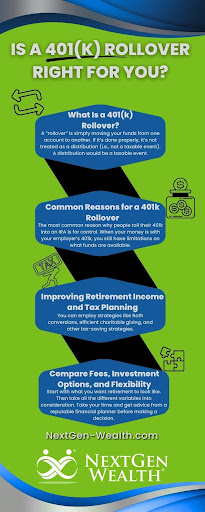
What Is a 401(k) Rollover?
In short, a “rollover” is simply when you move your funds from one account to another. The key aspect of a rollover is that, if it’s done properly, it’s not treated as a distribution (i.e. not a taxable event). A distribution would be a taxable event.
This allows you to move your money to another financial institution while continuing to defer taxes. You can keep your money invested, except for the short time it takes to transfer. However, this usually happens pretty quickly.
How a Rollover Works
You have two options for rolling over your 401 (k). You can have the money distributed to you and then deposit the money, but this isn’t preferred because you’ll have to withhold taxes. The better option is to complete a direct rollover.
You’ll need to have a “like-item” account open at the receiving institution first. For your 401k, you’ll need to roll into an IRA or another 401k. If you’re retiring with both traditional and Roth 401k balances, you’ll need both a traditional IRA as well as a Roth IRA.
Common Reasons People Roll Over Old 401(k)s
The most common reason why people roll their 401k into an IRA is for control. When your money is with your employer’s 401k, you still have limitations on what funds are available. Traditionally, these are also more expensive than what you could invest in on your own.
Another reason is if you want to work with a financial planner. For most financial planners, you’ll roll your 401k to an institution where they have an established relationship.
The money remains in your account, and they’ll have “discretionary” authority to make trades, rebalance, and make distribution requests on your behalf. Many financial planners can also withdraw their fees directly from your account, called an assets under management (AUM) billing model.
Simplifying Your Retirement Accounts
Many retirees enter retirement with multiple employer accounts. You might have a 401k, a pension lump sum, and another account like a 403b, 457, or even another IRA. Picking one account to roll everything into greatly simplifies your financial life.
Instead of rebalancing each account individually, you can manage one account. This will also greatly simplify things when it comes time for required minimum distributions (RMDs). You must calculate the RMD for each individual account (usually done by the custodian where your money is held).
Expanding Your Investment Options
Another big reason to do a 401k rollover is to expand your investment options. In most cases, your employer plan will have a standard set of target date funds as well as a handful of other mutual and index funds. It can be difficult to find the right mix of low-cost funds to meet your needs.
For most folks in their accumulation phase, a target date fund is a great option. However, these are typically fairly safe options with slightly lower yields than you might get otherwise. You or your financial planner may be able to design a better low-cost, diversified portfolio to match your retirement wants and needs.
Improving Retirement Income and Tax Planning
Once you reach retirement with all the funds you need, taxes become one of your biggest hurdles. There are a variety of tax-saving strategies for retirees, but it can be confusing to know which one is best for you. In many cases, planning early can save you a significant amount of money on taxes in retirement.
You can employ strategies like Roth conversions, efficient charitable giving, and others. You’ll always have taxes to contend with, but you don’t want to pay extra.
Image Credit: NextGen Wealth
When You May Want to Keep Your 401(k) Where It Is
In some cases, it may be better to leave your 401k right where it is. It’s best to evaluate this decision with eyes wide open on each possible option.
Access to Low-Cost Institutional Funds
As time goes on, more and more 401k providers are offering lower-cost fund options. It used to be common to see expense ratios of 1% or more. This is less and less common today.
Many target-date, index, and mutual funds are available in employer plans at competitive expense ratios. Many of these might be well below 0.5%. However, the 401k plan may have additional administrative or advertising fees (12b-1 fees) baked in.
Check your employer plan documents and each individual fund prospectus to see what fees you’re paying. Most seem minimal, but once you add them all up, it could be more than you think.
Creditor Protection and Plan-Specific Benefits
For most people with a large 401k balance, bankruptcy isn’t a primary concern – at least initially. With the high cost of medical care and uncovered long-term care expenses, the threat of bankruptcy is probably slightly more than zero.
If you’re thinking about retiring before reaching age 59-1/2, then you may want to consider the “rule of 55” before you complete a 401k rollover. In short, the rule of 55 is an exemption to the early withdrawal penalty. If you terminate employment after age 55, you can make penalty-free withdrawals from your 401(k).
You may also be able to complete a partial rollover. This would allow you to move most of your money into your IRA, leaving your living expenses covered until you reach age 59-1/2 in your 401 (k).
Key Tax Traps to Avoid
As with any movement of money, there’s generally a little risk involved. However, if you plan it out, you shouldn’t have much trouble.
Rolling Pre-Tax Money Into the Wrong Account
The biggest mistake folks make is rolling funds into the wrong type of account. The best way to avoid this is to make sure you know what “flavor” of money you have. You want to roll traditional “pre-tax” money into a regular, traditional IRA – not a Roth IRA. If you make this mistake, it’ll be treated as a Roth IRA conversion and be a taxable event.
On the other hand, you want to make sure to roll Roth 401k balances into a Roth IRA. Just remember to match “like items” across different types of accounts.
Missing the 60-Day Rollover Window
Another mistake is missing the 60-day rollover window. If you opted to have your 401k distributed to you and then deposit the check yourself, you run the risk of missing the 60-day rollover window. There are waivers to the 60-day rollover window, but we’d recommend not chancing it.
At the end of the day, you need to come back to what’s best for your personal situation. It may mean leaving your money right where it is. It could also be rolling over to a different financial institution, so you or your advisor can manage it the way you want.
Compare Fees, Investment Options, and Flexibility
It’s best to look at all the numbers first. Check fees in your current 401k (including the fees within individual funds we talked about) and compare those to other options you might have in your IRA. However, higher fees don’t mean it’s all bad if the fund options are good.
The next step is to look at which funds will give you the best options. Keep in mind, nobody can guarantee performance, and just because a fund did well in the past doesn’t mean it will continue to do so. Make sure you compare the same timeframes (e.g., 10-year returns for both funds).
Consider Your Retirement Timeline
The first variable you should start with is what you want retirement to look like. It’s not simply a matter of not working anymore. You’ll fill your days with something.
Start exploring and planning your retirement timeline. In other words, carefully define what you’re retiring to, not just what you’re retiring from.
Talk Through the Decision Before Moving Money
Finally, we recommend getting advice and counsel from a variety of sources. What to do with your 401k may be one of the largest financial decisions you’ll ever make. It’s best to get as much info as possible, take time to sleep on it, and then make an informed decision.
This article reflects the insights and opinions of its author and is not a recommendation or endorsement of their views or services.
Clint Haynes, CFP®Helping you build a retirement with pleasure, purpose, and peace of mind.
[The explosion of ETFs and ETF issuers is increasingly creating a marketplace quagmire and a growing quandary for investors. ETFs with similar names or objectives can look alike, but may differ significantly in holdings, sector exposure, geographic exposure, weighting methodology, concentration, income characteristics, and risk. Standardized and extremely granular ETF reference data, along with detailed classifications, have become necessary to help investors make more accurate comparisons and avoid relying only on a fund’s name or broad category.
There are also a host of other important data issues involved, especially in engineering the data quality needed for effective AI usage in research and portfolio construction. Data design and data platforms are becoming important areas for InvestTech innovation.
To better understand the vital need for this data management solution, we spoke with Jack Kimmel, VP, Business Development and Edward Silverstein, Director, Business Development and Co-Head EMEA atETF Global – a leading independent provider of enterprise-grade ETF reference data and analytics, and host of the semiannualETP Forum dedicated exclusively to the global Exchange-Traded Products ecosystem. ETF Global’s next ETP Forum will take place in New York City on November 10, 2026.]
Hortz: What are the key issues and hidden risks for investors amid the explosion of ETF choices?
Silverstein: With the rush of ETF sponsors and products coming into the market, many ETFs may share similar names, investment objectives, or broad categories while providing investors with significantly different exposures that can ultimately produce very divergent and unexpected portfolio outcomes.
Kimmel: The continued growth of the ETF market has made product selection more complicated, not less. Investors now have access to multiple funds targeting many of the same themes, sectors, asset classes, and strategies. Small differences in investment methodology or ETF portfolio construction can have a meaningful impact over time, making timely and standardized reference data increasingly important for advisors, institutions, researchers, and other market participants
.
Hortz: As an ETF data provider, how are you addressing these issues?
Silverstein: As the ETF universe continues to evolve and products become increasingly specialized, having a more granular framework for understanding these differences becomes increasingly important. We see clients compute incredibly selective universes of ETFs, and a granular understanding of fund-level characteristics is paramount to selecting the appropriate vehicle.
ETF Global’s Expanded ETF Taxonomy is specifically designed to provide that deeper level of classification. The taxonomy classifies U.S. Listed ETFs across asset and geographic segmentations, as well as Product Structure, Strategy, Style, and Exposure attributes.
Jack Kimmel: Within the Expanded Taxonomy, we also maintain 1,557 unique classification combinations across eight primary taxonomy categories, helping distinguish products that may appear similar at first glance but provide meaningfully different investment exposures.
Hortz: What are other ways that you develop and ensure more granular data?
Silverstein: We source and maintain our data directly from ETF issuers through our Data Consortium. Each night, ETF Global receives direct feeds from U.S.-listed ETF issuers, enabling us to maintain the most accurate, granular, and timely ETF data across the marketplace.
Kimmel: Let me emphasize, though, that a strong ETF data infrastructure requires more than simply collecting quality information. It requires consistent classifications, standardized fields, careful validation, timely updates, and a clear understanding of how different data points should be interpreted.
ETF Global’s work with market participants through its Data Consortium helps support this broader effort by encouraging collaboration and improving the consistency and credibility of ETF information across the industry by building confidence through data standards.
Hortz: How does more granular and standardized data support the increasing usage of AI by investment managers in investment research and portfolio construction?
Silverstein: Bottom line, the quality of AI depends on the quality of its data. Artificial intelligence can process large amounts of information quickly, but the reliability of its output remains dependent on the quality of the underlying data.
An AI model analyzing incomplete information may reach a very different conclusion than one working with complete and accurately classified portfolio holdings. As AI becomes more widely integrated into investment research and product comparison, data integrity, timeliness, and granularity will become essential.
Hortz: Is there long-term value to reliable ETF data?
Kimmel: The value of ETF data is not limited to a single trade or portfolio decision. Accurate, timely, and detailed information supports product research, risk analysis, portfolio construction, regulatory review, academic research, artificial intelligence applications, and long-term investment oversight.
Maintaining the integrity of that information over time is essential to helping market participants understand what they actually own and how small ETF differences can have a big impact on their portfolio.
Readers interested in exploring these distinctions can request a complimentary trial of ETF Global’s data and analytical capabilities.
Ed Silverstein: One theme that continues to emerge during ETF Global’s biannual ETP Forum is the need for deeper, more dependable ETF analysis and greater visibility into the data below the water line. As products become more sophisticated and investors gain access to an increasing number of seemingly similar choices, in-depth ETF data can be used to uncover hidden impacts on risk and returns.
This conversation will continue during the next ETP Forum on November 10, where ETF investors and industry professionals will examine the trends shaping the next stage of ETF market growth.
Bill Hortz is an independent business consultant and Founder/Dean of the Institute for Innovation Development- a financial services business innovation platform and network. With over 30 years of experience in the financial services industry including expertise in sales/marketing/branding of asset management firms, as well as, creatively restructuring and developing internal/external sales and strategic account departments for 5 major financial firms, including OppenheimerFunds, Neuberger&Berman and Templeton Funds Distributors. His wide ranging experiences have led Bill to a strong belief, passion and advocation for strategic thinking, innovation creation and strategic account management as the nexus of business skills needed to address a business environment challenged by an accelerating rate of change.
What this article covers
XY Planning Network is a network of more than 2,200 fee-only financial advisors who sign a fiduciary oath, serve clients virtually, and offer financial planning without requiring a minimum account size. This guide explains what XYPN is, what its members agree to, what they charge, who they serve, and how to find and vet the right XYPN advisor for your situation, including advisors featured on Wealthtender with verified client reviews.
Key Takeaways
1
Every XY Planning Network advisor is a fee-only fiduciary with no required account minimum
XYPN members sign a fiduciary oath and are paid only by their clients, using the CFP Board’s definition of fee-only. Members must also offer financial planning without requiring a certain asset level, which is why XYPN advisors work with people who are still building wealth, not only those who already have it.
2
The network has grown past 2,200 advisors serving roughly 100,000 client households
XYPN reports more than 2,200 advisors today, up from 1,000 in 2019. Member firms served about 100,000 client households as of early 2025, and 456 advisors joined in 2024 alone, the network’s largest single year. That growth has been organic rather than driven by acquisitions or private equity.
3
Specialization, not geography, is the reason to shop the network
Every XYPN advisor can work with you virtually, so the right advisor is rarely the closest one. Members build practices around specific professions, life stages, family structures, and planning needs, which means you can look for someone who already understands your situation instead of explaining it from scratch.
Unlike many financial advisors, XYPN advisors do not set asset minimums, and the network grew up serving Generation X and Generation Y (Millennial) individuals and couples who were often turned away elsewhere.
Many XYPN advisors hold the CERTIFIED FINANCIAL PLANNER™ (CFP®) designation, and XYPN requires it for any member who wants to be listed in its public Find an Advisor directory. Every XY Planning Network advisor can also work with you virtually, so you can choose the right professional for your circumstances rather than the one who happens to live nearby.
XYPN Advisors in the Spotlight This Month (Randomly Selected):
📍 Click a pin in the map view below to preview financial advisors affiliated with the XY Planning Network who can help you reach your money goals with a personalized plan. Or choose the grid view to search our directory with additional filtering options, including advisors with verified Certified Advisor Reviews™ from their clients.
The idea behind the XY Planning Network took shape in 2012. Alan Moore was 25 years old and could not keep a job at any financial planning firm. When he decided to start his own, he realized he did not know many wealthy 65-year-olds with million-dollar accounts who would pay him 1% of their portfolio.
He did know a lot of 30 and 40-year-olds, so he decided to serve them and charge a fee for advice rather than a percentage of assets he did not have to manage. Eventually he emailed industry researcher Michael Kitces to say he believed there was an opportunity to help advisors start and run firms built around younger clients.
Kitces replied with a multi-thousand-word email agreeing, and with plenty of ideas on how to make it work. Five months later, XY Planning Network was born. Today XYPN describes itself as the leading support platform for fee-only financial planners who want to build an independent firm with complete autonomy, and it is one of the largest communities of fee-only advisors in the country.
XYPN advisors go beyond investment advice and offer comprehensive financial planning. Members commonly help clients with estate planning, insurance planning, tax planning, retirement planning, equity compensation, student loans, and career decisions.
XYPN by the numbers
2,200+
fee-only advisors in the network
~100,000
client households served by member firms
$0
required account minimum to get financial planning
100%
of members sign a fiduciary oath
Sources: XY Planning Network (advisor count and membership standards, 2026) and XYPN’s March 2025 growth announcement (client households). Figures reflect XYPN’s own reporting and change over time.
XYPN’s own reporting shows how quickly that community has grown. The network welcomed its 1,000th advisor in 2019. In 2024 it added 456 advisors, its largest single year, and registered 267 new RIA firms through its compliance service. XYPN also reported that member firms grew their client base by an average of 18% that year, against a 6.2% industry average, and its leadership has emphasized that the expansion has been organic rather than the result of acquisitions or private equity money.
“
XYPN advisors are fee-only fiduciaries, so you do not have to question if the advisor has your best interests in mind. Most do not require a minimum asset level like some of the larger firms, and since they are fee-only, you do not have to worry about getting sold a life insurance policy you do not need like some of the insurance-based firms.
Members connect with one another through private forums where they ask questions, trade feedback, and work through complicated client situations together. XYPN also gives members compliance support, business coaching, discounted access to planning and portfolio technology, and, for members who hold the CFP® designation, a listing in its public Find an Advisor directory.
“
It is extremely important for Millennials and Gen Z individuals to start financial planning. In fact, it may be more important to start planning at a young age than any other time in your life, since you are setting a foundation for savings habits, budgeting, choosing workplace benefits, and more. Choosing the right accounts to begin saving into is extremely important when you consider the compounding effect of these investments.
XYPN was built around advisors who wanted to serve Generation X and Generation Y clients, and that is still the network’s center of gravity. It is worth being precise about one thing, though: a client-age focus is no longer part of XYPN’s published membership standards. Today those standards center on the fiduciary oath, fee-only compensation, planning without an asset minimum, virtual service, and background screening. In practice, many XYPN advisors work happily with clients in their 50s, 60s, and beyond.
What most members do have is a specific area of specialization, or niche. An advisor’s niche usually reflects who they enjoy working with, the problems they like to solve, and how they want to engage with clients.
If you want highly specialized service, there is a good chance you can find an XYPN advisor who works with people just like you. The benefit is real: an advisor who already understands your profession, your benefits package, or your family situation spends less time getting up to speed and more time giving you advice.
What Are the Requirements to Become an XYPN Financial Advisor?
To join and remain in the XY Planning Network, an advisor has to meet the network’s published membership standards. These are the commitments that sit behind the XYPN name:
XYPN membership standards
1
Sign a fiduciary oath
Every XYPN member signs a fiduciary oath, committing in writing to act in the client’s best interest.
2
Be paid only by clients
Members must operate on a fee-only basis, using the CFP Board’s definition: all compensation from all client work comes exclusively from clients as fixed, flat, hourly, percentage, or performance-based fees. No commissions, and no payments from fund companies or insurers.
3
Offer planning without an asset minimum
Members must be able to deliver financial planning without requiring a client to bring a certain level of assets. Fees can still be structured as a flat fee, an hourly rate, a retainer, or a percentage of assets.
4
Serve clients virtually
Members must be able to accommodate clients regardless of location, mobility, or accessibility needs. Where you live should not limit who you can hire.
5
Pass BrokerCheck screening
Every applicant is screened through BrokerCheck, FINRA’s public database of brokers and advisers. No advisor is approved with a regulatory fine, arbitration, or settlement in excess of $10,000.
6
Break cleanly from commission business
Advisors coming from a commission background must stop selling new products, eliminate any remaining trail commissions within 12 months, and may not describe themselves as fee-only while trails are still being paid.
One note for anyone comparing this article to an older version of it: XYPN once listed a Generation X and Generation Y client focus among its membership requirements. That is no longer a published standard. The network still skews heavily toward advisors serving younger and mid-career clients, but you should evaluate an individual advisor on who they actually serve, not on an assumption about the network.
Should You Hire an XYPN Advisor with a Specialty Focus?
Many XY Planning Network advisors have developed areas of specialization to serve clients who share a profession, a life stage, a set of values, or a specific planning problem. Common specialties across the network include:
Business and ownership
Business owners, family businesses, nonprofit leaders, and private foundations.
Career stage
Recent graduates, mid-career professionals, established professionals, and career changers.
What XYPN Advisors Say About Hiring an Advisor in the Network
We asked XY Planning Network advisors featured on Wealthtender why someone might want to hire an advisor in the network. Here is what they had to say:
“
XYPN members are not just fee-only fiduciaries (required to provide advice in your best interest); they understand the importance of specialization and providing a personalized experience. The network truly embodies an abundance mindset where members work together to advance the financial planning profession. No matter your income or assets, there is an advisor in the network that is willing to help you with your specific needs.
XYPN members must have a financial planning-centric approach, and working with an XYPN advisor is a great way for individuals and families to access financial planning without needing a certain portfolio size to invest. Many XY Planning Network advisors offer investment management as well, but flat-fee pricing that does not require managed investments is common. Another great thing about XYPN is that it is a network of advisors who are eager to share their knowledge and experience when other members have complex client-related questions, ultimately leading to better client advice and outcomes.
XYPN is a network of fee-only, fiduciary advisors geared toward serving Gen X and Gen Y. Breaking that down: the network was founded keeping in mind that finding a trusted advisor is tough, so expect any advisor you find through XYPN to have your best interest in mind, which is surprisingly uncommon in the financial industry. They are also compensated only by the client, so they do not make money peddling you substandard funds or insurance for a kickback. Lastly, a lot of advisors cater to the younger generation, so even if you do not have a million dollars to manage, they are able to serve you effectively.
Advisor comments reflect their own opinions about the XY Planning Network and are not client testimonials. They are not an endorsement of any individual advisor by Wealthtender, and they are not a guarantee of any outcome. Please conduct your own due diligence before hiring any financial advisor.
How Much Does It Cost to Hire an XY Planning Network Financial Advisor?
XYPN advisors are paid only by their clients. They do not earn commissions, and they are not compensated by a mutual fund company, brokerage firm, or insurance company. Because members must be able to deliver planning without an asset minimum, many price their services in ways that traditional firms do not. You can expect one of these four structures, or a combination of them:
Flat fee
One agreed price for a defined set of services, set in advance. Useful when you want a plan, a second opinion, or help with a specific decision without an ongoing commitment.
Hourly rate
You pay for the time your advisor spends with you. Straightforward, and often the least expensive way to get professional advice on a narrow question.
Monthly or quarterly retainer
A recurring fee, similar to an ongoing subscription. A good fit if you want your advisor to build a plan, help you carry it out, and stay with you as your situation changes.
Percentage of assets under management
Your advisor charges a percentage of the assets they manage for you, typically deducted quarterly. Common when investment management is a meaningful part of the engagement.
XY Planning Network advisors are required to be transparent about how they charge. Before you agree to work with anyone, you should know exactly what you will pay, how it is calculated, and when it is due. Most advisors publish this on a pricing or services page of their own website, and every advisor featured on Wealthtender displays their fee structure on their profile.
Should I Hire an XY Planning Network Financial Advisor?
If you want advice from someone who is paid only by you, who has agreed in writing to act in your best interest, and who will work with you whether or not you have a large portfolio, an XY Planning Network advisor belongs on your shortlist.
The network is not the only place to find a fee-only fiduciary, and XYPN membership is not a substitute for your own due diligence. But it does screen for things that matter: compensation, disclosure history, and a commitment to planning rather than product sales. Combine that with an advisor whose specialty matches your situation and whose fee structure fits how you want to work, and you have a strong short list.
How to Find the Best XYPN Financial Advisor for You
With more than 2,200 XY Planning Network advisors across the country, you have a wide range of professionals to consider, nearly all of whom can work with you no matter where you or they live. You may find an XYPN advisor nearby, or you may find one several states away whose specialization is a much better fit for your circumstances.
You will find a growing number of XY Planning Network advisors on Wealthtender, where you can compare profiles, read verified Certified Advisor Reviews™ from their clients, and reach out directly. You can also search XYPN’s own Find an Advisor directory, or browse other financial advisor directories to widen your search.
FAQs About the XY Planning Network
Do XY Planning Network advisors have account minimums?
No. XYPN’s membership standards require members to offer financial planning without requiring a client to bring a certain level of assets. Individual advisors still set their own fees, and some have a minimum fee rather than a minimum account size, so ask about pricing early in your first conversation.
How much does an XY Planning Network financial advisor charge?
It depends on the advisor and on what you need. XYPN members are fee-only, so all of their compensation comes directly from clients, typically as a flat project fee, an hourly rate, a monthly or quarterly retainer, a percentage of assets they manage, or a combination. Advisors are required to be transparent about pricing, and you can compare fee structures on advisor profiles here on Wealthtender.
Are all XY Planning Network advisors CFP® professionals?
Not every member holds the designation, but XYPN requires the CERTIFIED FINANCIAL PLANNER™ (CFP®) certification for any member who wants to be listed in its public Find an Advisor directory, so the advisors most consumers encounter through XYPN are CFP® professionals.
CFP® professionals hold a bachelor’s or graduate degree from an accredited college or university, complete a CFP Board-registered education program, pass the CFP® exam, and complete either 6,000 hours of professional financial planning experience or 4,000 hours through an apprenticeship. They also complete 30 hours of continuing education every two years and commit to CFP Board’s fiduciary standard.
Do XYPN advisors only work with Gen X and Millennial clients?
No. XYPN was founded to help advisors serve Generation X and Generation Y clients profitably, and that remains the network’s heritage and much of its membership. A client-age focus is no longer part of XYPN’s published membership standards, though, and plenty of members work with retirees, pre-retirees, and clients of every age. Check an individual advisor’s profile to see who they actually serve.
How do I check an XYPN advisor’s background and disciplinary history?
XYPN screens every applicant through BrokerCheck and does not approve advisors with a regulatory fine, arbitration, or settlement in excess of $10,000. You can and should verify independently: search the advisor and their firm on FINRA’s BrokerCheck and on the SEC’s Investment Adviser Public Disclosure site, and read the firm’s Form ADV Part 2 brochure.
If you have a concern about a specific advisor, the firm itself is the first place to raise it, followed by the state securities regulator or the SEC, depending on where the firm is registered. XYPN retired the standalone consumer complaint form that was previously published on its website.
How do I learn more about a specific XYPN financial advisor?
Most XYPN members who hold the CFP® designation have a profile in XYPN’s Find an Advisor directory, searchable by niche, specialty, keyword, and location. Each profile includes a photo, a description of the advisor’s services and specialties, a website link, and a way to get in touch.
Advisors featured on Wealthtender go a step further. Their profiles include their fee structure, their areas of specialization, links to their published articles, and verified Certified Advisor Reviews™ from clients who have actually worked with them.
Is the XY Planning Network the same as NAPFA or the CFP Board?
No. They do different things. The CFP Board is the certifying body for the CFP® designation. NAPFA is a professional association of fee-only advisors. XYPN is a support platform and business ecosystem for independent fee-only firms, providing compliance support, technology, community, and back-office services, along with a consumer-facing advisor directory. Many advisors belong to all three.
Are you a financial advisor thinking about joining the XY Planning Network?
We invite XY Planning Network advisors featured on Wealthtender to share their perspective with other advisors considering membership. Here is what they have to say:
Vrishin Subramaniam (CapitalWe):“If you are a new advisor or career changer looking to serve Gen X and Millennial clients, I would highly recommend it. As a career changer, I wanted to stay away from the traditional sales-heavy model. The cost of membership included a ton of advantages, including software and pricing discounts along with support for compliance and other aspects of running your firm. They also have a community forum where I was able to get a lot of support from other advisors. If you are starting out or want to pivot toward a fee-only model and serve younger clients, and your intent aligns with the network’s mission, I would urge you to consider joining.”
TJ van Gerven (Memento Financial Planning):“I would not have been able to launch my firm when I did without the help of XYPN. For advisors looking to go independent or build a firm from scratch, joining XYPN is a no-brainer. Even beyond launching a firm, the network provides crucial fintech, compliance support, and community.”
Are you an XYPN financial advisor interested in joining Wealthtender?
Please check your XYPN membership benefits portal to learn more.
Next step
Compare XYPN advisors, then talk to two or three
Most first conversations are free and last about 30 minutes. Head back up to the XYPN advisor directory on this page, compare profiles and verified client reviews, and reach out to the advisors whose specialty and fee structure fit your situation.
Anna Baluch is a freelance personal finance writer from Cleveland, Ohio. Her work has appeared on sites including The Balance, Freedom Debt Relief, LendingTree, and RateGenius. Anna holds an MBA in marketing from Roosevelt University. You can reach her on LinkedIn.
What this article covers
The SEC Marketing Rule changed the game for financial advisors. Client testimonials are now a legitimate and powerful marketing tool, and the advisors using them are converting more referred prospects into clients than those who aren’t. But “using testimonials” and “using testimonials compliantly” are meaningfully different things, and the gap between them is where most advisors run into trouble. This guide covers exactly how to display client reviews on your financial advisor website, including what the SEC requires when you show all your reviews versus just a curated few, two proven implementation approaches for different firm sizes, step-by-step instructions for adding Wealthtender widgets to your site, and a tool that writes the handoff email to your website developer for you.
In this guide, learn how to add widgets from Wealthtender to display testimonials on advisor websites compliantly. Whether you’re creating a dedicated testimonials page, adding reviews to your homepage and bio pages, or simply trying to explain what you need to your website developer, you’ll find step-by-step instructions, links to live examples, an interactive tour of your embed codes, and answers to frequently asked questions to help you leverage the power of social proof while staying within regulatory guidelines.
Displaying testimonials compliantly takes more than copying and pasting a review.
The SEC Marketing Rule sets different disclosure requirements depending on how many reviews you display and where. When a widget shows all of your reviews, the built-in disclosures on a compliant platform like Wealthtender generally satisfy the requirements. When you feature just one or a select few, in a homepage carousel or a social media post, you must also disclose that the views shown are not representative and provide easy access to your complete review history. Getting this wrong is one of the most common compliance missteps in advisor testimonial marketing.
2
83% of consumers say online reviews are the first thing they look for after being referred to a financial advisor.
The referred prospect who Googles your name before calling is making a hiring decision, not browsing. An advisor website with no visible testimonials, or with testimonials displayed without proper disclosures, loses that prospect to a competitor who made it easier to feel confident. Wealthtender embed widgets address both problems at once: they display your complete review history automatically and include the required regulatory disclosures by design.
3
A testimonial carousel and a Wealthtender widget are two different things, and most firms end up using both.
A carousel is something your website developer builds using your website platform’s own component. It shows a curated few reviews, which is exactly why it needs disclosure text directly beneath it. A Wealthtender widget is a snippet of code your developer pastes in, and it shows every review with the required disclosures already attached to each one. Confusing the two is the single most common reason an implementation stalls.
4
The step that stalls most implementations is the handoff to your website team, not the compliance.
Most advisors know what they want on their site. Far fewer know how to explain it to a web developer in terms that come back correct the first time. This guide includes a tool that writes that email for you, with your firm name, your review link, and the required disclosure language already filled in.
Why 83% of Referred Prospects Look for Reviews Before Calling and What That Means for Your Website
Testimonial marketing is quickly becoming an integral component of effective growth strategies employed by advisors and wealth management firms for three key reasons:
1
Building Trust with Prospects
When potential clients research financial advisors online, testimonials provide the social proof they need to feel confident about scheduling an introductory call. Reviews published on third-party platforms like Wealthtender and displayed on advisor websites demonstrate the real-world experiences of clients that offer prospects a glimpse of what to expect.
An August 2025 Wealthtender consumer study reinforced the reasons why financial advisors interested in getting found and hired should incorporate online reviews and testimonials in their marketing plans. The report showed that almost all Americans preparing to hire financial advisors will research at least two advisors online before making a hiring decision, and 83% of consumers ranked online reviews as the first thing they will look for after being referred to an advisor.
With fewer than 10% of advisors currently using testimonials in their marketing activities, it’s no surprise why advisors with online reviews and testimonials published on their websites are most likely to get the first call.
Wealthtender consumer researchWhat people do first after being referred to a financial advisor. August 2025 study of Americans preparing to hire an advisor.
2
Search Engine Optimization (SEO)
Traditional search engines like Google and Bing reward advisors who publish authentic client testimonials on their websites and who have positive reviews on reputable third-party platforms. Online review platforms like Wealthtender use SEO best practices like ‘review schema’ when coding advisor profile pages to ensure search engines recognize the reviews and ingest them properly to improve their effectiveness. With proper coding, these testimonials send positive trust signals to search engine algorithms, helping advisors rank higher in search results. And consumers are drawn to search results that display gold stars.
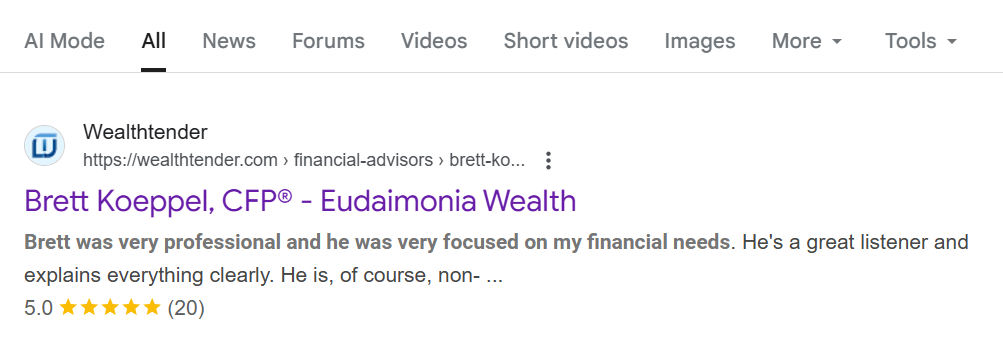
Example of a Google search result listing displaying gold stars from reviews published on Wealthtender.
3
AI Platform Discovery
As more consumers turn to AI tools and answer engines like ChatGPT, Perplexity, and Google AI Overviews to find and research financial advisors, these platforms actively scan for credible online reviews and testimonials. Advisors with a robust collection of reviews and testimonials online are more likely to be recommended by AI tools in generated answers to consumer queries. As FMG Chief Evangelist Samantha Russell often suggests, online reviews represent one of the most important elements of an effective Answer Engine Optimization (AEO) strategy, and Wealthtender offers one of the most impactful AI-optimization tools for advisors and wealth management firms.
The combination of these three factors means that advisors who embrace testimonial marketing today position themselves to capture a disproportionate share of new client opportunities in the years ahead. By combining the power of online reviews published on Wealthtender with the testimonial marketing tools provided by Wealthtender to display reviews compliantly on advisor websites, in social media posts, and other marketing materials, financial advisors and wealth management firms can stand apart from more than 90% of all advisors and expect to convert more prospects into clients.
Wealthtender consumer researchThe highlighted rows show that consumers trust reviews on an independent third-party site more than testimonials published on an advisor’s own website.
Independent research backs this up. The 2026 Kitces Report on how advisors market their services found that practices displaying reviews on their own websites spent just $0.13 on this tactic for every $1 of new client revenue, compared with roughly $0.85 for practices that collect Google reviews but don't feature reviews on their site. Yet only about a third of advisors using review platforms display reviews or testimonials on their website. For more, see our breakdown of the 2026 Kitces Report.
SEC Disclosure Requirements for Financial Advisor Testimonials: What You Need to Know
While the SEC Marketing Rule now permits financial advisors to use client testimonials in advertisements, the regulations come with specific requirements that must be followed carefully. This is especially important when choosing how you will display reviews on your website. Before inviting clients to write reviews or publishing testimonials online, be sure to speak with your compliance officer for regulatory guidance and to ensure adherence to firm policies and procedures.
The Three Disclosures the SEC Requires on Every Promoted Testimonial
The SEC makes it clear that every promoted testimonial should ‘clearly and prominently’ disclose details intended to provide consumers with important information to judge the merits of each review, including:
The three ‘clear and prominent’ disclosures
1
Is the reviewer a client or a non-client?
A prospect reading a glowing review deserves to know whether the person writing it has actually worked with you.
2
Was any cash or non-cash compensation paid for the review?
This covers more than money. Gift cards, charitable donations, and discounts on your fee all count.
3
Do any conflicts of interest exist that may have influenced the reviewer?
A reviewer who is also a business partner, a referral source, or a family member has a relationship a prospect should know about.
The SEC expects these three clear and prominent disclosures to always be visible alongside the review. In other words, clear and prominent disclosures effectively become a part of the review itself and cannot be hidden or accessible only via a link.
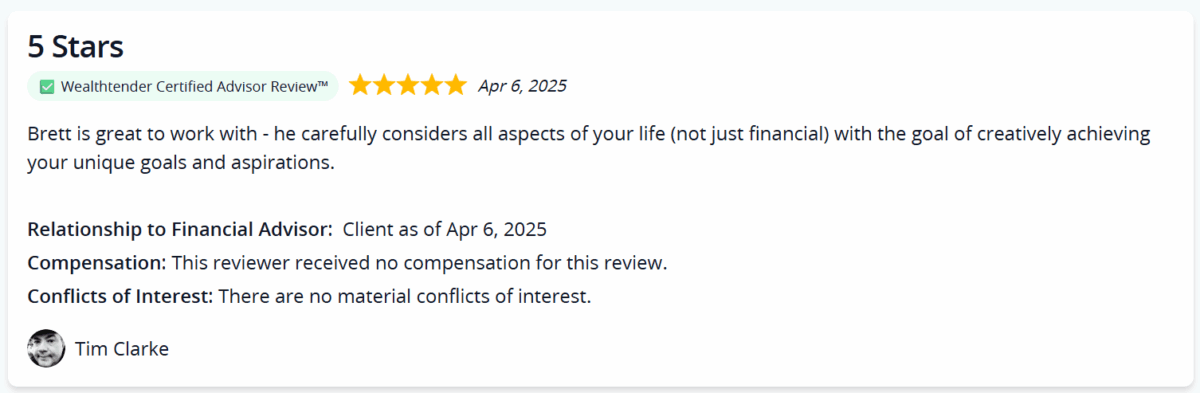
Review with its disclosuresAn online review published on Wealthtender with the accompanying ‘clear and prominent’ disclosures required by the SEC Marketing Rule.
When all reviews for a financial advisor are displayed in one place, for example on an advisor’s Wealthtender profile page or a dedicated testimonials page on an advisor’s website, then these three clear and prominent disclosures may be the only ones required, as shown in the screenshot just above extracted from an advisor’s Wealthtender profile page. But if you wish to promote a single review, say in a social media post, or a handful of reviews in a carousel of three on your homepage, additional disclosures must be added to satisfy regulatory requirements as we’ll discuss next.
What Changes When You Feature Just One or a Few Reviews: The “Not Representative” Requirement
When you display just one or a select few testimonials in your marketing activities, for example on your homepage, additional disclosure requirements apply. Specifically, your disclosures must also indicate that the single or selected reviews are ‘not representative’ and you must provide easy access for consumers to view all, or a representative selection, of your reviews, most often by sharing a URL or QR code.
This increases transparency and reduces the optics that you’re only showing your best testimonials while hiding less favorable feedback. Linking to your Wealthtender profile page where all reviews are accessible, or to a dedicated testimonials page on your website that includes all of your reviews, can satisfy this critical compliance requirement.
Let’s consider two examples.
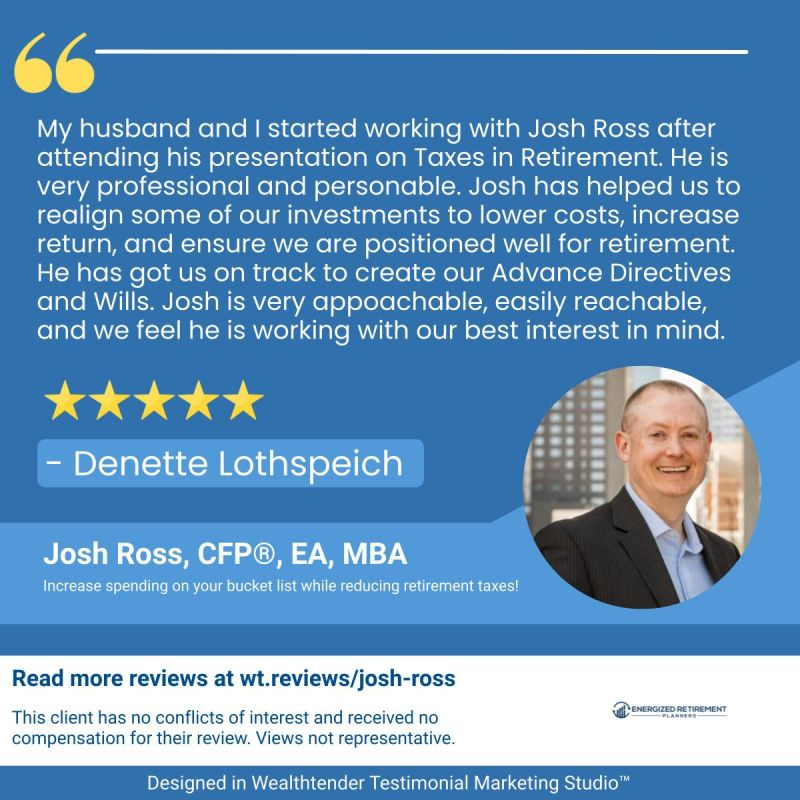
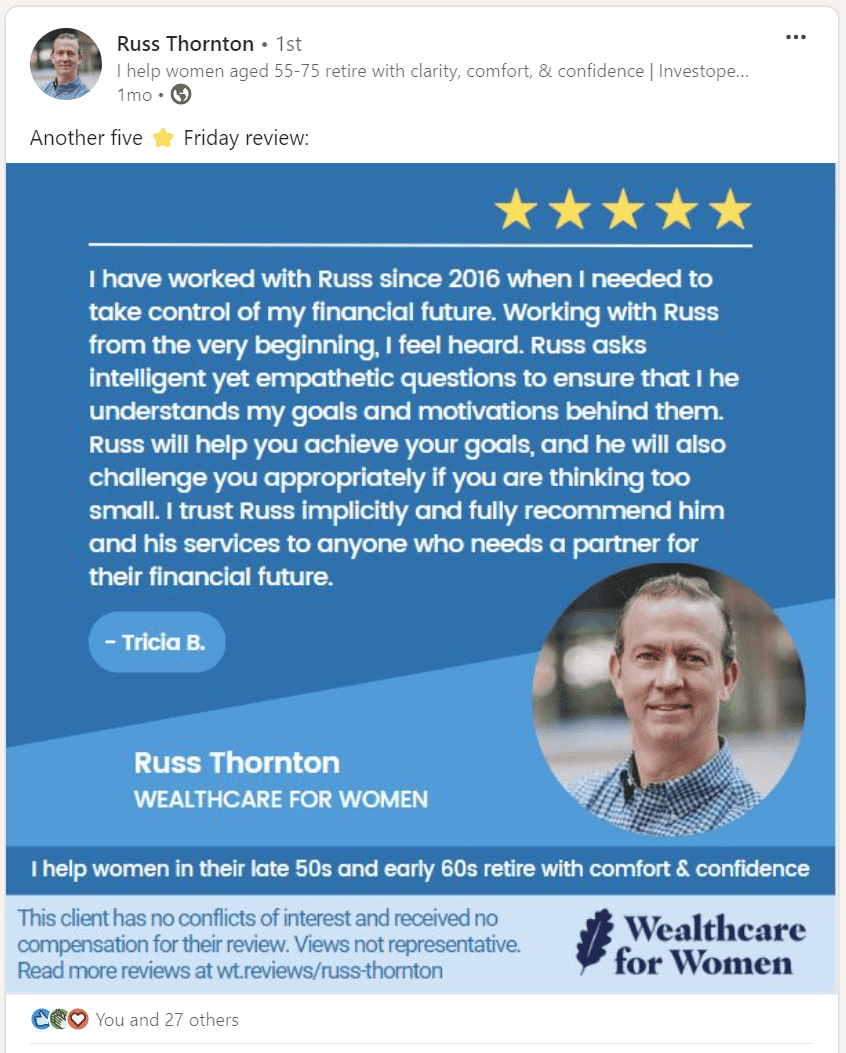
First, in the screenshot just below, a single testimonial is featured in a social media post that satisfies the SEC Marketing Rule disclosure requirements as follows:
The three ‘clear and prominent’ disclosures are conveyed in the first sentence within the disclosure area.
The second sentence addresses the ‘views not representative’ disclosure requirement.
The ‘Read more reviews…’ statement satisfies the regulatory requirement to provide consumers with an easy ability to access and read all reviews for this advisor, available by visiting the URL: wt.reviews/josh-ross
Compliant social media postExample of a compliant social media post displaying a single testimonial. The three ‘clear and prominent’ disclosures are conveyed in the first sentence within the disclosure area. The second sentence addresses the ‘views not representative’ disclosure requirement. And the ‘Read more reviews…’ statement satisfies the regulatory requirement to provide consumers with an easy ability to access and read all reviews for this advisor, available by visiting the URL: wt.reviews/josh-ross
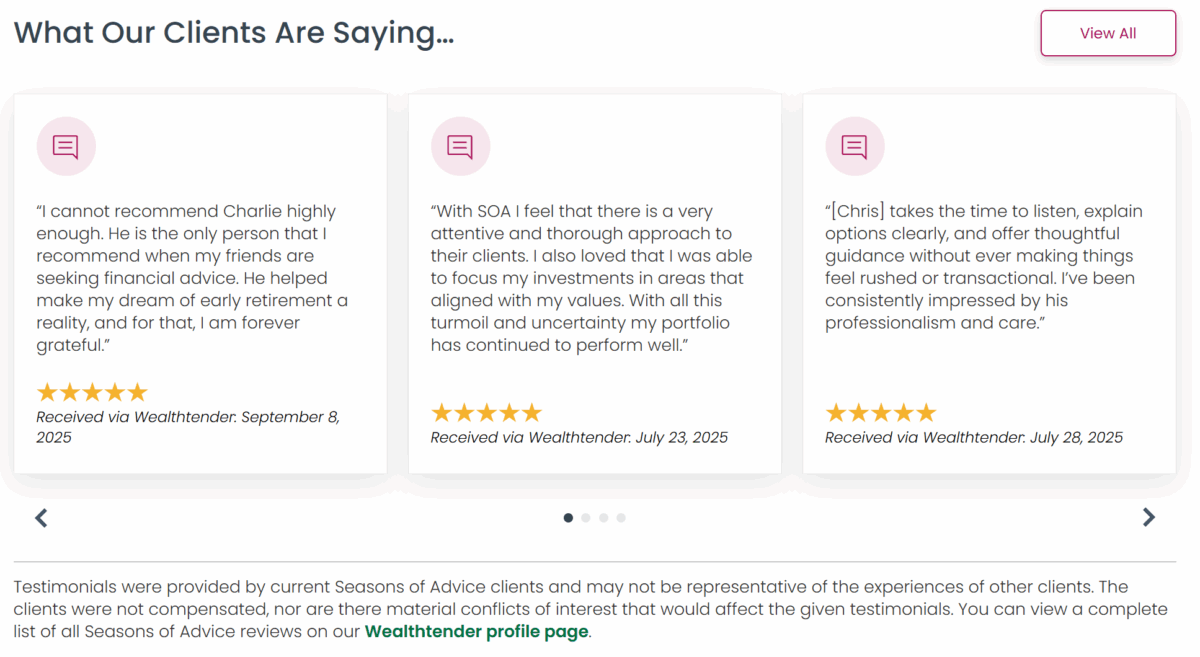
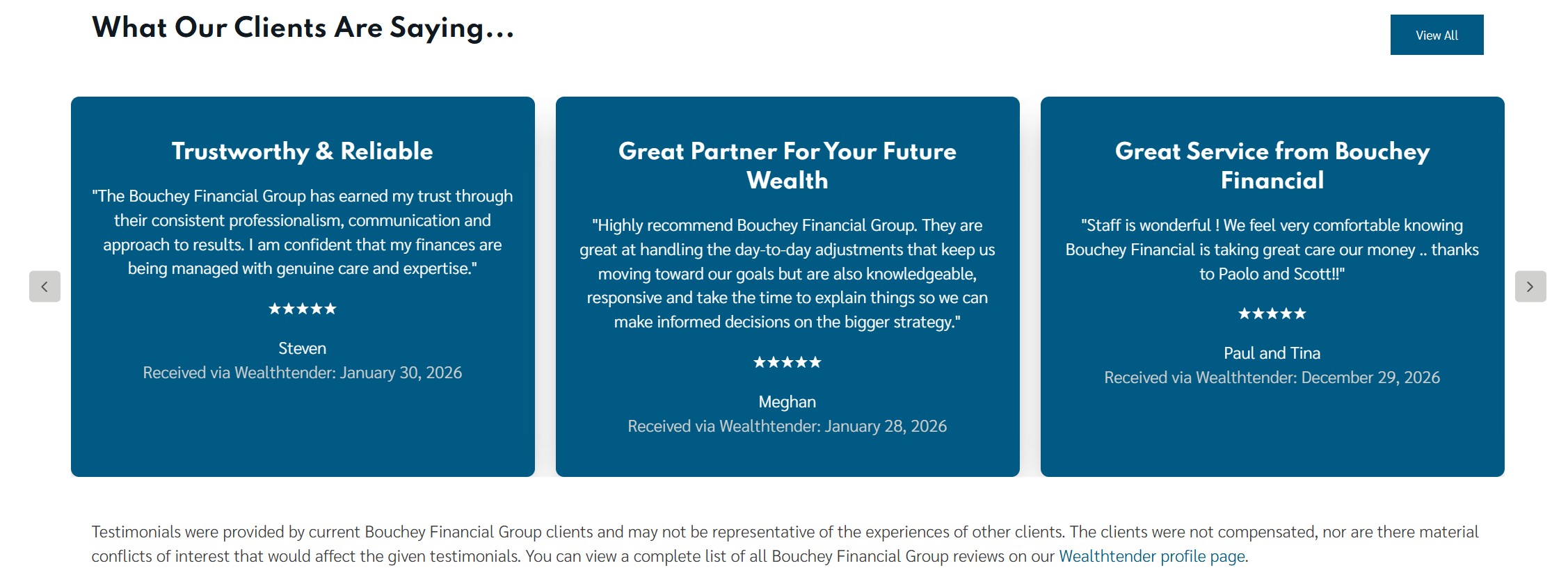
Second, in the screenshots just below, you’ll see a carousel feature on the homepage of advisory firm websites that display just a handful of testimonials. This approach satisfies the SEC Marketing Rule disclosure requirements as follows:
The three ‘clear and prominent’ disclosures are conveyed in the first two sentences within the disclosure area. In these examples, the wealth management firm ensured that each testimonial displayed is from a current client, who was not compensated, and where no conflicts of interest exist.
The first sentence also addresses the ‘views not representative’ disclosure requirement.
The last sentence lets consumers know where they can go, with a link to read a complete list of all of the firm’s reviews “on our Wealthtender profile page”.
Carousel example 1 · Seasons of Advice Wealth PartnersA compliant carousel feature displaying a curated selection of testimonials on the homepage of an advisor’s website. The three ‘clear and prominent’ disclosures are conveyed in the first two sentences within the disclosure area. The first sentence also addresses the ‘views not representative’ disclosure requirement. And the last sentence lets consumers know where they can go with a link to read a complete list of all of the firm’s reviews “on our Wealthtender profile page”. Screenshot from soawealth.comCarousel example 2 · Bouchey Financial GroupA second compliant homepage carousel, in a different visual style. The same disclosure pattern applies: the clear and prominent disclosures and the ‘views not representative’ statement sit directly beneath the carousel, followed by a link to the firm’s complete review history. Screenshot from bouchey.com
Real-World Examples: How Advisory Firms Display Compliant Homepage Carousels
Today, many wealth management firms have incorporated a carousel of a few testimonials on their homepage. Each of the firms below is worth a look before you brief your own website team:
A compact carousel treatment that works well for a smaller firm.
Two Popular Ways to Promote Testimonials on Advisor Websites
Before we get to the two approaches, there is a distinction worth settling, because confusing these two things is the single most common reason a website request comes back built wrong. A carousel and a Wealthtender widget are not competing options. They are different mechanisms that do different jobs, and most firms end up using both.
Mechanism A · Built on your site
A carousel of selected reviews
Nothing from Wealthtender is needed to build this. Nearly every website platform already ships a testimonial or quote carousel component. You choose three to five reviews, your developer pastes the text into the slots, and the carousel rotates them.
Because it shows a curated selection of reviews, a block of disclosure text must sit directly below it.
The carousel content is static. When you want to swap reviews in or out, someone replaces the text inside the carousel component.
Best placement: your homepage.
Mechanism B · Pasted into your site
A Wealthtender embed widget
One snippet of code. It renders every review found on a particular Wealthtender profile, whether that is your firm profile or an individual advisor profile. The widget displays the newest review first and refreshes as new reviews are published on Wealthtender. It is standard third-party embed markup, offered via iframe or JavaScript code, with no API key and no build step. The disclosures added to a review through Wealthtender render inside the widget with each review automatically.
Because the widget shows every review rather than a subset, an additional disclosure block beneath it is typically not required by a firm’s compliance officer, though your compliance team should always be consulted for their guidance and signoff.
Available at the firm level, for multi-advisor Wealthtender subscriptions, and/or per advisor, displaying only that advisor’s reviews.
Best placement: a dedicated testimonials page, and/or individual advisor bio pages.
Put plainly: a carousel is something your developer builds. A Wealthtender widget is code your developer pastes in. The second one is not a link to your profile. Most firms run a carousel on the homepage to showcase a handful of reviews and use Wealthtender widgets on the testimonials page and/or advisor bios for comprehensive coverage. The “read all reviews” link the carousel disclosure requires then points at the testimonials page, or at your Wealthtender profile, to satisfy regulatory compliance.
Most website providers make it easy to implement testimonials in compliance-friendly ways using Wealthtender widgets and by giving advisors the flexibility to add required regulatory disclosures to testimonial carousels and lists. Based on our work at Wealthtender with financial advisors and wealth management firms using a variety of website providers, we’ve identified two popular approaches that combine those mechanisms and work especially well:
The Comprehensive Approach (popular among multi-advisor wealth management firms)
The Homepage Spotlight Approach (popular with solo advisors and smaller firms)
Let’s explore each approach in detail.
Approach #1: The Comprehensive Approach for Multi-Advisor Firms
Wealth management firms with multiple advisors often take a strategic, layered approach to displaying testimonials across their website. This method balances firm-wide social proof with individual advisor credibility, and it uses both mechanisms described above.
Step 1: Implement a Testimonial Carousel on Your Homepage
Ask your website provider, or search their help documentation, for the carousel feature you can use to display a rotating selection of three to five standout reviews on your homepage. For maximum effectiveness, prioritize reviews with content aligned to your Ideal Client Profile. If your ideal clients are Chevron executives nearing retirement, for example, a review that includes text like “…helped me make the most of my Chevron benefits as I transitioned into retirement…” will prove especially impactful. This immediately captures visitor attention, establishes trust, and makes it very likely you will be the first advisor a prospect chooses to contact.
Important compliance reminder
When using a carousel to display a curated selection of testimonials, you must also clearly display all required regulatory disclosures immediately below the carousel. The disclosure text has to be visible on the page itself. It cannot sit behind a tooltip, a modal, or a “disclosures” link, and it belongs with the carousel rather than down in the site footer. Refer back to the section above for the specific disclosure requirements.
Step 2: Create a Dedicated Testimonials Page
Create a standalone testimonials page on your website where prospects can view your complete collection of client reviews. You can then link to this page, and/or your Wealthtender profile, to satisfy regulatory requirements.
To ensure this page continuously reflects all of your client reviews, we recommend using a widget from Wealthtender, also known as an ‘embed code’, available from your Wealthtender dashboard.
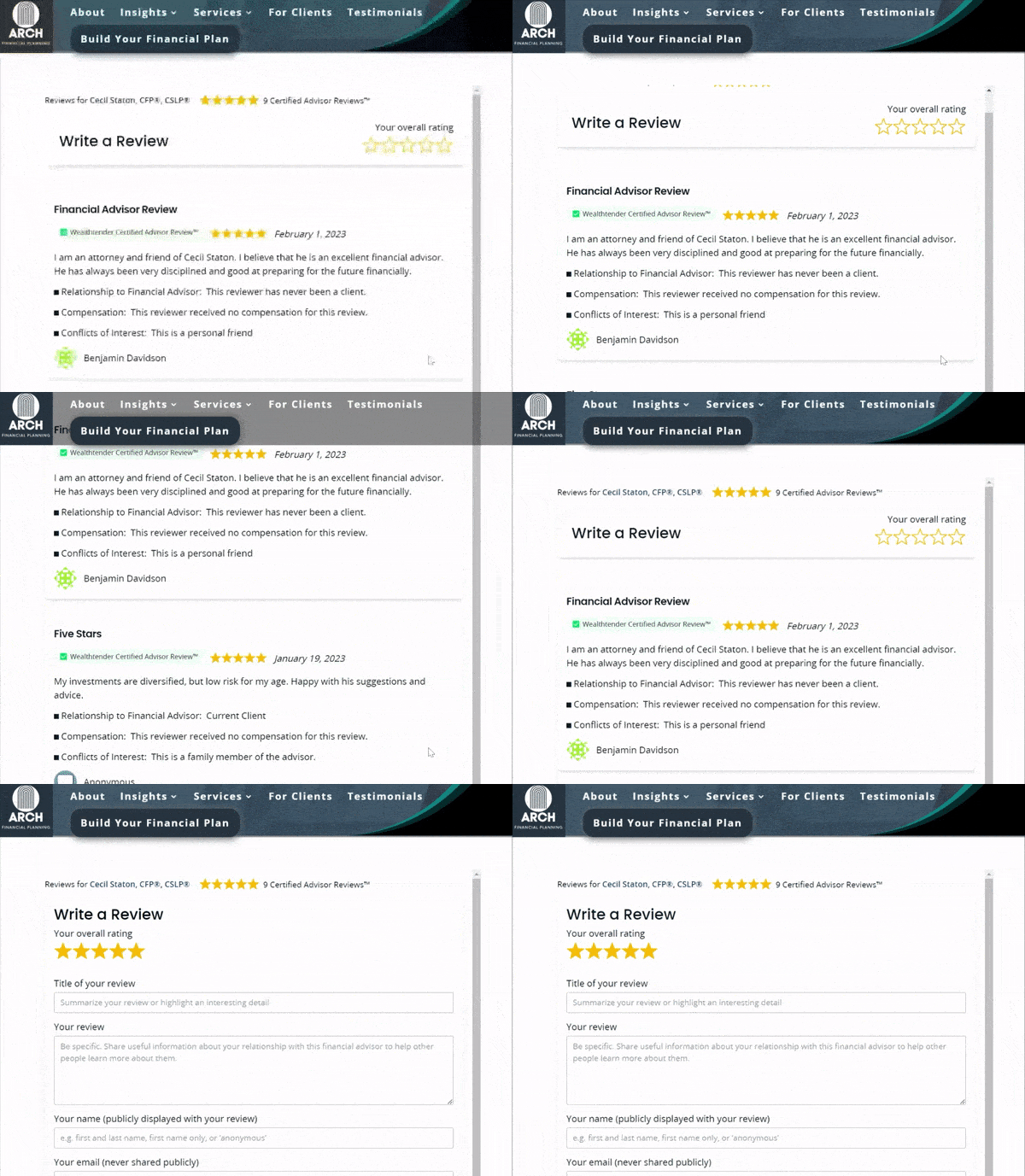
Recommended Wealthtender widget: the Wealthtender JavaScript widget is ideal for testimonials pages. This widget inherits formatting used elsewhere on your site and automatically displays all of your firm’s reviews in reverse chronological order, newest first, which satisfies SEC requirements about not filtering reviews to only show the highest ratings. The JavaScript widget includes built-in compliance disclosures for each review and is responsive across all devices. Your website provider’s help desk should be able to implement this widget quickly using the embed code from your Wealthtender dashboard. Alternatively, the Wealthtender iframe HTML widget can be used.
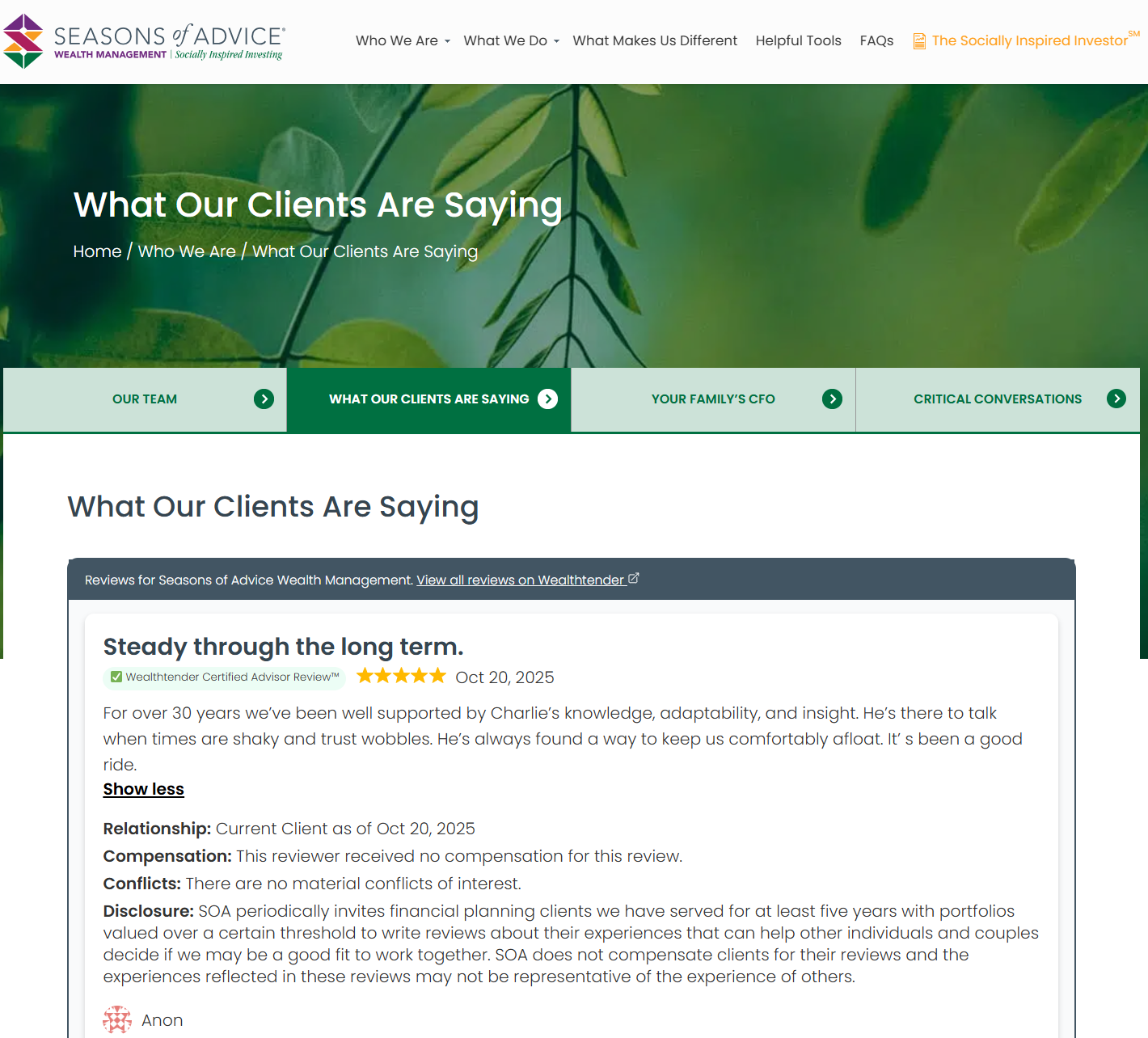
Here’s an example of a testimonials page on a wealth management firm’s website that uses the Wealthtender JavaScript widget:
Dedicated testimonials pageBuilt with the Wealthtender JavaScript widget. Screenshot from soawealth.com/reviews
Step 3: Display Reviews on Individual Advisor Bio Pages
Take your testimonial strategy a step further by featuring advisor-specific reviews on each advisor’s bio page. Wealthtender offers widgets that display only the reviews written specifically for individual advisors, for firms that collect reviews at the individual advisor level. This approach helps prospective clients see testimonials most relevant to the specific advisor they’re considering working with, while the firm-wide testimonials page and Wealthtender profile provide access to all reviews for complete transparency.
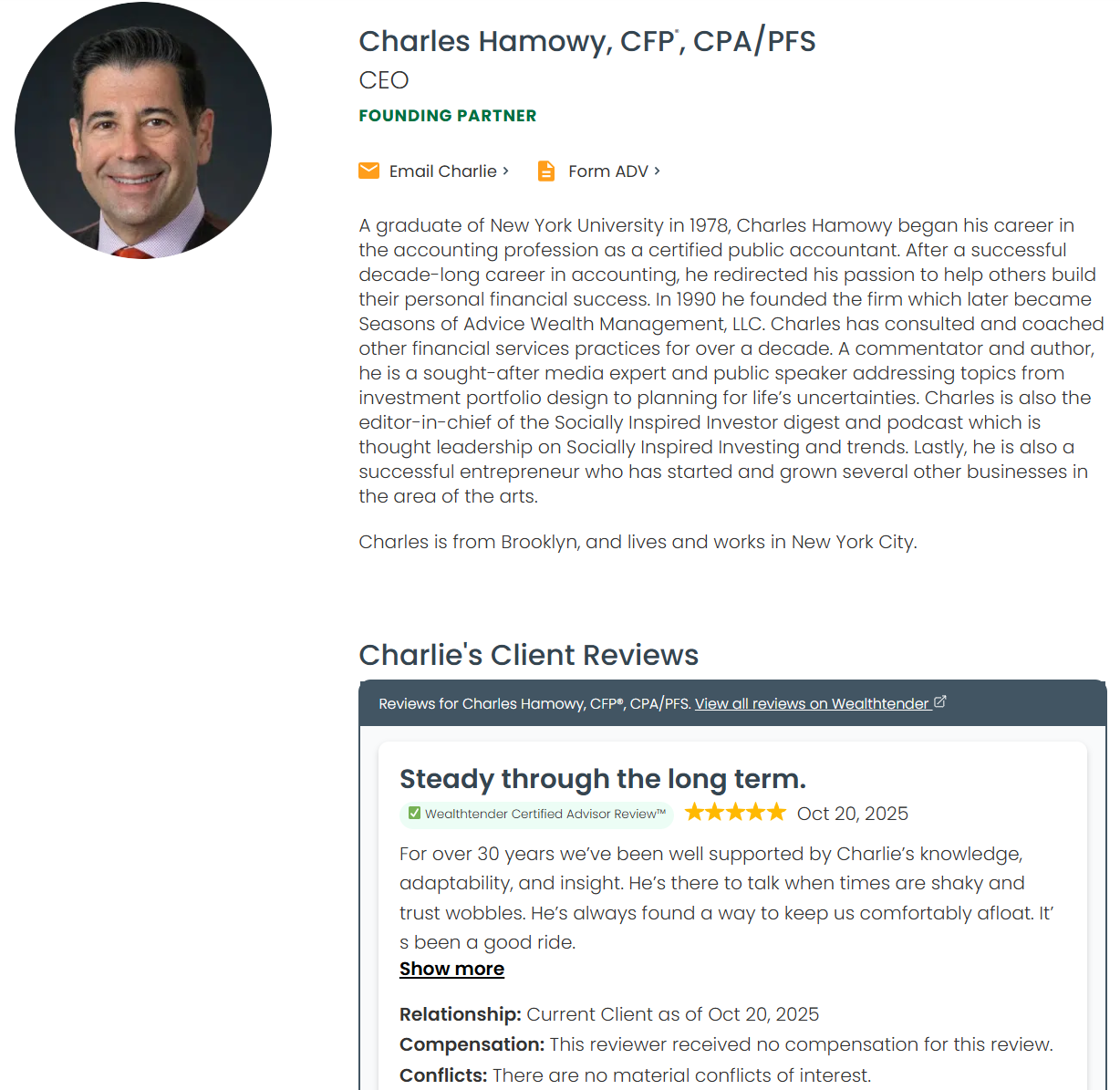
Here’s an example of an advisor bio page on a wealth management firm’s website that uses the Wealthtender JavaScript widget:
Advisor bio pageDisplaying only the reviews written for that advisor. Screenshot from soawealth.com
Real-World Example: Seasons of Advice Wealth Partners
Seasons of Advice Wealth Partners provides an excellent example of the comprehensive approach in action, with all three layers live on one site:
What their website does
✓
A homepage carousel showcasing client testimonials that immediately greet visitors
✓
Clear, compliant disclosure language integrated naturally into their design
✓
Links to view all reviews on their dedicated testimonials page and Wealthtender profiles
✓
Individual advisor pages highlighting reviews specific to each team member
This multi-layered approach maximizes the impact of testimonials across the entire website while maintaining full regulatory compliance.
Approach #2: Homepage Spotlight for Solo Advisors and Smaller Firms
Solo advisors and smaller wealth management firms often prefer a more straightforward approach: prominently displaying all reviews on their website’s homepage using a Wealthtender widget, with no carousel involved at all.
How to Add a Wealthtender Widget to Your Homepage
Many advisors in the Wealthtender community embed a Wealthtender widget directly on their homepage, making testimonials one of the first things prospects see when visiting their website. This immediate social proof motivates website visitors to schedule introductory calls.
Widget options: advisors can choose either the Wealthtender JavaScript or iframe HTML embed code to display reviews on their website. Both are standard third-party embed markup and both include the required disclosures with each review.
Compliance note
Unlike a carousel featuring a selected few reviews, a Wealthtender widget that displays all of your reviews shows a complete and representative sample. Because visitors are already seeing every review, with the review-level disclosures attached to each one, an additional disclosure block beneath the widget is typically not required and no separate link to your full review history is needed. As always, your compliance team should have the final say on what appears on your website.
Here’s an example of a solo advisor who displays an iframe widget on his homepage:
Solo advisor homepageA Wealthtender iframe widget displaying every review. Screenshot from eudwealth.com
Ready to Add a Dedicated Testimonials Page? Here’s How That Works
Alternatively, some advisors choose to create a dedicated testimonials page as the primary location for their reviews, then link to that page prominently from their homepage and throughout their site. Either approach works well from a compliance standpoint, as long as the widget displays your complete collection of reviews rather than a filtered selection.
Five Advisors and Firms Using the Homepage Spotlight Approach
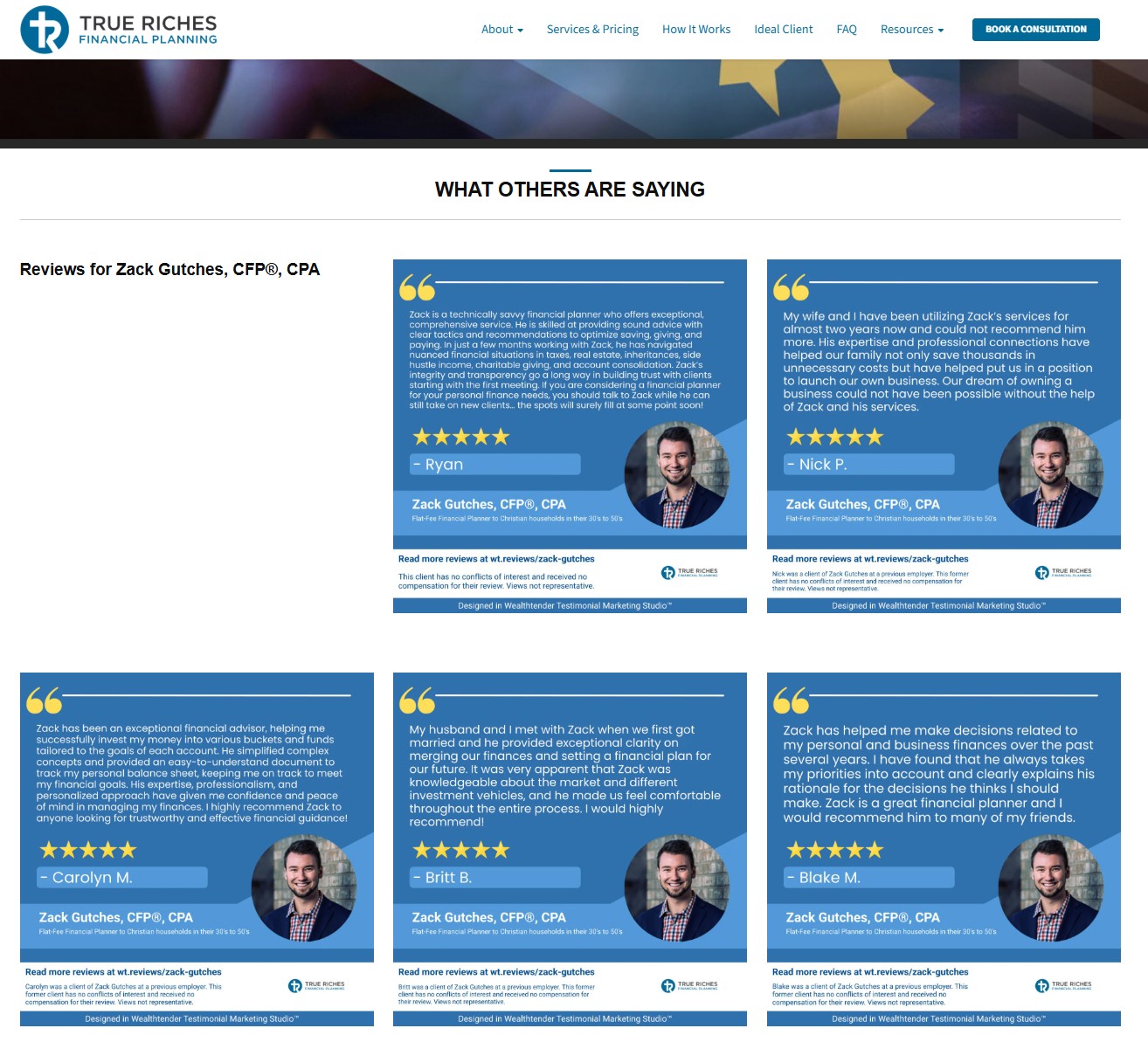
Today, many advisors and wealth management firms have incorporated the homepage spotlight or testimonials page approach with a Wealthtender widget embedded on their websites, including these examples:
Shows how solo advisors can leverage testimonials effectively without a carousel.
Each of these firms demonstrates that when reviews are displayed compliantly, they become one of the most powerful trust-building elements on an advisor’s website.
How to Access Your Wealthtender Embed Codes
To access your embed codes from Wealthtender, it’s easy to do:
Sign in to your Wealthtender account and visit your dashboard, or the Enterprise Dashboard for multi-advisor subscriptions
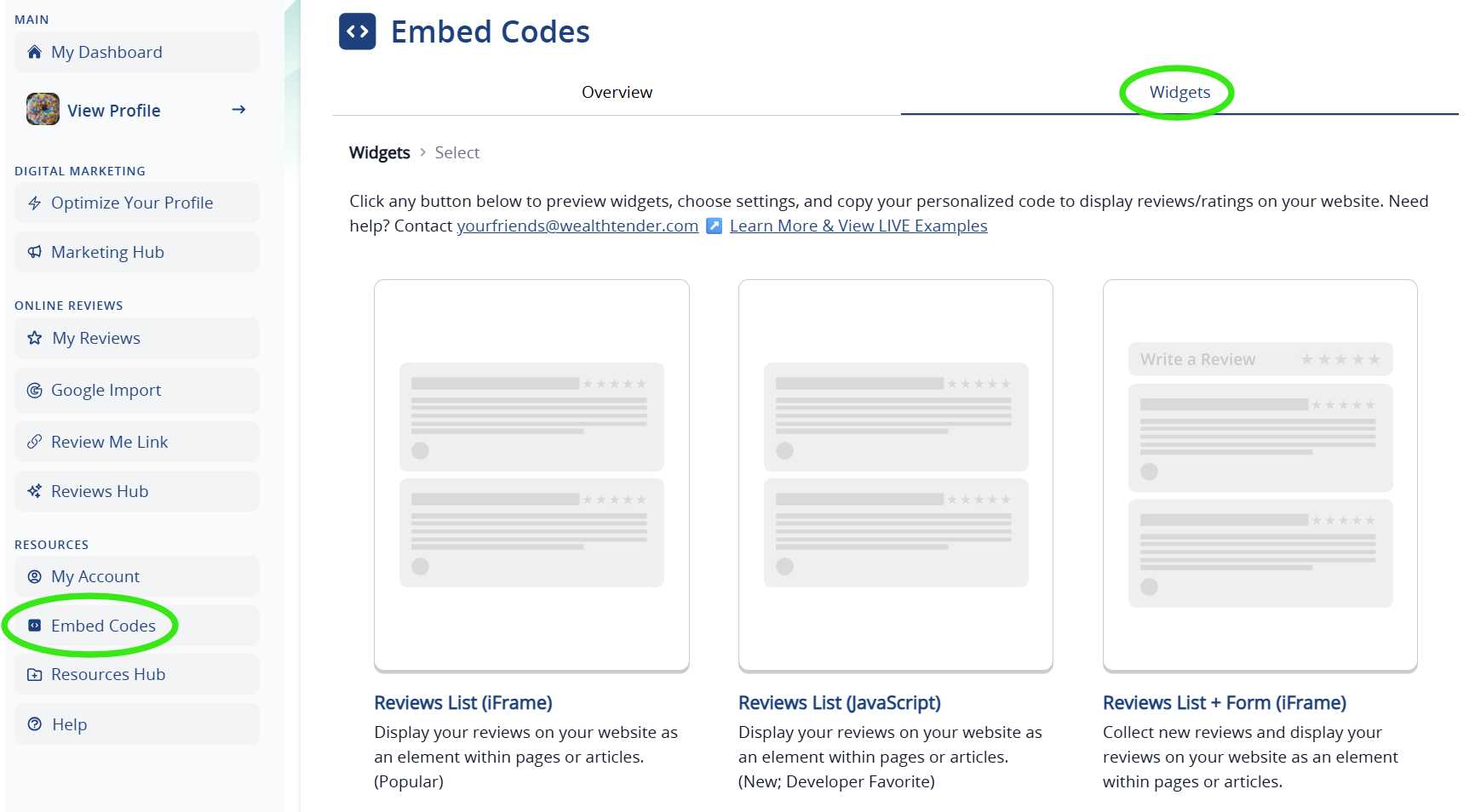
In the left sidebar menu, look for Embed Codes
Preview and then choose the embed code(s) you’d like to use and look for the Copy Code button
Your dashboardThe Embed Codes screen, with the sidebar menu items highlighted.
Take an Interactive Tour: Finding Your Embed Codes
Prefer to see it before you sign in? Click through the interactive tour below to walk the exact path from your dashboard to a copied embed code. It takes about 60 seconds, and nothing you click here affects your live profile.
Interactive tour: locating and copying your review widget embed codes inside the Wealthtender dashboard.
Once you’ve copied your preferred embed code, you can:
Share it with your website provider contact, who can implement it for you. All website providers and developers should be familiar with these industry-standard embed code formats and able to add them quickly.
Add it directly to your website if you manage your own site content.
Email it to your marketing team if they handle website updates. The section below writes that email for you.
The widget implementation typically takes just a few minutes, and once live, your testimonials will automatically update whenever you receive new reviews, with no additional website updates required. Please note that depending on your website cache refresh settings, your widget may take a few minutes or several hours to reflect new reviews. Speak with your website representative to discuss your cache settings.
Email Template: What to Send Your Website Developer About Adding Client Testimonials
The question we field most often is not about the SEC Marketing Rule. It is simpler and more practical than that: what do I actually say to my web person?
It matters more than it sounds, for the reason covered earlier. A carousel is something your developer builds using your website platform’s own tools. A Wealthtender widget is a snippet of code they paste in. A request that blurs the two tends to come back as the wrong implementation, or as a question you have to research before you can answer.
So we wrote the email for you. Add your details below and the tool assembles a complete, ready-to-send message that explains both mechanisms, includes the disclosure language your carousel will need with your firm name and review link already inserted, and points your developer to live advisor websites they can inspect. Copy it, read it over, send it.
Copy, personalize, send
Generate the email to send your website developer
Fill in a few details and this builds a ready-to-send email explaining exactly what you want added to your site, including the disclosure language your carousel needs and links to live examples your developer can inspect. Nothing is stored or sent anywhere.
1Your details
Leave anything blank and it stays as a clearly marked placeholder you can fill in later.
2Your email, ready to send
Subject line
Adding our client reviews to the website
Email body
3The disclosure text on its own
This is the block that sits directly below a carousel showing a selected few reviews. It is already included in the email above, but your developer will probably want it by itself. Have your compliance team review and approve the final wording before it goes live.
Carousel disclosure text
Need your embed code first? Sign in to Wealthtender and open Embed Codes in the left sidebar of your dashboard, or the Enterprise Dashboard for multi-advisor firms. Prefer we work with your developer directly? Email yourfriends@wealthtender.com with their name and address and we will set them up with developer portal access.
One caution worth repeating. The disclosure language this tool produces reflects how wealth management firms are handling curated carousels today, and it addresses each element the SEC Marketing Rule calls for. It is a starting point for your compliance team, who should always have final say on the disclosure language displayed on your website.
Would you rather we work with your website developer directly? Email yourfriends@wealthtender.com with their name and email address and we will give them their own access to the Wealthtender developer portal, where every embed code for your profiles lives. Most firms find this is the fastest path when an outside agency manages the site.
Quick answers for the handoff
QDo I need a Wealthtender embed code to add a testimonial carousel to my homepage?
No. A homepage carousel is built with your website platform’s own testimonial or quote component, and nothing from Wealthtender is required to build it. You supply the three to five reviews you want featured, and your developer builds the carousel. What the carousel does require is a block of disclosure text directly beneath it, because you are displaying a curated selection rather than all of your reviews.
QDoes a Wealthtender widget need its own disclosure block underneath it?
Typically not. A Wealthtender widget renders every review found on a Wealthtender profile, and the required disclosures are attached to each individual review inside the widget. Because visitors are seeing the complete set with the review-level disclosures, an additional disclosure block beneath the widget is usually unnecessary. Your compliance team should always have the final say on what appears on your website.
QWhat is a Wealthtender embed code, technically?
It is standard third-party embed markup, offered via iframe or JavaScript code. There is no API key and no build step. Any website developer or website platform help desk will recognize the format and can add it in a few minutes, on a managed platform like FMG, Squarespace, WordPress, or Wix as easily as on a custom-built site.
Your Next Three Steps: From Embed Code to Live Testimonials
The way consumers find and compare financial advisors is shifting rapidly as AI tools like ChatGPT become a popular discovery and research platform. Consumers expect to find online reviews for financial advisors just as they do for doctors, attorneys, and other service providers. Advisors who proactively collect and promote client testimonials compliantly are positioning themselves to capture a disproportionate share of new client opportunities.
With Wealthtender as your digital marketing partner, you already have a strong foundation to generate growth through a powerful online presence. Now it’s time to amplify your advantage by implementing client testimonials strategically across your website. Whether you choose the comprehensive approach with testimonials featured in a homepage carousel and advisor bio pages, or the homepage spotlight approach featuring your complete review collection in one place, both strategies shine on advisor websites and help you stay fully compliant with SEC regulations.
Ready to get started?
1
Sign in to your Wealthtender dashboard and grab your embed codes. The interactive tour above walks the whole path in about a minute.
2
Share them with your website contact, or implement them yourself. Use the email template above so nothing gets lost in translation, and don’t overlook the disclosure requirements.
3
Start showcasing the testimonials you’ve worked hard to earn.
Your future clients are online right now, searching for a financial advisor they can trust. Make sure they find you and that they see the proof of the exceptional service you provide through the voices of your satisfied clients.
FAQs: Review Widgets, Troubleshooting & More
What should I tell my website developer to get my reviews displayed?
Be explicit that you are asking for two different things, because they are easy to confuse and only one of them involves Wealthtender code.
A testimonial carousel on the homepage, built with your website platform’s own component. You supply three to five reviews. Your developer supplies the carousel. Directly beneath it, they add disclosure text stating that the reviewers are current clients, that no compensation was paid, that no known conflicts of interest exist, that the testimonials displayed are not representative of the experience of all clients, and where visitors can view a more complete representative list of your reviews.
A Wealthtender embed widget on a dedicated testimonials page and, optionally, on each advisor bio page. This is a single snippet of standard embed markup, offered via iframe or JavaScript code. It displays all of your reviews newest first, renders the required disclosures with each one, and updates itself as new reviews arrive. Because it shows every review rather than a subset, an additional disclosure block beneath it is typically not required, though your compliance team should always have the final say.
Instead of using an embed widget to display testimonials, other advisors have chosen to create a testimonials page using designs they created within Wealthtender Testimonial Marketing Studio.
Have an FMG website? Learn how FMG and Wealthtender offer ways to display testimonials on your website.
If you’re a financial advisor or wealth management firm using FMG as your website platform and Wealthtender as your digital marketing partner, you have a powerful opportunity to showcase client testimonials in ways that build trust with prospects while maintaining regulatory compliance.
Visit this guide to learn how FMG users are successfully promoting testimonials on their websites using FMG’s carousel feature and widgets from Wealthtender.
Beyond websites, how can financial advisors promote client testimonials on social media?
You’ll have opportunities to promote your reviews on popular social media sites like Facebook, Instagram, LinkedIn, and X (Twitter), but doing so compliantly within the character count limitations and other constraints means it’s important to proceed with caution. Fortunately, each of these platforms permits creating posts with image and video files which can be designed to incorporate the required disclosures.
To compliantly promote a client testimonial on social media, you’ll need to ensure you incorporate the required clear and prominent disclosures alongside the review, along with a link to a representative sample of your testimonials, for example all of your reviews on your own website or Wealthtender profile page.
For financial advisors in the Wealthtender community, we created Testimonial Marketing Studio to help advisors promote their online reviews compliantly in social media posts and beyond.
With Testimonial Marketing Studio, you can:
✔️ Access a growing library of professionally designed video and image templates
✔️ Import your online reviews from Wealthtender into Studio projects with just two clicks
✔️ Create scroll-stopping social media content and impactful resources for marketing campaigns in under two minutes
✔️ Preview and regenerate projects to optimize their design and ensure disclosures satisfy compliance requirements
Where can website developers access embed codes for Wealthtender review widgets?
Please visit the Wealthtender dev portal to preview and access embed codes for financial advisors and wealth management firms with profiles on Wealthtender. Questions? Please contact yourfriends@wealthtender.com. We’re always happy to help.
How can I troubleshoot issues with a Squarespace website?
In October 2025, an isolated issue with the Wealthtender JavaScript embed code resulted in the display not rendering properly in the Google Chrome browser. To resolve it, the code below was tested and provided to an advisor as a solution. The issue lies in the way Chrome chooses to render the page on mobile.
Note: the code below will only work by replacing the id “XXXXX” with the correct provider ID for the applicable Wealthtender profile. Questions? Please contact yourfriends@wealthtender.com. We’re always happy to help.
Building a Testimonial Marketing Strategy That Compounds Over Time
We hope you found this article helpful, and we encourage you to read each of the articles in our SEC Marketing Rule Education Series for more ideas to compliantly attract new clients and grow your business with online reviews and testimonials. Financial advisors who embrace online reviews in their marketing efforts will lead the industry in attracting new clients during the historic transfer of wealth from Baby Boomers to Millennials over the next decade.
Online reviews establish a human connection with prospects, demonstrating your trustworthiness and increasing their confidence in contacting and hiring you. But online reviews are just one important part of an effective marketing plan to strengthen your online reputation and attract new clients in today’s world.
At Wealthtender, we’re dedicated to helping you grow your business compliantly with Certified Advisor Reviews™ and our Modern Advisor Marketing platform, providing you with the tools to ensure prospects can find you online and feel confident about their hiring decision.
Questions or feedback?
If you have questions, feedback, or would like to discuss the SEC Marketing Rule with us, email yourfriends@wealthtender.com or call Wealthtender Founder and CEO Brian Thorp directly at (512) 856-5406.
Brian is CEO and founder of Wealthtender and Editor-in-Chief. He and his wife live in Austin, Texas. With over 25 years in the financial services industry, Brian is applying his experience and passion at Wealthtender to help more people enjoy life with less money stress. Learn More about Brian
SEC Marketing Rule Education Series: Grow with Testimonials & Endorsements
Joseph Wickremasinghe, Executive Director of MSCI Research | Image Credit: Institute for Innovation Development
[To understand how modern financial data technology and advanced research are responding to the evolving challenges of portfolio management — and what they mean for the relationship between adviser and client — we spoke with Joseph Wickremasinghe, Executive Director of MSCI Research.
Our conversation on InvestTech solution development explores how research and technology come together to support wealth managers, with a particular focus on strengthening the client relationship and the allocation conversations at the heart of it.
A few of the challenges explored included helping investment managers effectively manage portfolios across public and private allocations and personalization at scale. The data points referenced throughout our discussion come from their 2026 MSCI Wealth Trends Report and MSCI Research.]
How exactly does your research and technology work together to design portfolio management solutions for wealth managers? Do you have a particular innovation process?
It starts with a real problem, not a model looking for a use. Our process is to observe where advisers are stuck, formalize it as a research question, then translate the answer into something that lives inside the workflow. The discipline throughout is that research and engineering work together from the start; a brilliant model an adviser cannot act on in the moment is not a solution.
Take a simple, well-established fact — that more than 90% of a portfolio’s return variability is explained by asset allocation. That tells us the highest-leverage place to put better data and models is the allocation decision itself and the conversations around it. So, we build analytics that let an adviser look across a client’s entire set of accounts at once, rather than one at a time.
Our broader conviction is that the future of investment technology is an intelligence layer — high-quality data and models that empower the workflow, delivered through platforms or, increasingly, AI agents. We do not produce reports; we produce trusted, reusable components that the adviser’s tools, and eventually their agents, draw on consistently.
How do you determine which investment areas or topics to focus on?
We follow the pressure points in the industry and the evidence in the data. Right now, three signals are loud.
First, geopolitical risk is reshaping allocation — 86% of wealth managers report clients are concerned about global uncertainty and tariffs, and they are reallocating accordingly, with 61% planning to increase developed non-US exposure.
Second, private markets are moving to the core: 71% expect to raise private and alternative allocations.
Third, personalization has become the baseline, with 98% of new HNW portfolios carrying some customization.
We prioritize the areas where advisers face the most complexity and where better data and models would most directly improve the client conversation. The test is always whether research can change a decision an adviser makes for a client — not whether it is intellectually interesting. That keeps us focused on the public-private convergence, scalable personalization, and the risk and transparency tools that let advisers explain their choices with confidence.
Where do you see modern investment technology changing advisers’ day-to-day conversations with clients most?
In three places. First, the asset allocation conversation. With a complete, household-level view and a common risk framework, an adviser can move past account-by-account performance — “your 401(k) returned 8.2%” — to the questions clients actually care about: “Am I on track to retire?” and “What happens if markets fall 30%?” The intelligence layer turns those into evidence-based answers rather than reassurance.
Second, the rebalancing conversation. Coordinating across accounts lets an adviser rebalance in a tax-aware way and explain why a trade is happening — surfacing concentration risk that’s invisible when accounts are viewed separately.
Third, the alpha-seeking conversation. For clients who want to pursue excess return through factor tilts, thematic exposures, or private markets, the same models let an adviser show where that alpha is coming from and what risk it adds, instead of selling a product.
The common thread is that better data and models shift the adviser from a technician reporting the past to a partner shaping future outcomes — and that’s the relationship clients are least likely to leave.
How does a shared, common analytical language change those conversations, and what does the technology actually contribute?
Trust is built on consistency. When the risk numbers an adviser presents reconcile with the numbers the investment team used, and both trace back to the same intelligence layer, the client gets one coherent story rather than a marketing version and an analytical version.
The technology is what makes that practical — surfacing concentration risk hidden across accounts, coordinating tax-aware rebalancing, and answering “what if markets drop 30%?” with real numbers. We use the MSCI Multi-Asset Class factor model to run those scenarios, so a shock to one part of the portfolio flows through to the rest based on actual factor exposures and correlations. That lets an adviser show, not just assert, what role each position plays and why a rebalance makes sense.
It is also the foundation for agent-assisted advice: an agent can only support a conversation if it reasons over the same trusted data the adviser trusts. The relationship stays human — but it is backed by a common analytical language that makes the adviser more credible, more responsive, and freer to spend time on judgment rather than reconciliation.
How do you help wealth managers address growing personalization demands around portfolio construction and alignment?
Personalization at scale is fundamentally a measurement problem: how do you keep hundreds of customized accounts aligned to a model when each client has different tilts, exclusions, constraints, and even international preferences?
Part of the answer is the MSCI Similarity Score, which takes a factor-based view of risk and return rather than comparing exact holdings, giving a single score for how closely any portfolio tracks a target — so an adviser applying a client’s thematic preferences (53% of advisers cite thematic exposure as a top driver) can immediately see whether they have drifted.
The other part is separating the target from its implementation. The model portfolio defines the risk budget and asset-class weights; the client’s values or style then forms an implementation layer on top. The same risk budget can be expressed through cap-weighted indexes, ESG or climate-aligned indexes, factor tilts, or thematic exposures — different implementations, identical allocation.
That is how you deliver direct indexing and SMAs with international exposure at scale, including for values-based investors, without each account becoming a manual, bespoke exercise that erodes the firm’s capacity.
How do you help advisers manage portfolios across public and private allocations and communicate the value of alternatives to clients?
The core challenge is that public and private assets have historically lived in separate analytical worlds, so advisers could not see a portfolio’s true total risk. Our work brings them onto a common factor framework, so a private credit, private equity, or real-estate allocation can be assessed alongside public holdings rather than treated as a black box.
That changes the allocation conversation in two ways. It lets the adviser show genuine diversification — the lower correlation that makes private credit attractive — rather than asserting it. And it quantifies the trade-off.
In our analysis, introducing a 10% private allocation improved the risk-return profile across private equity, credit, and real estate, with private credit producing the largest uplift. In a multi-generational case, adding a 15% private allocation improved expected return by roughly half a percentage point at comparable risk.
That is consistent with the broader MSCI Research estimate that a 15% private allocation may add about 40 basis points annually while maintaining similar market risk. With 83% of wealth managers now calling a robust private-asset suite essential, that evidence-based case is what advisers need.
Can you give a concrete example of how this plays out for a real client?
A common one is the concentrated portfolio. Picture a 45-year-old technology executive with $8M in assets, over 70% of it in company stock, who wants to retire in ten years. The traditional account-by-account view misses the real problem: their entire net worth rides on one sector.
Using the factor model, we can quantify it — in a repeat of the 2022 tech correction, where several large tech names fell more than 50%, their portfolio would draw down nearly 30%, enough to force a delayed retirement. That reframes the allocation conversation: this client does not need aggressive growth, they need to protect a number they have nearly reached, because the downside of missing retirement far outweighs the upside of excess returns.
So, you reposition for much better downside protection while keeping enough upside to meet the goal. We apply the same factor logic to thornier instruments too — translating opaque structured products into their true equity and bond exposures via delta and duration, so they do not sit in an “other” bucket distorting the portfolio’s real risk. In every case, the data turns an abstract worry into a concrete, defensible conversation.
What do you see as the next key advancements in InvestTech for wealth managers?
The throughline is the maturing of the investment intelligence layer and how it gets delivered. In the near term, the biggest gains come from fixing the data foundation — 44% of wealth managers feel the segment lags on AI, and that is a data problem more than an appetite problem, even as 95% plan to increase AI investment.
Once the data is clean and connected, agents become genuinely useful: an agent that can monitor household-level drift, surface a concentration risk, run a scenario, or draft a goals-based allocation proposal grounded in trusted models gives advisers real capacity back.
I would also expect a more holistic, household-level view of allocation to become standard, continued progress on the public-private convergence, and better tools for translating complex instruments — private funds, structured products — into a common factor language. But the consistent theme is that technology should strengthen the advisory relationship, not replace it.
The future I see is advisers spending less time wrangling systems and more time on judgment and relationships, supported by an intelligence layer and AI agents that handle the analytical heavy lifting beneath them.
Bill Hortz is an independent business consultant and Founder/Dean of the Institute for Innovation Development- a financial services business innovation platform and network. With over 30 years of experience in the financial services industry including expertise in sales/marketing/branding of asset management firms, as well as, creatively restructuring and developing internal/external sales and strategic account departments for 5 major financial firms, including OppenheimerFunds, Neuberger&Berman and Templeton Funds Distributors. His wide ranging experiences have led Bill to a strong belief, passion and advocation for strategic thinking, innovation creation and strategic account management as the nexus of business skills needed to address a business environment challenged by an accelerating rate of change.
Discover financial advisors trusted by residents of DeKalb, Illinois in the only local directory featuring 5-Star Certified Advisor Review™ recipients and Wealthtender Voice of the Client Award™ winners—recognition earned for exceptional client feedback. Compare fiduciary, fee-only advisors, CFP® professionals, and specialists to find the right fit for your unique financial needs.
Whether you have lived in DeKalb for years or recently moved to town, you may need help finding the right financial advisor in the community best suited for your individual needs.
It’s important to first consider your own financial planning priorities before choosing an advisor. Here are a few quick tips to help you get started along with financial advisors in DeKalb featured on Wealthtender you may want to add to your shortlist.
Featured DeKalb Financial Advisors
As you prepare to interview financial advisors in DeKalb who may be right for you, get to know local financial advisors featured on Wealthtender.
📍 Map: Financial Advisors with their Primary Office Location in DeKalb
Double-click (or pinch the map on mobile devices) to zoom in and expand the details for financial advisors whose primary office location is in DeKalb.
The Benefits of Hiring a Financial Advisor in DeKalb
Hiring a financial advisor can be a great move to help you build a long-term investing strategy. Advisors can help you build an investment portfolio to meet your financial goals and help you plan appropriately for retirement.
As a resident living in DeKalb, hiring a financial advisor who lives nearby and understands the local economy, cost of living, and regional employers can be quite valuable, especially if your individual circumstances are deeply tied to such factors.
Do you work for one of the largest employers in DeKalb? If so, there’s a good chance the local financial advisor you hire will also have other clients who work there. This knowledge could prove valuable if they are already familiar with your employee benefits, such as a 401(k) plan, Health Savings Accounts, and other components of your total compensation package.
When you reach out to financial advisors you’re considering hiring, let them know where you work and ask if they are familiar with your employer’s unique benefits and compensation structure.
Quick Tips For Hiring an DeKalb Financial Advisor
Before hiring a financial advisor in DeKalb, here are a few quick tips to help you find the best advisor for you.
1. Decide Which Services You Need
Before hiring an advisor, determine what services you need from them. Whether it’s full-service investment management or a plan focused on a specific area of your finances, put together a list of what you’d like help with before contacting an advisor.
Though most people use a financial planner simply to invest for retirement, this is only a small part of what many advisors offer. Here’s a quick rundown of potential services a financial advisor may offer you:
Budgeting and money management
Debt management
Insurance planning
Retirement planning
Other investment planning
Inheritance planning
Estate planning
Tax planning
As you can see, financial advisors can help you with your entire financial picture, not just investing. As you start to plan for life’s bigger milestones, you should consider finding a financial advisor that specializes in those areas.
Finding the right advisor can help you minimize risk, maximize gains and take advantage of tax breaks while investing for your future. They can also help you protect your assets with the right kinds of insurance and help you pass on your financial legacy with a proper estate plan.
2. Consider Your Budget and Payment Preferences
Once you have a list of services you would like, review the fee structures financial advisors offer. Finding a balance between the services you need and the cost of those services will help narrow down the field of advisors you may want to work with.
If you are looking for a full-service advisor to manage all of your investments, consider searching among fee-based financial advisors. If you want to manage your money yourself, consider the flat fee and monthly subscription advisors for ongoing support.
3. Interview Multiple Financial Advisors
Once you have chosen the services and fee structure you prefer, it’s time to contact a few advisors and interview them. Here are questions to ask financial advisors:
What services do you provide?
What are all the ways you get paid? (fee transparency)
What is your investment strategy?
How do you measure investment performance?
How do we communicate about my plan?
Interview multiple advisors to get a feel for who you want to work with. A combination of fees, services, and customer service will help you determine the best fit for your financial advice.
4. Review Financial Advisor Credentials
Once you find an advisor (or two) you feel comfortable with, it’s always a good practice to check their credentials and the firm’s details. You can do this at the Investment Adviser Public Disclosure (IAPD) website.
You can check both the individual and the firm to view their background and experience details, as well as any disciplinary action taken against them or their firm.
As licensed financial professionals, there is oversight into how financial advisors conduct business, so running a quick (free) check on them is recommended.
For additional information about advisor credentials, read our article to learn the most popular designations held by financial advisors, as well as specialized credentials which may be important to consider if you have unique financial planning needs.
Frequently Asked Questions & Additional Resources
How do I know if I’m ready to hire a financial advisor?
You should strongly consider hiring a financial advisor if you have a significant amount of money available for saving or investing. This could occur after years of making annual contributions to a retirement plan like a 401(k) through your employer or suddenly if you receive a large inheritance or sell your house for a large profit.
But even if you don’t have a lot of money saved, many financial advisors and planners provide reasonable pricing options and valuable services you should consider, especially if you’re facing a significant life event. For example, if you’re starting a new job, getting married, starting a family, getting divorced, lost your job, starting or selling a business, or approaching retirement age, working with a trusted financial advisor or planner may prove worthwhile.
Before I hire a new financial advisor, should I fire my current advisor?
You don’t need to fire your current advisor before beginning your search for a new financial advisor. In fact, your new advisor can help coordinate the transition of your assets from your previous financial advisor.
Where can I read reviews about financial advisors written by their clients to help me decide if I should hire them?
After 60 years of regulatory prohibition of financial advisor reviews in the US, a rule issued by the Securities and Exchange Commission (SEC) became effective on May 4, 2021 that means both financial advisors and directory websites that help consumers search for a financial advisor can collect and display financial advisor reviews, an important factor worth considering when choosing who you’ll hire to manage your investments and life savings.
Wealthtender is the first independent advisor review platform designed to be fully compliant with the new SEC rule, and we look forward to helping you evaluate financial advisors based on reviews written by their clients.
I’m a local financial advisor interested in being featured in this guide. How do I get started?
Thanks for your interest. We look forward to learning more about your practice and helping you attract your ideal clients where you may be a good fit based on their individual needs and circumstances. Please click here to learn how you can join local financial advisors featured on Wealthtender.
Brian is CEO and founder of Wealthtender and Editor-in-Chief. He and his wife live in Austin, Texas. With over 25 years in the financial services industry, Brian is applying his experience and passion at Wealthtender to help more people enjoy life with less money stress. Learn More about Brian
Discover financial advisors trusted by residents of Kingsport, Tennessee in the only local directory featuring 5-Star Certified Advisor Review™ recipients and Wealthtender Voice of the Client Award™ winners—recognition earned for exceptional client feedback. Compare fiduciary, fee-only advisors, CFP® professionals, and specialists to find the right fit for your unique financial needs.
Whether you have lived in Kingsport for years or recently moved to town, you may need help finding the right financial advisor in the community best suited for your individual needs.
It’s important to first consider your own financial planning priorities before choosing an advisor. Here are a few quick tips to help you get started along with financial advisors in Kingsport featured on Wealthtender you may want to add to your shortlist.
Featured Kingsport Financial Advisors
As you prepare to interview financial advisors in Kingsport who may be right for you, get to know local financial advisors featured on Wealthtender.
📍 Map: Financial Advisors with their Primary Office Location in Kingsport
Double-click (or pinch the map on mobile devices) to zoom in and expand the details for financial advisors whose primary office location is in Kingsport.
The Benefits of Hiring a Financial Advisor in Kingsport
Hiring a financial advisor can be a great move to help you build a long-term investing strategy. Advisors can help you build an investment portfolio to meet your financial goals and help you plan appropriately for retirement.
As a resident living in Kingsport, hiring a financial advisor who lives nearby and understands the local economy, cost of living, and regional employers can be quite valuable, especially if your individual circumstances are deeply tied to such factors.
Do you work for one of the largest employers in Kingsport? If so, there’s a good chance the local financial advisor you hire will also have other clients who work there. This knowledge could prove valuable if they are already familiar with your employee benefits, such as a 401(k) plan, Health Savings Accounts, and other components of your total compensation package.
When you reach out to financial advisors you’re considering hiring, let them know where you work and ask if they are familiar with your employer’s unique benefits and compensation structure.
Quick Tips For Hiring an Kingsport Financial Advisor
Before hiring a financial advisor in Kingsport, here are a few quick tips to help you find the best advisor for you.
1. Decide Which Services You Need
Before hiring an advisor, determine what services you need from them. Whether it’s full-service investment management or a plan focused on a specific area of your finances, put together a list of what you’d like help with before contacting an advisor.
Though most people use a financial planner simply to invest for retirement, this is only a small part of what many advisors offer. Here’s a quick rundown of potential services a financial advisor may offer you:
Budgeting and money management
Debt management
Insurance planning
Retirement planning
Other investment planning
Inheritance planning
Estate planning
Tax planning
As you can see, financial advisors can help you with your entire financial picture, not just investing. As you start to plan for life’s bigger milestones, you should consider finding a financial advisor that specializes in those areas.
Finding the right advisor can help you minimize risk, maximize gains and take advantage of tax breaks while investing for your future. They can also help you protect your assets with the right kinds of insurance and help you pass on your financial legacy with a proper estate plan.
2. Consider Your Budget and Payment Preferences
Once you have a list of services you would like, review the fee structures financial advisors offer. Finding a balance between the services you need and the cost of those services will help narrow down the field of advisors you may want to work with.
If you are looking for a full-service advisor to manage all of your investments, consider searching among fee-based financial advisors. If you want to manage your money yourself, consider the flat fee and monthly subscription advisors for ongoing support.
3. Interview Multiple Financial Advisors
Once you have chosen the services and fee structure you prefer, it’s time to contact a few advisors and interview them. Here are questions to ask financial advisors:
What services do you provide?
What are all the ways you get paid? (fee transparency)
What is your investment strategy?
How do you measure investment performance?
How do we communicate about my plan?
Interview multiple advisors to get a feel for who you want to work with. A combination of fees, services, and customer service will help you determine the best fit for your financial advice.
4. Review Financial Advisor Credentials
Once you find an advisor (or two) you feel comfortable with, it’s always a good practice to check their credentials and the firm’s details. You can do this at the Investment Adviser Public Disclosure (IAPD) website.
You can check both the individual and the firm to view their background and experience details, as well as any disciplinary action taken against them or their firm.
As licensed financial professionals, there is oversight into how financial advisors conduct business, so running a quick (free) check on them is recommended.
For additional information about advisor credentials, read our article to learn the most popular designations held by financial advisors, as well as specialized credentials which may be important to consider if you have unique financial planning needs.
Frequently Asked Questions & Additional Resources
How do I know if I’m ready to hire a financial advisor?
You should strongly consider hiring a financial advisor if you have a significant amount of money available for saving or investing. This could occur after years of making annual contributions to a retirement plan like a 401(k) through your employer or suddenly if you receive a large inheritance or sell your house for a large profit.
But even if you don’t have a lot of money saved, many financial advisors and planners provide reasonable pricing options and valuable services you should consider, especially if you’re facing a significant life event. For example, if you’re starting a new job, getting married, starting a family, getting divorced, lost your job, starting or selling a business, or approaching retirement age, working with a trusted financial advisor or planner may prove worthwhile.
Before I hire a new financial advisor, should I fire my current advisor?
You don’t need to fire your current advisor before beginning your search for a new financial advisor. In fact, your new advisor can help coordinate the transition of your assets from your previous financial advisor.
Where can I read reviews about financial advisors written by their clients to help me decide if I should hire them?
After 60 years of regulatory prohibition of financial advisor reviews in the US, a rule issued by the Securities and Exchange Commission (SEC) became effective on May 4, 2021 that means both financial advisors and directory websites that help consumers search for a financial advisor can collect and display financial advisor reviews, an important factor worth considering when choosing who you’ll hire to manage your investments and life savings.
Wealthtender is the first independent advisor review platform designed to be fully compliant with the new SEC rule, and we look forward to helping you evaluate financial advisors based on reviews written by their clients.
I’m a local financial advisor interested in being featured in this guide. How do I get started?
Thanks for your interest. We look forward to learning more about your practice and helping you attract your ideal clients where you may be a good fit based on their individual needs and circumstances. Please click here to learn how you can join local financial advisors featured on Wealthtender.
Brian is CEO and founder of Wealthtender and Editor-in-Chief. He and his wife live in Austin, Texas. With over 25 years in the financial services industry, Brian is applying his experience and passion at Wealthtender to help more people enjoy life with less money stress. Learn More about Brian
Do you work at Bell Textron?
Get expert insights from a financial advisor who specializes in helping Bell Textron employees and executives make the most of their compensation package and benefits.
Looking for a financial advisor who specializes in working with Bell Textron employees? You’re in the right place. Below, you’ll find an advisor who understands Bell Textron benefits and compensation — along with his answers to common financial questions from Bell Textron employees and executives.
Whether you recently joined Bell Textron or you’ve advanced into a management or executive leadership role over a multi-year career, making smart decisions about your income and Bell Textron benefits can have a lasting impact on your financial future. For example:
✅ Do you know the right moves to get the greatest value from the Bell Textron benefits available to you?
✅ If you’re thinking about leaving Bell Textron for another job or planning to retire in a few years, are you taking the right steps today to receive all the compensation and benefits you’ve earned?
Key Takeaways
1
HSA triple-tax benefits make it a powerful long-term savings tool for Bell Textron employees.
Contributions to a Health Savings Account receive favorable tax treatment at three stages: on contributions, on investment growth inside the account, and when funds are used for qualified medical expenses. For Bell Textron employees paying healthcare costs out of pocket, an HSA can function as a meaningful long-term investment vehicle beyond its immediate healthcare utility.
2
Overconcentration in Textron stock can undermine portfolio diversification.
Bell Textron employees who hold significant positions in Textron Inc. stock through equity compensation or the employee stock purchase plan may be exposed to concentration risk that reduces overall portfolio diversification. It is also worth noting that Textron shares reflect the performance of the entire conglomerate, not Bell’s segment alone, which adds another layer of planning consideration.
3
Ask any prospective financial advisor these key questions before hiring them.
The most critical question to ask is whether the advisor is a fiduciary, followed by specific questions about who gets paid when assets are rolled over, how the advisor is compensated, and what direct experience they have working with Bell Textron employees. Verifying fiduciary status through concrete compensation questions is recommended rather than simply taking the advisor’s word for it.
Why Bell Textron Employees Work with a Specialist Financial Advisor
Throughout the year, Bell Textron provides its employees and executives with updates about their benefits, ranging from health insurance and health savings accounts to retirement plans like a 401(k) and a defined benefit pension, along with equity compensation such as restricted stock units and an employee stock purchase plan tied to Textron Inc. While the company offers many useful resources and access to knowledgeable staff who can assist with questions, you’ll also find financial professionals not affiliated with Bell Textron who specialize in helping Bell Textron employees make the most of their income and benefits.
Whether you work at Bell Textron’s headquarters in Fort Worth, Texas, a manufacturing or assembly facility elsewhere in the country, or remotely from home, you may have questions about your compensation package and benefits better suited for a financial professional who can offer unbiased advice and guidance.
Sensitive topics — like the steps you should take before quitting your job at Bell Textron to work elsewhere, protecting yourself in advance of a corporate layoff, or deciding when you should plan to retire — are all conversations that may be more comfortable with a trusted financial advisor.
Should You Hire a Bell Textron Specialist or a Local Financial Advisor?
You’ll likely find dozens of nearby financial advisors well-suited to help you reach your money goals with a personalized plan. But it can be harder to find a financial advisor who specializes in serving Bell Textron employees. Fortunately, many financial advisors offer virtual services, so you can meet online no matter where you (or they) live — which means you can hire a specialist financial advisor who lives hundreds of miles away if their knowledge and experience working with Bell Textron employees is the better fit for your unique needs.
💡 In the Q&A below, you’ll gain insights from a financial advisor who works with Bell Textron employees to help them make smart decisions, get the most value from their compensation and benefits, reduce their money stress, and prepare for a comfortable retirement.
🙋♀️ Have a question not yet answered? Use the form below to submit your question. You can also contact the financial advisor below directly to set up an introductory call or reach him with your questions.
Q&A: Financial Planning Tips for Bell Textron Employees & Executives
In this section, you’ll learn how you can make the most of your Bell Textron employee benefits and gain valuable tips from a financial advisor who specializes in working with Bell Textron employees and executives.
Joshua Brooks is a financial advisor based in Weatherford, TX who specializes in offering financial planning services to Bell Textron employees. Joshua helps clients get the most value from their Bell Textron benefits and compensation package so they can enjoy life and feel confident about their financial future.
QWhen you first speak with a Bell Textron employee, what questions do you like to ask to better understand their unique circumstances and determine how you can best help them achieve their goals?
What is most important to me is service. Not just customer service, but the type of service Jesus demonstrated when he washed feet. Service takes effort and humility. Without those two things, it’s just lip service.
I ask questions to get to know people, not transact with them. I ask questions like this: “What is most important to you?” Some clients may pause and ask to qualify the question. Others have an answer. That’s why I ask, because financial planning drives the boat to get you to the shoreline of your life’s destination.
A couple other questions: “What keeps you up at night?” “What are the biggest challenges that you’re facing right now?” “What would need to be true in a year or two for the season to go well?”
I’ve also learned that one spouse is usually the point person for the finances. So, I look to the other spouse and ask, “What do you think about all of this?” Their answer will likely come from a different angle.
Small talk and deep questions are my specialty as an Army Reserve chaplain. I heard from a financial services leader that financial advisors are like “counselors with calculators.”
QBeyond Bell Textron employee benefits for retirement savings, are there other types of benefits offered by the company that you find valuable to discuss with your clients (e.g. stock, education savings, health savings)?
Why would you want to contribute to a Health Savings Account? I encourage contributions to these accounts because of triple-tax savings. If you don’t know what that means, it may be worth reading up on.
Bottom line: it includes favorable tax treatment on contributions, on the growth of the investments in the account, and when used for qualified medical expenses. Sounds like a pretty good deal to me. Again, it’s based on your situation. I don’t contribute to one because my healthcare plan is through the military, which is pretty good, too. For families who pay healthcare bills out of pocket, it might be a good long-term investment account.
QFor Bell Textron employees thinking about leaving the company to accept a job elsewhere, what actions do you recommend they take before resigning and shortly thereafter?
Please review your employment contract and benefits. The grass is NOT always greener on the other side.
I recommend consulting with Human Resources if a manager or supervisor doesn’t align with how you want to be treated or exhibits counterproductive leadership tendencies.
The correct military terminology is “counterproductive.” The previous military term was “toxic leader.” There are ways to work around the situation if your boss is not friendly or helpful. You have resources.
I learned at TCU that people are more likely to leave their job based on their relationship with their direct supervisor than they are based on other factors such as compensation, culture, benefits, mission, etc.
Make sure you have runway to pay the bills because inflation has not helped the situation. Lastly, take your time. As Dr. Jason Selk said, “There’s always a solution.”
QFor Bell Textron employees approaching retirement age, how do you recommend they prepare to make the transition from living off their salary to relying upon other sources of income?
Prior planning prevents poor performance. This is a military maxim for a reason, and the reverse corollary is also true. Poor planning generally gets poor results. Many employees simply don’t have the bandwidth to plan properly for their retirement, although an employer retirement plan can help model their retirement savings, investment allocations, risk tolerance, and, potentially, how long the money will last.
I feel like a broken clock. Some people are forced to retire through lay-offs, health issues, or family caregiving. Others choose to retire.
It depends on when they retire. It depends on how well they managed their expenses and protected themselves from the lifestyle monster. If they paid off their house, have minimal to no debt, and lead a modest lifestyle, they’ll likely have flexibility and peace of mind.
If they chose to take expensive vacations, buy heavy-duty monster trucks with 28” jacked-up tires, and eat out all the time, it might be a different conversation.
The transition is real because you feel it. You’re living off a nest egg and Social Security benefits and whatever other assets and income options you have at your disposal.
QFor Bell Textron employees who have managed their finances on their own to this point, what would you suggest they consider to help them decide if they should begin working with a financial advisor at this stage in their lives?
In my experience, one spouse or partner generally handles the financial activities. It’s important, though, for those who are married or have a partner to be on the same page.
Talk with a financial professional, not someone who wants to sell you products, but a fee-only fiduciary.
As a Certified Financial Planner®, I am required to put the interests of my client ahead of my own and my firm’s interests.
As an Army Reserve chaplain, I put the interests of my Soldiers ahead of my own, not because I have to but because I’m called by God to do so.
QWhat questions do you recommend Bell Textron employees ask financial advisors they’re considering hiring to help them decide if they’re a good fit?
Are you a fiduciary? Period. Even if they say it, trust but verify.
Here’s how you do that:
1. If I roll over my assets to your company or investment management, who gets paid? 2. How do you get paid? 3. How much do you get paid from this transaction? 4. What experience do you have working with Bell Textron employees? 5. How much experience do you have in the financial services industry? 6. Are you a Certified Financial Planner? 7. What other qualifications and designations do you have?
You are literally interviewing this person or team because they are going to advise you on important financial and life decisions.
QBell Textron employees often have access to Textron Inc. stock through equity compensation and the employee stock purchase plan — what unique financial planning considerations come up when a client’s wealth is significantly tied to a parent conglomerate’s stock rather than their direct employer’s?
Let’s talk about overconcentration. You may or may not have heard about it. It’s when you have a concentrated position (think frozen orange juice concentrate), and it generally negatively impacts your portfolio’s diversification. Diversification is a good thing; overconcentration is not. That’s why you put water in the orange juice concentrate to dilute it.
Be advised that Textron shares track the whole company, not just Bell (Helicopter). Just something to think about. Not making a definitive statement.
QGiven that Bell Textron operates heavily in defense contracting with significant work tied to government program cycles, how do you help clients plan for the income and career uncertainty that can come with large contract wins, losses, or program cancellations?
Job security is always a risk, a concern. Bell Textron is not a Silicon Valley tech startup. It’s been around the block once or twice – in the air.
I’m familiar with the defense tech-startup space. I would argue that you should work hard and make yourself so indispensable to the company that it would be insane to fire you.
Even with good results and getting fired, you would have a good resume to get hired somewhere else. Or if you worked with a good financial planner, you would have a nice emergency fund because they would tell you to live within your means and not do what all the people in Dallas do and buy fancy cars, boats, and jewelry.
QHow do you help Bell Textron employees navigate the financial planning complexities of their defined benefit pension plan alongside other retirement savings options like their 401(k)?
Planning is key. Pensions are simply a formula. Every ERISA employer plan has its own rules. You have to know the details and follow the rules.
It’s surprising to me how many people don’t read the fine print. I’m guilty of this myself. However, I have a qualified Reserve Component retirement through the Department of Defense. I received the letter, so you know it’s genuine.
QMany Bell Textron employees are veterans or military spouses. How does your military background shape the way you serve them?
I’ve interacted with Bell Textron employees through my military service and in Tarrant and Parker counties. Bell is not just a helicopter company. It integrates into medical, rescue, and military services. The MV-75 is one of the coolest things I’ve ever seen.
Our kids go to the same daycare. We see each other at the park, and our kids go jump in the creek. This is community, not a transaction, not a one-sided dynamic, but a relationship, a commitment; I guess you could call it doing life together.
I’ve served in the Army for 22 years + counting. I take a planning-first approach, not a commission- or product-based approach.
Thank you for taking the time to read this article.
This material is for general educational purposes and is not individualized investment, tax, legal, or benefits advice. Bell Textron plan provisions vary by employee group, hire date, and plan year; tax and benefit rules change. Review current plan documents and official sources and consult qualified professionals about your circumstances. Exponential Advisors LLC is an investment adviser registered with the Texas State Securities Board. Registration does not imply a certain level of skill or training. Investing involves risk, including possible loss of principal. Exponential Advisors LLC is not affiliated with or endorsed by Bell Textron or Wealthtender.
Are you a financial advisor who specializes in working with employees at Bell Textron or another large company?
✅ Join Wealthtender and get featured as a specialist financial advisor based on your knowledge and experience working with employees at Bell Textron or another large company. (Subject to availability and terms.) ✅ Sign up today and join financial advisors attracting their ideal clients on Wealthtender ✅ Or request more information by email:
Ask a Financial Advisor Your Bell Textron Benefits & Career Questions
Get answers from the Wealthtender network of financial professionals and educators.
Are you ready to enjoy life more with less money stress?
Sign up to receive weekly insights from Wealthtender with useful money tips and fresh ideas to help you achieve your financial goals.
Brian Thorp is the founder and CEO of Wealthtender and serves as Editor-in-Chief. With over 25 years in the financial services industry — including nearly 22 years at Invesco, where he led strategic partnerships with wealth management firms representing more than $100 billion in assets — Brian founded Wealthtender to help people find financial advisors they can trust and make more informed money decisions.
A member of the National Society of Compliance Professionals and its SEC Marketing Rule Working Group, Brian was recognized by WealthManagement.com as one of its “Ten to Watch in 2024” for his work reshaping how financial advisors market their services. He holds a B.B.A. in Finance from The University of Texas at Austin.