At Life Story Financial, we believe investing isn’t just about building wealth—it’s about building the life you want to live. As women, we approach money with intention, and we invest not just for profit, but for purpose: to create freedom, security, and opportunity.
This Financial Literacy Month, let’s talk about how to grow your money with clarity and confidence—by focusing on the long game, avoiding common missteps, and aligning your portfolio with the life you’re creating.
Start With the Basics: Why You Need to Keep Increasing Your Retirement Contributions
If you’re already contributing to your retirement plan—great! But here’s something many women overlook: keeping your savings rate the same year after year might not be enough.
Life gets more expensive. Inflation eats into purchasing power. And as women, we often live longer, meaning we need our money to stretch further.
The solution? Consistently increase your contributions.
Even a small annual bump—just 1%—can make a big difference over time. Combine that with the power of compound interest, and you have one of the most powerful wealth-building tools available.
Think of compound interest as your money’s ability to earn money on its own earnings. The earlier you start, and the more consistent you are, the more your money can grow quietly behind the scenes.
Diversification: What It Really Means—and Why It Matters
You’ve heard it before: Don’t put all your eggs in one basket. But diversification isn’t just a buzzword—it’s your portfolio’s secret weapon against volatility.
True diversification means more than just owning a mix of stocks. It means spreading your investments across:
Different asset types (stocks, bonds, real estate, cash)
Different sectors (technology, healthcare, energy, etc.)
Different account types (pre-tax, Roth, taxable)
Different time horizons (short-term needs vs. long-term goals)
Why is this so important? Because it helps you stay on track even when the markets get bumpy. Diversification protects your goals, smooths out risk, and supports sustainable growth over time.
When your portfolio is well-diversified, you’re not relying on one “hot stock” or trend—you’re building a strong, balanced foundation.
Beyond the 401(k): Where to Invest When You’re Ready for More
An employer-sponsored retirement plan like a 401(k) is a great starting point—but it’s not the finish line. If you’re maxing out your contributions or simply want more flexibility, there are other smart ways to keep growing your wealth.
Here are a few places to consider:
1. Roth IRA or Traditional IRA
These individual retirement accounts offer different tax advantages depending on your income and goals. A Roth IRA in particular is great for tax-free growth and flexibility later in life.
2. Taxable Brokerage Account
This account gives you the most freedom—no income limits or withdrawal penalties. It’s ideal for mid-term goals like travel, a second home, or launching a business.
3. Health Savings Account (HSA)
If you have a high-deductible health plan, an HSA is a powerful, triple-tax-advantaged tool for saving now and in retirement.
4. 529 Plan
Planning for education costs? A 529 lets your savings grow tax-free when used for qualified expenses—and some states even offer tax deductions for contributions.
The best place to invest next depends on you: your goals, your timeline, and your lifestyle priorities.
The Bottom Line: Your Money Should Match Your Life
When you invest like a woman, you invest with intention. You think about the big picture. You ask, How will this help me build the life I want? And you don’t chase trends—you create a strategy that reflects your values and vision.
At Life Story Financial, we’re here to help you align your money with your story—so your investments support your goals, your peace of mind, and your future.
This Financial Literacy Month, let’s make sure your portfolio reflects you—smart, strong, and ready for what’s next.
Most retirees don’t really understand how their Social Security benefits are calculated. The more we learn, the more surprised we are. Social Security has evolved over the years to become a major piece of the retirement puzzle for most Americans.
In short, those who understand Social Security can get the most out of the benefits they earned. On the other hand, if you start drawing Social Security without fully understanding the impact on your situation, it could cost you big time.
Social Security is Based on Your Top 35 Earning Years
The basic premise behind your Social Security benefit calculations is to average your highest 35 years of earnings. However, it’s a little more complicated than just averaging your top-earning years.
Impact of Fewer Than 35 Years of Earnings
You may have heard “rolling a zero” for a year or two will have a significant impact on your Social Security Benefits. Although averaging a true $0 for earnings lowers your average, it may not be as significant as you might think. Because of the way wages are indexed and credited (more on this later), a low-income year won’t have as large of an impact as you might think.
However, if you have large gaps in your income, it could impact you. It could hurt you if you only have 25 years of earnings to add to the primary insurance amount (PIA) calculation. If you have 35 years of covered earnings (known as “computation years”), it might not be as big of a deal.
Retiring early might be on your list of goals but be careful about drawing Social Security early. In many cases, delaying the start of Social Security can be very beneficial. Your Social Security withdrawal strategy needs to be created by carefully considering all your retirement income sources.
Explanation of Full Retirement Age (FRA)
For retirees born in 1960 or later, your full retirement age (FRA) is age 67. If you were born in 1959 or earlier, your FRA will be different. In short, the FRA is when you’re considered to be fully eligible for Social Security retirement benefits.
The Surprising Impact of Claiming Benefits Early
It’s common for folks to think about drawing Social Security when they sign up for Medicare at age 65. However, there is no requirement to do so. Drawing before age 67 (or later) can have a significant impact on your benefit amount.
Drawing early decreases your Social Security significantly. If you draw at age 62, your benefits could be permanently reduced by up to 30%.
Keep in mind, it’s adjusted by each month you draw early. If your personal situation changes and you need to draw early by a few months or a year, the reduction would be much less than 30%.
The Advantage of Delaying Benefits Up to Age 70
On the other hand, delaying benefits until age 70 could increase your benefit amount by as much as 24%. To see the impact of delaying Social Security, check out this calculator on the SSA website.
Besides the higher payout, delaying Social Security could allow you to complete Roth Conversions or other tax-saving strategies more efficiently. Even drawing down your traditional 401(k) or IRA balance could save you from higher required minimum distributions (RMDs). Once again, this adjustment is done by the month, so even delaying a month or two could be helpful.
In effect, this increases your annual earnings for the calculation and, therefore, your benefit amounts. In theory, even if you didn’t earn much in your early working years, those annual amounts could have an outsized impact compared to later years. It’s important to understand this calculation isn’t tied to inflation (consumer price index (CPI)) directly, but has the effect of adjusting for inflation.
One interesting thing to note is the Social Security Administration doesn’t index amounts past the second year before earning eligibility. We know, this sounds confusing (because it is). In other words, anything you earn when you’re 62 or older will not be adjusted using the AWI.
Average Indexed Monthly Earnings (AIME)
Once all your covered years are indexed for wage growth, the Average Indexed Monthly Earnings (AIME) is the next calculation completed. The highest 35 years of index-adjusted earnings are added together, and then divided by the total number of months in those years (35×12=420). This figure is rounded down to the nearest dollar, giving your AIME (sometimes referred to as AME).
Once your AIME is calculated, your Primary Insurance Amount (PIA) can be determined.
Primary Insurance Amount (PIA) and the Bend Points
Your PIA is the final piece of what determines your monthly retirement benefit amount. What happens next seems to really “bend” and shape the final outcome.
How “Bend Points” Affect Your Social Security Benefits
The final step to determining your PIA (amount you’ll receive) is applying the “bend points” to your AIME. We apologize for all the acronyms; we promise it’s easier than reading the whole name each time. The bend points are a sort of “weighting” system to give more credit for lower income levels versus higher amounts.
The first bend point segment credits your PIA with 90% of indexed earnings (AIME), the second bend point segment gives you 32%, and the third bend point segment credits at 15% up to the maximum covered amount. In theory, the maximum Social Security retirement benefits you could receive for 2025 (if you had maximum earnings for 35 years) would be $4,020.90. This figure is rounded down to the nearest 10 cents ($0.10).
Here’s how bend point crediting breaks down:
AIME = $13,689*
First Bend Point Segment = $1,103.40*
Second Bend Point Segment = $1,972.80*
Third Bend Point Segment = $944.70*
Total PIA Amount (Your Monthly Benefit) = $4,020.90* *Numbers are not exact; there is more nuance to these calculations, for demonstration only.
What does this really mean for us? The bend points create a situation where lower-income earners receive proportionally higher benefits. We won’t get into why this is, but we will illustrate the effects of bend points.
Example: Max and Minny Benny
Let’s assume our pal, Max Benny, and his wife, Minny, are looking at their potential Social Security payouts. Max has worked full-time and earned the maximum covered amount or more every year since he was 21. Minny worked part-time when their kids were young, then full-time later.
We’ll just assume Max’s AIME as the maximum amount of $13,689* – the same as the example above. We’ll assume Minny’s average indexed monthly earnings were half of Max’s, giving her an AIME of $6,844* (always rounded down to the nearest dollar). Max and Minny are the same age in this case.
Once we apply Minny’s AIME to the bend points, her benefit amount (PIA) breaks down like this:
AIME = $6,844*
First Bend Point Segment = $1,103.40*
Second Bend Point Segment = $1,836.90*
Third Bend Point Segment = $0*
Total PIA Amount (Monthly Benefit) = $2,940.30* *Numbers are not exact; there is more nuance to these calculations, for demonstration only.
As you can see, even though Minny earned 50% less than Max on average, she’ll receive roughly 73% of the benefit Max will receive. This also shows how much goes into leveling things out across different wage earners for Social Security.
Working Extra Years to Avoid “Rolling a Zero”
The other implication of the collective effects of Social Security calculations is the marginal utility of working extra to avoid “rolling a zero” in early retirement. There are two main reasons why having a few non-earning or low-earning years may not affect you as much as you think: covered/base years and bend points.
As we mentioned earlier, if you have 40 or more working years, only the highest 35 will be counted. So, if you didn’t work for five years and had zero income, those years would be excluded from the calculation. In other words, if you have 35 “good” earning years, you can quit working and not worry about it (assuming you have enough money to cover your bills).
The Bend Points Applied
The other interesting factor is the effect of bend points on removing another five years of working. For fun, we removed the top 10 years of earnings in a scenario presented on the Social Security site where the AIME was $11,351. The resulting AIME (simulating quitting working at age 55) was $9,480*.
This gives us a benefit amount of $3,670.20* and $3,400.20* respectively. So, in other words, taking another five whole years off work reduced the monthly Social Security retirement benefits by $270*. This may seem like a lot, but this difference could be made up by delaying claiming benefits by one year after reaching full retirement age ($3,400.20 + 8% = $3,672.22*).
*Numbers are not exact; there is more nuance to these calculations, for demonstration only.
Our point is, don’t let some strange concoction of formulas control your life. This is why we love what we do. When we can put real numbers to real and specific situations, you can have the freedom to build the retirement you want.
Surprising Impact of Continued Work After Claiming Benefits
In general, continuing to work after claiming Social Security has a negative effect. Before full retirement age, you’re limited to how much you can make before receiving a reduction in benefits. There’s a direct reduction of Social Security benefits of either $1 for every $2 you earn or a reduction of $1 for every $3 you earn.
After full retirement age, you can earn as much as you want without a reduction in benefits. The higher your earnings, the more Social Security benefits are taxed. You’ll still have more money in your pocket from earnings, but you need to be aware of the tax implications.
How Continuing to Work Can Increase Your Benefits
The surprising thing about continuing to work is it could increase your Social Security payments at full retirement age. The Social Security Administration reviews your records each year, and if your earnings would increase your PIA, they’ll recalculate your benefit amount.
There may be some unique circumstances where this could be beneficial.
Little-Known Family and Spousal Benefits Calculations
The rules for family benefits are complex. One of the interesting things is families may receive more than what the covered worker would have received in benefits. However, the formulas for this are complex.
The calculated family maximum reduces potential benefits for all beneficiaries. The spouse’s benefits are also adjusted based on their own estimated benefits they earned. Each family’s situation will be unique.
Spousal Benefits
Spouses may also be entitled to up to 50% of an employee’s PIA. There are still reductions for withdrawing early unless the spouse is caring for a qualifying child. For more information, you can calculate estimated benefits for spouses here.
Special Calculation Rule Changes for Government Workers
Until recently, the Windfall Elimination Provision (WEP) and Government Pension Offset (GPO) impacted the benefits of retirees who were entitled to both a pension and Social Security. However, the Social Security Fairness Act was signed into law on January 05, 2025. This eliminated the WEP and GPO.
Affected retirees should receive (or may have already received) a back payment for the reduction in benefits retroactive to January of 2024.
The Bottom Line on Social Security Calculations
As you can see, many surprising facts about Social Security calculations exist. Significant offsets in calculations, such as indexing for inflation, bend points, and adjustments for starting benefits before or after your Full Retirement Age (FRA), can make dramatic differences. Deciding on the right Social Security strategy can get even more complicated when you layer on other income, such as retirement account withdrawals and pension income.
We highly recommend consulting with a financial planner to create a personalized strategy. At NextGen Wealth, we start every client relationship with a financial assessment to ensure we’re a good fit and get you started on your retirement journey.
[Most investors, even many professionals, run from volatility or build walls to protect from it, seeing it as a major form of risk. Others get prepared and run to volatility with a specialized toolkit to capture alpha from it, seeing it as a major form of opportunity. This never-ending investment given of volatility has spawned a multitude of alpha generation and risk management approaches that have steadily been getting more sophisticated with modern analytics and technology to approach volatility from a different perspective. They attempt to go beyond the typical active vs passive investing mindset that most are still tethered to by uncovering more opportunities and risk management approaches than standard investment thinking allows.
To explore this more fully, I was introduced to Ryan Stever, PhD, Executive Vice President, Chief Investment Officer, and Jose Marques, PhD, Chief Executive Officer of Intech—a privately owned, quantitative asset manager dedicated to delivering a more varied and distinctive alpha creation methodology that goes beyond active and passive investing to capture what they see as an evolutionary investment model.
Talking with them about their real-world insights and unconventional, mathematics-based approaches on investing to capture diversified sources of alpha, reminded me of the stories by Peter Bernstein of the trailblazers of risk management in his book, “Against the Gods – The Remarkable Story of Risk” – that illustrated how even small evolutions in thinking and changes in perspectives can have major effects in the progression of our ability to better understand and manage risks in a volatile world.
In seeking to harness stock-price volatility to deliver unique alpha sources, they studied the best elements of both active and passive investing but also isolated not as well-known or acknowledged risks of both to engineer ways to enhance overall returns. We asked them questions to better understand their investment methodology that is creating a new narrative or paradigm for active investing.]
Hortz: Can you share with us how you developed your investment methodology and what your motivators were for looking for a more modern portfolio management approach? What general investment management challenges or obstacles were you trying to address?
Marques: Investors often face a tradeoff: passive strategies offer simplicity and broad market exposure but can lead to concentration risks in a handful of stocks. Active strategies, on the other hand, depend heavily on stock-picking—a difficult game to play consistently. Our approach bridges this gap, maintaining index exposure while going beyond the typical passive vs. active debate by leveraging portfolio-level effects that many investors overlook.
Our methodology is built on decades of research into how portfolios grow—through the interplay of stock selection with portfolio-level dynamics driven by volatility and correlations. Volatility, in particular, is not just a risk to manage—it also fuels diversification and rebalancing, which can create incremental return opportunities. At the same time, prioritizing stocks with strong fundamentals enhances the portfolio’s resilience and return potential. These two dimensions—portfolio-level effects driven by volatility and stock-level fundamentals—offer a more complete picture of portfolio growth. What’s more, we find that these dimensions complement each other. When one zigs, the other zags.
What really motivated us was recognizing that conventional active investing approaches typically miss half the picture. Our investment process integrates these insights into a systematic methodology—built on the framework of Stochastic Portfolio Theory pioneered by Intech’s founder in 1982. By combining these elements, our strategies seek to maintain broad market alignment with trusted benchmarks but aim to deliver a more consistent return profile, manage risks more effectively, and unlock a distinctive, uncorrelated alpha source that traditional approaches often overlook.
Hortz: What are the specific risks that you see need to be addressed in passive and index funds? How are you addressing them?
Stever: Passive investing offers tremendous benefits: it is simple, efficient, and cost-effective. But while indexing is a powerful tool, the way many passive indexes are constructed can create hidden risks.
Cap-weighted indexes concentrate risk by allocating more weight to the largest companies—not because of strong fundamentals, but simply due to their size. This often leads to a handful of stocks disproportionately driving returns and volatility. While this is not always apparent in stable markets, during periods of stress like recently, these top-heavy indexes can amplify downturns, undermining the diversification investors expect from broad market exposure.
Some investors turn to equal-weighted indexes to address concentration risk, but this approach may simply trade one problem for another—overexposure to smaller, more volatile stocks.
Factor-based index strategies attempt to improve upon traditional indexing by systematically weighting stocks based on characteristics like value, profitability, or momentum. However, these models apply fixed weighting rules that do not adjust to changing market conditions. Since factors are cyclical, these strategies can experience extended periods of underperformance. Additionally, as they gain popularity, crowding can dilute their effectiveness, leading to diminished returns.
At Intech, we took a different approach. Instead of relying on fixed rules that embed structural risks into an index, we actively improve diversification using volatility and correlations to balance how each stock contributes to overall portfolio risk and return. But diversification alone is not enough. When two stocks have similar volatility and correlation contributions, we prioritize the one with stronger fundamentals—companies with healthier balance sheets, better profitability, and attractive valuations.
Once we have set those weights, we systematically rebalance the portfolio, seeking to capture incremental returns from natural market fluctuations—what we call a “rebalancing premium.” This disciplined approach enhances risk-adjusted returns while maintaining the transparency and efficiency that make index investing so appealing.
In short, we have built our approach to maintain indexing’s core strengths—simplicity, efficiency, and market coverage—but thoughtfully enhance them.
Hortz: What are the specific risks or standard processes of active management that you feel need to be addressed? How are you addressing them?
Stever: Conventional active management often focuses almost entirely on stock selection—trying to pick winners, predict future performance, or time factor exposures. The problem is, history suggests this approach often leads to inconsistent results, as the S&P SPIVA studies repeatedly highlight. These inconsistencies may become even more pronounced during market stress when correlations rise, and stock selection alone may not provide sufficient diversification.
Factor-driven active strategies, while more systematic than traditional stock picking, also come with challenges. Unlike factor-based index strategies that typically follow static rules, active factor strategies seek to adjust allocations dynamically based on perceived opportunities. However, factors are inherently cyclical and attempting to time these cycles can exacerbate the feast-and-famine sequence. What’s more, factor-based active strategies may be affected by overcrowding risks just like their passive counterparts.
At Intech, we take a broader view—one that seeks to capture the full scope of how portfolios grow. Many investors—including professionals—believe fund performance is just the weighted-average sum of stock returns, but portfolio-level dynamics—volatility and correlations—also play a critical role. Our approach systematically balances risk and return contributions across holdings, aiming to maintain diversification regardless of market cycles.
Our process, rooted in Stochastic Portfolio Theory, aims to adjust portfolio weights based on volatility and correlations, helping to maintain diversification, a step that many active managers may not consider. But improved efficiency is not enough. When two stocks have similar volatility and correlation contributions, we prioritize the one with stronger fundamentals—companies with healthier balance sheets, better profitability, and attractive valuations. Then, we systematically rebalance the portfolio, seeking to capture potential trading profits from market fluctuations. This is called a rebalancing premium and it is often overlooked by conventional approaches.
Rather than making concentrated bets or attempting to time factor cycles, our approach seeks to generate multiple sources of return while staying closely aligned with market indexes. The goal is to provide a more stable and risk-aware approach to active portfolio management, offering a replacement for multi-manager arrangements or a complement to the right active manager.
Hortz: What are the overall net benefits you designed in your investment approach for investors?
Marques: First, we genuinely like indexing. It is efficient, transparent, and provides broad exposure to equity markets. But as we have discussed, we want to move beyond traditional indexing due to its limitations.
Our investment approach directly addresses these limitations without sacrificing indexing’s core strengths. We stay closely tethered to trusted benchmarks, like the S&P 500® and S&P 1000®, maintaining their valuable attributes —broad exposure, liquidity, and scalability—but we actively seek to improve upon them by harnessing volatility to better balance risk and return contributions across stocks in the index.
At the same time, our approach also seeks to improve upon conventional active strategies by combining volatility-driven diversification and systematic rebalancing with fundamentally driven stock selection. Our models prioritize high-quality companies while maintaining broad diversification. By pairing these two complementary sources—volatility-driven portfolio effects and fundamentally strong stock selection—we create what we call “Diversified Alpha.”
Ultimately, our strategies aim to offer investors the best of both worlds: the simplicity and market alignment investors expect from indexing, combined with systematic, risk-aware alpha generation. We believe investors can benefit from diversified alpha delivered through a consistent, disciplined, and systematic approach—without losing the core benefits traditional indexing and active management provides.
Hortz: Can you give us an overview of what kind of investors your strategies were designed for?
Marques: Our strategies are built for investors who want broad market exposure but also recognize the risks that come with traditional indexing—whether it is the heavy concentration in a few mega-cap stocks or the cyclicality of factor-based strategies embedded in some indices. We wanted to provide a more balanced, risk-aware approach to index investing while keeping the efficiency and familiarity of S&P/DJI benchmarks.
They follow the same systematic investment process, but different strategies apply to different segments of the market. The goal is to maintain index alignment while seeking to improve risk-adjusted returns for investors.
They are a natural fit for advisors and self-directed investors who want passive simplicity without their potential blind spots. And from a pricing perspective, we have positioned our strategies at 0.25% for large caps and 0.35% for SMID caps, placing us right between pure passive and active strategies—offering the benefits of both without the drawbacks of either.
Hortz: Can you share with advisors and asset allocators how they can deploy your investment strategy in their client portfolios?
Stever: Our strategies are designed to be flexible tools that fit different portfolios, whether an advisor is managing passive, active, or risk-managed allocations.
For core equity exposure, advisors can use our strategies as a more balanced alternative to traditional index funds. They aim to provide a more diversified, risk-aware way to track the market while staying aligned with trusted S&P® benchmarks—without added complexity or high fees.
For active portfolios, our strategies work as a diversifier. Many active managers focus on stock selection or factor tilts, which potentially introduce unintended risks. Our strategies seek to smooth out those risks by offering uncorrelated alpha from rebalancing trades—all while maintaining market exposure. This makes them a strong complement to fundamental or factor-driven active strategies.
And for all asset allocators focused on precise market coverage, using our strategies together provides seamless exposure to the full U.S. equity market—from large caps through small- and mid-caps—without unintended overlap or gaps. With our approach, investors can scale their allocations efficiently while seeking balanced risk and return contributions across market caps.
Ultimately, investors get a versatile set of tools that deliver broad market exposure, systematic diversification, and improved portfolio resilience—all in a transparent, reasonably priced package that bridges the gap between traditional passive and active strategies.
Bill Hortz is an independent business consultant and Founder/Dean of the Institute for Innovation Development- a financial services business innovation platform and network. With over 30 years of experience in the financial services industry including expertise in sales/marketing/branding of asset management firms, as well as, creatively restructuring and developing internal/external sales and strategic account departments for 5 major financial firms, including OppenheimerFunds, Neuberger&Berman and Templeton Funds Distributors. His wide ranging experiences have led Bill to a strong belief, passion and advocation for strategic thinking, innovation creation and strategic account management as the nexus of business skills needed to address a business environment challenged by an accelerating rate of change.
If you’ve never heard of money dysmorphia, you’re not alone. The term seems to be a relatively recent phenomena, although the concept is not. It’s a modern-day take on the age-old phenomenon of feeling pressure to “keep up with the Joneses”. Except now we all think we know exactly how much money the Joneses have, because they tend to flaunt it online.
We more commonly hear the word dysmorphia — generally used by mental health practitioners — as part of the phrase “body dysmorphia”, defined as a disorder where patients see their own bodies as significantly worse than they objectively are, and tend to constantly compare their own body with that of others who, to their mind, have a much more attractive appearance.
Money Dysmorphia
“Money dysmorphia” then, can be defined as a situation where an individual has a self-perception around their finances (including a constant comparison with other people’s finances) that doesn’t tie in with objective reality. You may be money dysmorphic if you’re convinced that all your friends and family members are doing better than you financially. And that’s an understandable belief to have.
Browse your social media feed and you’ll see friends, relatives, colleagues and perfect strangers doing fun — and often very expensive — things with their lives. They’re on vacation, buying a new car, having an extravagant wedding, wearing a designer dress, or taking their kids to Disney World on a random Tuesday.
That’s the thing about social media of course. We post the highlight reel. The red-letter days. The wedding, or the trip, or picking up the keys to the new car or home. We don’t post the days that we’re home eating Ramen in sweats to pay for it all. And we don’t tend to post about the mortgage, the car payments or the days the credit card bills come due.
That can lead to us assuming that people can afford everything they post. And if we can’t? We must be much worse off financially than they are, right? We must be quite poor compared to these rich friends, acquaintances, and strangers.
That’s why we’re prone to become a little detached from reality, , with a recent report from Credit Karma finding that 29% of Americans now have money dysmorphia. The figure is even higher among younger generations, with 43% of Gen Z and 41% of millennials experiencing the phenomena.
What’s more, for the purposes of the above study, the researchers defined money dysmorphia as “having a distorted view of one’s finances that could lead them to make poor decisions”. We’re not (just) talking about something that can impact self-worth and mental health. We’re talking about something that can actually lead to bad financial decisions.
Worryingly, money dysmorphia can prevent people from optimizing their income and building wealth because they don’t perceive themselves as having enough money to engage in financial planning, invest for the future, or even investigate how to decrease things like tax liability.
While a wealthy person will do everything they can to optimize the money they have, a middle class person with money dysmorphia may wrongly assume they don’t have enough money for it to really matter how they manage it.
Ali Katz, an estate lawyer and founder of the Family Wealth Planning Institute, talking to Ryan Emery of CNBC, defines money dysmorphia as:
“A distorted view that we have around money that causes us to make poor decisions,”
Katz reports that many of her clients see themselves as not being wealthy enough to have to think about estate planning, when in fact everyone who has dependents should be thinking about making provisions for what happens to them if they pass away, even if they own minimal assets and have a very modest net worth.
Many people with money dysmorphia are so detached from reality that they see themselves as poor when they’re actually better off than their peers. The above report found that 82% of those who showed signs of money dysmorphia say they feel behind on their finances (compared to 29% in the group who didn’t seem to suffer from it).
That’s where things really get interesting though. Because the study was done on people who — overall — had a high income and a higher savings rate than average. Those in the “money dysmorphic” group tended to have higher than average savings with 37% having at least $10,000 in savings and 23% of those having more than $30,000 in savings.
In the non-dysmorphic high-income group however, savings were even higher — with 52% reporting savings of $10,000 or more, and 52% of those reporting savings of $50,000.
This, of course, makes sense. If you pay a lot of attention to those around you, and feel you’re not as financially well off as them, a couple of things can happen. You can decide to spend a lot, like them, to fulfil your need to “keep up with the Jonses” resulting in lower savings. You can also tend to think that you don’t really earn enough to make a big impact by saving and investing, and be more likely — overall — to spend instead.
Perhaps ironically, the images of wealth and prosperity on social media may be predominantly all the money dysmorphic people spending money they should probably be saving, and doing it conspicuously so that no-one guesses at their insecurity around money. While the non-dysmorphic may be more inclined to stay off the socials — or at least not be overly influenced by what they see on there — and build their wealth instead.
The big picture is more complex, of course. But if you feel like you’re behind your peers financially, and you spend a lot of time on social media, it may be time to shut down the apps, look at your real net worth, and have a chat to a financial advisor. You may be making poor financial decisions based on a false — or at least somewhat distorted — reality.
Karen Banes is a freelance writer specializing in entrepreneurship, parenting and lifestyle. She writes articles, website content, ebooks and the occasional award winning short story. Her work has appeared in a range of publications both online and off, including The Washington Post, Life Info Magazine, Transitions Abroad, Brave New Traveler, Natural Parenting Group, and Copia Magazine.
Learn More About Karen
Find fee-only financial advisors who are ready to help with your financial planning needs so you can enjoy life more with less money stress.
Before hiring a financial advisor, it’s important to first consider your own financial planning priorities. In this guide, we’ll share quick tips to help you get started in your search and introduce you to fee-only financial advisors featured on Wealthtender you may want to add to your shortlist.
It’s important to avoid as many conflicts of interest as possible when hiring a financial advisor, or at least to ensure any financial advisor you hire is fully transparent about the potential conflicts of interest that could exist before you sign on the dotted line. Many financial professionals are sales professionals, paid to tout products and services their clients may or may not need. Worse yet, some of those financial products may be overpriced, and others could be unsuitable for you.
While there are laws designed to protect financial planning clients, consumer protection agencies say they are often inadequate. If you want to be smart about your finances, you need to take an active interest in the process, and that starts with hiring a professional you can trust – one who is paid to put your best interests first.
Unlike their commission-paid and fee-based counterparts, fee-only financial planners are paid directly by their clients. And since they are not compensated based on the products and services they recommend, they are free to provide expert guidance based on the best interests of the individuals they serve.
That does not mean, of course, that all fee-only financial planners are the same or that just anyone who claims to be “fee only” will be suitable for your needs. Some fee-only financial planners have been around for decades, while others are new to the industry. If you want to hire a financial planner who has your best interests at heart and the skills to make it happen, you need to ask the right questions.
Get to Know Fee-Only Financial Advisors
📍 Click on a pin in the map view below for a preview of fee-only financial advisors who can help you reach your money goals with a personalized plan. Or choose the grid view to search our gallery of financial advisors with additional filtering options.
Here are some key questions to ask and things to know when interviewing a fee-only financial planner.
What Are Your Fees and How Are They Collected?
Since you will be paying the fee for the financial planning services you receive, it is important to know what those fees are and how they will be collected. Some fee-only financial advisors require an up-front payment based on time spent and services provided, while others take a percentage of the total portfolio as their only form of compensation.
There are pros and cons to both types of compensation. A flat fee is simpler and more predictable, but you will pay the same amount no matter how well or poorly your portfolio performs. Under this type of arrangement, the financial planner does not have a huge incentive to improve your performance over time.
A financial planner who is paid based on the value of the portfolio has a strong incentive to ensure good performance, but this type of arrangement could entice the planner to ramp up the risk. It is important to discuss your goals and your tolerance for risk when working with this type of financial professional.
How Should I Prioritize My Investments?
An experienced fee-only financial planner will work with you to prioritize your investment vehicles, from your 401(k) at work and your separate IRA account to your emergency fund and short-term savings. It is important to know how the financial planner views these various accounts and what strategies they will use to prioritize their funding.
There are a number of factors to consider when prioritizing investment accounts, and a good financial professional will take them all into account. An experienced financial planner will also recognize that funding priorities change over time – a young worker may prioritize tax-free retirement accounts like the Roth IRA, while an employee who is nearing retirement may put more into a 401(k) account or after-tax savings.
Do You Invest in the Products You Recommend?
Even though they do not directly profit from the products and services they recommend, every fee-only financial planner will have their preferred vehicles. Before you invest with any fee-only professional, you should ask if they put their money where their mouth is.
Always ask the financial planner if they invest in the same products they recommend to their clients. A financial planner who is unwilling to invest in their own recommendations is unworthy of your business – or your trust.
How Do You Determine Your Clients’ Risk Tolerance?
Risk tolerance is a critical subject for every investor and every client of a fee-only financial planner. Unfortunately, it is not always easy for an individual investor to know how much risk they can tolerate or how many paper losses they can take until a market downturn takes place.
That is why it is so important for potential clients to ask how their planners determine the risk tolerance of their clients. A simple interview may not be enough to determine the real level of risk tolerance, and a good fee-only financial planner will always delve deeper. If you want your fee-only financial planner to make appropriate recommendations, he or she needs to truly understand your tolerance for risk.
What is Your Strategy for Rebalancing?
Your investment priorities do not stay static over time – they change and evolve as you go through the various stages of your life. A young person may be perfectly happy with a stock-heavy portfolio, while an older worker nearing retirement may need to take a more balanced approach.
Strategic rebalancing is a key part of successful financial planning, and it is important to know how your would-be advisor plans to handle that process. Always ask the fee-only financial planner how they approach rebalancing and what techniques they use to reap profits and invest in asset classes that are temporarily undervalued.
Do You Keep Up With (and Prepare For) Tax Law Changes?
The tax code is a critical part of the financial planning process, and it is important to know how the fee-only financial planner approaches it. You cannot expect your fee-only financial advisor to moonlight as a tax expert, but you should expect them to have a solid knowledge of the tax code and how it works.
It is especially important for fee-only financial planners to stay abreast of changes in the tax law. This information will help them make smart recommendations to their clients – advice that will help those clients keep more money in their pockets.
When interviewing fee-only financial planners, always ask about their familiarity with the tax code and what changes they are making to their investment recommendations. The answers to these tax questions could be enough to tip the balance in favor of one advisor over another.
If you want to hire a professional who truly has your best interests at heart, it pays to consider hiring a fee-only financial advisor. Fee-only planners lack the conflicts of interest that exist with their commission-only and fee-based counterparts, and that could be good news for you and your portfolio. Now that you know what questions to ask, you can find a professional who is ready to put your interests first.
Advisors in the Spotlight This Month (randomly selected):
Expert Insights: What are the Benefits of Hiring a Fee-Only Financial advisor?
Elizabeth Alf, CFP®Enlightened Financial Planning
If you choose to work with a fee “only” advisor, you can feel confident that the advisor is not basing any recommendations on potential compensation to them. Fee “only” advisors are able to provide insurance and investment recommendations that solely reflective of what is in your best interest.
Before hiring a financial advisor, here are a few quick tips to help you find the best advisor for you.
1. Decide Which Services You Need
Before hiring an advisor, determine what services you need from them. Whether it’s full-service investment management or a plan focused on a specific area of your finances, put together a list of what you’d like help with before contacting an advisor.
Though most people use a financial planner simply to invest for retirement, this is only a small part of what many advisors offer. Here’s a quick rundown of potential services a financial advisor may offer you:
Budgeting and money management
Debt management
Insurance planning
Retirement planning
Other investment planning
Inheritance planning
Estate planning
Tax planning
As you can see, financial advisors can help you with your entire financial picture, not just investing. As you start to plan for life’s bigger milestones, you should consider finding a financial advisor that specializes in those areas.
Finding the right advisor can help you minimize risk, maximize gains and take advantage of tax breaks while investing for your future. They can also help you protect your assets with the right kinds of insurance and help you pass on your financial legacy with a proper estate plan.
2. Consider Your Budget and Payment Preferences
Once you have a list of services you would like, review the fee structures financial advisors offer. Finding a balance between the services you need and the cost of those services will help narrow down the field of advisors you may want to work with.
If you are looking for a full-service advisor to manage all of your investments, consider searching among fee-based financial advisors. If you want to manage your money yourself, consider the flat fee and monthly subscription advisors for ongoing support.
3. Interview Multiple Financial Advisors
Once you have chosen the services and fee structure you prefer, it’s time to contact a few advisors and interview them. Here are questions to ask financial advisors:
What services do you provide?
What are all the ways you get paid? (fee transparency)
What is your investment strategy?
How do you measure investment performance?
How do we communicate about my plan?
Interview multiple advisors to get a feel for who you want to work with. A combination of fees, services, and customer service will help you determine the best fit for your financial advice.
4. Review Financial Advisor Credentials
Once you find an advisor (or two) you feel comfortable with, it’s always a good practice to check their credentials and the firm’s details. You can do this at the Investment Adviser Public Disclosure (IAPD) website.
You can check both the individual and the firm to view their background and experience details, as well as any disciplinary action taken against them or their firm.
As licensed financial professionals, there is oversight into how financial advisors conduct business, so running a quick (free) check on them is recommended.
For additional information about advisor credentials, read our article to learn the most popular designations held by financial advisors, as well as specialized credentials which may be important to consider if you have unique financial planning needs.
🙋♀️ Have Questions About Hiring a Fee-Only Financial Advisor?
Get answers from the Wealthtender network of financial professionals and educators.
Frequently Asked Questions & Additional Resources
How do I know if I’m ready to hire a financial advisor?
You should strongly consider hiring a financial advisor if you have a significant amount of money available for saving or investing. This could occur after years of making annual contributions to a retirement plan like a 401(k) through your employer or suddenly if you receive a large inheritance or sell your house for a large profit.
But even if you don’t have a lot of money saved, many financial advisors and planners provide reasonable pricing options and valuable services you should consider, especially if you’re facing a significant life event. For example, if you’re starting a new job, getting married, starting a family, getting divorced, lost your job, starting or selling a business, or approaching retirement age, working with a trusted financial advisor or planner may prove worthwhile.
Before I hire a new financial advisor, should I fire my current advisor?
You don’t need to fire your current advisor before beginning your search for a new financial advisor. In fact, your new advisor can help coordinate the transition of your assets from your previous financial advisor.
Where can I read reviews about financial advisors written by their clients to help me decide if I should hire them?
After 60 years of regulatory prohibition of financial advisor reviews in the US, a rule issued by the Securities and Exchange Commission (SEC) became effective on May 4, 2021 that means both financial advisors and directory websites that help consumers search for a financial advisor can collect and display financial advisor reviews, an important factor worth considering when choosing who you’ll hire to manage your investments and life savings.
Wealthtender is the first independent advisor review platform designed to be fully compliant with the new SEC rule, and we look forward to helping you evaluate financial advisors based on reviews written by their clients.
I’m a financial advisor interested in being featured in this guide. How do I get started?
Thanks for your interest. We look forward to learning more about your practice and helping you attract your ideal clients where you may be a good fit based on their individual needs and circumstances. Please click here to learn how you can join local financial advisors featured on Wealthtender.
Brian is CEO and founder of Wealthtender and Editor-in-Chief. He and his wife live in Austin, Texas. With over 25 years in the financial services industry, Brian is applying his experience and passion at Wealthtender to help more people enjoy life with less money stress. Learn More about Brian
Find financial advisors in West Palm Beach, Florida ready to help with your financial planning needs so you can enjoy life more with less money stress.
Whether you have lived in West Palm Beach for years or recently moved to town, you may need help finding the right financial advisor in the community best suited for your individual needs.
It’s important to first consider your own financial planning priorities before choosing an advisor. Here are a few quick tips to help you get started along with financial advisors in West Palm Beach featured on Wealthtender you may want to add to your shortlist.
Featured West Palm Beach Financial Advisors
As you prepare to interview financial advisors in West Palm Beach who may be right for you, get to know local financial advisors featured on Wealthtender.
📍 Map: Financial Advisors with their Primary Office Location in West Palm Beach
Double-click (or pinch the map on mobile devices) to zoom in and expand the details for financial advisors whose primary office location is in West Palm Beach.
The Benefits of Hiring a Financial Advisor in West Palm Beach
Hiring a financial advisor can be a great move to help you build a long-term investing strategy. Advisors can help you build an investment portfolio to meet your financial goals and help you plan appropriately for retirement.
As a resident living in West Palm Beach, hiring a financial advisor who lives nearby and understands the local economy, cost of living, and regional employers can be quite valuable, especially if your individual circumstances are deeply tied to such factors.
Who are the largest employers in West Palm Beach?
Do you work for one of the largest employers in West Palm Beach? If so, there’s a good chance the local financial advisor you hire will also have other clients who work there. This knowledge could prove valuable if they are already familiar with your employee benefits, such as a 401(k) plan, Health Savings Accounts, and other components of your total compensation package.
When you reach out to financial advisors you’re considering hiring, let them know where you work and ask if they are familiar with your employer’s unique benefits and compensation structure.
Quick Tips For Hiring a West Palm Beach Financial Advisor
Before hiring a financial advisor in West Palm Beach, here are a few quick tips to help you find the best advisor for you.
1. Decide Which Services You Need
Before hiring an advisor, determine what services you need from them. Whether it’s full-service investment management or a plan focused on a specific area of your finances, put together a list of what you’d like help with before contacting an advisor.
Though most people use a financial planner simply to invest for retirement, this is only a small part of what many advisors offer. Here’s a quick rundown of potential services a financial advisor may offer you:
Budgeting and money management
Debt management
Insurance planning
Retirement planning
Other investment planning
Inheritance planning
Estate planning
Tax planning
As you can see, financial advisors can help you with your entire financial picture, not just investing. As you start to plan for life’s bigger milestones, you should consider finding a financial advisor that specializes in those areas.
Finding the right advisor can help you minimize risk, maximize gains and take advantage of tax breaks while investing for your future. They can also help you protect your assets with the right kinds of insurance and help you pass on your financial legacy with a proper estate plan.
2. Consider Your Budget and Payment Preferences
Once you have a list of services you would like, review the fee structures financial advisors offer. Finding a balance between the services you need and the cost of those services will help narrow down the field of advisors you may want to work with.
If you are looking for a full-service advisor to manage all of your investments, consider searching among fee-based financial advisors. If you want to manage your money yourself, consider the flat fee and monthly subscription advisors for ongoing support.
3. Interview Multiple Financial Advisors
Once you have chosen the services and fee structure you prefer, it’s time to contact a few advisors and interview them. Here are questions to ask financial advisors:
What services do you provide?
What are all the ways you get paid? (fee transparency)
What is your investment strategy?
How do you measure investment performance?
How do we communicate about my plan?
Interview multiple advisors to get a feel for who you want to work with. A combination of fees, services, and customer service will help you determine the best fit for your financial advice.
4. Review Financial Advisor Credentials
Once you find an advisor (or two) you feel comfortable with, it’s always a good practice to check their credentials and the firm’s details. You can do this at the Investment Adviser Public Disclosure (IAPD) website.
You can check both the individual and the firm to view their background and experience details, as well as any disciplinary action taken against them or their firm.
As licensed financial professionals, there is oversight into how financial advisors conduct business, so running a quick (free) check on them is recommended.
For additional information about advisor credentials, read our article to learn the most popular designations held by financial advisors, as well as specialized credentials which may be important to consider if you have unique financial planning needs.
Frequently Asked Questions & Additional Resources
How do I know if I’m ready to hire a financial advisor?
You should strongly consider hiring a financial advisor if you have a significant amount of money available for saving or investing. This could occur after years of making annual contributions to a retirement plan like a 401(k) through your employer or suddenly if you receive a large inheritance or sell your house for a large profit.
But even if you don’t have a lot of money saved, many financial advisors and planners provide reasonable pricing options and valuable services you should consider, especially if you’re facing a significant life event. For example, if you’re starting a new job, getting married, starting a family, getting divorced, lost your job, starting or selling a business, or approaching retirement age, working with a trusted financial advisor or planner may prove worthwhile.
Before I hire a new financial advisor, should I fire my current advisor?
You don’t need to fire your current advisor before beginning your search for a new financial advisor. In fact, your new advisor can help coordinate the transition of your assets from your previous financial advisor.
Where can I read reviews about financial advisors written by their clients to help me decide if I should hire them?
After 60 years of regulatory prohibition of financial advisor reviews in the US, a rule issued by the Securities and Exchange Commission (SEC) became effective on May 4, 2021 that means both financial advisors and directory websites that help consumers search for a financial advisor can collect and display financial advisor reviews, an important factor worth considering when choosing who you’ll hire to manage your investments and life savings.
Wealthtender is the first independent advisor review platform designed to be fully compliant with the new SEC rule, and we look forward to helping you evaluate financial advisors based on reviews written by their clients.
I’m a local financial advisor interested in being featured in this guide. How do I get started?
Thanks for your interest. We look forward to learning more about your practice and helping you attract your ideal clients where you may be a good fit based on their individual needs and circumstances. Please click here to learn how you can join local financial advisors featured on Wealthtender.
Brian is CEO and founder of Wealthtender and Editor-in-Chief. He and his wife live in Austin, Texas. With over 25 years in the financial services industry, Brian is applying his experience and passion at Wealthtender to help more people enjoy life with less money stress. Learn More about Brian
Find financial advisors in Redwood City, California ready to help with your financial planning needs so you can enjoy life more with less money stress.
Whether you have lived in Redwood City for years or recently moved to town, you may need help finding the right financial advisor in the community best suited for your individual needs.
It’s important to first consider your own financial planning priorities before choosing an advisor. Here are a few quick tips to help you get started along with financial advisors in Redwood City featured on Wealthtender you may want to add to your shortlist.
Featured Redwood City Financial Advisors
As you prepare to interview financial advisors in Redwood City who may be right for you, get to know local financial advisors featured on Wealthtender.
📍 Map: Financial Advisors with their Primary Office Location in Redwood City
Double-click (or pinch the map on mobile devices) to zoom in and expand the details for financial advisors whose primary office location is in Redwood City.
The Benefits of Hiring a Financial Advisor in Redwood City
Hiring a financial advisor can be a great move to help you build a long-term investing strategy. Advisors can help you build an investment portfolio to meet your financial goals and help you plan appropriately for retirement.
As a resident living in Redwood City, hiring a financial advisor who lives nearby and understands the local economy, cost of living, and regional employers can be quite valuable, especially if your individual circumstances are deeply tied to such factors.
Who are the largest employers in Redwood City?
Do you work for one of the largest employers in Redwood City? If so, there’s a good chance the local financial advisor you hire will also have other clients who work there. This knowledge could prove valuable if they are already familiar with your employee benefits, such as a 401(k) plan, Health Savings Accounts, and other components of your total compensation package.
When you reach out to financial advisors you’re considering hiring, let them know where you work and ask if they are familiar with your employer’s unique benefits and compensation structure.
Quick Tips For Hiring a Redwood City Financial Advisor
Before hiring a financial advisor in Redwood City, here are a few quick tips to help you find the best advisor for you.
1. Decide Which Services You Need
Before hiring an advisor, determine what services you need from them. Whether it’s full-service investment management or a plan focused on a specific area of your finances, put together a list of what you’d like help with before contacting an advisor.
Though most people use a financial planner simply to invest for retirement, this is only a small part of what many advisors offer. Here’s a quick rundown of potential services a financial advisor may offer you:
Budgeting and money management
Debt management
Insurance planning
Retirement planning
Other investment planning
Inheritance planning
Estate planning
Tax planning
As you can see, financial advisors can help you with your entire financial picture, not just investing. As you start to plan for life’s bigger milestones, you should consider finding a financial advisor that specializes in those areas.
Finding the right advisor can help you minimize risk, maximize gains and take advantage of tax breaks while investing for your future. They can also help you protect your assets with the right kinds of insurance and help you pass on your financial legacy with a proper estate plan.
2. Consider Your Budget and Payment Preferences
Once you have a list of services you would like, review the fee structures financial advisors offer. Finding a balance between the services you need and the cost of those services will help narrow down the field of advisors you may want to work with.
If you are looking for a full-service advisor to manage all of your investments, consider searching among fee-based financial advisors. If you want to manage your money yourself, consider the flat fee and monthly subscription advisors for ongoing support.
3. Interview Multiple Financial Advisors
Once you have chosen the services and fee structure you prefer, it’s time to contact a few advisors and interview them. Here are questions to ask financial advisors:
What services do you provide?
What are all the ways you get paid? (fee transparency)
What is your investment strategy?
How do you measure investment performance?
How do we communicate about my plan?
Interview multiple advisors to get a feel for who you want to work with. A combination of fees, services, and customer service will help you determine the best fit for your financial advice.
4. Review Financial Advisor Credentials
Once you find an advisor (or two) you feel comfortable with, it’s always a good practice to check their credentials and the firm’s details. You can do this at the Investment Adviser Public Disclosure (IAPD) website.
You can check both the individual and the firm to view their background and experience details, as well as any disciplinary action taken against them or their firm.
As licensed financial professionals, there is oversight into how financial advisors conduct business, so running a quick (free) check on them is recommended.
For additional information about advisor credentials, read our article to learn the most popular designations held by financial advisors, as well as specialized credentials which may be important to consider if you have unique financial planning needs.
Frequently Asked Questions & Additional Resources
How do I know if I’m ready to hire a financial advisor?
You should strongly consider hiring a financial advisor if you have a significant amount of money available for saving or investing. This could occur after years of making annual contributions to a retirement plan like a 401(k) through your employer or suddenly if you receive a large inheritance or sell your house for a large profit.
But even if you don’t have a lot of money saved, many financial advisors and planners provide reasonable pricing options and valuable services you should consider, especially if you’re facing a significant life event. For example, if you’re starting a new job, getting married, starting a family, getting divorced, lost your job, starting or selling a business, or approaching retirement age, working with a trusted financial advisor or planner may prove worthwhile.
Before I hire a new financial advisor, should I fire my current advisor?
You don’t need to fire your current advisor before beginning your search for a new financial advisor. In fact, your new advisor can help coordinate the transition of your assets from your previous financial advisor.
Where can I read reviews about financial advisors written by their clients to help me decide if I should hire them?
After 60 years of regulatory prohibition of financial advisor reviews in the US, a rule issued by the Securities and Exchange Commission (SEC) became effective on May 4, 2021 that means both financial advisors and directory websites that help consumers search for a financial advisor can collect and display financial advisor reviews, an important factor worth considering when choosing who you’ll hire to manage your investments and life savings.
Wealthtender is the first independent advisor review platform designed to be fully compliant with the new SEC rule, and we look forward to helping you evaluate financial advisors based on reviews written by their clients.
I’m a local financial advisor interested in being featured in this guide. How do I get started?
Thanks for your interest. We look forward to learning more about your practice and helping you attract your ideal clients where you may be a good fit based on their individual needs and circumstances. Please click here to learn how you can join local financial advisors featured on Wealthtender.
Brian is CEO and founder of Wealthtender and Editor-in-Chief. He and his wife live in Austin, Texas. With over 25 years in the financial services industry, Brian is applying his experience and passion at Wealthtender to help more people enjoy life with less money stress. Learn More about Brian
I’m finally in the home stretch.
After four and a half decades, I’m perhaps two to three years from becoming “work optional” and downshifting my career from full-time to half-time or less.
At that point, besides writing online, I’ll only work when I find an interesting project that lets me work with people I like, with compensation a far second consideration (if even that).
Of course, if the recent market turmoil continues, I may choose to put off “pulling the trigger” on this change for a little longer.
My (Financial) Concerns Around “the ‘R’ Word”
This brings up the question – how do we optimize the following three things:
The likelihood of not running out of money, even if we live into the three-digit age bracket
The amount we can spend in retirement
The predictability of our retirement income
This reminds me of former NASA Administrator Daniel Gordin, who coined the motto “Cheaper, Better, Faster,” which led to many NASA people jokingly adding “… pick any two.” I later privately added, “… and you may get it.”
The problem is, if you want to increase the likelihood you won’t run out of money, you need to reduce your spending or accept higher volatility in your annual budgets.
Alternatively, to spend more in retirement, you need to accept a higher risk of running out or higher budget volatility.
Finally, increasing predictability typically requires giving up higher returns, which means you need to spend less or accept a higher likelihood of running out of money.
An Interesting Option – Annuities
Annuities have a long and mostly well-deserved negative reputation as needlessly complicated and expensive products, sporting high fees to pay enough to get agents to sell them to clients.
Along with delaying Social Security retirement benefits and flexible portfolio spending strategies, Morningstar looked at annuities as a tool to lift lifetime retirement income, “… an allocation to a simple immediate or deferred annuity can … help enlarge in-retirement cash flows. But … allocation to the annuity early in retirement reduces the money in the portfolio that can compound over the retiree’s drawdown period.”
How Annuities Can Help with a Static Draw Strategy
For a plan based on total returns from an investment portfolio (i.e., not limited to dividends), especially with a static strategy like the so-called “4 percent rule,” safe withdrawal amounts are calculated to help the portfolio survive a worst-case scenario. More accurately, if you’re looking for a 90 percent chance of success (i.e., not running out of money), the withdrawals have to be such that no more than the 10 percent worst simulated runs lead to failure.
As a result, you will almost certainly draw less than your portfolio could actually support. Annuities, on the other hand, pay more than this (10 percent) worst-case scenario allows for, letting you (a) spend more, (b) improve your likelihood of retirement success, or (c) a combination of those two.
Of course, there’s a downside to this – your portfolio will be smaller, at least during the early portion of your retirement, likely resulting in a smaller remaining balance when you die.
Morningstar’s analysis showed that buying an immediate annuity at age 67 with 10 percent of your portfolio balance increases your initial annual draw (relative to a static 3.7 percent draw plus Social Security benefits assumed to allow a $73k initial draw) by $1k to $74k.
Increasing the fraction of your portfolio used to buy the annuity to 20 percent adds $2k for that first year (relative to the baseline), while using 50 percent of the portfolio adds $3k.
If you were to buy an 18-year-deferred annuity at age 67 with 10 percent of your portfolio and retire at age 67, you’d add $6k to the baseline, bringing it to $79k. Upping the fraction used for the annuity to 20 percent adds $11k to the baseline.
How Annuities Can Help with a Dynamic Draw Strategy
If you opt instead to go with a dynamic strategy (e.g., the so-called Guardrails Approach) that allows a higher safe initial withdrawal rate, covering more of your expenses by annuity income means that when a market crash forces you to cut spending, that cut will apply to a smaller portion of your retirement income, making it less painful.
How Do You Use Annuities?
What’s Appropriate for Retirees?
Let’s start with a more straightforward question: What type(s) of annuities may be appropriate for retirees?
Morningstar states, “Annuity contracts sold by insurance companies come in many forms. The most appropriate annuity version for retirees seeking guaranteed income consists either of 1) immediate lifetime annuities, which distribute monthly payouts for the remainder of the retiree’s life or some predetermined period, starting when they are purchased; or 2) deferred annuities, which begin their payments at a specified later date.”
What About Inflation?
The next question we should ask is: Do annuity payments keep up with inflation, as do Social Security benefits?
The simple answer is: Not really.
The more accurate answer is that the base version of annuities pays out a constant payment in nominal dollars, so over a 30-year retirement, the purchasing power will decline by nearly 60 percent (assuming a 3 percent average annual inflation rate).
However, you can often purchase an inflation rider that increases your payout in nominal dollars by, e.g., 3 percent each year. The problem is that this rider decreases your initial payments (for example, an immediate annuity purchased by a 67-year-old may lose nearly a quarter of the initial payment size).
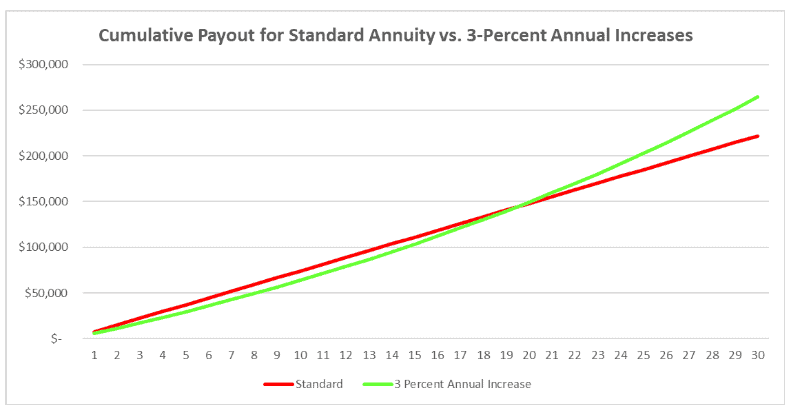
The following graph compares the cumulative payments from the two flavors of immediate annuity. In red, we see the standard case, where the payouts are the same each year, so the cumulative total increases in a straight line.
The other type, in green, however, starts with a lower annual payment, but increases it by 3 percent each year. As we can see, the break-even point is after 20 years. If the recipient survives longer than 20 years beyond the annuity starting point, they will come out ahead, in nominal dollar terms. If they die sooner, they’d have come out behind.
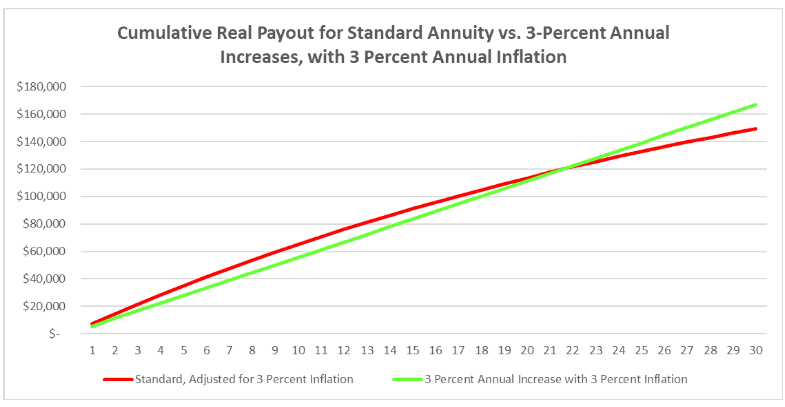
The second graph, below, is the same, except that here we assume an annual inflation rate of 3 percent, and compare real (i.e., inflation-adjusted) cumulative payments. With this, the break-even point moves further to the right, to 22 years.
How likely is a 67-year-old retiree to survive beyond age 89?
But what if inflation runs hotter, say 5 percent a year?
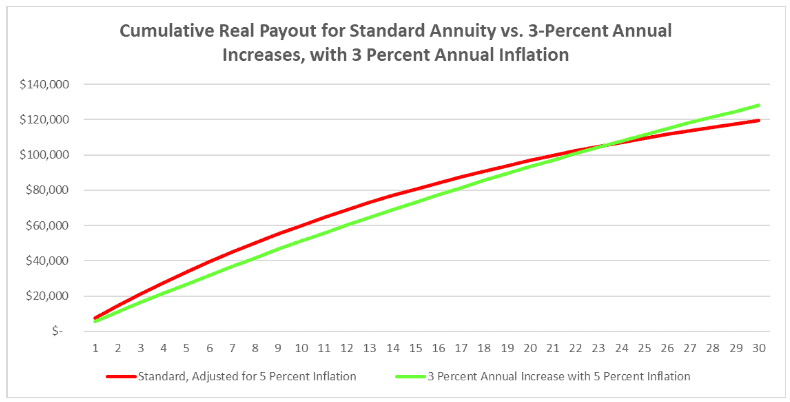
As we see in the third and final graph, both lines curve to the right, showing a gradual decrease in purchasing power. The difference is that the red line shows a 5 percent annual decrease while the green line shows a more gradual decline of about 2 percent annually.
Here, the break-even point moves even further to the right, to 24 years!
With this change, the likelihood of a man surviving to age 91 and coming out ahead with the 3 percent annual increase rider drops to one in six, while for a woman, the odds are about 27 percent, a bit better than one in four.
Given those figures, and the fact that retiree spending tends to trend down by as much as 2 percent a year, it may be a better bet to stick with the standard version and have more money to spend when you’re more likely to need it.
How Do Annuities Compare to Social Security Retirement Benefits?
This makes annuities a distant second to Social Security benefits for two reasons. First, Social Security gives cost-of-living adjustments (COLAs), and these COLAs are determined by increases in the Consumer Price Index (CPI), even if that’s double digits, vs. annuity insurance riders that are for a set annual percentage increase. If inflation is tamer than that rate, you win. If inflation runs hotter, you lose.
Second, while Social Security benefits are backed by the full faith and credit of the US federal government (and no matter your political persuasion or views on the US national debt, that’s still considered near-zero risk), annuity payments are backed solely by the insurance company’s financial stability.
What Are the Main Types of Fixed Annuities?
The two main types of fixed annuities are so-called single-premium immediate (typically called single-premium immediate annuities) and deferred annuities.
As the names suggest, the former starts paying out as soon as you give a lump sum of money to the insurance company, while the latter lets the insurance company invest the money you give them during the deferment period.
The insurance company’s expectation of positive investment returns allows it to increase your payout from deferred annuities relative to immediate ones for the same premium. The longer the deferment, the greater the increase in payouts.
However, inflation will eat away at the value of those higher payouts during that deferment (as well as after). In addition, there is the opportunity cost of not being able to invest the money yourself, with potentially a higher return than the insurer’s guaranteed increase. Thus, you’re giving up the possibility of a higher inflation-adjusted payout from investing the money for the period you’d have deferred the annuity, which would allow you to then buy an immediate annuity with the larger sum of money you’d have, in return for the (likely smaller but) guaranteed increase.
What Else Do You Need to Decide?
Another matter is the type of payout you want. If the insurer stops paying as soon as you die (a.k.a, single life), they’ll pay you more each year than if you have them keep paying until both you and your spouse die (a.k.a, joint life). Also, not that you can do much about it one way or the other, but (all other things being equal) men typically receive a higher payout than women, because women have longer life expectancies, so the insurer assumes it’ll have to pay longer.
What Are the Typical Results of Using Annuities with Part of Your Portfolio?
Along with Social Security, annuity payments (though the latter, as discussed above, will gradually lose purchasing power due to inflation) aren’t subject to the stock market or to market interest rates. This means you have a larger “floor” of retirement income to cover as much as you can of your fixed costs.
Since annuity payouts tend to be higher than you’d expect to draw from a portfolio, you’ll be able to spend more in retirement. However, once you (or you and your spouse) die, the insurer keeps the remaining money (if any), so your bequest is smaller.
Morningstar research shows that a retiree can increase their spending by buying an annuity with part of their portfolio’s value. However, they’d need to spend a big chunk of their portfolio to see a significant increase.
For example, someone claiming Social Security benefits at age 67 and having a $1 million portfolio could expect to spend about $2.19 million over a 30-year retirement and have $1.33 million left over (but recall that these dollars would be worth 30 years’ worth of inflation less).
If they’d spend 10 percent of their portfolio’s value on an annuity (Morningstar assumed they’d buy the 3 percent annual inflation rider), they’d get an extra $1k a year or $30k over a 30-year retirement. As a result, their balance after 30 years would be (on average) $1.17 million. This means they’d be buying a total of $30k with $160k worth of remaining balance to bequeath to their heirs (or charity).
Increasing the fraction of the portfolio used to buy the annuity to 50 percent increases annual payments by $3k and the 30-year retirement total by $90k. However, the remaining balance shrinks by $600k to a mere $730k!
How about buying a deferred annuity?
Morningstar shows that with similar assumptions, a 10-year-deferred annuity purchased with 10 percent of portfolio value would increase annual payouts by $5k and total 30-year payouts by $150k. However, this would reduce the ending balance, on average, by $270k. Deferring by 18 years (the maximum age allowed at payment start is 85, which is 18 years after the assumed age of 67 when the annuity is purchased) increases the total payout by $180k but reduces the ending balance by $300k.
Obviously, doing the same with 20 percent of your portfolio would lead to a higher total spend, but decrease the ending balance by even more. However, the likelihood of living from age 67 to age 85 or more, so you get to enjoy the higher payouts from an 18-year deferred annuity, is 40 percent for men and 54 percent for women.
Given all this, why would you even consider an annuity?
Simple. It reduces your risk of market losses gutting your portfolio, especially if the market crashes early in your retirement. This is because the larger fixed income you get from Social Security, plus the annuity, reduces how much you need to draw from your portfolio by more than the fraction of the portfolio value used to buy the annuity, so you’d be selling fewer shares when the market is down.
How Annuities Can Work as Part of a Holistic Plan
Optimizing your retirement finances can be complicated. Some questions you’ll need to answer for yourself (perhaps with the help of a financial advisor) include these:
What does your ideal retirement budget look like? How much of that is non-discretionary (think mortgage payments, utilities, car payments, groceries, etc.) vs. discretionary (e.g., travel, gifts to family, charity, etc.)?
What are your big goals? Do you want to leave a large bequest to heirs and/or charity? Want to take a luxury trip around the world? Maybe undertake a large upgrade to your home?
How much of your non-discretionary expenses do you want to (or are able to) cover from non-portfolio income sources, e.g., rental income, Social Security, annuities (this is where these fit in), pension (if you’re exceptionally lucky), part-time work, etc.?
There is an interplay between many of these decisions.
For example, if you want to have more non-portfolio income, you’ll need to pay for a larger annuity, which reduces your portfolio size. This limits your long-term growth potential but decreases the volatility of your income stream.
If your priority is money available for spending and/or gifting while alive, you might buy a larger annuity and use a dynamic withdrawal strategy such as the Guardrails Approach. The larger annuity makes your portfolio smaller. However, that’s offset by the higher safe initial withdrawal with the dynamic strategy. The downside is that this would make your eventual bequest much smaller, but that’s less of a concern if your priority is lifetime spending and gifting.
If your priority is to leave as large a bequest as possible, you’d try to minimize how much of your budget is non-discretionary. This can be done, e.g., by downsizing and/or moving to a lower-cost-of-living area, paying off your mortgage and car loans, completing any major home upgrades while still working, etc.
Next, you’d delay Social Security as long as possible while still working (possibly part-time) to avoid draining your portfolio too much.
Finally, you’d consider the tradeoff between the larger percentage of income you’d get from an annuity relative to a fixed safe withdrawal, vs. the impact of reducing your portfolio size to cover the annuity premium, trying to optimize for the largest likely portfolio ending balance.
Mike Hunsberger, Owner, Next Mission Financial Planning, shares his take on annuities, saying, “I encourage clients to make sure they have secure income (pension, Social Security, annuity income) that will cover their essential expenses. These are things like housing, healthcare, and food that they will have for their entire life. This is the way you can make a promise to your older self that you will never run out of money for the basics. My preferred annuity vehicle is the single premium immediate annuity to generate this needed income. It’s simple, and typically there aren’t many fees or moving parts a retiree needs to worry about.”
Joshua Mangoubi, Founder and Wealth Manager at Considerate Capital, offers some nuance, “Annuities serve as protection against the financial risks that come with outliving your savings. High-net-worth (HNW) people typically don’t need insurance against longevity because their amassed wealth can support them throughout an extended retirement period without needing annuity funds. People with small savings who lack pension benefits can find a timely Single-Premium Immediate Annuity (SPIA) to act as a financial backup by delivering dependable income support during retirement. Still, it’s not something to rush into. Try to maintain flexibility before you decide to allocate a large sum of money to a product that doesn’t allow for simple reversal.”
Stephen Mazer, Principal, Senior Wealth Advisor at Rational Wealth Solutions, agrees, “Our industry, too often, only promotes the idea that over time, market returns will provide the basis for retirement income. Guaranteed income in retirement is what I believe allows retired clients to peacefully sleep at night. We work with our clients to see if an annuity adds value to their long-term retirement income plan. Whether the goal is highest income, possible Long Term Care (LTC) income boost, or another annuity benefit, there are a multitude of annuity alternatives to consider for many retirees and pre-retirees. Sufficient guaranteed income could come from Social Security and/or a well-funded pension for some. For others, it could additionally come from a reliable income stream of rental properties or dividend-paying stocks. Annuities are THE opportunity for many people to create their own private pension guaranteed income that does not require the client’s active involvement (think repairs or reviewing quarterly dividend announcements) to keep flowing.
Omar Morillo, Founder of Imperio Wealth Advisors, elaborates, “Annuities can play a strategic role in retirement planning when used thoughtfully, particularly to cover essential, non-negotiable expenses like housing, food, and insurance. I often recommend them as part of a ‘guardrails’ approach: using guaranteed income sources to fund baseline living costs while allowing investment portfolios to support discretionary spending, such as travel or lifestyle upgrades. This structure helps retirees maintain confidence that their core needs are met regardless of market volatility.
“The type of annuities I typically recommend are deferred Registered Index-Linked Annuities (RILAs). These contracts offer a blend of market participation with downside protection and can provide lifetime income benefits. For retirees concerned about longevity risk and inflation, certain RILAs can also provide opportunities for income growth over time, and many can be structured to support both spouses over their lifetimes.
“That said, I advise caution with high-cost or opaque annuity products. Not all annuities are created equal; some come with complex riders or steep internal charges that can diminish their value. Transparency, cost, and the financial strength of the issuing insurer are critical when evaluating these options. As for how much of a client’s portfolio to allocate to an annuity, it’s driven by their essential spending needs. We work backward from their required monthly income (adjusted for inflation) to determine the present-day funding necessary. The goal isn’t to replace the entire portfolio with annuities but to strategically de-risk the portion needed to secure basic living expenses. For clients who value predictability and peace of mind, a well-structured annuity can be a powerful complement to a diversified investment strategy.”
The Bottom Line
Between Social Security (and when to claim benefits, and how much of your retirement budget benefits will cover), rental properties, stocks (and do those pay out dividends or not), bonds, cash, maybe a pension, and now annuities (and deciding whether to buy an immediate one, deferred, or both…), not to mention your desired retirement budget, the fraction that’s fixed vs. discretionary… it can be a lot.
Given the enormous complexity and sheer number of moving pieces, hiring the right advisor, at least for crafting your initial financial plan for retirement, may be your best investment.
Disclaimer: This article is intended for informational purposes only, and should not be considered financial advice. You should consult a financial professional before making any major financial decisions.
About the Author
Opher Ganel, Ph.D.
My career has had many unpredictable twists and turns. A MSc in theoretical physics, PhD in experimental high-energy physics, postdoc in particle detector R&D, research position in experimental cosmic-ray physics (including a couple of visits to Antarctica), a brief stint at a small engineering services company supporting NASA, followed by starting my own small consulting practice supporting NASA projects and programs. Along the way, I started other micro businesses and helped my wife start and grow her own Marriage and Family Therapy practice. Now, I use all these experiences to also offer financial strategy services to help independent professionals achieve their personal and business finance goals. Connect with me on my own site: OpherGanel.com and/or follow my Medium publication: medium.com/financial-strategy/.
Find financial advisors in Lake Oswego, Oregon ready to help with your financial planning needs so you can enjoy life more with less money stress.
Whether you have lived in Lake Oswego for years or recently moved to town, you may need help finding the right financial advisor in the community best suited for your individual needs.
It’s important to first consider your own financial planning priorities before choosing an advisor. Here are a few quick tips to help you get started along with financial advisors in Lake Oswego featured on Wealthtender you may want to add to your shortlist.
Featured Lake Oswego Financial Advisors
As you prepare to interview financial advisors in Lake Oswego who may be right for you, get to know local financial advisors featured on Wealthtender.
📍 Map: Financial Advisors with their Primary Office Location in Lake Oswego
Double-click (or pinch the map on mobile devices) to zoom in and expand the details for financial advisors whose primary office location is in Lake Oswego.
The Benefits of Hiring a Financial Advisor in Lake Oswego
Hiring a financial advisor can be a great move to help you build a long-term investing strategy. Advisors can help you build an investment portfolio to meet your financial goals and help you plan appropriately for retirement.
As a resident living in Lake Oswego, hiring a financial advisor who lives nearby and understands the local economy, cost of living, and regional employers can be quite valuable, especially if your individual circumstances are deeply tied to such factors.
Who are the largest employers in Lake Oswego?
Do you work for one of the largest employers in Lake Oswego? If so, there’s a good chance the local financial advisor you hire will also have other clients who work there. This knowledge could prove valuable if they are already familiar with your employee benefits, such as a 401(k) plan, Health Savings Accounts, and other components of your total compensation package.
When you reach out to financial advisors you’re considering hiring, let them know where you work and ask if they are familiar with your employer’s unique benefits and compensation structure.
Quick Tips For Hiring a Lake Oswego Financial Advisor
Before hiring a financial advisor in Lake Oswego, here are a few quick tips to help you find the best advisor for you.
1. Decide Which Services You Need
Before hiring an advisor, determine what services you need from them. Whether it’s full-service investment management or a plan focused on a specific area of your finances, put together a list of what you’d like help with before contacting an advisor.
Though most people use a financial planner simply to invest for retirement, this is only a small part of what many advisors offer. Here’s a quick rundown of potential services a financial advisor may offer you:
Budgeting and money management
Debt management
Insurance planning
Retirement planning
Other investment planning
Inheritance planning
Estate planning
Tax planning
As you can see, financial advisors can help you with your entire financial picture, not just investing. As you start to plan for life’s bigger milestones, you should consider finding a financial advisor that specializes in those areas.
Finding the right advisor can help you minimize risk, maximize gains and take advantage of tax breaks while investing for your future. They can also help you protect your assets with the right kinds of insurance and help you pass on your financial legacy with a proper estate plan.
2. Consider Your Budget and Payment Preferences
Once you have a list of services you would like, review the fee structures financial advisors offer. Finding a balance between the services you need and the cost of those services will help narrow down the field of advisors you may want to work with.
If you are looking for a full-service advisor to manage all of your investments, consider searching among fee-based financial advisors. If you want to manage your money yourself, consider the flat fee and monthly subscription advisors for ongoing support.
3. Interview Multiple Financial Advisors
Once you have chosen the services and fee structure you prefer, it’s time to contact a few advisors and interview them. Here are questions to ask financial advisors:
What services do you provide?
What are all the ways you get paid? (fee transparency)
What is your investment strategy?
How do you measure investment performance?
How do we communicate about my plan?
Interview multiple advisors to get a feel for who you want to work with. A combination of fees, services, and customer service will help you determine the best fit for your financial advice.
4. Review Financial Advisor Credentials
Once you find an advisor (or two) you feel comfortable with, it’s always a good practice to check their credentials and the firm’s details. You can do this at the Investment Adviser Public Disclosure (IAPD) website.
You can check both the individual and the firm to view their background and experience details, as well as any disciplinary action taken against them or their firm.
As licensed financial professionals, there is oversight into how financial advisors conduct business, so running a quick (free) check on them is recommended.
For additional information about advisor credentials, read our article to learn the most popular designations held by financial advisors, as well as specialized credentials which may be important to consider if you have unique financial planning needs.
Frequently Asked Questions & Additional Resources
How do I know if I’m ready to hire a financial advisor?
You should strongly consider hiring a financial advisor if you have a significant amount of money available for saving or investing. This could occur after years of making annual contributions to a retirement plan like a 401(k) through your employer or suddenly if you receive a large inheritance or sell your house for a large profit.
But even if you don’t have a lot of money saved, many financial advisors and planners provide reasonable pricing options and valuable services you should consider, especially if you’re facing a significant life event. For example, if you’re starting a new job, getting married, starting a family, getting divorced, lost your job, starting or selling a business, or approaching retirement age, working with a trusted financial advisor or planner may prove worthwhile.
Before I hire a new financial advisor, should I fire my current advisor?
You don’t need to fire your current advisor before beginning your search for a new financial advisor. In fact, your new advisor can help coordinate the transition of your assets from your previous financial advisor.
Where can I read reviews about financial advisors written by their clients to help me decide if I should hire them?
After 60 years of regulatory prohibition of financial advisor reviews in the US, a rule issued by the Securities and Exchange Commission (SEC) became effective on May 4, 2021 that means both financial advisors and directory websites that help consumers search for a financial advisor can collect and display financial advisor reviews, an important factor worth considering when choosing who you’ll hire to manage your investments and life savings.
Wealthtender is the first independent advisor review platform designed to be fully compliant with the new SEC rule, and we look forward to helping you evaluate financial advisors based on reviews written by their clients.
I’m a local financial advisor interested in being featured in this guide. How do I get started?
Thanks for your interest. We look forward to learning more about your practice and helping you attract your ideal clients where you may be a good fit based on their individual needs and circumstances. Please click here to learn how you can join local financial advisors featured on Wealthtender.
Brian is CEO and founder of Wealthtender and Editor-in-Chief. He and his wife live in Austin, Texas. With over 25 years in the financial services industry, Brian is applying his experience and passion at Wealthtender to help more people enjoy life with less money stress. Learn More about Brian