If you’re an American, you’re probably familiar with various Forbes lists, but here’s one you may have missed. For the last nine years, Forbes has started each new year with a published list of places that are, in their words “so affordable you might not need to work.” The January 2025 list is out, and today we’re taking a look at it.

We’ve looked before, here at Wealthtender, at some of the best places to live as an ex-pat retiree, or as a digital nomad. If you fall into the first category, or indeed if you can live off of US based investments (including maybe renting out a home in the US) you may actually find these places viable to live in — completely work-free.

Some things to be aware of:

  • If you’re a US citizen living outside of the U.S. you still need to submit a tax form and you’ll usually have to pay tax on unearned income (like investments or rental income). You generally don’t have to pay tax on earned income (whether earned remotely or in your adopted country). As always, do your research and consult a professional about your particular situation.
  • You’ll need to check visa requirements for any country you move to temporarily, including the situation regarding work permits. If you work locally, even a little (and in some cases even if it’s volunteer work) you may need a permit. In some countries you’ll need a permit to work remotely too, if you’re staying there for any length of time. In most cases, you don’t need a permit to work remotely while on vacation, and depending on the country a vacation may include any stay of up to 90 days or even longer, but again, check the rules before you go.

If you’re looking for a place to spend time, with a minimal need to generate income, here are just a few of the places you could consider.

Columbia

Super affordable and more popular with ex-pats than you’d imagine. The Columbian city of Medellin is now renowned as a digital nomad paradise. It has long been a regular stop on remote work programs such as the formerly-popular remote year, and has a great choice of cool and quirky co-working spaces.

According to Forbes, rental costs in smaller cities can be as low as $500 monthly, with lunch specials in restaurants available from around $4. They suggests $1,500 a month as a reasonable monthly budget — for a couple.

Bali, Indonesia

Bali has long attracted digital nomads from all over the world. Particularly popular with Aussie remote workers and ex-pats, it’s also a common choice for those from the UK, so there’s a fairly substantial English-speaking ex-pat community.

Rental costs vary hugely, but again a couple can feasibly live on a $1,500 monthly budget, and again, you’ll find restaurant deals for as little as $4 per person.

Like the idea of Indonesia but want to look outside of the popular and touristy island of Bali? Then you’ll be able to slash your costs further. Check out this YouTube channel run by an American who’s lived in Indonesia for over 40 years.

Thailand

Another country much loved by ex-pats from Australia, the UK and many other European countries. In the big cities — and in many of the resorts — you’ll find amazing co-working spaces and often co-living options too, and the cost of living is still shockingly low in most areas.

The Digital Nomad Asia suggests that $650 per month is enough to cover basic accommodation, food, and utilities for a single person. As always, that will tend to come in a little cheaper per person if you’re a couple.

Costa Rica

Costa Rica has come up before when we’ve discussed places where US ex-pats can make their retirement dollars go further.

International Living recommends Costa Rica’s Southern Zone, and in particular the area around the town of Dominical, although if you’re looking for a more cosmopolitan lifestyle you might be better off further north, somewhere like San Jose. Furnished rentals are available from as little as $700 a month, and meals out start at around $10.

Northern Spain

Spain is — in European terms at least — still relatively affordable, and Forbes picks the lower-cost Northern region, highlighting areas such as Galicia, Asturias and Cantabria, or San Sebastián and Bilbao if you’re more of a city person.

Rentals (usually furnished) in smaller towns are incredibly affordable. Shawn Forno, an ex-pat living in Galicia, has done a great break down of what it costs him to live an excellent life there. He and his wife pay €600 per month for a two-bed, two-bath home, and their monthly expenses come in at a little over €2,000 per month to live a truly awesome life (that includes luxury gym memberships, twice-weekly Spanish lessons, entertainment, alcohol, and eating out).

Living abroad, even for a short time, is always complex. Don’t forget to factor in travel and medical insurance, visa fees if needed, and any other admin fees that might be involved in settling in a specific country. Still interested? You can access the full Forbes list here, and check out the average cost of living anywhere in the world here.

Are You Ready to Hire a Financial Advisor?

You’ll find a growing number of financial advisors featured on Wealthtender. You can search based on the areas of specialization most important to you and where they’re located, or browse our financial advisor directory for more search options to find advisors who may be a good fit for you.

Find Financial Advisors for Travel Lovers on Wealthtender

📍 Click on a pin in the map view below for a preview of financial advisors for travel lovers who can help you reach your money goals with a personalized plan. Or choose the grid view to search our directory of financial advisors with additional filtering options.

📍Double-click or pinch pins to view more.

Showing

About the Author

Karen Banes is a freelance writer specializing in entrepreneurship, parenting and lifestyle. She writes articles, website content, ebooks and the occasional award winning short story. Her work has appeared in a range of publications both online and off, including The Washington Post, Life Info Magazine, Transitions Abroad, Brave New Traveler, Natural Parenting Group, and Copia Magazine. Learn More About Karen

You can use Exchange-Traded Funds (ETFs) to avoid the wash-sale rule in several ways. Here are three, from the clearly legal to the more questionable.

Most wealthy people constantly look for legal ways to minimize their taxes, and the rest of us can learn from their tricks.

Some expand that to include tax reduction strategies that aren’t clearly legal but are at least defensible and haven’t been disallowed by the IRS.

“Harvesting” investment losses to offset realized gains, and (some) regular income can be completely legal if you don’t run afoul of the so-called “wash-sale rule.”

That’s where things start getting murky…

Senior couple reviewing documents together with a laptop at home.
Image Credit: Depositphotos.

What is the “Wash-Sale Rule”?

The wash-sale rule is intended to prevent taxpayers from claiming a tax loss while keeping the investment that generated that loss. 

The rule says you can’t claim the loss if, within 30 days before or after selling at a loss, you buy a “substantially identical” investment, even if the purchase is in an IRA or other retirement plan.

This applies to buying the same security, acquiring it through a taxable exchange, or even buying a contract or option to buy that security.

Using ETFs to Circumvent the Wash-Sale Rule — a Legit Loophole?

You can use Exchange-Traded Funds (ETFs) to avoid the wash-sale rule in several ways. 

Here are three, from the clearly legal to the more questionable.

1. Sell a stock and buy an ETF following the relevant investment sector.

Say you bought 100 shares of company ABC in the healthcare sector a year ago for $10,000, and those shares have since dropped to $4000.

You sell the shares, realizing a $6000 long-term capital gains loss. 

You can use this loss to offset up to $6000 in realized long-term capital gains (if you held the shares less than 12 months this would be short-term capital gains loss), and if you don’t have enough such gains from other investments to offset, you can use the loss to offset up to $3000 in regular income ($1500 if married filing separately), carrying any remaining losses to future tax year(s) when you can use them.

The problem arises if you still believe in the company and the healthcare sector and don’t want to risk missing a potential jump in price during the 30 days when the wash-sale rule would disallow the tax loss.

The solution is to buy an ETF that follows the healthcare sector. 

This isn’t an identical security to ABC, avoiding the wash-sale problem.

2. Sell a mutual fund and buy a similar ETF.

One could argue that an index mutual fund and an ETF following the same index are not substantially identical because they charge different fees and may not own an identical mix of underlying stocks. The latter is because index funds like the S&P 500 approximate the weightings of stocks in the index.

This may allow you to sell shares of, say, Vanguard 500 Index Fund Admiral Shares (VFIAX) if the index drops, harvesting the tax loss, and replace them immediately with shares of Vanguard 500 Index Fund (VOO).

If you’re concerned the IRS may deem the two substantially identical because both are from Vanguard, you could instead buy shares of, e.g., SPDR S&P 500 ETF Trust (SPY).

3. Sell an Index ETF and buy an ETF from a different sponsor that follows the same index.

Here, the idea would be that if you sell shares of an ETF that declined in price, say, SPY, you could immediately buy shares in another S&P 500 ETF, e.g., VOO, at the same price point where you sold. 

Both ETFs follow the S&P 500, but the trustee of the first is State Street Bank, while Vanguard offers the latter. As a result, the two likely don’t share an identical weighting of the S&P 500 stocks and thus may not be considered substantially identical.

The IRS has yet to rule on whether they consider ETFs from different sponsors that follow the same index as substantially identical and do not (yet) enforce the wash-sale rule on ETFs. 

In general, the more people who save more taxes by using a specific loophole, the bigger a target this becomes for the IRS (though Congress may not accept that way of increasing revenue).

Should the IRS so rule (and should Congress not overrule them), the result could be one or more of the following:

  • Future use of the loophole will be illegal.
  • Past use of the loophole would be disallowed, with back taxes owed.
  • Should the IRS rule this is tax fraud, those who used the techniques in question may also be subjected to monetary and/or other penalties.

Even the Pros Don’t All Agree on What’s Acceptable

Melody Brady, Founder of Beechmont Financial, would be comfortable with these methods, saying, “I often rebalance my portfolios to realize a capital loss for tax harvesting by swapping an ETF for a similar one managed by a different manager, or a similar mutual fund. There’s always talk of tax legislation changing, but I only pay attention when it’s close to being passed before I adjust how I rebalance my portfolios.”

Douglas M. Lynch, President, Lynch Financial Group, LLC, argues, “Indeed, the IRS hasn’t clearly defined what substantially identical means, so the issue is somewhat muddy. However, we wouldn’t recommend an investor sell one S&P 500 Index fund and buy another S&P 500 ETF or a fund from an alternate provider. I’d have a hard time arguing to the IRS the funds aren’t substantially identical. We’d recommend buying an index fund that tracks a similar but different index. For example, we’ve sold an S&P 500 fund to harvest tax losses and purchased the Schwab 1000 ETF (SCHK).”

Alison Roth, Financial Advisor at AdvicePeriod, agrees, saying, “There’s never a perfect way to harvest losses and maintain an identical exposure (both upside and downside) without triggering the IRS wash sale rule. That said, we use two approaches: 1) With an individual stock, we’ll sell a company to harvest losses, and purchase a comparable one in the same industry, e.g., Pepsi versus Coca-Cola, to avoid wash sale rules. While each has company-specific risks and unique drivers of performance, owning Coca-Cola for the necessary time will at least provide exposure to the overall sector/industry. 2) With ETFs or mutual funds, we’ll harvest one fund for losses, then purchase a replacement that performs similarly, but tracks a different index. For example, if you sell an ETF that tracks the S&P 500, instead of purchasing a replacement ETF that also tracks the S&P 500, you might purchase one that tracks the Russell 1000 that has similar upside/downside, risk, and exposure. While tax loss harvesting can add value for many different investors, the IRS wash sale rule certainly leaves elements up for interpretation, so it’s important to avoid potential issues down the line.”

Anthony Ferraiolo, Partner Advisor of AdvicePeriod, feels similarly, “Tax loss harvesting can be a powerful tool, but there’s some gray area. Of the three strategies, the only one I’d suggest to clients is #1. The rule says you cannot buy substantially identical assets, so I wouldn’t feel comfortable switching to an ETF following the same index. Instead, I’d suggest investors swap, e.g., from an S&P 500 ETF to one following the NASDAQ Composite Index; similar indexes based on environmental, social, and governance (ESG) considerations; or, for an individual stock, finding a similar company in the same industry. You can look at the correlation between the two assets to feel more comfortable with the switch. By being more strategic, you avoid adverse tax consequences.”

Another Interesting (and Fully Legit) Tax Benefit of ETFs

Mutual funds are required to distribute annually to their investors any realized capital gains, whether or not you owned the shares when those gains were realized.

This can cause a distorted result if XYZ fund soars 50% from January to June when you buy shares, after which the share price drops 20% by the end of the year. 

In this scenario, you lose 20% on your investment but may be taxed on up to 30% of realized capital gains from which you did not benefit.

ETFs provide authorized participants who serve as a buffer, insulating investors from taxable events triggered by the ETF selling shares in its underlying investments. 

This way, you only get taxes on your actual gains, if any, realized when selling the ETF shares.

The Bottom Line

ETFs open up several interesting ways of circumventing the IRS’s “wash-sale” rule, letting you harvest tax losses while maintaining a similar investment position to avoid missing out on a potential rapid price appreciation.

These ways vary from the clearly legit to the questionable.

Should the IRS rule that one or more of these is not allowed, the impact on taxpayers will be preventing future use of the loophole, possibly owing back taxes, and potentially being assessed financial and/or other penalties.

Are You Ready to Hire a Financial Advisor Knowledgeable About ETFs?

You’ll find a growing number of financial advisors featured on Wealthtender. You can search based on the areas of specialization most important to you and where they’re located, or browse our financial advisor directory for more search options to find advisors who may be a good fit for you.

Find Your Next Financial Advisor on Wealthtender

📍 Click on a pin in the map view below for a preview of financial advisors who can help you reach your money goals with a personalized plan. Or choose the grid view to search our directory of financial advisors with additional filtering options.

📍Double-click or pinch pins to view more.

Showing

Have a Question to Ask a Financial Advisor?

When you’re uncertain about money matters, submit your question to Wealthtender, and it may be answered by a financial advisor in an upcoming article or in the Wealthtender Expert Answers Forum

Need personalized help? Visit wealthtender.com to find the right financial advisor for your unique needs.

This article was originally published on Wealthtender and is intended for informational purposes only and should not be considered financial advice. You should consult a financial professional before making any major financial decisions. Wealthtender earns money from financial professionals, which creates a conflict of interest when these professionals are featured in articles over others. Read the Wealthtender editorial policy and terms of service to learn more. Wealthtender is not a client of these financial services providers.

Disclaimer: This article is intended for informational purposes only, and should not be considered financial advice. You should consult a financial professional before making any major financial decisions.

Opher Ganel

About the Author

Opher Ganel, Ph.D.

My career has had many unpredictable twists and turns. A MSc in theoretical physics, PhD in experimental high-energy physics, postdoc in particle detector R&D, research position in experimental cosmic-ray physics (including a couple of visits to Antarctica), a brief stint at a small engineering services company supporting NASA, followed by starting my own small consulting practice supporting NASA projects and programs. Along the way, I started other micro businesses and helped my wife start and grow her own Marriage and Family Therapy practice. Now, I use all these experiences to also offer financial strategy services to help independent professionals achieve their personal and business finance goals. Connect with me on my own site: OpherGanel.com, and/or follow my Medium publication. Opher Ganel’s Bio on Wealthtender.

Is a flat fee financial advisor right for you? Learn what you should look for if you’re preparing to hire an advisor who charges a fixed cost and search the flat fee advisor directory.

A growing number of financial advisors offer services for a flat fee as an alternative to traditional pricing models (e.g., charging you 1% of the value of your portfolio managed by the advisor). Especially as your net worth grows, you may find a flat fee compensation arrangement can save you thousands of dollars each year vs. an advisor who is paid a percentage of the assets they manage for you. And, of course, the less money that goes to your financial advisor means more money available for you to spend in retirement.

If you’re thinking about hiring a flat fee financial advisor, it’s important to look under the hood to understand what services are offered and how the fee is calculated. For example, a flat fee charged by some financial advisors may include developing a financial plan for you but not investing your money on your behalf. Other flat fee financial advisors might include investment advisory services.

And just because a financial advisor charges a flat fee doesn’t mean every client will pay the same rate. In many instances, the flat fee might be calculated based on your income, portfolio size, and/or the overall complexity of your individual circumstances.

📍 Click on a pin in the map view below to discover flat fee financial advisors who can work with you to develop a personalized financial plan. Or click the Grid option to view these advisors in a directory.

📍Double-click or pinch pins to view more.

Showing

What Services Will I Receive for a Flat Fee?

Flat fee financial advisors will typically outline exactly what is included in this planning service, with different tiers for more comprehensive planning. For example, the flat fee may include creating a detailed financial plan for your debt, goals, investments, and more. Be sure to ask the financial advisor upfront if they will implement the plan for your investments on your behalf or if they will leave it up to you to follow the details of the plan.

In certain instances, you may only require a flat-fee financial advisor’s work one time (in which case, you may want to consider an hourly financial advisor, though the same financial advisor may offer both pricing models and should steer you to the pricing model likely best for your individual needs).

How Much Does a Flat Fee Financial Advisor Really Cost?

Clients of flat fee financial advisors often work together for many years, where the flat fee is often billed quarterly. The cost of hiring a flat fee financial advisor can vary significantly from $1,000 to $10,000 per year (or more), depending on the scope and detail of the financial plan provided, whether or not investment management is involved, and the complexity of your circumstances.

Should I Hire a Financial Advisor Who Charges a Flat Fee?

If you plan to establish a longer-term relationship with a financial advisor who charges you a fixed cost each year, a flat fee financial advisor may be an ideal solution for you. This is especially true for affluent clients with larger asset balances above $1 million who are seeking ongoing investment management and planning in retirement.

ASK THE EXPERTS

We asked flat fee financial advisors to offer their perspectives on when and why people may want to hire a financial advisor who charges a flat fee. Here’s what they said.

Headshot of Don Rudolph
Don Rudolph FLAT FEE CIO is Your Fixed Fee Chief Investment Officer

For affluent investors, your advisor fee can “make or break” your retirement income plan as a 1% fee charged on your investments can devour over 30% of your after tax investment income each year in retirement.

Now, thanks to advancing financial technology, a low fixed fee is rapidly replacing the 30-year-old legacy percentage on asset (AUM) advisor fee and can transform your “income outcome” in retirement.

Today’s low fixed fee offers clients greater transparency and control over their annual fee and, unlike legacy percentage on asset fees, fixed fees do not rise each time the market goes up or when you add to your investment account.

Show more

Don Rudolph | FLAT FEE CIO

Headshot of TJ van Gerven, CFP®
TJ van Gerven, CFP® Helping high-earning professionals in their 30s and 40s align money with meaning

While no type of fee model is perfect, the flat fee model is one of the most transparent and fair advisor-client compensation methods. It helps to remove the conflict of interest of “looking to gather your assets,” as well as a variety of conflicts around paying down debt vs. investing. With a flat fee model, you always know what you’re paying and what you’re paying for. It also allows you to work with an advisor regardless of your assets.

A flat fee model may not make sense for you if you’re looking for a one-off engagement. In that case, you may be better served by an hourly advisor.

Show more

TJ van Gerven, CFP® | Memento Financial Planning

Expert Insights: What are the Benefits of Hiring a Flat Fee Financial advisor?

Headshot of Elizabeth Alf, CFP®
Elizabeth Alf, CFP® Enlightened Financial Planning

Flat fee advisors can be a great option for younger clients who might not meet the asset requirements for advisors who charge on AUM. This allows younger clients to get the important financial advice that will set them up for early success. I also feel that a large part of the value of a financial advisor comes from the planning work and so tying a fee to invested assets and market movements does not truly align with the value of services.

Show more

Elizabeth Alf, CFP® | Clerestory Advisors

Headshot of Michael Reynolds, CFP®, CSRIC®, AIF®, CFT-I™
Michael Reynolds, CFP®, CSRIC®, AIF®, CFT-I™ Progressive Financial Planning & SRI/ESG Investing.

I love the flat-fee model because, in my opinion, it is the most conflict-free. For example, if a client asks – “should I invest this money in my brokerage account or buy a rental property?” – under a flat-fee model they can be reassured that my answer is truly un-biased because neither option is tied to my compensation.

I think flat-fee works well for everyone but especially for those with substantial assets. The AUM model would lead to ever-increasing fees but the flat fee model is a more fair way to bill them since the size of assets doesn’t necessarily correlate to more complexity or effort on the part of the advisor.

Show more

Michael Reynolds, CFP®, CSRIC®, AIF®, CFT-I™ | Elevation Financial

Headshot of Kelly Klingaman, CFP®, RLP®
Kelly Klingaman, CFP®, RLP® Financial Planning for Professional Women & Their Families

One example of a flat fee compensation model is an advisor that provides ongoing financial planning with investment management for a flat annual fee that’s determined at the start of the engagement based on the complexity of the client’s situation. The flat fee might be revisited each year and adjusted to account for any increased complexity in the client’s financial life, or even simply to make an annual inflation adjustment.

There are quite a few benefits of hiring a financial planner that is compensated this way. A flat-fee model like this offers a way of ensuring that clients have proper awareness of what they’re paying at any given time, and the planner is fairly compensated for the ongoing work. It is more transparent and links the fee directly to the value of overall financial guidance being delivered to clients and not just to the management of assets. This also allows more families to start working with a financial planner during their 30s and 40s because they can afford to pay a flat fee out of their cash flow.

Show more

Kelly Klingaman, CFP®, RLP® | Kelly Klingaman Financial Planning

Are You a Flat Fee Financial Advisor?

👋 Hi there! We’re excited to help more people understand the benefits of working with a flat fee financial advisor. And we want to help connect people to the best financial advisors for their individual needs. If you offer services for a flat fee, we encourage you to join our growing community of financial advisors featured on Wealthtender so we can feature you in this guide soon. Click here to learn more and get started.

About the Author
A headshot of Brian Thorp, the founder and CEO of Wealthtender

About the Author

Brian Thorp

Brian is CEO and founder of Wealthtender and Editor-in-Chief. He and his wife live in Austin, Texas. With over 25 years in the financial services industry, Brian is applying his experience and passion at Wealthtender to help more people enjoy life with less money stress. Learn More about Brian

Women in their fifties and sixties have a lot to look forward to as they transition from careers and raising families to a more leisurely lifestyle in retirement. Spending time with friends and family, traveling, and pursuing new hobbies are just a few of the activities many women envision in their golden years.

To enjoy life in retirement with less money stress, many women over 50 are choosing to work with financial advisors specializing in financial planning for women who are nearing retirement. These advisors know the right money moves to make to help women feel confident they can live comfortably with a personalized plan tailored to their unique circumstances.

You’ll likely find dozens of nearby financial advisors in your community well-suited to help with general financial planning services. But it may be more difficult to find a financial advisor with the specialized knowledge and experience helping women in their fifties and sixties successfully transition into retirement.

Fortunately, many financial advisors offer virtual services so you can meet online no matter where you (or they) live. This means you can choose to hire a financial advisor who lives hundreds of miles away if you decide their specialist knowledge and understanding of your particular needs may prove a better fit.

Financial Advisors for Women Over 50

This page is organized into sections to help you quickly find the information you need and get answers to your questions:

  1. Interactive Map of Financial Advisors for Women Over 50
  2. Q&A with Financial Advisors for Women Over 50
  3. Get Answers to Your Questions About Financial Planning for Women Over 50
  4. Browse Related Articles

Find Financial Advisors for Women Over 50

📍 Click on a pin in the map view below for a preview of financial advisors who specialize in serving women over 50 . Or choose the grid view to search our directory of financial advisors with additional filtering options.

📍Double-click or pinch pins to view more.

Showing

Q&A with Financial Advisors for Women Over 50

We’re fortunate to count several financial advisors in the Wealthtender community who specialize in helping women over 50 prepare for a comfortable retirement. We asked these advisors to answer a few questions useful to women over 50, including:

  • What are the biggest financial challenges faced by women in their fifties and sixties?
  • What are the biggest financial opportunities for women over 50?
  • How should women over 50 invest?
  • How should women over 50 approach financial planning?

Just below, you’ll find the thoughtful insights shared by these specialist advisors to help women over 50 feel more confident about their financial future.

Headshot of Stephanie McCullough
Stephanie McCullough Dedicated to women on their own who want a true partner in $$ decision-making.

The challenges faced by women in their fifties and sixties are numerous and real. Jobs and marriages may end sooner than planned. Potential potholes and storms can throw off the best-laid plans. But one of the biggest challenges I see women facing is their own self-judgment. So many women feel like they should be “better” about their money, and that they should know how to do this stuff. There’s often an underlying feeling of guilt or shame that keeps them from facing reality head-on and taking steps to do the planning.

Q: What are the biggest financial opportunities for women over 50?

As a woman of 55 I can attest that this age brings some clarity on priorities and values, and some shedding of the “shoulds” and supposed obligations we picked up along the way. With this clarity can come a reevaluation of all of our financial decisions – not only how we spend our money, but how we earn it, to whom we gift it, and where we save it. Each brings opportunity to be in alignment and integrity with our true values.

Q: How should women over 50 invest?

Same as how women over 50 “should” dress – however they want! By that I mean that each individual’s investing plan should be customized to what they have going on in their life. Some women hope to “retire” from their main career and do something new which may or may not bring remuneration; whereas others might be ramping up their earning power and not looking to transition to another chapter for 20 years! Since investing is only for long-term money, getting clear on how much should be in short-term buckets vs. long-term is always an important first step.

Q: How should women over 50 approach financial planning?

I believe it’s crucial to look at money as merely a tool, not the goal in itself. And if you’re working with a financial professional, you want one that’s going to talk about much more than simply your investments. Investing is important, but it’s only one part of a comprehensive financial plan. I think women should approach it holistically – all aspects of their financial lives, and how they interact with all the things they hold most dear!

It’s also crucial to recognize that money is emotional. Of course we’re going to have feelings about something that impacts our personal security, our health, our families, our sense of self-worth, and so much more. You need to be able to talk about the emotions as well as the numbers!

Show more

Stephanie McCullough | Sofia Financial

Headshot of Marianne Nolte, CFP®
Marianne Nolte, CFP® FINANCIAL CLARITY, EDUCATION, AND PEACE OF MIND FOR WOMEN & COUPLES

In retirement, women may become impacted by low Social Security benefits and the Widows Tax Trap.

Low Social Security benefits: Women often hold lower-paying jobs; therefore, they receive lower benefits in retirement. Often, if a couple has a small business, the husband takes the financial lead and is taxed on the income received. He is contributing to Social Security, but the wife is not building a benefit for herself.

Widows Tax Trap: Husband and wife each have an employer 401(k). They are taxed as Married Filing Jointly which receives the largest standard deduction. In retirement, they each begin taking Required Minimum Distributions (RMD) at the appropriate age (currently age 72). Statistically, women tend to outlive their male partners. He passes away and she inherits his 401(k). Now she has to take RMDs for both her account and his, but 2 years after he passes away, she now files Single and receives the considerably less standard deduction.

How should women over 50 approach financial planning?

Finances aren’t taught in school. Many families don’t have conversations about money with their children. Women often feel uneducated about their money. Once married, the higher money earner tends to manage the money. As a Certified Financial Planner™, many widows have approached me and stated, that their husbands took care of the finances. They simply don’t understand what they have, where it is located, and if they will now have enough to get by for the rest of their lives. An experience like this is truly frightening!

What can be done?

Ladies, ask questions! Begin to educate yourself about your finances. Start by talking with your spouse. At which financial institutions are the family’s accounts held? Make a list, request the online account access username and password, begin to review the accounts regularly, and ask questions if you see significant changes. Next, sit in on all meetings with your financial professional. If you do not understand the terminology used, ask questions. As an account owner or joint account owner, you have a right to ask and learn about your money.

Show more

Marianne Nolte, CFP® | Imagine Financial Services

Have Questions About Financial Planning for Women Over 50?


Are you ready to enjoy life more with less money stress?

Sign up to receive weekly insights from Wealthtender with useful money tips and fresh ideas to help you achieve your financial goals.

  • This field is for validation purposes and should be left unchanged.


About the Author
Brian Thorp, Founder and CEO of Wealthtender profile picture

Brian Thorp

Founder and CEO, Wealthtender

Brian and his wife live in Texas, enjoying the diversity of Houston and the vibrancy of Austin.

With over 25 years in the financial services industry, Brian is applying his experience and passion at Wealthtender to help more people enjoy life with less money stress.

Connect with Brian on LinkedIn

Understanding health insurance is hard, leading Americans to spend too much on healthcare with outcomes worse than many developed countries.

As Americans, we should all be outraged.

According to a Commonwealth Fund report, “The U.S. is a world outlier when it comes to health care spending,” yet we don’t get what we’re paying for – better health outcomes.

We Pay More for Health Insurance to Get Less

In 1980, we were already at the high end of developed economies, at 8.2% of Gross Domestic Product (GDP). But the latest data show we’ve more than doubled that since, to 17.8%.

Germany, in second place, spends just 12.8% of its (far lower) GDP, while the average for the 12 non-US developed countries stands at 11.1%.

The report states that in absolute dollar terms, “Health spending per person in the U.S. was nearly two times higher than in the closest country, Germany, and four times higher than in South Korea.

And lest you think this means we get better health outcomes, the report shows life expectancy in the US, at 77, is lower than all 12 of those other countries. The next lowest was the UK, at 80.4, and the average was 82.6, over five years longer than us.

In terms of avoidable deaths, the US leads the pack, by a lot. According to the most recent data, for 2020, we had 336 avoidable deaths per 100,000 population – in absolute numbers that was a heart-wrenching 1.1 million American lives needlessly lost.

Even before the Covid-19 pandemic, we lost 273 lives per 100,000, for a total of nearly 900,000 whose deaths were preventable.

In 2020, the next highest, Germany, stood at 195 per 100,000, 42% lower than us; while in 2019 their number was over 30% lower than us, at 188.

We Don’t Fully Understand Our Health Insurance 

According to the Commonwealth Fund report, “The U.S. is the only high-income country that does not guarantee health coverage.

And even when we do have health insurance, it’s expensive, often hard to navigate and make informed choices, and even when we buy it, insurers regularly deny coverage even for covered conditions, knowing only 1 in 500 who get denied will challenge them.

Indeed, according to a KFF study, “Insurers of qualified health plans (QHPs) sold on HealthCare.gov denied 19% of in-network claims in 2023 and 37% of out-of-network claims for a combined average of 20% of all claims… The in-network denial rate ranged from 1% to 54%.

Another study, the 2024 Consumer Engagement in Health Care Survey (CEHCS), surveying more than 2000 adults aged from 21 to 64, was conducted by the Employee Benefit Research Institute (EBRI) and Greenwald Research. 

This survey found that most of us who buy health insurance do understand two things:

  • Premium, what we pay even if we never file a single claim (known by 86%)
  • Deductible, how much we have to spend on a specific claim before insurance kicks in their part (known by 82%)

However, the picture was far less rosy when they asked about the following:

  • Prescription drug copays, the percentage of the cost of drugs we have to pay (after satisfying the deductible), which percentage varies for different tiers of drugs (known by just 1 in 4; more on that below)
  • Maximum out of pocket limit, the most we’d have to pay ourselves in a policy year even under the most catastrophic conditions, including deductibles, copays, and coinsurance amounts (just over 1 in 5 were able to correctly answer three of four questions)

Given how expensive it is to get health coverage, you’d think we’d put a good deal of time and effort to fully understand our options before picking which plan we sign up for.

You’d think, but you’d be wrong.

During open enrollment, according to the CEHCS, most of us spend less than 2 hours before making our choice, half of us spend under an hour, and 30% spend less than 30 minutes!

Who Can Help Solve This?

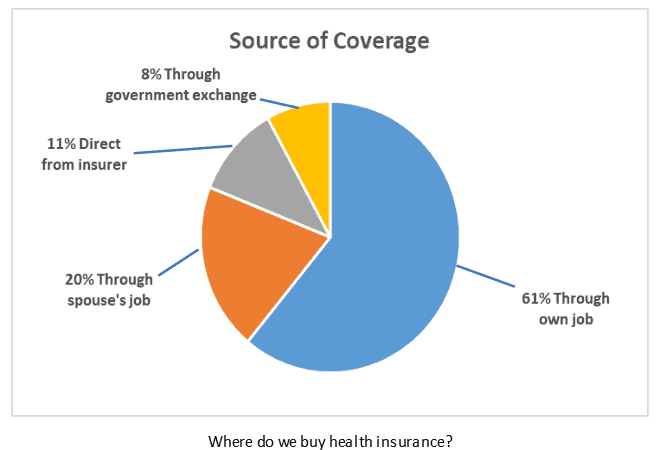
More than 4 in 5 Americans get health insurance through an employer: 61% our own employer and 20% via a spouse’s employer.

Pie chart titled "Source of Coverage" showing health insurance sources: 61% through own job, 20% through spouse's job, 11% direct from insurer, and 8% through government exchange. Caption reads: "Where do we buy health insurance?.

While it’s really our responsibility to make sure we fully understand our health insurance options before picking one, the sad fact is that many of us don’t do a good job of that.

This is where employers, through their benefits team, can step up and educate their employees.

Dale Ratner Hershman, Principal Sick Advisory Services, offers some advice for people making a good, but not spectacular, living. He says, “Middle-class entrepreneurs are in the toughest spot in terms of health insurance. People with very low income can get Medicaid and/or Affordable Care Act (ACA) plans, and families that make $300,000 a year or more are simply rich enough to afford even the most outrageous monthly premiums. But a family of four that earns roughly $125,000 may be faced with monthly healthcare premiums of $2,000 or more. This is BEFORE we even consider deductibles or co-pays. 

There are a few tactics to avoid this predicament… (a) Sometimes, one spouse will continue to work a corporate job while the other pursues entrepreneurship. The employed spouse can then cover the whole family on her corporate health insurance. (b) Some employers, such as Apple, offer excellent, affordable health insurance, even for part-time employees. (c) A clever entrepreneur may be able to tailor her taxable income so as to be, “not too poor, but not too rich” to qualify for discounted healthcare. (d) Depending on where you live and your comfort with international travel, you may be able to get excellent care at much better prices by flying abroad. For example, a top-quality dental procedure that costs $10,000 in South Florida, may cost less than $1,500 in Colombia, which is an easy three-hour flight away. The healthcare situation for the self-employed is not pretty in the United States, but with proper planning and a proactive attitude, you can get by.

The Prescription Cost Problem

However, even the most astute and dedicated of us simply can’t get at the data we need.

For example, coming back to prescription drug tiers, according to the Medical University of South Carolina (MUSC), drug pricing is seriously opaque. 

For most products, the provider tells the consumer what they’ll get and how much they need to pay. This price will cover the cost of manufacturing and the manufacturer’s profit, transportation costs and other costs for the retailer along with that retailer’s profit.

With prescription drugs, however, things are not so straightforward.

As the MUSC article says, “Pharmacy benefit managers (PBMs) act as intermediaries between the drug manufacturers and the insurance companies. PBMs negotiate rebates from the drug manufacturers, which lower the cost that insurance companies must pay for medications. In return, the medication is moved up on the formulary list – a catalog of prescription medications covered by a specific insurance plan. Formulary lists are typically organized into tiers and moving a medication up reduces the copay patients are responsible for, driving higher sales. The higher the rebate paid by the drug company, the higher up on the formulary the medication is moved and the more likely patients will fill their prescriptions for the medication.

“These rebates are shrouded in secrecy. The exact amounts of these rebates and the cuts taken by the PBMs are not publicly disclosed. However, drug manufacturers often cite this system as the reason that they continuously raise drug prices.

The Best Use of Health Savings Accounts

Health Savings Accounts (HSAs), are arguably the best tax-advantaged plan in the US. This is the only account type that has a triple tax advantage:

  1. Contributions (up to IRS annual limits) are fully tax deductible, no matter how much you earn.
  2. Within the account (if you choose the right HSA), you can invest your contributions in mutual funds, and the growth of your HSA money isn’t taxable.
  3. When you withdraw money for qualified health-related costs, whether in the year you contributed or in retirement, those withdrawals are tax-free.

The one caveat is that you must be eligible for an HSA. Per the IRS, to be eligible:

  • You have to be covered by a High-Deductible Health Plan (HDHP) on the first day of the month
  • You can have no other health coverage (with some limited exceptions)
  • You cannot be enrolled in Medicare
  • You can’t be claimed as a dependent on someone else’s tax return

What counts as an HDHP? The IRS says:

  • It must have a higher annual deductible than typical health plans
  • It must have a maximum limit on the sum of the annual deductible and out-of-pocket medical expenses that you must pay for covered expenses. Out-of-pocket expenses include co-payments and other amounts, but don’t include premiums.

As Ryan P. McGonigal, Founder of RPM Financial Group LLC says, “Clients need better education on their employer-provided benefits to fully leverage them. For example, if you’re single and rarely see a doctor, a high-deductible health plan (HDHP) with lower premiums might be the best option. You can then use the money saved on premiums to contribute to your employer’s Health Savings Account (HSA). Why? HSA contributions are pre-tax, grow tax-deferred, and can be withdrawn tax-free for qualified medical expenses. This approach helps you maximize your health benefits at a lower cost. Understanding these options empowers employees to make smarter choices and save money.

Jason Gilbert, Managing Partner, RGA Investment Advisors, agrees, “I wish more people knew that their Health Savings Account (HSA) is not just a spending account—it can be a powerful long-term investment vehicle. If you’re eligible, maxing out your HSA contributions and investing those funds can create a tax-advantaged safety net for healthcare expenses in retirement, where medical costs tend to rise significantly.

Note that not all employers’ HSAs have investment options. Some offer just an interest-paying savings account. However, even if you get an HSA-compliant health plan through your employer, you’re not obligated to use the employer’s HSA. For example, I like Optum Bank’s HSA (this isn’t intended as an endorsement — do your own due diligence before picking the right HSA for you.

Clearly, the best way to take advantage of an HSA is to contribute each year the full amount allowed, invest the money in growth-oriented assets such as stock mutual funds, and let the money grow tax-free until you retire. Then, you can use the much higher amount the account holds by that point to cover the (high) medical expenses you’ll incur as you age.

According to the CECHS, nearly 2 in 3 consider the HSA as a savings account, possibly because that’s what the “S” in the middle stands for. Another 19% view it as a checking account. 

Two-thirds use the money in the account to cover health-related expenses in the year they made the contribution or shortly thereafter. Sadly, fewer than 4 in 10 consider their HSA an investment account to be used for healthcare in retirement.

Smart Health Technology

Finally, the CEHCS states that 62% of those surveyed reported using smart health technology (e.g., wearable devices and/or apps that can sense or track activities to help manage and improve health), and over 4 in 10 use it currently.

About 3 in 4 agreed that such smart health technology makes it easier to access care, but 2 in 3 said they wish they could share the data collected by such technology with their doctor. Six in 10 said they wished they could share it with their health insurance provider.

The Future of Health Insurance

Arguably, the best thing you can do for your future self is to stay as healthy as possible as you age.

Getting the best health insurance can help achieve that goal. Unfortunately, too many of us don’t dedicate enough time to educating ourselves about our options, and even those who do so often run into problems such as denied claims and opaque pricing.

Kevin Estes, founder and financial planner of Scaled Finance agrees, “Having the right insurance takes priority. Don’t let the tax tail wag the healthcare dog! Paying a higher premium and less out of pocket may be better for someone with ongoing medical expenses. If a high-deductible plan is best, then consider a Health Savings Account (HSA). Many people overestimate future healthcare premiums. Both exchange plans and Medicare are based on income, not wealth. The cost of medical treatment is the bigger unknown.

Gilbert adds, “Many of my clients have the assets to weather medical costs, but they don’t always realize how much strategic planning, whether through insurance selection, tax-advantaged accounts, or investment strategies, can improve their long-term financial security. A well-structured financial plan doesn’t just focus on growing wealth; it ensures that when health issues arise, they don’t derail financial goals.”

Given our lack of information, it’s no wonder that, as a country, we spend too much on healthcare and get poorer outcomes than other developed countries that spend far less.

Disclaimer: This article is intended for informational purposes only, and should not be considered financial advice. You should consult a financial professional before making any major financial decisions.

Opher Ganel

About the Author

Opher Ganel, Ph.D.

My career has had many unpredictable twists and turns. A MSc in theoretical physics, PhD in experimental high-energy physics, postdoc in particle detector R&D, research position in experimental cosmic-ray physics (including a couple of visits to Antarctica), a brief stint at a small engineering services company supporting NASA, followed by starting my own small consulting practice supporting NASA projects and programs. Along the way, I started other micro businesses and helped my wife start and grow her own Marriage and Family Therapy practice. Now, I use all these experiences to also offer financial strategy services to help independent professionals achieve their personal and business finance goals. Connect with me on my own site: OpherGanel.com and/or follow my Medium publication: medium.com/financial-strategy/.


Learn More About Opher

Do you work at Adobe?

Get expert insights from financial advisors who specialize in helping Adobe employees and executives make the most of their compensation package and benefits.

Looking for a financial advisor who specializes in working with Adobe employees? You’re in the right place. Below, you’ll find advisors who understand Adobe benefits and compensation, along with their answers to common financial questions from Adobe employees and executives.

Whether you’re a new Adobe employee or you’ve advanced into a management or executive leadership role over a multi-year career, making smart decisions about your income and Adobe benefits can have a lasting impact on your financial future. For example:

✅ Do you know the right moves to get the greatest value from the Adobe benefits available to you?

✅ If you’re thinking about leaving Adobe for another job or planning to retire in a few years, are you taking the right steps today to receive all the compensation and benefits you’ve earned?

Key Takeaways

1

Adobe’s ESPP Lookback Can Push the Discount Well Above 15%

Adobe employees can buy company stock at a 15% discount, typically twice a year. Because the Adobe plan includes a lookback provision that can lock in a price from up to two years earlier, the effective discount often exceeds 15%, making the ESPP one of the most underused benefits available.

2

Equity Compensation Can Quietly Become a Concentration Risk

For longtime Adobe employees, RSUs and other equity awards often grow into a large share of total net worth. Deciding how and when to sell, and how to manage the tax consequences, rarely has a one-size-fits-all answer and benefits from a deliberate plan.

3

A Specialist Who Knows Adobe Surfaces Value Employees Miss

Demanding roles leave little bandwidth to decode every benefit. A thorough review of salary, equity, the 401(k), healthcare, insurance, and stock plans, from an advisor already familiar with Adobe’s offerings, helps employees move forward with confidence.

Why Adobe Employees Work with a Specialist Financial Advisor

Throughout the year, Adobe provides its employees and executives with updates about their benefits, ranging from health insurance and health savings plans to retirement plans like a 401(k) and deferred compensation, along with equity compensation such as RSUs and the Employee Stock Purchase Plan (ESPP). While the company offers many useful resources and access to knowledgeable staff who can assist with questions, you’ll also find financial professionals not affiliated with Adobe who specialize in helping Adobe employees make the most of their income and benefits.

Whether you work at Adobe’s San Jose, California headquarters, the campus in Lehi, Utah, an office in Seattle, San Francisco, New York, or Austin, another location around the country, or remotely from home, you may have questions about your compensation package and benefits better suited for a financial professional who can offer unbiased advice and guidance.

Sensitive topics, like the steps you should take before quitting your job at Adobe to work elsewhere, protecting yourself in advance of a corporate layoff, or deciding when you should plan to retire, are all conversations that may be more comfortable with a trusted financial advisor.

Should You Hire an Adobe Specialist or a Local Financial Advisor?

You’ll likely find dozens of nearby financial advisors well-suited to help you reach your money goals with a personalized plan. But it can be harder to find a financial advisor who specializes in serving Adobe employees. Fortunately, many financial advisors offer virtual services, so you can meet online no matter where you (or they) live, which means you can hire a specialist financial advisor who lives hundreds of miles away if their knowledge and experience working with Adobe employees is the better fit for your unique needs.

💡 In the Q&A below, you’ll gain insights from financial advisors who work with Adobe employees to help them make smart decisions, get the most value from their compensation and benefits, reduce their money stress, and prepare for a comfortable retirement.

🙋‍♀️ Have a question not yet answered? Use the form below to submit it anonymously and watch this article for updates with answers to your questions. You can also reach out to the financial advisors below to set up an introductory call or contact them with your questions by email.

Q&A: Financial Planning Tips for Adobe Employees & Executives

In this section, you’ll learn how you can make the most of your Adobe employee benefits and gain valuable tips from financial advisors who specialize in working with Adobe employees and executives.

Financial Advisor Q&A  ·  Adobe Employees & Executives

Sheila McGinn, CFP®, Financial Advisor for Adobe Employees at Brightview Financial

Sheila McGinn, CFP®

Brightview Financial  ·  Redwood City, CA  ·  Serves clients nationwide

Guiding tech professionals through complex financial decisions.
Book Intro Call

Sheila McGinn is a financial advisor based in Redwood City, California who specializes in offering financial planning services to Adobe employees. Sheila helps her clients get the most value from their Adobe benefits and compensation package so they can enjoy life and feel confident about their financial future.

QWhat makes you uniquely qualified to work with so many Adobe employees?

I spent over 20 years working at San Francisco Bay Area software companies (including six wonderful years at Adobe), so I can relate to the challenges you’re facing. And because I work with so many current and former Adobe Employees, I am very familiar with their compensation and benefits packages.

QAs a financial advisor with experience helping Adobe employees save for their retirement, how do you help them make the most of their employee benefits?

Adobe has excellent employee benefits. However, Adobe employees often have demanding jobs and sometimes lack the bandwidth to fully understand the ins and outs of all of their benefits. When working with Adobe employees, we do a thorough review of compensation (salary and equity such as RSUs), retirement savings plans (401(k)), and other benefits such as healthcare, insurance, and optional employer stock plans.

By demonstrating how participation in these benefits can impact their long-term financial outcomes, they are able to move forward with confidence.

QIs there a particular benefit available to Adobe employees you feel isn’t as well utilized or understood by employees as it should be?

Many tech companies have Employee Stock Purchase Plans (ESPP). Adobe has an ESPP program that’s head and shoulders above the rest. Many Adobe employees that I speak with aren’t aware of the unique aspects of the Adobe ESPP program and the advantages of participating fully.

At Adobe, like most tech companies’ ESPP offerings, you can purchase the company stock at a 15% discount, usually twice per year. But the Adobe ESPP plan has a “lookback” provision, allowing you to lock in a lower price from up to two years prior. This often results in a discount that goes well above 15%.

A common hurdle in participating in this program is making sure you have the cash flow to afford this investment. When I discuss this opportunity with Adobe employees, they are often motivated to find a way to take advantage of this excellent employee benefit.

QWhat are some of the unique financial planning challenges you commonly see among your clients who are Adobe employees and how do you help them overcome these obstacles?

For longtime Adobe employees, equity compensation is often a significant portion of their compensation and total net worth (which is, in many ways, a good problem to have) but it also comes with risk.

It can be overwhelming to make decisions about how and when to begin selling your employer stock. (What about taxes? What do I do with it after I sell it?)

Helping tech employees understand how to manage their employer stock is a specialty at Brightview Financial and I can confidently say that there is not a “one-size-fits-all” answer.

Your unique goals, needs, and circumstances should inform your approach to managing your employer stock compensation. To learn more about how to think about your equity compensation, download my free eBook, Optimizing your Equity Compensation.

Considering a financial advisor who specializes in working with Adobe employees and executives?

Are you a financial advisor who specializes in working with employees at Adobe or another large company?

✅ Join Wealthtender and get featured as a specialist financial advisor based on your knowledge and experience working with employees at Adobe or another large company. (Subject to availability and terms.)
Sign up today and join financial advisors attracting their ideal clients on Wealthtender

Ask a Financial Advisor Your Adobe Benefits & Career Questions

Are you ready to enjoy life more with less money stress?

Sign up to receive weekly insights from Wealthtender with useful money tips and fresh ideas to help you achieve your financial goals.

  • This field is for validation purposes and should be left unchanged.


About the Author

Brian Thorp, Founder and CEO of Wealthtender and Editor-in-Chief

Brian Thorp

Founder & CEO, Wealthtender  ·  Editor-in-Chief

Brian Thorp is the founder and CEO of Wealthtender and serves as Editor-in-Chief. With over 25 years in the financial services industry — including nearly 22 years at Invesco, where he led strategic partnerships with wealth management firms representing more than $100 billion in assets — Brian founded Wealthtender to help people find financial advisors they can trust and make more informed money decisions.

A member of the National Society of Compliance Professionals and its SEC Marketing Rule Working Group, Brian was recognized by WealthManagement.com as one of its “Ten to Watch in 2024” for his work reshaping how financial advisors market their services. He holds a B.B.A. in Finance from The University of Texas at Austin.

Brian and his wife live in Austin, Texas.

Read Brian’s full bio →   ·   Connect on LinkedIn →

Find financial advisors in Manassas, Virginia ready to help with your financial planning needs so you can enjoy life more with less money stress.

Whether you have lived in Manassas for years or recently moved to town, you may need help finding the right financial advisor in the community best suited for your individual needs.

It’s important to first consider your own financial planning priorities before choosing an advisor. Here are a few quick tips to help you get started along with financial advisors in Manassas featured on Wealthtender you may want to add to your shortlist.

As you prepare to interview financial advisors in Manassas who may be right for you, get to know local financial advisors featured on Wealthtender.

📍 Map: Financial Advisors with their Primary Office Location in Manassas

Double-click (or pinch the map on mobile devices) to zoom in and expand the details for financial advisors whose primary office location is in Manassas.

📍Double-click or pinch pins to view more.

Showing

The Benefits of Hiring a Financial Advisor in Manassas

Hiring a financial advisor can be a great move to help you build a long-term investing strategy. Advisors can help you build an investment portfolio to meet your financial goals and help you plan appropriately for retirement.

As a resident living in Manassas, hiring a financial advisor who lives nearby and understands the local economy, cost of living, and regional employers can be quite valuable, especially if your individual circumstances are deeply tied to such factors.

Do you work for one of the largest employers in Manassas? If so, there’s a good chance the local financial advisor you hire will also have other clients who work there. This knowledge could prove valuable if they are already familiar with your employee benefits, such as a 401(k) plan, Health Savings Accounts, and other components of your total compensation package.

When you reach out to financial advisors you’re considering hiring, let them know where you work and ask if they are familiar with your employer’s unique benefits and compensation structure.

Quick Tips For Hiring a Manassas Financial Advisor

Before hiring a financial advisor in Manassas, here are a few quick tips to help you find the best advisor for you.

1. Decide Which Services You Need

Before hiring an advisor, determine what services you need from them. Whether it’s full-service investment management or a plan focused on a specific area of your finances, put together a list of what you’d like help with before contacting an advisor.

Though most people use a financial planner simply to invest for retirement, this is only a small part of what many advisors offer. Here’s a quick rundown of potential services a financial advisor may offer you:

  • Budgeting and money management
  • Debt management
  • Insurance planning
  • Retirement planning
  • Other investment planning
  • Inheritance planning
  • Estate planning
  • Tax planning

As you can see, financial advisors can help you with your entire financial picture, not just investing. As you start to plan for life’s bigger milestones, you should consider finding a financial advisor that specializes in those areas.

Finding the right advisor can help you minimize risk, maximize gains and take advantage of tax breaks while investing for your future. They can also help you protect your assets with the right kinds of insurance and help you pass on your financial legacy with a proper estate plan.

2. Consider Your Budget and Payment Preferences

Once you have a list of services you would like, review the fee structures financial advisors offer. Finding a balance between the services you need and the cost of those services will help narrow down the field of advisors you may want to work with.

If you are looking for a full-service advisor to manage all of your investments, consider searching among fee-based financial advisors. If you want to manage your money yourself, consider the flat fee and monthly subscription advisors for ongoing support.

3. Interview Multiple Financial Advisors

Once you have chosen the services and fee structure you prefer, it’s time to contact a few advisors and interview them. Here are questions to ask financial advisors:

  • What services do you provide?
  • What are all the ways you get paid? (fee transparency)
  • What is your investment strategy?
  • How do you measure investment performance?
  • How do we communicate about my plan?

Interview multiple advisors to get a feel for who you want to work with. A combination of fees, services, and customer service will help you determine the best fit for your financial advice.

4. Review Financial Advisor Credentials

Once you find an advisor (or two) you feel comfortable with, it’s always a good practice to check their credentials and the firm’s details. You can do this at the Investment Adviser Public Disclosure (IAPD) website

You can check both the individual and the firm to view their background and experience details, as well as any disciplinary action taken against them or their firm.

As licensed financial professionals, there is oversight into how financial advisors conduct business, so running a quick (free) check on them is recommended.

For additional information about advisor credentials, read our article to learn the most popular designations held by financial advisors, as well as specialized credentials which may be important to consider if you have unique financial planning needs.

Frequently Asked Questions & Additional Resources

How do I know if I’m ready to hire a financial advisor?

You should strongly consider hiring a financial advisor if you have a significant amount of money available for saving or investing. This could occur after years of making annual contributions to a retirement plan like a 401(k) through your employer or suddenly if you receive a large inheritance or sell your house for a large profit.

But even if you don’t have a lot of money saved, many financial advisors and planners provide reasonable pricing options and valuable services you should consider, especially if you’re facing a significant life event. For example, if you’re starting a new job, getting married, starting a family, getting divorced, lost your job, starting or selling a business, or approaching retirement age, working with a trusted financial advisor or planner may prove worthwhile.

Before I hire a new financial advisor, should I fire my current advisor?

You don’t need to fire your current advisor before beginning your search for a new financial advisor. In fact, your new advisor can help coordinate the transition of your assets from your previous financial advisor.

Where can I read reviews about financial advisors written by their clients to help me decide if I should hire them?

After 60 years of regulatory prohibition of financial advisor reviews in the US, a rule issued by the Securities and Exchange Commission (SEC) became effective on May 4, 2021 that means both financial advisors and directory websites that help consumers search for a financial advisor can collect and display financial advisor reviews, an important factor worth considering when choosing who you’ll hire to manage your investments and life savings. 

Wealthtender is the first independent advisor review platform designed to be fully compliant with the new SEC rule, and we look forward to helping you evaluate financial advisors based on reviews written by their clients.

I’m a local financial advisor interested in being featured in this guide. How do I get started?

Thanks for your interest. We look forward to learning more about your practice and helping you attract your ideal clients where you may be a good fit based on their individual needs and circumstances. Please click here to learn how you can join local financial advisors featured on Wealthtender.

How Much Does a Financial Advisor Cost?

➡️ How Much Does a Financial Advisor Cost? Read the Article

About the Author
A headshot of Brian Thorp, the founder and CEO of Wealthtender

About the Author

Brian Thorp

Brian is CEO and founder of Wealthtender and Editor-in-Chief. He and his wife live in Austin, Texas. With over 25 years in the financial services industry, Brian is applying his experience and passion at Wealthtender to help more people enjoy life with less money stress. Learn More about Brian

Find financial advisors in Nacogdoches, Texas ready to help with your financial planning needs so you can enjoy life more with less money stress.

Whether you have lived in Nacogdoches for years or recently moved to town, you may need help finding the right financial advisor in the community best suited for your individual needs.

It’s important to first consider your own financial planning priorities before choosing an advisor. Here are a few quick tips to help you get started along with financial advisors in Nacogdoches featured on Wealthtender you may want to add to your shortlist.

As you prepare to interview financial advisors in Nacogdoches who may be right for you, get to know local financial advisors featured on Wealthtender.

📍 Map: Financial Advisors with their Primary Office Location in Nacogdoches

Double-click (or pinch the map on mobile devices) to zoom in and expand the details for financial advisors whose primary office location is in Nacogdoches.

📍Double-click or pinch pins to view more.

Showing

The Benefits of Hiring a Financial Advisor in Nacogdoches

Hiring a financial advisor can be a great move to help you build a long-term investing strategy. Advisors can help you build an investment portfolio to meet your financial goals and help you plan appropriately for retirement.

As a resident living in Nacogdoches, hiring a financial advisor who lives nearby and understands the local economy, cost of living, and regional employers can be quite valuable, especially if your individual circumstances are deeply tied to such factors.

Who are the largest employers in Nacogdoches?

Do you work for one of the largest employers in Nacogdoches? If so, there’s a good chance the local financial advisor you hire will also have other clients who work there. This knowledge could prove valuable if they are already familiar with your employee benefits, such as a 401(k) plan, Health Savings Accounts, and other components of your total compensation package.

When you reach out to financial advisors you’re considering hiring, let them know where you work and ask if they are familiar with your employer’s unique benefits and compensation structure.

Quick Tips For Hiring a Nacogdoches Financial Advisor

Before hiring a financial advisor in Nacogdoches, here are a few quick tips to help you find the best advisor for you.

1. Decide Which Services You Need

Before hiring an advisor, determine what services you need from them. Whether it’s full-service investment management or a plan focused on a specific area of your finances, put together a list of what you’d like help with before contacting an advisor.

Though most people use a financial planner simply to invest for retirement, this is only a small part of what many advisors offer. Here’s a quick rundown of potential services a financial advisor may offer you:

  • Budgeting and money management
  • Debt management
  • Insurance planning
  • Retirement planning
  • Other investment planning
  • Inheritance planning
  • Estate planning
  • Tax planning

As you can see, financial advisors can help you with your entire financial picture, not just investing. As you start to plan for life’s bigger milestones, you should consider finding a financial advisor that specializes in those areas.

Finding the right advisor can help you minimize risk, maximize gains and take advantage of tax breaks while investing for your future. They can also help you protect your assets with the right kinds of insurance and help you pass on your financial legacy with a proper estate plan.

2. Consider Your Budget and Payment Preferences

Once you have a list of services you would like, review the fee structures financial advisors offer. Finding a balance between the services you need and the cost of those services will help narrow down the field of advisors you may want to work with.

If you are looking for a full-service advisor to manage all of your investments, consider searching among fee-based financial advisors. If you want to manage your money yourself, consider the flat fee and monthly subscription advisors for ongoing support.

3. Interview Multiple Financial Advisors

Once you have chosen the services and fee structure you prefer, it’s time to contact a few advisors and interview them. Here are questions to ask financial advisors:

  • What services do you provide?
  • What are all the ways you get paid? (fee transparency)
  • What is your investment strategy?
  • How do you measure investment performance?
  • How do we communicate about my plan?

Interview multiple advisors to get a feel for who you want to work with. A combination of fees, services, and customer service will help you determine the best fit for your financial advice.

4. Review Financial Advisor Credentials

Once you find an advisor (or two) you feel comfortable with, it’s always a good practice to check their credentials and the firm’s details. You can do this at the Investment Adviser Public Disclosure (IAPD) website

You can check both the individual and the firm to view their background and experience details, as well as any disciplinary action taken against them or their firm.

As licensed financial professionals, there is oversight into how financial advisors conduct business, so running a quick (free) check on them is recommended.

For additional information about advisor credentials, read our article to learn the most popular designations held by financial advisors, as well as specialized credentials which may be important to consider if you have unique financial planning needs.

Frequently Asked Questions & Additional Resources

How do I know if I’m ready to hire a financial advisor?

You should strongly consider hiring a financial advisor if you have a significant amount of money available for saving or investing. This could occur after years of making annual contributions to a retirement plan like a 401(k) through your employer or suddenly if you receive a large inheritance or sell your house for a large profit.

But even if you don’t have a lot of money saved, many financial advisors and planners provide reasonable pricing options and valuable services you should consider, especially if you’re facing a significant life event. For example, if you’re starting a new job, getting married, starting a family, getting divorced, lost your job, starting or selling a business, or approaching retirement age, working with a trusted financial advisor or planner may prove worthwhile.

Before I hire a new financial advisor, should I fire my current advisor?

You don’t need to fire your current advisor before beginning your search for a new financial advisor. In fact, your new advisor can help coordinate the transition of your assets from your previous financial advisor.

Where can I read reviews about financial advisors written by their clients to help me decide if I should hire them?

After 60 years of regulatory prohibition of financial advisor reviews in the US, a rule issued by the Securities and Exchange Commission (SEC) became effective on May 4, 2021 that means both financial advisors and directory websites that help consumers search for a financial advisor can collect and display financial advisor reviews, an important factor worth considering when choosing who you’ll hire to manage your investments and life savings. 

Wealthtender is the first independent advisor review platform designed to be fully compliant with the new SEC rule, and we look forward to helping you evaluate financial advisors based on reviews written by their clients.

I’m a local financial advisor interested in being featured in this guide. How do I get started?

Thanks for your interest. We look forward to learning more about your practice and helping you attract your ideal clients where you may be a good fit based on their individual needs and circumstances. Please click here to learn how you can join local financial advisors featured on Wealthtender.

How Much Does a Financial Advisor Cost?

➡️ How Much Does a Financial Advisor Cost? Read the Article

About the Author
A headshot of Brian Thorp, the founder and CEO of Wealthtender

About the Author

Brian Thorp

Brian is CEO and founder of Wealthtender and Editor-in-Chief. He and his wife live in Austin, Texas. With over 25 years in the financial services industry, Brian is applying his experience and passion at Wealthtender to help more people enjoy life with less money stress. Learn More about Brian

What this article covers

If you’re within 10 years of retirement, you’re entering the most financially consequential period of your life. The decisions you make in the years before and immediately after you stop working — when to claim Social Security, how to structure your accounts to minimize taxes, how to handle healthcare costs before Medicare, and how to invest so your money doesn’t run out — are largely irreversible and interact with each other in ways that are genuinely difficult to navigate without help. This guide introduces you to retirement financial advisors featured on Wealthtender, offers smart tips for finding a specialist who understands your situation, and shares detailed Q&A responses from five retirement-focused advisors on the challenges they see most often and the strategies that make the biggest difference for their clients.

It’s an exciting time when you’re approaching retirement and preparing for the next phase of your life. You’ve likely spent decades working towards this milestone and have a vision for how you’ll spend your days, perhaps enjoying more time with grandchildren, traveling, or volunteering in your community.

But retirement comes with a cost, and knowing how you’ll afford to live comfortably while preserving your savings to last a lifetime is no easy task.

If you’re thinking about hiring a retirement advisor who can help you make the most of your golden years, you may want to hire an advisor who specializes in helping people transition from work to living off their savings and other sources of income.

With their experience, credentials, and knowledge of retirement planning strategies and pitfalls to avoid, you may find your life in retirement includes one less worry so you can enjoy your days more.

Let’s learn more about retirement financial advisors who specialize in serving near-retirees and people living in retirement to help you decide if a retirement advisor may be right for you.

You’ll also find retirement advisors featured on Wealthtender who live near you. Most advisors can also work with you no matter where you (or they) live, so you can choose to hire a retirement advisor who lives hundreds of miles away if you believe they’re the best advisor for you.

Key Takeaways

1

Retirement is the moment when financial planning stakes are highest — and many of the decisions you’ll make are one-time, irreversible, and interact with each other in ways that are difficult to model without professional guidance.

When to claim Social Security, how to structure withdrawals across tax-deferred and Roth accounts, how to sequence income to manage Medicare premium thresholds (IRMAA), whether to do Roth conversions before required minimum distributions kick in — these decisions interact in complex ways that can cost or save tens of thousands of dollars over a retirement. Working with a retirement specialist who thinks about these tradeoffs every day for clients like you significantly reduces the risk of costly mistakes during a transition you’ve never navigated before.

2

Most retirees are surprised to find their taxes don’t drop much in retirement — and many find they rise, especially once required minimum distributions begin.

When you retire, you lose some of the deductions that reduced your taxable income while working. And drawing income in retirement — especially from tax-deferred accounts like a 401(k) or IRA — is a taxable event. Once Social Security, pension income, and RMDs stack up, many retirees find themselves in a higher bracket than expected. A retirement-focused financial advisor helps minimize your lifetime tax bill, not just the bill in any one year — often by doing counterintuitive things like paying more tax before retirement through strategic Roth conversions.

3

Don’t wait until the year you retire to hire a retirement financial advisor — many of the highest-value planning decisions need to happen 3–10 years before your last day of work.

Building a “war chest” of low-risk assets to cover 5–10 years of expenses before retiring, maximizing pension benefits, optimizing final-year 401(k) contributions, and timing a retirement date to align with tax thresholds are all decisions that require runway. Many people also retire earlier than they planned — due to health, layoffs, or a market shift — which means having a plan already in place protects you if retirement arrives ahead of schedule.

Find Retirement Financial Advisors Near You (Interactive US Map)

📍 Click on a pin in the map view below for a preview of retirement financial advisors near you who specialize in working with clients approaching and living in retirement. Or choose the grid view to search our directory of financial advisors with additional filtering options.

📍Double-click or pinch pins to view more.

Showing

Have Questions About Financial Planning for Retirement?


Smart Tips to Find a Retirement Financial Advisor

Before hiring a retirement financial advisor, here are a few quick tips to help you find the best advisor for you.

1. Decide Which Services You Need

Before hiring a financial advisor, determine what services you need from them. Whether it’s full-service investment management or a plan focused on a specific area of your finances, put together a list of what you’d like help with before contacting an advisor.

Though most people use a financial advisor simply to invest for retirement, this is only a small part of what many advisors offer. Here’s a quick rundown of potential services a financial planner may offer you:

  • Budgeting and money management
  • Debt management
  • Insurance planning
  • Retirement planning
  • Other investment planning
  • Inheritance planning
  • Estate planning
  • Tax planning

As you can see, financial advisors can help you with your entire financial picture, not just investing. As you start to plan for life’s bigger milestones, you should consider finding a financial advisor that specializes in those areas.

Finding the right advisor can help you minimize risk, maximize gains and take advantage of tax breaks while investing for your future. They can also help you protect your assets with the right kinds of insurance and help you pass on your financial legacy with a proper estate plan.

2. Consider Your Budget and Payment Preferences

Once you have a list of services you would like, review the fee structures financial advisors offer. Finding a balance between the services you need and the cost of those services will help narrow down the field of advisors you may want to work with.

If you are looking for a full-service advisor to manage all of your investments, consider searching among fee-based financial advisors. If you want to manage your money yourself, consider the flat fee and monthly subscription advisors for ongoing support.

3. Interview Multiple Financial Advisors

Once you have chosen the services and fee structure you prefer, it’s time to contact a few advisors and interview them. Here are questions to ask financial advisors:

  • What services do you provide?
  • What are all the ways you get paid? (fee transparency)
  • What is your investment strategy?
  • How do you measure investment performance?
  • How do we communicate about my plan?

Interview multiple advisors to get a feel for who you want to work with. A combination of fees, services, and customer service will help you determine the best fit for your financial advice.

4. Review Financial Advisor Credentials

Once you find an advisor (or two) you feel comfortable with, it’s always a good practice to check their credentials and the firm’s details. You can do this at the Investment Adviser Public Disclosure (IAPD) website

You can check both the individual and the firm to view their background and experience details, as well as any disciplinary action taken against them or their firm.

As licensed financial professionals, there is oversight into how financial advisors conduct business, so running a quick (free) check on them is recommended.

For additional information about advisor credentials, read our article to learn the most popular designations held by financial advisors, as well as specialized credentials which may be important to consider if you have unique financial planning needs.

Q&A with Retirement Advisors

We sat down with financial advisors who specialize in serving pre-retirees and people living in retirement to ask their advice for people preparing to transition into retirement. Scroll down to view the Q&As and see what we learned in these interviews with retirement experts.

Get to Know:
Jeremy Keil | ✅ Alex Lynch | ✅ Nick Covyeau | ✅ Cameron Capriotti | ✅ Amar Shah

Retirement Advisor Showcase:
– Jeremy Keil –

Three Questions with Jeremy Keil

We asked Wisconsin-based financial advisor Jeremy Keil who specializes in helping near-retirees to answer three common questions asked by people planning to retire soon.

Q: I’m approaching retirement and haven’t needed a financial advisor to make it this far. Why should I think about hiring a financial advisor now?

Jeremy: Retirement is something you’ve never faced before, with a lot of one-time decisions you can never reverse. Working with a retirement-focused advisor can help you avoid mistakes during this huge transition.

Q: How can I feel confident I’m choosing a financial advisor who understands I simply want to enjoy a comfortable retirement, not outperform the stock market?

Jeremy: When you’re looking for good retirement-focused financial advisors, you want to start with the basics. Make sure they have their Certified Financial Planner (CFP®) designation and either the Retirement Management Advisor (RMA®) or Retirement Income Certified Professional (RICP®) designations.  You should also ask them for references to other clients facing retirement and look at their website: does it address the issues you are facing?

Get to Know Jeremy Keil:

View Jeremy’s profile on Wealthtender or visit his website to learn more.

Q: I have a few more years before I plan to retire. Should I wait until closer to my retirement date before hiring a financial advisor?

Jeremy: You should plan for retirement well before your retirement date. Many people retire before they expected, and you will fare much better if you have a plan ahead of time. There may be many decisions that affect your retirement that come up along the way, such as making sure you’re maximizing your vacation pay rules (sometimes you can move this money tax-free into a Health Reimbursement Arrangement), or your pension (learning your formula and maximizing it helps).  You don’t want to miss out on benefits because you waited until just before retirement to do the research.


Retirement Advisor Showcase:
– Alex Lynch –

Three Questions with Alex Lynch

Seattle-area financial advisor Alex Lynch says his most important duty to his clients is ensuring they never run out of money. We asked Alex to answer 3 questions helpful to people approaching retirement who want to enjoy their golden years and make their money last a lifetime.

Q: Will my taxes be lower when I’m in retirement?

Alex: Oftentimes, clients are surprised when we project out their retirement income that their tax bracket does not fall significantly in retirement and often increases. Between losing some of the tax deductions clients were able to enjoy while working and incurring taxes to generate the income in retirement clients need, their tax rate does not always fall (i.e., withdrawing money from 401k/403b is a taxable transaction).

At Jarvis Financial, our approach with clients is to project out their tax liabilities over both the next several years and their lifetime. With our goal being to minimize their lifetime tax bill, not just the bill from any one year.

Clients are often surprised when we suggest paying more tax before retirement (i.e., Roth conversions) and then delighted by how the numbers look over the long term. During this time, we are thoughtful about how tax rates could change in the future, how unexpected large withdrawal needs could impact their taxes and a client’s goals for charitable/estate planning.

Get to Know Alex Lynch:

View Alex’s profile on Wealthtender or visit his company’s website to learn more.

Q: How should I invest when I’m nearing retirement?

Alex: When those close to retirement ask us this question first, we have to determine that retirement is feasible. Then of highest importance is for clients to begin building a proverbial “war-chest.” This generally means having 5-10 years of retirement expenses set aside in a low-risk account.

While we are in our careers and actively saving and accumulating wealth, dips in the stock market are our friends and buying opportunities. The converse is true when we are required to draw income from our portfolios, and we are effectively in the de-accumulation game.

At Jarvis Financial, we have found that regularly discussing our “war-chest” and using it as a bridge during less favorable times in the markets has worked extremely well for clients.

Q: What is biggest financial surprise to new retirees?

Alex: I see recent retirees most surprised by the cost of private health insurance before Medicare and the various out of pockets costs associated with Medicare. For individuals retiring before Medicare eligibility, we encourage you to talk with your current employer about any healthcare options after retirement and go on the various health exchanges to have a planned budget for healthcare expenses.

Upon Medicare eligibility, it’s very important to understand that not all the parts of Medicare are free. Part B alone could cost $500 a month for each individual. And having a plan for the various Medicare/supplemental options before retirement is a must.


Retirement Advisor Showcase:
– Nick Covyeau –

Three Questions with Nick Covyeau

We asked financial planner Nick Covyeau to share insights based on his experience helping people over age 50 pay less in taxes throughout their retirement. Based in Costa Mesa, California, Nick works with many clients in-person locally and meets with others nationwide online.

Q: As the founder of Swell Financial Partners, you’ve chosen to specialize in working with people who are over the age of 55 and ready to retire in the next 5 to 10 years. What is a common financial planning challenge you often encounter when you begin working with new clients? And how do you help them overcome this obstacle?

Nick: I see a lot of clients struggle with being able to see the entire picture and knowing where they’re at financially and how close (or far) they are from retirement. Thus, organization and clarity are by far the two most important elements to every plan.

Before any technical work can begin, we must start first with identifying what an ideal retirement looks like and then get an inventory of where each person or family is starting from.

Our process starts with framing the intention of our work together by going into a series of intentional questions designed to zero in on what’s most important to each person. Though every plan and each client’s situation and circumstances are different, the process and outcome remain the same.

Once we’ve identified their purpose and vision, we can then begin to comb through statements, documents, and tax returns to begin organizing their picture, consolidating accounts, and simplifying the complex.

Last, we present multiple options and recommendations for clients to choose from as we believe financial planning is a collaborative process and each plan has many ways towards achieving a successful outcome.

Get to Know Nick Covyeau:

View Nick’s profile on Wealthtender or visit his website to learn more.

Q: How do the services you offer distinguish Swell Financial Partners from other advisory firms people in their fifties might be considering?

Nick: Planning for retirement is all we do. It’s all we think about and all we read about.

By narrowing our focus to only work with individuals and families preparing for retirement, allows us to go much deeper in our planning work than most traditional firms that serve a wide array of clients.

We have created an entire process dedicated to centering around all the major events one would need to think about in preparing for the years leading up to retirement such as how to pay less in taxes throughout your entire lifetime, how to build an investment account so that you don’t outlive your money, creating a coordinated withdrawal strategy to the timing of Social Security and Pensions and last, understanding the impact of Medicare, taxes and new legislative changes.

Q: How do you coordinate with other professionals like accountants and estate planning attorneys to help your clients feel more confident and less stressed about their retirement plans?

Nick: Communication and teamwork are critical. It takes an entire village worth of professionals to get our clients to retirement. We help to assemble a team around our clients or partner together to work with their existing relationships to collaborate and all get on the same page for our clients.  

In working with CPA’s, we are actively communicating to work on reducing their lifetime taxable income by figuring out where the timing of various tax planning techniques like Roth Conversions, Donor Advised Funds or Charitable Trusts make sense.  

Throughout the year, we continue to be a second set of eyes on tax returns, discuss current tax thresholds and monitor how future changes to Income or Retirement dates will impact Medicare thresholds, possible deductions, or the timing of Social Security.  

With respect to Estate Planning, we are actively involved in the discussion and the implementation of Trust, Wills, and various Estate Gifting vehicles.  

Each year we review our client’s current Estate Plan to ensure accuracy and verify that their wishes were drafted correctly and that all of their assets and beneficiary continue to match.  

Q: In circumstances when older clients pass away, do you offer to provide ongoing financial planning services to their children who may not yet be in their fifties? 

Nick: Each circumstance is unique, and it all comes down to the relationship we have with the family and the children. It is our promise to always provide guidance and counsel to our client’s children, especially during a time of transition and loss.

Through our process, it is very common for us to be in contact with our client’s children and have an established relationship with them.

Thus, if there’s a mutual fit and a relationship, then yes, it’s very common for children of clients to continue working with us. We understand that not every situation makes sense, nonetheless, we always strive to make ourselves available and provide prudent advice in the process.


Retirement Advisor Showcase:
– Cameron Capriotti –

Three Questions with Cameron Capriotti

Cameron Capriotti is a financial advisor based in The Woodlands, Texas, serving clients locally, in Tomball, and the surrounding areas. As a CPA and CFP® Professional, Cameron can engage his clients deeply and offer a personalized plan and high level of service that generates tangible results in his clients’ lives. 

Q: For people nearing retirement who are unsure whether or not they should hire a financial advisor at the current point in their lives, what guidance can you provide to help them make a more informed and educated decision?

Cameron: Having a plan in place to be as efficient with a retirement income plan as possible. Meaning if you retire mid to late in the year, having a plan to build or set aside an after-tax bucket of funds to live off of can help make sure you are not stacking additional taxable income from IRA/retirement distributions on top of an already high-income year.

Also, this could be a great opportunity to adjust 401k contributions to max out a 401k through that last year of pay to get into a lower tax bracket for that year which will help with not only how much taxes are owed but also what future Medicare premiums will be based off.

Secondly, getting a second opinion on your retirement plans and getting feedback on how healthy that plan is would be a prudent decision. Often times I see people want to blindly make the decision to avoid hearing something they might not want to. Our goal as a planner is to hear clients out regarding what is important to them and helping construct a plan to make that value come to fruition.

Get to Know Cameron Capriotti:

View Cameron’s profile on Wealthtender or visit his website to learn more.

Q: How do the services you offer individuals and couples nearing retirement distinguish your firm, Legacy CFO, from other advisory firms?

Cameron: We offer a truly comprehensive planning/investment offering to our clients. When clients retire, Uncle Sam is entitled to 0-50+% of their portfolio typically. This means there are considerable planning opportunities to make sure Uncle Sam’s portion remains as low as legally allowable. What accounts certain investments are held in, where distributions come from, what pot of money is used for charitable giving, etc. can all be customized to create a plan that is tax efficient.

Q: For people approaching retirement age, how do you recommend they prepare to make the transition from living off their salary to relying upon other sources of income?

Cameron: Having a built-out plan that shows their sources of income pensions/S.S./Etc. and what additional funds the portfolio can provide and weighing this up to what their current standard of living is. It’s good to quantify this to make sure you fully understand where the money will come from and if that will be adequate to maintain the lifestyle you are hoping for. Also, knowing how to pay taxes on these new sources of income is important not only to avoiding tax surprises, underpayment penalties and to keeping Medicare premiums as low as possible.


Retirement Advisor Showcase:
– Amar Shah –

Three Questions with Amar Shah

Amar Shah is a financial advisor based in San Diego, California, who specializes in helping clients in retirement and pre-retirement develop customized wealth and investment solutions aligned with their values and family dynamics.

Q: What is a common financial planning challenge unique to pre-retirees that you frequently encounter when working with your clients? How do you work with them to overcome this challenge?

For many, retirement has been thought of as the end of work and a transition to a life focused on leisure.  However, with increased life expectancy, this traditional definition of retirement is changing, and retirement is now viewed as another life chapter during which an individual retires from a current job or career but does not exit the workforce. 

Nearly half of current retirees say have either worked or plan to do so in retirement, while close to 70% of pre-retirees plan to work during retirement, which impacts retirement planning and taxes.  Increasingly, I have been having conversations with clients around work during retirement.  At Client First Capital, we have created a Next Decade Workbook to help our clients discover their goals for the next decade, including balancing work with life experiences.

Q: For people nearing retirement who are unsure whether or not they should hire a financial advisor at the current point in their lives, what guidance can you provide to help them make a more informed and educated decision?

A common misconception is that financial advisors only manage investment portfolios and that if you have met your retirement savings goal, then the value of a financial advisor decreases.  However, a strong financial advisor provides guidance on other key factors during retirement such as a tax-efficient withdrawal strategy, estate planning, and charitable giving. 

When considering financial advisors, it is also critical to ensure that your advisor adheres to the fiduciary standard, meaning that he/she will put your interests ahead of their own.  At Client First Capital, we adhere to the fiduciary standards set by the Certified Financial Planner (CFP) and Certified Financial Analyst (CFA) institutions.

Get to Know Amar Shah:

View Amar’s profile on Wealthtender or visit his website to learn more.

Q: How do the services you offer pre-retirees distinguish your firm from other advisory firms?

Client First Capital uses an integrated approach to wealth management.  We rely on our deep knowledge and insight around best practices for wealth management to build and execute highly-tailored, comprehensive, and dynamic financial strategies. 

Our integrated approach to wealth management lies at the intersection of investments, taxes, risk planning, and estate planning.  As a family advisor, we are best positioned to understand how decisions impact all four of these areas.


Are you a financial advisor who specializes in helping near-retirees?

✅ Get added as a specialist in this area in our next monthly update (Subject to availability and qualification criteria.)
Sign up today and join financial advisors attracting their ideal clients on Wealthtender
✅ Or request more information by email:

  • This field is for validation purposes and should be left unchanged.

📰 Browse Related Articles


About the Author
Brian Thorp, Founder and CEO of Wealthtender profile picture

Brian Thorp

Founder and CEO, Wealthtender

Brian and his wife live in Texas, enjoying the diversity of Houston and the vibrancy of Austin.

With over 25 years in the financial services industry, Brian is applying his experience and passion at Wealthtender to help more people enjoy life with less money stress.

Connect with Brian on LinkedIn